Designing Developer-Centric Platforms
Chapter Info
Calculating... Writing Progress: 80%
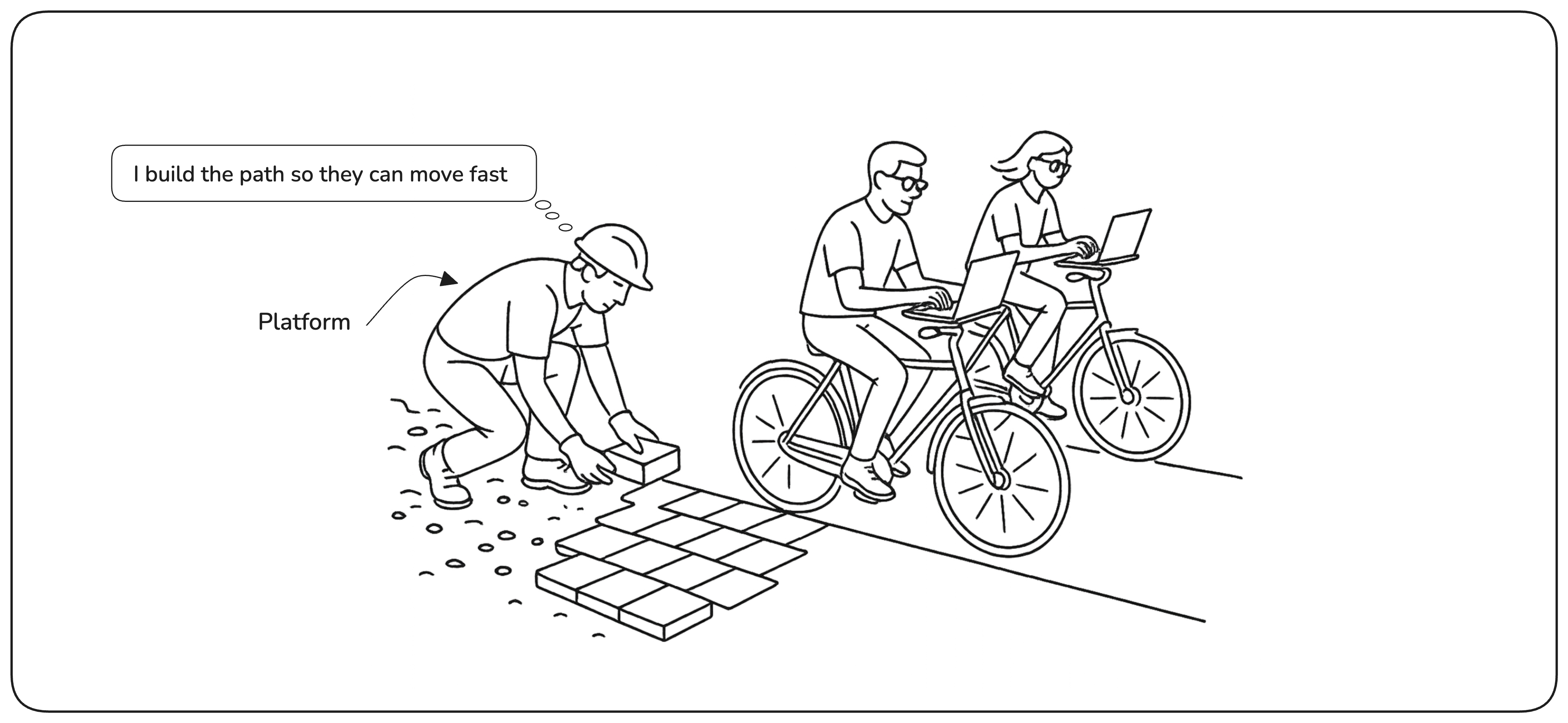
Software teams are hired to build products, but the path to production is filled with work that is not the product itself: infrastructure, security, compliance, deployment pipelines, observability, cost management, incident response, and the conventions that make systems safe to operate. When every team has to solve those problems for itself, each developer is asked to be an infrastructure engineer, a security specialist, a DevOps engineer, and a cloud expert at once. The organization pays twice: teams duplicate the same foundations, while standards, security postures, and operating models drift apart — and the organization loses its ability to understand and govern what it is running. This chapter is about building a platform inside the organization: a shared foundation, built once, that absorbs what should not be reinvented, turns standards into the default path, and gives developers a simpler world in which to focus on the product itself.
The Organization's Governance Challenge [Governance Challenge]
What Governance Demands [What Governance Demands] {1}
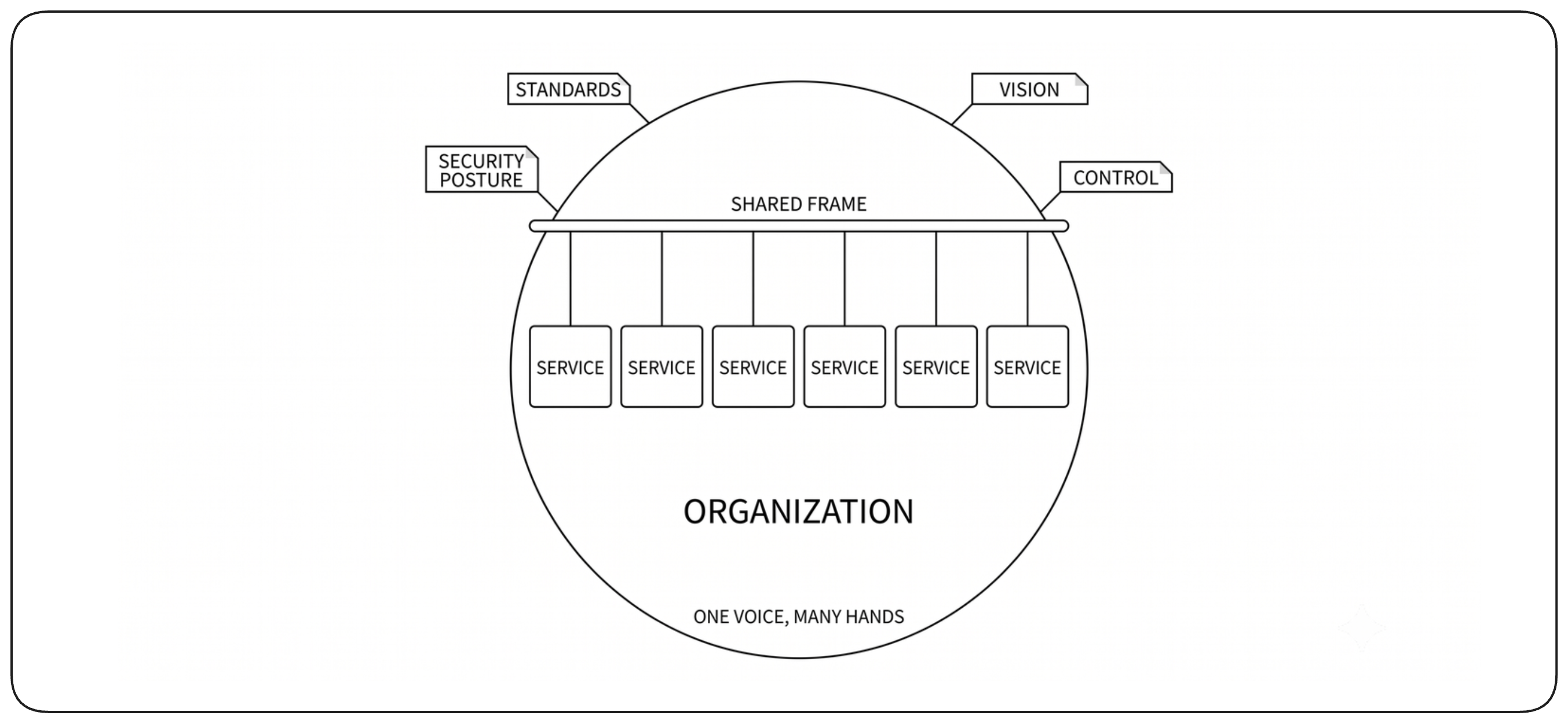
Every organization has a vision, a security posture it stands behind, a way of doing things it wants to hold. Governance is what turns that intent into reality: enforcing standards, imposing a common security model, deciding what runs and how, keeping full visibility on its own systems. !!It has to be secure by default, not secure by review — the right behaviour must be the only available behaviour, so that deviating from the standard is not a matter of discipline but a path that simply does not exist.!! At small size, culture and word-of-mouth can carry this. As the organization grows, they cannot — governance must be built into the system itself.
When Governance Fails [When Governance Fails]
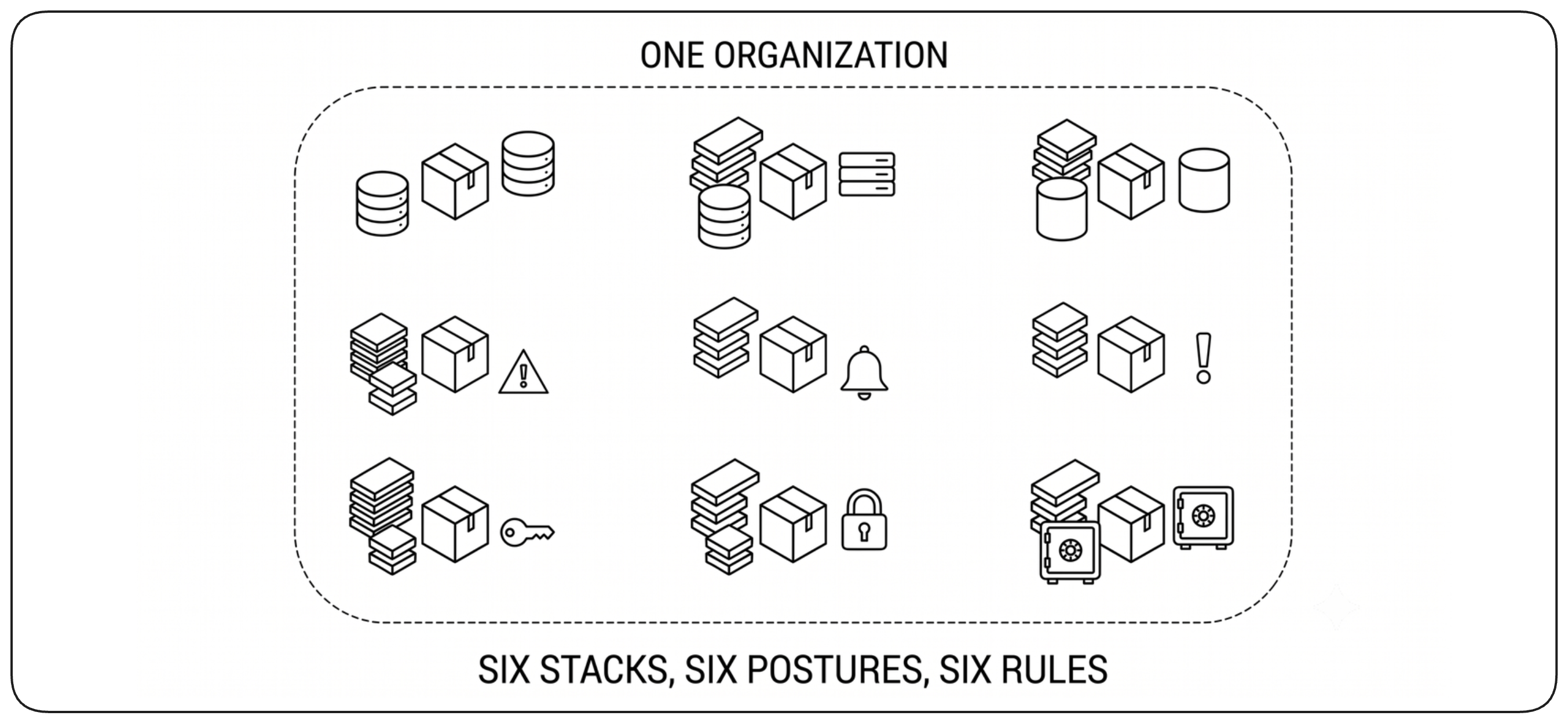
Without a shared substrate, teams converge on nothing. Each one invents its own way of doing things — its own deployment pattern, its own definition of "secure enough", its own way of handling secrets, alerts, on-call. None of these choices are unreasonable on their own — they are simply uncoordinated. The result is an organization that cannot audit its own security posture, cannot operate its own infrastructure consistently, and cannot move people between teams without friction. !!Worse still, it loses its own power of description: it can no longer answer the simplest questions about itself — what services exist, who has access, which standards apply, where the exceptions live. An organization cannot govern what it cannot consistently see.!!
The Developer Productivity Challenge [Developer Productivity]
Complexity of Modern Development [Development Complexity]
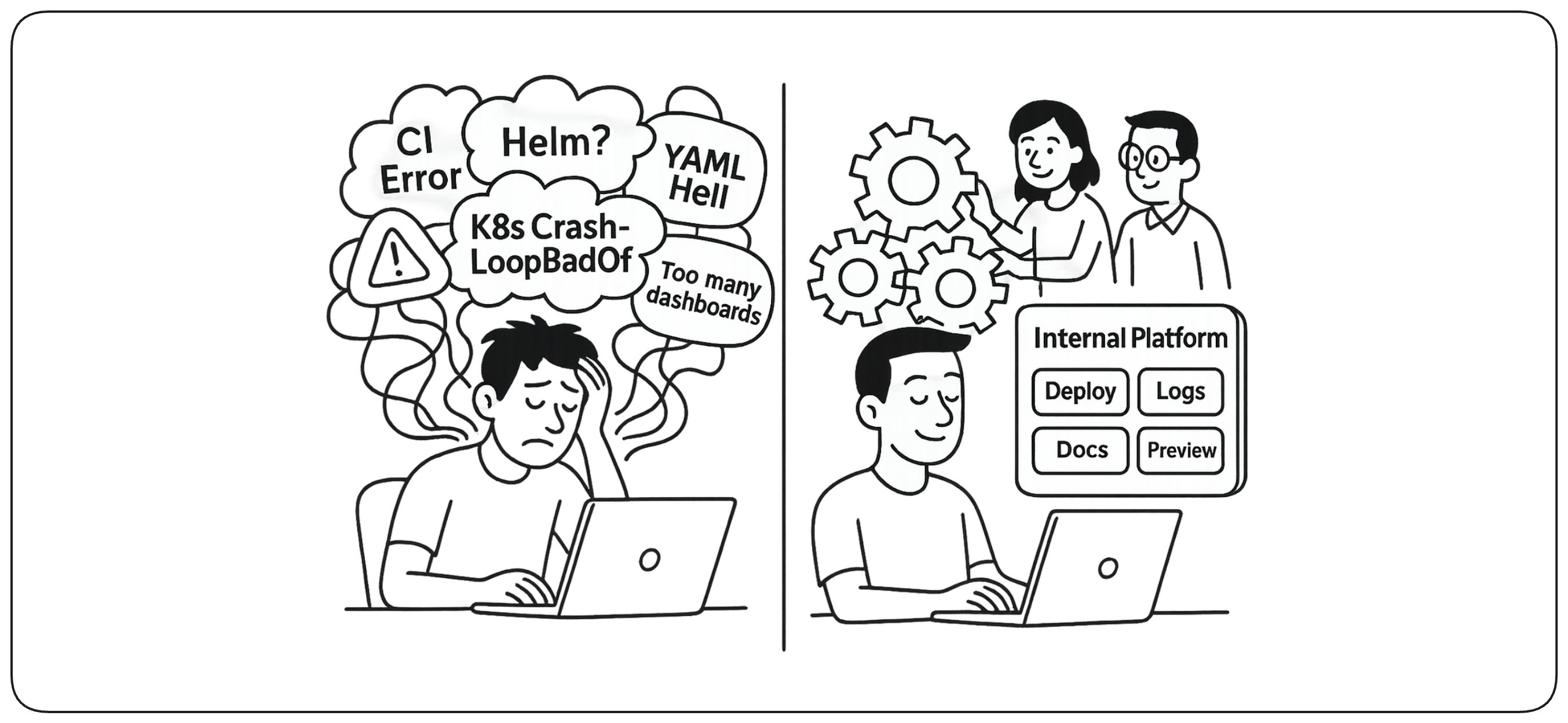
Modern software has fragmented developer attention. A single team is now expected to juggle code, infrastructure, security, deployment pipelines, observability, compliance, and cost — each with its own tools, vocabulary, and on-call burden. The cognitive load is not a productivity inconvenience; it is what slows innovation, erodes quality, and drains the people the organization most depends on.
The Burden of Full-Service Ownership [Full-Service Burden]
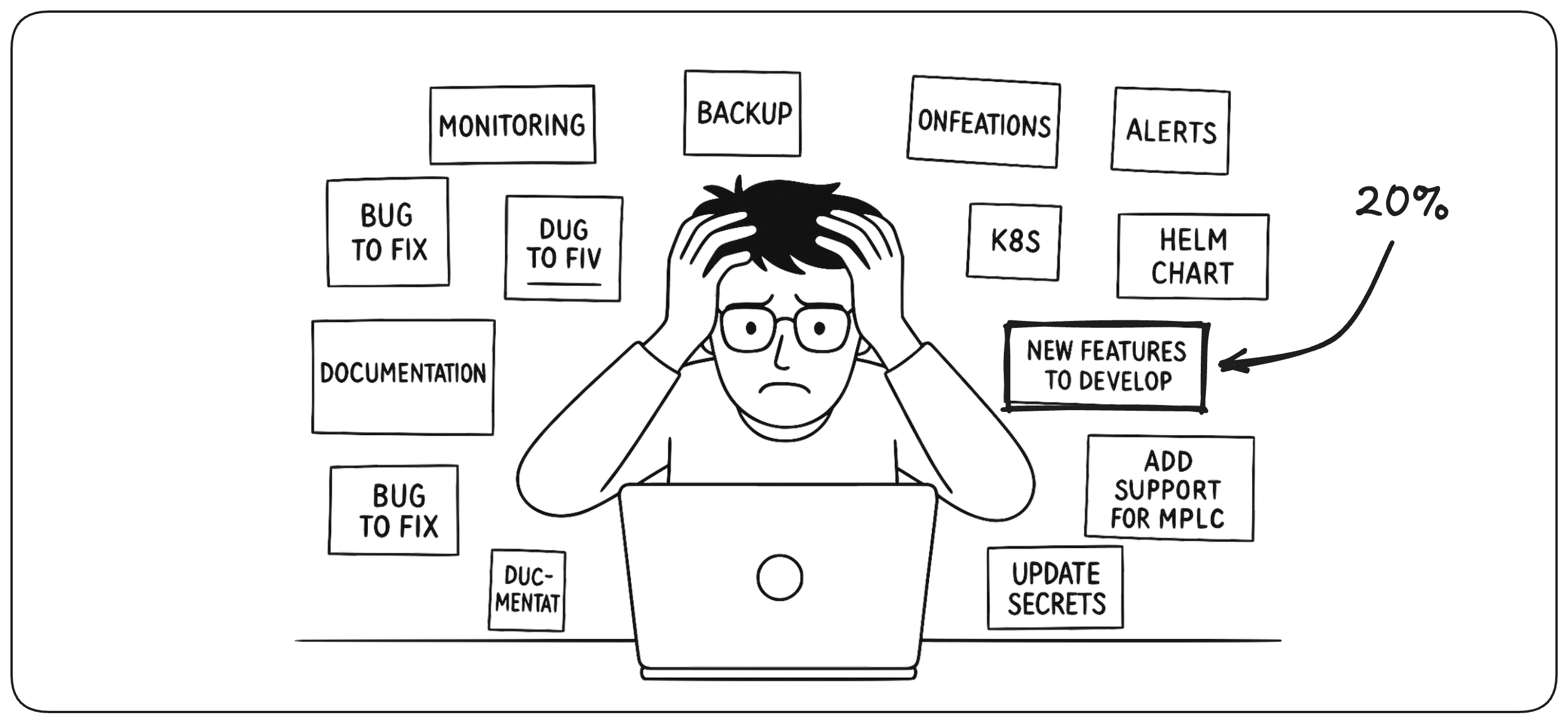
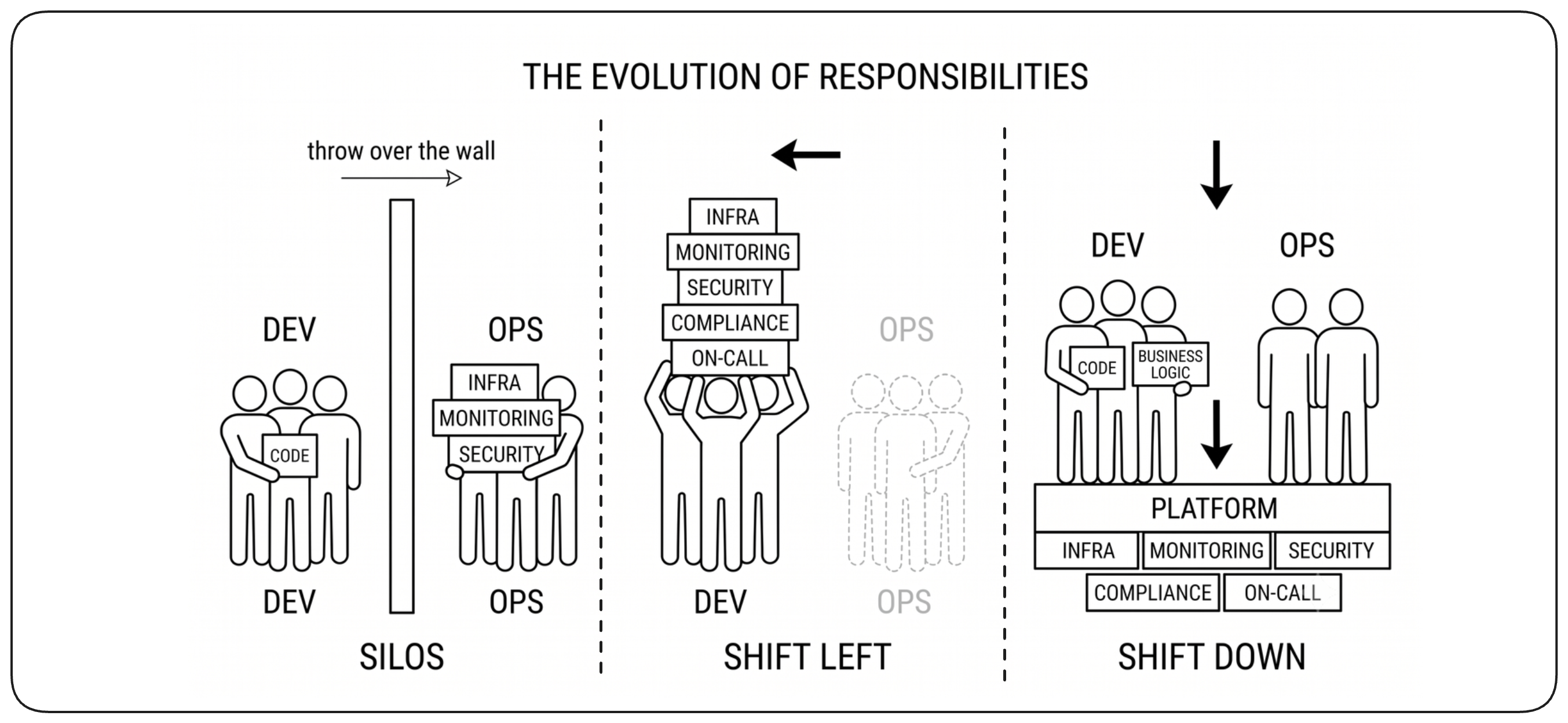
Full-service ownership was a necessary correction to slow, siloed operations, where developers threw code over a wall and waited for Ops to run it. The intent was sound: end-to-end ownership accelerates delivery. But like many corrections, it eventually overshot. The wall disappeared, but the weight did not — it simply moved onto developers. Every team became accountable for code, infrastructure, on-call, monitoring, and compliance at once; developers became overwhelmed by an ever-growing list of skills they were never trained for, and the organization fragmented as every team built its own answer to the same problem.
The Limit of Service Ownership [Limit of Service Ownership] {1}
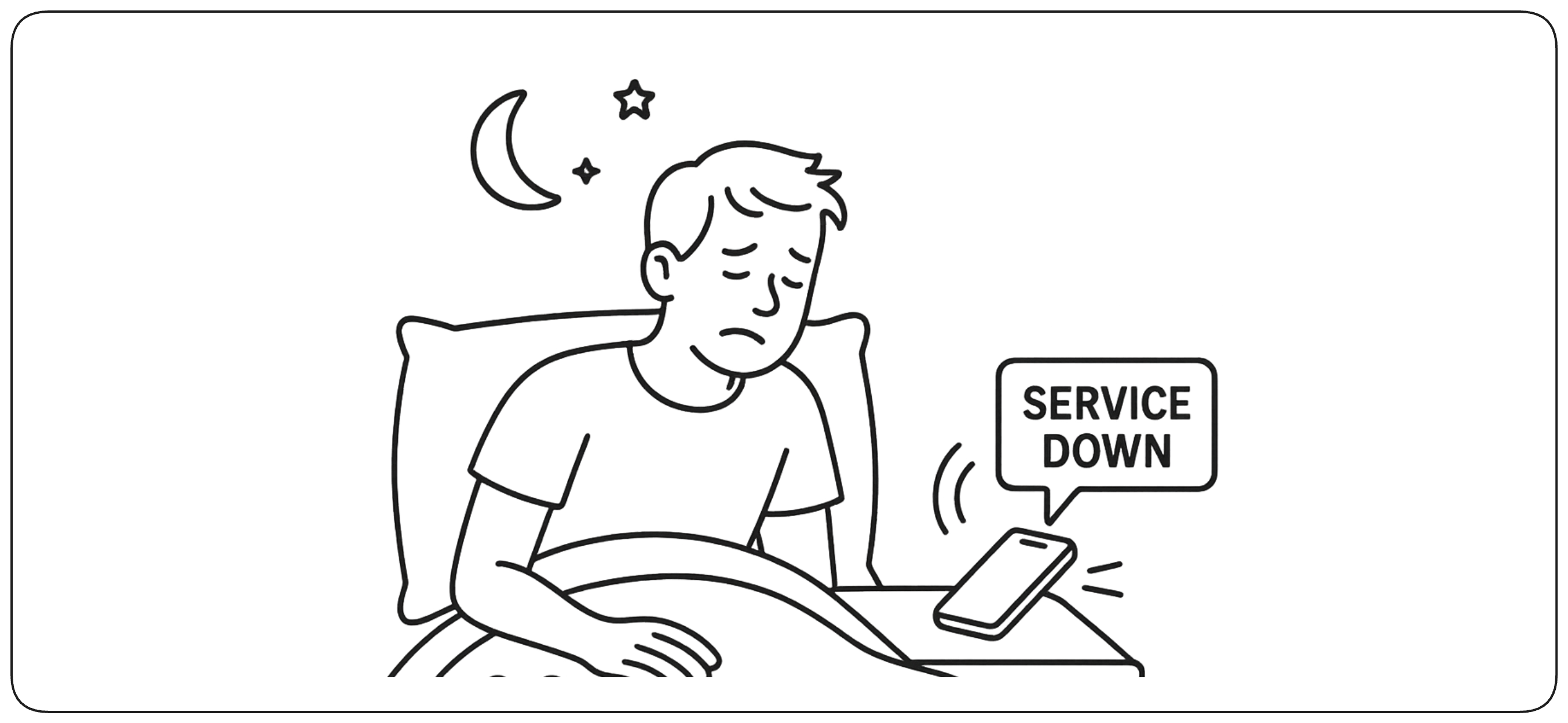
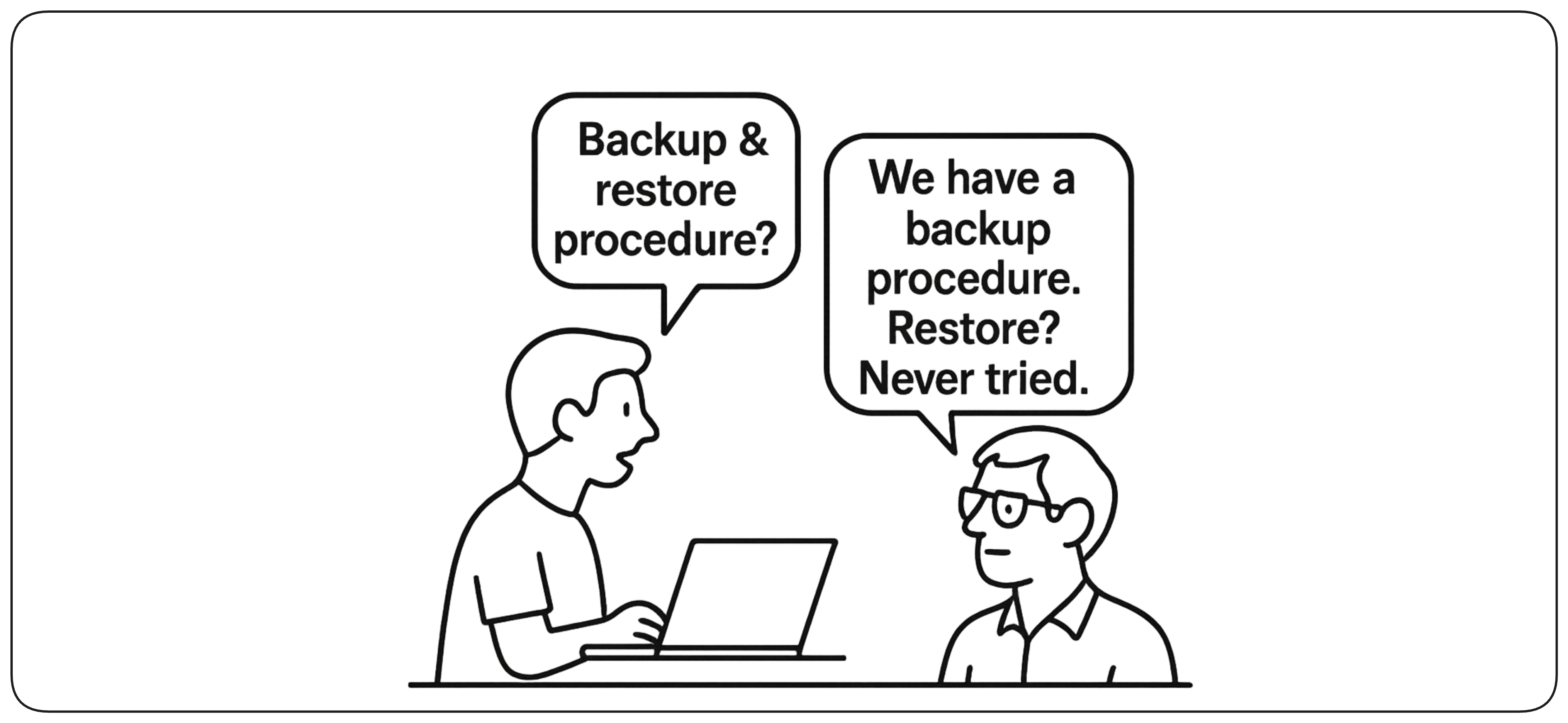
The deeper problem is that full-service ownership confuses accountability with expertise. !!It makes teams accountable for outcomes across observability, backups, compliance, secrets rotation, capacity planning — while giving them neither the time, the training, nor the incentive to become excellent in any of them.!! Developers do care about operational quality, but they are measured, interrupted, and rewarded around product delivery; operational hygiene is the work that quietly loses every trade-off until the day it breaks. The result is uneven coverage, fragile implementations, and growing technical debt — a structural limit of the model, not a discipline problem.
The Platform Answer [The Platform Answer]
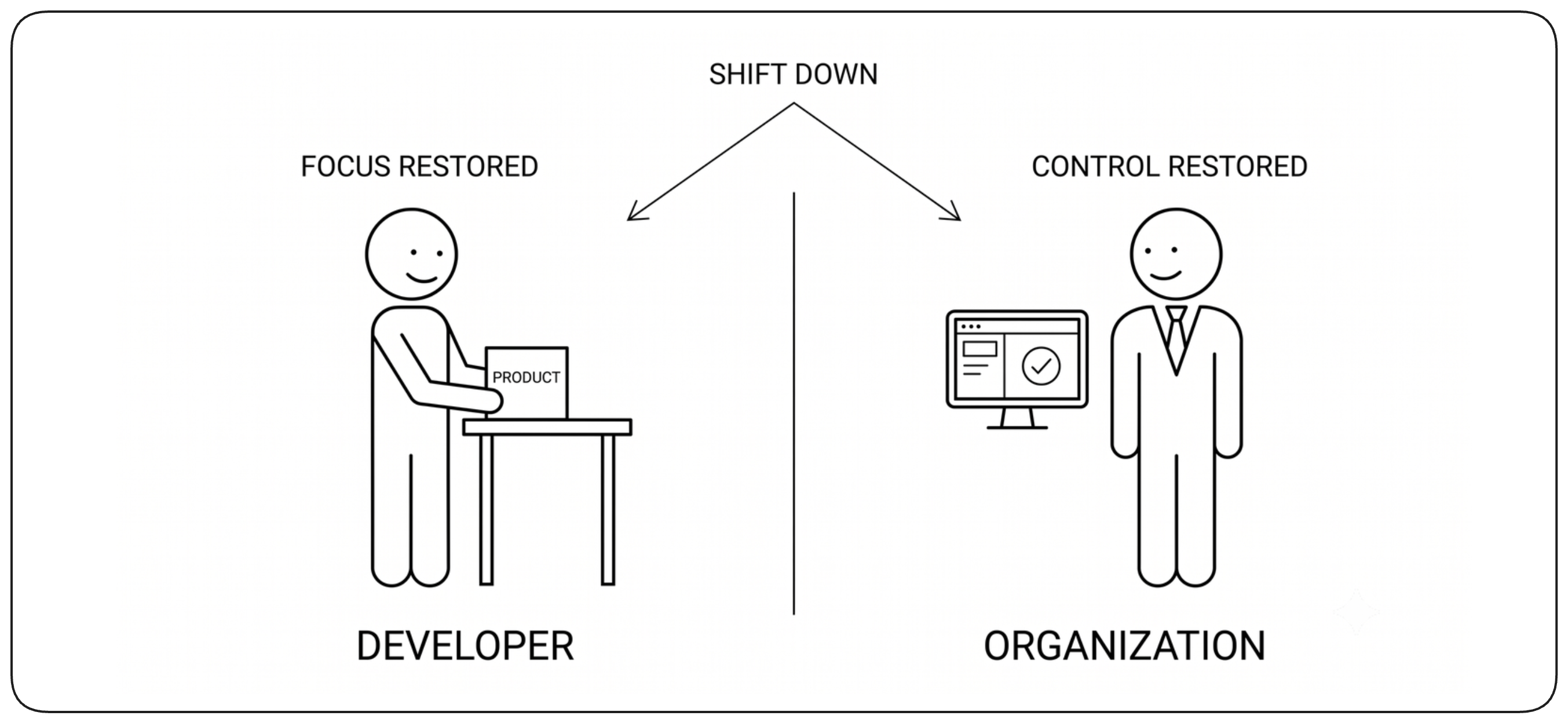
Two Challenges, One Answer: Shift Down [Two Challenges, One Answer] {1}
The platform is not a compromise between developer autonomy and organizational control — it is the mechanism that makes both possible at the same time. It becomes the backbone on which the whole organization runs. !!Everything that pulls a developer out of focus — infrastructure, security, compliance, monitoring, on-call, secrets, cost management — is pushed out of the developer's critical path and down into the platform. This is what the industry calls shift down.!! It is not a return to old operational silos. Developers still own their services and their product outcomes; what moves down is the undifferentiated operational burden — the repeated, security-sensitive, compliance-heavy machinery that every team needs but no team should reinvent.
Velocity Without Losing Control [Velocity & Control]
The remarkable thing about shift down is that both sides of the organization come out ahead. Developers get their focus back — no more juggling six operational domains they were never trained for, no more foundations to rebuild. The organization gets a single place from which to enforce standards, secure its systems, and govern the shape of its own presence. !!What looked like a trade-off — either move fast or stay under control — turns out not to be one. The same move gives the developer their day back and gives the organization its grip.!!
Governance Encoded in the Platform [Governance as Code] {1}
Once the operational weight is absorbed by the platform, governance stops being something the organization writes down and starts being something it deploys. Security postures are enforced at deployment time, not reviewed at the end of a sprint. Compliance is inherited by every service that runs on the platform, not proven service by service. Access is granted just-in-time, not left standing. Standards are encoded once, distributed everywhere, and no team can deploy outside them. !!The platform turns governance into infrastructure: rules become gates, policies become code, and coherence becomes a property of the system rather than an aspiration of the org chart.!! The company stops managing the sprawl of its teams and starts governing the shape of its own presence.
How the Business Scales [Business Scale] {1}
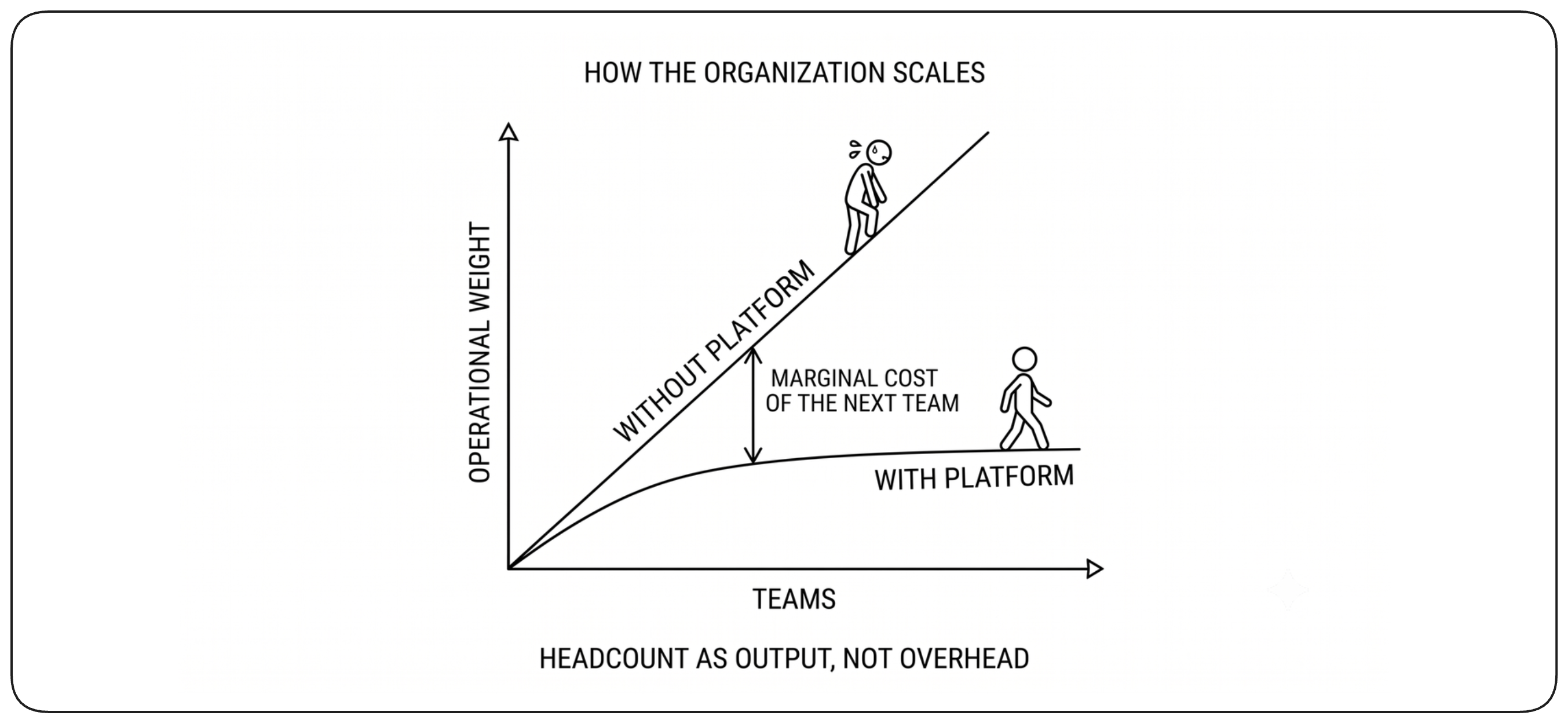
Without a platform, every new team drags its own operational weight behind it — its own infrastructure, its own security work, its own compliance effort, its own on-call. The machinery around the product grows faster than the product itself, and past a certain size the organization spends most of its energy running itself rather than building. A platform breaks that curve. The heavy work is done once, and every additional team inherits it at near-zero marginal cost. !!A platform is what lets an organization keep growing without its own weight catching up with it — it is the mechanism that turns headcount into output instead of overhead.!!
Development, Re-Centered [Development Re-Centered]
Developer-Centric by Design [Developer-Centric by Design] {1}
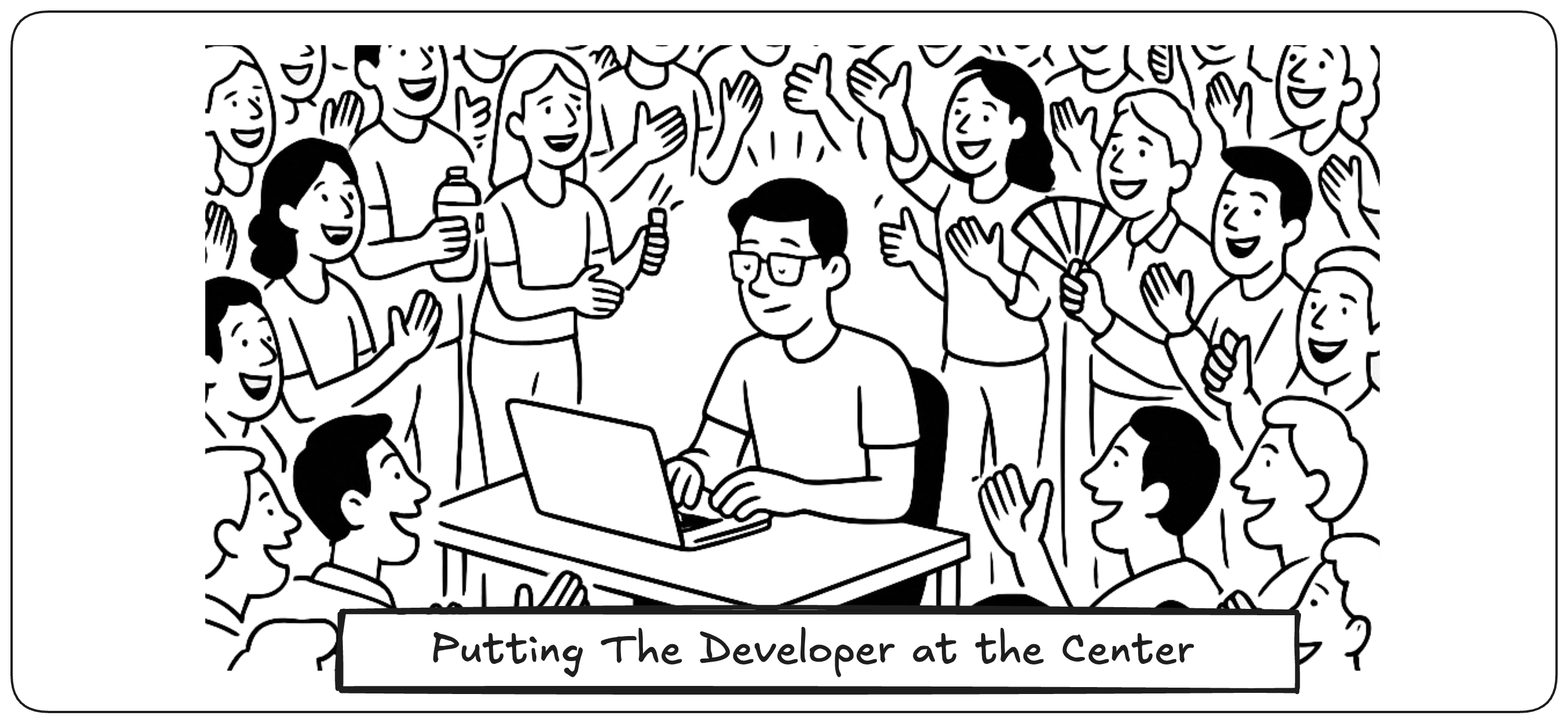
For decades, writing software meant adapting to the machinery — learning the infrastructure, understanding the deployment pipeline, mastering the security model, absorbing the conventions before a single line of code could ship. The developer had to bend to the system. A platform reverses this relationship. !!It is a product built for the developer, and so the system now bends to the developer: abstractions are shaped by what they want to express, interfaces by how they think, workflows by how they work.!! A developer-centric platform does not start from the cloud provider's vocabulary — it starts from the developer's intent. Developer-centric is not a value written on a wall; it is the direction in which every design decision points.
A Self-Service Ecosystem [Self-Service Ecosystem] {1}
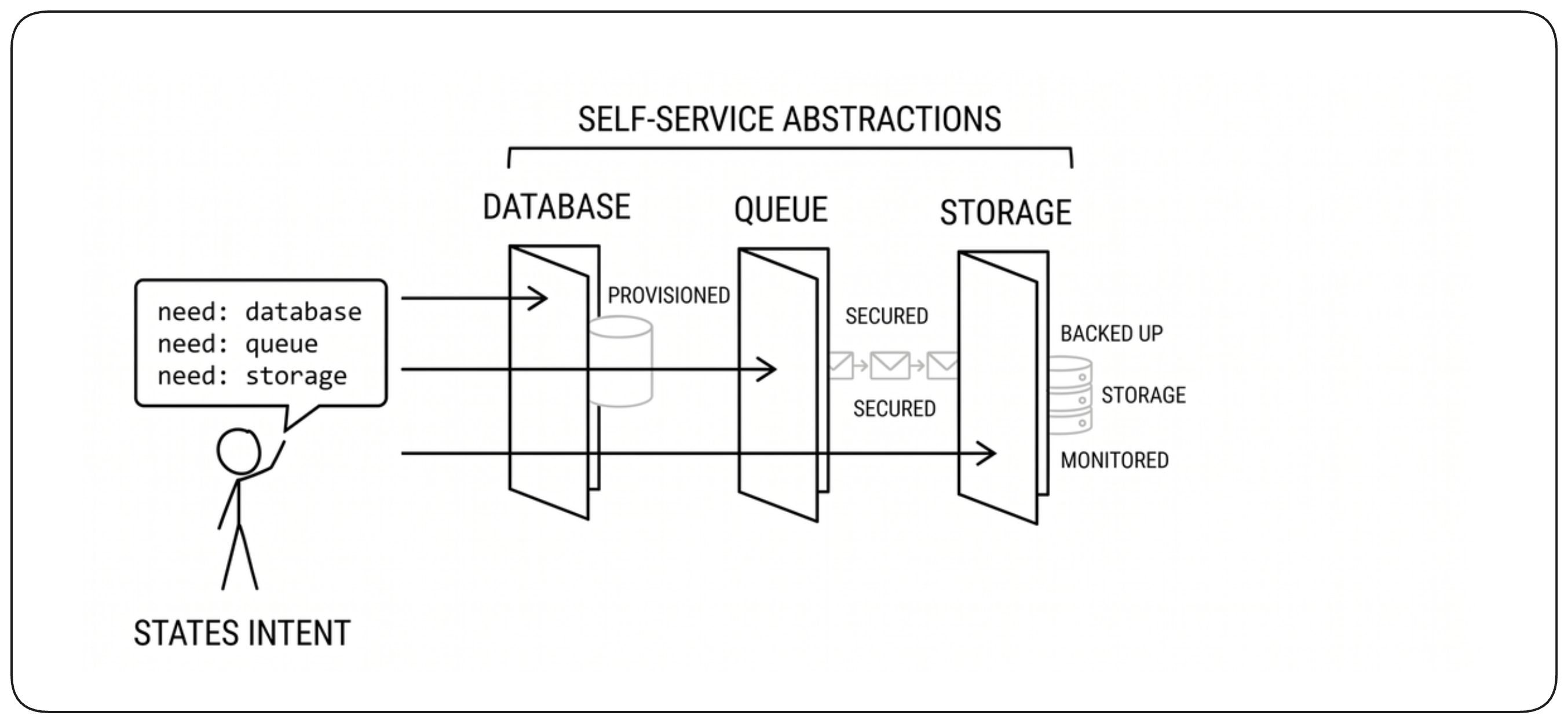
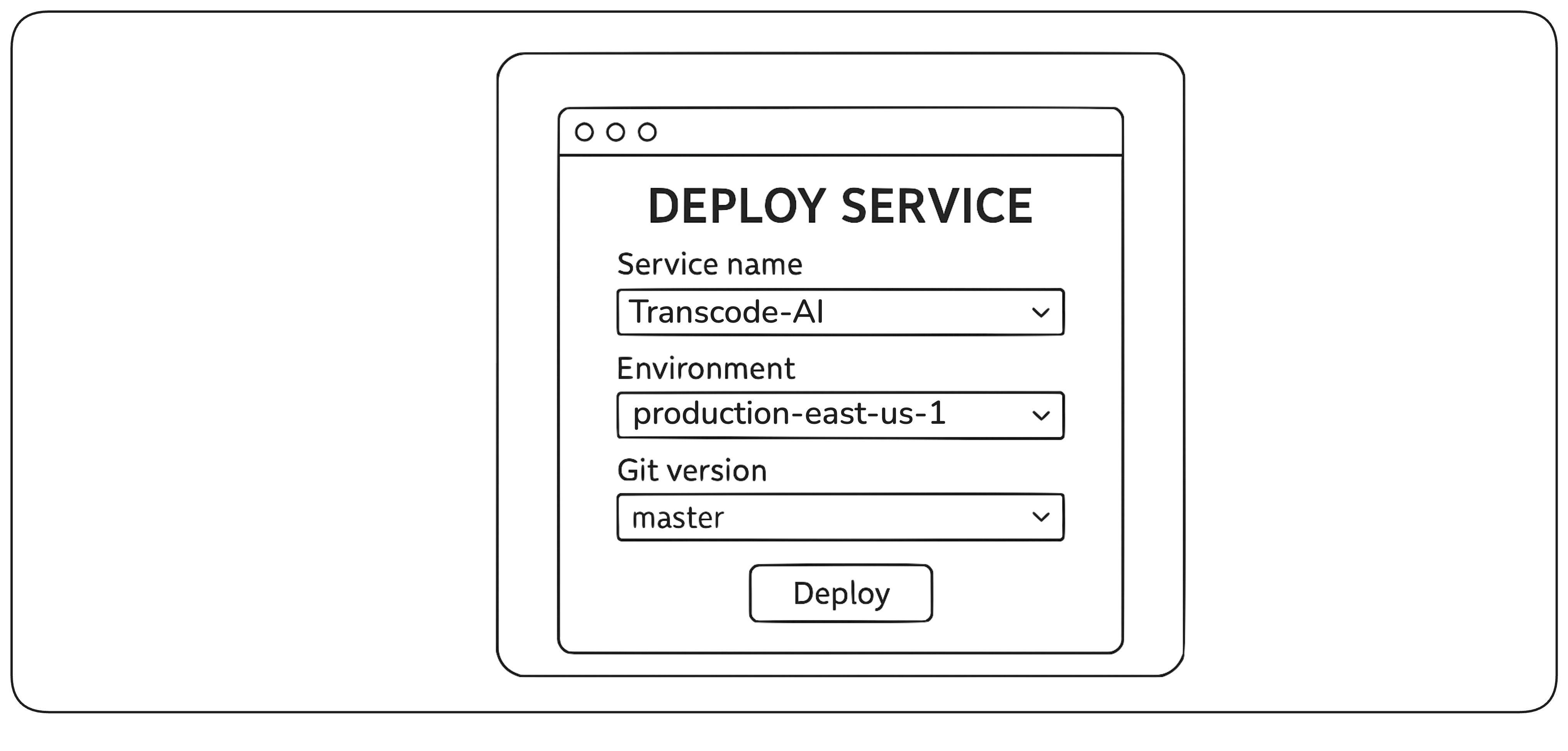
The reversal takes a concrete shape: self-service. The developer expresses intent in a few lines of code — "I need a database", "I need a queue", "I need to deploy my service", "I need to call another service" — and the platform delivers everything behind it: provisioning, configuration, security, routing, backups, monitoring, compliance. !!What used to require a ticket, a runbook, and a week of waiting becomes a door the developer walks through without leaving their code.!! Whether the developer is asking for a primitive resource, shipping their own service, or wiring a new dependency between services, the same self-service pattern applies. The details of how each capability is materialized remain available when they matter — for debugging, for tuning, for incident response — but they are no longer the entry point into the work.
Platform Fundamentals [Platform Fundamentals]
A Platform Is a Translation System [Translation System] {1}
A platform is not a portal, a Kubernetes cluster, or a collection of automation scripts. Those may be parts of it, but they are not the platform itself. !!A platform is a translation system: it translates developer intent into governed, production-ready capabilities — running services, wired dependencies, provisioned resources, enforced policies.!! Developers express what they need — a service to deploy, an environment, a call to another service, a database, a queue — and the platform carries that intent through security, compliance, provisioning, routing, and operations to produce something real that runs. Everything the rest of this chapter describes is a piece of that translation.
The Three Foundational Layers [The Three-Layer Model] {1}
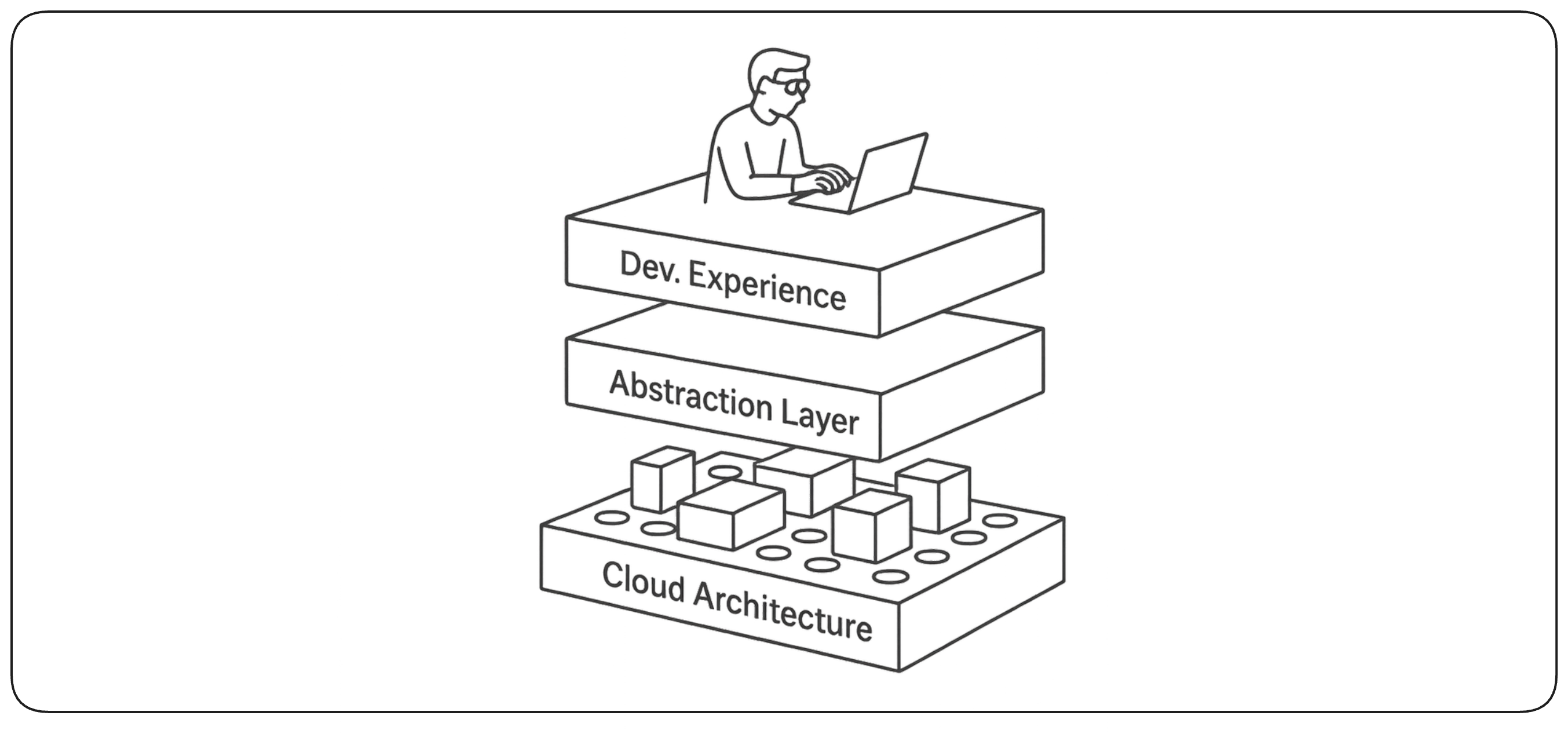
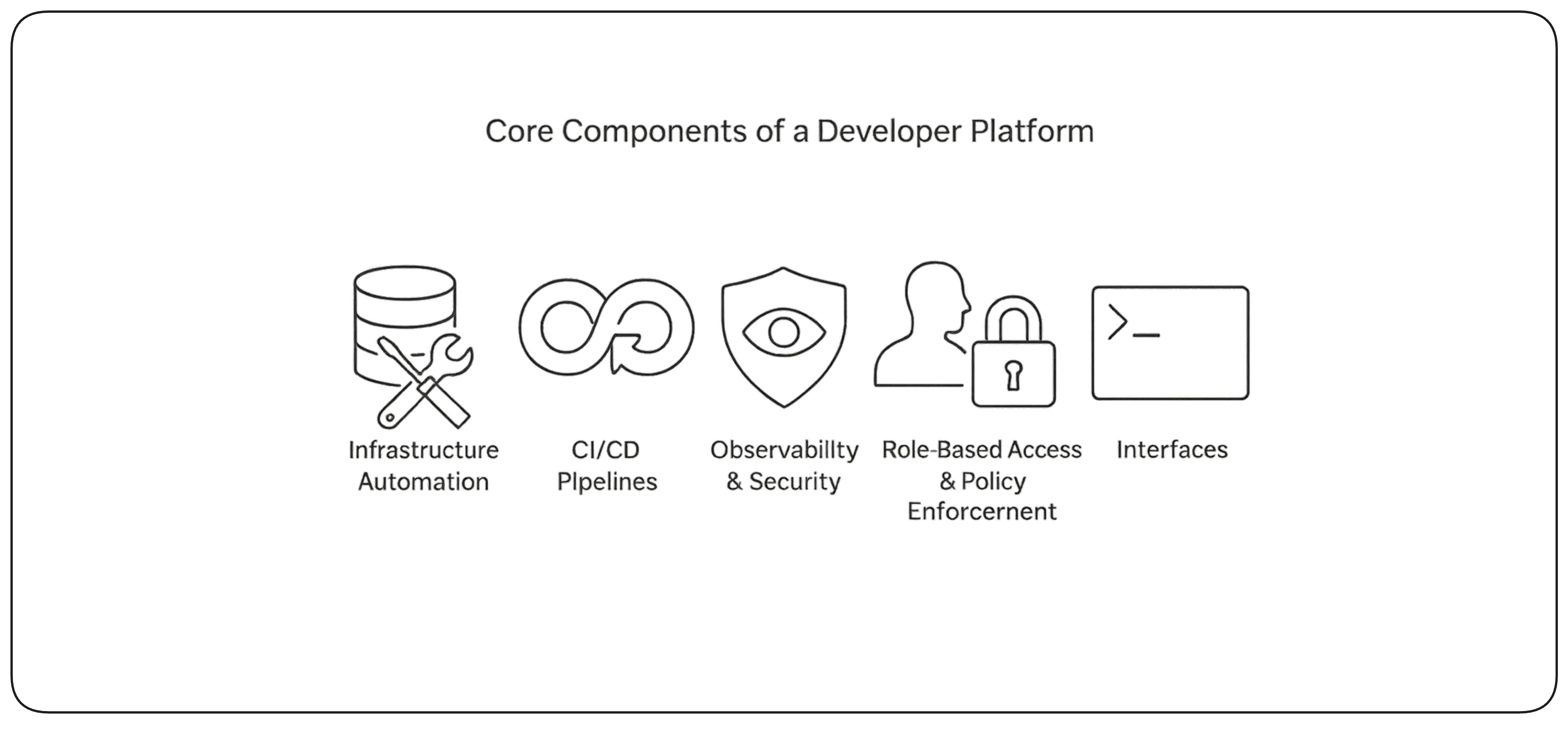
The translation happens through three interconnected layers. The abstraction layer defines the what: a working model of the organization's software — its entities, their properties, their relationships, and the rules that govern how they should behave. This is where services, environments, deployments, dependencies, security postures, and processes are made explicit as contracts. The architecture layer defines the how: it materializes that abstract model into real infrastructure — cloud resources, identity, networking, policies, observability, compliance. The interface layer exposes the whole thing through CLIs, portals, APIs, and workflows — the surface through which developers actually interact with the platform. !!Each layer serves the one above it. Together, they turn a developer's "I need X" into a governed, running system.!! The rest of this chapter walks through each layer in depth.
A Stable Contract, an Evolving Machine [Stable Contract, Evolving Machine]
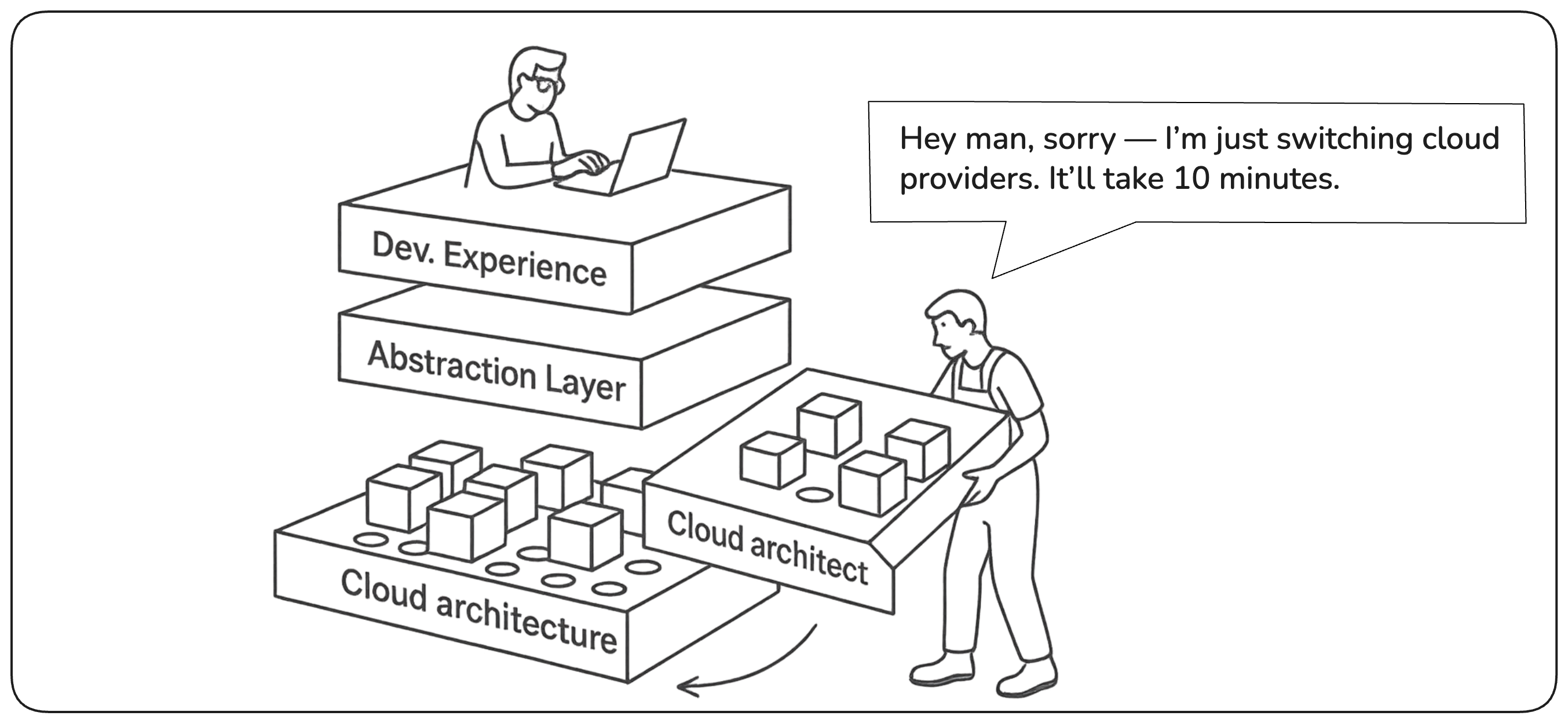
Separating the what from the how lets the implementation evolve without disturbing developers. The platform can change its internal choices at will — tighten a policy, adjust a topology, adopt a new technology, absorb a migration — while the developer-facing contract stays untouched. In the extreme case, even the cloud provider itself can be replaced. The everyday value is smaller and constant: the freedom to keep improving the architecture underneath a stable model.
The Pit of Success [Pit of Success] {1}
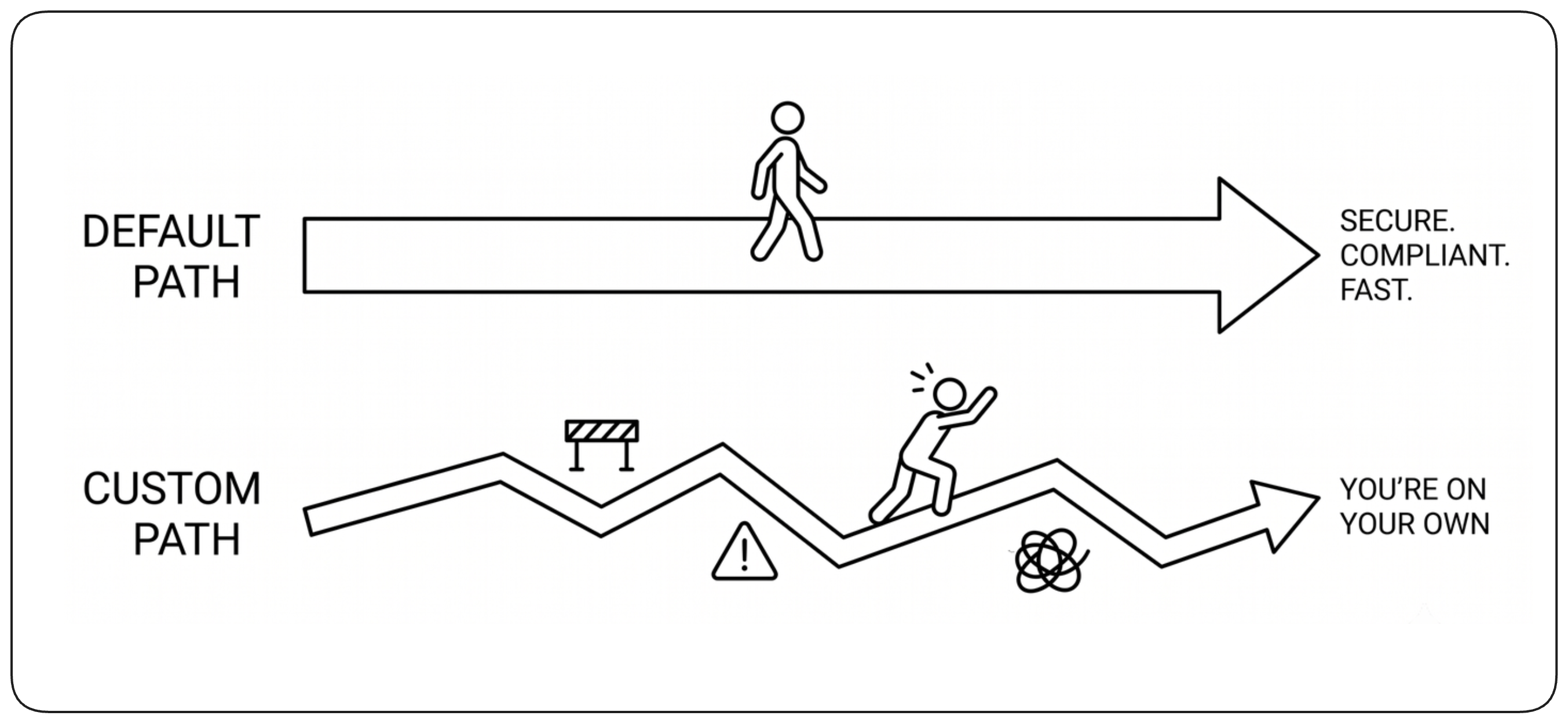
A well-designed platform makes it easy to do the right thing and difficult to do the wrong thing. Developers should naturally fall into secure, compliant, and efficient patterns without conscious effort. !!When the default path is the safe path, and deviating requires deliberate friction, the platform becomes a force multiplier for quality across the entire organization.!! This is the principle that ties all three layers together: abstractions expose only what should be exposed, architecture enforces standards by construction, interfaces make the right move the obvious one.
Opinionated, Modular, Extensible [Opinionated & Modular]
A platform is not a neutral toolkit — it is an opinionated one. It reflects how the organization believes software should be built: which patterns are supported, which are discouraged, which are outright unavailable. Being opinionated is not a limitation but a design choice: it is what turns a collection of tools into a coherent system. At the same time, a good platform stays modular — capabilities can be added, replaced, or evolved without rewriting the whole — and extensible, so that teams with legitimate special needs can extend the platform rather than route around it.
The Abstraction Layer [The Abstraction Layer]
The Heart of the Platform [The Platform Heart] {1}
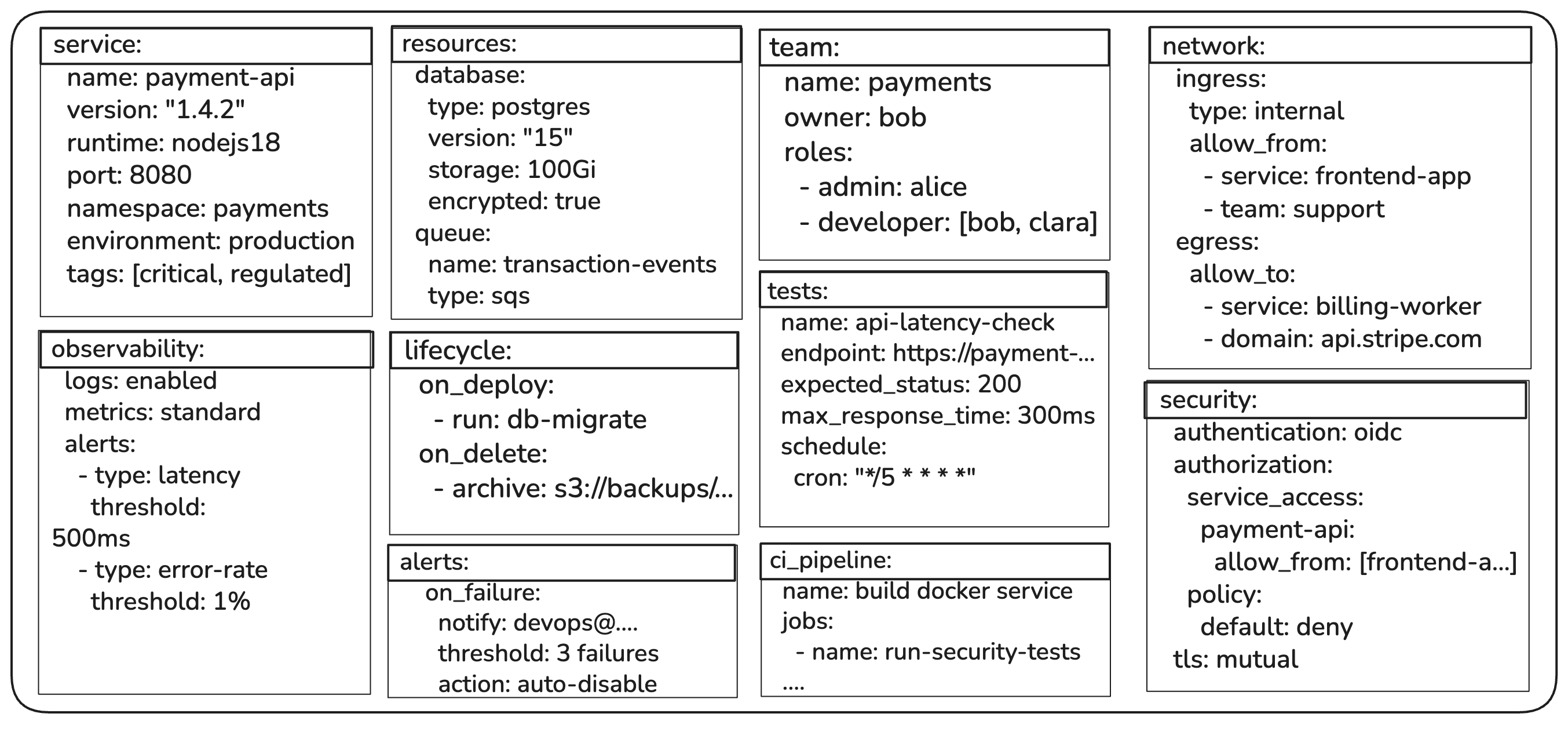
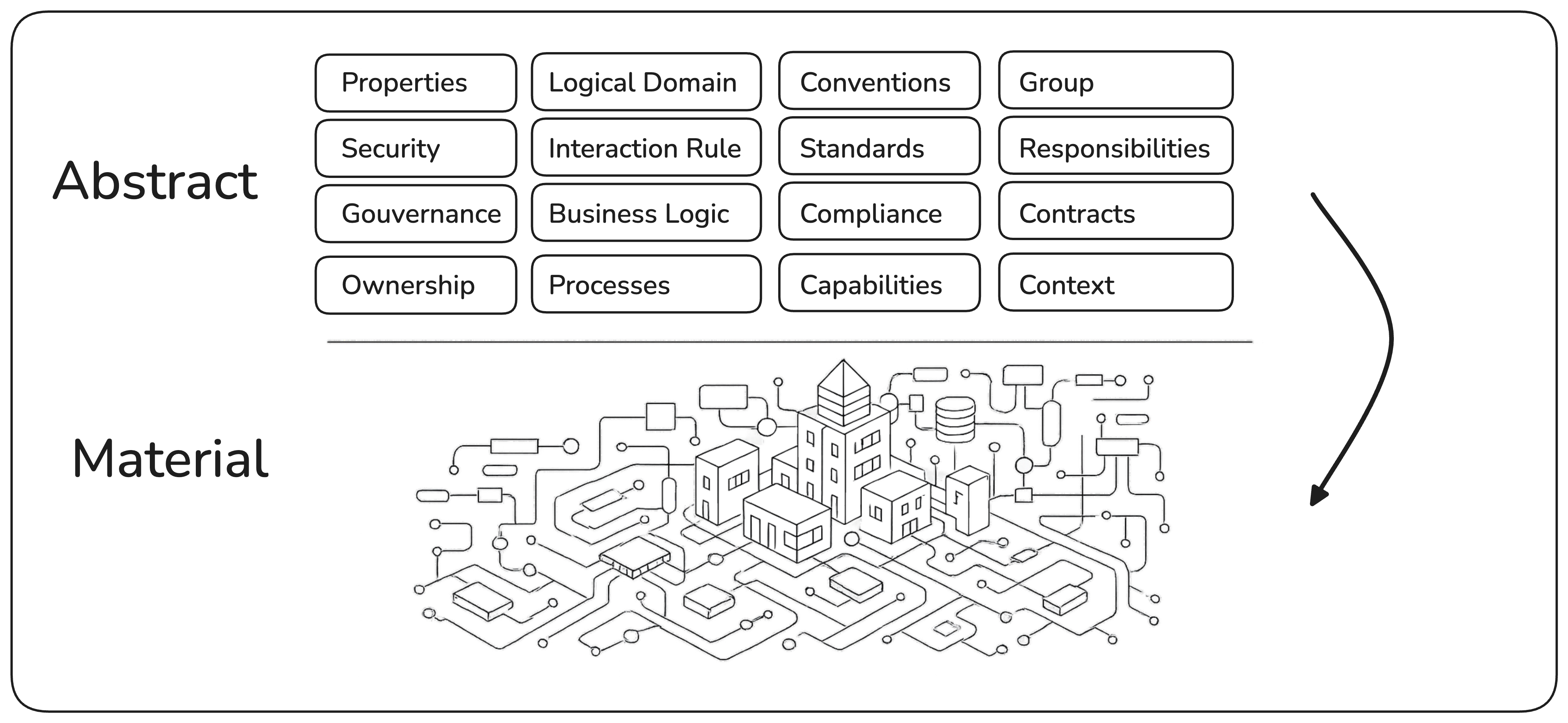
At the heart of every platform sits a working model of how the organization builds, ships, and operates software — a layer of metadata describing entities, their properties, and how they connect. It turns implicit expectations into explicit contracts — what a service is made of, how it is deployed, who operates it, what dependencies it can declare, what SLOs it must meet — and carries a philosophy that reflects your organization's values: security, speed, autonomy, control.
Abstractions Must Reflect the Organization [Reflect the Organization]
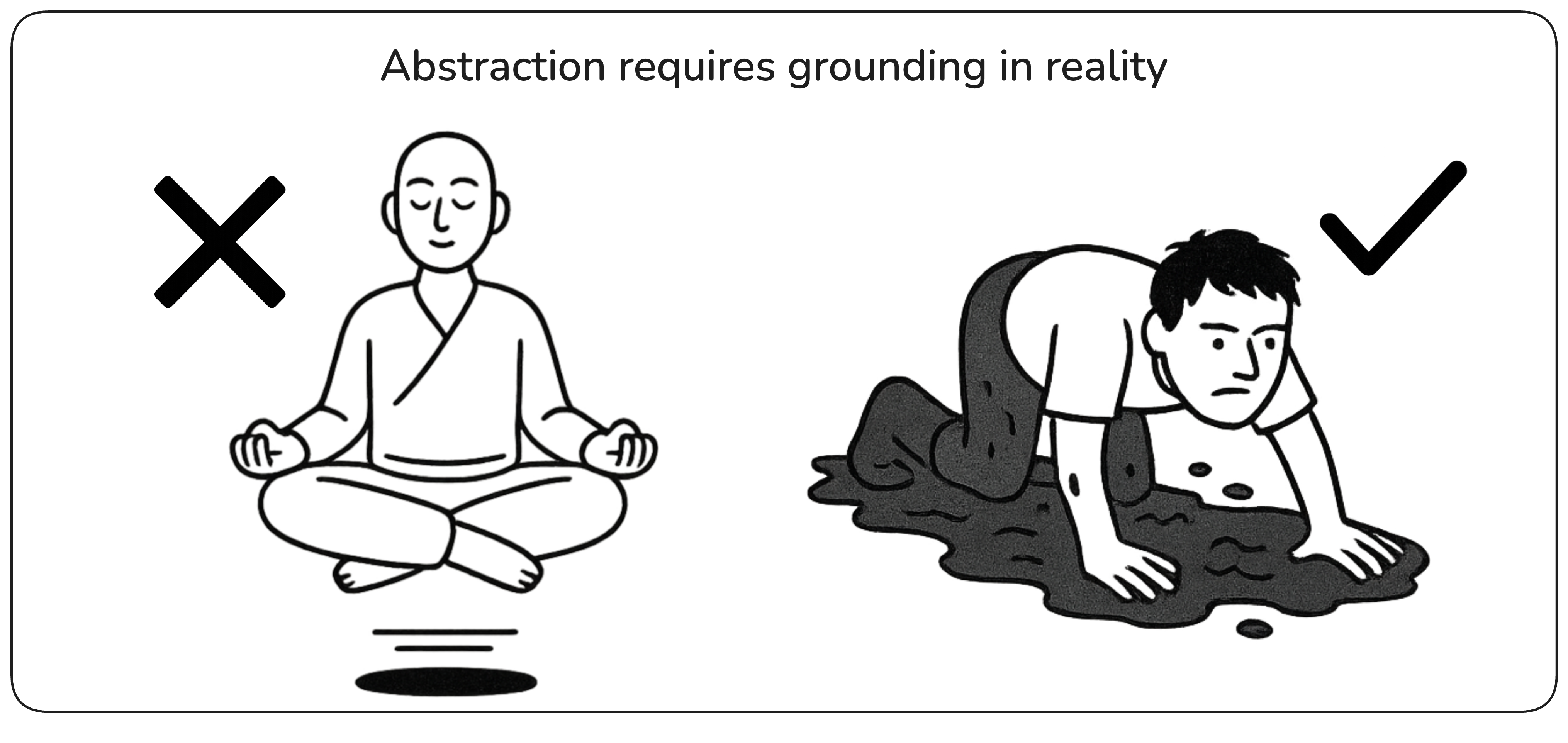
Abstractions are not intellectual exercises. They must reflect how the organization actually works — its development processes, compliance constraints, approval workflows, operational dependencies. This is why no universal model exists: to define a service, an environment, or a deployment policy, the organization must first decide what each of these means for its own reality. Formalizing forces that clarity, and that clarity is what makes the platform fit the company rather than the reverse.
Capabilities as Building Blocks — the LEGO Model [LEGO Model] {1}
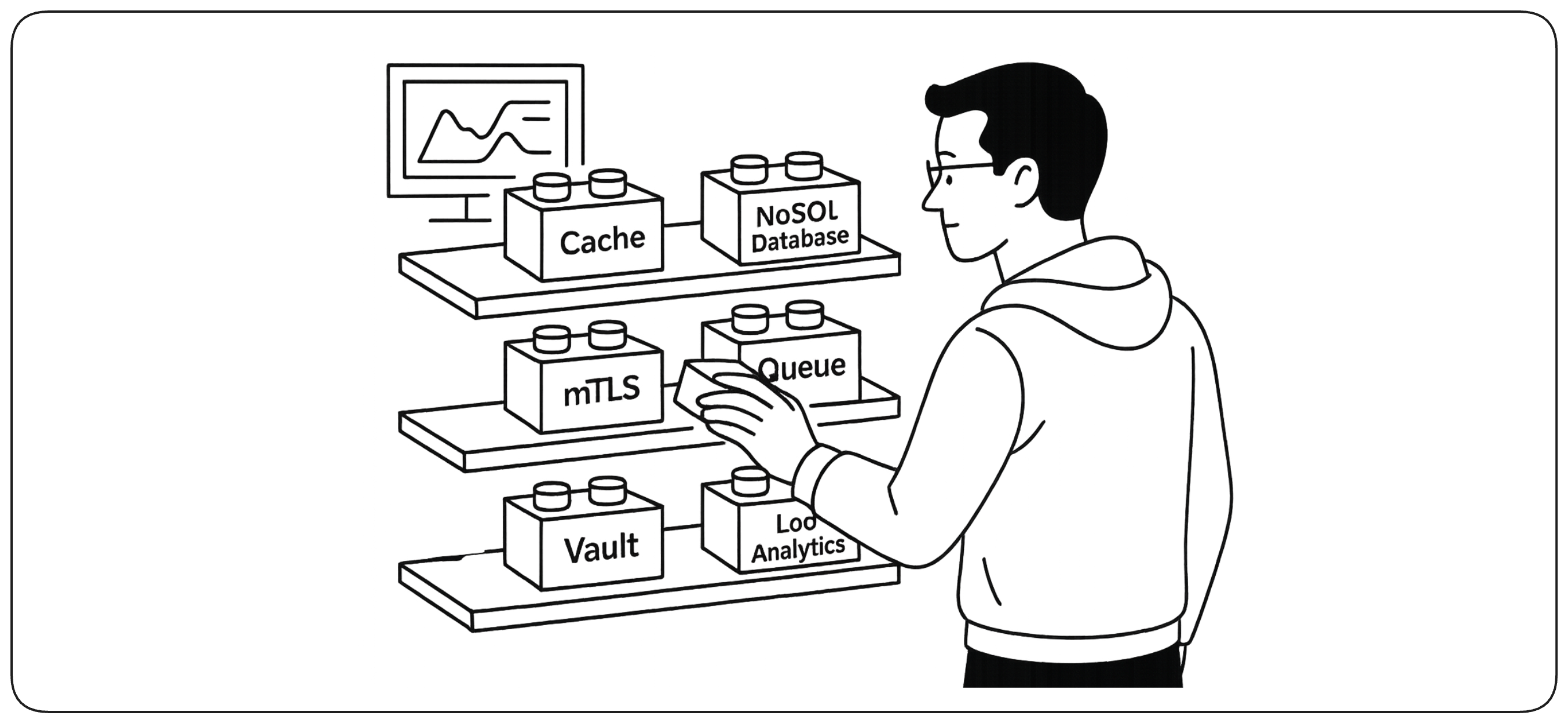
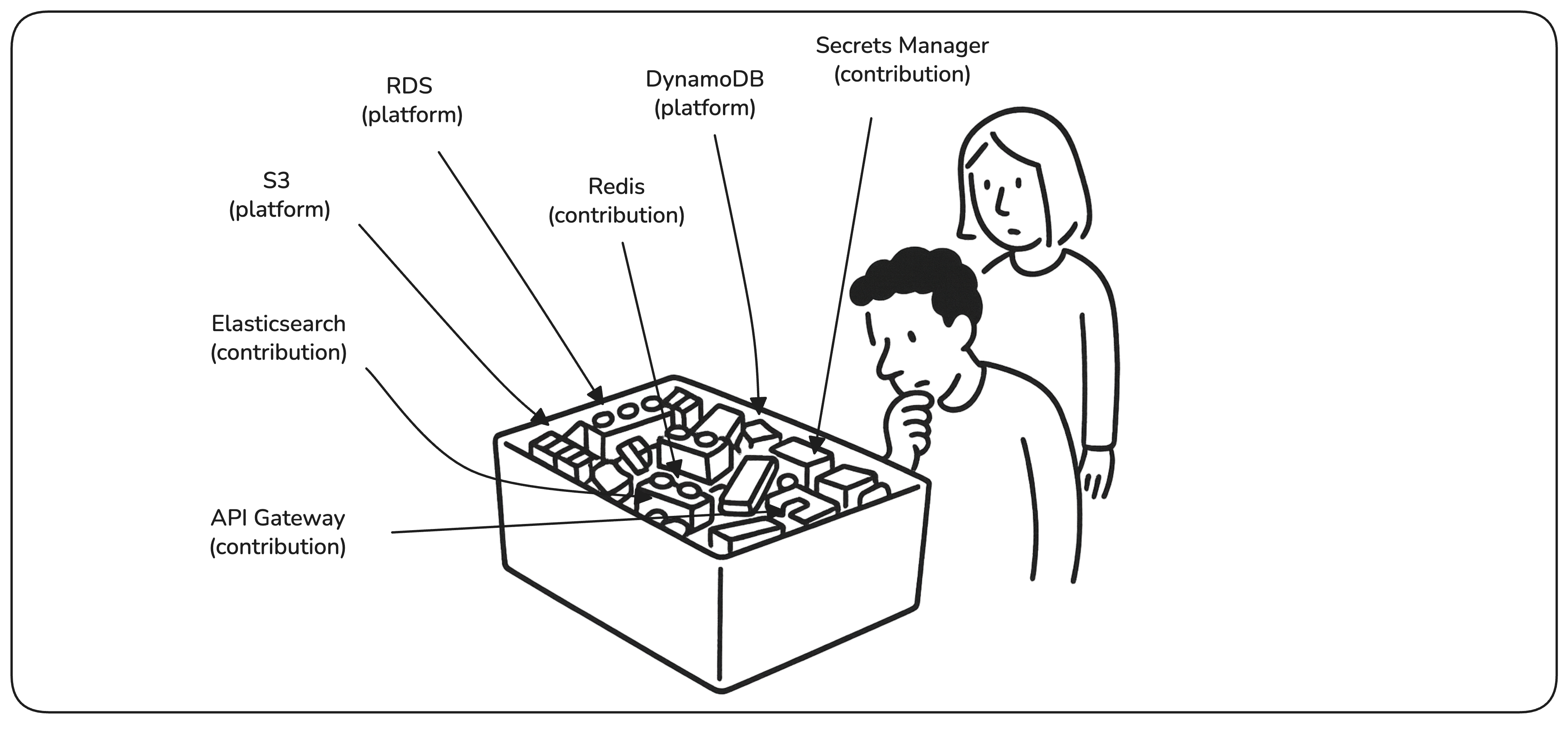
The key act of abstraction is modeling capabilities as modular building blocks — LEGO pieces developers pick and assemble on demand. The platform narrows broad cloud services into opinionated components that fit the organization's most common patterns: deployment, storage, messaging, authentication, monitoring. Each piece is standardized, composable, and safe to mix with the others. Consistency emerges from reuse, not from documentation.
Encoding Standards, Security, and Compliance [Encoding Standards]
Security, compliance, and organizational conventions are not enforced at this layer — they are made expressible in the model itself. Access controls, audit trails, data protection, naming rules, deployment patterns: each becomes a field in the abstraction rather than a policy checked after the fact. Developers who use platform abstractions follow standards by construction. !!The model is what makes governance a design property rather than a review step.!!
Modeling Interactions [Modeling Interactions]
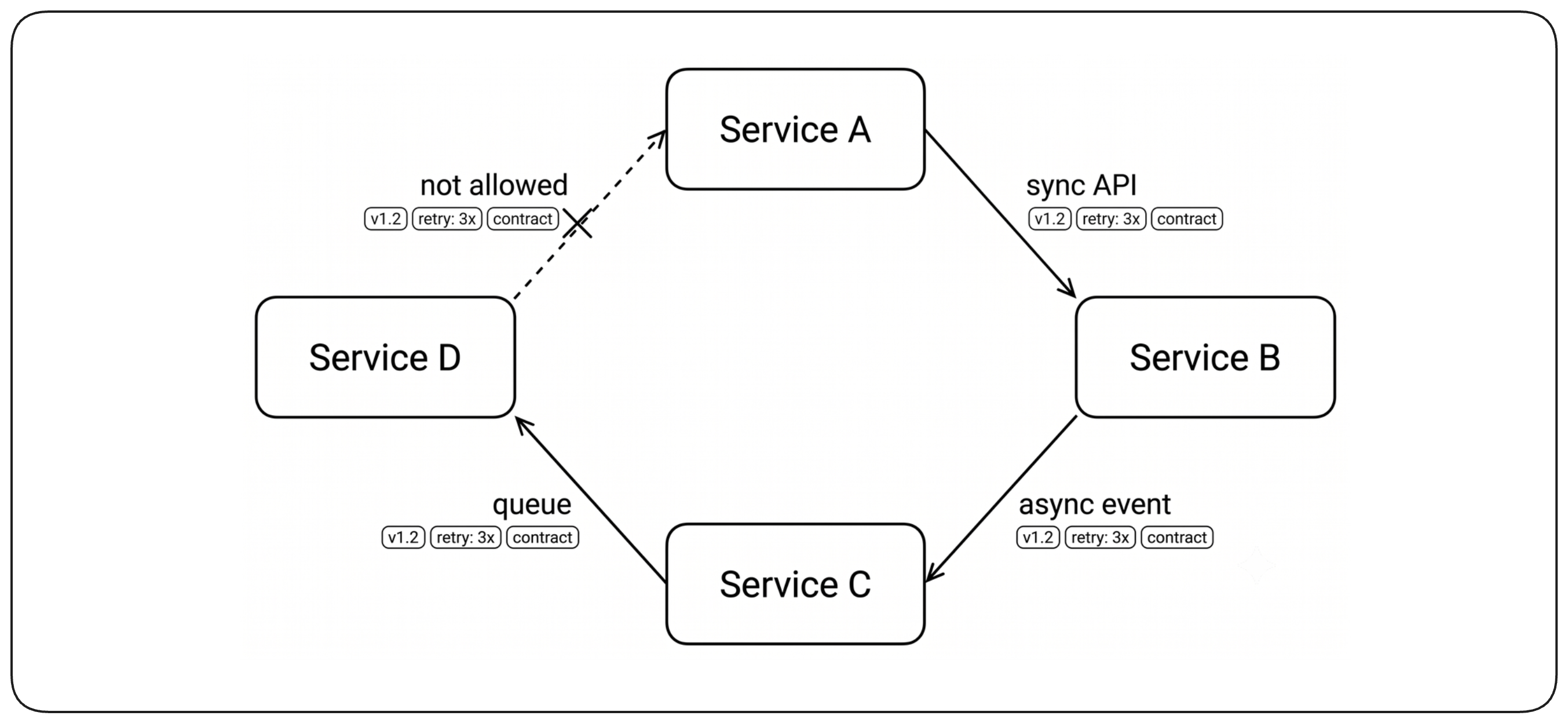
LEGO pieces need standardized connectors — services need consistent interaction patterns. The platform defines how services communicate: APIs, event formats, retry policies, versioning. Just as important, it makes these interactions explicit and controlled — which service can talk to which, through which channel, under which contract. Every connection becomes intentional rather than accidental, and the system as a whole stays observable, governable, and free to evolve.
Modeling Processes [Modeling Processes]
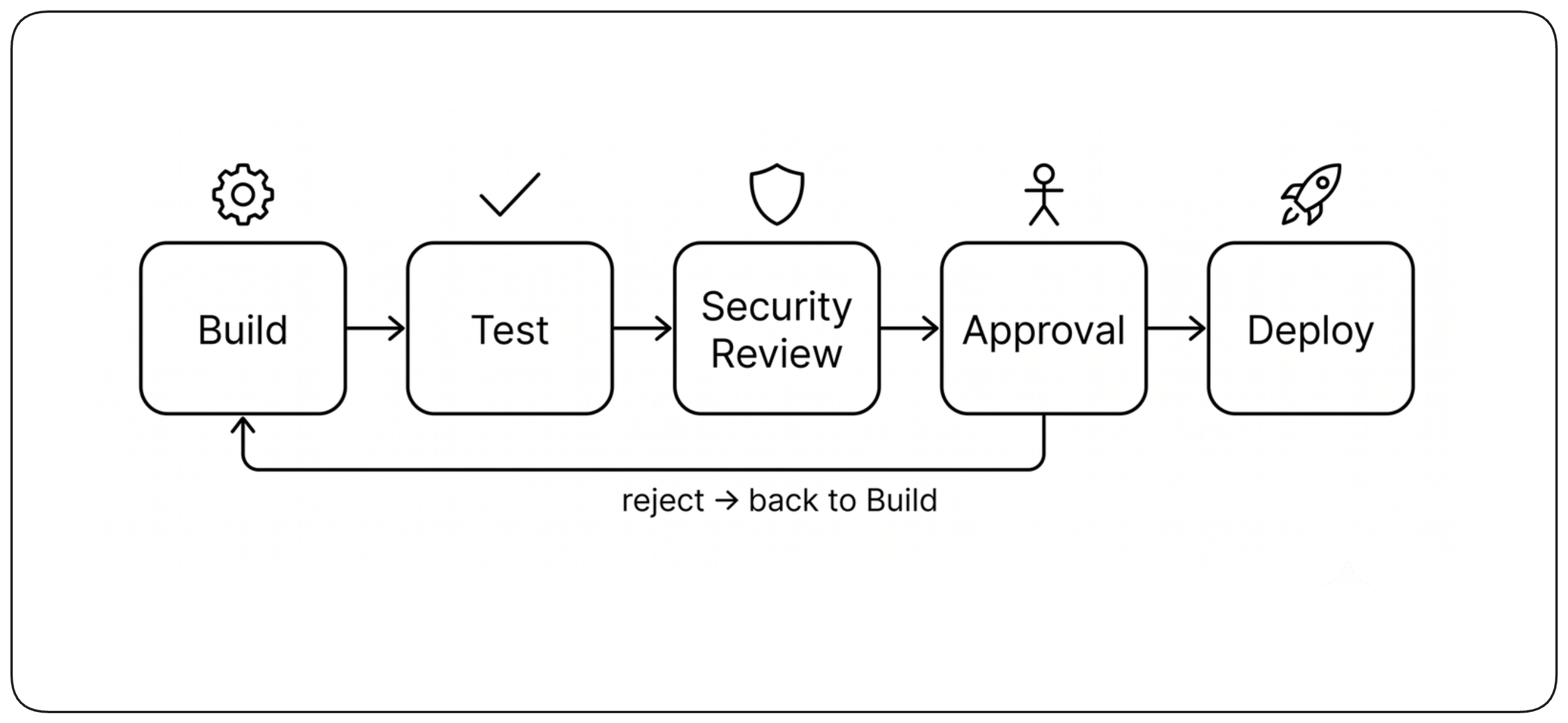
Abstraction extends beyond technical capabilities to the processes that structure the path to production: CI/CD, approvals, security reviews, deployments, incident response. Each has its own stakeholders and cadence. The platform models them as clean, composable steps developers can navigate predictably — turning ad-hoc workflows into first-class objects of the platform. This is what makes service ownership sustainable end-to-end.
Turning an Abstract Model into a Well-Architected System [Model Materialization]
From Model to Running Infrastructure [Model to Infrastructure] {1}
The abstraction layer defines the platform at the conceptual level — the properties, relationships, interactions, and rules that describe how everything is supposed to work. But by itself, this conceptual model runs nothing. Value emerges only when it is materialized: infrastructure provisioned, processes wired in, interactions made real, policies enforced end-to-end. This is where the platform stops being a model and becomes a system: something that actually runs, complies, and scales.
One Abstraction, Many Implementations [Many Implementations]
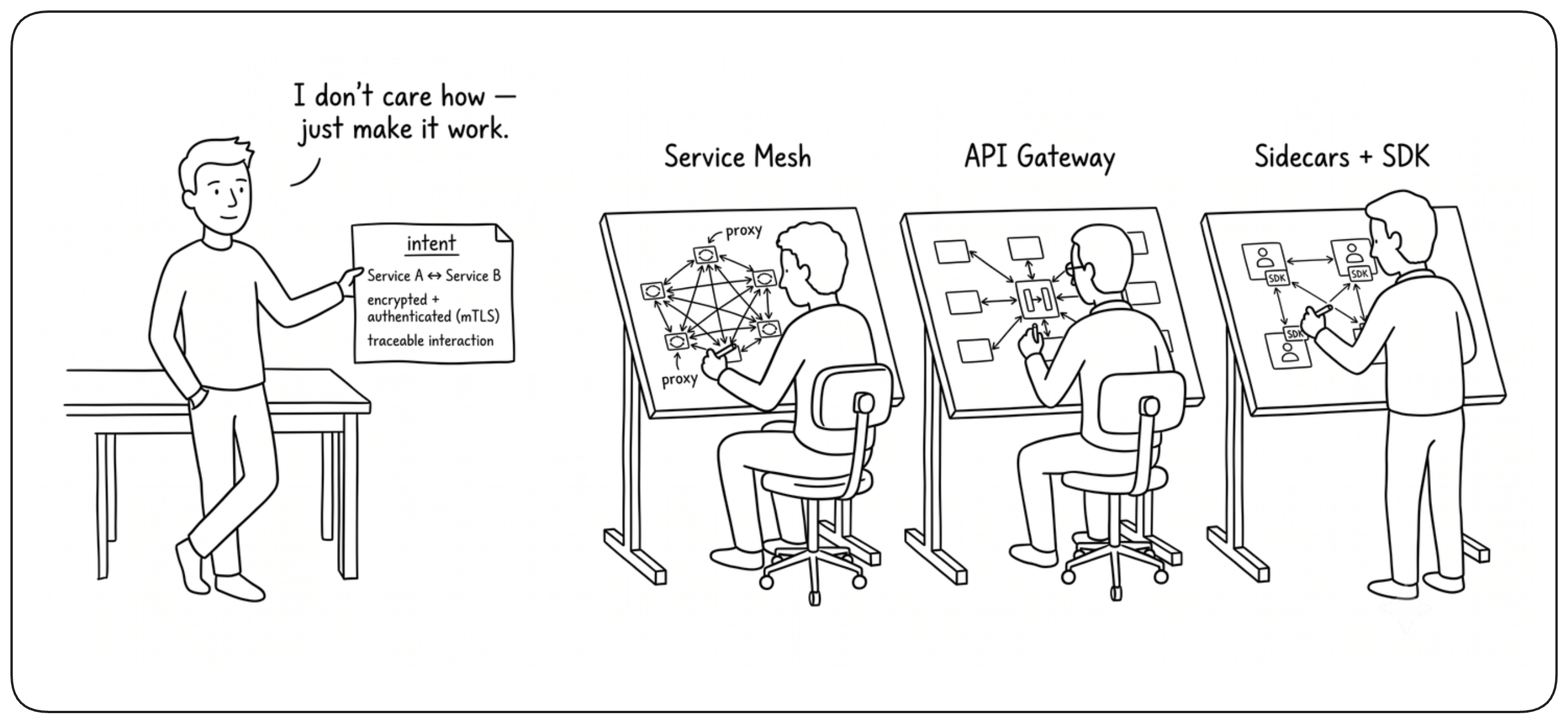
An abstraction defines the intent, not the mechanism. For example, the service model may say that Service A is allowed to communicate with Service B, the security model that traffic must be encrypted and authenticated using mTLS, and the observability model that the interaction must be traceable — without deciding how those guarantees are implemented. One platform may materialize this with a service mesh. Another may go through API gateways. A third may rely on sidecars and platform SDKs. The contract stays stable; the implementation stays free to fit the platform's context — its scale, its culture, its strategy, and how it expects to evolve.
A Landscape Every Service Inherits [Shared Landscape]
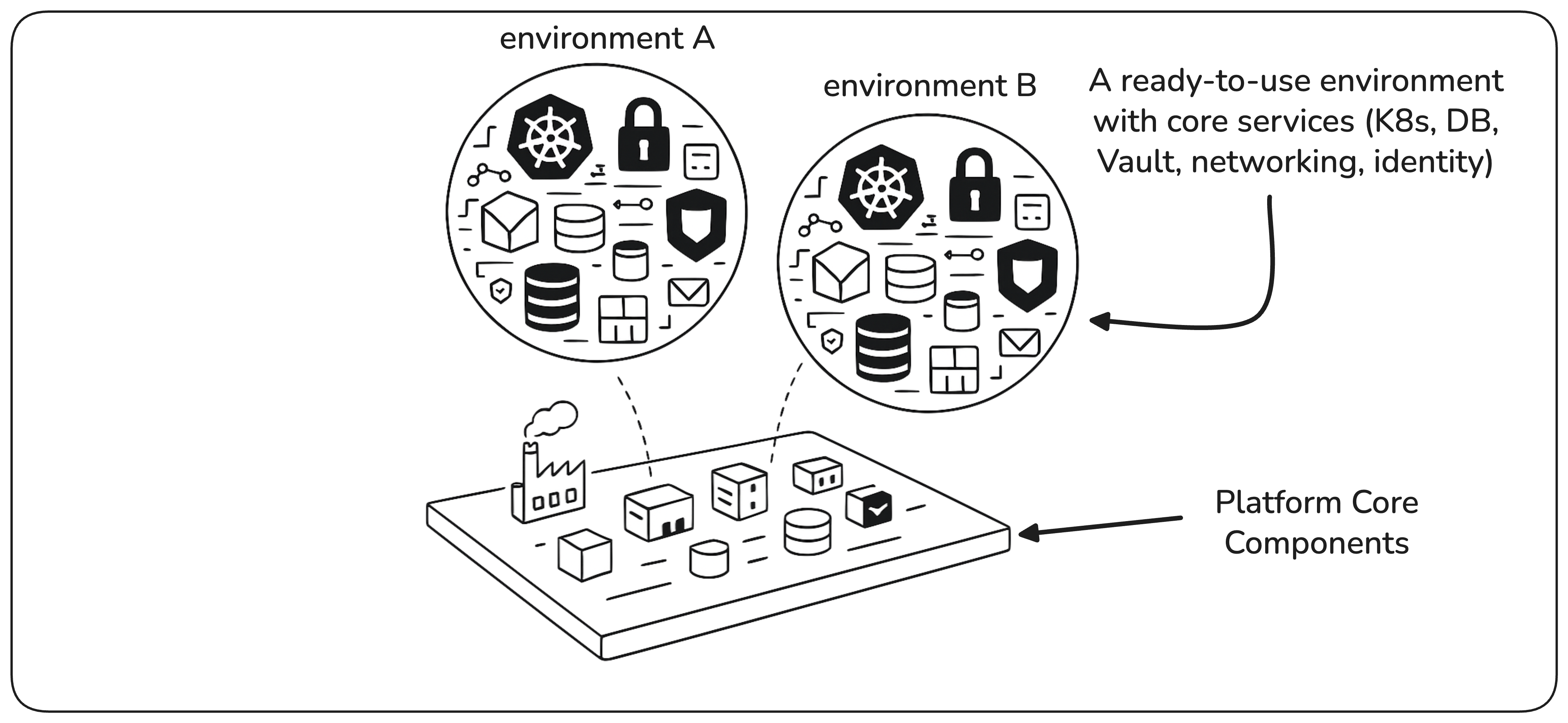
Materializing an abstraction is not a mechanical step — it is a series of structural decisions. The compute substrate on which every service will run. The identity model, and where trust originates. The way networks are partitioned, and what crosses which boundary. The observability backbone. These choices are not made service by service — they are made once, by the platform team, and every service inherits them. This is what makes the architecture layer a place of authority, not just of execution: the platform team shapes the landscape in which everything else will live.
From Requirements to Constraints [Requirements to Constraints]
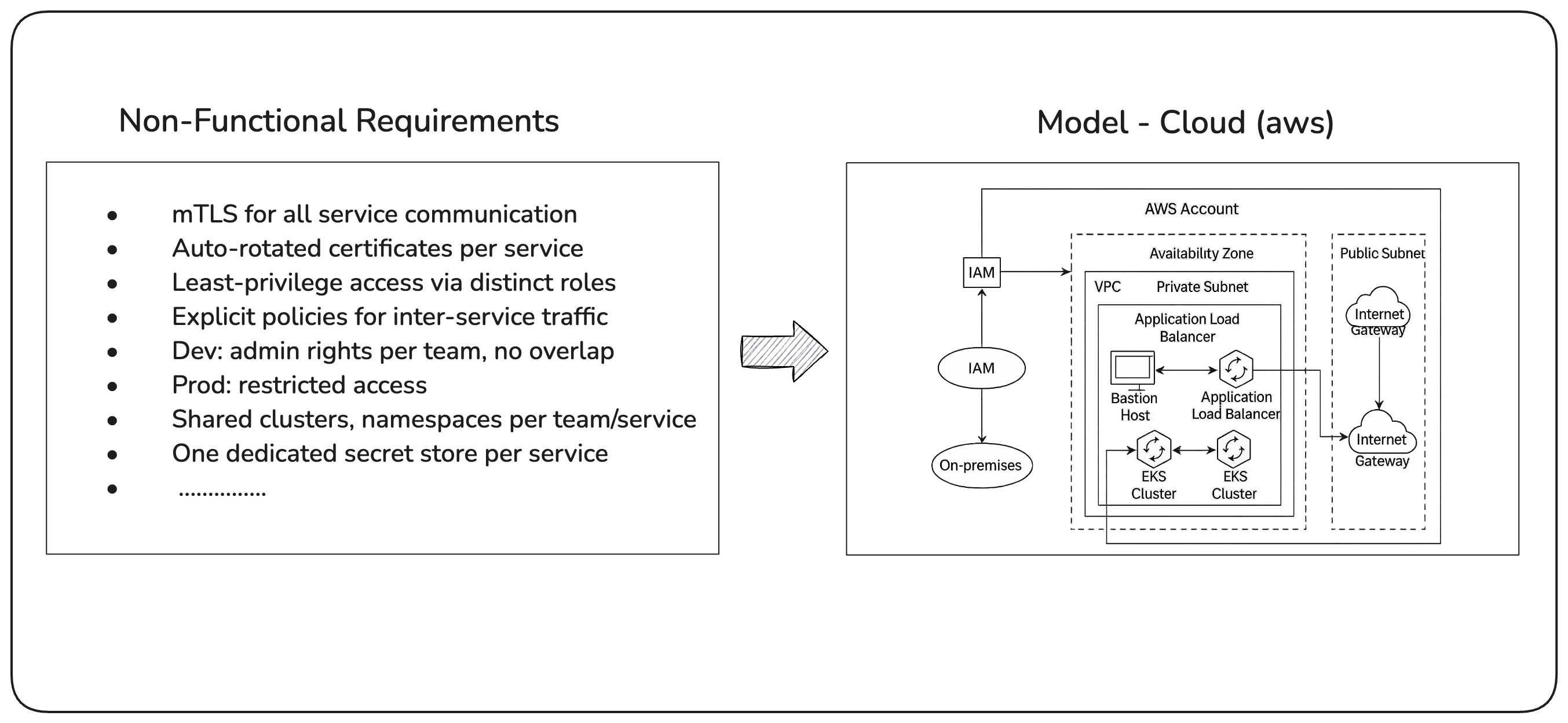
The abstraction layer makes non-functional requirements expressible — data classification, SLO, access boundary, retention policy. The architecture layer makes them effective. A customer-data tag becomes stricter access boundaries, dedicated keys, longer audit retention, and tenant isolation. A 99.9% availability SLO becomes multi-AZ deployment, health checks, and autoscaling policies. Requirements declared once in the model propagate as constraints across the entire architecture.
The Control Plane Reconciles the Model [Control Plane]
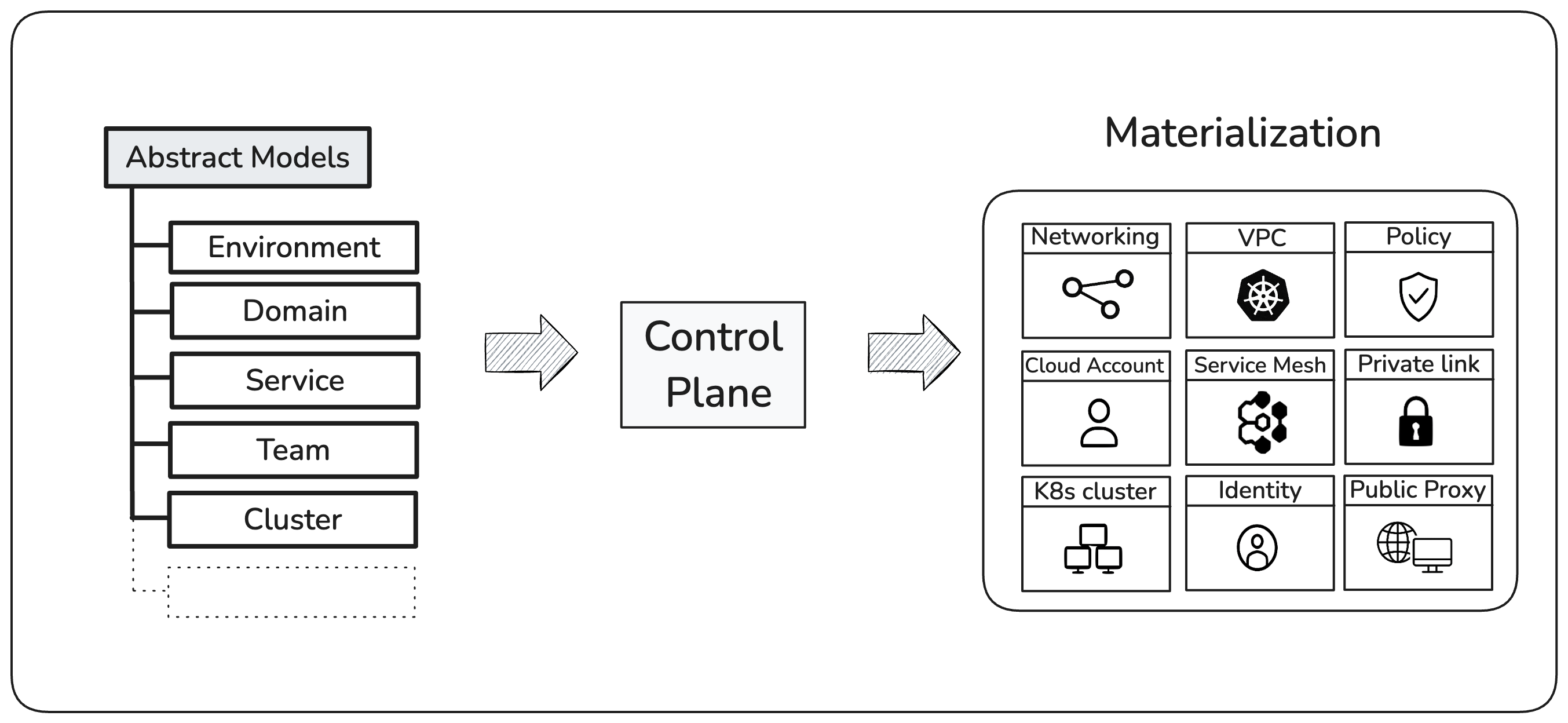
The control plane is the active mechanism that turns the model into reality. It reads declared intent, validates it against platform policies, calls the provisioning systems, applies the standards, observes the running state, and reconciles any drift. Whenever the model changes — a new service, a new dependency, a stricter policy — the control plane closes the gap. It is the piece that makes the platform continuous rather than a one-shot deployment.
Building Blocks and their Operational Ecosystem [Operational Ecosystem] {1}
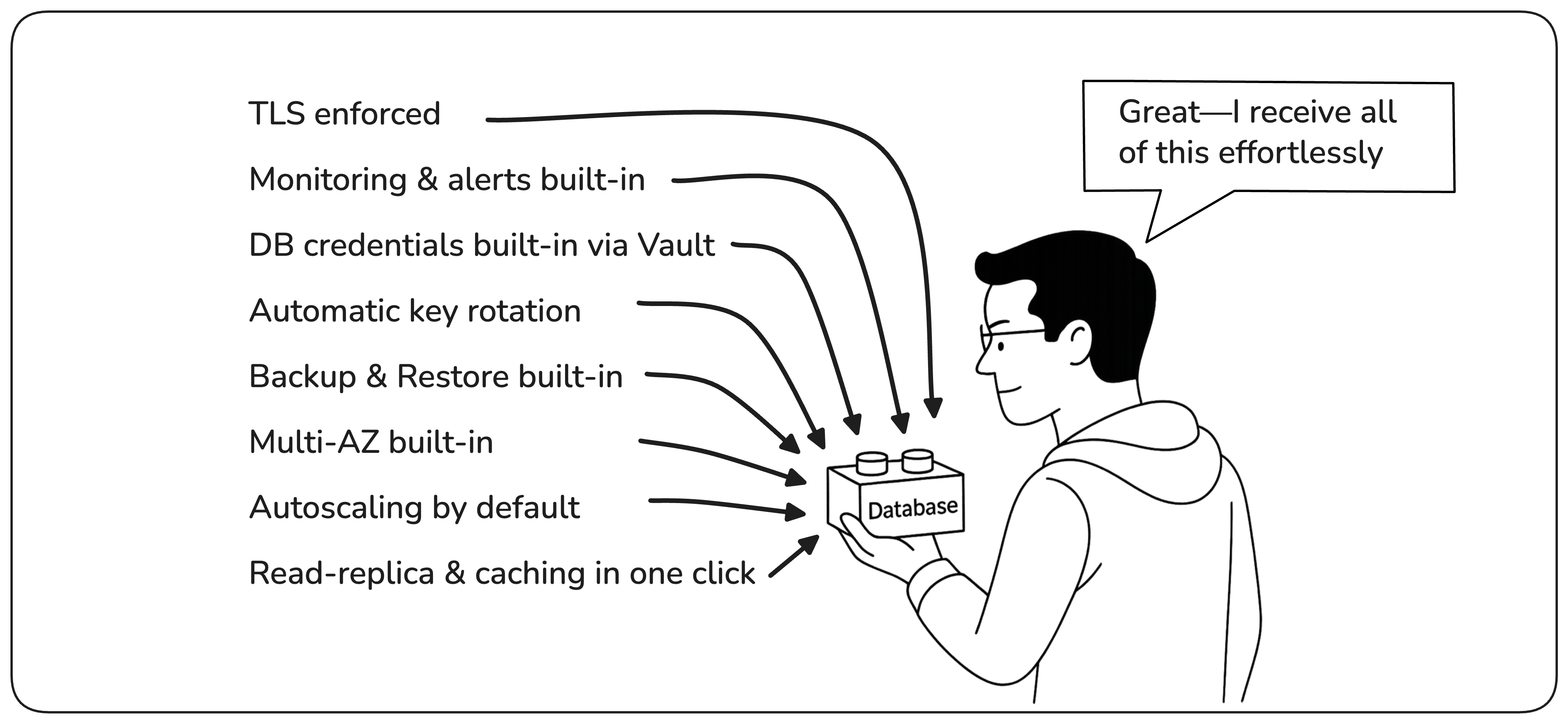
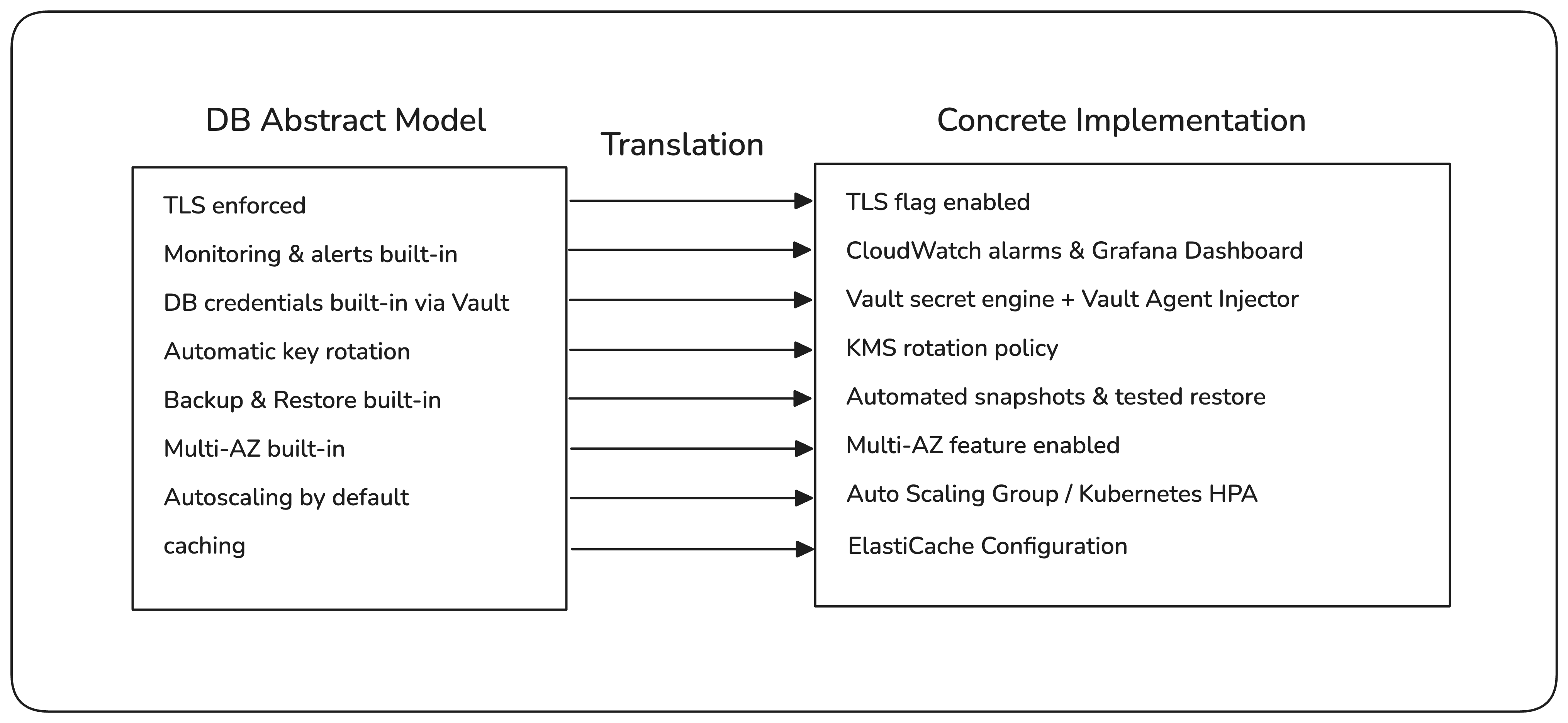
A building block is a complete system, engineered across every dimension that production demands — security, operations, resilience, compliance, observability. The platform delivers the block with all these dimensions built in, so that consuming it means inheriting production-grade behavior from the start. A database, for example, comes with TLS enforced by default, credentials injected via Vault, keys rotated, monitoring and alerts wired in, snapshots tested, multi-AZ deployment, and autoscaling configured. Requesting a database means receiving a production-grade system, not a bare primitive.
A Shared Building-Block Catalog [Shared Catalog]
No central team can build every block for every use case. The platform delivers paved paths for the most common needs — databases, caches, queues, buckets — and defines the patterns for contributing the rest. Teams with a less common need build their block following the platform's operational standards, and the block becomes reusable by others. The catalog grows through the organization, not in spite of it.
The Developer Experience [Developer Experience]
From Intent to Feedback [Intent to Feedback] {1}
Developer experience is the visible surface of the platform — the place where the abstraction layer, the architecture layer, and the control plane become usable in daily work. A good developer experience does not expose the full machinery of the organization; it gives developers a clear path from intent to feedback. !!The platform succeeds when developers no longer experience the organization's complexity directly — they experience intent, feedback, and flow.!!
Flow, Confidence, and Trust [Developer Trust] {1}
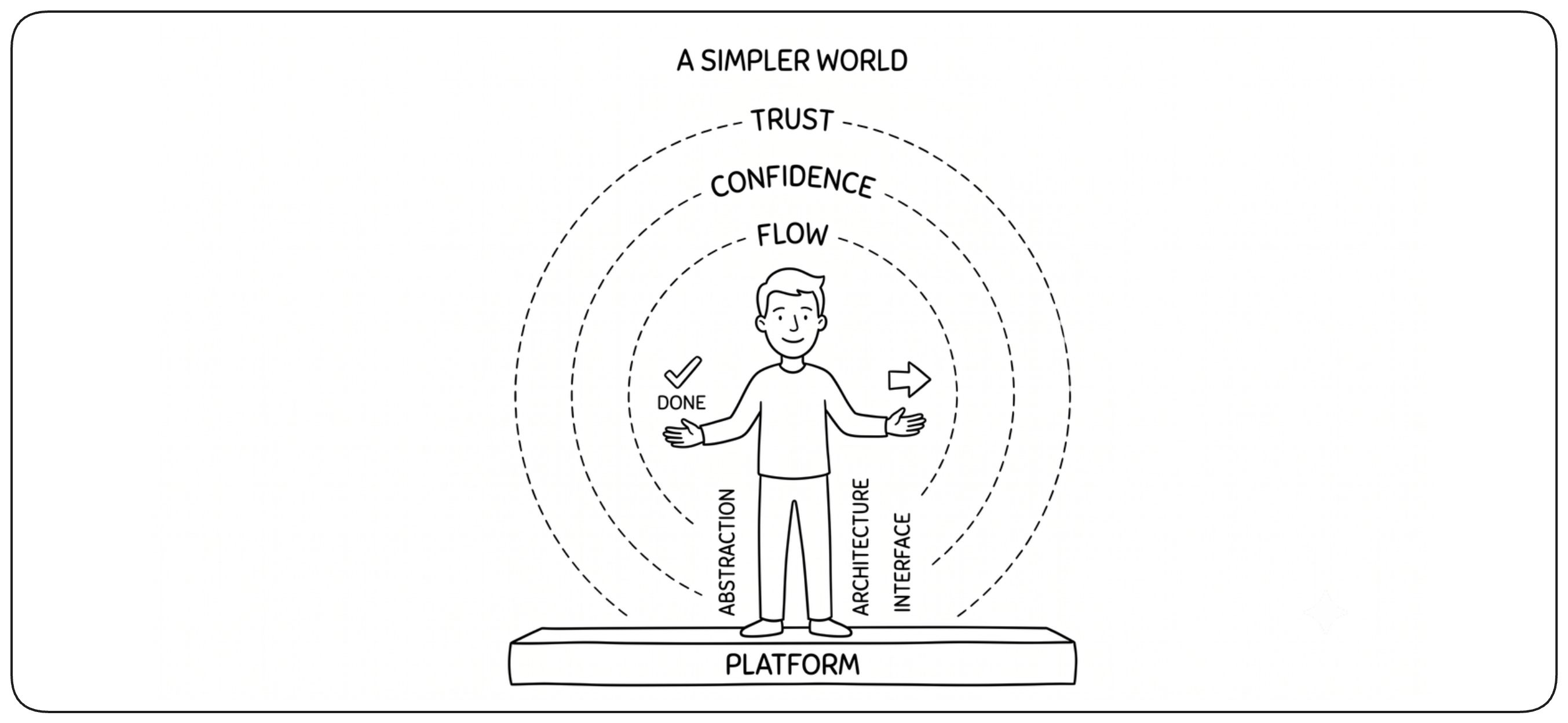
Developer experience is not measured by decoration, slogans, or the number of tools exposed. It is measured by flow, confidence, and trust. Developers are in flow when common actions are obvious, fast, and reversible. They gain confidence when feedback is clear, state is visible, and errors explain what to do next. They trust the platform when it helps them move quickly without forcing them to bypass standards. !!Developer experience is the expression of the platform's design — the abstraction layer defines what developers can express, the architecture layer makes it real, and the interface layer turns it into daily practice. When all three work together, the developer experiences a simpler world.!!
Self-Service as the Default Path [Self-Service Default]
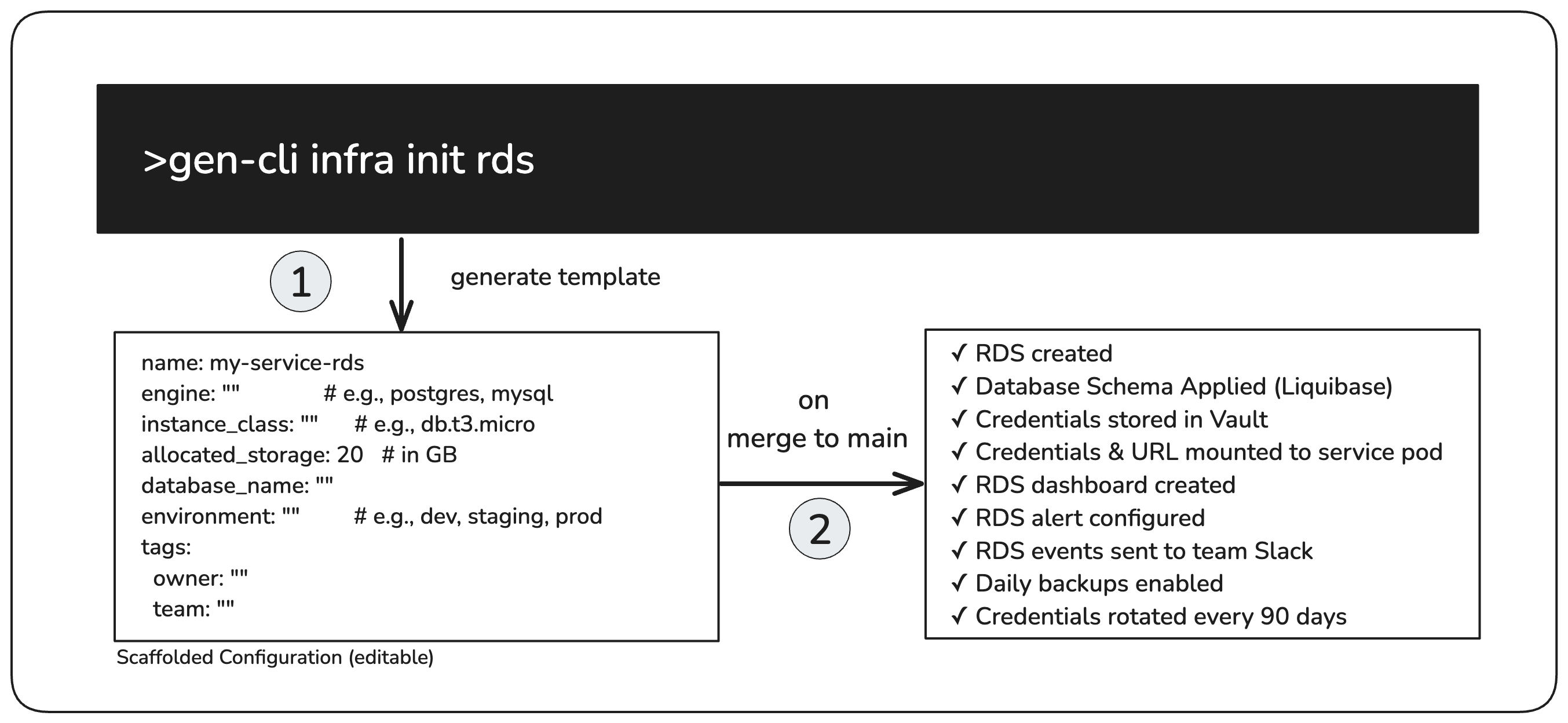
Self-service is the core experience of a developer-centric platform. A developer should be able to say "I need a database", "I need a queue", "I need to deploy this service", and start a governed workflow — without opening a ticket or learning every system underneath. The platform then translates that request into everything required behind the scenes: provisioning, identity, network access, encryption, backups, monitoring, cost controls. !!Self-service does not mean unrestricted freedom; it means freedom inside a well-designed path.!!
One Platform, Many Interfaces [Many Interfaces]
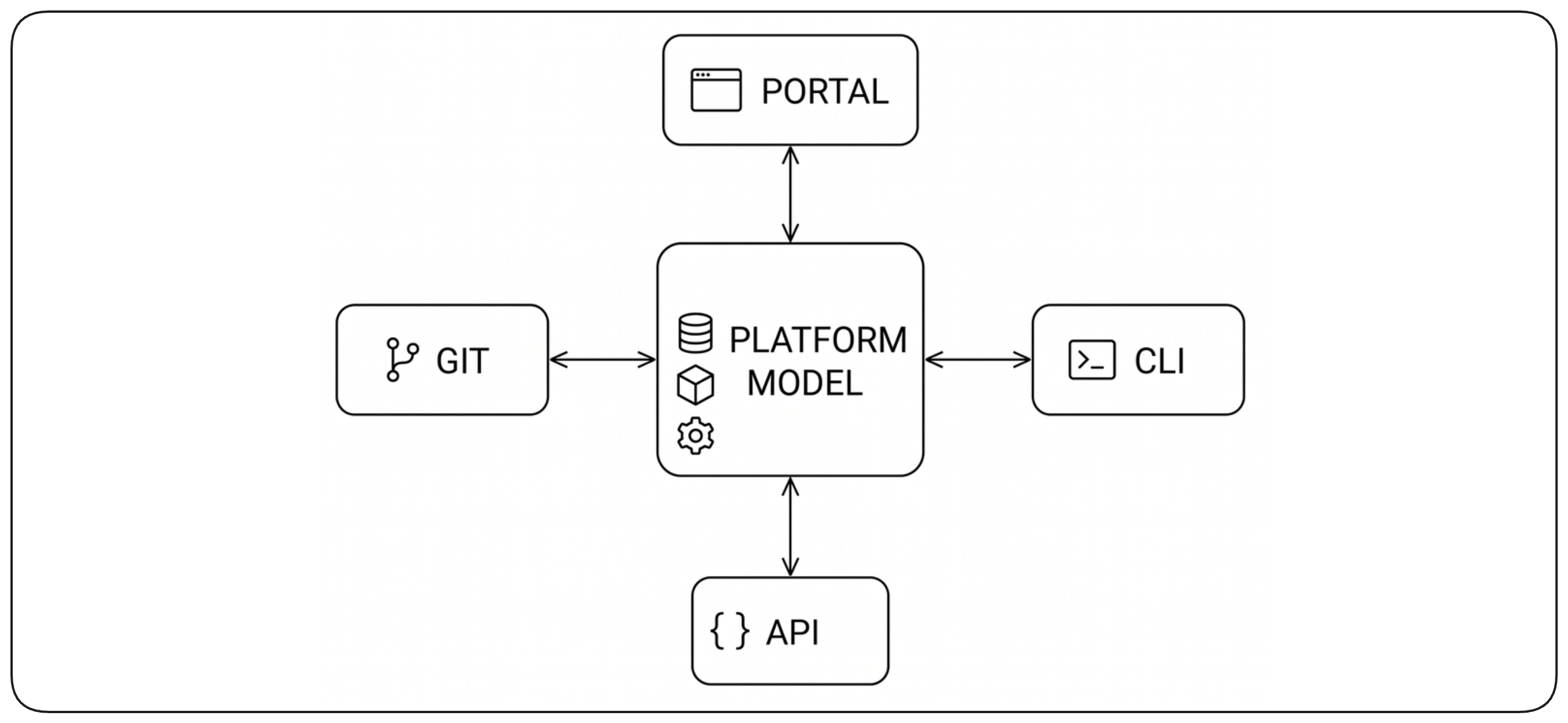
Developers interact with platforms in different ways: some prefer a portal, some live in the terminal, some want APIs, some workflows belong in Git. A strong platform does not force every interaction into one surface — it exposes the same model through several, and lets the developer pick.
Consistency Across Surfaces [Surface Consistency]
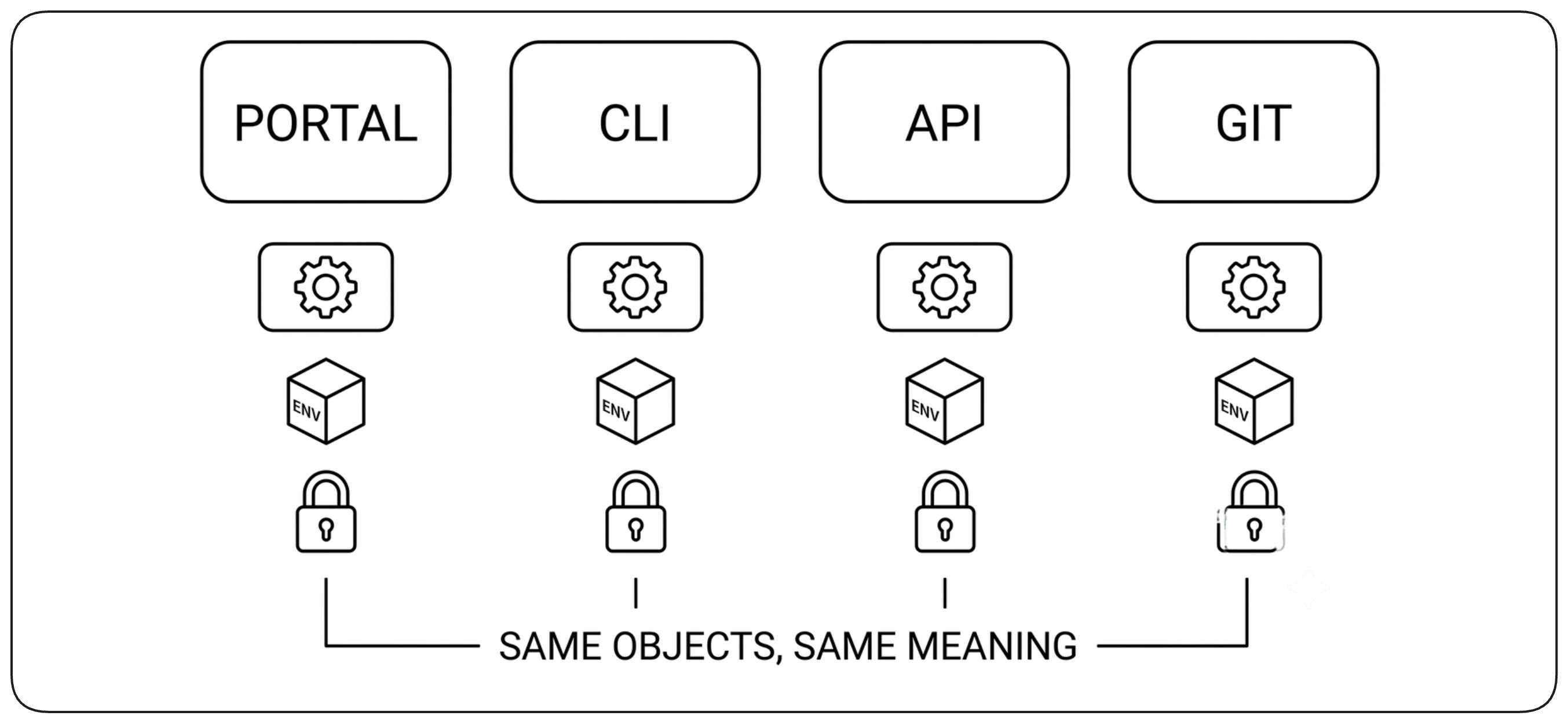
The important point is consistency. The portal, CLI, APIs, and Git flows should all speak the same language, expose the same objects, enforce the same permissions, and reflect the same state. A service means the same thing everywhere. An environment means the same thing everywhere. A deployment, dependency, secret, or policy does not change meaning depending on the tool used to access it.
The Internal Developer Portal [Developer Portal]
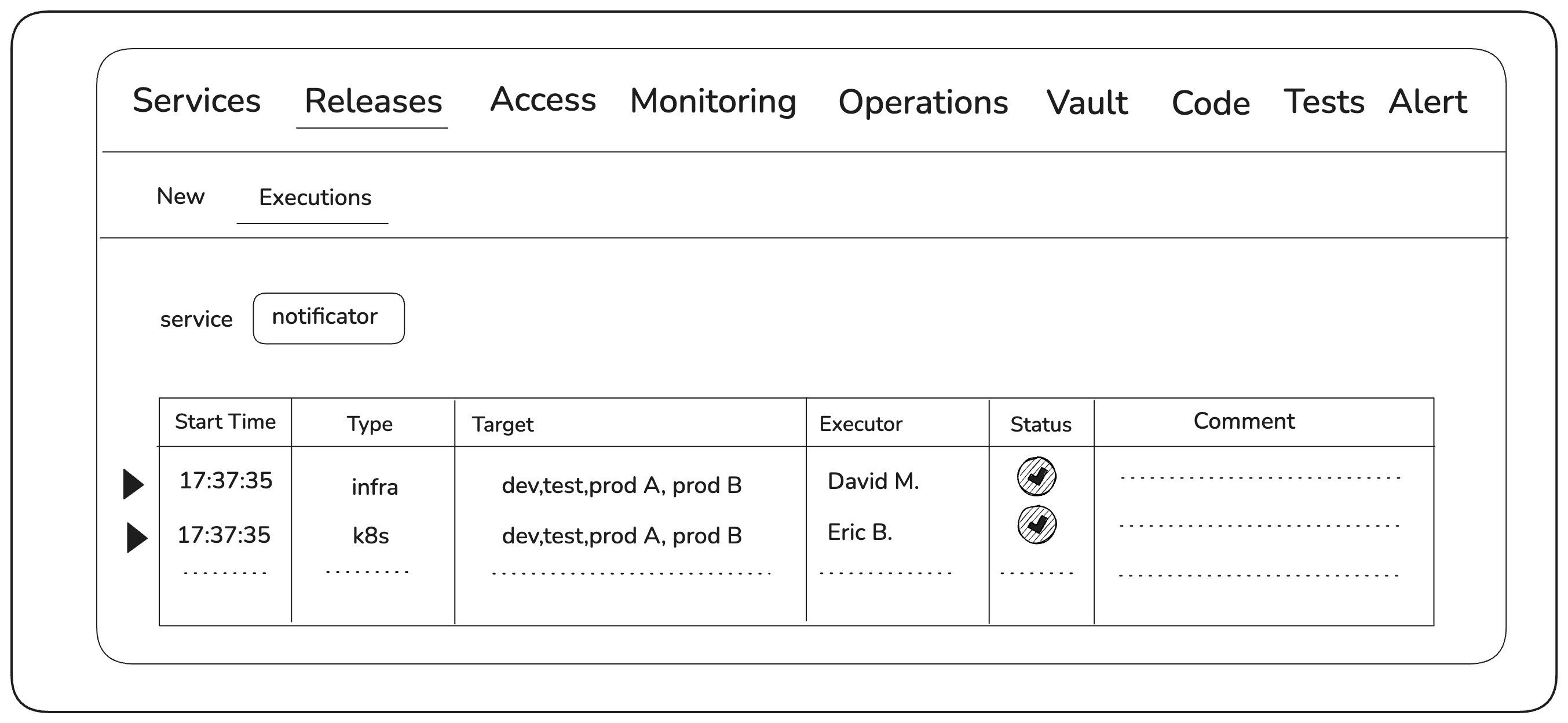
The internal developer portal is where developers discover and understand the platform: services, ownership, dependencies, environments, documentation, operational status, and available actions. It is not a page of links — it is the visible face of the platform's model, so a developer always knows where to look and what is possible.
The Unified CLI [Unified CLI]
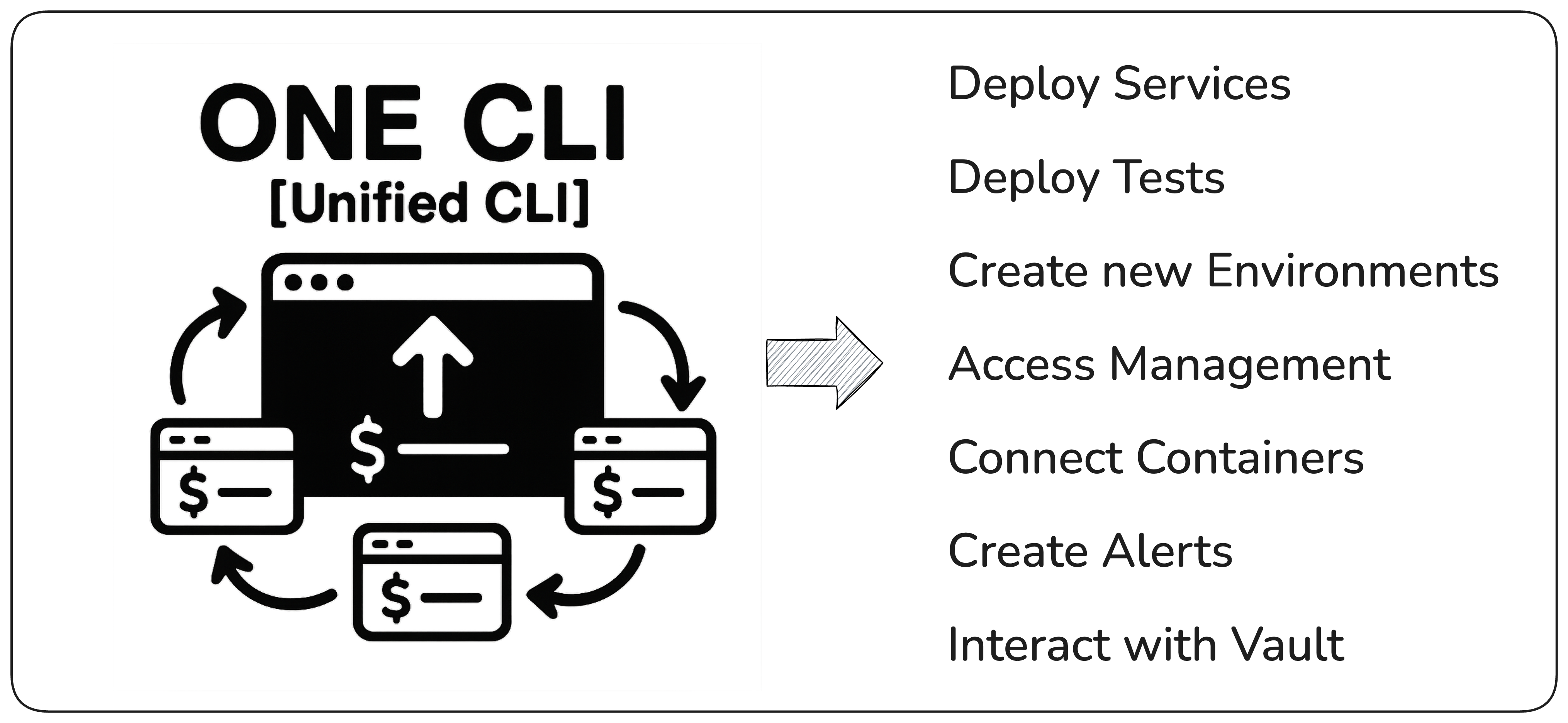
The CLI is the fast path for daily work: creating, deploying, inspecting, debugging, automating. It exposes the same capabilities as the portal, but in a form that scripts, integrates into pipelines, and becomes muscle memory. Portal and CLI are two views on the same model — a developer moves between them without changing mental gears.
Preserving Developer Flow [Developer Flow]
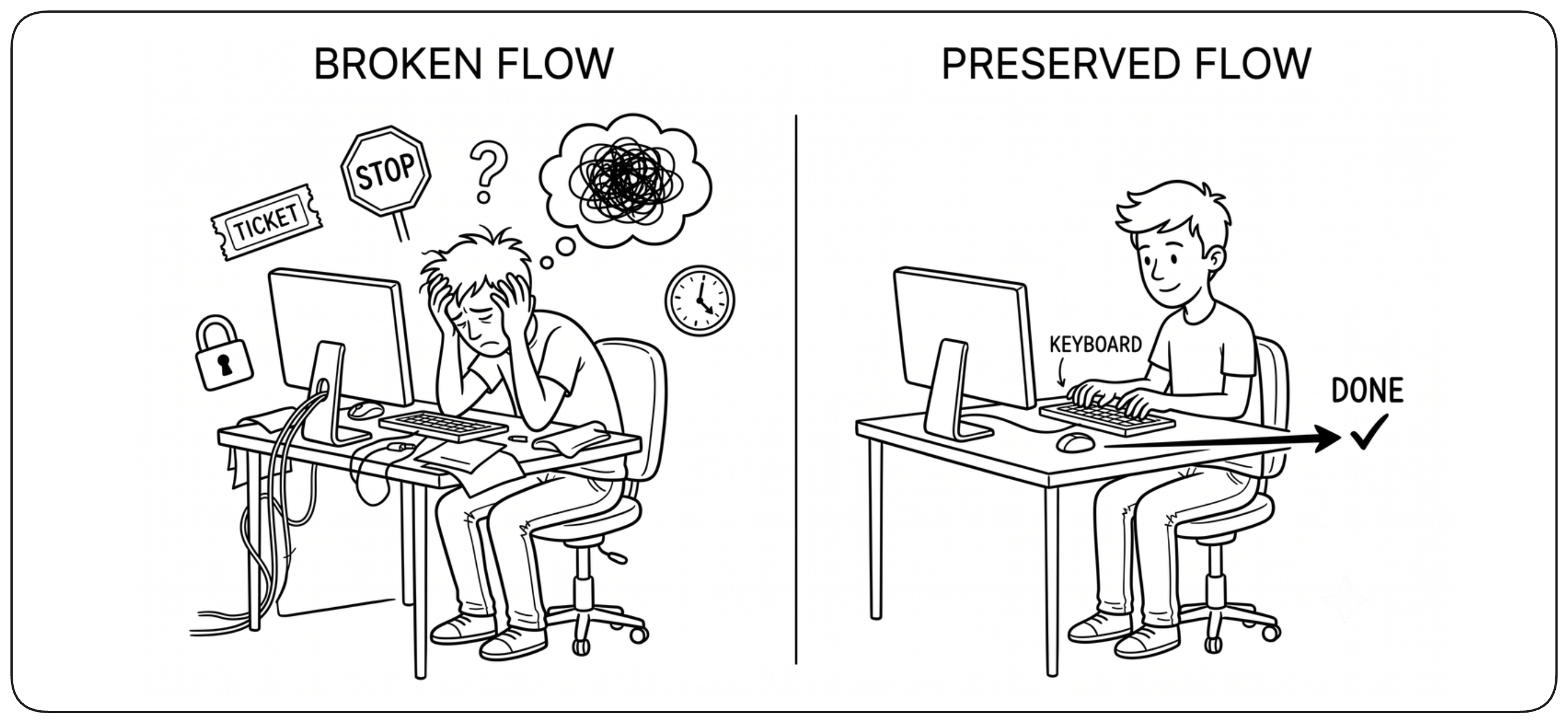
The greatest enemy of developer productivity is interruption. Every ticket, unclear process, missing permission, slow deployment, unknown dashboard, or undocumented dependency breaks flow — and the cost is larger than the time spent waiting, because the developer also loses context, confidence, and momentum. A platform should therefore make common actions obvious, fast, and reversible, with clear errors and visible state. !!A platform that preserves flow lets teams move faster without bypassing standards, because the supported path is also the easiest path.!!
Shortening the Feedback Loop [Feedback Loop]
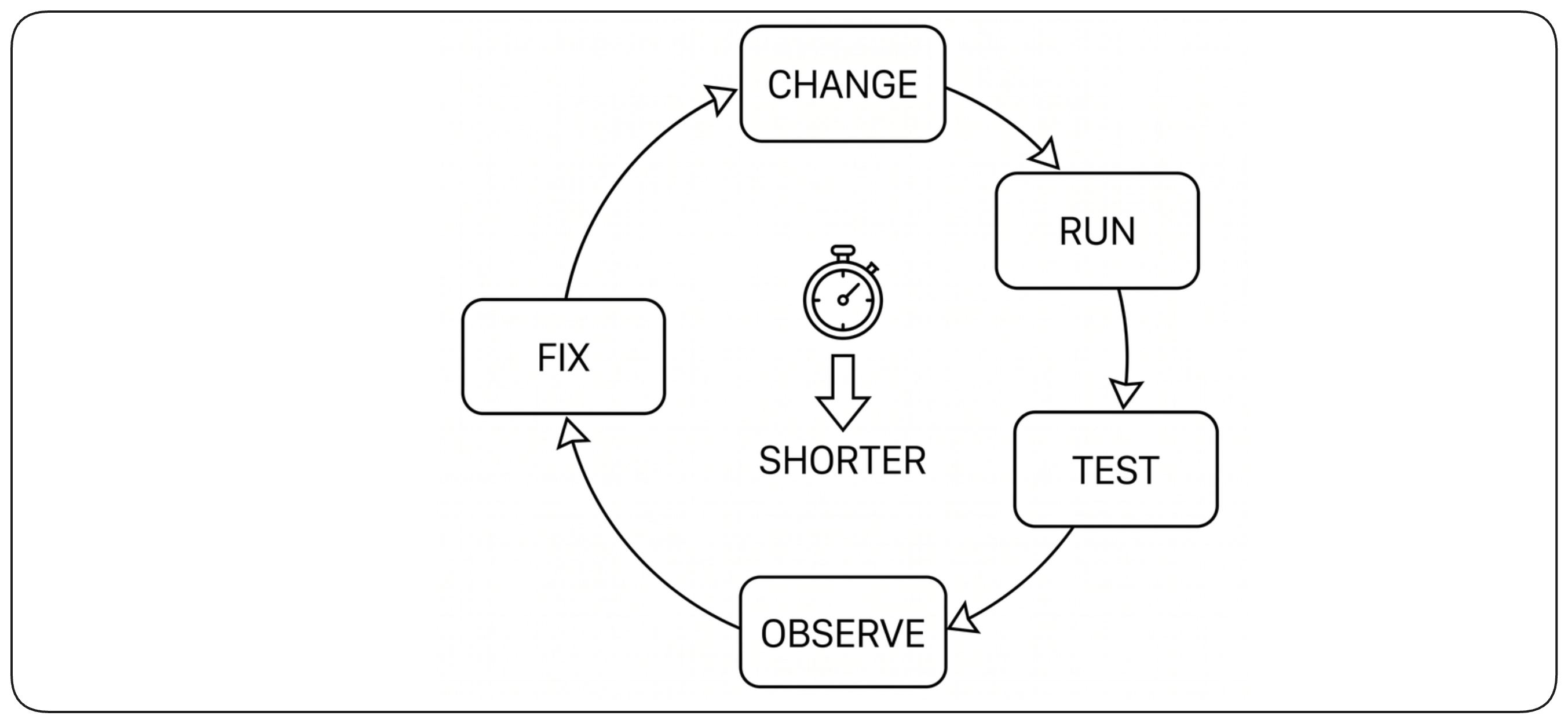
The daily rhythm of development is a loop: !!change → run → test → observe → fix!!. The shorter this loop, the faster developers learn — and the more courage they have to try things. A platform improves developer experience by reducing the time between a change and trustworthy feedback, at every step of that cycle.
Local Development [Local Development]
Local development is the first level of the loop. Docker Compose files, service mocks, or lightweight local clusters let a developer run their service on the laptop, with realistic dependencies, in complete isolation. It is the fastest, cheapest feedback available — no shared environment to wait for, no queue to fight.
Cloud Inner Loop [Inner Loop]
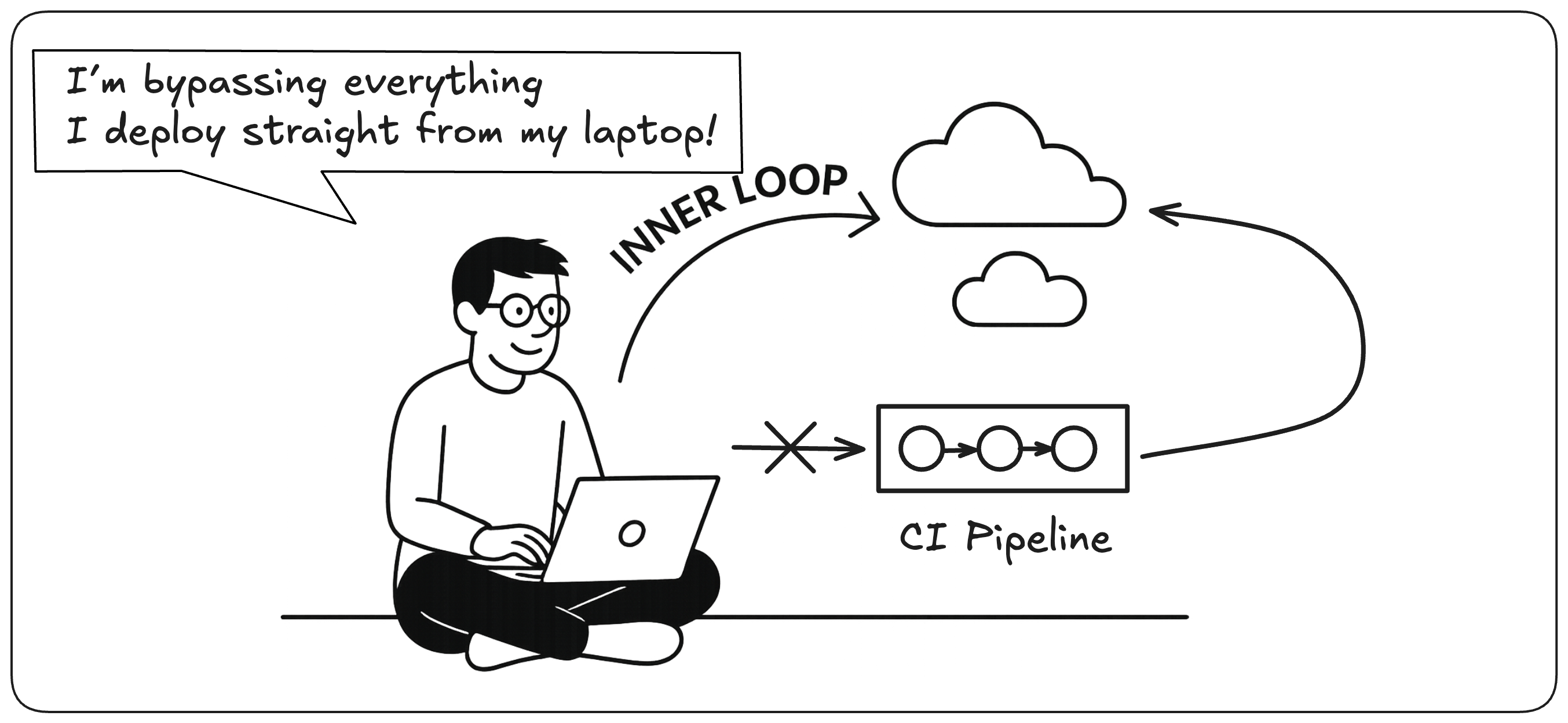
Local has limits. In distributed systems, many behaviors only appear when the service runs inside the real platform: identity, routing, network policies, service-to-service communication, observability. A fast cloud inner loop lets developers push a change into a dev environment quickly and iterate there — not to bypass quality controls for production, but to create a fast learning path before it.
Feature Branch Deployment [Feature Branch]
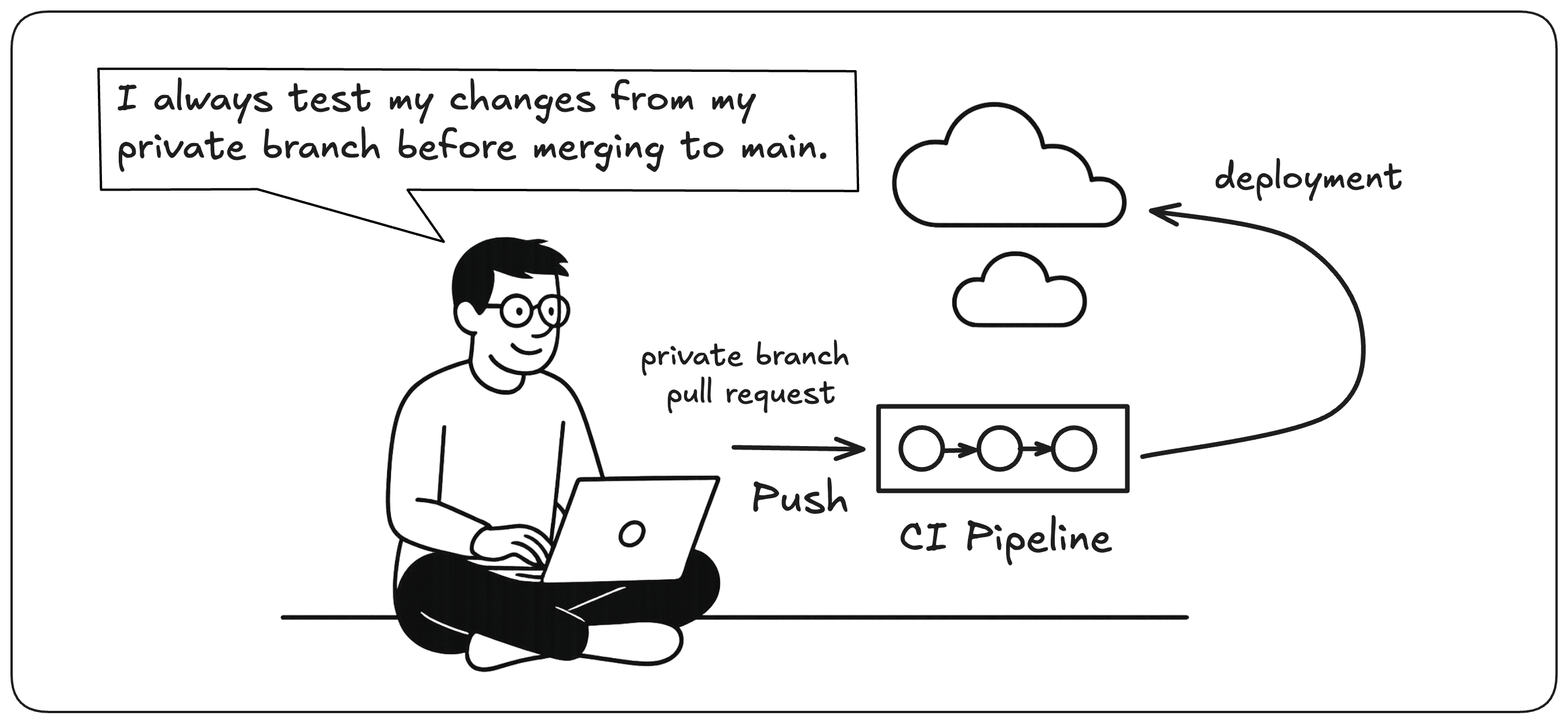
A feature branch should produce a temporary, isolated version of the service where changes can be reviewed, tested, and demonstrated before merge. This turns "review" into "try it": teammates click a real URL, exercise the behavior, and give feedback grounded in what the code does, not what the diff says.
Safe Experimentation [Safe Experimentation]
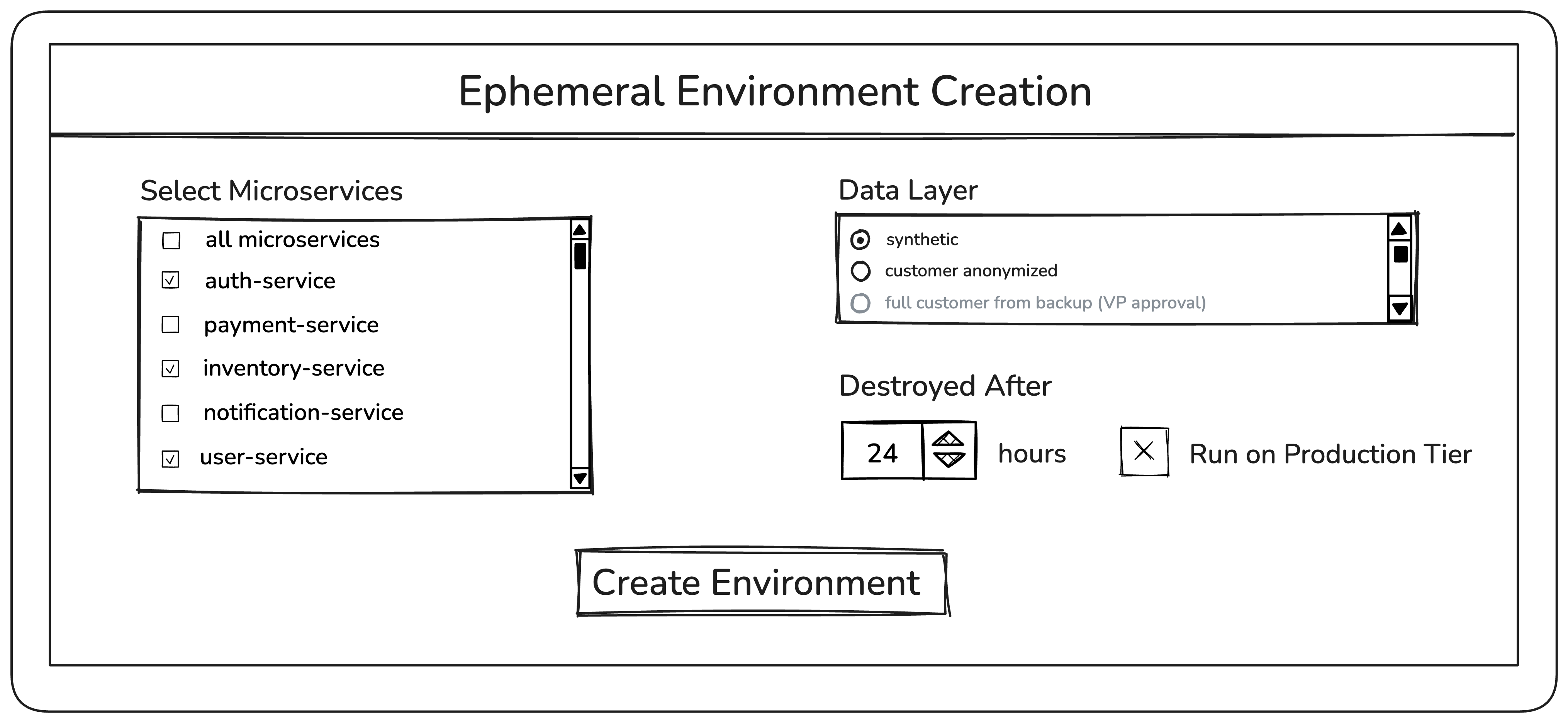
Developers also need room to experiment. Not every idea deserves a permanent environment or a long approval process — sometimes a team just needs to test a risky change, reproduce a bug, or explore a new dependency. Ephemeral environments give them a temporary, isolated space, created on demand and destroyed automatically when no longer needed. !!This is the same platform principle again — autonomy without chaos: freedom for the developer, control for the organization through lifecycle, isolation, quotas, and automatic cleanup.!!
AI-Augmented Developer Experience [AI-Augmented DevEx] {1}
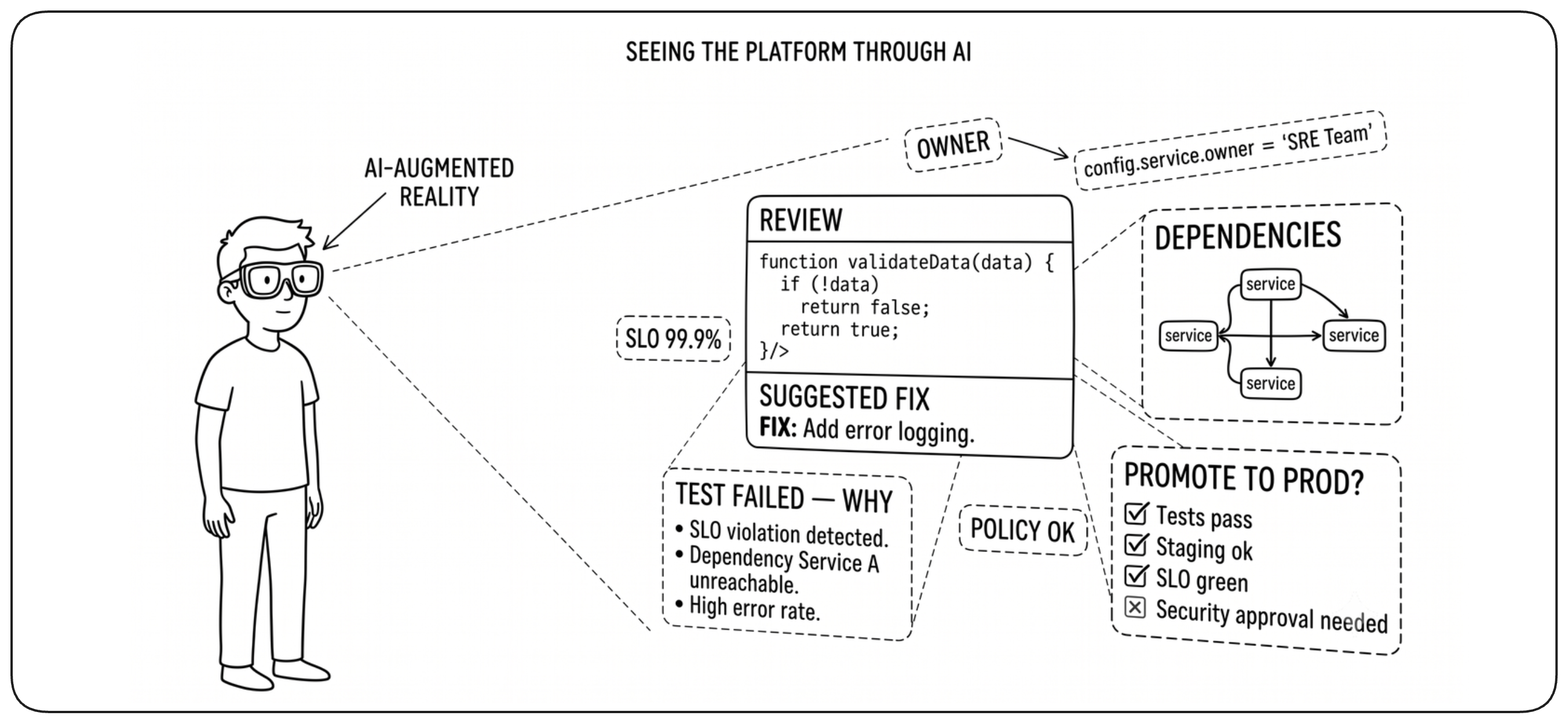
AI reshapes developer experience at every step. It does not replace the portal, the CLI, Git workflows, documentation, or human judgment — it makes each of them more contextual, faster, and easier to use. Developers still work through the platform, but AI shortens the distance between intent and action: asking, generating, reviewing, debugging, documenting, and navigating with guidance that fits the moment. !!This augmentation only reaches its full power when AI is embedded inside the platform itself, plugged into the shared model — services, owners, dependencies, deployments, policies, incidents, logs, tests, standards — and turning that real context into guidance, explanations, and safe actions exactly when the developer needs them.!!
AI as an Intent Assistant [AI Intent Assistant]
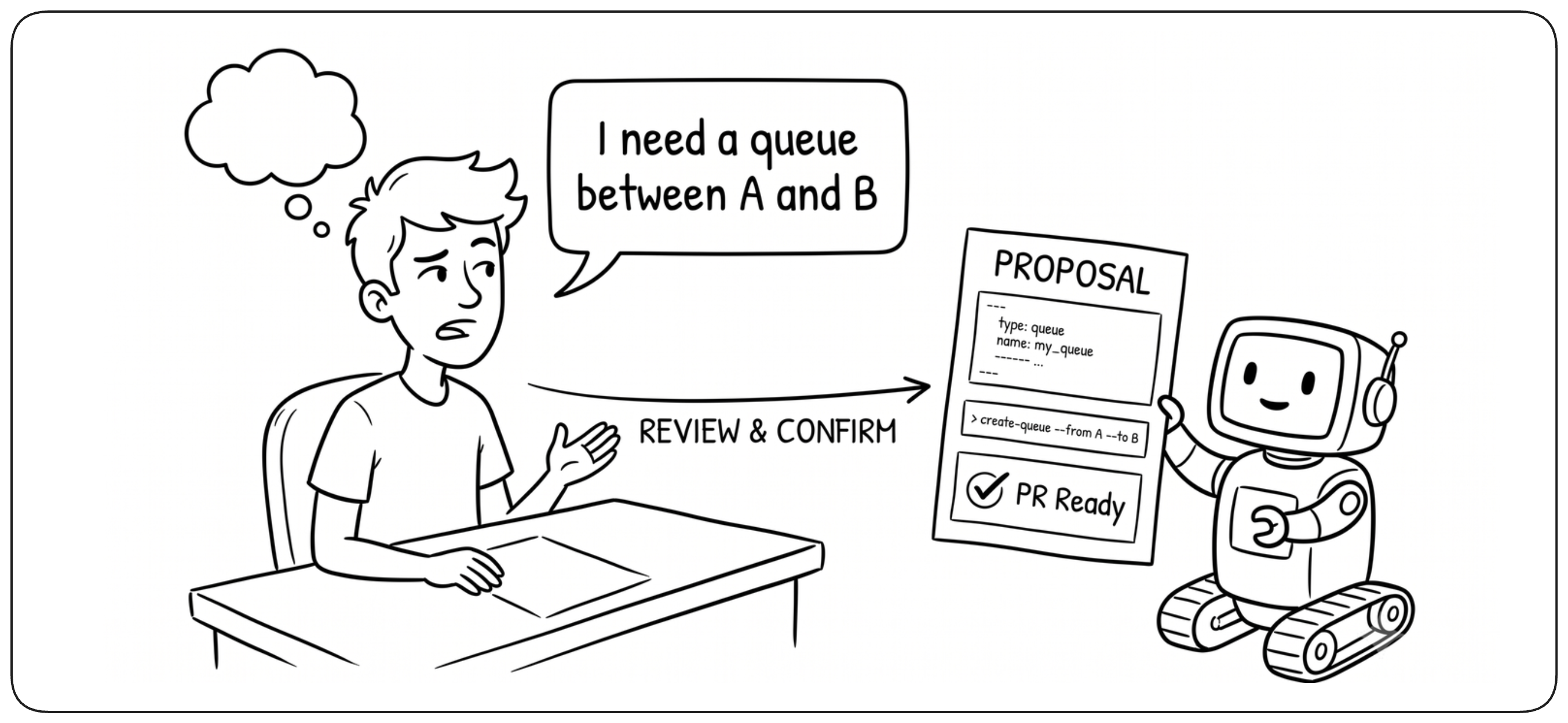
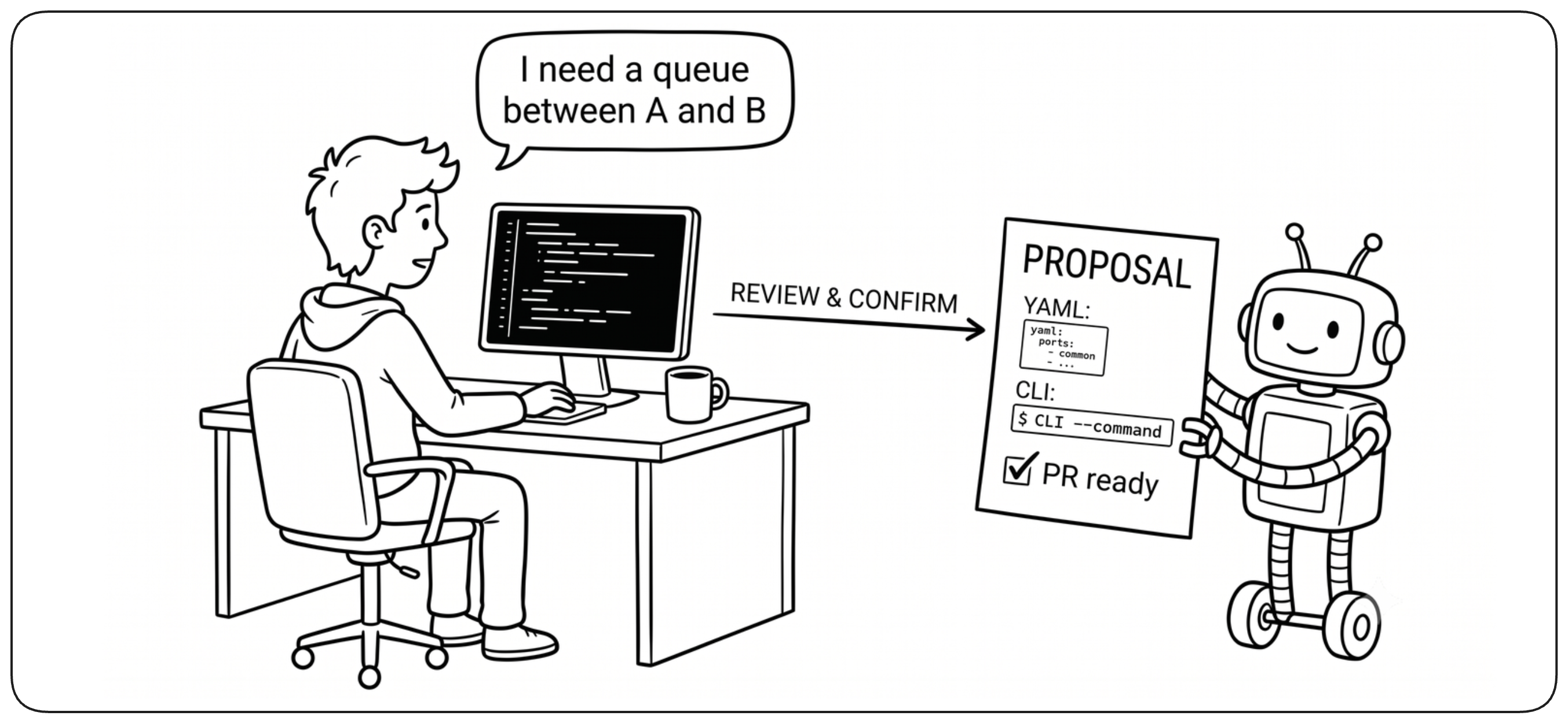
Self-service assumes the developer can express intent cleanly — the right resource, the right YAML, the right CLI command, the right PR. In practice, expressing intent is where many developers get stuck: they know what they want, not exactly how the platform expects it to be declared. AI closes that gap. The developer says "I need a queue between these two services", "expose this endpoint publicly", "add this dependency", and AI produces a proposal that already respects the platform's standards, naming, security posture, and approval flow. The developer reviews and confirms — the platform still owns the decision, but the friction of expressing intent disappears.
AI as a Code Reviewer [AI Code Reviewer]
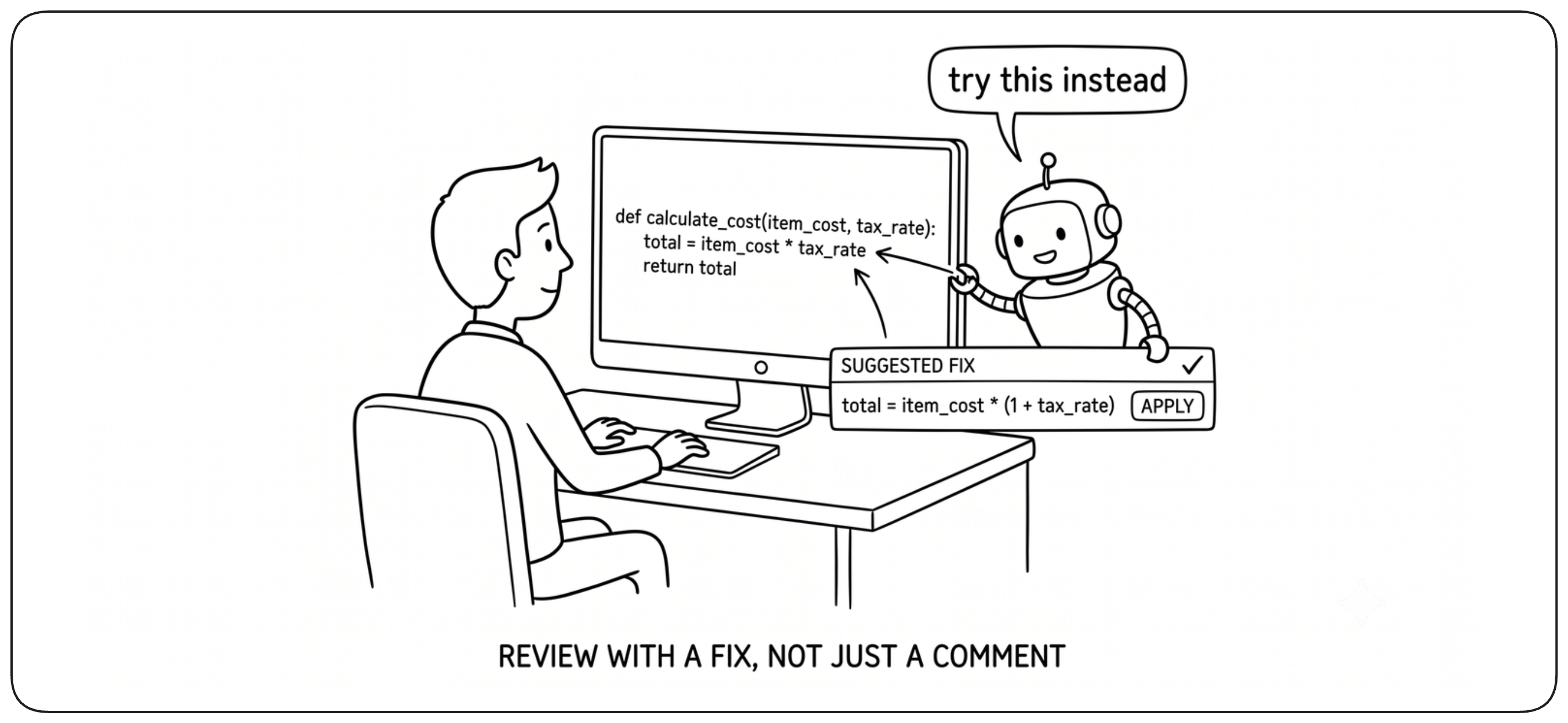
The earliest place AI can act is before the code ever runs. Sitting in the editor and the pull request, it reads the change against the platform's real context — coding standards, security policies, addon patterns, how similar code looks elsewhere in the fleet — and flags what looks wrong before CI complains. !!Every finding comes with a concrete fix — a diff the developer can accept, adjust, or reject in one click — so review becomes a conversation about intent, not a hunt for typos.!! Human reviewers keep what matters: design, trade-offs, judgment.
AI as a Troubleshooter [AI Troubleshooter]
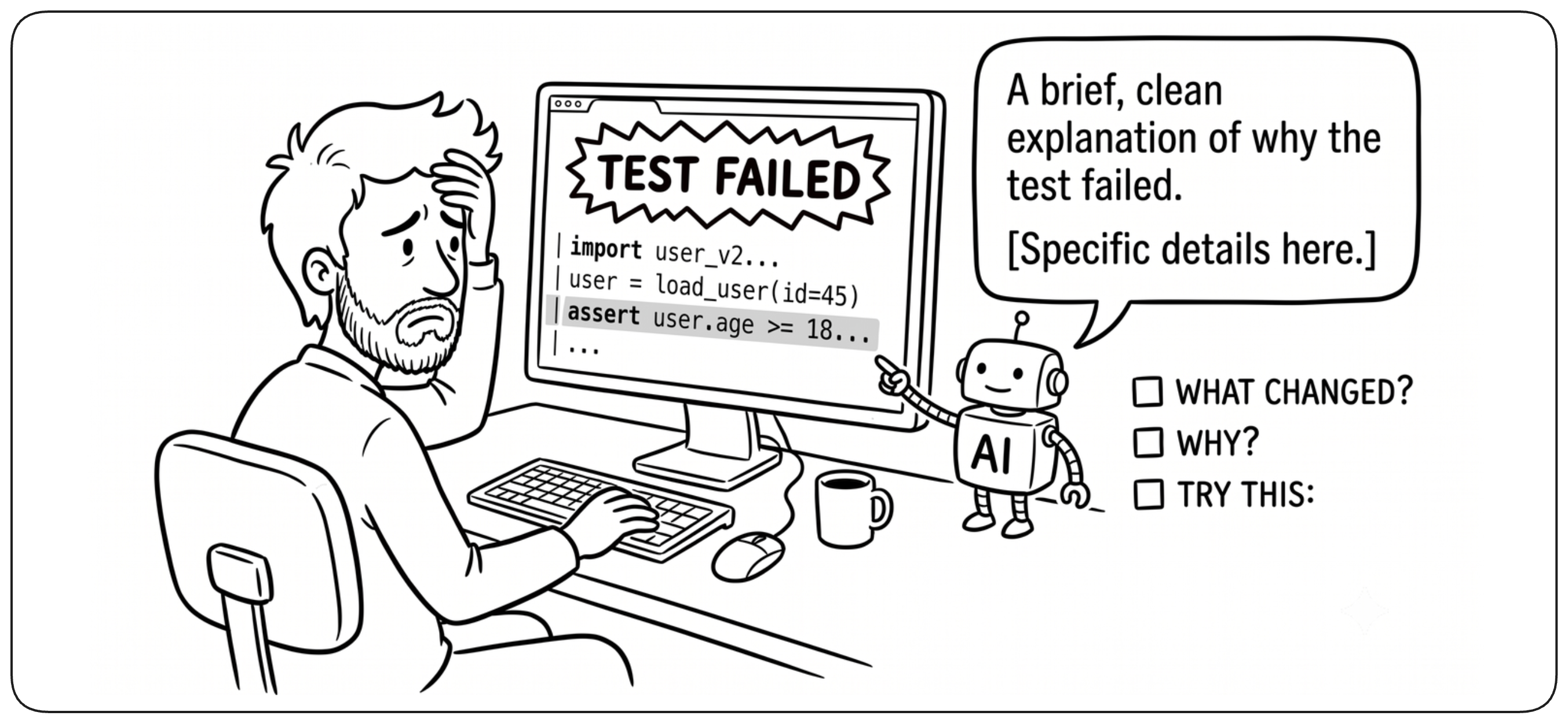
Another place AI pays off is failure. A broken deployment, a failing test, a red pipeline, or a noisy alert already contains the evidence for diagnosis — logs, diffs, traces, recent changes, ownership, previous incidents. The platform assembles that context, and AI turns it into a readable explanation: what failed, what changed, why, whether it happened before, what to try next. The developer stays in flow instead of chasing dashboards, tickets, and tribal knowledge.
AI as Living Documentation [AI Living Docs]
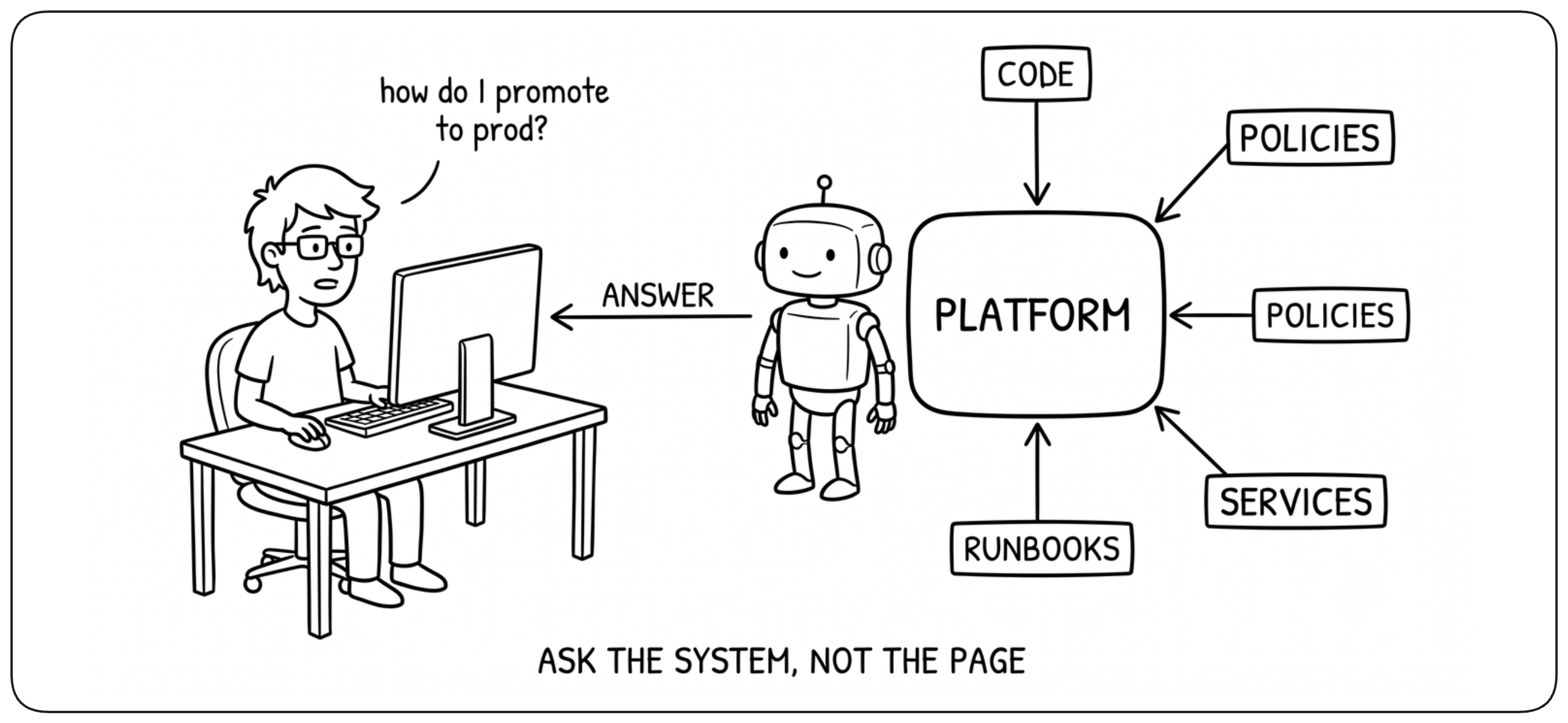
Documentation is always one step behind the code. The platform evolves — new policies, new addons, new promotion rules — and the pages drift from the moment they are written. Written docs still matter, but they should no longer be the only source. The real behavior also lives in the executed policies, the wired pipelines, and the services as they are declared. !!AI reads both sides — the written guides and the running system — so the answer stays grounded in what actually happens today, not in a page someone forgot to update.!! Living Documentation answers how do I do this here — start a new service, move from dev to prod, pick the right addon, expose an endpoint — anchored in the current state of the platform.
AI as a Consistency Guardian [AI Consistency Guardian]
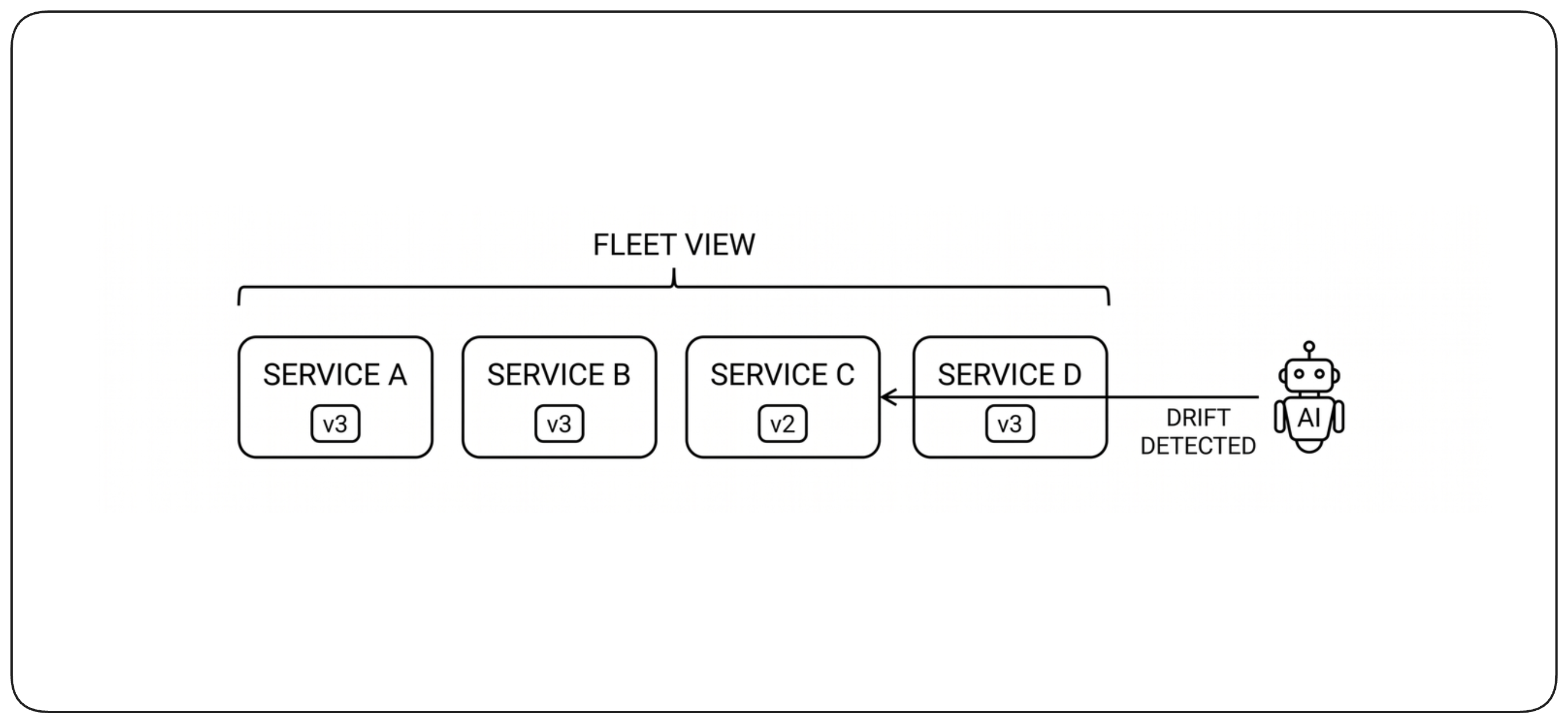
Across many services, small deviations accumulate quietly: an old base image, a skipped security patch, a stale runtime, a non-standard deployment setting, a dependency outside the approved pattern. Each drift looks local and harmless to the team owning it — and obvious to a platform that sees the whole fleet. AI turns that fleet-wide view into local guidance: where the service differs from the standard, why it matters, and how to bring it back onto the supported path before drift becomes an incident.
AI as a Platform Navigator [AI Platform Navigator]
Where Living Documentation answers how do I do this here, the Platform Navigator answers how is this system connected. Modern systems are too large to hold in one head — dependencies, owners, environments, incidents, related PRs, downstream consumers. The platform is where those relationships already meet, and AI makes that graph navigable. A developer can ask what breaks if an endpoint changes, who owns a dependency, which services consume an event, whether a failure happened before. !!AI on top of a good platform gives every developer a senior engineer's peripheral vision — not by inventing answers, but by navigating the real platform graph.!!
Best Practices for Platform Development [Best Practices]
Treat Your Platform as a Product [Platform as a Product] {1}
Successful platforms are built like products, not projects — developers are the customers, and their needs, feedback, and satisfaction drive the roadmap. That means public roadmaps, clear versioning, real support channels, and documentation people actually read. !!When a platform is chosen rather than mandated, it has become a product.!!
Treat Your Platform as a Tier 1 Service [Tier 1 Service]
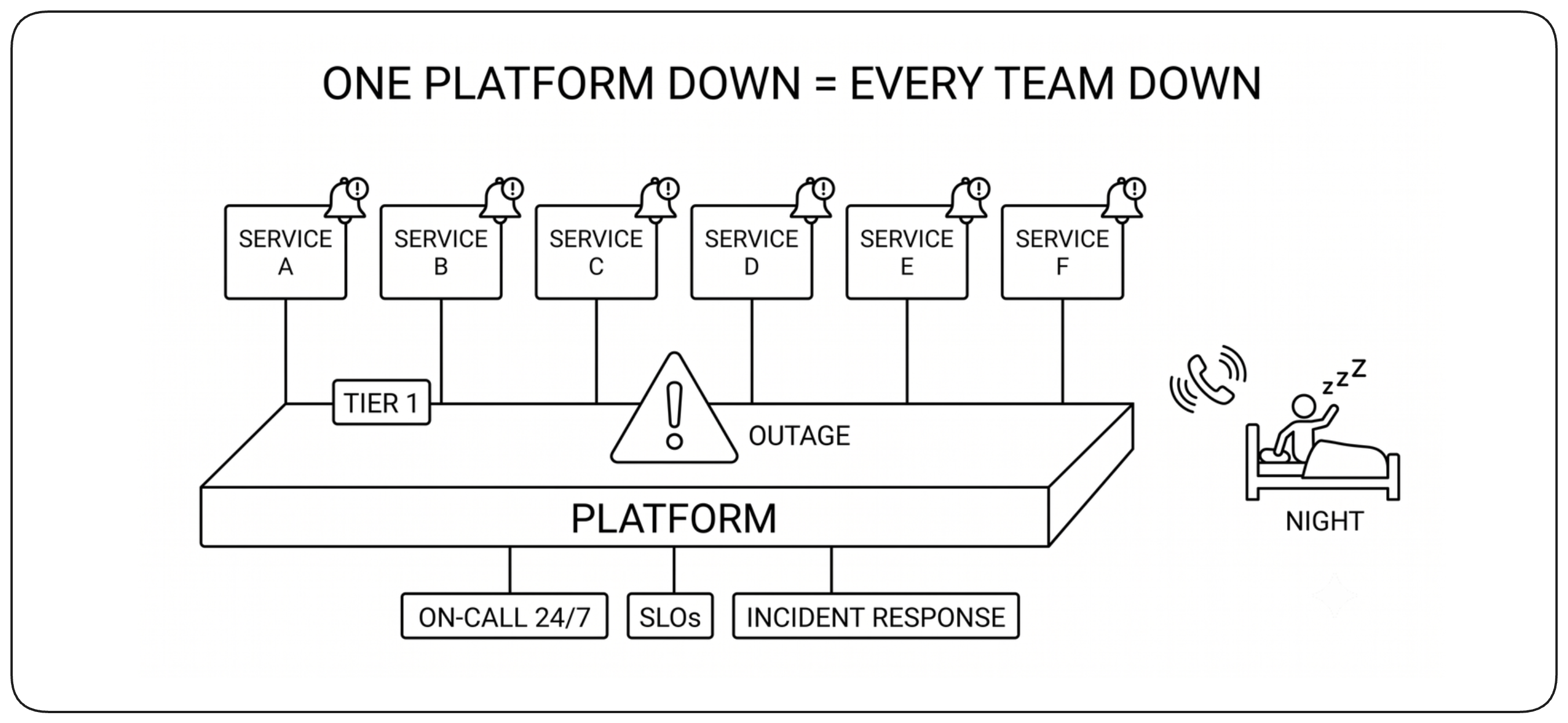
When the platform breaks, every team is blocked — deployments freeze, builds fail, developers cannot ship. That is the definition of a Tier 1 service, and the platform must be operated as one: real on-call, real SLOs, real incident response, real postmortems, real error budgets. !!A platform used by everyone must be operated as if it were the most critical product in the company — because it is.!!
Kubernetes as a Natural Control Plane for the Platform [Kubernetes]
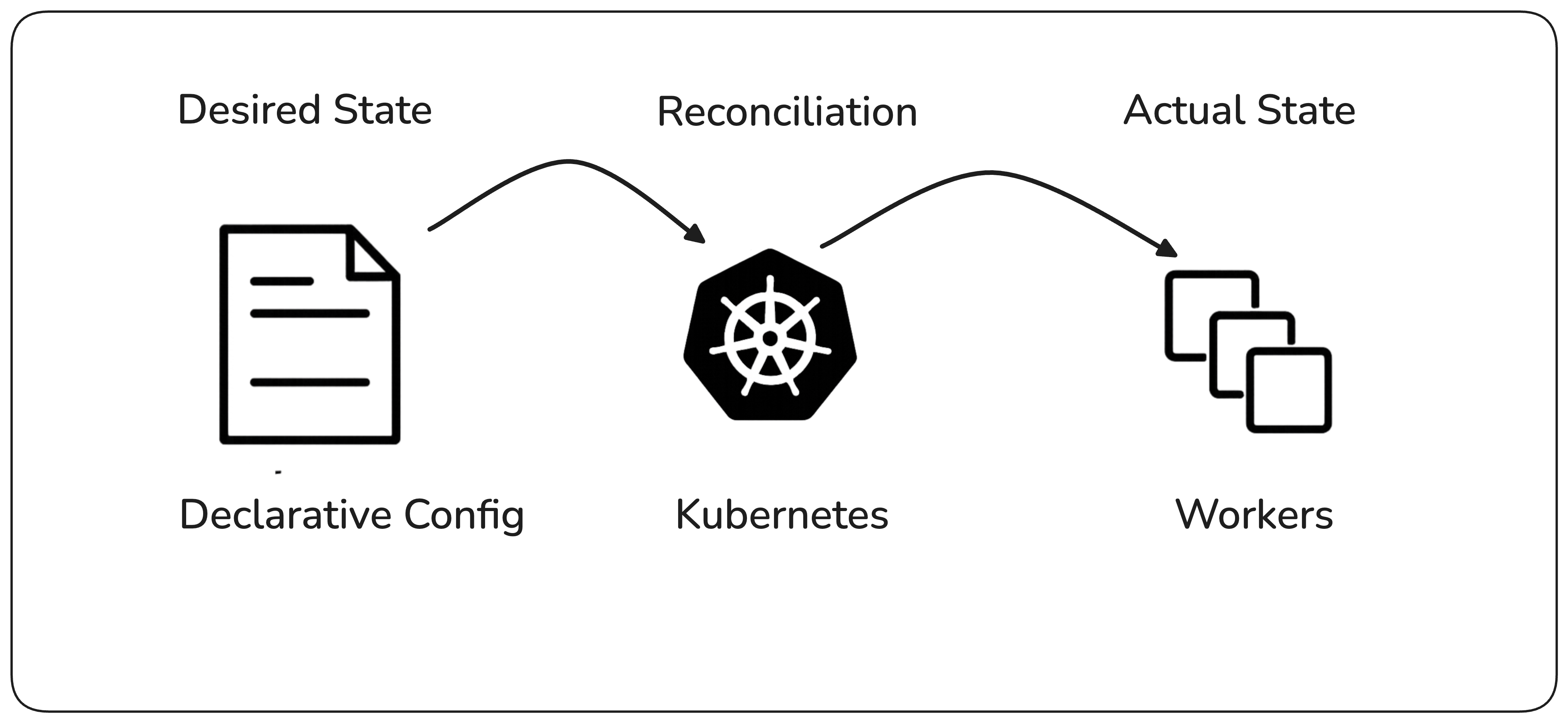
A platform is a control plane by nature: developers declare intent, and something has to reconcile the real world to match. Kubernetes is a natural fit because it was built around exactly that loop — reconcile declared state with real state. Its second strength is extensibility: CRDs, operators, and controllers let you model almost anything on top of that same loop — compute, networking, storage, databases, custom resources. !!Kubernetes gives the platform a control plane it can extend, so almost anything the organization needs to govern can live inside the same model.!!
GitOps as a Natural Platform Interface [GitOps Interface]
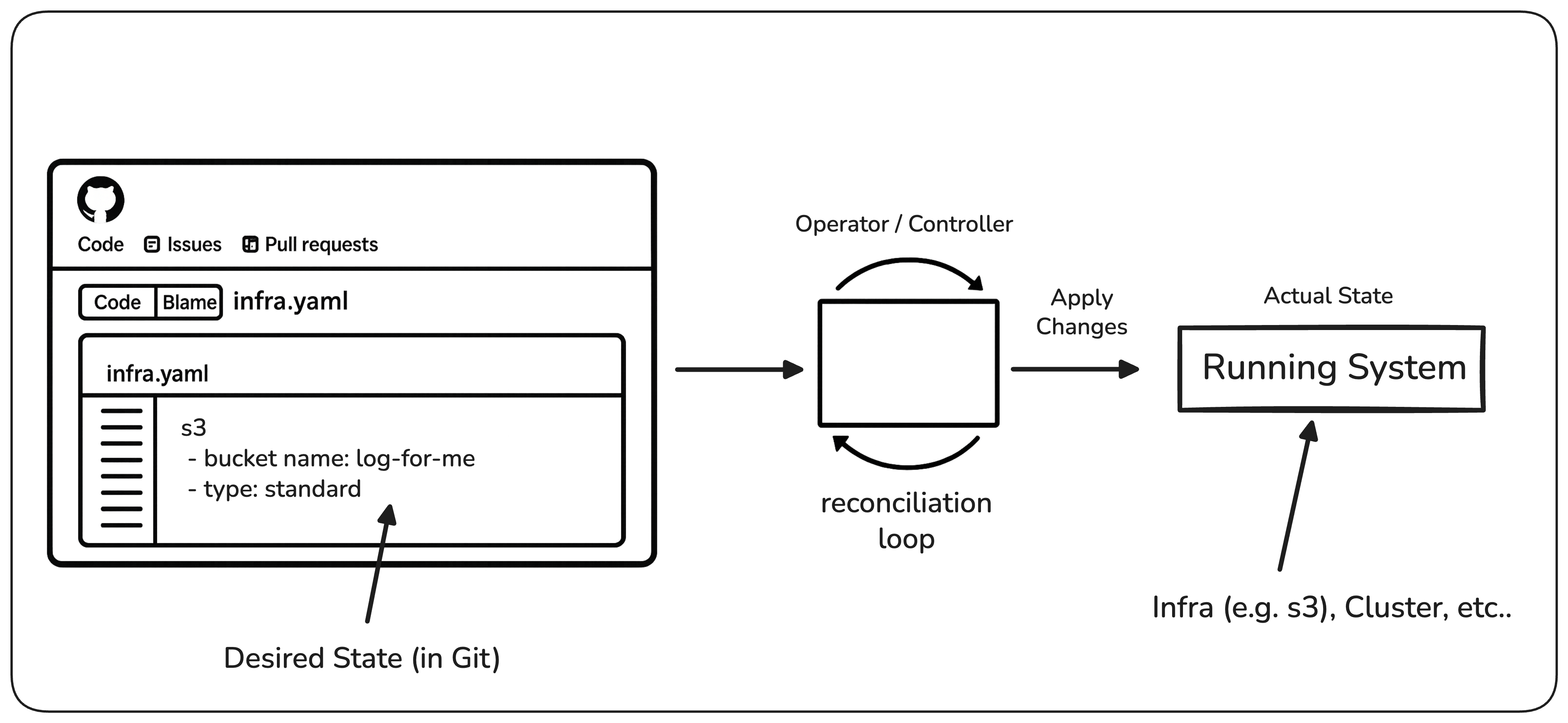
GitOps turns the repository into the platform's front door. Developers declare intent through pull requests, an operator reconciles the running system to match, and the change history, review, and rollback come for free. !!Platform adoption stops feeling like a new tool to learn — it feels like the workflow developers already trust, extended to infrastructure.!!
Understanding GitOps Limitations [GitOps Limitations]
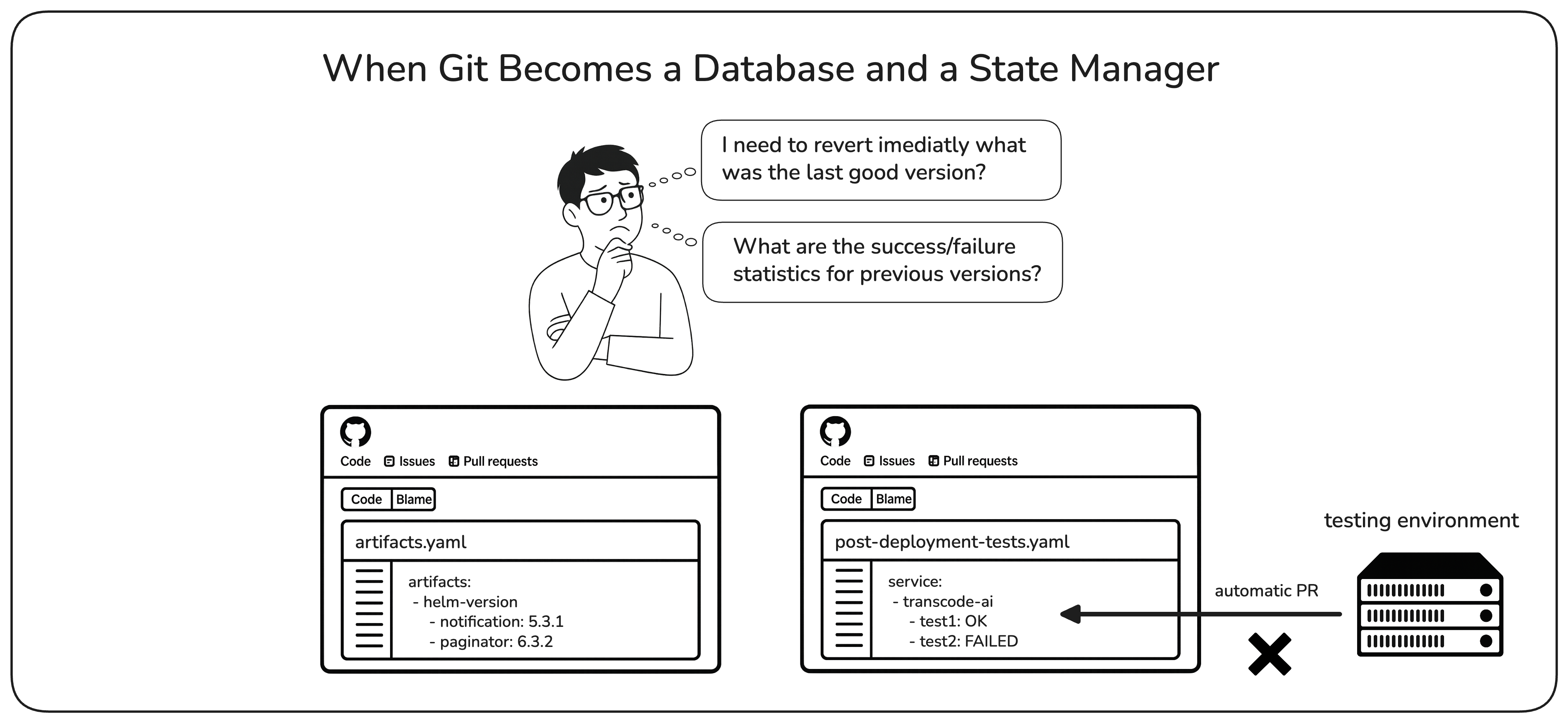
Git is a version control system, not a database. The moment a platform starts using it to track dynamic state — runtime facts, live metadata, the current version deployed across the fleet — the pain shows up on both sides: automated pull requests to write every change, and no way to query the answer without cloning and parsing repos. A real API answers in one call; Git turns it into a nightmare. !!Use Git for declarative configuration; pair it with real services and real databases for everything else.!!
Favor Logical Boundaries [Logical Boundaries]
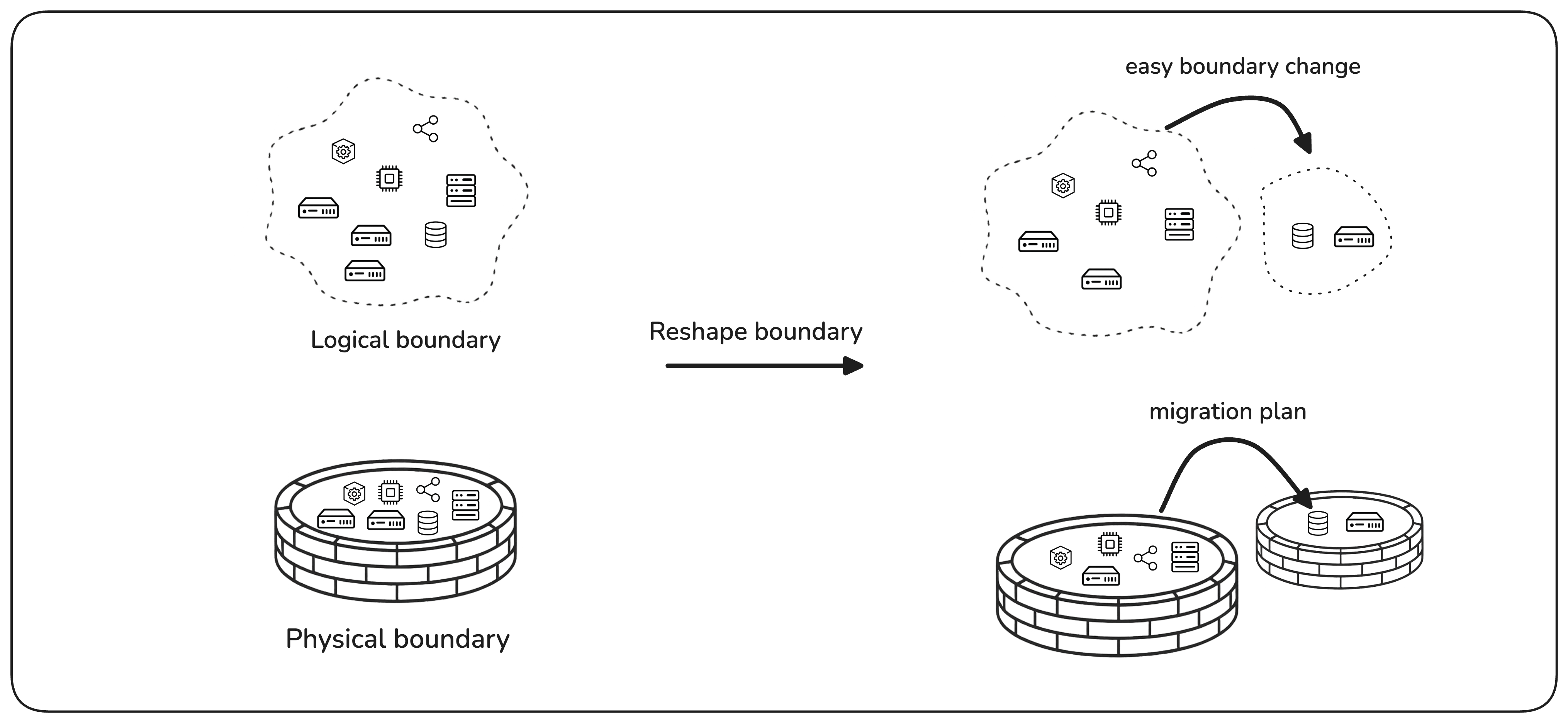
A platform materializes environments, tenants, and isolation constantly — every choice made there is either logical or physical. Logical boundaries (namespaces, labels, policies, roles) can be redrawn as needs evolve; physical ones (accounts, VPCs, clusters) freeze the model into infrastructure that is painful to reshape later. Physical boundaries are sometimes unavoidable — regulatory isolation, hard blast-radius limits, cost boundaries — but they should be chosen as a last resort, not as a default, because every one of them becomes a structural constraint the organization will carry for years. !!Favor logical boundaries wherever possible — the platform stays reshapeable, and the organization keeps the freedom to change its mind.!!
Abstract From Real Usage [Abstract From Real Usage]
On a platform, every abstraction is a contract signed with every team that adopts it. Getting one wrong is not a local refactor — it is a breaking change across dozens of consumers, all at once. That is why the platform team must resist the temptation to generalize "just in case" a second team might one day want the same thing: publish only what real usage has already justified. !!Abstract too early and you lock the whole organization into a shape no one actually needed; abstract from real usage and the shape fits the first time.!!
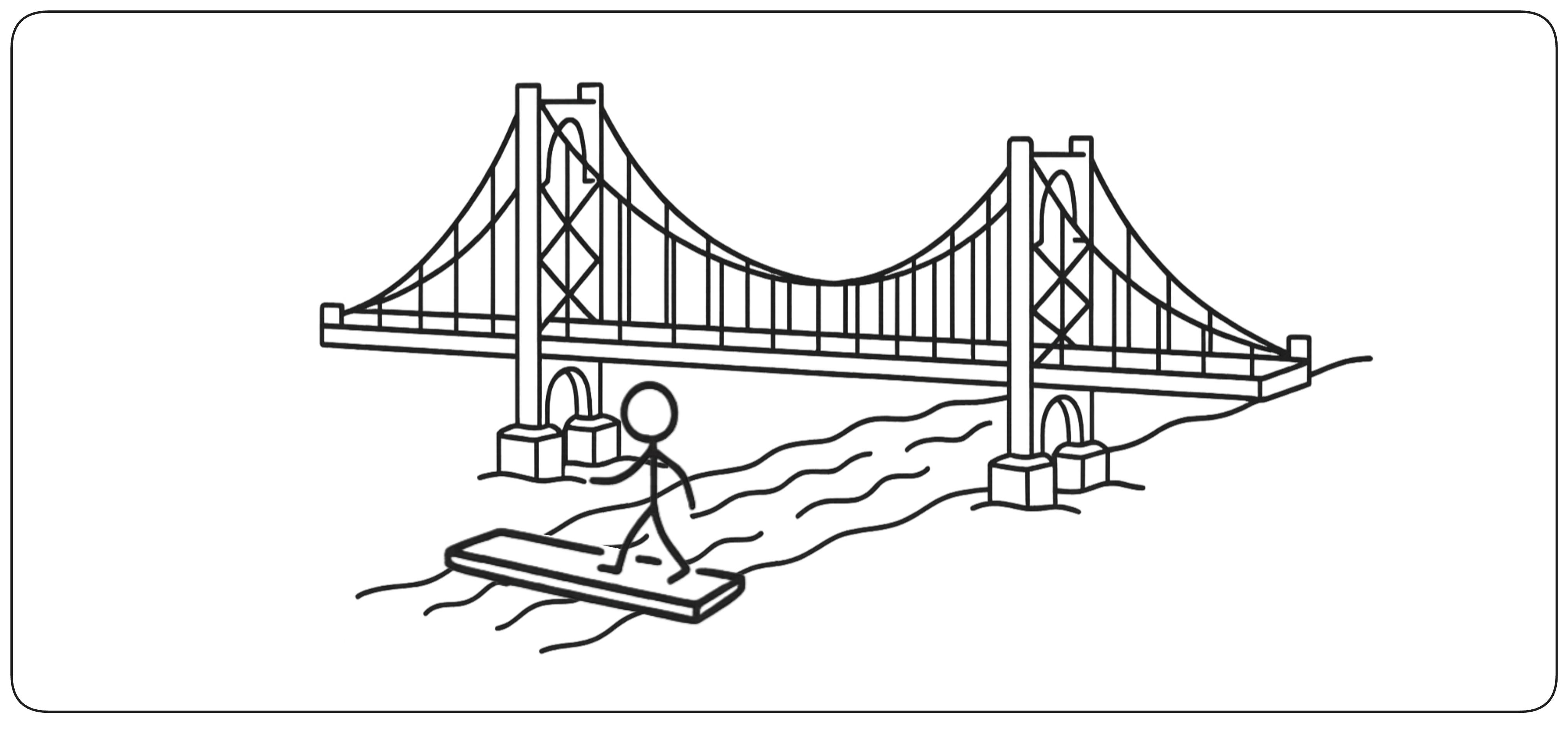
Contribution Mechanisms That Scale [Collaborative Evolution]
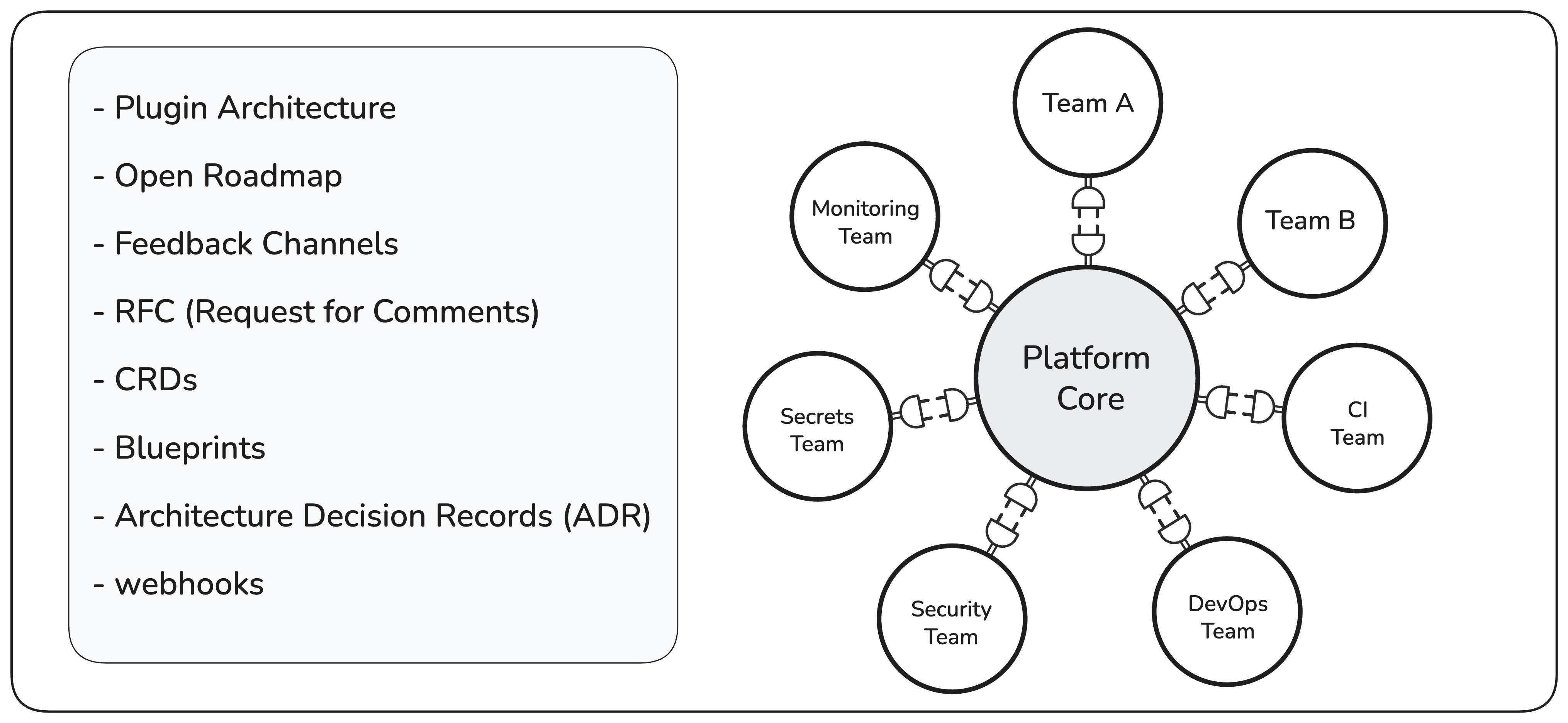
Collaboration works only when the mechanisms are as visible as the principle. An open roadmap makes the direction public. RFCs let teams propose changes before writing code. Blueprints and CRDs give ready-made shapes to build inside. Webhooks and plugin architectures let extensions plug in without forking. Architecture Decision Records capture the why so contributors don't relitigate old choices. !!The platform team owns the core; the organization builds the rest through channels everyone can see.!!
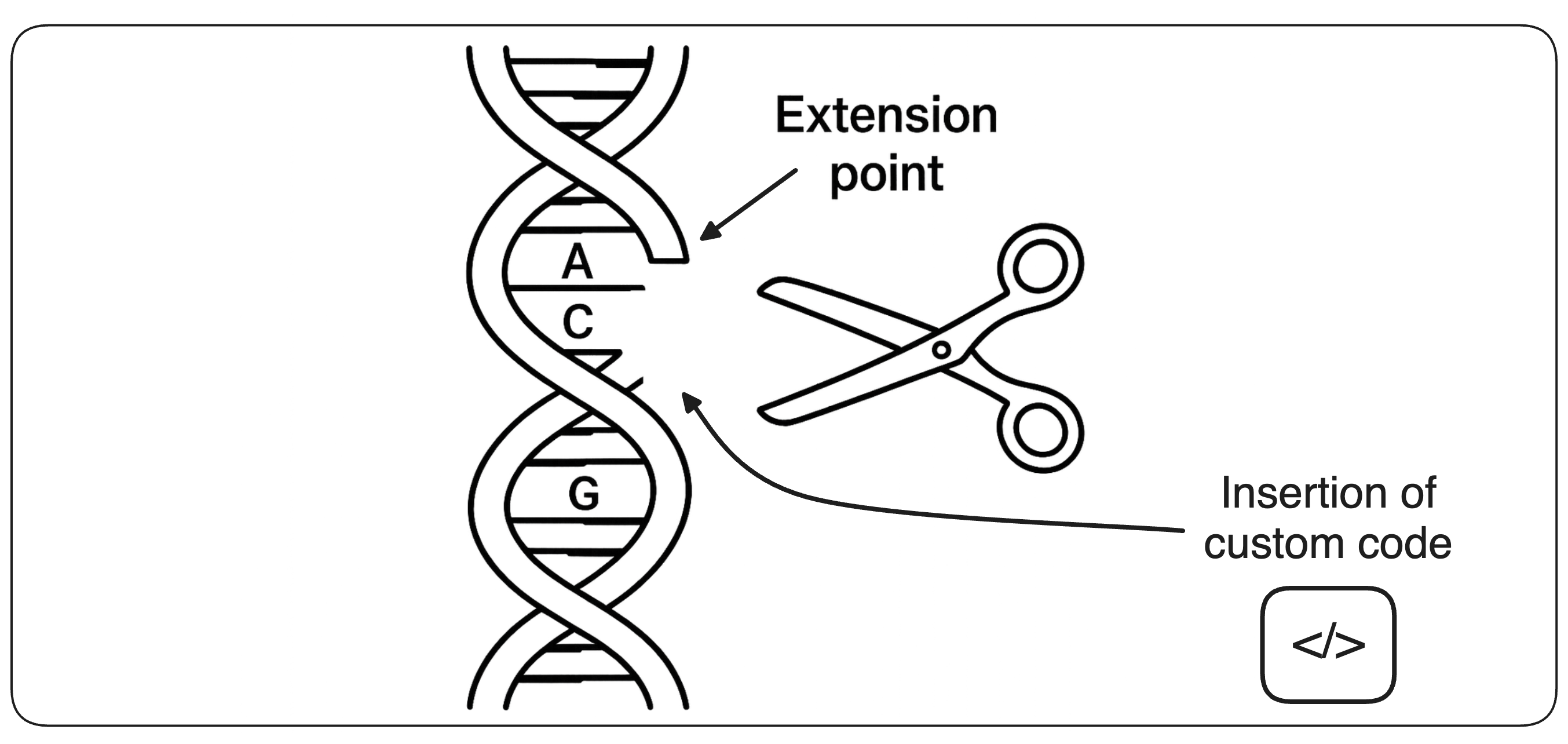
Favor Extensions Over Shortcuts [Extensions Over Shortcuts]
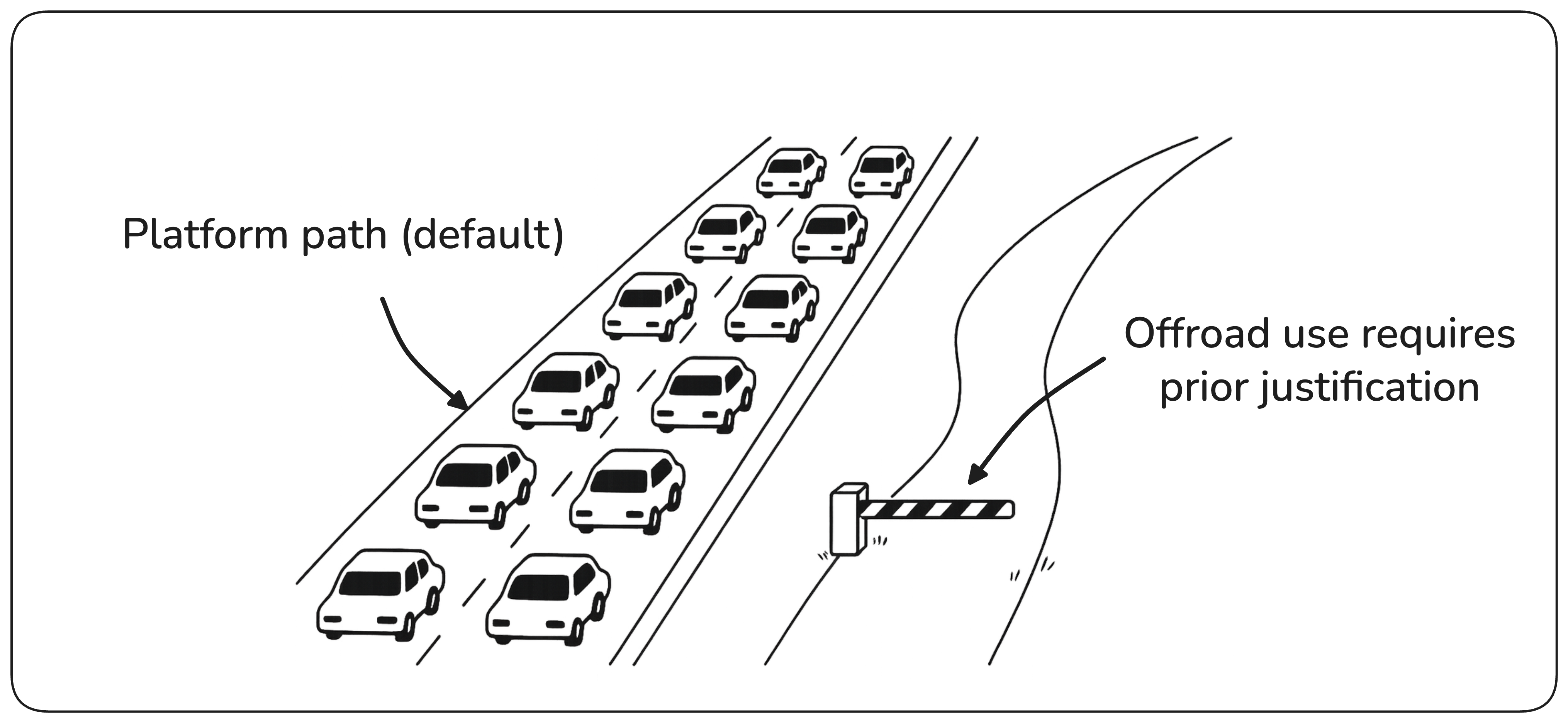
When a team hits a case the platform doesn't cover, they have two paths: fork off the supported path, or extend it through a hook. Hooks — pre-deployment, post-validation, custom handlers — keep the team inside the ecosystem: updates, patches, and improvements still flow to them. Off-road solutions become the team's sole responsibility, and every one of them accumulates as technical debt the organization eventually pays for. !!Design the platform opinionated enough to standardize, but extensible enough that no one has a reason to leave the road.!!
Platform as an Evolution [Platform Evolution] {1}
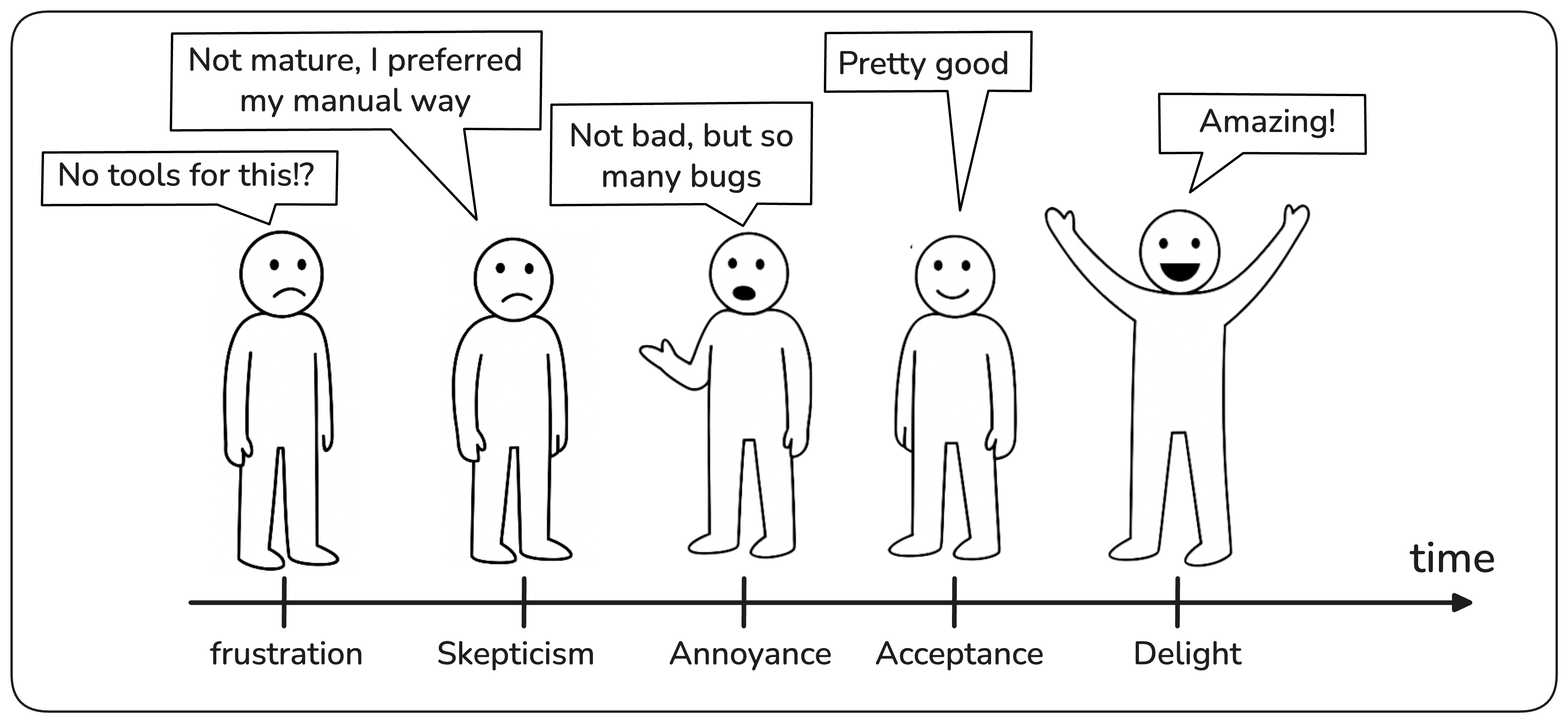
No platform starts mature. It begins with a clear vision and a small set of solid foundations, then evolves in contact with real usage — new patterns, new needs, new technologies reshape it every year. This is only possible if extensibility is designed in from the start: extension points, clear contracts, and modular boundaries that let the platform absorb new capabilities without rewriting itself. !!A platform's job is not to be finished; it is to remain shapeable, so that every year it fits the organization better — and does not become the thing teams route around.!!
Measuring Success [Success]
A platform is successful only when it changes how the organization builds software. It is not enough to count features delivered, resources provisioned, or workflows automated. Those numbers prove activity, not adoption, trust, or impact. The real question is sharper: has the platform become the default way teams move from idea to production because it is faster, safer, and easier than building around it?
Adoption Before Mandate [Adoption] {1}
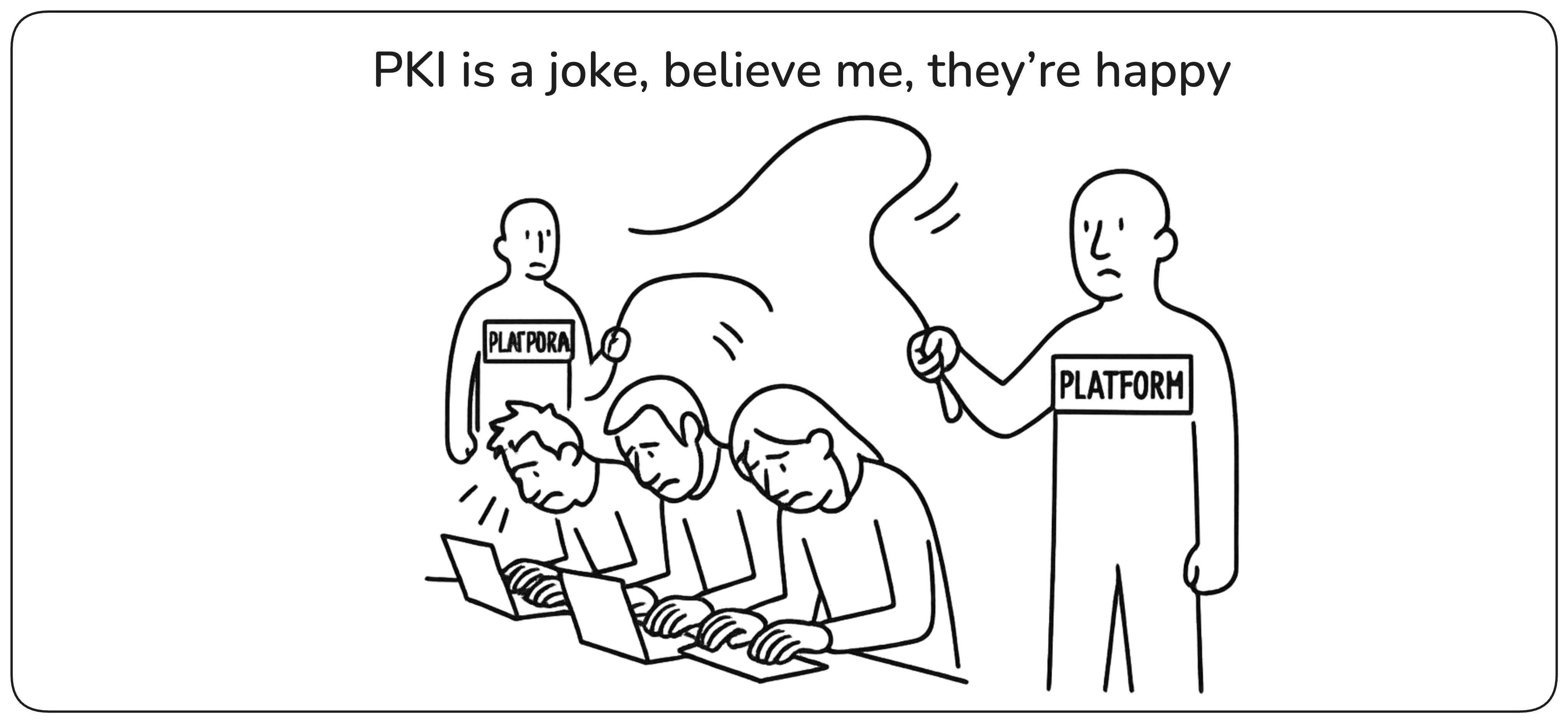
The strongest signal is voluntary adoption. Before the platform is mandated, teams should already prefer it because it removes friction and gives them capabilities they could not easily build alone. A mandate can come later, but it should recognize an existing reality, not force a weak product onto reluctant teams. If teams only use the platform because they have no other path, the metric is misleading. !!A platform that has to be mandated before it is loved has not yet become a platform product — it has become an internal obligation.!!
Time to First Production Service [Time to Service]
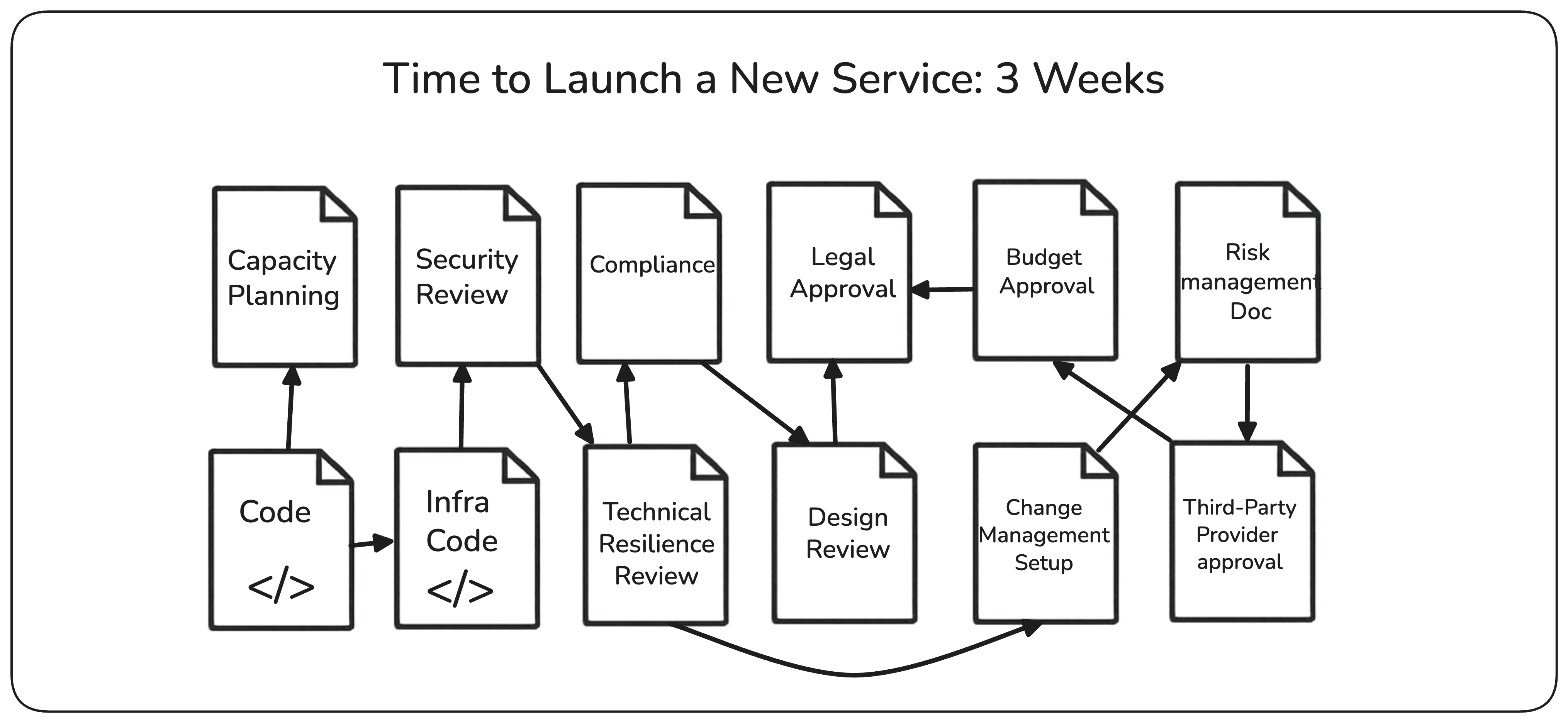
The most concrete measure of platform value is the time it takes to create a new production-ready service. Not a demo, not a sandbox, not a repository with a pipeline, but a service that runs safely in production with identity, networking, observability, deployment, compliance, ownership, and support already in place. The platform is supposed to absorb the navigation around capacity, security, compliance, networking, access, and operations. !!If the time from "I need a service" to "it runs safely in production" shrinks, the platform is working; if it does not, the platform is only a nicer entrance to the same old queue.!!
Flow, Confidence, and Trust [Flow & Trust]
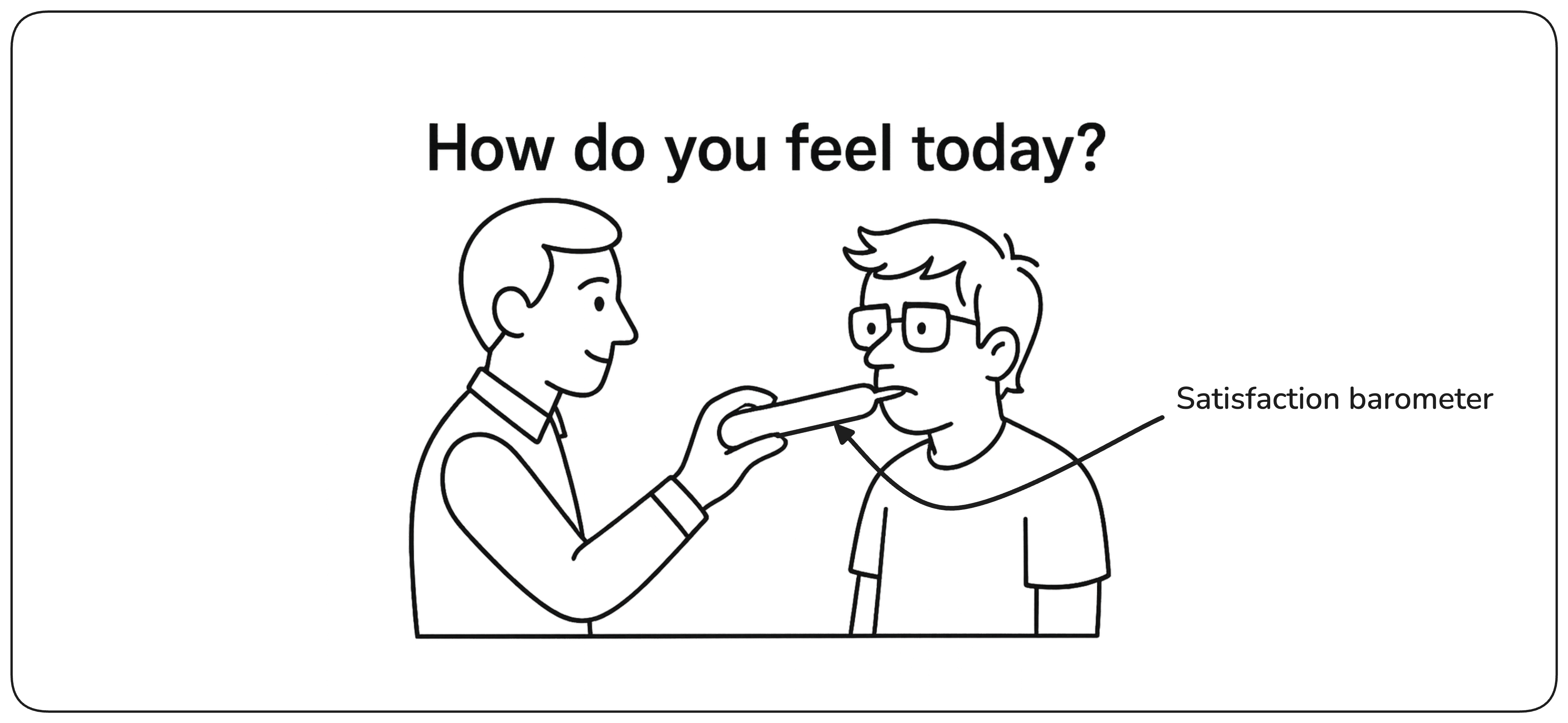
Developer experience must be measured as developers actually feel it. The useful questions are not whether the platform looks polished, but whether it preserves flow, builds confidence, and earns trust. Can developers complete common actions without interruption? Are errors understandable and actionable? Is the current state visible? Do teams stay on the supported path when pressure rises, or do they quietly bypass it? !!The platform is not judged by how it behaves on a perfect day; it is judged by whether developers still choose it on a bad one.!!
Governance Without Friction [Governance]
A developer platform must also prove that it improves organizational control. The goal is not only to make developers faster, but to make governance easier to achieve by default. The right measures are therefore governance metrics as much as productivity metrics: how many services follow the standard path, how many exceptions exist, how visible ownership is, how complete the catalog is, and how much of the production estate can be audited through the platform. !!A platform succeeds when control no longer requires slowing teams down — because the supported path is already the governed path.!!
Velocity and Quality Together [DORA]
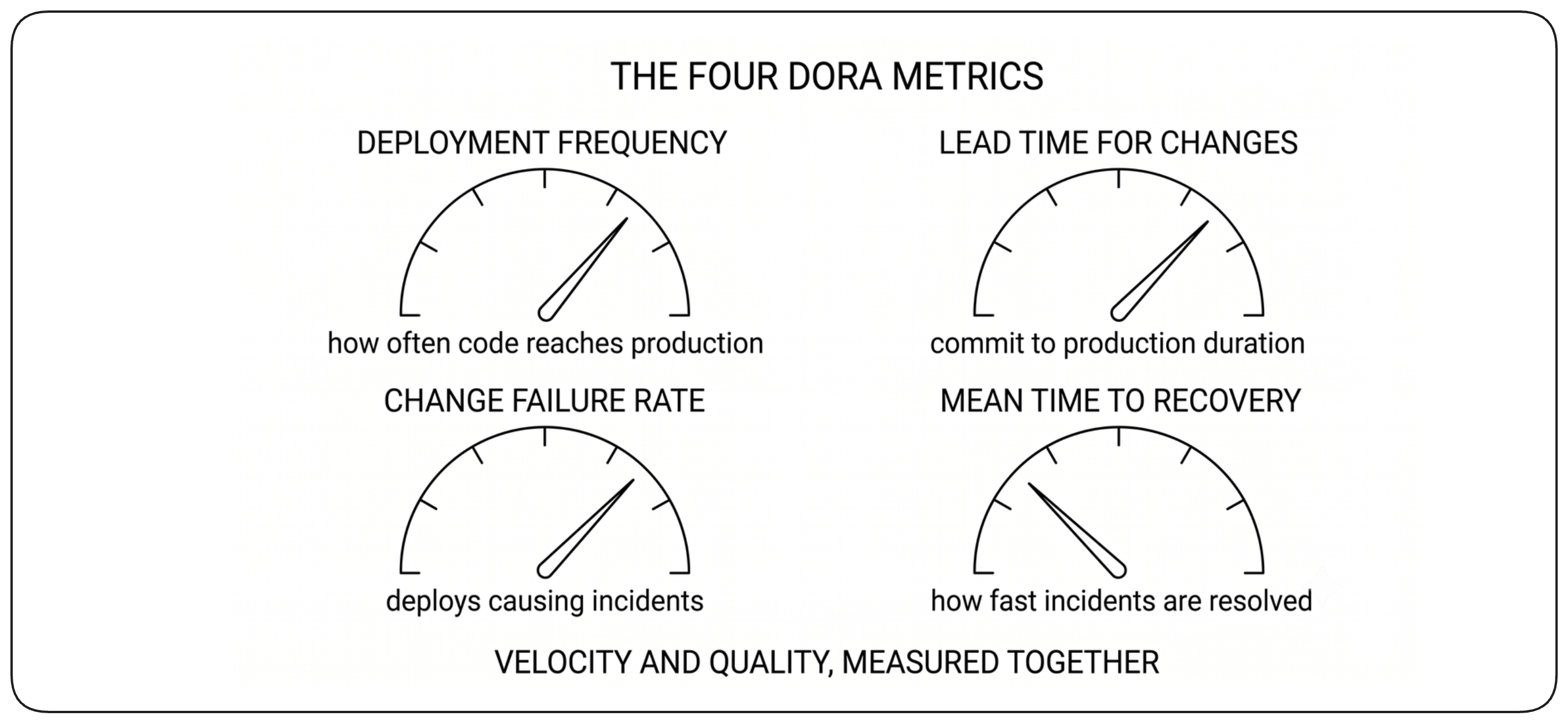
Speed alone is not success. A platform that increases deployment frequency while increasing incidents has only moved risk faster. Reliability alone is not enough either, if it comes from freezing change. The platform has to improve velocity and quality together. This is why the four DORA metrics remain useful: deployment frequency, lead time for changes, change failure rate, and mean time to recovery. !!The platform earns credibility when teams move more often, recover faster, and fail less — not when one number improves at the expense of the others.!!
Metrics That Reshape the Platform [Reshape]
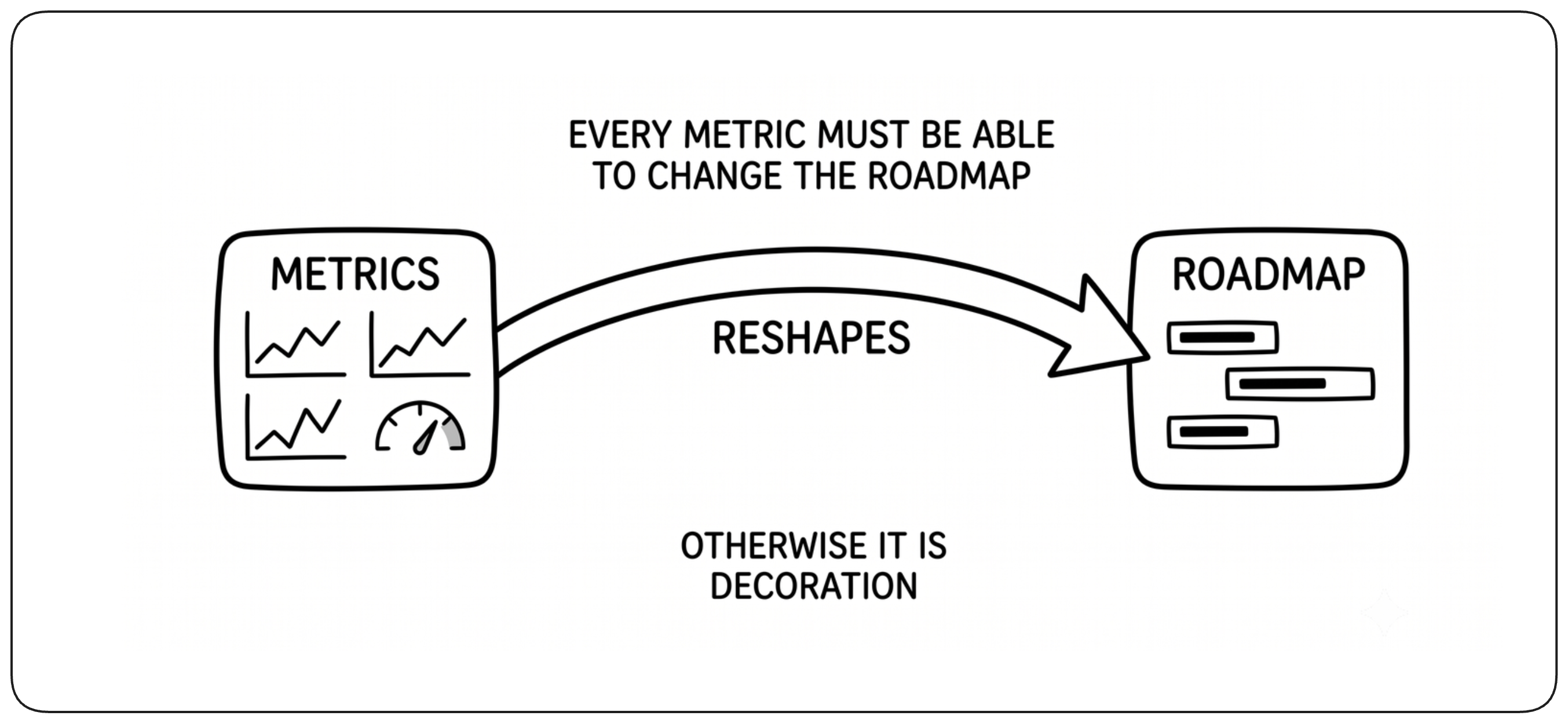
Measurement only matters if it changes what the platform team does next. If a slow time-to-first-service does not become a roadmap priority, if repeated support tickets do not lead to a better interface, if low trust does not trigger product work, or if governance gaps do not reshape the platform model, measurement is theater. Metrics should be treated as product signals, not as reporting decoration. !!Every metric the platform team publishes should be able to change the roadmap; otherwise, it is not a metric, it is decoration.!!
The Real Verdict [Verdict] {1}
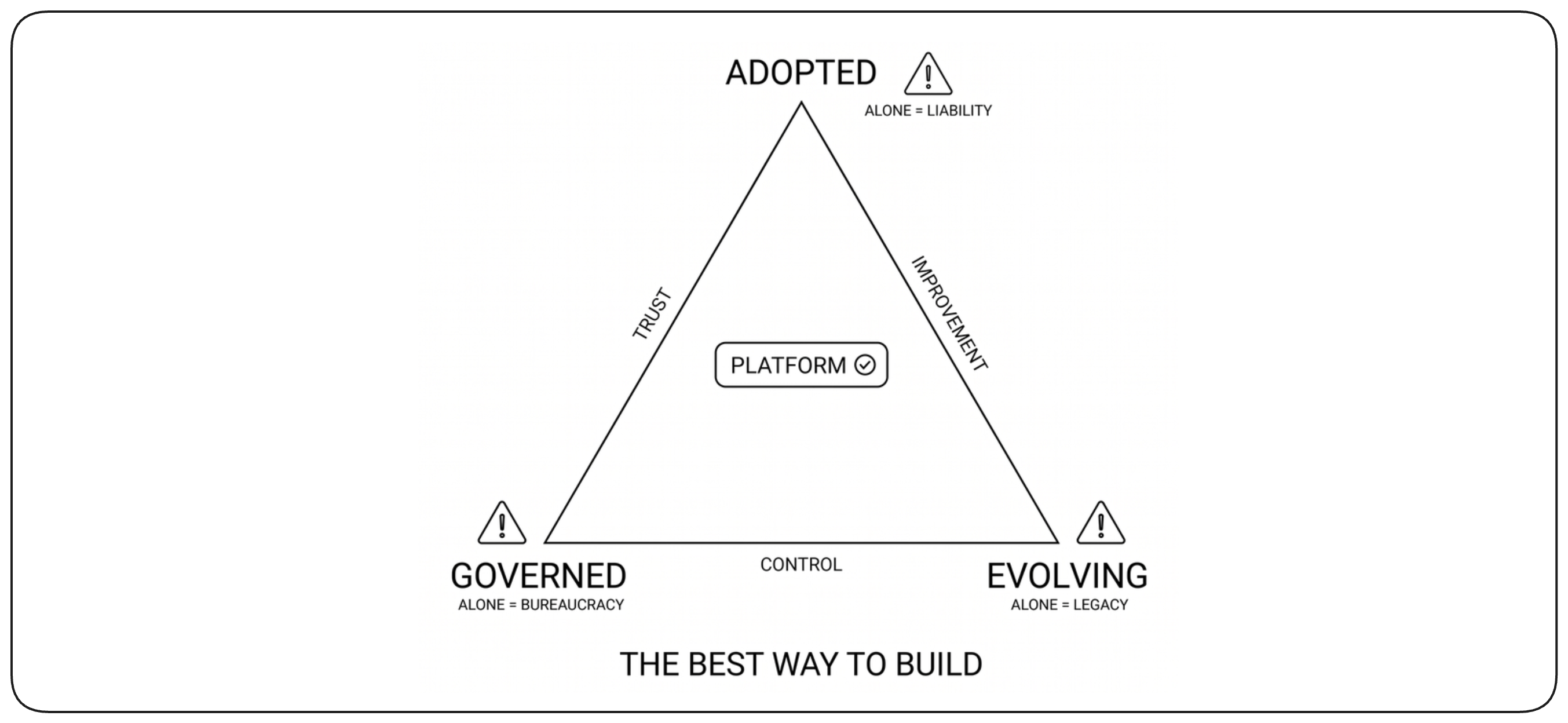
The real verdict is not a dashboard. A platform succeeds when developers choose it, the organization can govern through it, and both keep improving because real usage keeps reshaping the system. Any one of these alone is fragile: an adopted platform that cannot govern is a liability; a governed platform no one wants is a bureaucracy; a platform that stops evolving becomes another legacy system. !!A platform is not measured by whether it was built; it is measured by whether it remains the best way to build.!!
What AI Has Changed [AI Changed]
AI Lowers the Individual Burden [AI Lowers Burden] {1}
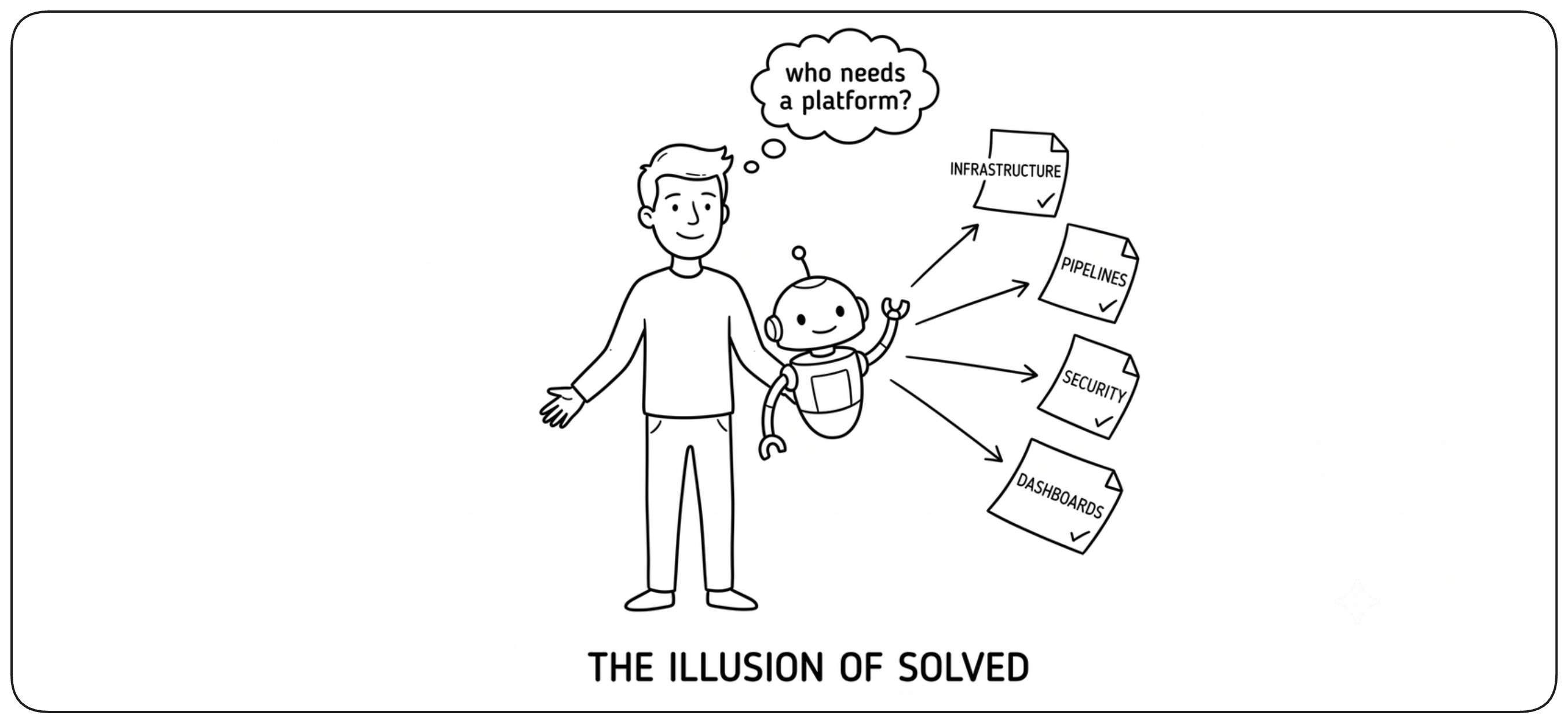
Before AI, producing the machinery around code — infrastructure, pipelines, security config, observability — took real expertise and real time. That effort was a natural brake on divergence. AI removes it. A single developer can now summon Terraform, manifests, pipelines, and dashboards in minutes. !!For the developer, this feels like liberation: everything the platform was supposed to solve, seemingly solved by the assistant alone.!!
The Same Speed Fractures the Organization [Fractures the Organization]
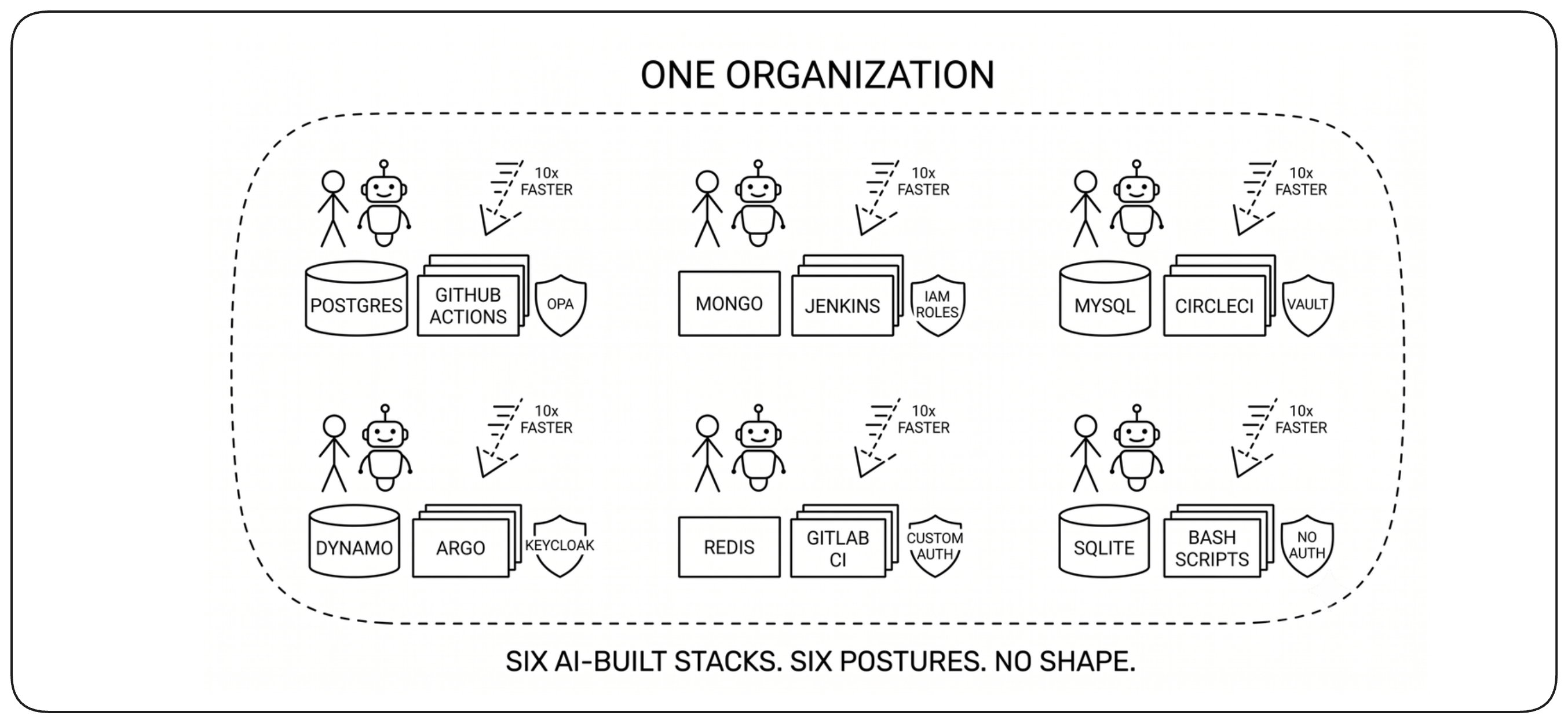
Then the fleet view catches up. Ten developers using AI in ten different ways produce ten different stacks, ten different security postures, ten different patterns — all plausible, all local, all faster than any review can absorb. The code runs; the organization loses its shape. !!AI does not remove the governance problem — without a platform, it accelerates it. Slow divergence becomes fast divergence, and the platform becomes the only frame that can hold the organization together.!!
Platform First, From Day One [Platform First] {1}
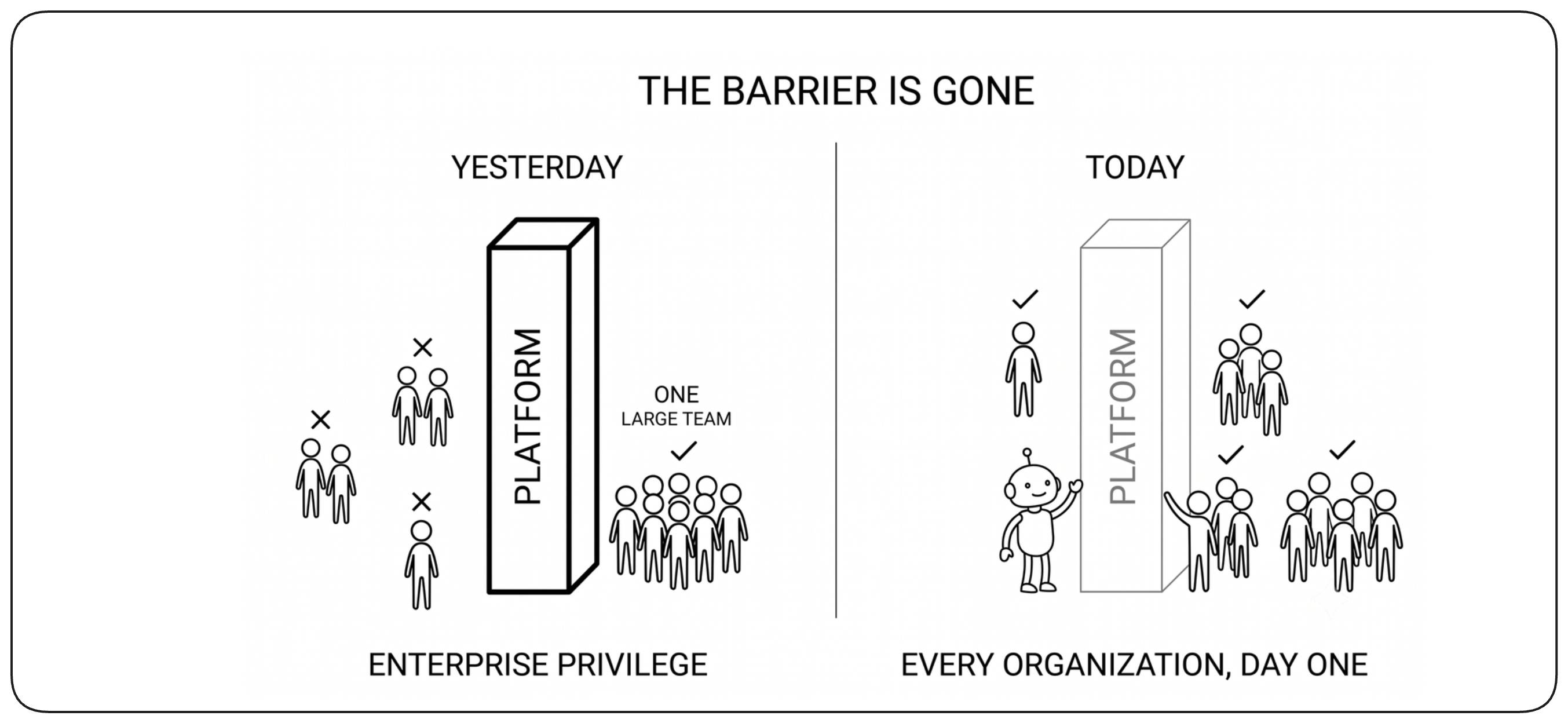
Building a platform used to be an enterprise privilege — years of investment, a dedicated team, a scale that justified the effort. Startups shipped without one, and small projects had no realistic path to build one. AI dissolves that barrier: what once took months of platform engineering now scaffolds in days. !!Every organization — from the smallest project to the largest company — should now think platform-first from day one, because the cost of not having a platform has become higher than the cost of building one.!!
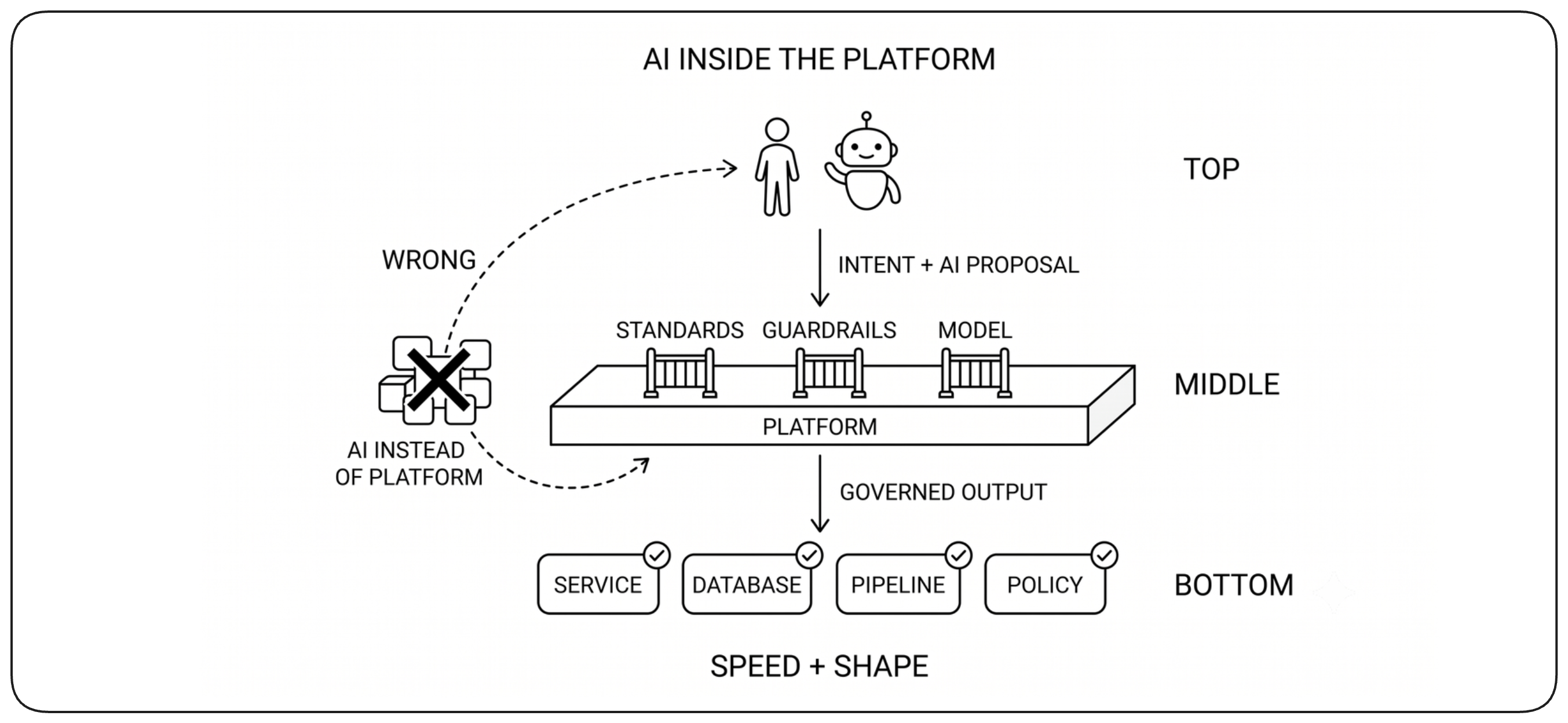
AI Inside the Platform, Not Instead [AI Inside Platform] {1}
The winning move is not to pick between AI and the platform — it is to fold one into the other. Developers keep using AI to express intent, generate proposals, debug failures, and move faster. But that assistance flows through the platform's model, vocabulary, and guardrails — not around them. !!AI supplies speed; the platform supplies shape. Fast individual progress inside a coherent organizational frame — that is what makes AI useful at scale, and it is what makes the platform indispensable.!!