Design for Cost Efficiency
Chapter Info
Calculating... Writing Progress: 85%
In the cloud era, cost is no longer a back-office line item — it is a property of the architecture. Every design choice, from instance family to deployment region to retention policy, lands on someone's bill. A careless system can waste millions a year; a thoughtful one delivers the same features at a fraction of the spend.
This chapter walks through the discipline of designing for cost without sacrificing quality. We start with the economics that make cloud different, then the techniques that bend the bill — right-sizing, pricing models, lifecycle, attribution — and the cultural practices that keep cost visible. We close with the trade-offs and the emerging AI and sustainability dimensions.
Understanding Cloud Cost [Understanding]
Cloud cost behaves differently from traditional infrastructure spend. It is variable, transparent, and tied directly to architectural decisions — which makes it both an opportunity and a daily risk for any team that ships.
From Capex to Opex [Cloud Economics] {1}
Traditional infrastructure required big upfront purchases and capacity planning for peak load. !!Cloud flipped the model — pay only for what you consume, when you consume it.!! That flexibility is also the danger: teams can provision in seconds without procurement, and bills can spiral just as fast. The transparency of cloud spending is a gift, but only to teams who actually look at it.
Cost is an Architectural Quality [Cost Quality] {1}
Cost belongs alongside performance, security, and reliability in the list of system qualities. !!Every architectural decision either spends from the budget or protects it — multi-AZ deployments triple costs, managed services raise unit price, multi-region multiplies everything.!! The right question is never "what is cheapest" — it is "does this spend match the business value it delivers".
Cost is Not About Cutting [Maximize Value] {1}
The goal of cost engineering is not minimum spend — it is maximum value per dollar. !!A system that delivers ten million in revenue on one million of infrastructure is not "expensive" — it is wildly efficient.!! Cutting blindly destroys capabilities the business depends on; what matters is killing the spend that produces nothing while protecting the spend that produces returns.
FinOps: Finance Meets Engineering [FinOps] {1}
FinOps brings finance, engineering, and ops into the same room. !!Engineers see the cost of what they build, finance learns the constraints, ops runs the optimization — cloud spend becomes an investment, not a fight.!! The conversation shifts from "stop spending" to "spend on the things that matter".
Visibility and Attribution [Visibility]
You cannot manage what you cannot see. Before any optimization, every dollar must be traceable to a team, a product, a use case — otherwise the conversation stays generic and the bill stays mysterious.
Tagging is Non-Negotiable [Tagging] {1}
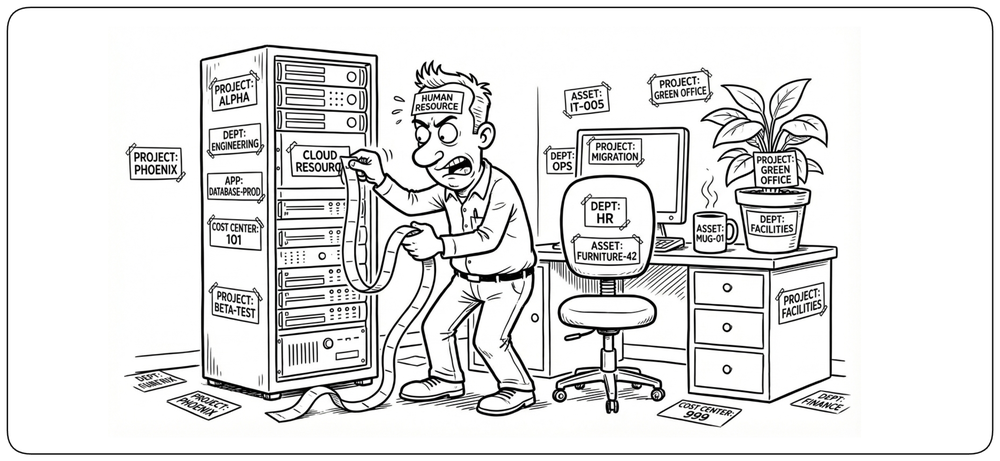
Tags are the labels that make cloud bills readable. !!Without consistent tagging — cost-center, team, environment, project — every cost analysis ends in "I don't know whose this is".!! A serious tagging policy is enforced by automation: untagged resources cannot launch, and the tags drive everything from chargeback to anomaly alerts. Skip this step and every later optimization stays guesswork.
Showback and Chargeback [Showback]
Showback gives each team a bill they can see; chargeback actually debits the team's budget. Showback alone changes behavior quickly — once engineers see "your service costs $40,000 a month", choices change. Chargeback adds real accountability but requires mature financial plumbing. Most organizations start with showback and graduate to chargeback as cost discipline matures.
Usage-Based Attribution for Shared Services [Shared Services]
Tagging falls apart on shared platforms — an internal AI API, a logging pipeline, a search index serves dozens of teams. Static ownership tags hide who is really consuming what. Usage-based attribution captures organizational context on every request — team, project, purpose — and turns shared services into honest invoices. Without it, the heaviest consumers ride free on the budgets of careful ones.
Cost Anomaly Detection [Anomalies]
A forgotten test cluster, a runaway log pipeline, leaked credentials mining crypto — all show up as cost spikes. Anomaly detection learns the normal shape and alerts when it drifts. The same alert often reveals both a financial leak and a security incident. Day one it costs minutes; day thirty it costs six figures.
Resource Optimization [Optimization]
Most cloud bills carry significant fat — oversized instances, idle resources, expensive storage tiers used for cold data. The wins here are direct and measurable, and the techniques are well understood; the only thing missing in most teams is the discipline to apply them.
Right-Sizing Resources [Right-Sizing] {1}
Right-sizing means matching instance types and sizes to actual workload. !!Most cloud instances run at single-digit utilization — the team picked a size "just in case" and never went back.!! A serious right-sizing pass typically cuts compute spend by twenty to forty percent without touching performance. It is not a one-time exercise — workloads drift, instance families evolve, and reviews must be a habit.
Reserved, Spot, On-Demand [Pricing Models] {1}
Cloud providers offer three pricing buckets, each for a different job. !!Reserved instances cut thirty to seventy-five percent for committed steady-state workloads. Spot instances cut up to ninety percent for interruption-tolerant work. On-demand keeps full flexibility at full price.!! The right mix — reserved for baseline, spot for batch, on-demand for variability — routinely cuts compute bills by sixty percent versus pure on-demand.
Serverless Economics [Serverless]
Serverless charges only for actual execution time — perfect for sporadic, bursty, or low-traffic workloads where idle resources dominate the bill. At high sustained traffic the math flips: a right-sized container often costs less per request than a busy Lambda. The wins come from picking serverless for the right workloads — event-driven, variable, idle-heavy — not from making it the default for everything.
Auto-Scaling and Idle Resources [Auto-Scale]
A system sized for peak wastes most of its capacity most of the time. Auto-scaling pulls capacity up on spikes and back down when traffic fades. The companion habit is killing idle — non-prod off nights and weekends, orphaned disks cleaned monthly, dev clusters that wake on demand.
Data and Storage Costs [Data Costs]
Data is the part of the bill that grows quietly. Storage tiers, retention, and transfer charges accumulate forever unless someone designs against them — and most teams discover the cost only after years of compounding.
Storage Tiers and Lifecycle Policies [Lifecycle] {1}
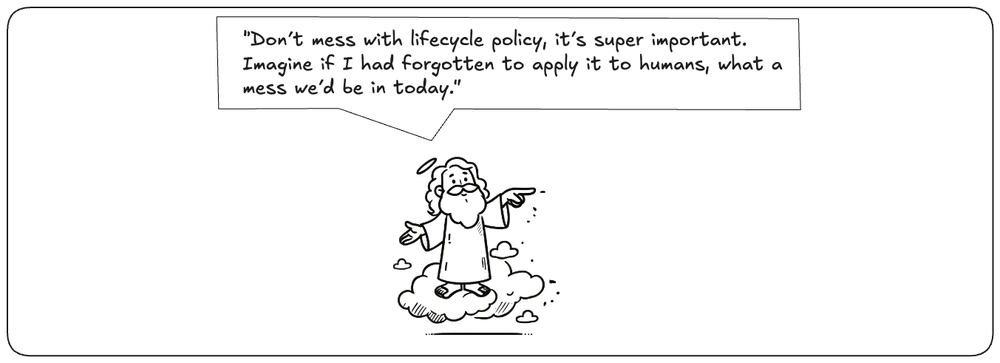
Not all data deserves premium storage. !!Lifecycle policies automatically move data from hot to cool to archive tiers as it ages — and delete it entirely when its useful life ends.!! A log file three years old costs the same as one created today if nothing moves it; a lifecycle rule cuts that cost by ten or a hundred without anyone reading the data.
Data Transfer: The Hidden Bill [Egress] {1}
Egress charges are the silent killer of cloud bills. !!Cloud providers charge for data leaving their network — between regions, between AZs, out to the internet — and these fees can quietly become the biggest single line item.!! Keep compute close to data, use CDNs for static assets, and cache aggressively at edges. The cheapest byte is the byte that does not move.
Retention as a Design Choice [Retention]
Keeping every log, every event, every snapshot forever is the default — and it is wrong. Retention must be explicit: what data is worth keeping, for how long, in which tier. Compliance sometimes mandates it; business value rarely does past a few months. Intentional retention beats any clever instance-type trick.
Cost-Aware Architecture [Architecture]
The biggest cost wins are not in tuning — they are in design. Architectures that match resource consumption to actual demand cost a fraction of those that provision for worst-case scenarios that may never materialize.
Event-Driven and Async Patterns [Event-Driven]
Event-driven architectures activate components only when there is work to do — idle services consume nothing. Asynchronous queues let batch jobs run on spot instances that may be interrupted without anyone noticing. The same workload built as always-on synchronous services would burn capacity around the clock; restructured around events, it pays only for actual work and is naturally elastic.
Caching as Cost Lever [Caching]
A cache hit costs microseconds and a fraction of a cent; the same query against a database costs milliseconds and many cents — multiplied by millions of requests. Caching is one of the rare patterns that improves performance and cost at the same time. The trade is invalidation complexity and the risk of serving stale data, but for read-heavy workloads no other optimization comes close.
Multi-Tenancy [Multi-Tenancy]
A single-tenant deployment per customer multiplies infrastructure by the customer count. Multi-tenant designs amortize the same infrastructure across many customers, dropping unit cost dramatically. The cost is engineering effort — isolation, quotas, per-tenant observability — and the architectural complexity of fair sharing. For most SaaS workloads, the math overwhelmingly favors multi-tenant.
Multi-Cloud is Rarely Cheaper [Multi-Cloud]
Multi-cloud is sold as cost optimization; it is usually the opposite. Splitting workloads weakens volume discounts, adds cross-cloud egress, and multiplies the operational surface. The legitimate case is resilience or regulation, not savings — negotiating with one provider almost always beats spreading thin.
Cost Trade-offs [Trade-offs]
Cost lives in tension with every other quality of the system. The right level of investment is rarely "as little as possible" — it is "the amount that matches what the business actually needs". Owning the trade-off is the engineering work.
Cost vs Reliability [Reliability]
Every additional nine of availability costs roughly ten times the previous one. Triple-AZ deployments, hot standbys, cross-region failover — each adds genuine resilience and genuine spend. A critical payment service deserves the investment; a marketing landing page does not. The art is matching reliability spend to the actual cost of being down, not to the loudest stakeholder.
Learn More
Chapter: Design for High Availability.
Cost vs Performance [Performance]
Sub-millisecond response times demand dedicated instances, in-memory grids, and premium network paths. Relaxing the target to tens of milliseconds often unlocks commodity infrastructure and serverless at a fraction of the cost. The right latency target is the one users actually need, not the smallest number an engineer can chase.
Learn More
Chapter: Design for Performance.
Cost vs Speed of Delivery [Time-to-Market]
Managed services and serverless cost more per unit than self-hosted equivalents — and they deliver weeks faster with fewer hires and fewer incidents. For an early product racing to find market fit, paying more for managed components is usually correct. Once the workload stabilizes and the team is mature, selective in-sourcing can pay back. Optimize the bill the business can afford to focus on.
Cost vs Engineering Complexity [Complexity]
Squeezing the last twenty percent often demands real engineering — custom autoscalers, spot orchestration, exotic storage. That complexity has its own cost in headcount and on-call burden. Past a point, savings cost more than they return. Know where that point is and stop there.
Cost-Conscious Culture [Culture]
The most effective cost lever is not technical — it is cultural. A team where engineers see the bill and care about it catches waste a dashboard never will. A team where cost belongs to "someone else" stays expensive forever, no matter how good the tooling.
Cost is Everyone's Job [Shared Responsibility] {1}
Cost optimization fails when it belongs only to finance or ops. !!Developers make architectural choices that drive costs; product teams define requirements that justify them; ops provisions and tunes — the cost belongs to the team that creates it.!! The cultural shift is making "what does this cost" as natural a question as "does this scale" or "is this secure".
Cost in CI/CD [Cost in CI]
Catching cost regressions in pull requests beats catching them in next month's invoice. Modern tools estimate the cost impact of infrastructure changes before they ship — a Terraform plan can show "this PR adds $4,200 a month" right in the review. Cost budgets become enforceable: a change that crosses a threshold needs explicit approval. The principle is the same as for performance and security — shift left, fail early, save the war room.
Continuous Optimization [Continuous] {1}
Cost optimization is a habit, not a project. !!Usage drifts, new services launch, prices change, instance families evolve — every quarter brings opportunities the architecture missed last time.!! Weekly cost reviews catch leaks early, monthly deep-dives surface trends, quarterly strategy reviews realign commitments. Automated policies kill obvious waste; humans tune the architecture. Skip the rhythm and the savings rot.
Education and Transparency [Education]
Many engineers have never seen the bill their service generates. Open dashboards, training on cloud pricing, post-incident reviews on cost spikes — all turn cost from a finance abstraction into engineering reality. A team that understands pricing makes better decisions without anyone telling them to.
The Future: AI and Sustainability [Future]
Cost engineering is shifting from manual analysis to autonomous platforms, and from pure dollars to a broader notion of impact that includes carbon. These trends are already shaping the next generation of FinOps.
AI-Driven Cost Optimization [AI Optimization]
Machine learning is moving cost work from reactive to predictive — anomaly detection, forecasting, automated right-sizing recommendations, autonomous purchase of commitments. The best systems do not replace human judgment; they surface options no human had the bandwidth to spot. The decision still belongs to the team that owns the workload, but the search is now machine-scale.
Carbon-Aware Computing [Sustainability]
Cost is no longer the only externality engineers must consider. Cloud providers publish carbon intensity per region, and workloads that are not latency-sensitive can be shifted to greener regions or to off-peak hours when renewable supply is high. Most cost-saving practices — right-sizing, killing idle, picking efficient instance families — also cut carbon, so the alignment is real. Where they diverge, sustainability is becoming a real second axis in architectural decisions.
Closing
Cost is a Daily Discipline [Synthesis] {1}
Cost efficiency is not a project anyone finishes. !!It is the property of an architecture that matches spend to value, a culture that makes the bill visible, and a daily habit of asking "is this worth it" before the bill arrives.!! Teams that treat cost as someone else's job stay expensive forever; teams that share the responsibility ship the same features at a fraction of the spend.