Design for Resilience & Fault Tolerance
Chapter Info
Calculating... Writing Progress: 75%
In distributed systems, failure is inevitable. Networks partition, servers crash, dependencies slow down, and resources become exhausted—yet users still expect the system to remain available.
This chapter explores how to design systems that treat failure as a normal operating condition. It presents the principles and patterns that contain disruption, preserve essential service, and help systems fail gracefully and recover autonomously.
This chapter focuses on runtime resilience. Resilience during deployments and other state transitions is covered in the chapter on Design to Be Released.
Introduction
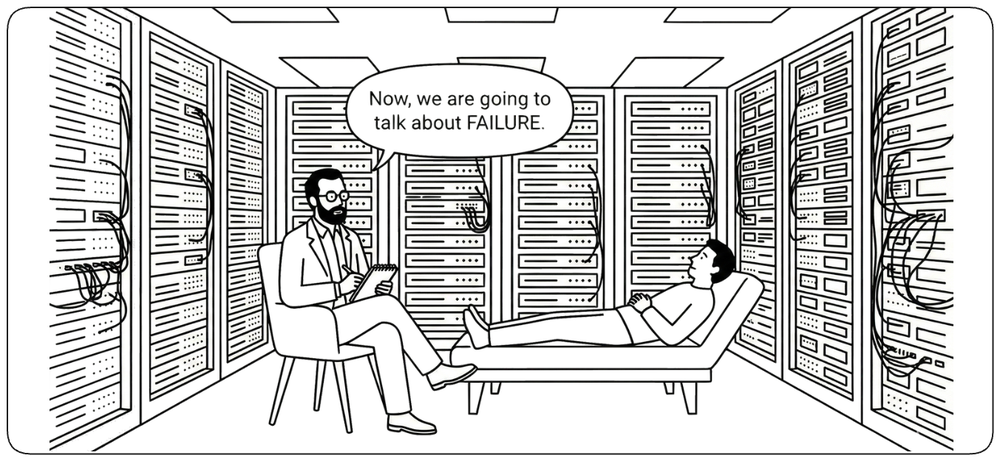
Design for Failure [Design for Failure] {1}
Designing for failure means accepting that components will break, dependencies will disappear, and assumptions will eventually be violated. These decisions are architectural: resilience is easiest to build into the system from the beginning and expensive to retrofit later. The objective is not to prevent every failure, but to keep failures contained, recoverable, and as invisible to users as possible. Isolation, redundancy, deadlines, graceful degradation, and recovery all follow from this principle.
Resilience vs Fault Tolerance [Definition]
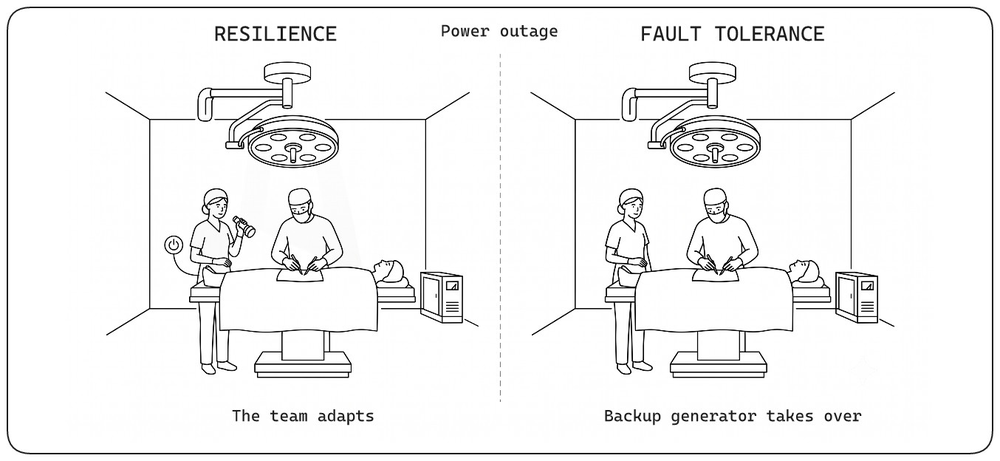
Two related but distinct properties describe how systems handle failure. Resilience is the ability to continue delivering an acceptable level of service despite failures by detecting, containing, and recovering from them. Fault tolerance is stricter: the ability to continue functioning correctly even when components fail, with zero visible disruption. Fault-tolerant systems use redundancy and replication so users never notice the failure. In practice, most modern systems aim for resilience across the board and reserve fault tolerance for the few critical paths where any disruption is unacceptable.
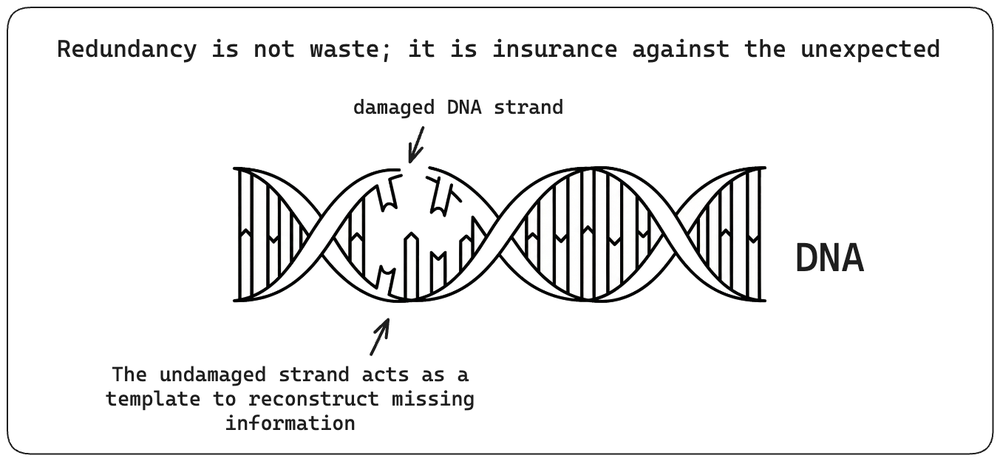
Resilience is in Our DNA [DNA]
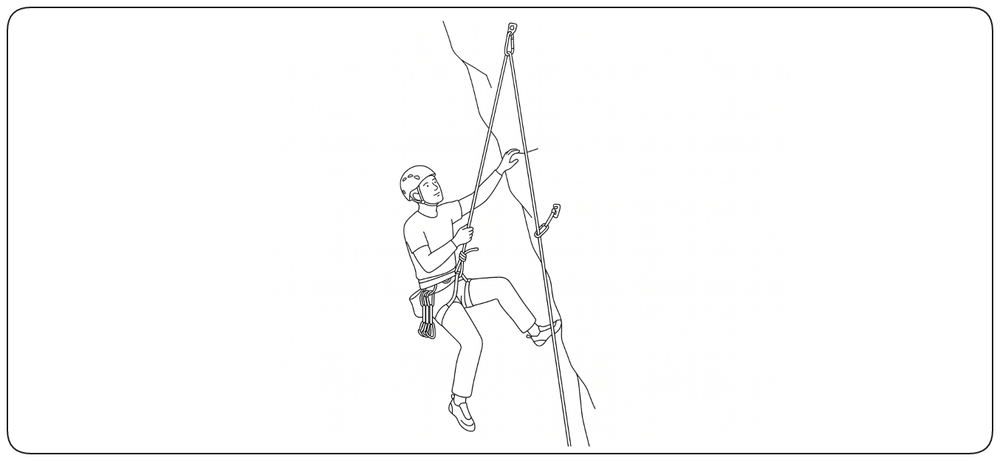
Biology already solved this problem. Every cell in the body carries a full copy of the genome; when one cell is damaged, its neighbours still hold the information needed to reconstruct what was lost. Local detection triggers local repair, and the organism keeps functioning while the fix happens in the background. The mechanisms are concrete: redundant copies of state, detection close to where the damage occurs, self-repair from an intact reference, and recovery without a central coordinator. Resilient software borrows the same primitives—replicated state, local health signals, autonomous recovery, and reconstruction from a healthy replica.
Understanding Failures
When Do Failures Occur? [When Failures Occur]
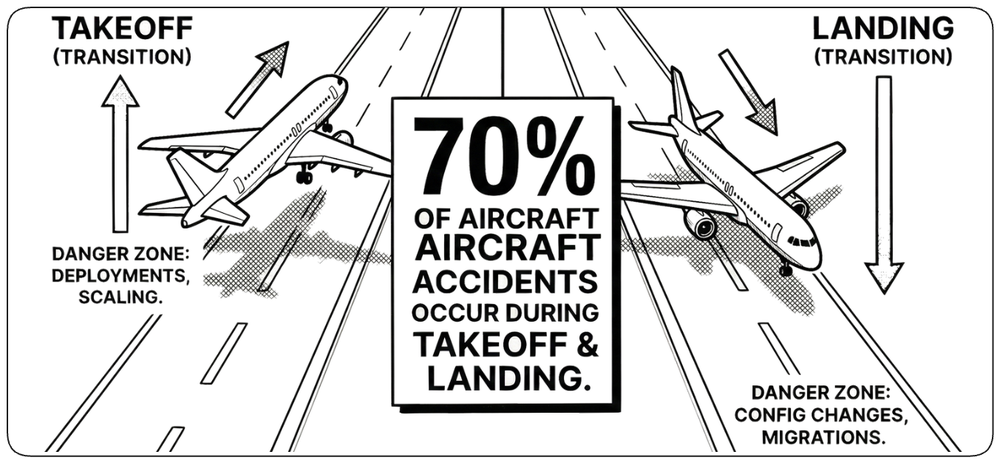
Failures can occur at any time, but state transitions often expose weaknesses that remain hidden during steady operation. Deployments, configuration changes, migrations, failovers, and major traffic shifts alter the system's conditions and can reveal fragile assumptions around scaling, cache state, queue depth, and dependency behavior. Transitions therefore deserve extra care, but they are not the only source of failure. This chapter focuses on how systems survive failures at runtime; the discipline of changing systems safely is covered in the release-management chapter.
Learn More
Chapter: Design to Be Released.
What Can Go Wrong? [Failure Scenarios]
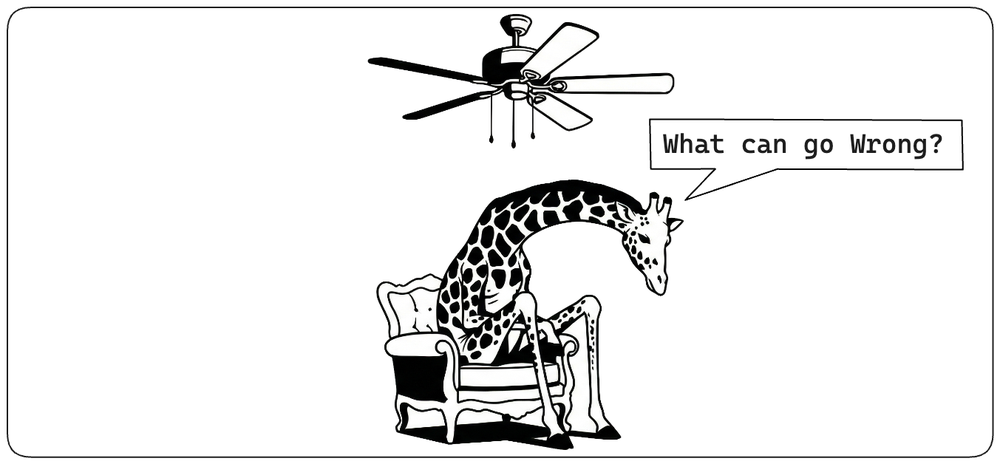
You cannot defend against failure modes you have never considered. Resilience begins by identifying what can break, how the failure can spread, and what the system should do when it happens. Failures cluster into three broad families: something disappears, something saturates, or something behaves incorrectly.
Something Disappears [Disappears]
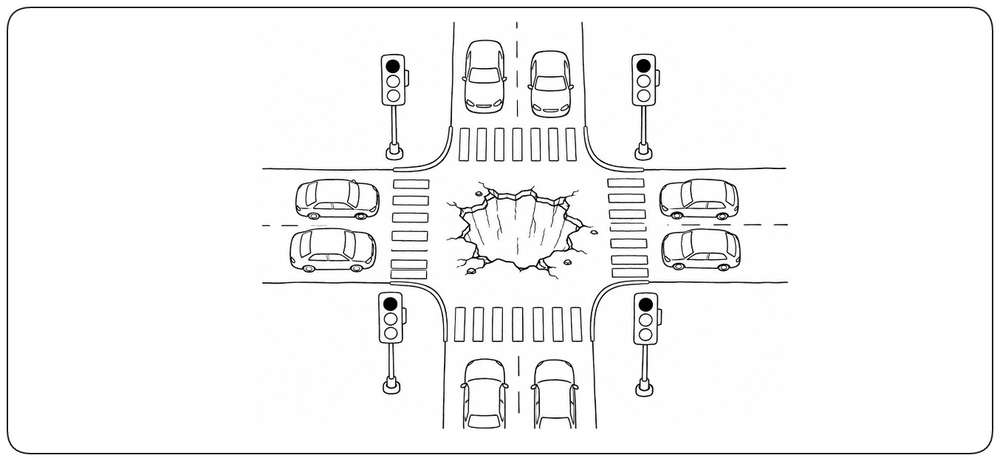
A component that the system depends on may suddenly become unavailable. A server can crash, a network partition can isolate part of the system, or an external service can stop responding. The resilient response is to detect the loss quickly, contain its impact, and continue operating through redundancy, failover, fallback, or graceful degradation.
Something Saturates [Saturates]
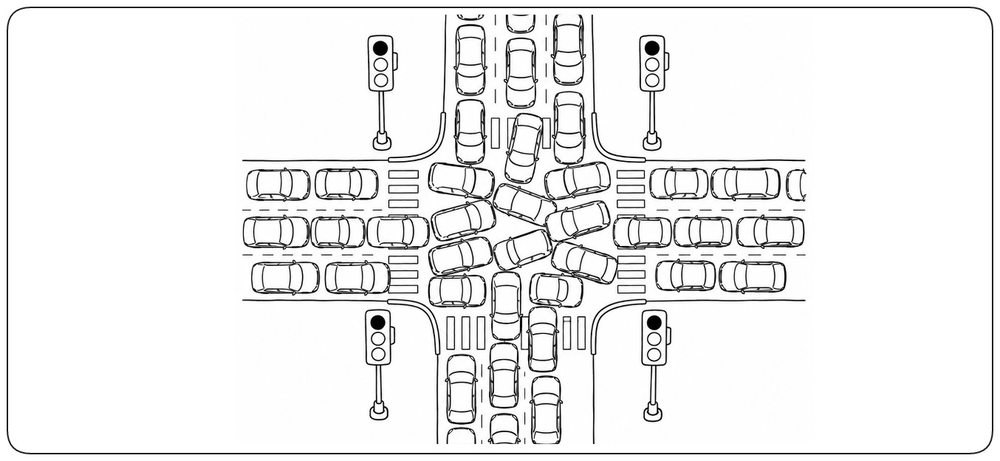
Every resource has a limit. CPU, memory, threads, connections, queues, and storage can all become exhausted when demand exceeds capacity or when work accumulates faster than it can be processed. Resilient systems use limits, isolation, backpressure, and load shedding to prevent local pressure from becoming a cascading outage.
Something Behaves Incorrectly [Behaves Incorrectly]
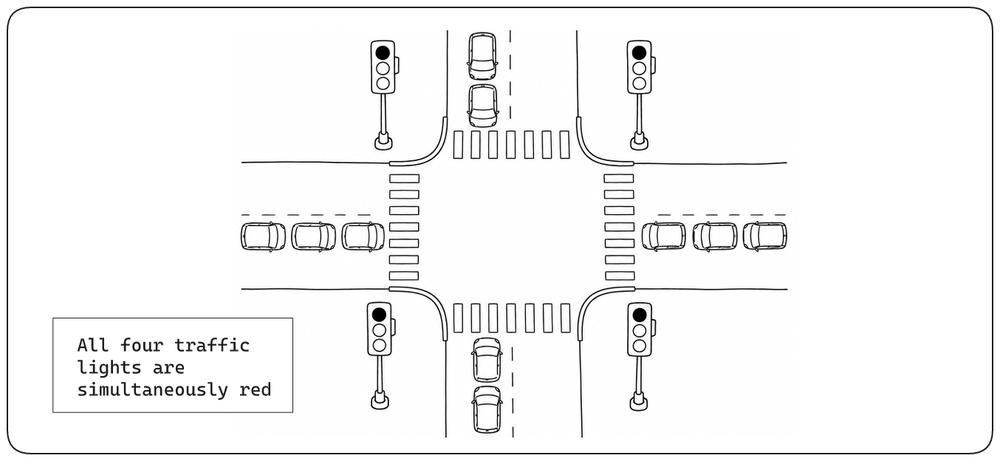
A component may remain available while producing the wrong result. Software defects, stale configuration, race conditions, corrupted state, and operator mistakes can all create failures that are difficult to detect because the system still appears to be running. Resilience requires validation, observability, safe defaults, and recovery paths that limit the damage when behavior is wrong rather than absent.
Failure is Multi-Dimensional [Multi-Dimensional]
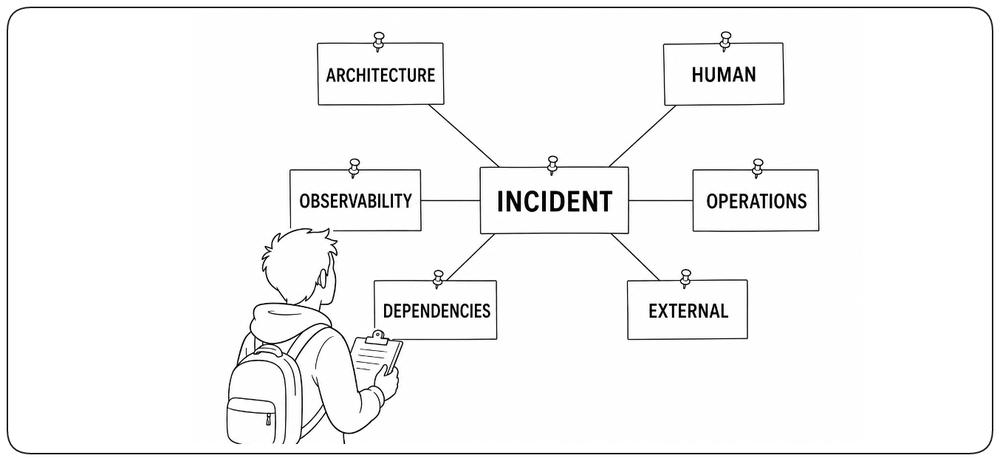
Major incidents rarely have a single cause. They emerge from weaknesses across multiple dimensions of the system: a technical defect, an architectural limitation, insufficient observability, operational gaps, human decisions, or external dependencies. Each issue may appear manageable in isolation, but together they create the conditions for failure. Incident analysis should therefore look beyond the triggering event and identify which architectural, operational, organizational, and technical weaknesses combined to allow the incident to occur.
The Cost of Resilience [Cost]
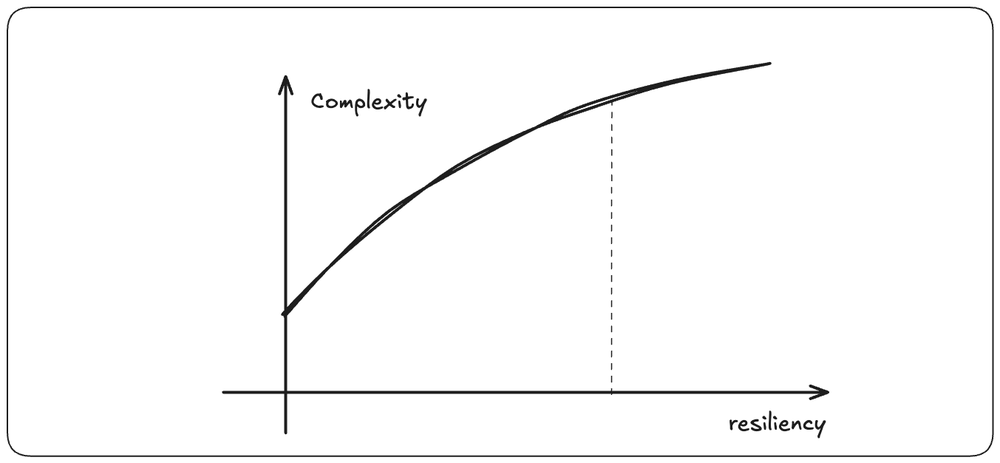
Building a resilient system adds both complexity and cost. It requires careful design to isolate failures, along with additional infrastructure such as replicas, backups, and failover mechanisms. These systems also take more effort to operate and maintain, so resilience investments should focus on the areas where failure would have the greatest business impact.
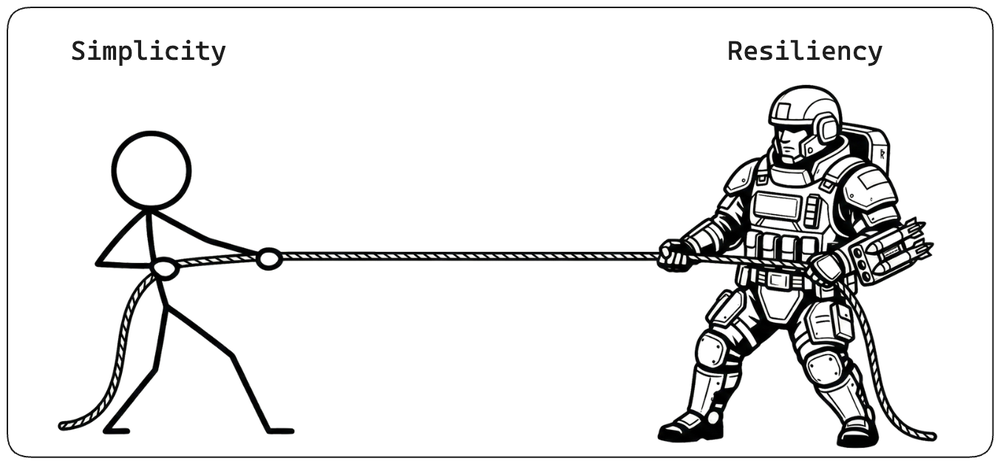
Balancing Simplicity and Resilience [Trade-offs]
A fundamental tension exists between simplicity and resilience. Simplicity should remain the default because it reduces complexity and improves adaptability. Additional resilience should be introduced only where the business impact of failure justifies the cost. The right balance is ultimately a business decision, weighing implementation complexity against the consequences of downtime.
Use the Simplest Pattern That Contains the Risk [Risk Fit]
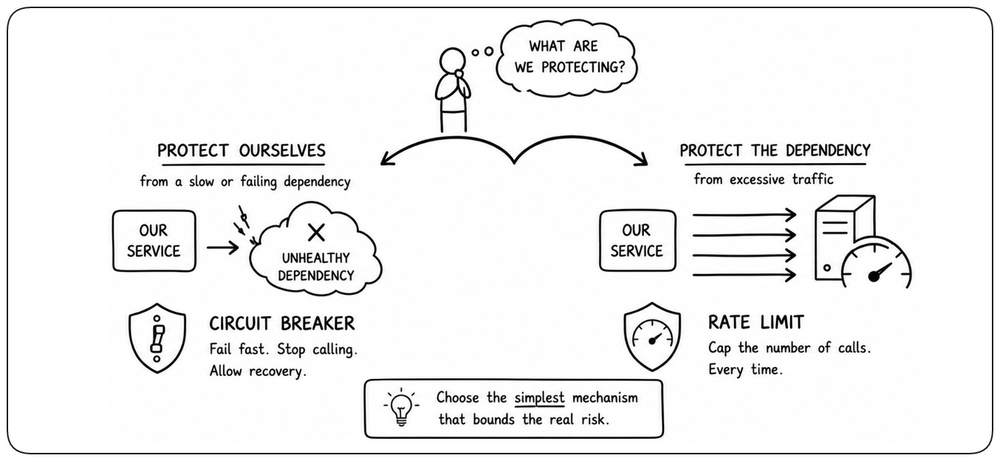
Resilience does not come from stacking every available pattern. Each mechanism protects against a specific failure mode and introduces its own complexity, state, and edge cases. Start with the risk you need to contain, then choose the simplest mechanism that bounds it. For example, a circuit breaker protects callers from an unhealthy dependency, while a rate limit protects a dependency from excessive traffic. Use the mechanism that matches the failure you are designing for.
When Failure Happens, You Have Choices [Failure Outcomes] {1}
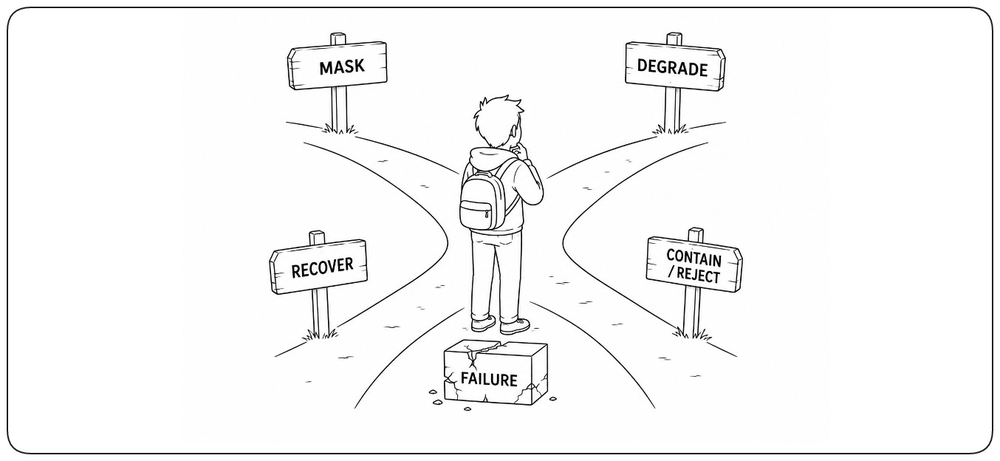
Failure is not binary. When something breaks, a system has four possible responses: !!mask the failure!! through redundancy, !!degrade!! by reducing functionality while preserving essential service, !!contain or reject!! requests to prevent wider damage, or !!recover!! by restoring healthy operation. Every resilience pattern in this chapter exists to achieve one of these outcomes. The design challenge is choosing the right response for each type of failure.
Core Resilience Principles
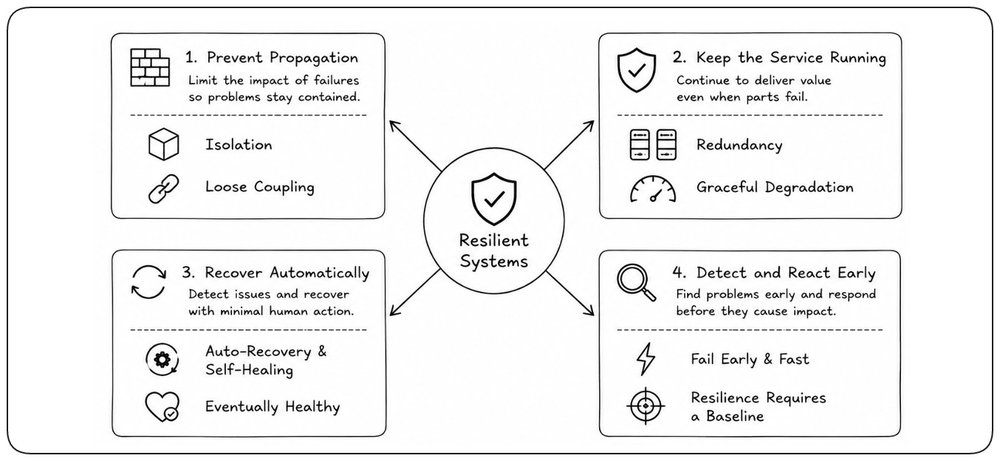
Resilience is built from a small set of complementary principles. Some shape the architecture before failures occur, while others define how the system behaves once failures happen. Together they limit failure propagation, preserve essential service, and enable predictable recovery.
Fail Early & Fast [Early Detection]
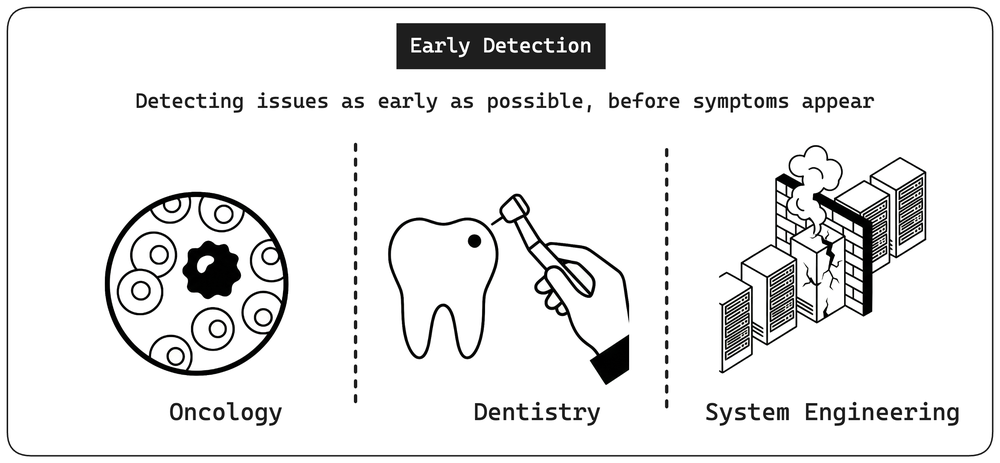
A resilient system exposes failure early instead of hiding or postponing it. At runtime, services should fail clearly and quickly rather than hang, retry blindly, or continue consuming resources on work that cannot succeed. Early failure limits the blast radius, simplifies diagnosis, and gives recovery mechanisms time to act.
Resilience Requires a Baseline [Baseline]
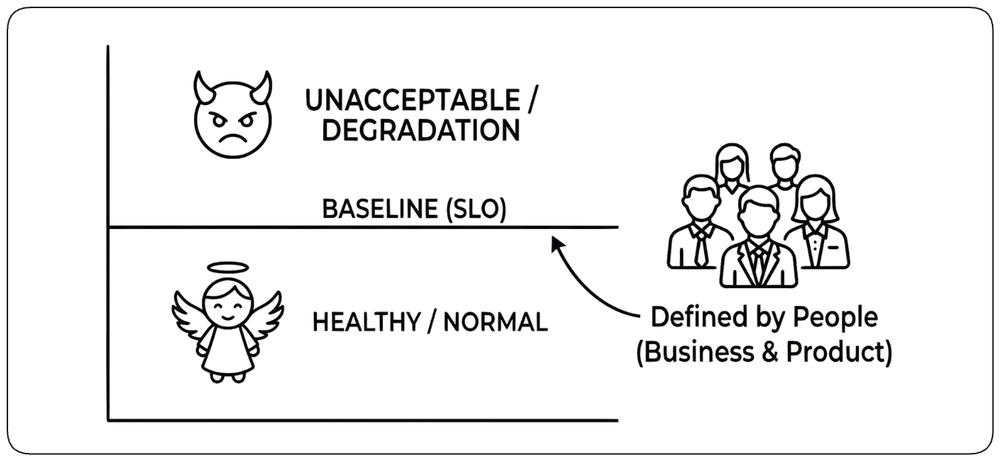
You cannot design for resilience without defining what "acceptable" means. That baseline is the Service Level Objective (SLO): the boundary between acceptable and unacceptable availability, latency, and error rates. The SLO is a product decision, not only a technical one—the business defines the service users need, and engineering determines how to achieve it. Without an SLO, teams cannot judge how much redundancy is justified, when degradation requires action, or which resilience investments matter most.
Hide Internal Recovery from Clients [Service Owned Resilience]
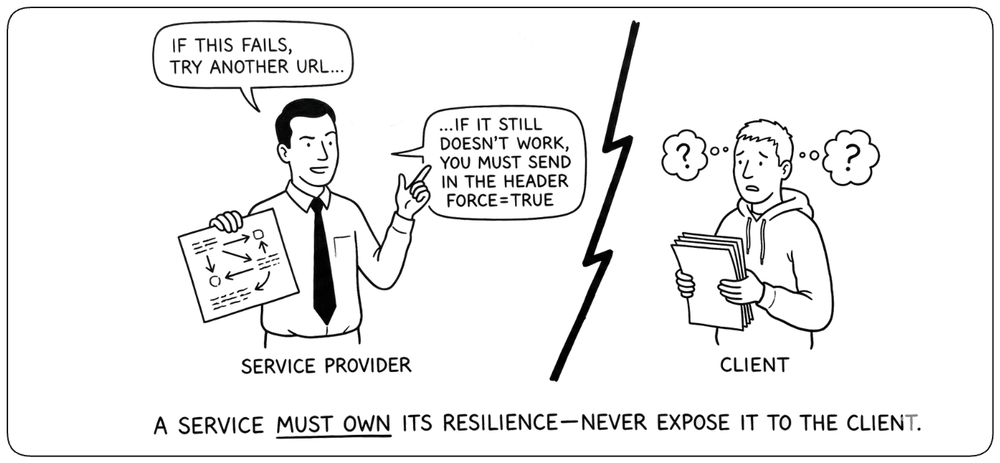
A service should own the recovery mechanisms inside its boundary: replica selection, retries to its own dependencies, cache warmup, internal circuit breakers, and failover between its own instances. Clients should see only the public failure contract—status codes, error semantics, deadlines, and backoff hints—not the service's internal topology or recovery paths. When recovery logic leaks across the boundary, every client reimplements it differently and system behavior becomes inconsistent.
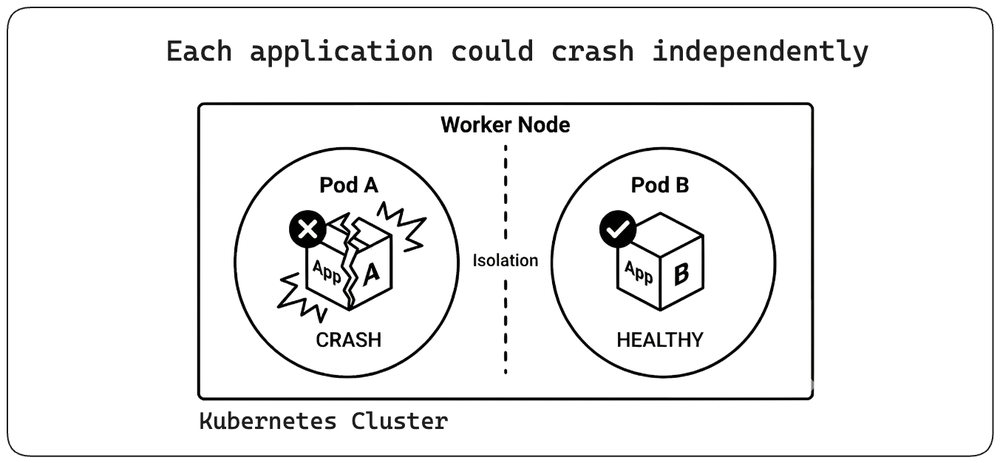
Isolation [Isolation]
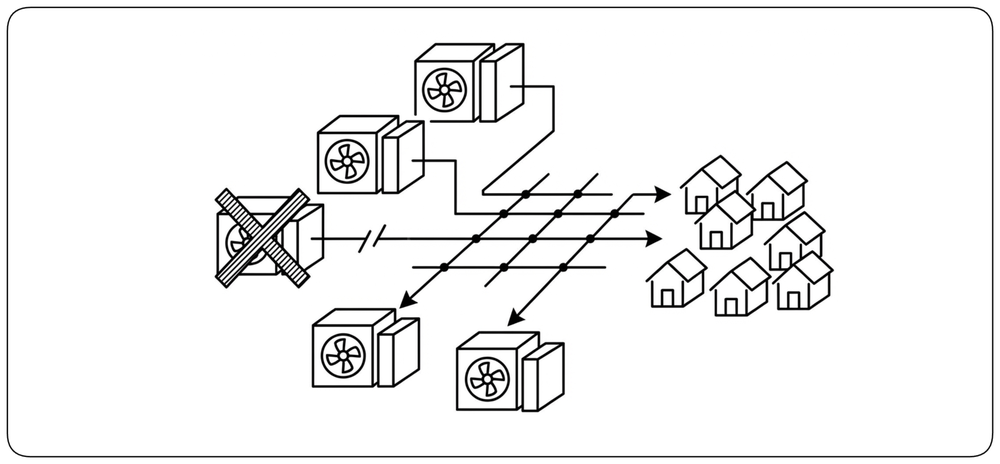
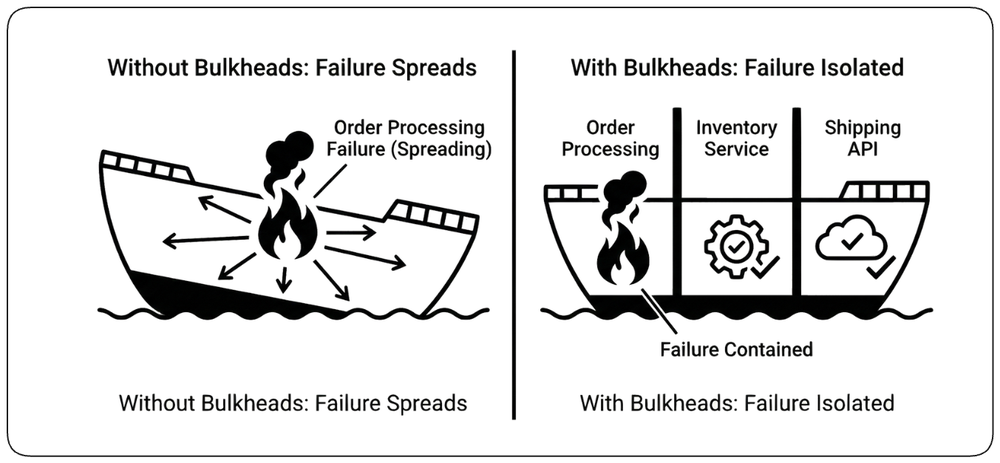
Isolation prevents failures from propagating across system boundaries. When components are properly isolated, a failure remains confined instead of cascading into unrelated services, workloads, tenants, or users. The objective is to create explicit failure domains—like bulkheads in a ship—so damage in one compartment cannot flood the rest of the system.
Service Isolation [Service Isolation]
Each service should operate as an independent failure domain with its own lifecycle, deployment path, and recovery behavior. A defect or dependency failure in one service should not directly destabilize the rest of the system. This independence also lets teams deploy, scale, and recover components without coordinating every change globally.
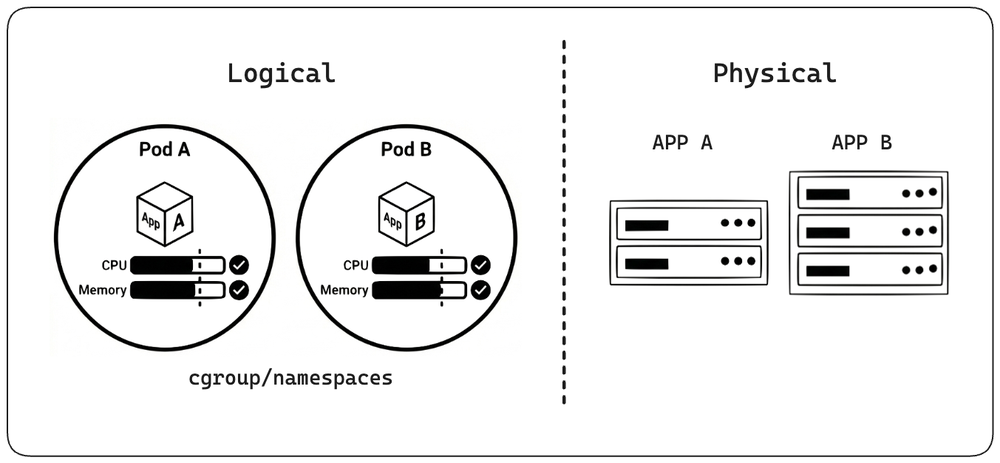
Resource Isolation [Resource Isolation]
Resource isolation prevents one workload from consuming the CPU, memory, storage, threads, or connections needed by others. Dedicated pools, quotas, container limits, and separate instances preserve capacity for critical work when another workload becomes noisy or slow.
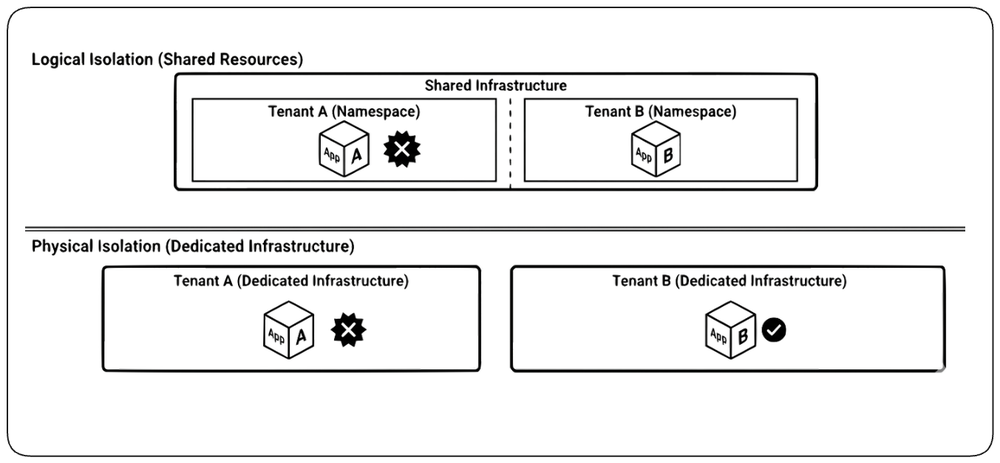
Tenant & Data Isolation [Tenant Isolation]
In multi-tenant systems, isolation prevents one tenant's load, defect, security incident, or data corruption from affecting others. The design can range from logical separation in shared infrastructure to dedicated databases or fully isolated environments. The stricter the business, regulatory, or blast-radius requirement, the stronger the boundary should be.
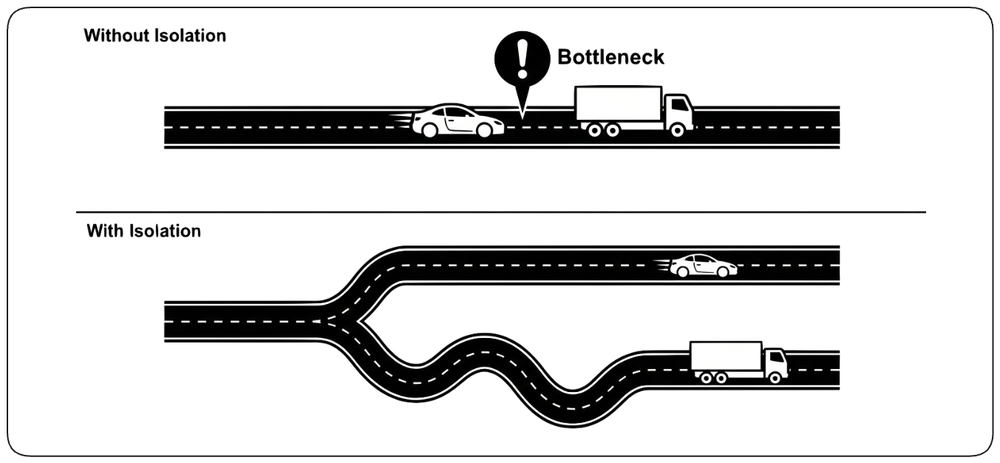
Workload Isolation [Workload Isolation]
Workload isolation separates traffic with different execution profiles. Long-running batch jobs, analytical queries, and background processing should not compete directly with latency-sensitive user requests. Separate queues, pools, or service instances keep slow work from degrading critical paths.
Redundancy [Redundancy]
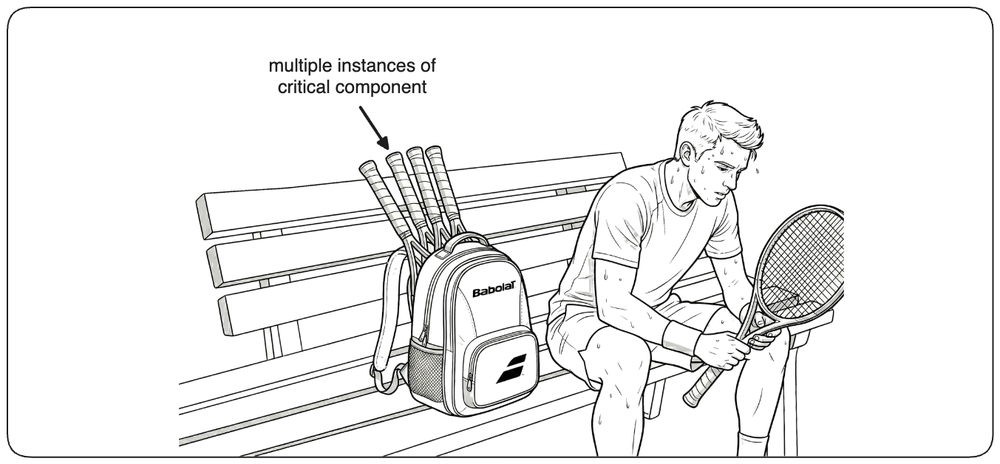
Redundancy removes single points of failure by maintaining multiple instances or copies of critical components. When one fails, another can continue serving traffic or preserve access to state. Replicas, load-balanced instances, synchronized databases, and standby systems all provide this protection. Redundancy is not free: each extra copy adds cost, operational complexity, and consistency trade-offs. Its level should therefore reflect the business impact of downtime.
Resilience Requires Headroom [Headroom] {1}
Resilience assumes !!capacity in reserve!!. A system running constantly at 95% CPU has no room to absorb a traffic spike, a slow dependency, a retry storm, or a failover event. !!Redundancy, retries, hedging, and failover all consume capacity when they activate!!—without headroom, the first incident saturates what remains and the failure spreads. Right-size for peak load plus a buffer, not the average.

Loose Coupling [Loose Coupling]
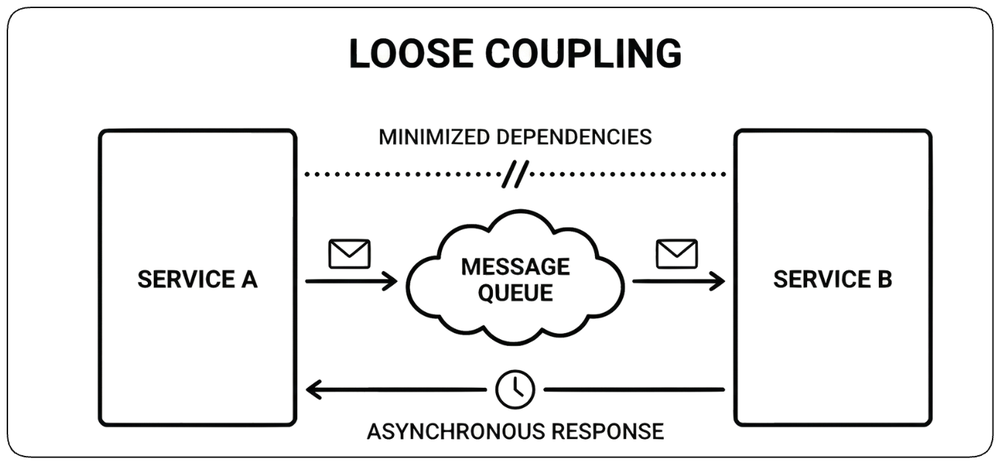
Loose coupling limits how far failures propagate. Components should interact through explicit contracts and avoid unnecessary assumptions about timing, implementation, and availability. Asynchronous communication can further separate producers and consumers in time, allowing each to fail and recover independently.
Auto-Recovery & Self-Healing [Self-Healing]
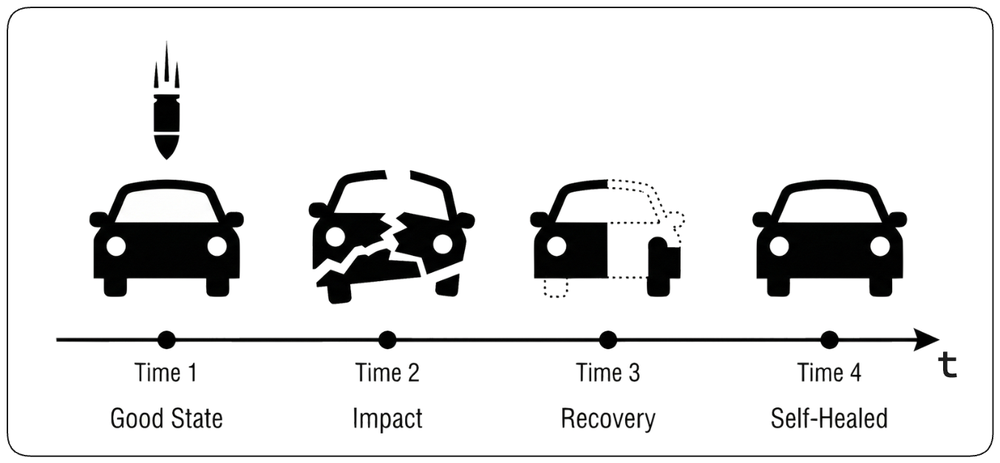
Resilient systems detect and correct routine failures automatically. Health checks, orchestration, and health-based routing can restart failed processes, replace unhealthy instances, and redirect traffic before users are affected. Automation reduces recovery time and operational load, but only when the recovery action is safe, bounded, and observable.
Know When to Restart
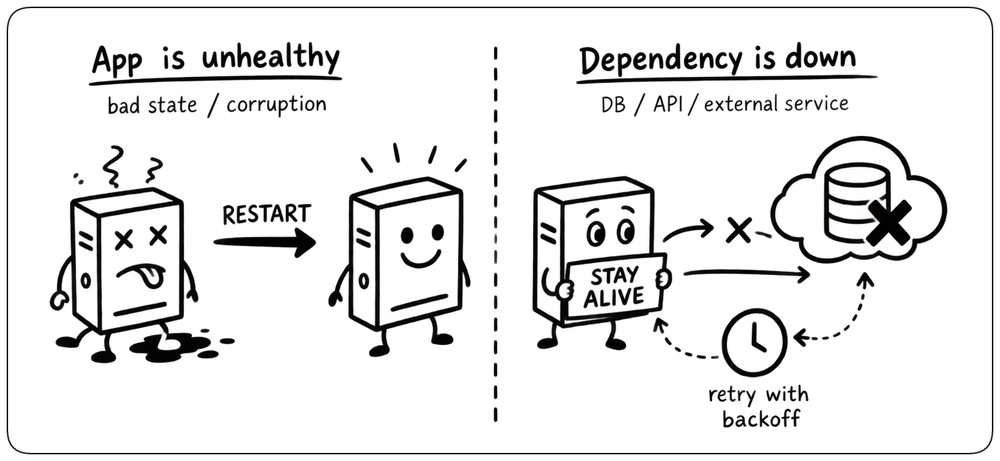
Restarting a process clears internal state and gives initialization another chance to succeed. Use it when the process itself is unhealthy, corrupted, or cannot guarantee its invariants—not to repair an unavailable database, a broken external API, or another persistent dependency failure. Repeated restarts can create loops, add load, and worsen an outage. If the process is sound, keep it alive, stop accepting work if needed, and recover with bounded retries, backoff, circuit breakers, or periodic probes. Restart when restarting can change the outcome; otherwise, recover in place.
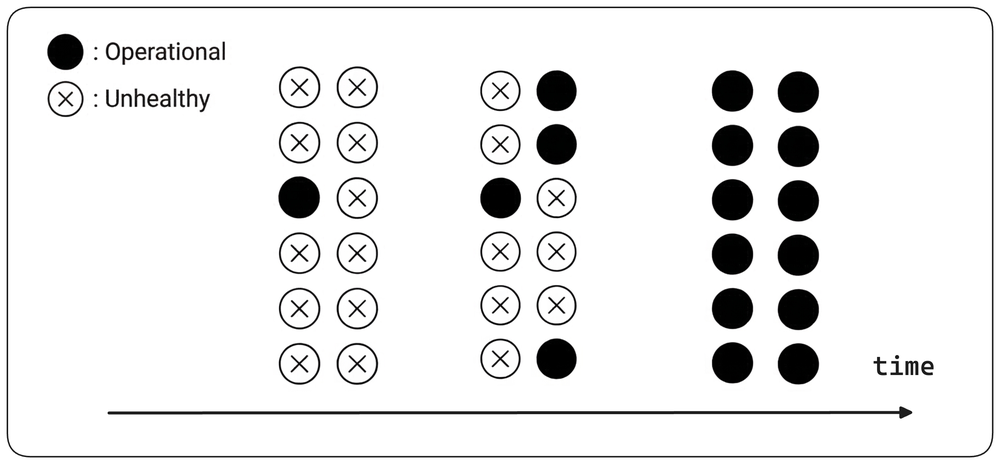
Eventually Healthy [Eventually Healthy]
Complex systems should converge toward a healthy state without relying on a fragile startup order or manual intervention. Components may become available at different times, but the system should stabilize automatically as dependencies recover.
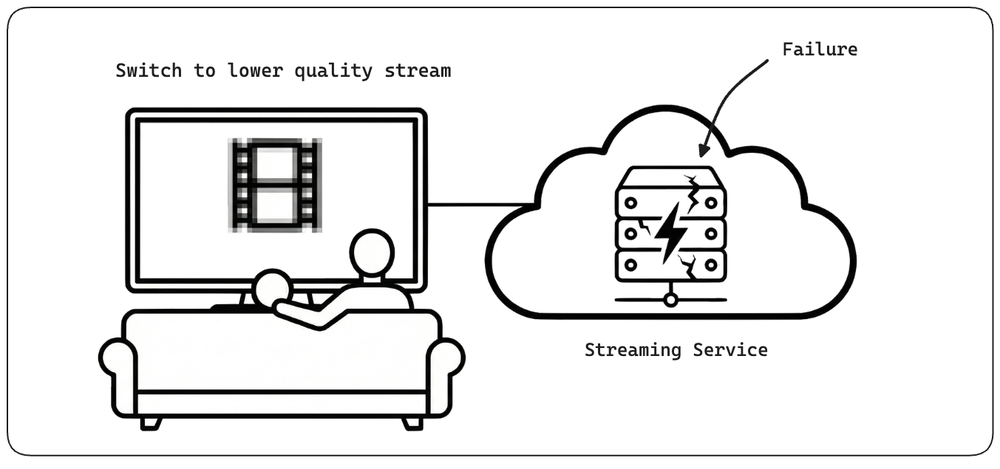
Graceful Degradation [Degradation]
Graceful degradation means continuing to provide the best possible service when full functionality is no longer available. Rather than failing completely, the system deliberately reduces quality, performance, or non-essential features so that core capabilities remain available.
Request Resilience
A single downstream call can fail by becoming slow, unavailable, or unreliable. Request-level patterns bound how long the caller waits, determine when another attempt is justified, stop calls to dependencies that are clearly unhealthy, and provide an acceptable alternative when the primary path cannot complete. Together, they prevent one failing interaction from consuming the caller's full latency and resource budget.
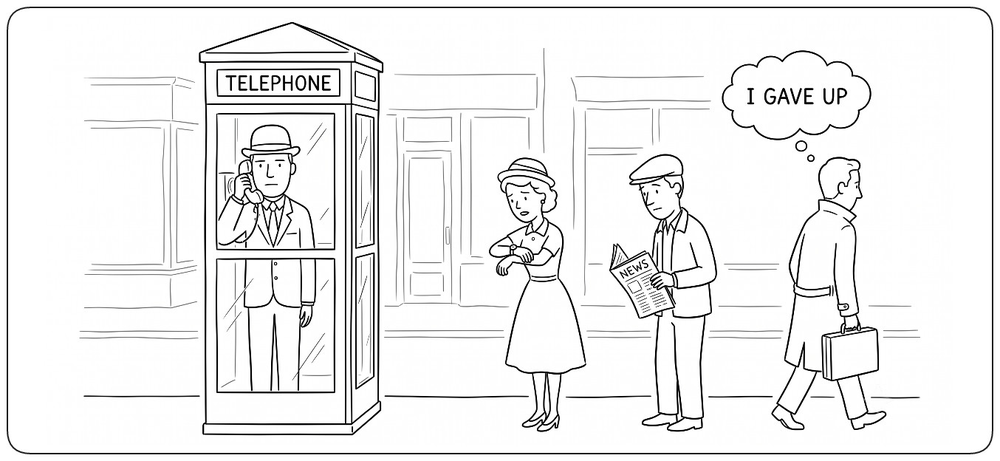
Timeout Pattern [Timeout]
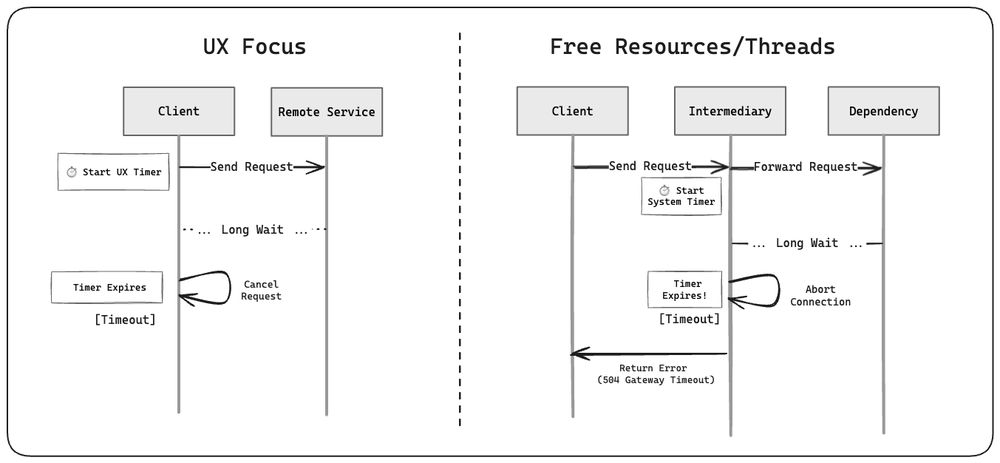
A timeout defines the maximum time a caller will wait before abandoning an operation and treating it as failed. It serves two purposes. At the client boundary, it protects responsiveness by preventing users from waiting indefinitely. Inside the system, it protects capacity. Without timeouts, slow dependencies hold threads, sockets, memory, and connection-pool entries until the system itself becomes saturated.
Set Timeouts from Observed Latency and the End-to-End Budget [Latency Timeout]
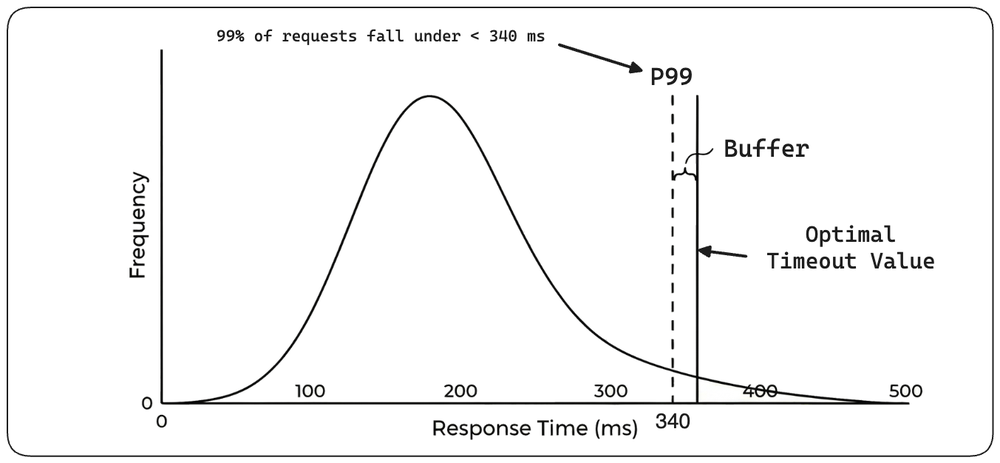
Timeout values should come from two inputs. First, observed service behavior: use the p99 latency as a lower-bound signal for how long a healthy call normally takes. Second, the end-to-end budget: how long the caller can wait, minus time already spent and room for retries. A timeout based only on p99 may outlive the caller's deadline, while one based only on the deadline may ignore whether the call can realistically succeed. Both are needed.
Propagate the Deadline, Not the Timeout [Timeout Chain]
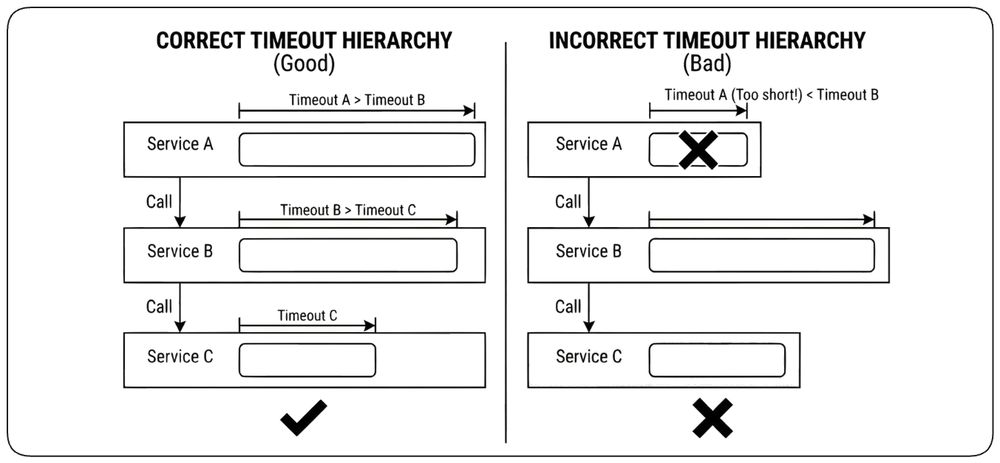
Static timeout chains are fragile because each service defines its own limit without knowing how much time the caller has already spent. The better approach is deadline propagation: the top-level caller sets an end-to-end deadline, and each service passes the remaining budget downstream. A request arriving with only 200ms left should not start a 5-second retry or call a dependency that cannot finish in time. Propagating the deadline keeps every decision aligned with the caller's real budget and avoids work whose result will arrive too late.
Deadline-Aware Behavior Under Degradation [Adaptive Timeout]
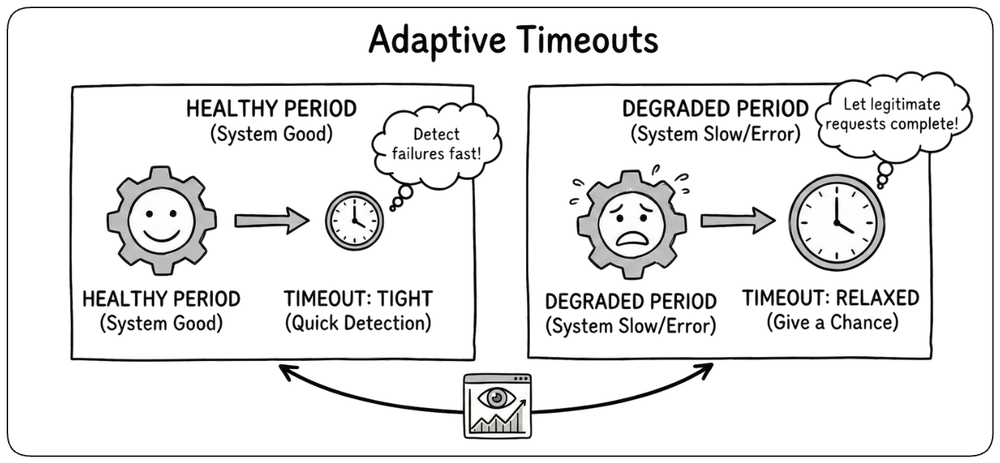
Under degradation, longer timeouts usually make things worse, not better. They keep threads, sockets, and memory occupied, increasing saturation. Instead, stay deadline-aware: track the caller's remaining budget and use signs such as rising latency or error rates to decide when to skip work through load shedding, circuit breakers, or fallbacks. Adapt what you abandon, not how long you wait.
Retry Pattern [Retry]
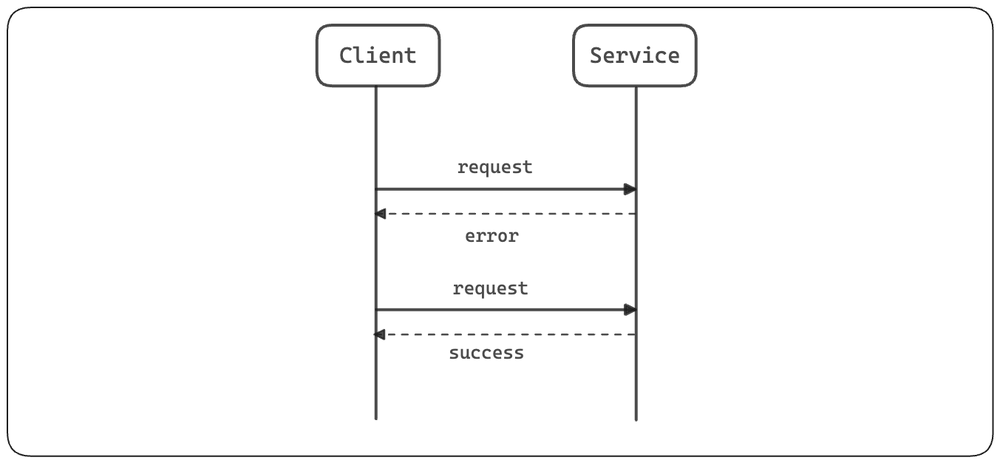
A retry repeats a failed operation when the failure is likely to be transient: a brief network interruption, temporary overload, or short-lived dependency outage. Retrying is useful only when another attempt has a realistic chance of producing a different result.
The Limits of Retry [Retry Limits]
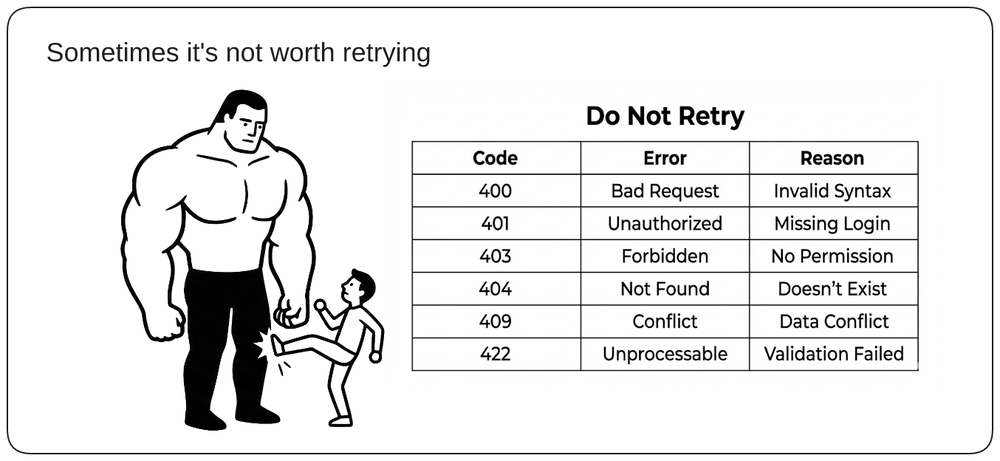
Retry is fundamentally a question of context. Before trying again, ask: "Can another attempt realistically produce a different outcome?" If not, retrying only wastes resources, delays failure, and may amplify load on an already struggling system. Retries make sense for transient failures such as brief network interruptions or temporary overload. They do not help with deterministic failures such as invalid credentials, malformed input, or a deleted resource, which should fail immediately.
Idempotency [Idempotency]
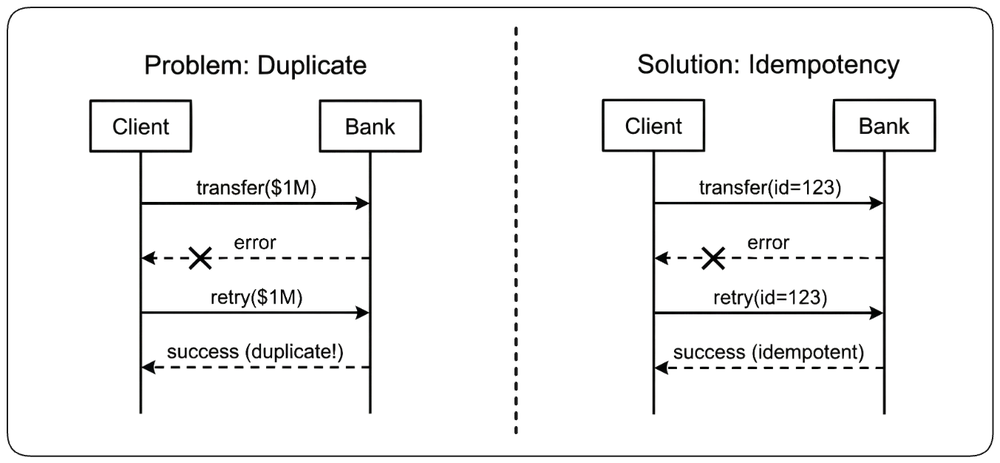
Safe retries require idempotency: repeating the same logical operation must not produce additional side effects. This matters when the caller cannot tell whether the first attempt succeeded before the connection failed. A unique idempotency key lets the receiver recognize duplicate attempts and return the original result instead of charging twice, creating two orders, or repeating another irreversible action.
Do Not Retry After the Caller's Deadline [Retry Strategies]
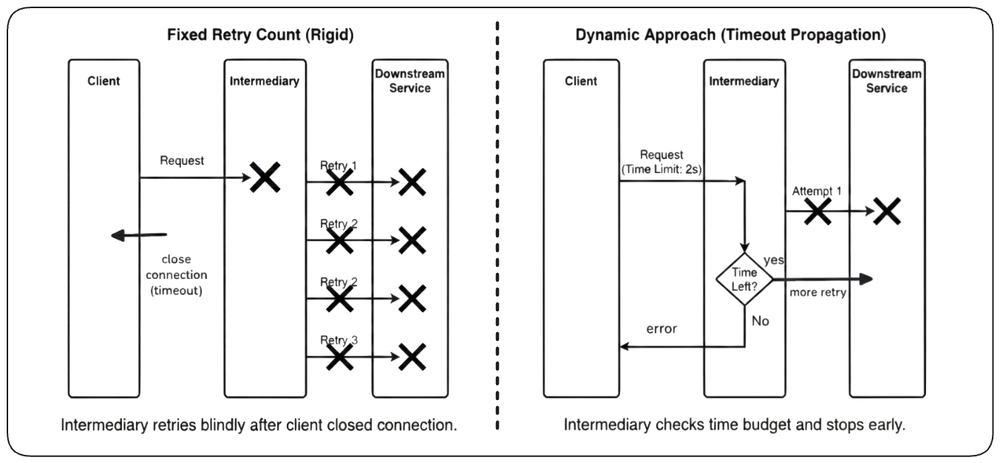
A common retry mistake is continuing after the caller has already given up. Fixed retry counts ignore time, so an intermediary may keep trying even after the end-to-end deadline has expired. That work is wasted and consumes capacity that could serve requests still within budget. Before every retry, check the remaining deadline. If there is not enough time for the attempt to complete, stop. Retries must fit inside the original time budget, not extend it.
Backoff and Jitter [Retry Pause]
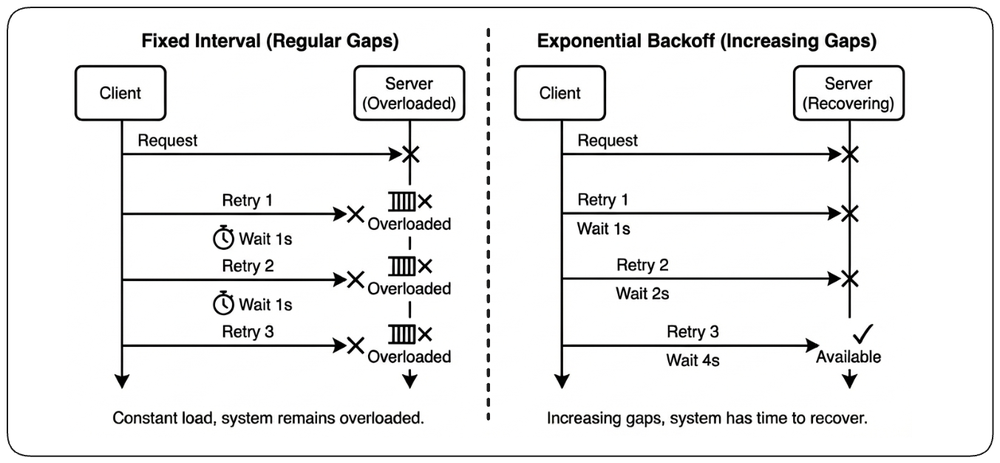
Retry scenarios usually result from overload, quota exhaustion, or temporary unavailability, so when to retry matters as much as whether to retry. Exponential backoff spaces attempts to give the system time to recover instead of hammering it continuously. Jitter randomizes those delays so clients do not retry in lockstep and create a thundering herd. When the server provides a Retry-After header, honor it—it reflects recovery information the client cannot infer on its own.
Circuit Breaker Pattern [Circuit Breaker]
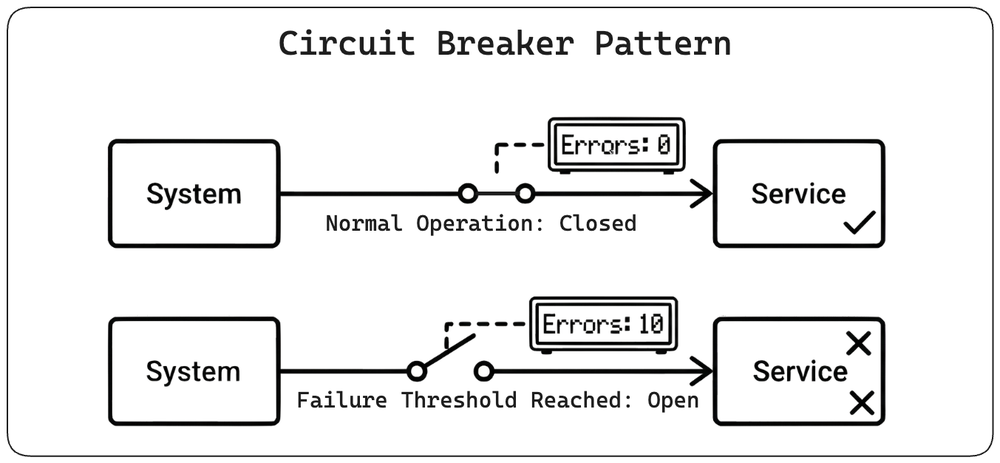
A circuit breaker stops calls to a dependency that is repeatedly failing. After a failure threshold is reached, the breaker opens and rejects new calls immediately. After a delay, it allows a limited number of probe requests through; if they succeed, normal traffic resumes. This prevents repeated calls from consuming resources and amplifying an outage.
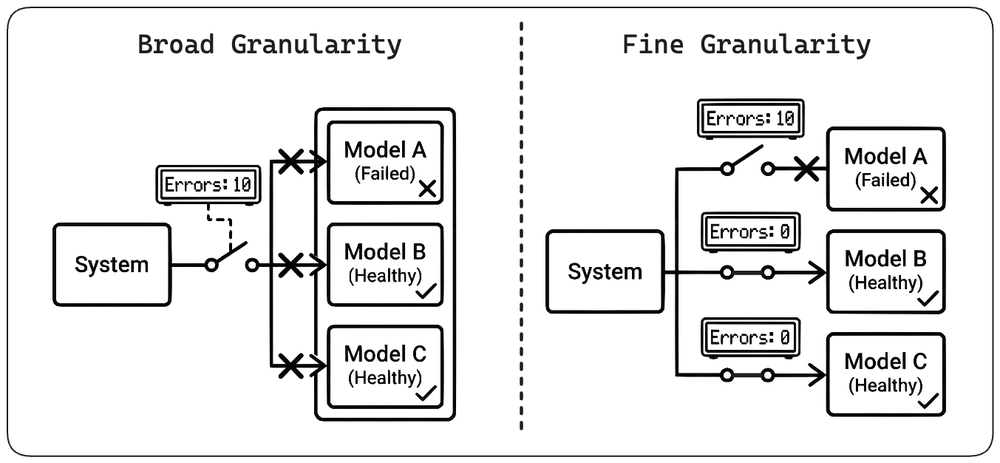
Circuit Breaker Granularity [CB Granularity]
A circuit breaker is only as effective as its granularity. If it protects multiple independent dependencies, a failure in one can block access to all of them, including healthy ones. For example, placing several LLM models behind a single circuit breaker means one deprecated or failing model can prevent requests to every other model. The circuit breaker, intended to contain failure, instead amplifies it. Scope circuit breakers to individual endpoints, models, or service instances so failures remain isolated and healthy alternatives stay available.
Hedging Pattern [Hedging]
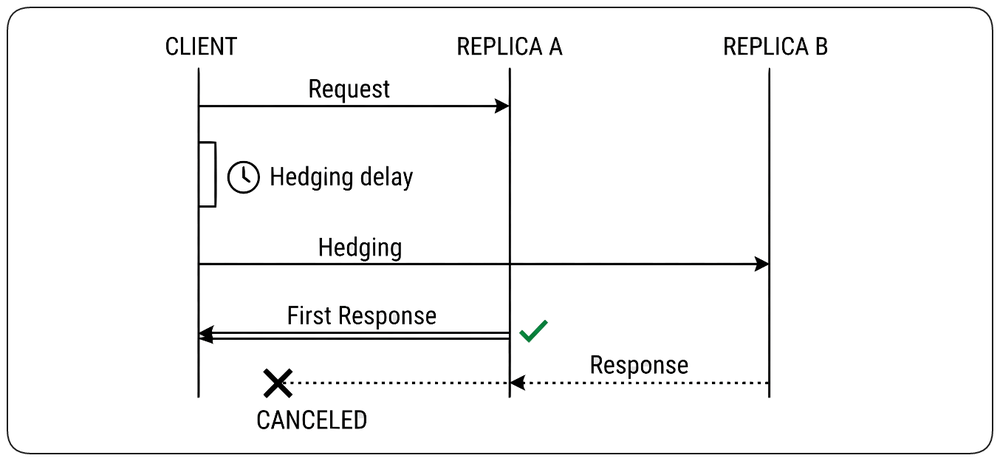
Hedging reduces the impact of unusually slow responses by sending a backup request before the original request has failed. The caller sends the request to one replica, waits briefly, and—if no response has arrived—sends the same request to another replica. The first successful response wins, and the other request is canceled. Hedging should be limited to idempotent operations and independent replicas because duplicate requests increase load.
Fallback Pattern [Fallback]
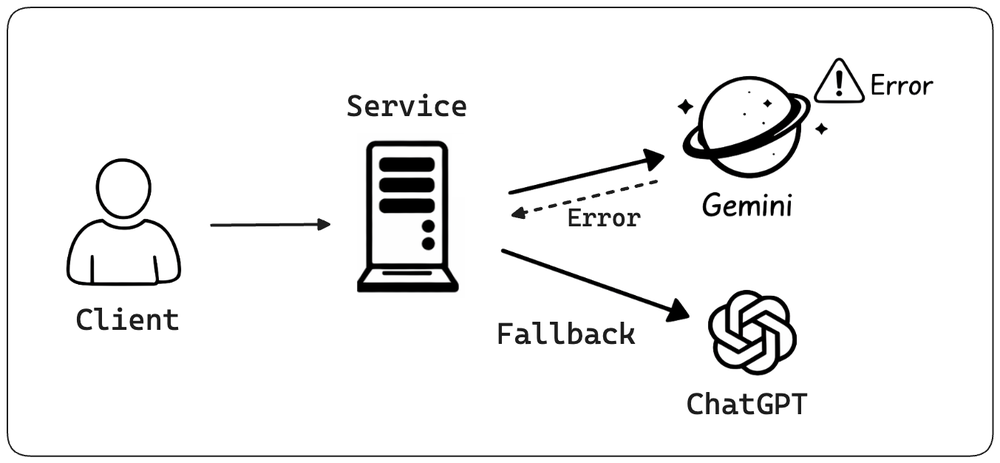
The fallback pattern provides an alternative response when the primary operation cannot complete. Rather than propagating an error, the system returns an acceptable—though degraded—result so essential functionality remains available. Fallbacks may return cached or stale data, safe default values, static content, or responses from an alternative service. The appropriate strategy depends on the acceptable trade-off between freshness, accuracy, and availability.
Capacity Protection
Even when every component behaves correctly, a system can fail simply because demand exceeds its capacity. Capacity protection patterns control how much work enters the system, isolate competing workloads, propagate saturation upstream, and discard work that cannot be processed safely. Their purpose is to keep the system operating within sustainable limits instead of collapsing under overload.
Bulkhead Pattern [Bulkhead]
The bulkhead pattern divides shared capacity into independent compartments so that exhaustion in one workload cannot consume everything. Separate thread pools, connection pools, queues, or instance groups preserve capacity for unaffected traffic when one dependency or workload becomes slow.
Rate Limiting Pattern [Rate Limiting]
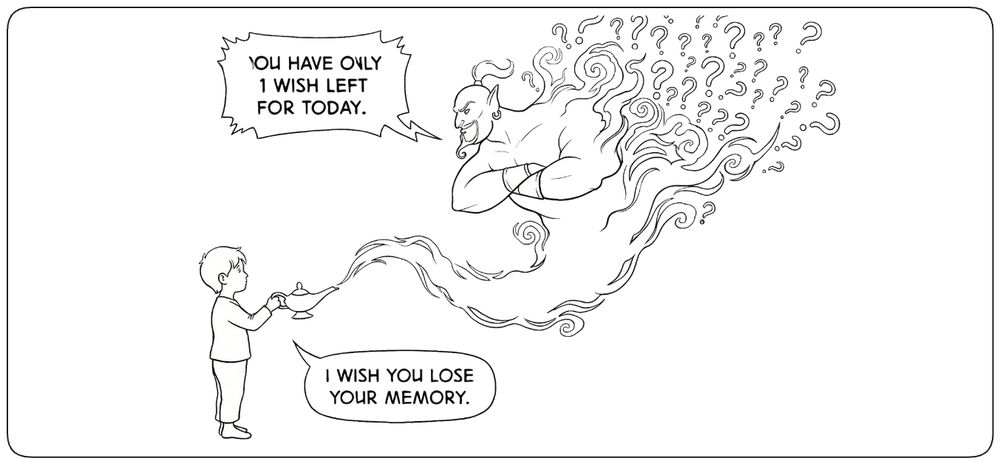
Rate limiting controls the number of requests a client or service can make within a given time window. By capping throughput, it prevents any single actor from overwhelming the system, whether through malicious attacks, misbehaving clients, or sudden traffic spikes. When limits are exceeded, the system returns a 429 Too Many Requests response, often with a Retry-After header indicating when to try again.
Rate Limiting Algorithms [Rate Algorithms]
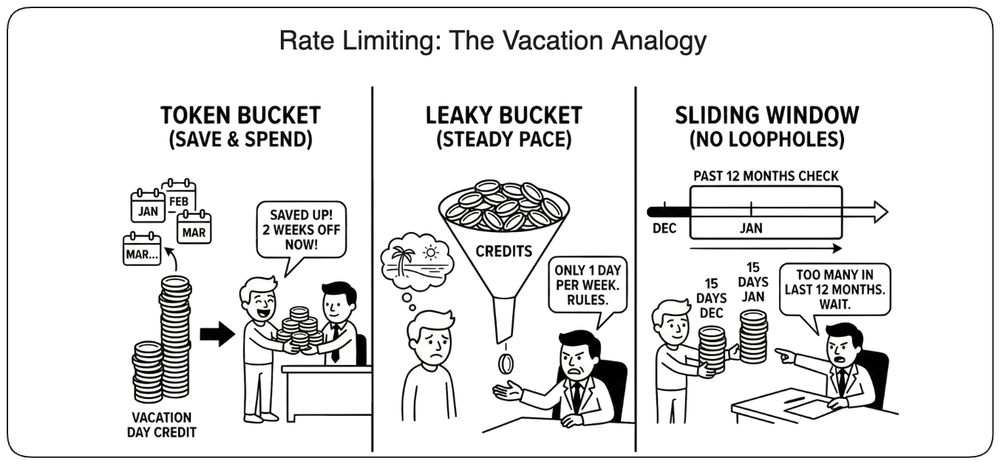
Several algorithms implement rate limiting, each with different trade-offs. Token Bucket allows short bursts while enforcing a steady average rate. Leaky Bucket smooths traffic by processing requests at a constant rate. Sliding Window tracks requests over a rolling time period, avoiding the abrupt resets of fixed windows. In practice, the algorithm matters less than deciding what to limit (requests, bytes, tokens, CPU) and where to apply the limit (per user, tenant, endpoint, or globally).
Rate Limiting Granularity [Rate Granularity]
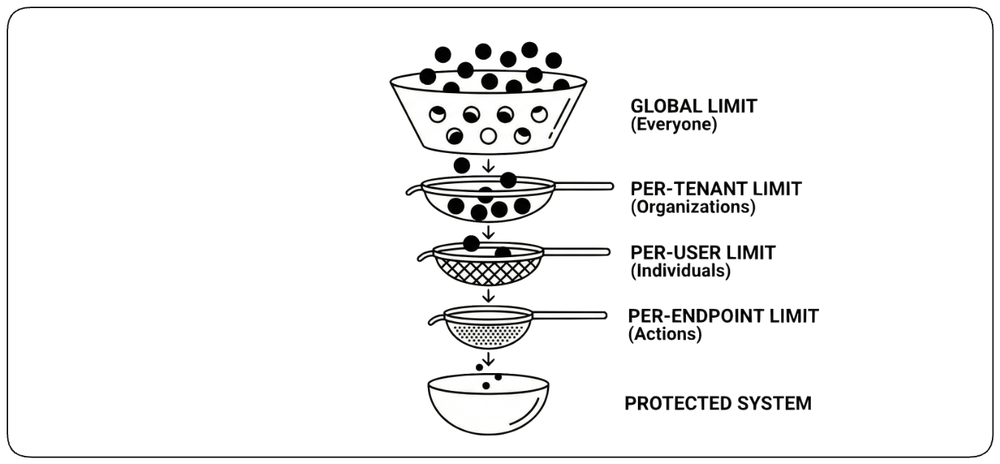
The effectiveness of rate limiting depends on choosing the right scope. Per-user limits prevent individual accounts from monopolizing resources. Per-tenant limits control consumption across an organization. Per-endpoint limits allow stricter protection for expensive operations, while global limits provide a last line of defense for the entire system. In practice, combining several levels offers the best protection and fairness.
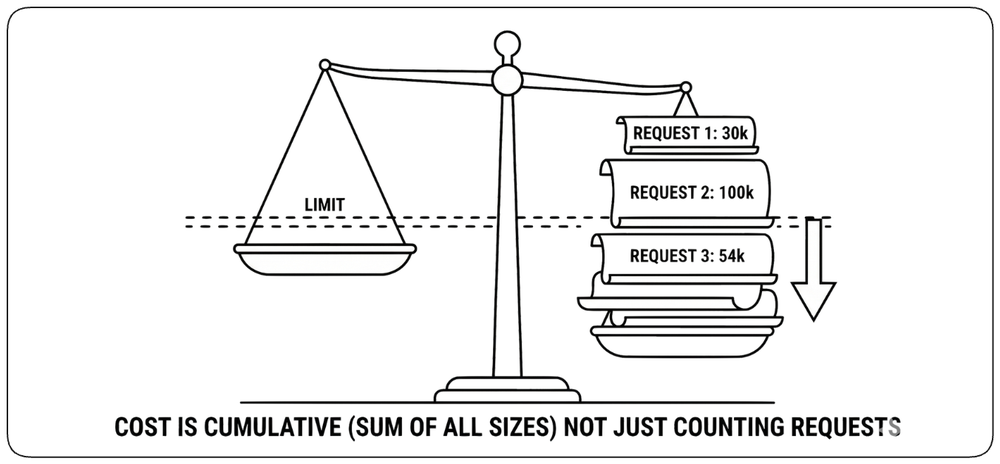
Limit Work, Not Just Requests [Token Rate Limiting]
Counting requests alone assumes every request costs the same, which is often false. A small read and a complex database query—or a short LLM prompt and a very long one—can consume vastly different resources. When request cost varies significantly, limit the actual unit of work instead: bytes transferred, query cost, CPU time, or generated tokens. LLM services popularized this approach by limiting tokens per minute rather than requests per minute, but the principle applies whenever request count is a poor proxy for resource consumption.
Backpressure Pattern [Backpressure]
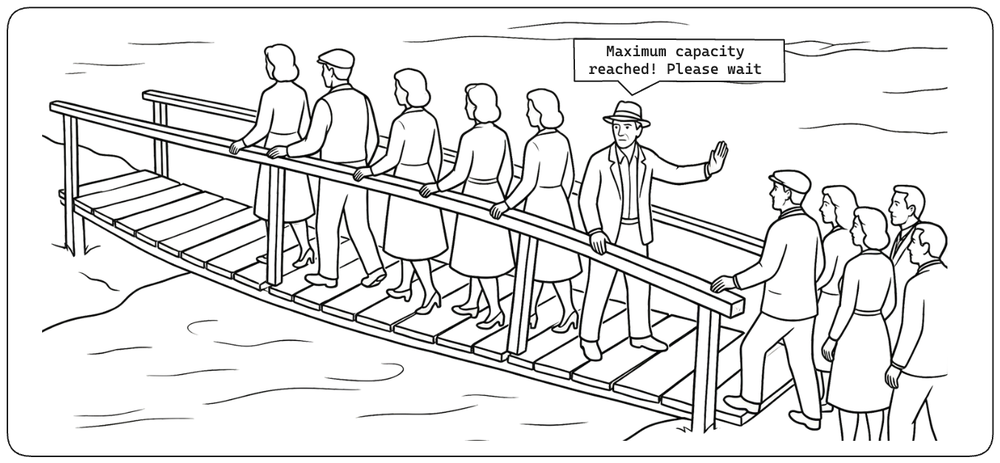
Backpressure is a flow-control mechanism where downstream services signal their limits to upstream producers. Instead of accepting work it cannot process, an overloaded service slows or rejects incoming traffic so pressure propagates backward through the system. Unlike rate limiting, which enforces a predefined cap, backpressure adapts to real-time capacity. This prevents unbounded queues, memory exhaustion, and cascading timeouts while keeping throughput within sustainable limits.
Implementing Backpressure [Implementation]
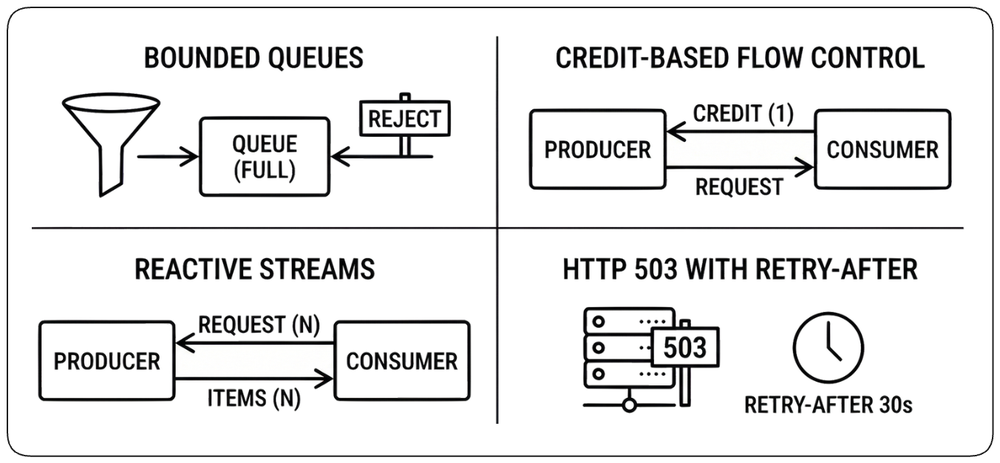
Backpressure can be implemented through bounded queues that reject requests at capacity, credit-based flow control where consumers grant tokens to producers, reactive streams frameworks that let consumers pull only what they can handle, or HTTP 503 responses with Retry-After headers. The key distinction from rate limiting: backpressure is adaptive and bidirectional, reflecting real-time system state rather than static thresholds.
Load Shedding Pattern [Load Shedding]
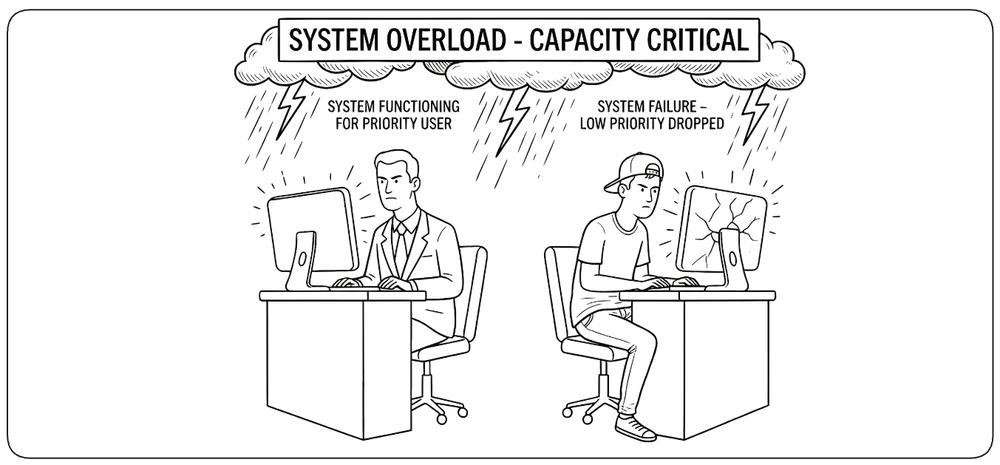
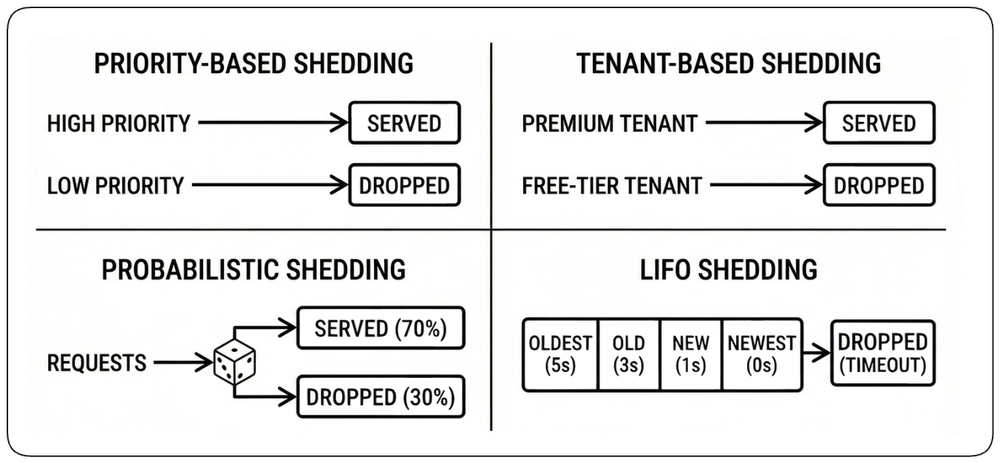
Load shedding deliberately drops low-priority requests during overload conditions to preserve capacity for critical operations. When a system cannot handle all incoming traffic, it's better to successfully serve important requests than to fail everyone equally.
Shedding Strategies [Shedding Strategies]
Effective load shedding starts by deciding what to drop first. Requests may be prioritized by importance, tenant, or probability, preserving critical operations while sacrificing less valuable work. Another useful strategy is age-aware shedding: if a request has already exceeded the caller's useful deadline, processing it only wastes capacity. Load shedding should always return a clear signal—typically HTTP 503 with a Retry-After header—so clients back off instead of creating retry storms.
Availability & Data Resilience [Availability & Data]
Some failures affect more than a single request: an instance crashes, a region becomes unavailable, or durable state is at risk. These patterns protect long-lived availability and data integrity through replication, failover, repair, and coordinated recovery. Their goal is to keep the service reachable and the system consistent despite infrastructure or storage failures.
Define What You Can Lose: RTO & RPO [RTO RPO]
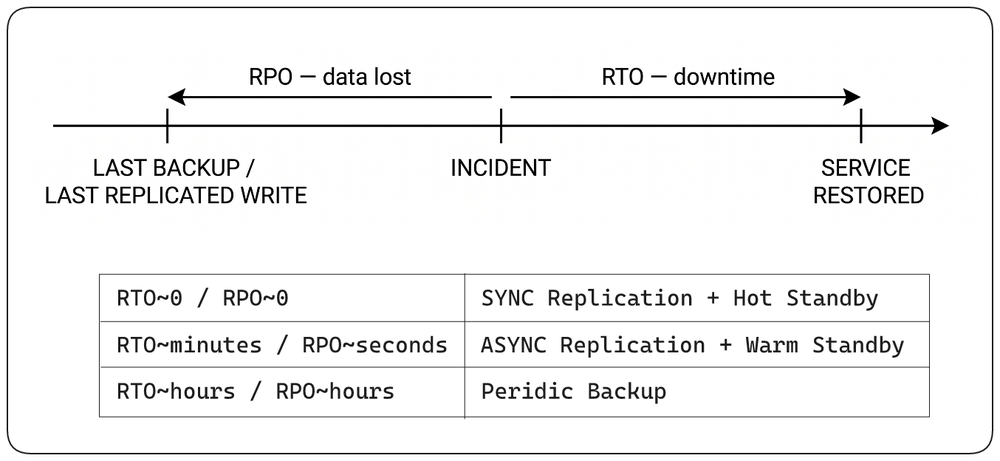
Before choosing a failover strategy or backup policy, define what the business can afford to lose. RTO (Recovery Time Objective) is the maximum acceptable downtime, while RPO (Recovery Point Objective) is the maximum acceptable data loss. These two objectives drive every resilience decision—from replication strategy and standby configuration to backup frequency. Without clear RTO and RPO targets, teams either over-engineer resilience or under-protect critical systems.
Failover & Replication [Failover]
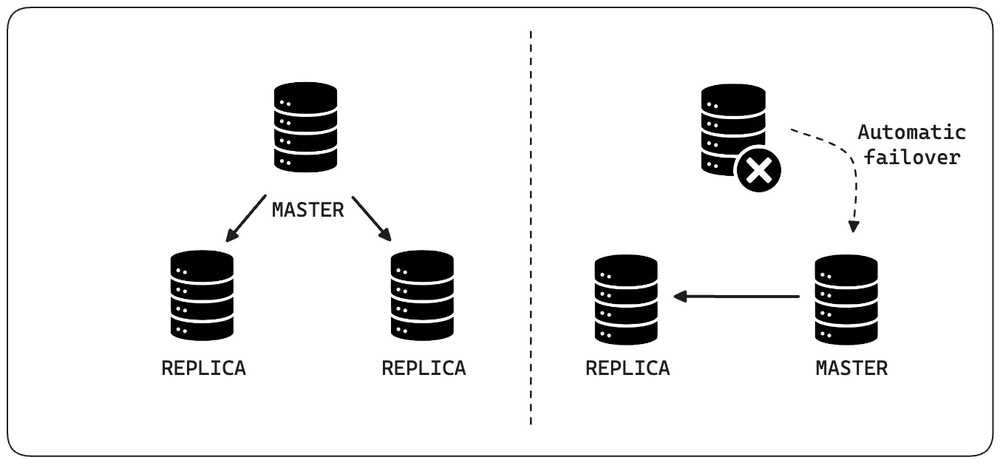
Failover redirects traffic to a healthy instance when one fails; replication ensures there is another copy of the state to fail over to. If a primary database goes down, a replica is promoted and traffic is redirected. Failover reduces downtime, but it is rarely seamless: brief errors may occur, some in-flight data can be lost depending on the replication mode, and poor designs can still suffer split-brain. The goal is not zero disruption, but disruption that stays within the system's RTO and RPO objectives.
Geographic Failure Domains [Geographic Isolation]
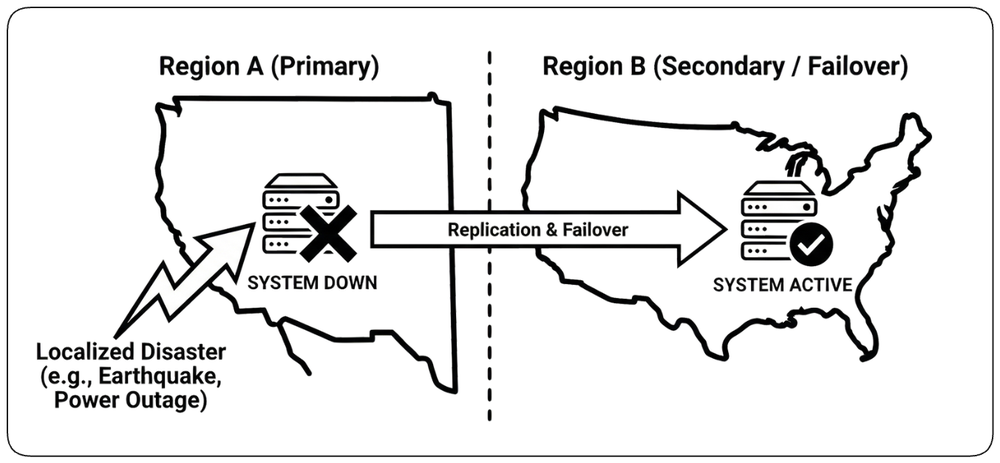
Geographic failure domains distribute critical services and data across independent regions or data centers so a failure in one location does not bring down the entire system. Replication across regions enables failover when an entire site becomes unavailable because of infrastructure, network, or regional outages. Geographic redundancy is justified when business availability targets, disaster recovery objectives, or regulatory requirements cannot be met from a single location.
Replica Repair [Auto-Repair]
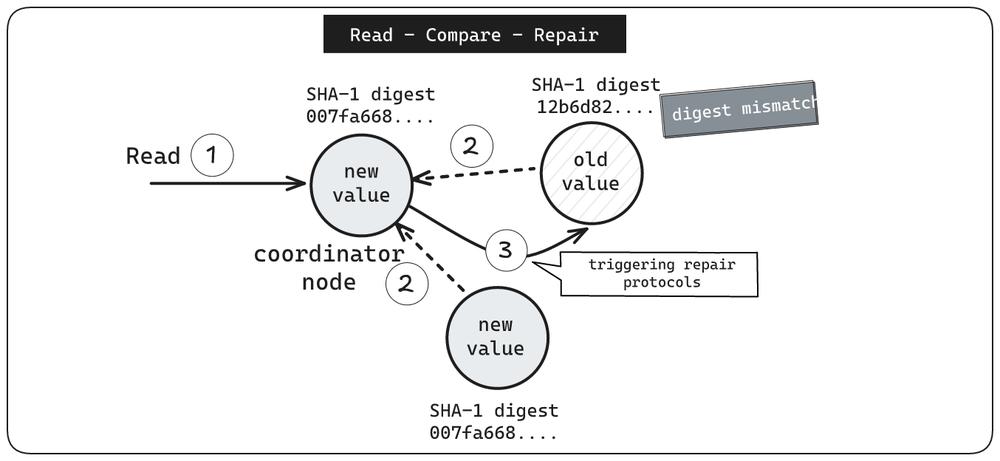
When data is replicated, replicas inevitably drift out of sync because of dropped writes, network partitions, or node failures. On every read, the coordinator queries the other replicas, compares their values, and repairs the ones that are behind along the way. The reparation is a side effect of the read: no periodic scan, no manual intervention — the replicas converge toward the same state as traffic flows through them.
Operating Resilient Systems
Designing for resilience is only the beginning. A resilient system must remain observable, testable, recoverable, and maintainable as it evolves in production. The practices in this section verify that recovery mechanisms still work, detect degradation early, and turn recovery from an improvised response into a practiced capability.
Maintainability Enables Resilience [Maintainability]
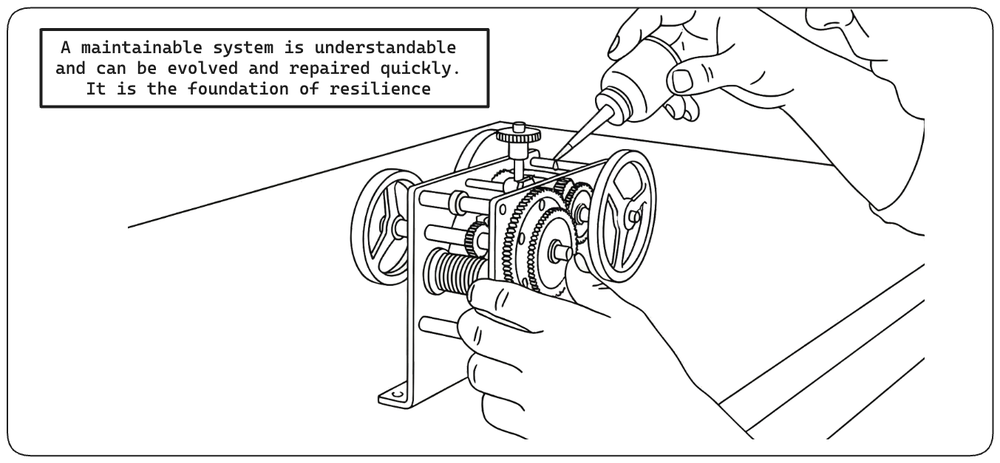
Maintainability and resilience reinforce each other. Systems that are difficult to understand, modify, or debug become fragile because incidents take longer to diagnose and recovery mechanisms become harder to evolve safely. Clear code, explicit boundaries, and simple recovery paths make failures easier to investigate and fix. Technical debt is also resilience debt: every shortcut that makes a system harder to change also makes it harder to recover and improve.
Learn More
Chapter: Design for Maintainability.
Health Checks Are Control Signals [Health Checks]
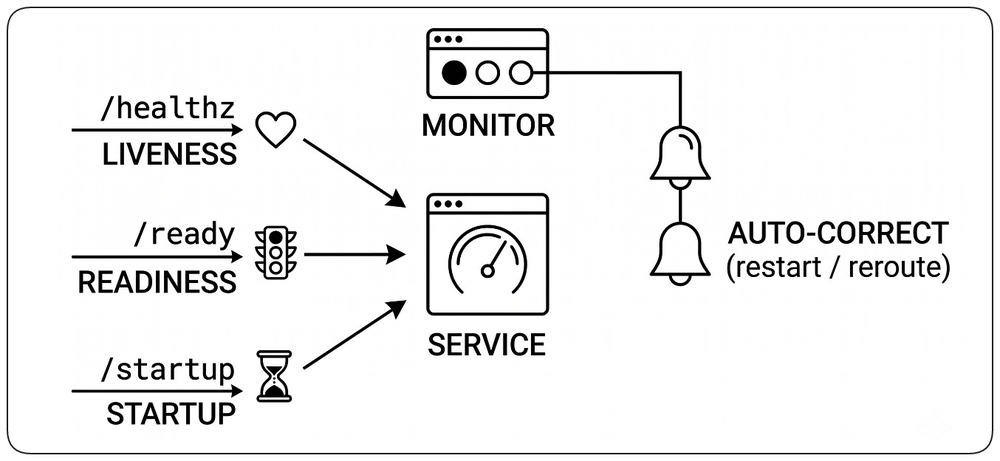
Health checks are not merely observability signals; they are inputs to automated control loops. Platforms use them to decide whether an instance should start, receive traffic, remain in service, or be restarted. Because these signals directly influence system behavior, they must be designed carefully. The following section explains the distinct roles of startup, readiness, and liveness checks, and why confusing them can create failures instead of correcting them.
Types of Health Checks [Health Check Types]
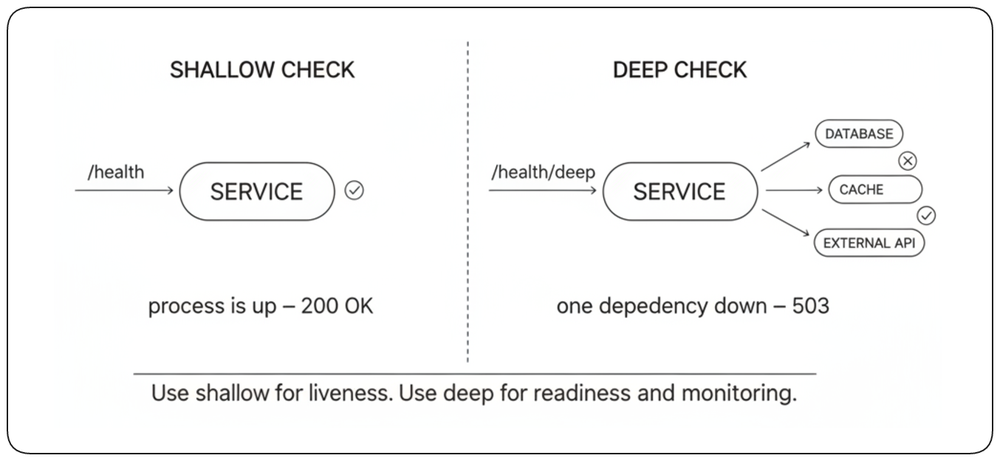
Each health check answers a different operational question: Liveness: Is the process still functioning? A failed check may trigger a restart. Keep it local and simple; dependency failures should not make the process appear dead. Readiness: Can this instance safely handle traffic now? A failed check removes it from rotation without restarting it. Startup: Has initialization completed? This prevents liveness checks from killing slow-starting applications before they are ready.
Shallow vs Deep Health Checks [Health Check Depth]
Shallow checks verify only the local process. They are fast, reliable, and best suited for liveness checks. Deep checks also verify dependencies such as databases or external services. They provide better diagnostics but should not usually trigger restarts, since a dependency failure does not necessarily mean the process itself is unhealthy. Use deep checks for readiness and monitoring.
SLOs Drive Resilience Investment [SLOs]
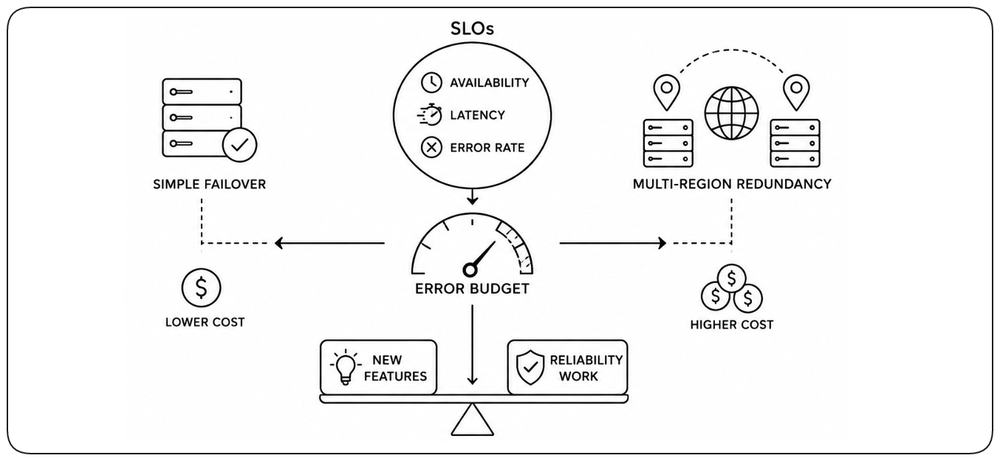
Service Level Objectives (SLOs) define the reliability users need in terms of availability, latency, and error rates. Together with the error budget, they determine how much resilience is justified—from simple failover to multi-region redundancy—and when reliability work should take priority over new features. Without an SLO, resilience investments become guesswork.
Learn More
Chapter: Design for Observability — SLIs, burn-rate alerting, and the full SLO/error-budget mechanics.
Chaos Engineering [Chaos Engineering]
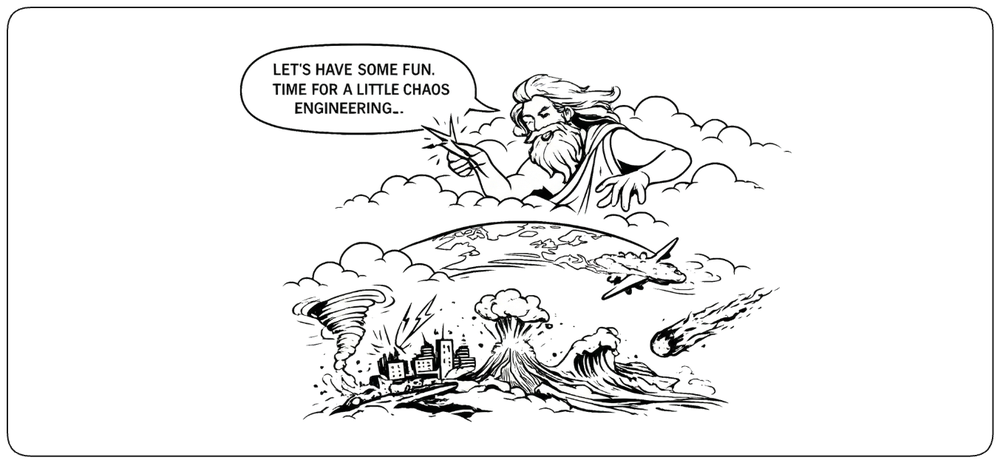
Chaos engineering is a controlled method for testing resilience assumptions. Each experiment begins with a measurable steady-state hypothesis, injects a specific and plausible failure within a limited blast radius, and defines an abort condition before the test begins. The objective is not to break the system, but to discover whether detection, containment, degradation, and recovery behave as designed. The findings should feed directly into architecture, automation, tests, and runbooks. Chaos engineering transforms "hoping for the best" into "knowing how the system will respond."
Test Degradation, Not Just Outage [Degradation Testing] {1}
Most real incidents !!begin as gradual degradation!!, not as a clean outage. DNS latency creeps up, a single availability zone loses partial capacity, network jitter rises, a dependency's error rate climbs from 0.1% to 5%. These !!grey failures!! are harder to detect than a crash and often defeat systems that were only tested against total loss. Chaos experiments should inject slow, partial, and asymmetric failures—added latency, packet loss, degraded replicas, throttled dependencies—not only kill switches.

Executable Disaster Recovery [Preparedness]
Disaster recovery must be designed before it is needed and executable when it is. Starting from the RTO and RPO targets, the plan should define responsibilities, communication paths, restoration order, decision points, and validation steps. Failover, restoration, and restart procedures should be codified, version-controlled, and exercised regularly. Automation reduces variation and human error, while operators remain responsible for initiating, observing, and validating the recovery.
Test and Rehearse Recovery [Rehearsal]
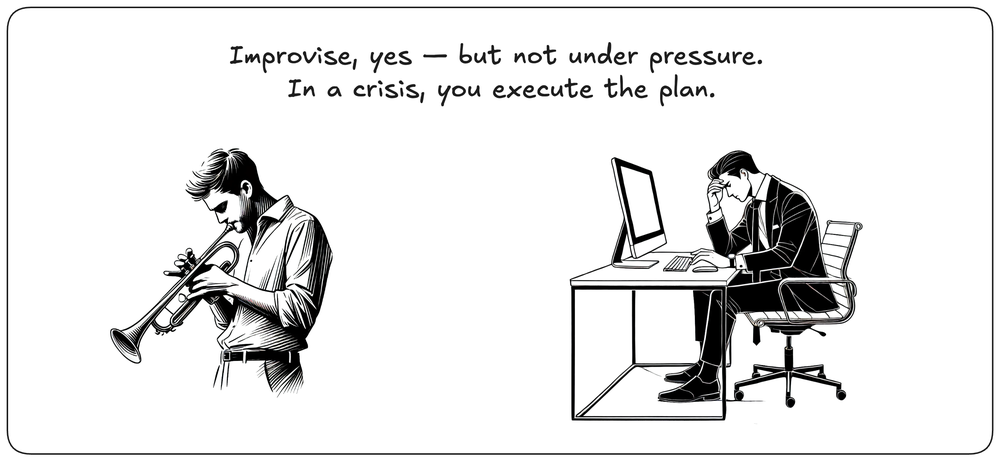
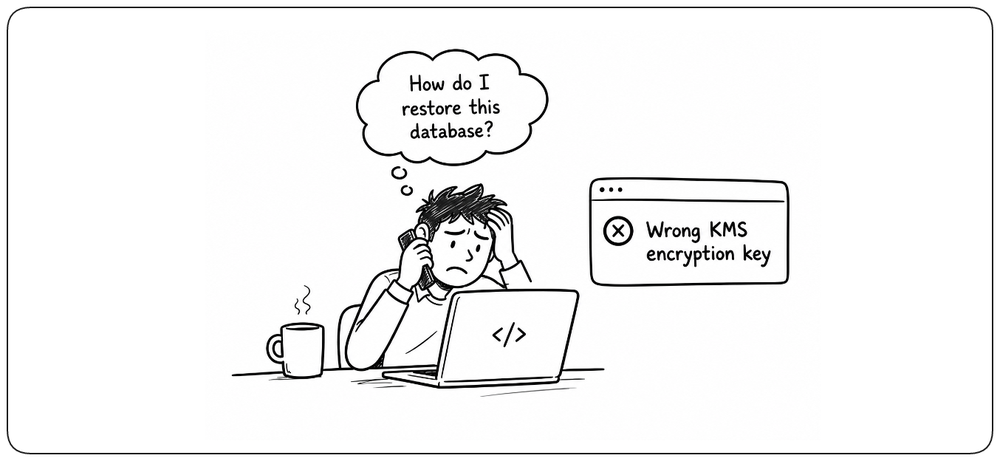
A recovery plan that has never been executed is still a hypothesis. Game days, staged failovers, and restore drills expose stale credentials, missing dependencies, outdated runbooks, and automation drift before a real incident. Rehearsal also gives operators practical familiarity with the recovery path.
Recovery Belongs to Practiced Operators [Routine Operators]
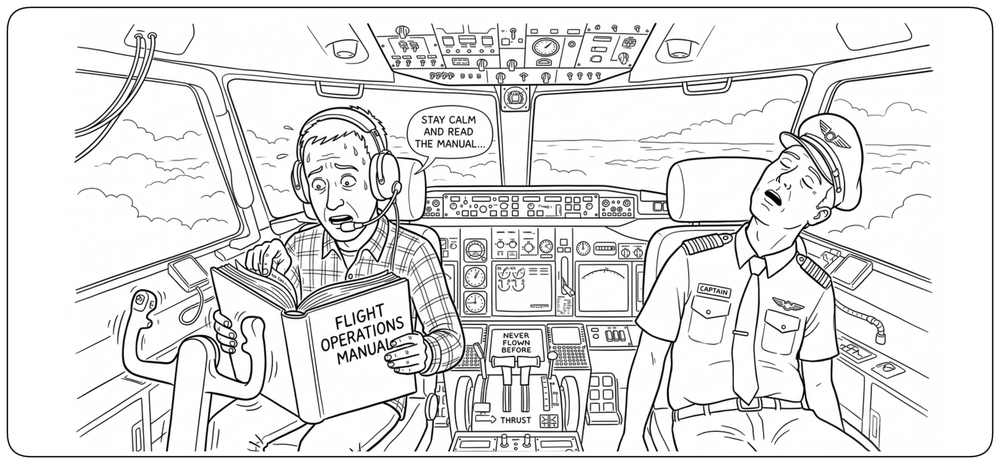
Recovery should be led by people who already understand the system or have rehearsed the procedure. A runbook is necessary, but it cannot replace operational familiarity. The responsible group may include the owning team, trained on-call engineers, and specialists who have practiced the recovery path. The incident should not be their first contact with the system.
Learning from Failures
Failures are inevitable in complex systems, but they should never be wasted. Examined carefully, incidents reveal hidden assumptions, fragile design choices, weak operational practices, and organizational blind spots. Learning from failure is what turns an outage from a temporary disruption into a durable improvement in how the system is designed, operated, and understood.
Incident Review [Incident Review]
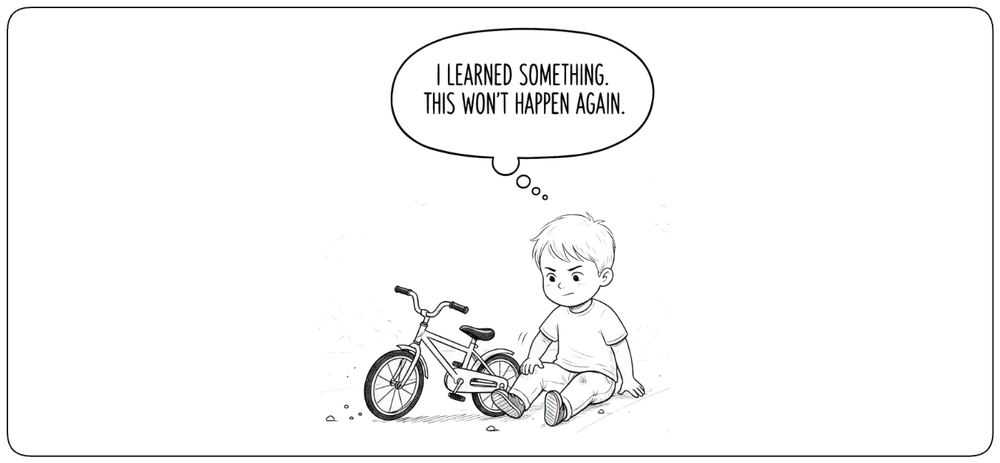
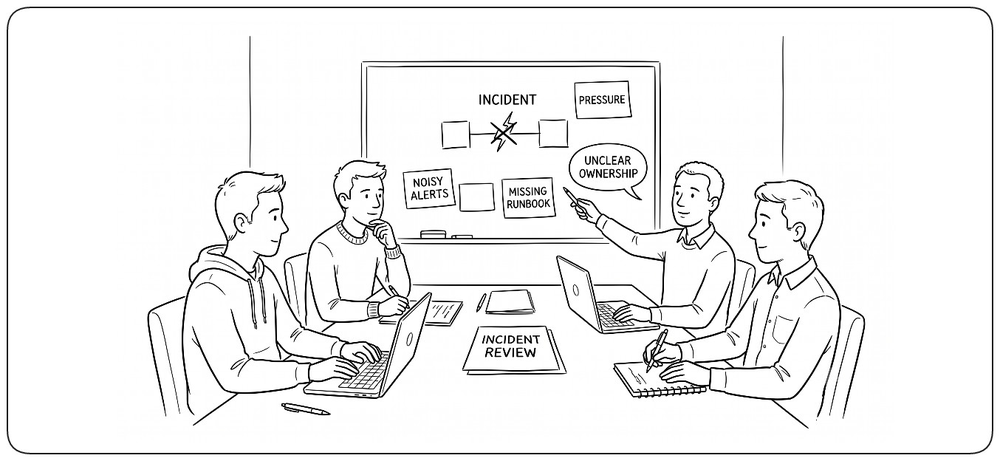
An incident review—often called a post-mortem—is the structured process used to turn an incident into concrete improvements. Its purpose is not to find a person to blame, but to decide what must change so the same failure is less likely to happen again, has less impact, or can be detected and recovered from faster. Done well, incident reviews produce prioritized action items, strengthen shared ownership, and convert painful events into concrete resilience work.
Incident Review as an Opportunity [Transparency]
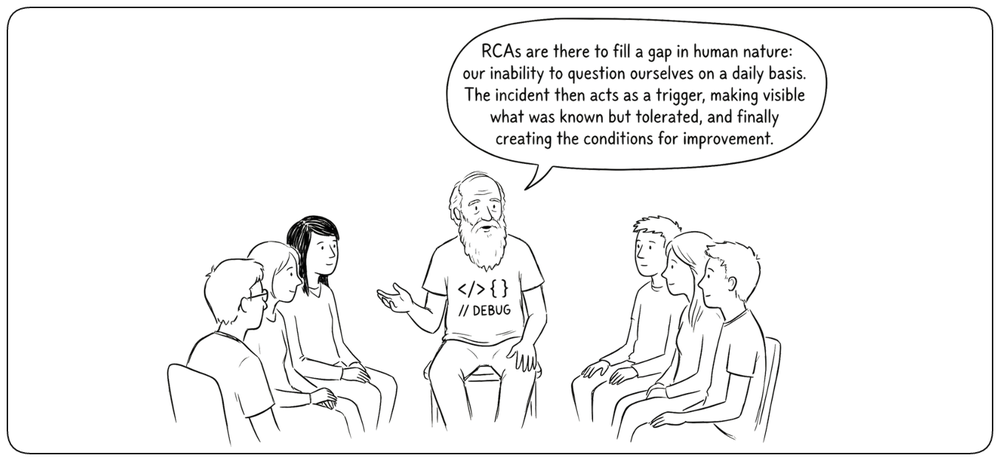
Incidents make hidden risks visible. During normal delivery, weak signals, deferred risks, unclear ownership, fragile dependencies, and cross-team friction often remain implicit because teams are busy keeping the system moving. The incident review creates a protected space to put those concerns on the table, grounded in evidence rather than opinion. This only works when the discussion is safe enough for people to explain what they saw, what they assumed, and why their decisions made sense at the time.
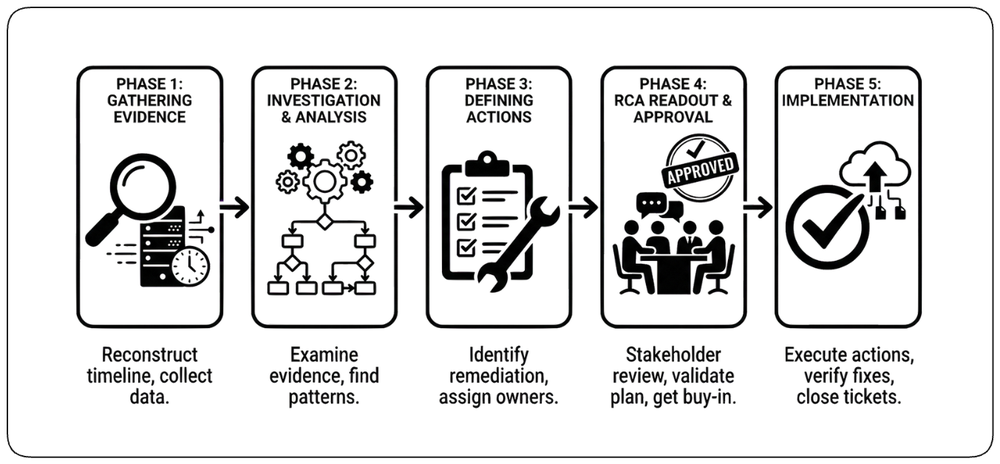
The Five Phases of Incident Review [Review Phases]
A structured incident review follows five phases: collect evidence, perform root cause analysis, define actions with owners and priorities, review and align with stakeholders, and follow up until actions are closed.
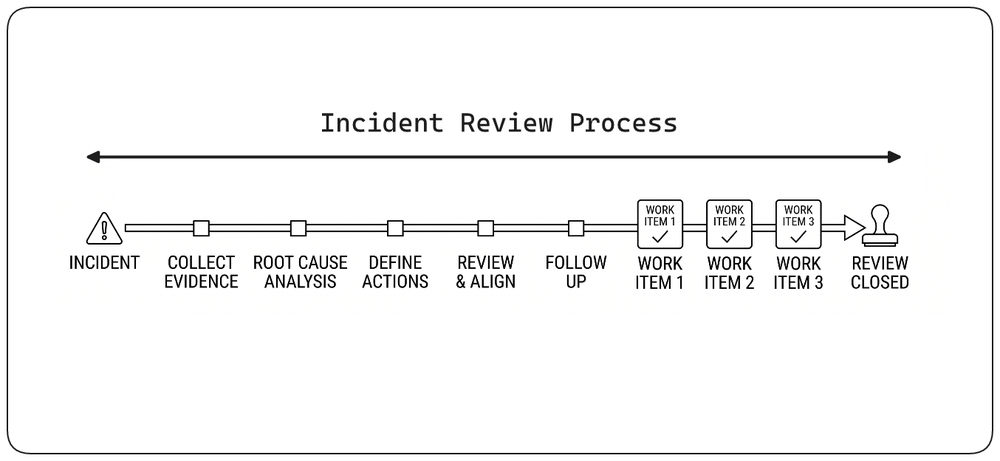
An Incident Review Is a Process, Not a Meeting [Review Process]
An incident review is a process, not just a meeting. It starts with the incident and ends when the work items for identified gaps are closed. The organization should define a recommended maximum duration for this process. Larger structural changes, such as redesigning a service or sharding a database, should move into the normal engineering backlog with clear ownership and priority.
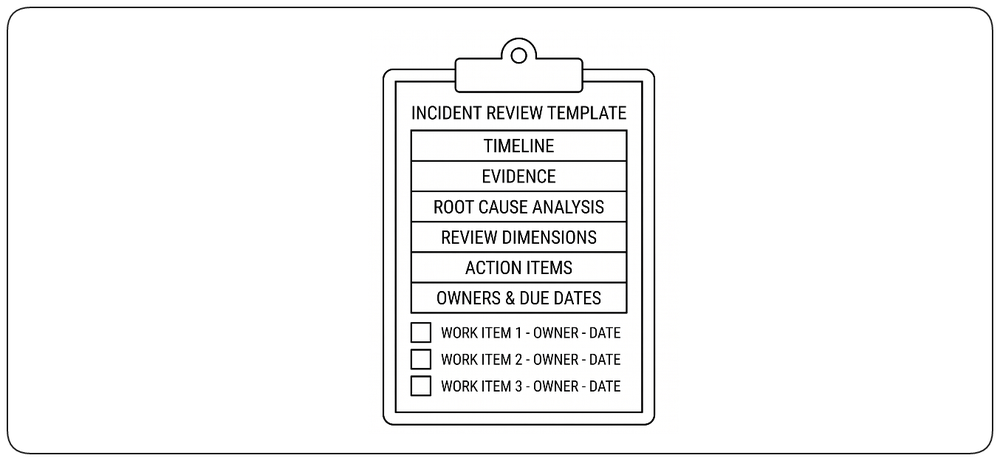
The Incident Review Template [Review Template]
An incident review should be guided by a shared template document that keeps the discussion focused, factual, and complete. Without structure, teams can jump to the first explanation, skip uncomfortable topics, or focus too much on the triggering bug. A good template guides the whole process: timeline, evidence, root cause analysis, action items, owners, and dates. The template is an operational tool, not just a document layout. It keeps the discussion factual and safe, makes reviews easier to compare, reduces blind spots, and turns identified gaps into tracked work.
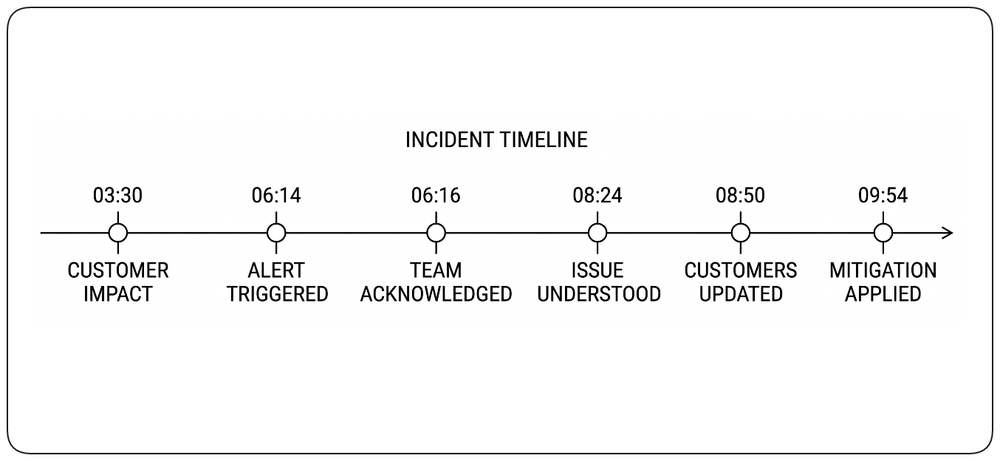
Start with a Factual Timeline [Incident Timeline]
The incident review starts by reconstructing the sequence of events as objectively as possible. The timeline should capture when the issue began, when customers were affected, when alerts fired, when people noticed, what actions were taken, and when service recovered. It should be built from evidence: monitoring data, logs, deployments, incident chat, customer communications, support tickets, emails, and status-page updates.
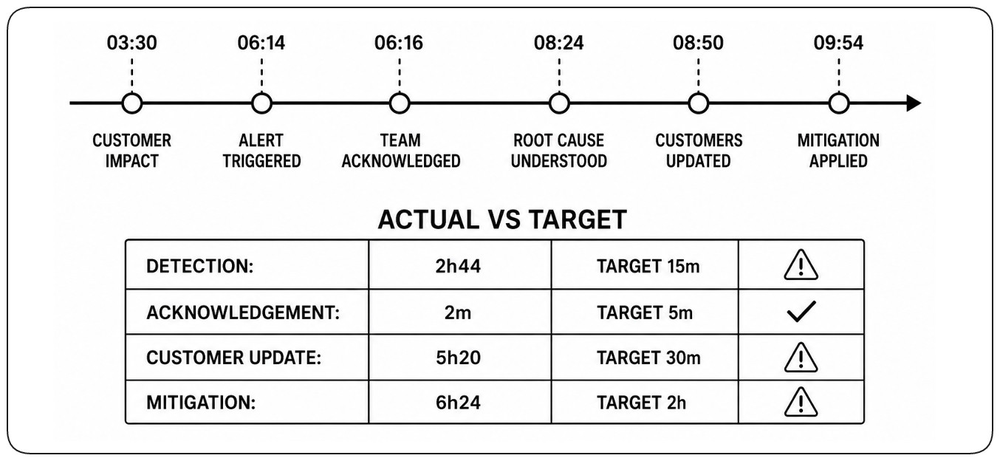
Compare Incident Metrics to Targets [Incident Metrics]
Once the timeline is clear, the team can compare the incident against the organization's expected targets. These targets define what is acceptable for customer impact, detection time, escalation, communication, mitigation, recovery time, error rate, data loss, or any other relevant measure. This analysis runs alongside root cause analysis: it asks where the response fell short and why. Why did the team notice the incident late? Why did mitigation take so long after the problem was understood? Why were customers informed too late? The answers create work items for alerts, dashboards, runbooks, tooling, training, communication, and operating processes.
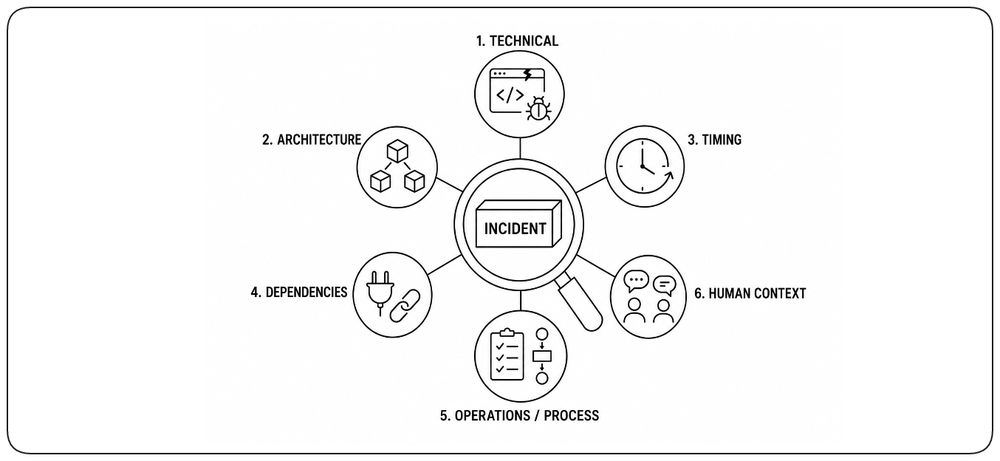
Find Root Causes Across Dimensions [RCA Dimensions]
Root cause analysis explains why the incident happened, why it had impact, and which factors allowed it to unfold. The review should be guided by concrete questions for each relevant dimension, such as technical causes, architectural resilience, timing, dependencies, operations and process, and human context, helping participants think through the incident themselves and explore directions they might not have considered.
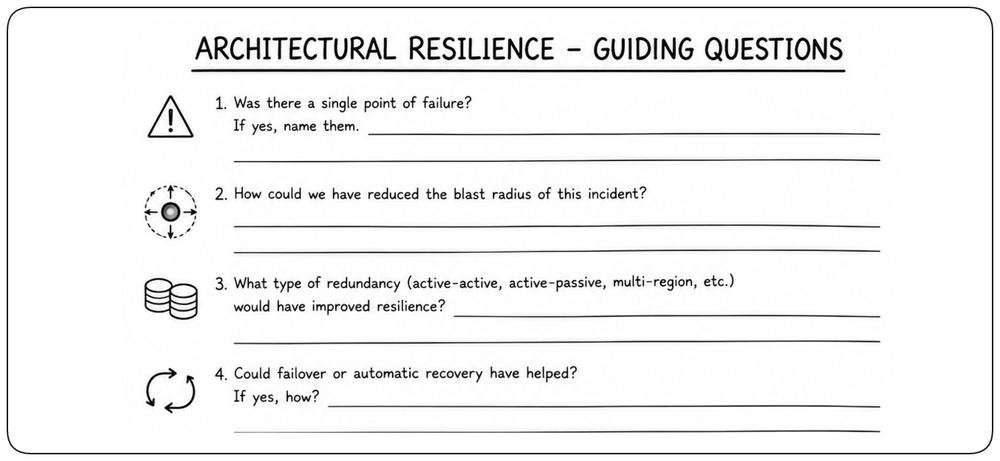
Not All Dimensions Are Equal: Architectural Resilience [Architectural Resilience]
Some dimensions improve how teams respond to incidents. Architectural resilience improves how the system behaves during incidents. That difference is why not all dimensions have the same leverage: response improvements reduce detection, coordination, and recovery time, while architectural improvements can reduce the probability or impact of an entire class of incidents. Bugs, delayed alerts, and process gaps may trigger an incident, but weaknesses such as tight coupling, missing isolation, or single points of failure often determine its ultimate impact.
Human Context and Process [Human Factor]
Human and team factors are often avoided because they can create tension. It is easier, and usually safer, to focus on the bug, the architecture, or the dependency. But incidents also expose communication gaps, unclear ownership, pressure, cognitive load, and processes that made the safe path harder than the risky one. The review should address these factors with neutral, evidence-based questions, so the team can improve how it works without turning the discussion into blame.
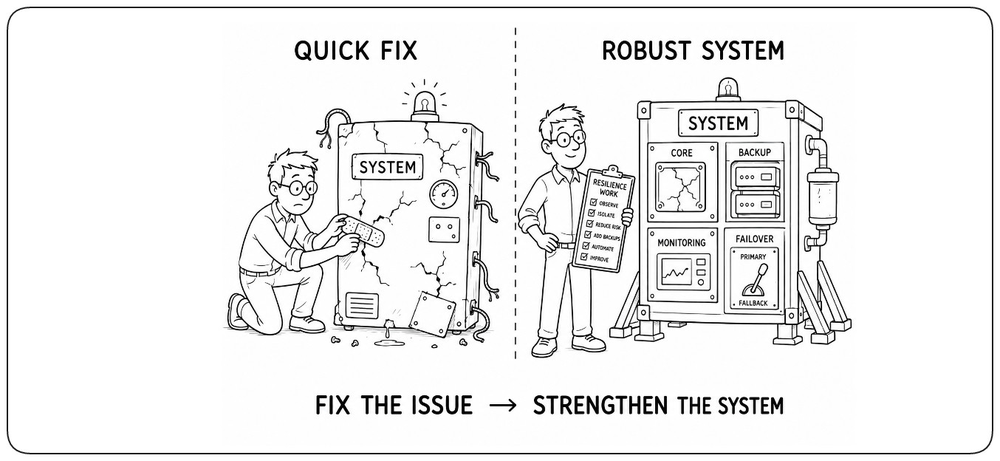
From Fixing Issues to Building Robust Systems [Systemic Robustness]
An incident review should do more than produce action items. The best reviews do not just resolve the incident; they leave the system fundamentally stronger than it was before. That means looking beyond the triggering defect and improving isolation, observability, scalability, recovery mechanisms, and operational readiness. A robust system is not one that never fails, but one that fails gracefully and recovers predictably.
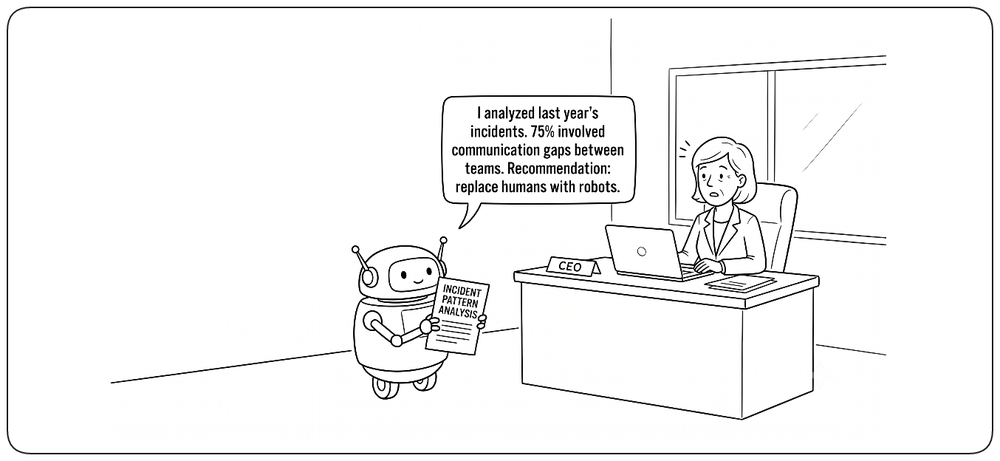
Incident Pattern Analysis [Incident Analysis]
Individual incident reviews explain what happened once; pattern analysis reveals what keeps happening. By classifying incidents consistently and comparing them over time, teams can uncover recurring weaknesses that no single review would expose. These may be temporal patterns, such as failures clustering around deployments, migrations, or peak traffic, or structural patterns, such as repeated incidents in the same component, dependency, tenant, region, or operational workflow. The goal is to turn a collection of isolated incidents into evidence for broader architectural and operational improvement.