Design to Be Released (formerly: CD)
Chapter Info
Calculating... Writing Progress: 70%
Change is how software delivers value, but every change introduces risk. Modern release management is the discipline of moving systems from one state to another in a controlled, observable, and reversible way.
This chapter explores how releases are defined, promoted, executed, and governed—from declarative state and progressive exposure to promotion gates, rollback, and the architecture of release platforms.
Introduction
Adaptive Software is the Heartbeat of Business [Change]
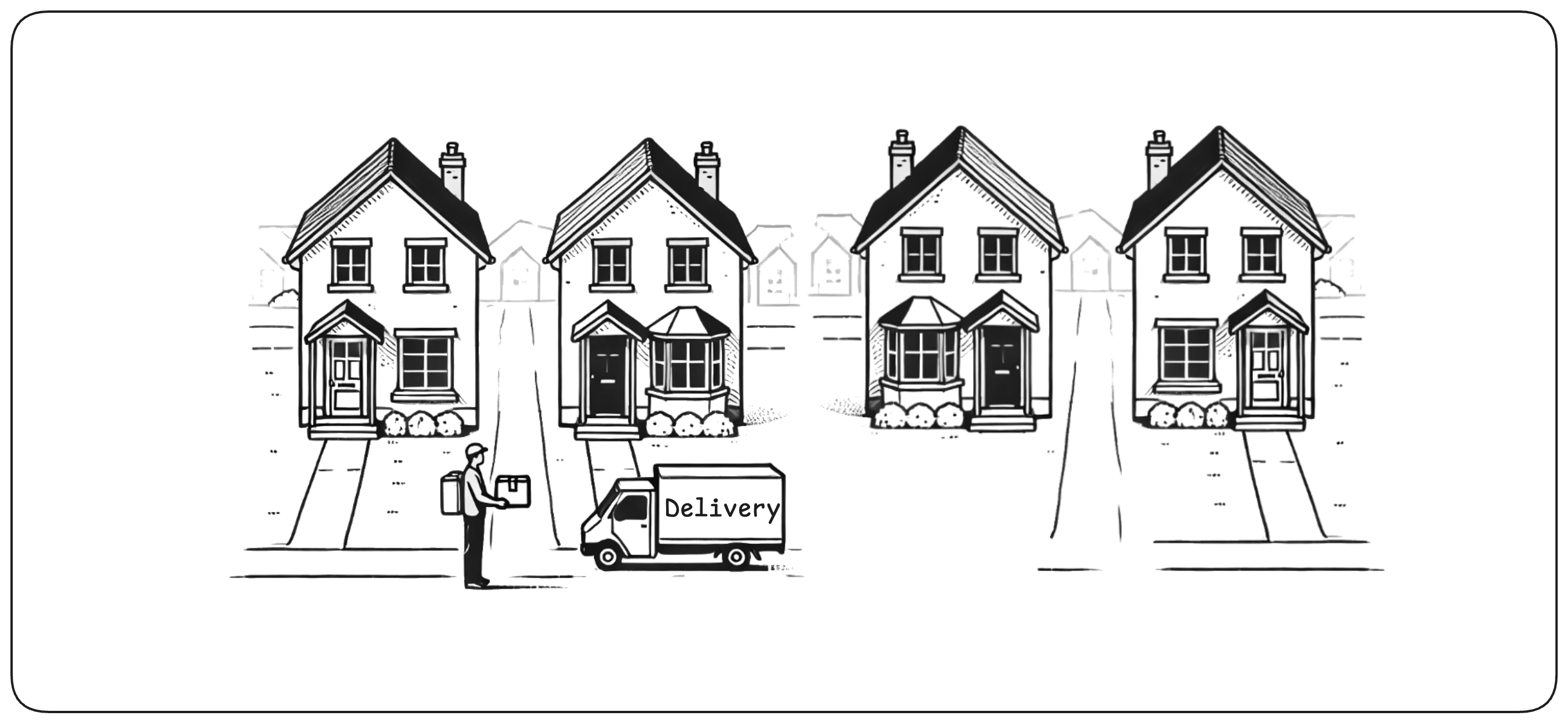
Software is not a static asset; its value comes from the ability to evolve. Every new capability, architectural improvement, or business adaptation requires change. The ability to turn ideas into working software safely and continuously has therefore become a core capability of the modern enterprise.
The Essence of Release: Provisioning vs. Deployment [Provisioning vs. Deployment]
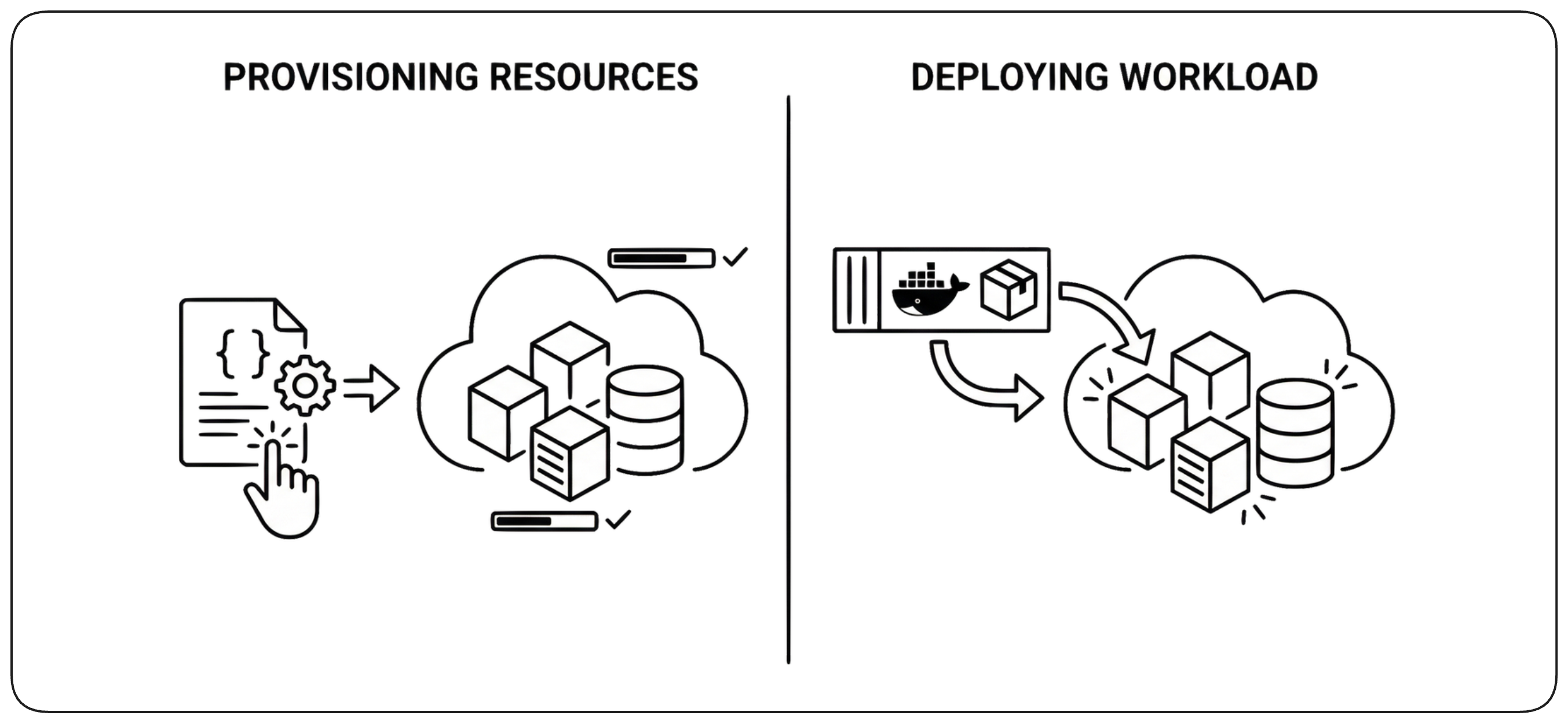
A system change acts on two complementary dimensions. Provisioning Resources uses Infrastructure-as-Code to create or modify the infrastructure required by the service. Deploying Workloads places immutable build artifacts—such as container images, binaries, or JARs—onto that infrastructure. Together, they evolve the infrastructure and the software running on it.
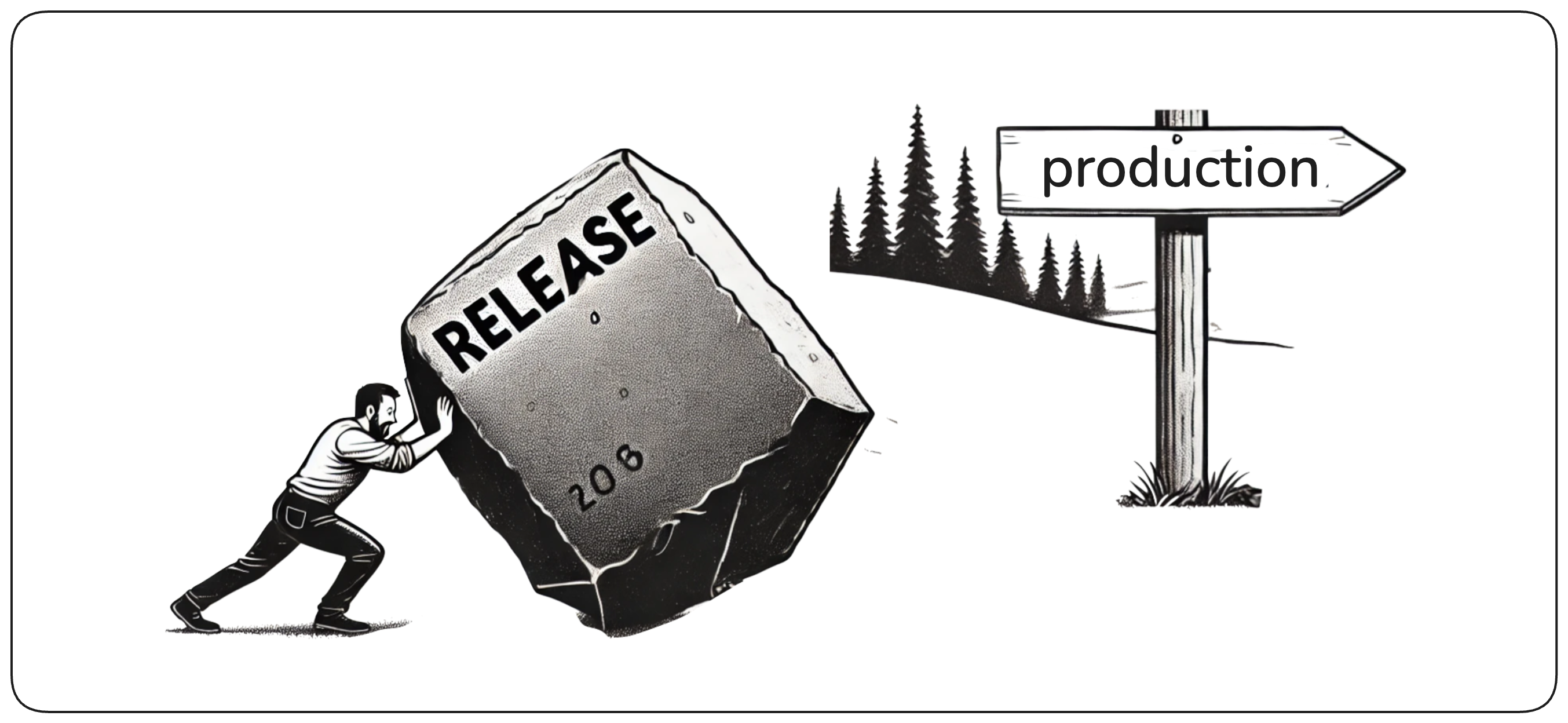
The Shift: From Deployment to Release Management [Evolution] {1}
Early deployment practices focused on execution: pushing an artifact to an environment quickly and repeatably. But a deployment only tells us that something happened; it does not define the resulting system state or make risk, rollback, and accountability easy to reason about. Modern release management therefore treats the release as a first-class object: a defined, versioned state that can be named, compared, promoted, audited, and restored.
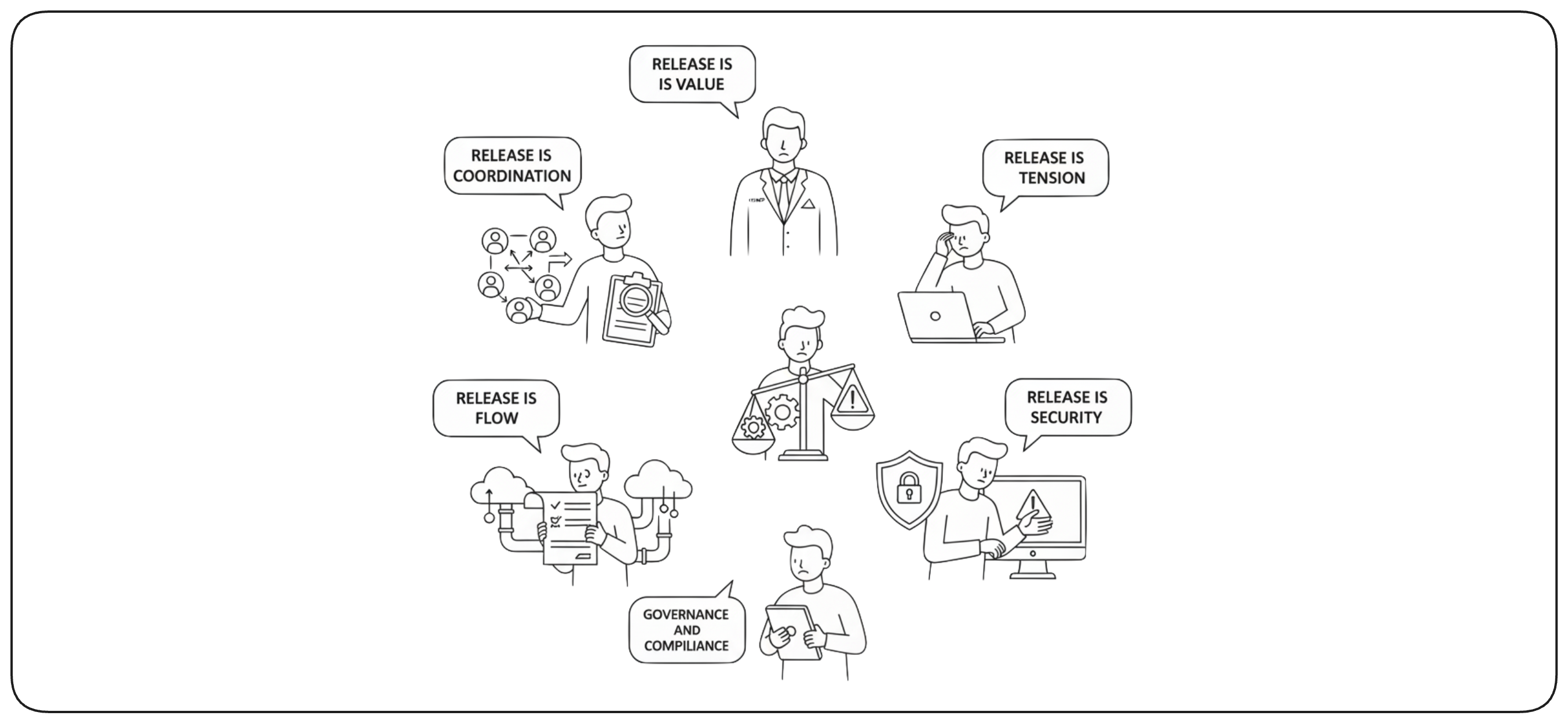
A Release Does Not Mean the Same Thing to Everyone [Different Perspectives]
A release means different things across an organization. Developers see a change reaching production, security sees new exposure, managers see risk and coordination, platform teams see a controlled flow, and the business sees value delivered. Each perspective brings different expectations and constraints. Modern release management exists to bring them together into a single lifecycle where value can move forward without losing control, safety, or accountability.
The Release
What Is a Release? [The Release]
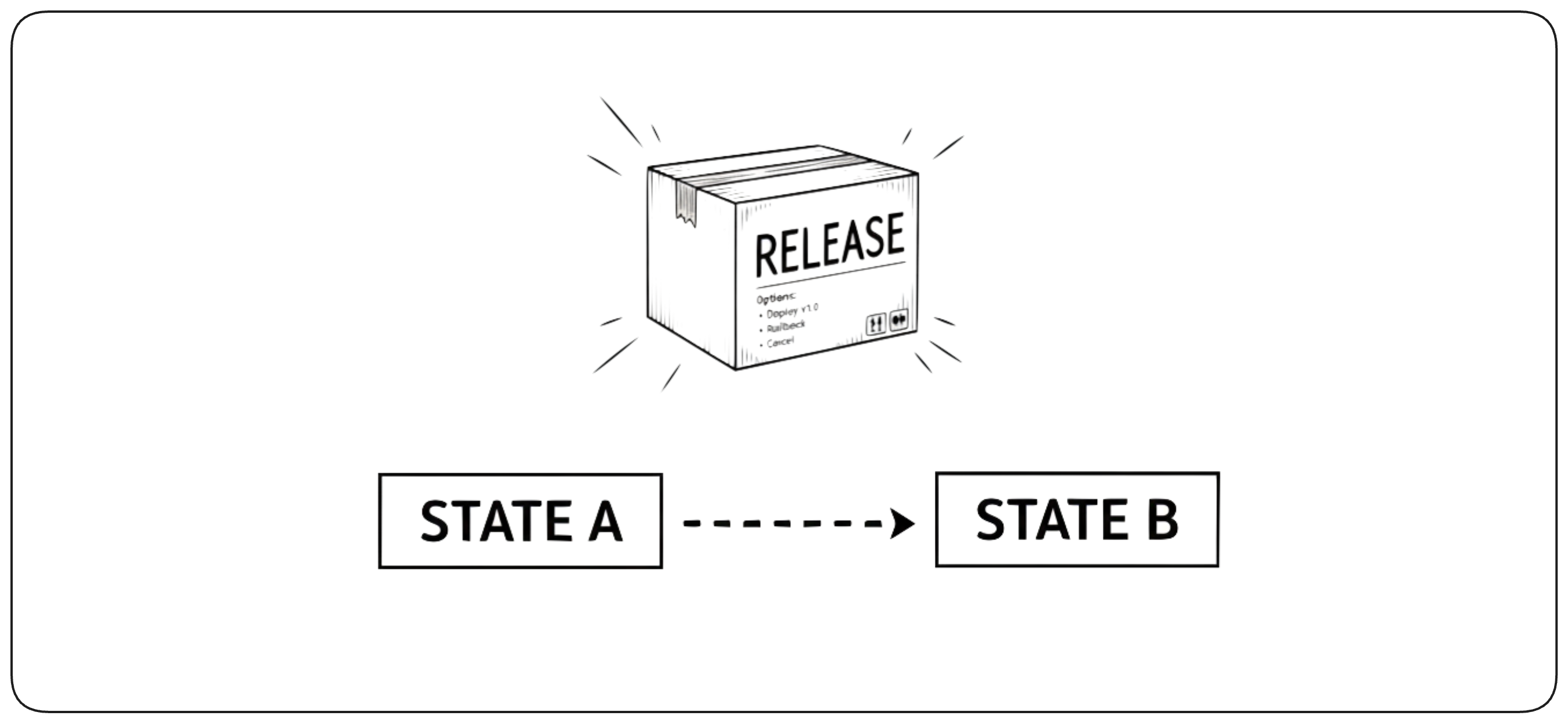
A resolved release identifies a specific, versioned system state: what runs, how it is configured, and the rules governing its promotion. It exists independently of any deployment action and provides a stable unit that can be tracked, evaluated, promoted, and rolled back.
Don't Plan Releases, Define Them [Define, Don’t Plan]
A release definition should describe the state we want, not prescribe a one-time sequence of deployment steps. The delivery system decides when and where a resolved release can progress based on evidence, policy, and target readiness. Release management therefore shifts from orchestrating steps to defining valid states and the rules governing their promotion.
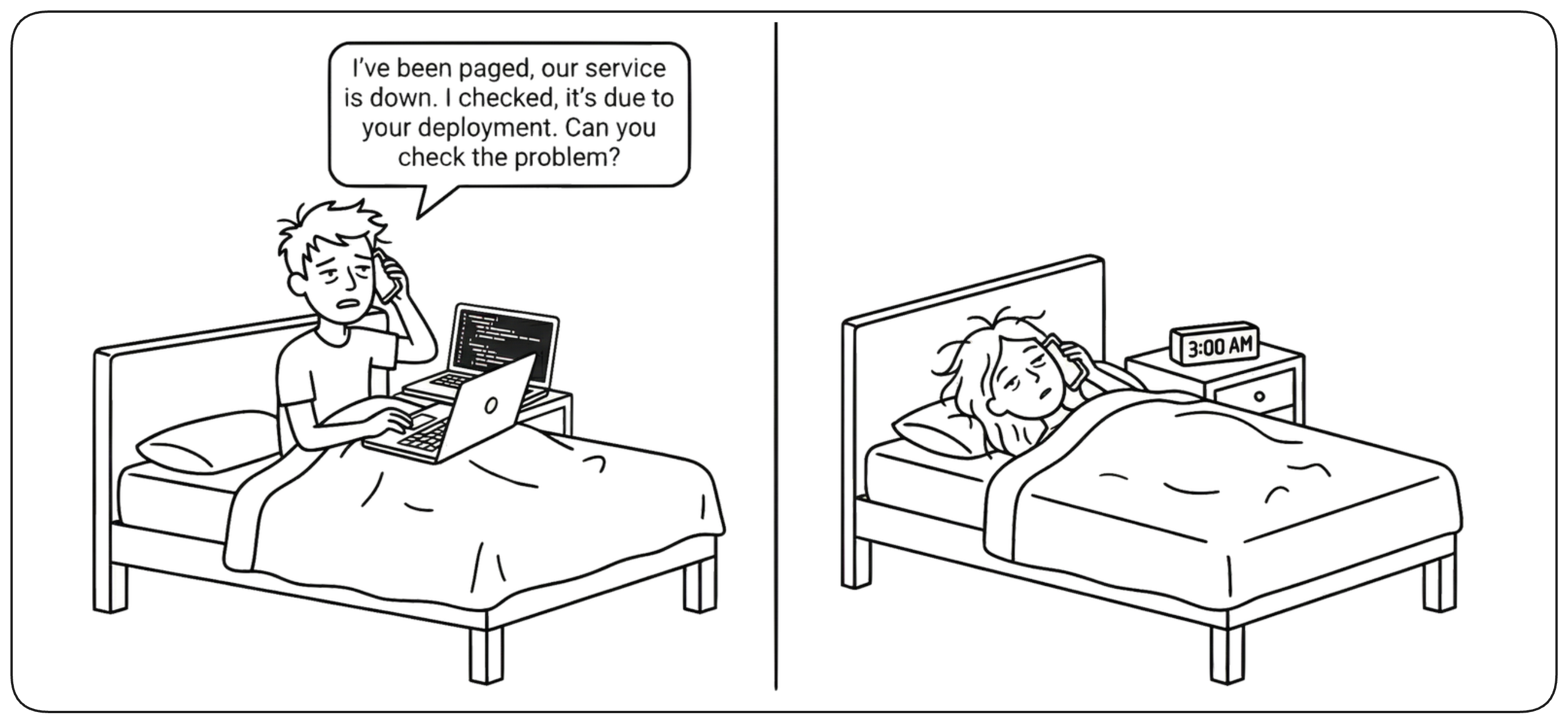
Release Is a Developer Responsibility [Developers Release] {1}
Developers introduce the change and understand its intent, so their responsibility should not end at merge. They remain accountable until the change reaches production and operates as expected. This creates a direct connection between development decisions and their production impact.
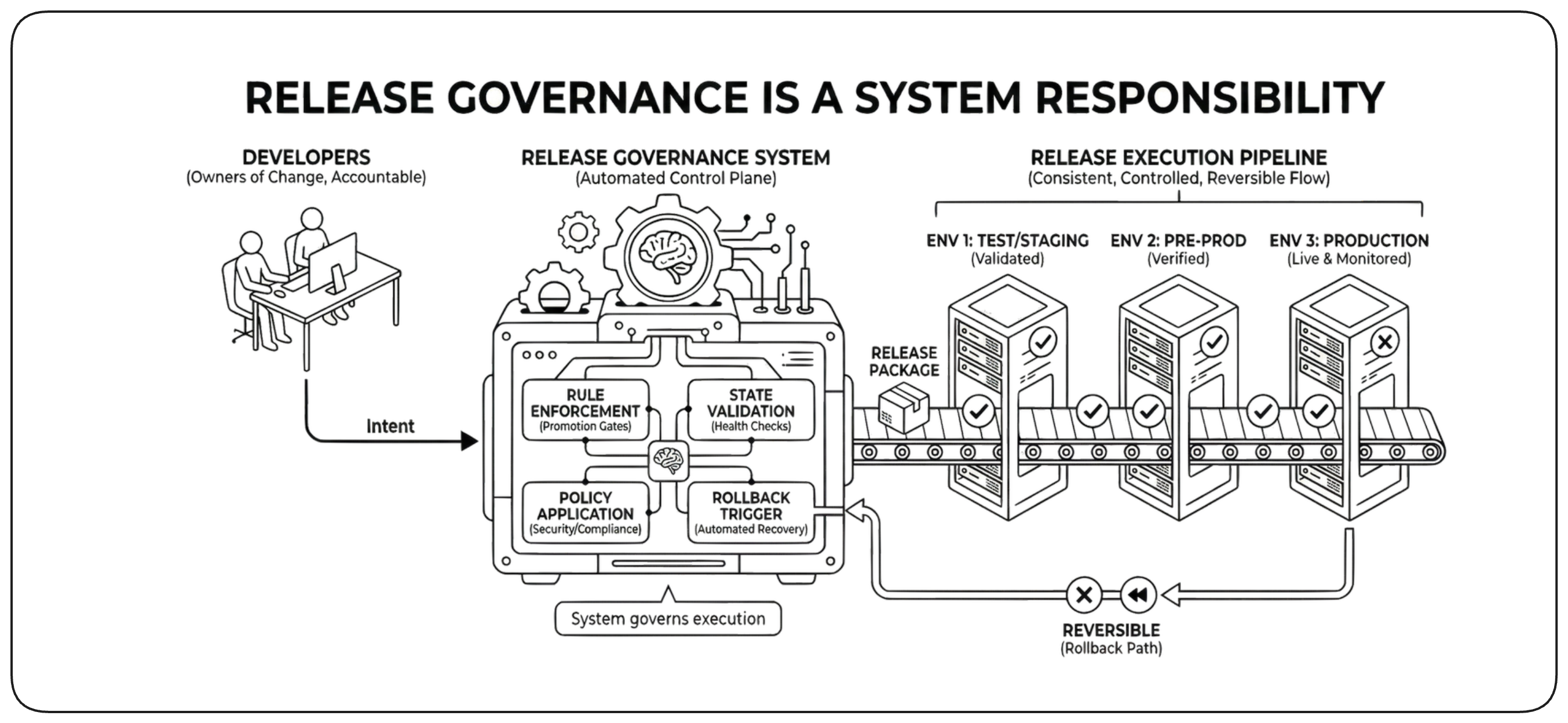
Release Governance Is a System Responsibility [System Governance]
Developers own the change, but release safety must not depend on human coordination. The release system enforces promotion rules, validates state transitions, applies organizational policies, and controls rollback. Developers remain accountable for the outcome; the system makes execution consistent and governed.
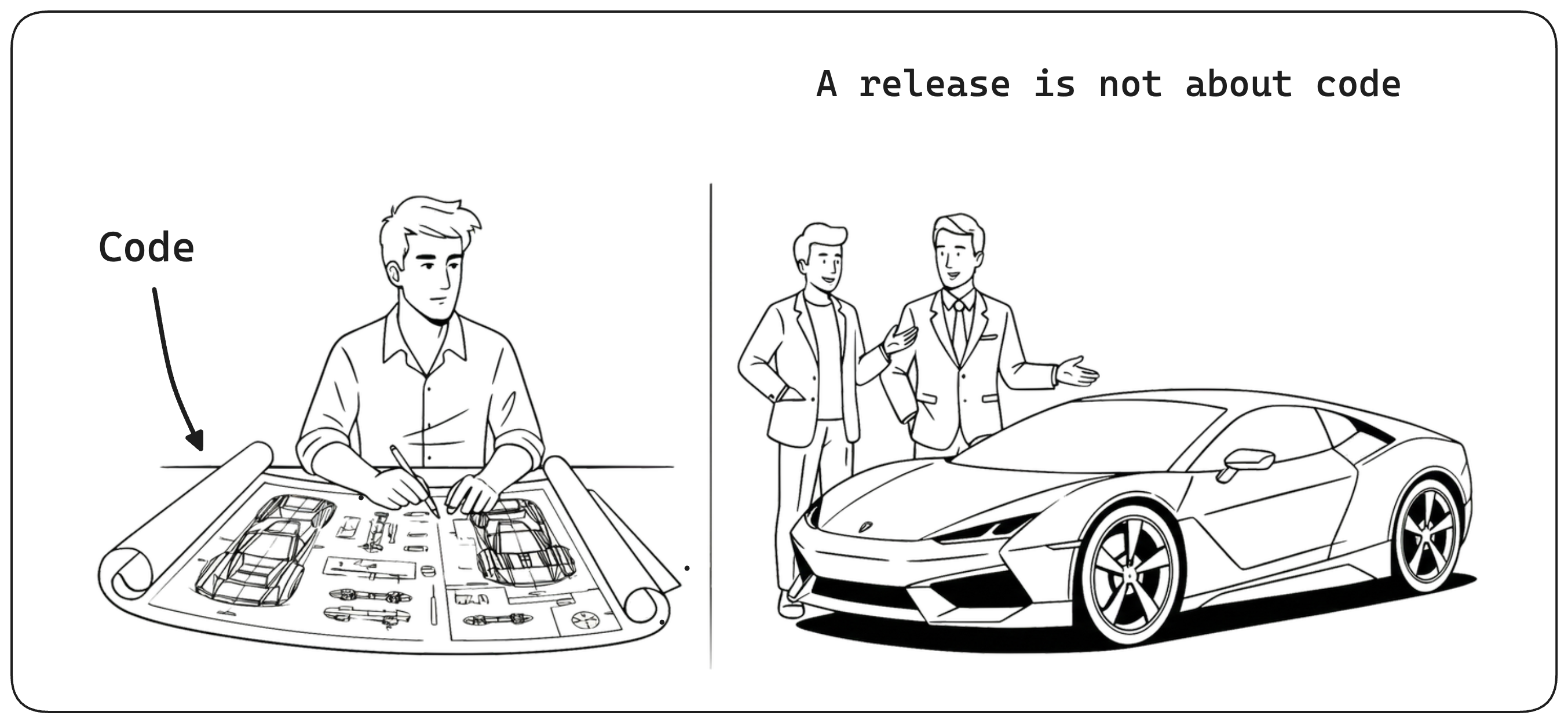
Releases Are About Artifacts, Not Code [Artifacts vs. Code]
A release operates on immutable artifacts and configuration, not source code. Source code is used earlier to produce versioned artifacts such as container images, binaries, charts, or packages. Once built and stored, those artifacts—not the codebase—become the units referenced by the release.
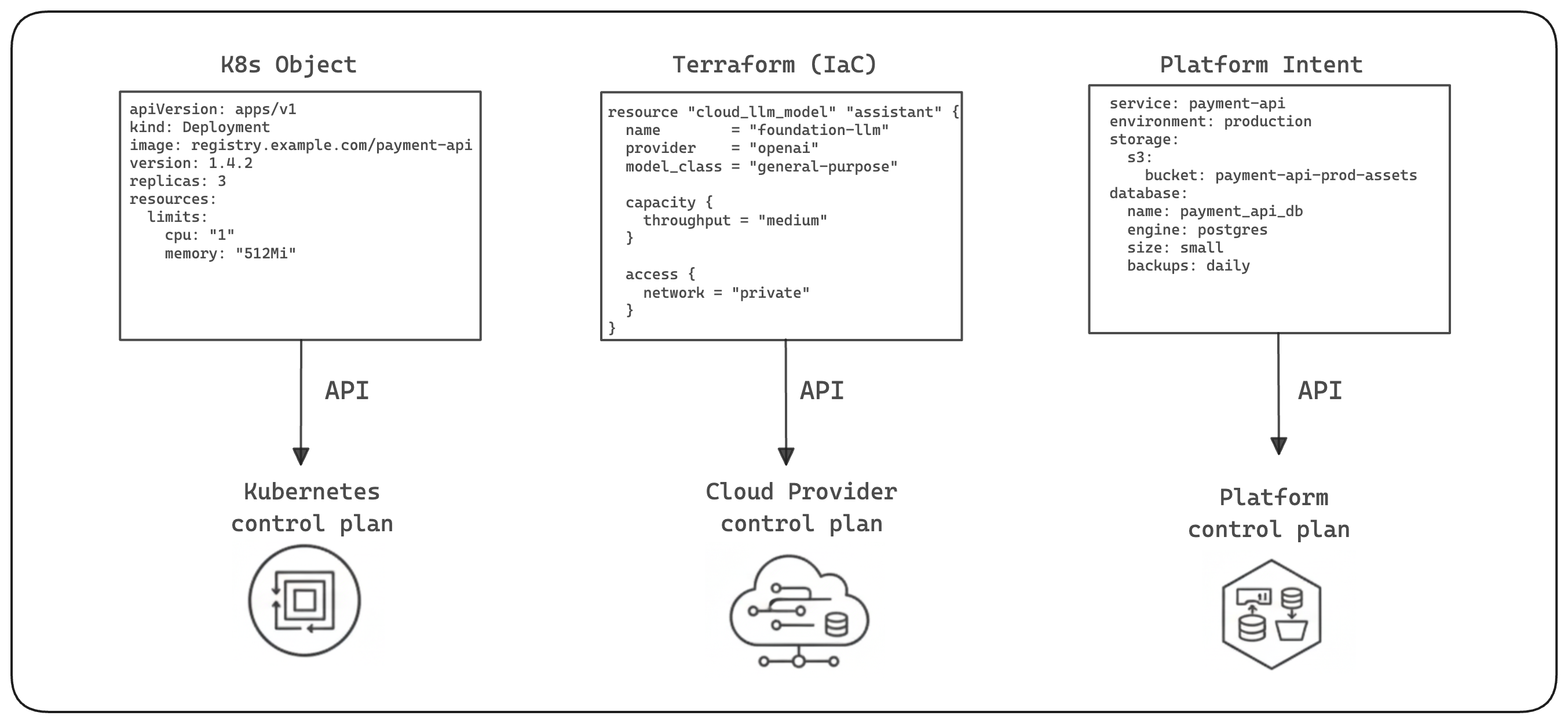
Cloud Interaction Through the Control Plane [Control Plan] {1}
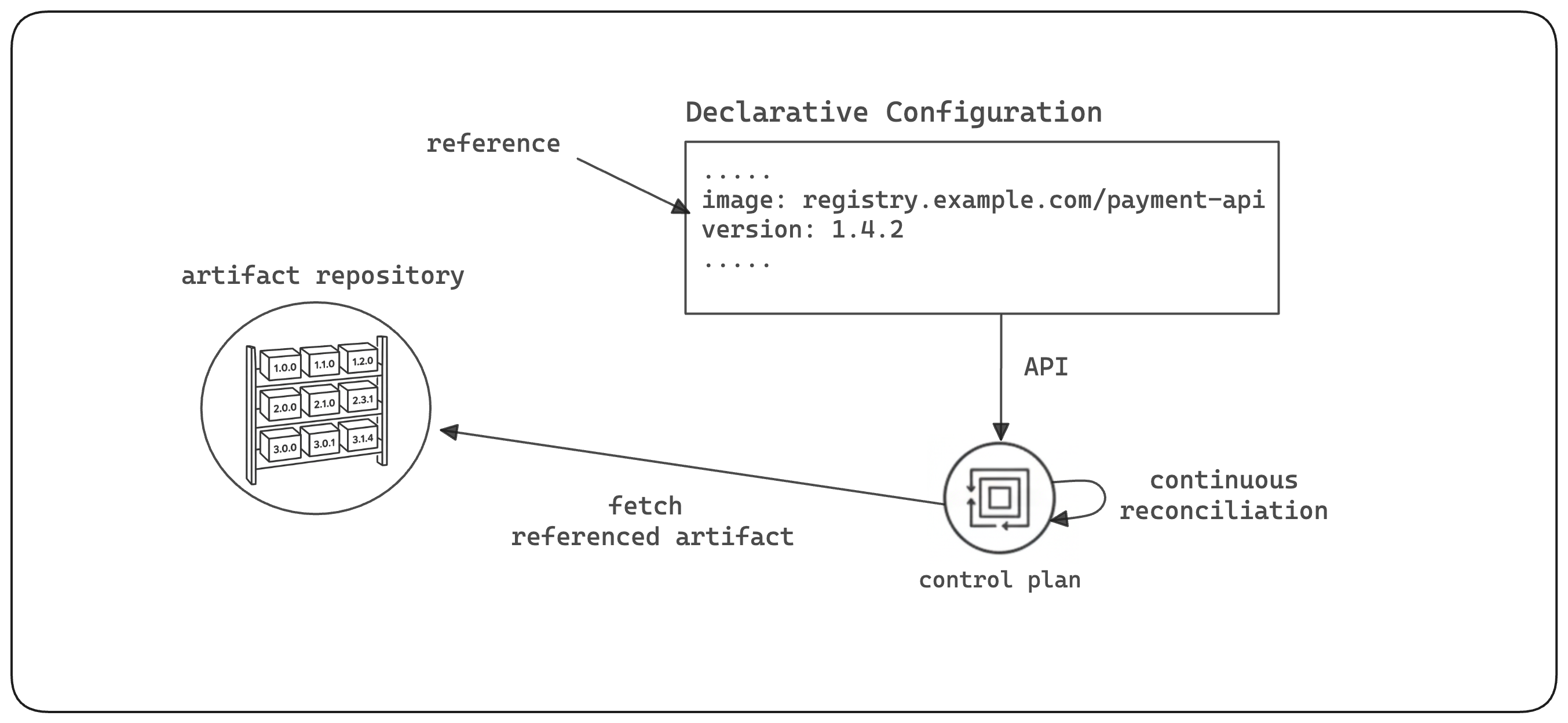
Modern systems are operated through control planes rather than direct imperative actions. Releases express intent to cloud APIs, infrastructure orchestrators, and platform layers that reconcile the desired state with reality. The release describes what the environment should become; the control planes determine how to establish and maintain that state.
Reference Artifacts, Don’t Move Them [Declarative Interaction]
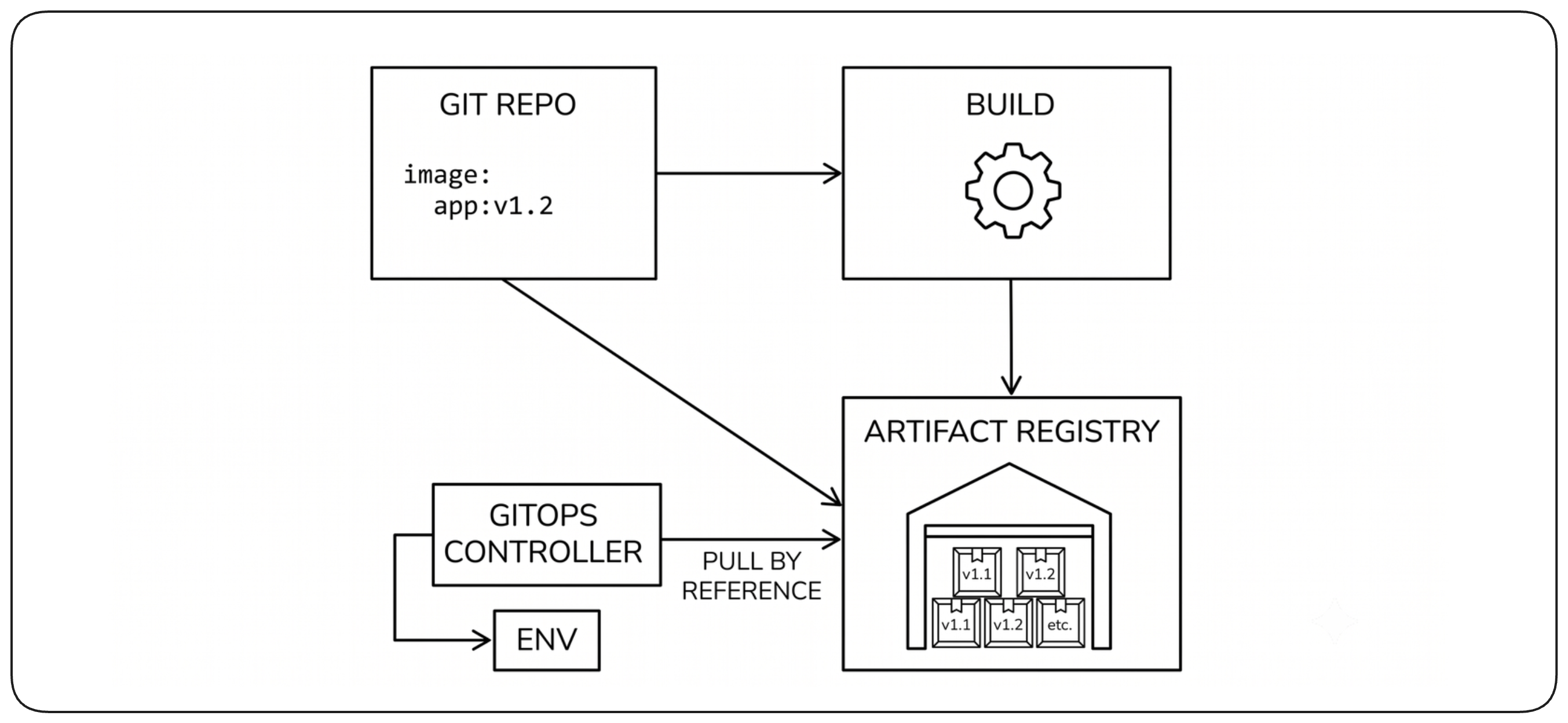
Once environments are mediated through control planes, execution shifts to the platform. The control plane receives declarative intent, pulls the referenced artifacts, applies the required changes, enforces policies, and continuously reconciles reality with the desired state. A release no longer moves payloads or executes steps itself; it updates intent and points to immutable artifacts. Nothing is transferred through the release—everything is referenced.
Declarative Configuration Defines System State [Declarative State]
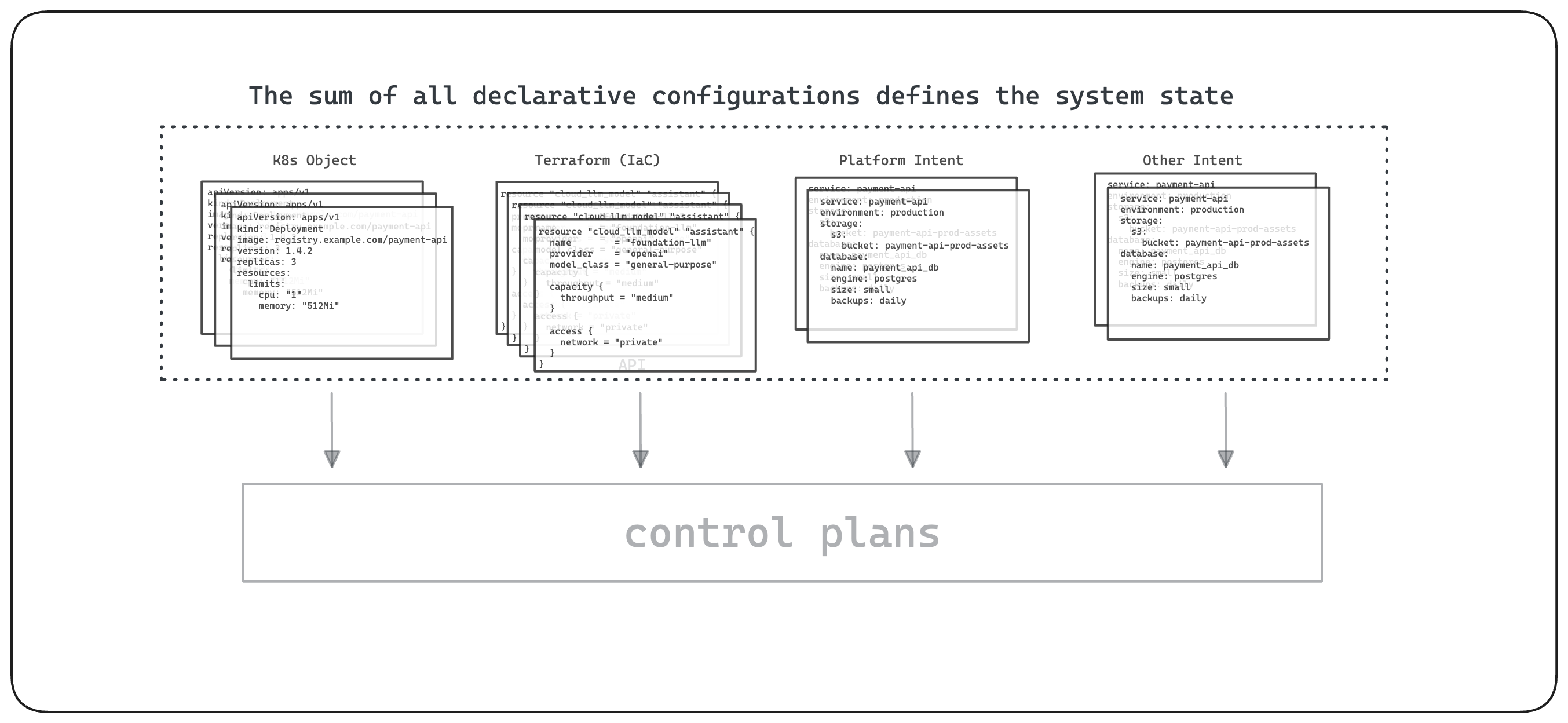
In a control-plane–driven architecture, system state is defined by declarative intent rather than execution history. Application manifests, infrastructure definitions, policies, and parameters together describe the desired state, while their respective control planes continuously reconcile reality toward it. Change the intent and the system converges forward; restore it and the system converges back.
Release Definition and Resolved Release [Release Model]
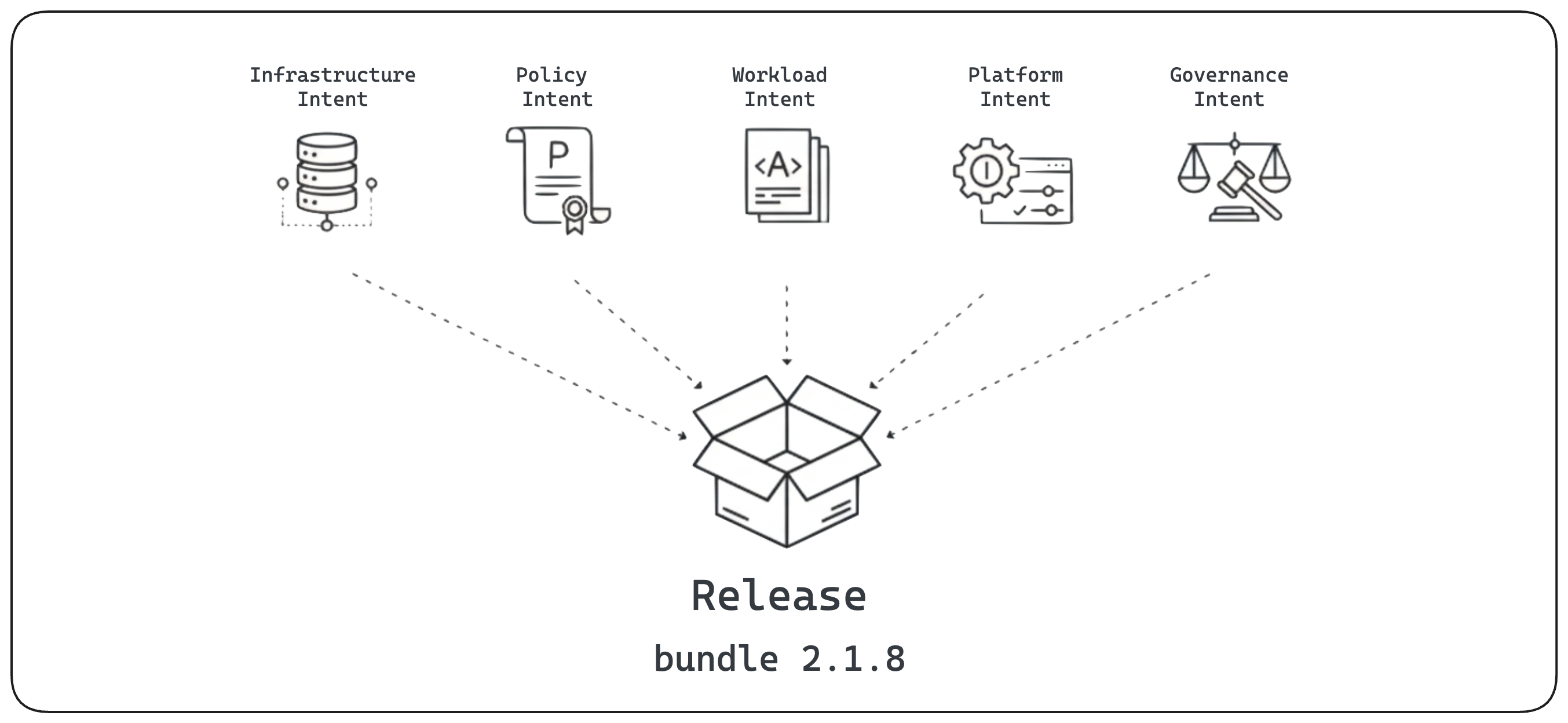
A release definition is a named, versioned bundle that expresses stable intent across infrastructure, workload, platform, policy, and governance. A resolved release binds that definition to specific artifact versions and execution parameters, producing the immutable system-state snapshot that can be compared, promoted, audited, deployed, and rolled back.
A Resolved Release Makes State Identifiable [Resolved Release Benefits]
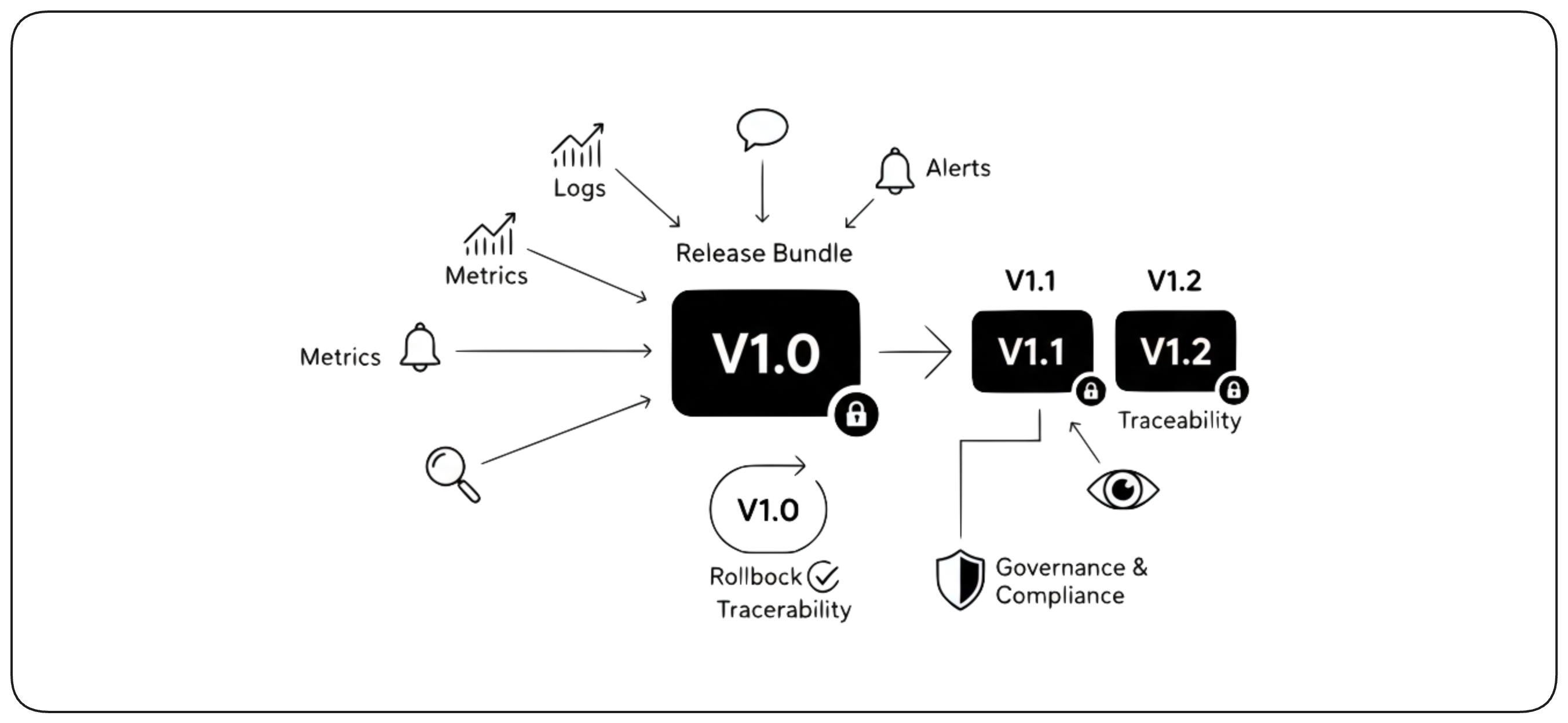
A resolved release gives system state a stable, immutable identity. Monitoring and incidents can be correlated to exactly what was running, previous states can be selected for rollback, and every binding remains traceable and auditable. Safety, observability, governance, and accountability become properties of the release model rather than processes reconstructed afterward.
Release Scope and Blast Radius [Release Scope]
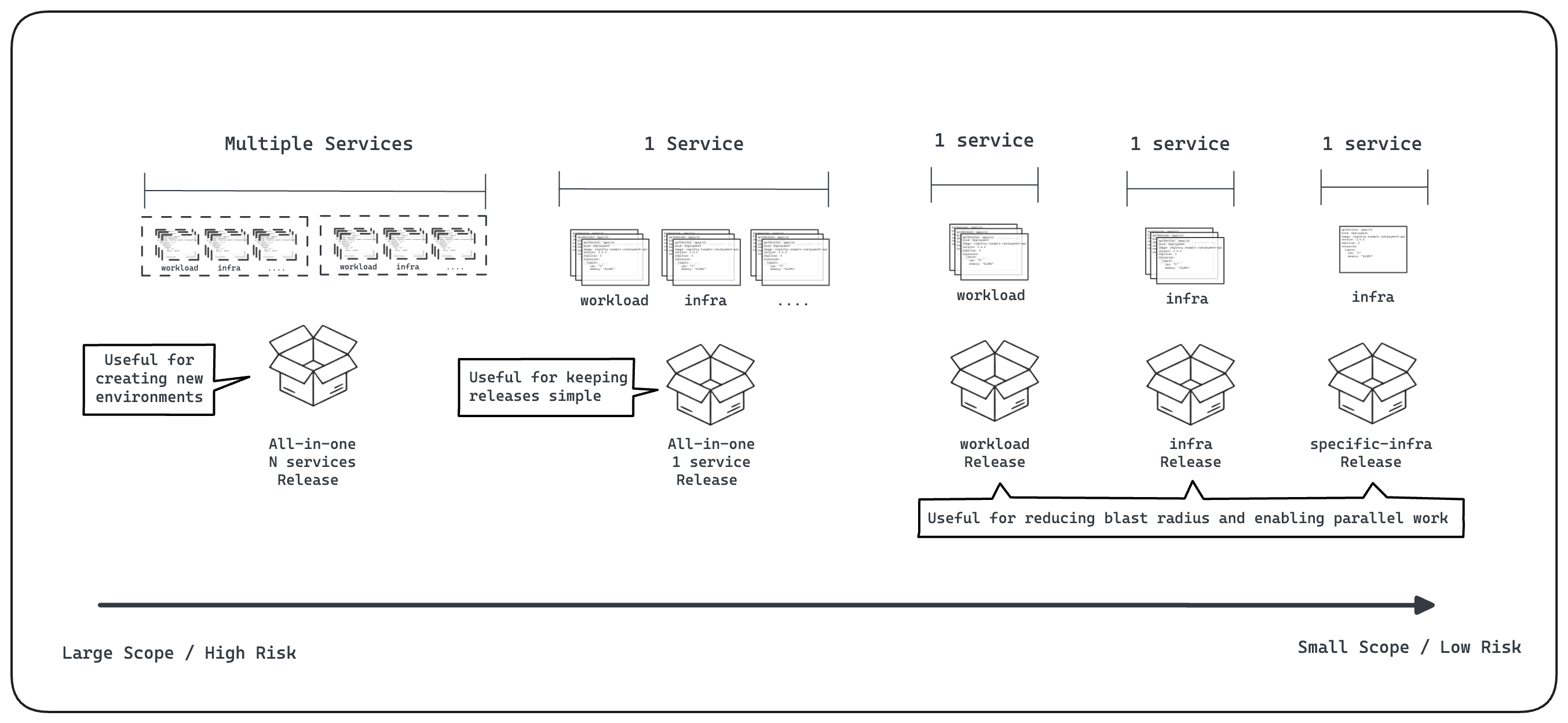
Release scope is a risk-management choice. Small, independent releases usually reduce blast radius, simplify recovery, and allow teams to move independently. But tightly coupled changes may be safer when released together. The goal is therefore not always the smallest release, but the smallest scope that preserves system consistency.
Artifact Versions and Release Versions Serve Different Purposes [Version Purposes]
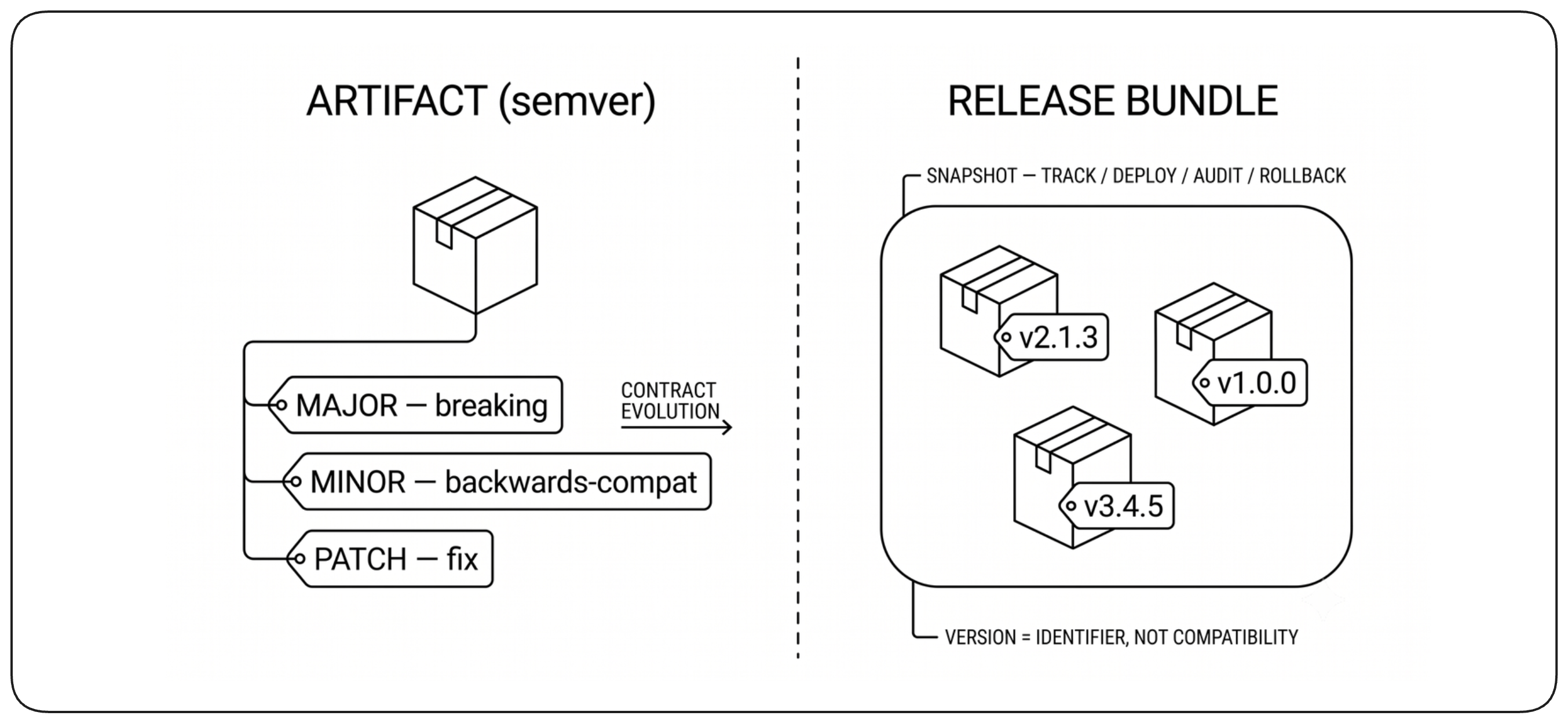
Artifact versions can communicate compatibility because artifacts expose contracts consumed by other components. A release version serves a different purpose: it identifies a resolved system-state snapshot. Artifact versions describe compatibility; release versions provide identity for tracking, promotion, audit, and rollback.
Making Declarative Releases Stable, Reusable, and Portable [Intent vs Execution]
Separate Definition from Resolution [Definition and Resolution]
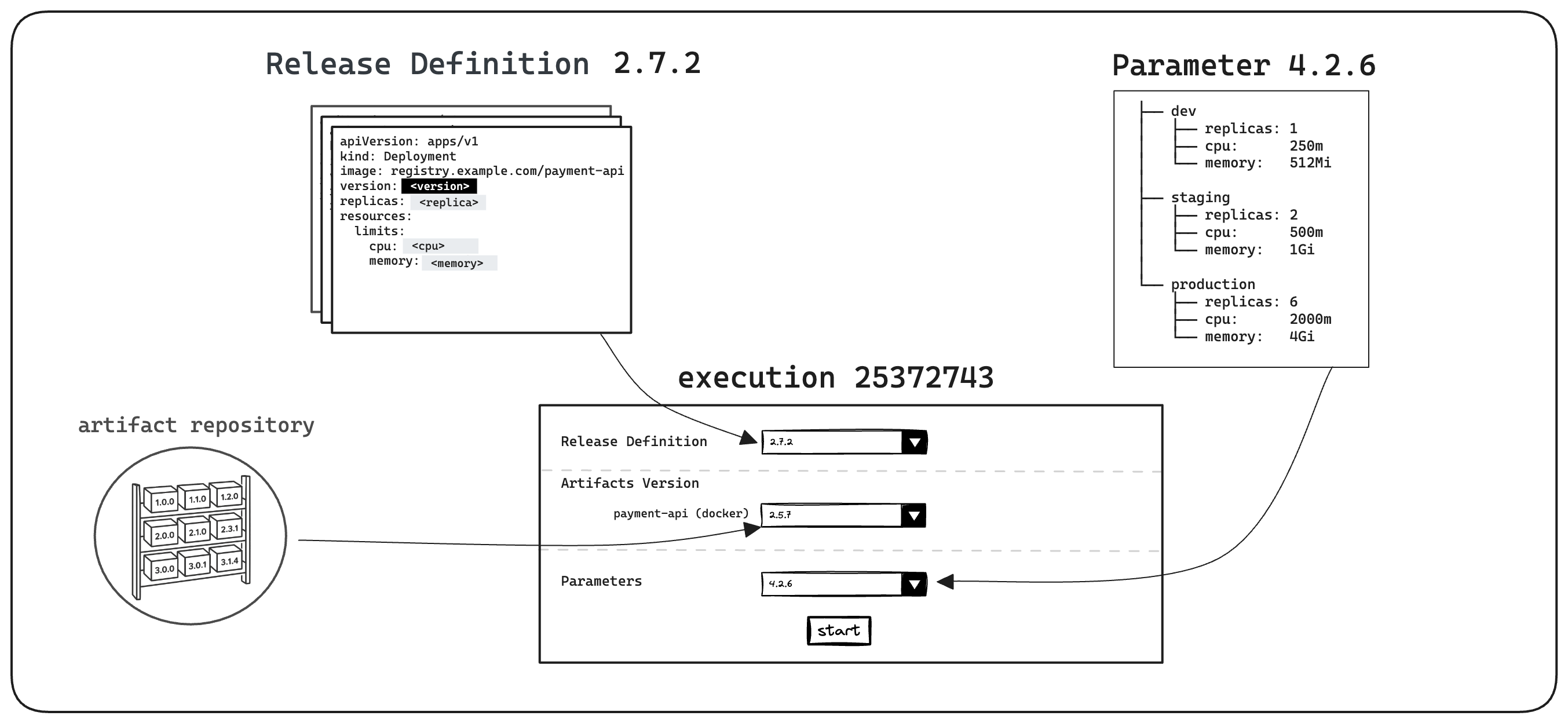
A release definition captures reusable intent. Resolution supplies the concrete values required for a specific release—such as artifact versions and environment parameters—and produces an immutable resolved release.
Keep Execution Context Out of Declarative Intent [Intent vs Execution Context]
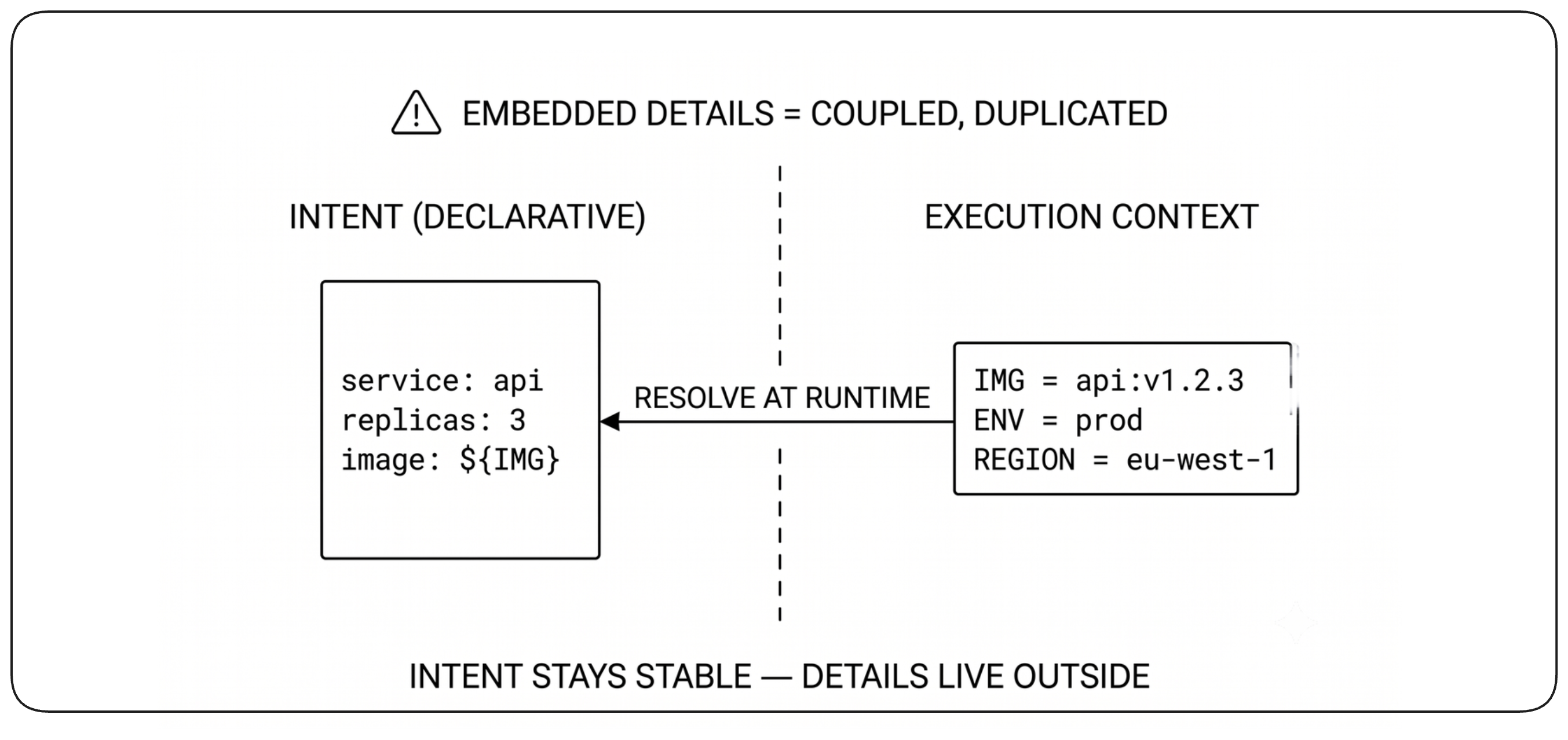
Declarative configurations should remain stable as execution context changes. Embedding values tied to a particular build, environment, or moment couples intent to execution, creating duplication and reducing reuse.
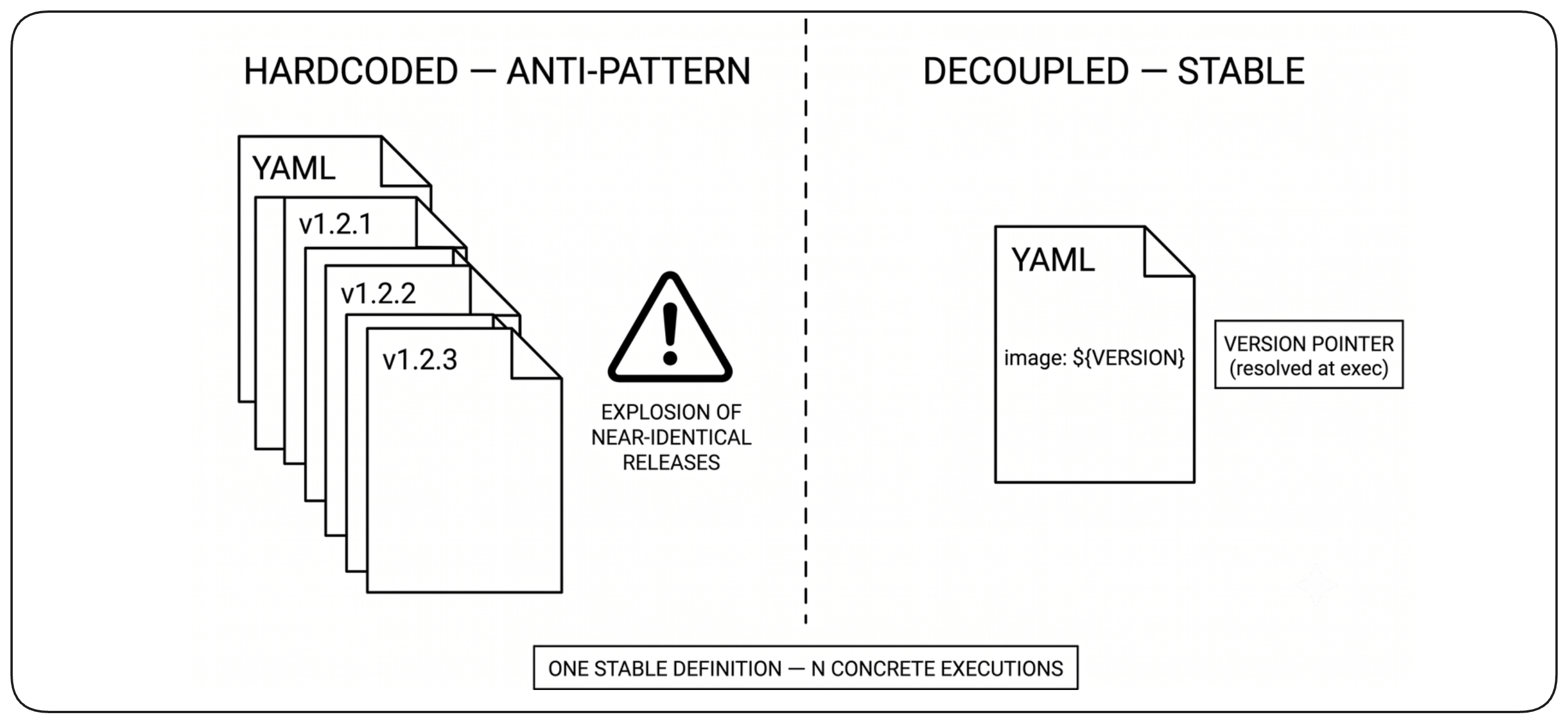
Why Artifact Versions Must Not Be Hardcoded [Version Decoupling]
Artifact versions change independently from release structure. Hardcoding them forces a new release definition for every build, creating many near-identical definitions. Keeping versions external preserves a stable, reusable definition, while the resolved release records exactly which artifacts were selected.
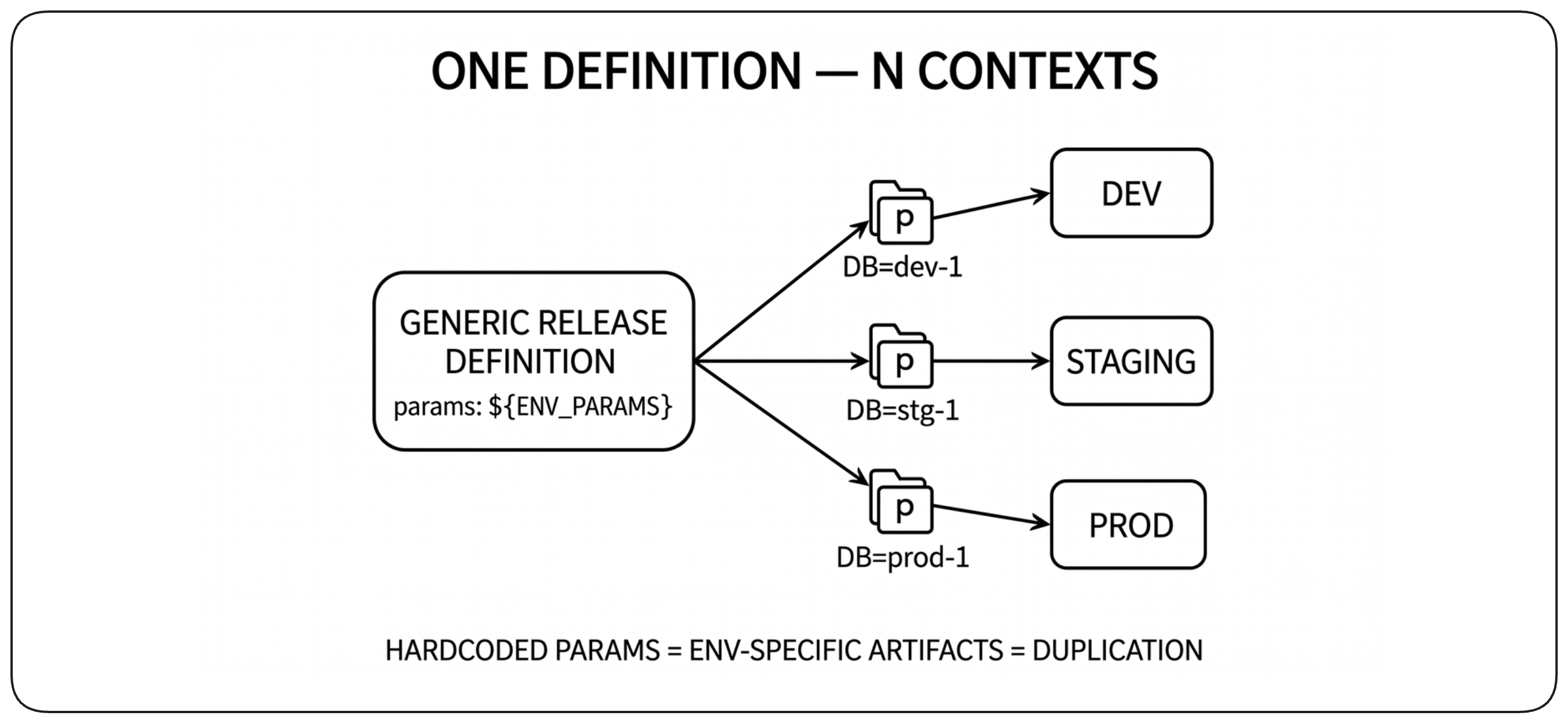
Why Parameters Must Not Be Hardcoded [Runtime Context]
Parameters represent execution context rather than stable intent. Hardcoding them binds a release definition to a specific environment, creating duplication and reducing reuse. Keeping parameters external preserves portability, while the resolved release records the concrete values used for each target.
The Configuration Triad: Static, Dynamic, and Secrets [Configuration Triad]
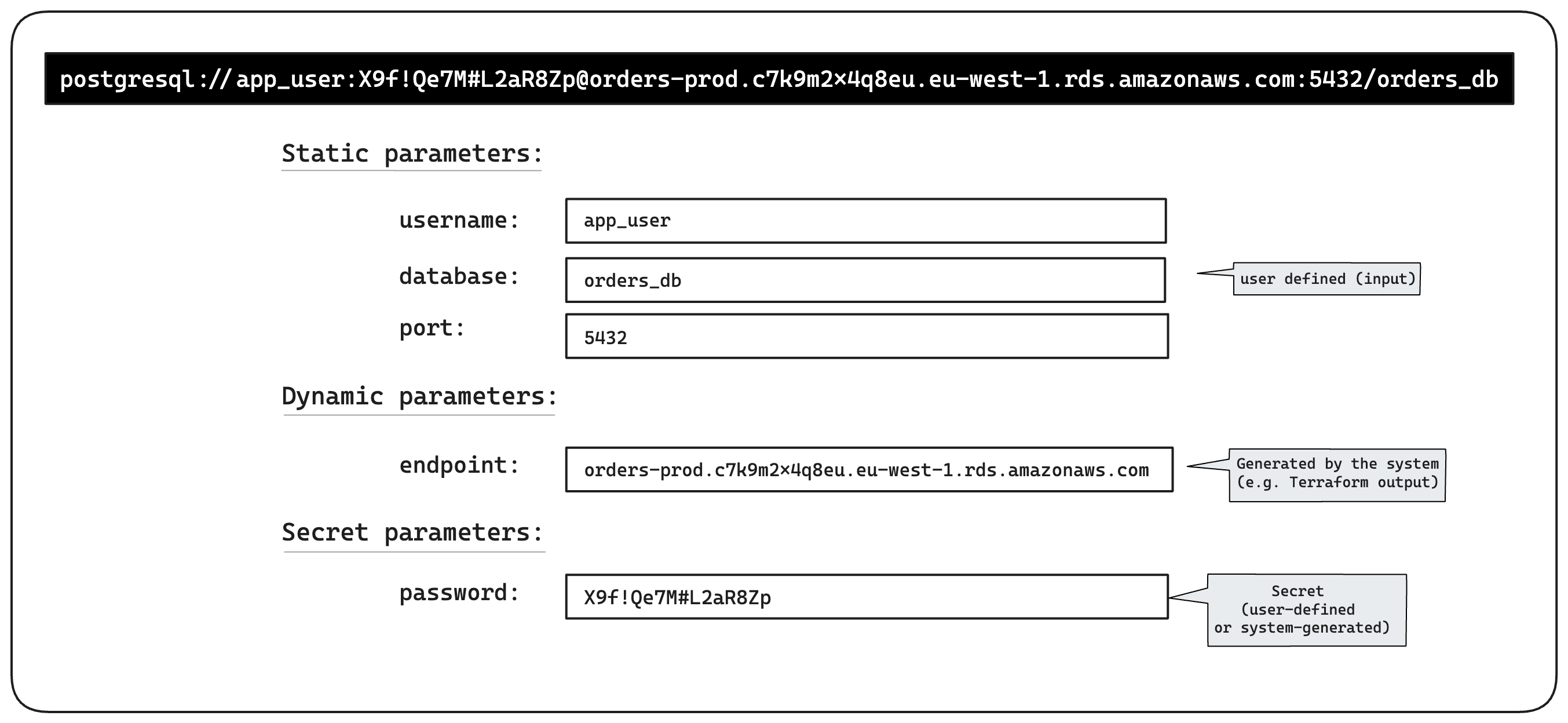
Configuration participates in releases through values with different origins and lifecycles: static parameters express human intent, dynamic parameters record discovered state, and secrets carry sensitive authority. Keeping those concerns distinct prevents the release pipeline from becoming the owner of every value.
Static Parameters [Static Parameters]
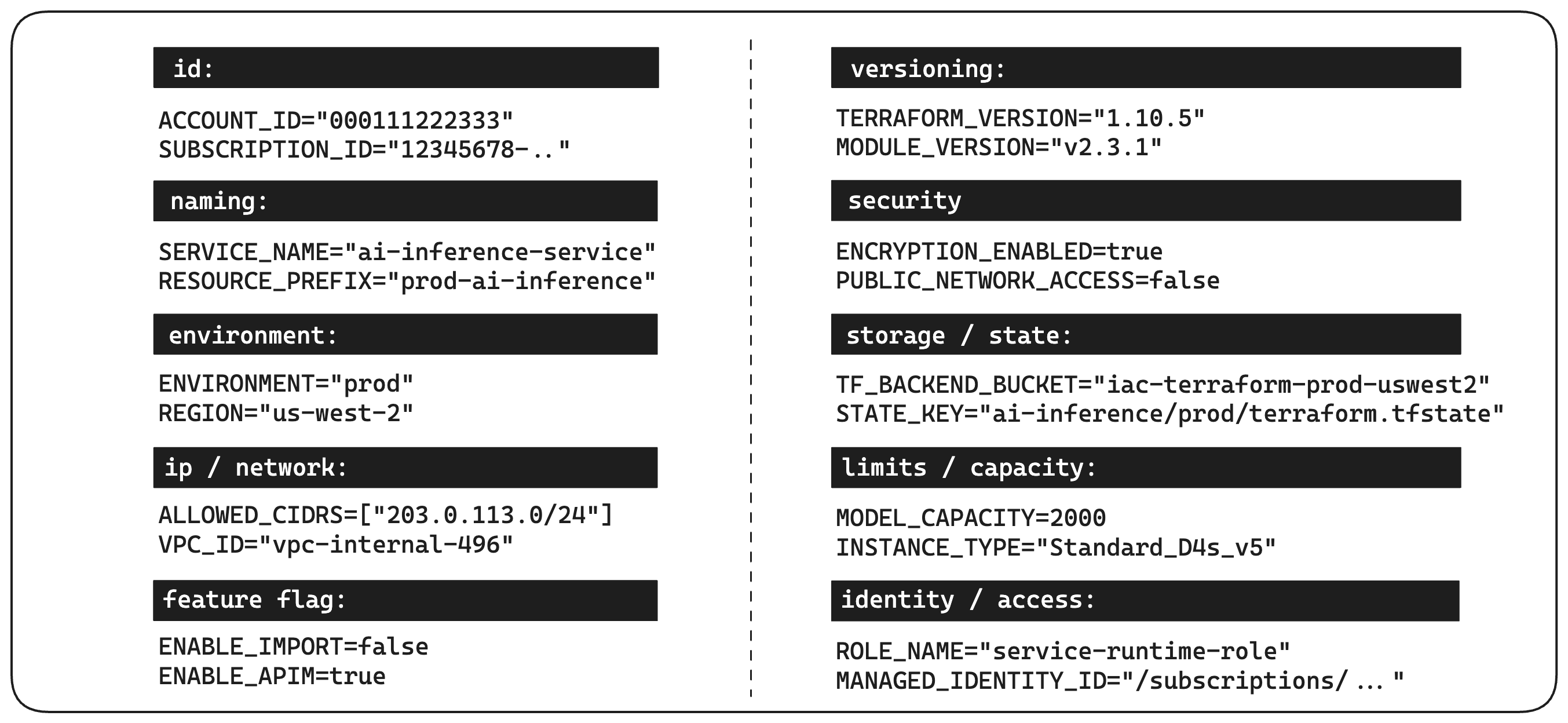
Static parameters are deliberate, reviewable human choices that describe how an environment should be configured. They belong with declarative intent and should remain separate from the execution machinery that applies a release.
Dynamic Parameters [Dynamic Parameters]
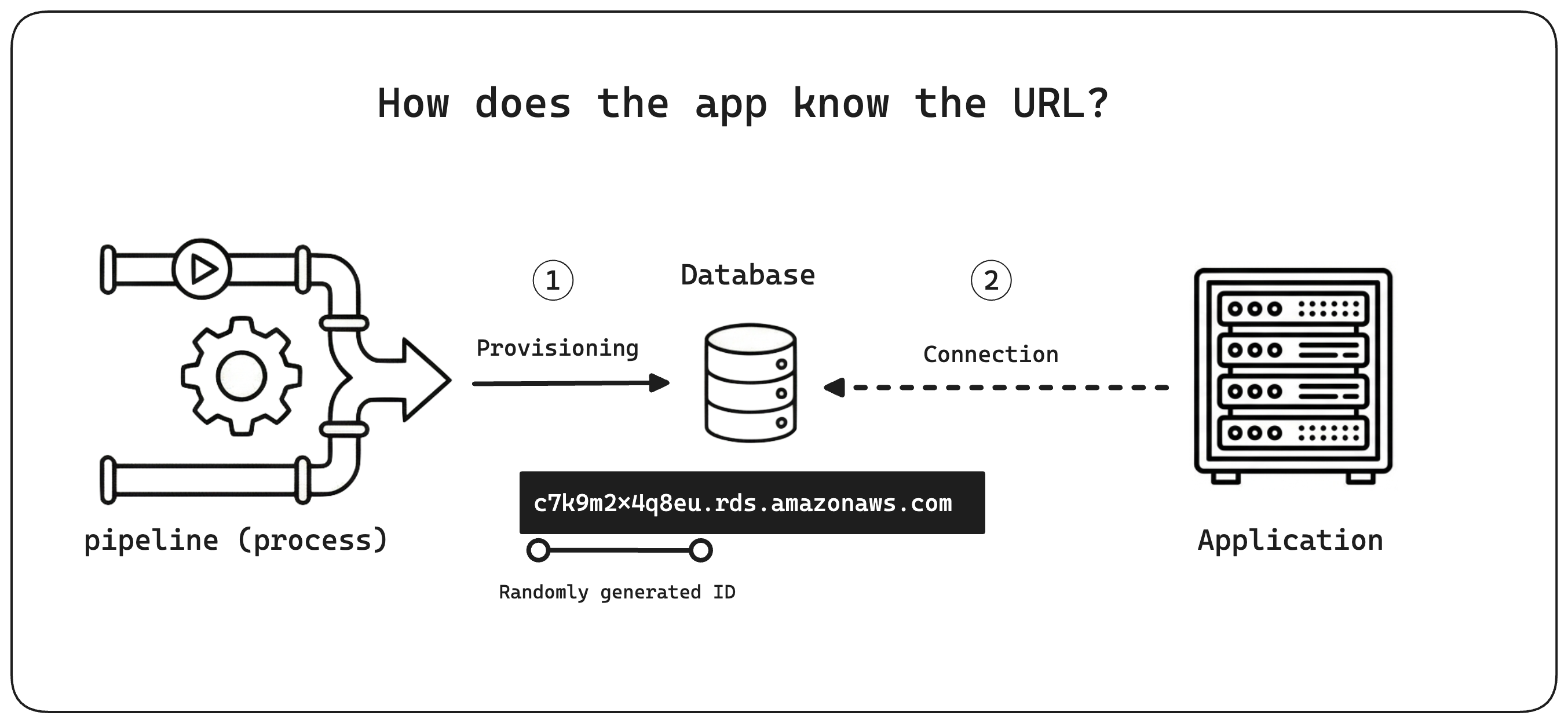
Dynamic parameters are values discovered or generated when systems execute, such as resource identifiers or endpoints. They describe observed reality rather than future intent, so consumers should retrieve them through a durable interface rather than coupling their lifecycle to a single deployment run.
Secrets [Secrets]
Secrets represent sensitive authority rather than ordinary configuration. Their storage, access, rotation, and lifetime therefore require a security lifecycle distinct from static and dynamic parameters.
Keep Secrets Out of the Release Path [Secret Autonomy]
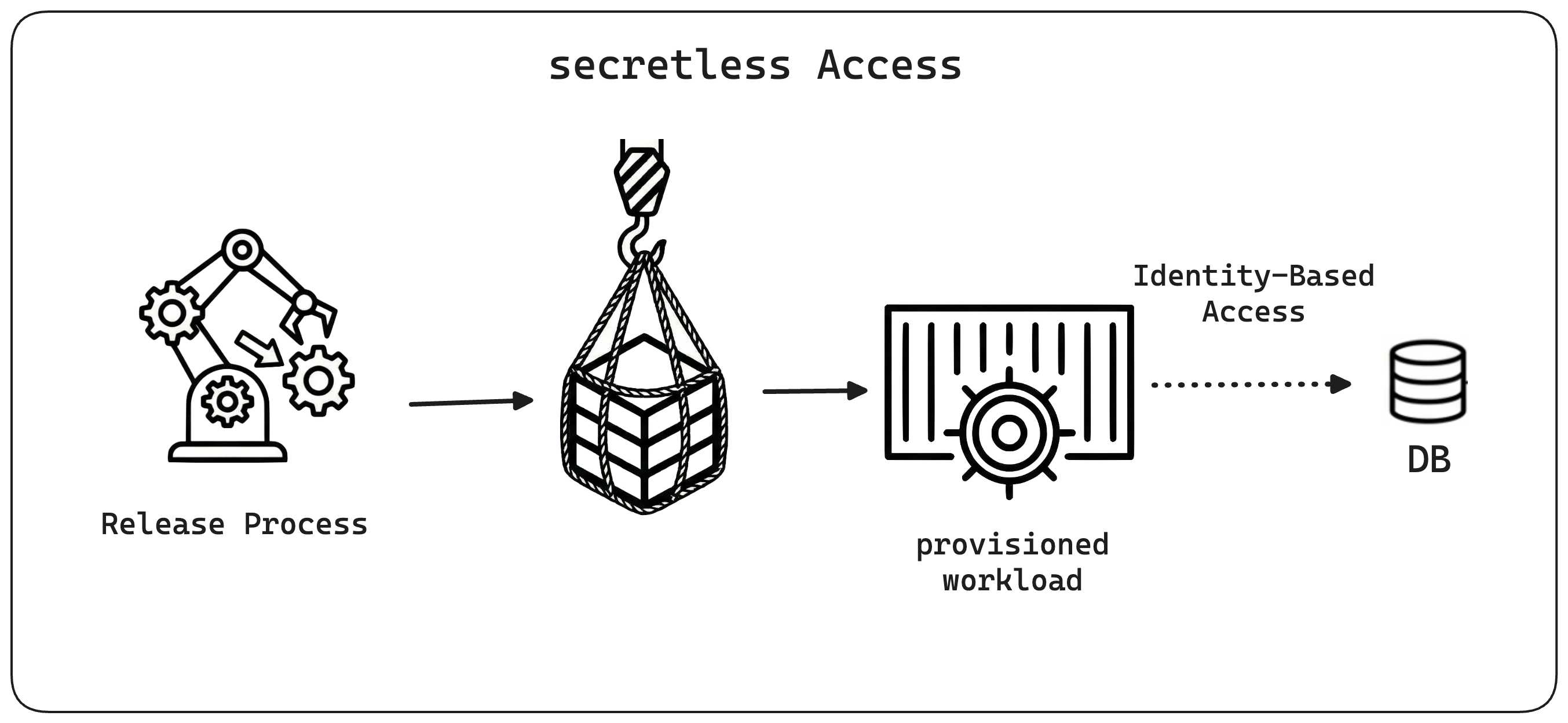
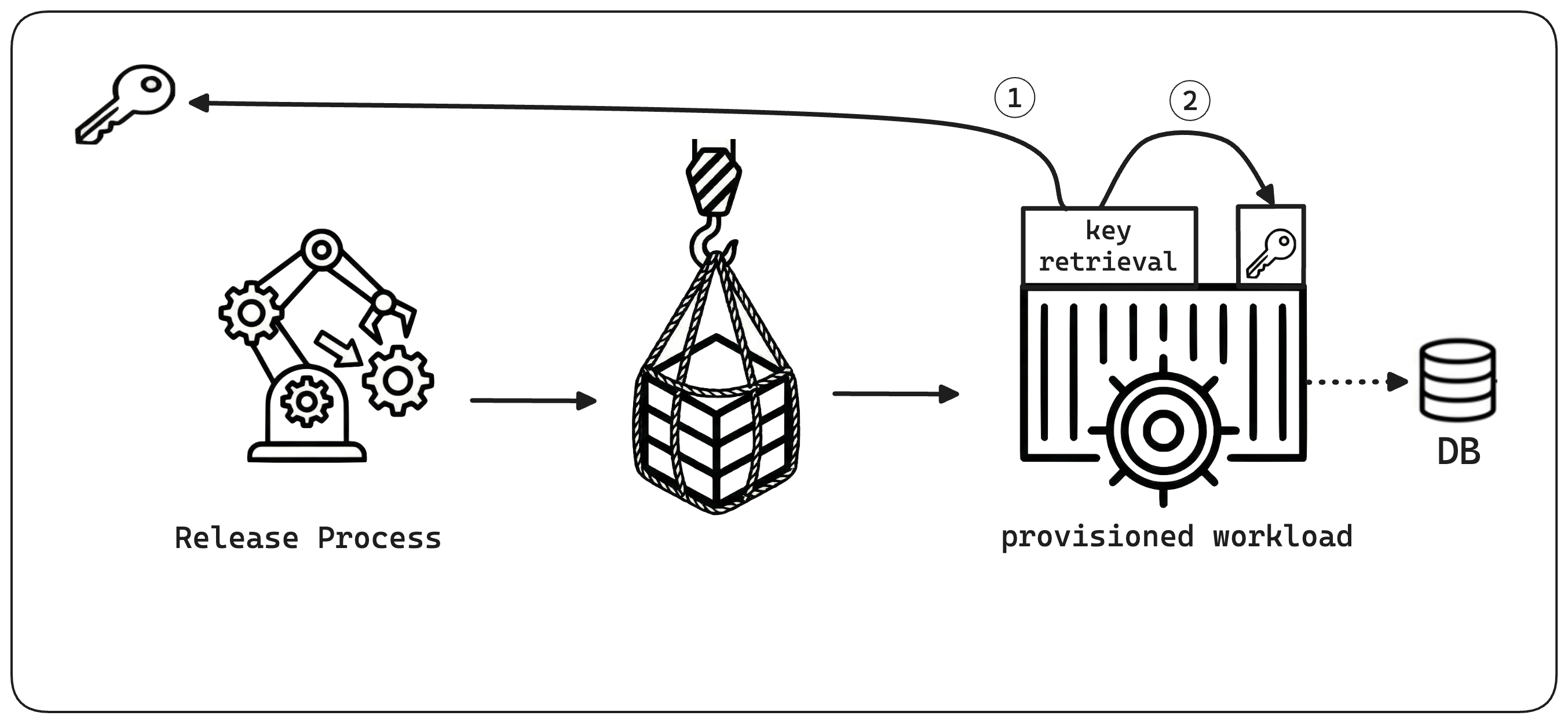
A release pipeline should not act as a courier for application credentials. Doing so exposes sensitive authority to the delivery system and couples secret rotation to deployment. Workloads should obtain their own runtime access directly, using workload identity wherever possible.
Unify Access, Not Storage [Unified Access]
Static configuration, dynamic state, and secrets may require different storage and security models. Consumers should not need to integrate separately with every backend that provides them. A platform can offer consistent access patterns while preserving the storage, security, and lifecycle semantics appropriate to each type.
GitOps [GitOps]
GitOps stores declarative desired state in Git and uses controllers to continuously reconcile that intent with the runtime environment.
Git Stores Desired-State Artifacts [Desired-State Artifacts]
GitOps treats declarative configuration as a versioned artifact: manifests, Helm values, infrastructure definitions, or other files that describe the desired state of an environment. These artifacts can reference immutable build artifacts stored elsewhere, such as a container image by digest. This keeps deployment intent versioned and auditable without turning Git into the storage location for executable build outputs.
GitOps Limitations [GitOps Limitation]
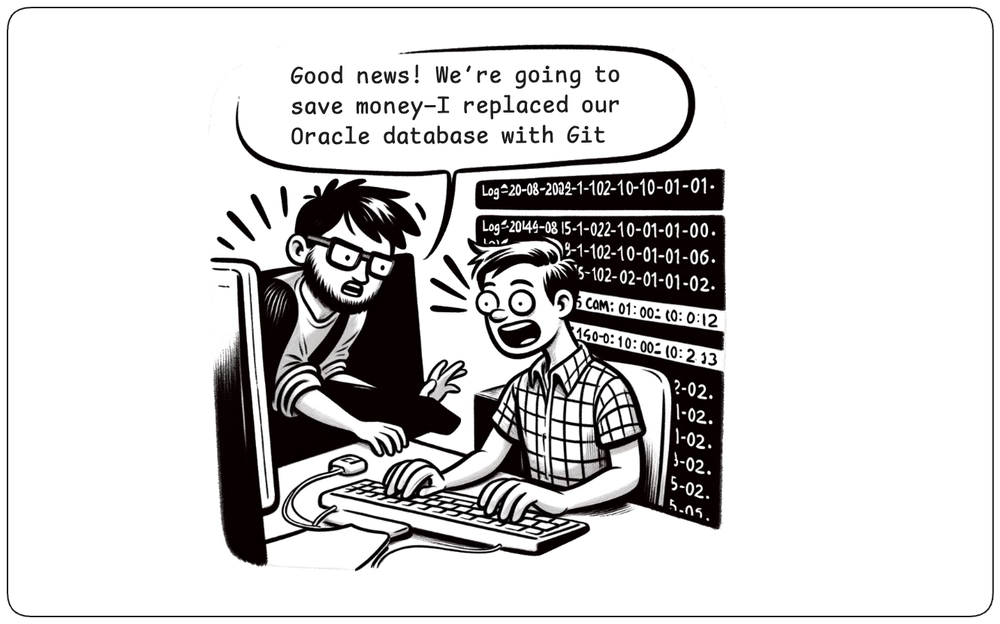
Git is well suited to declarative state that changes through reviewable commits, but it is not a general-purpose operational database. Frequently changing runtime data, deployment telemetry, inventories, or query-heavy operational history belong in systems designed for those access patterns. When automation constantly writes transient state back to Git or creates large numbers of mechanical pull requests, it is worth asking whether GitOps is being stretched beyond its intended role.
Safe Change
Safe change is the discipline of introducing change while controlling its uncertainty. The objective is not to eliminate risk, but to limit exposure, detect problems quickly, and preserve a safe path back.
No Change Is Without Risk
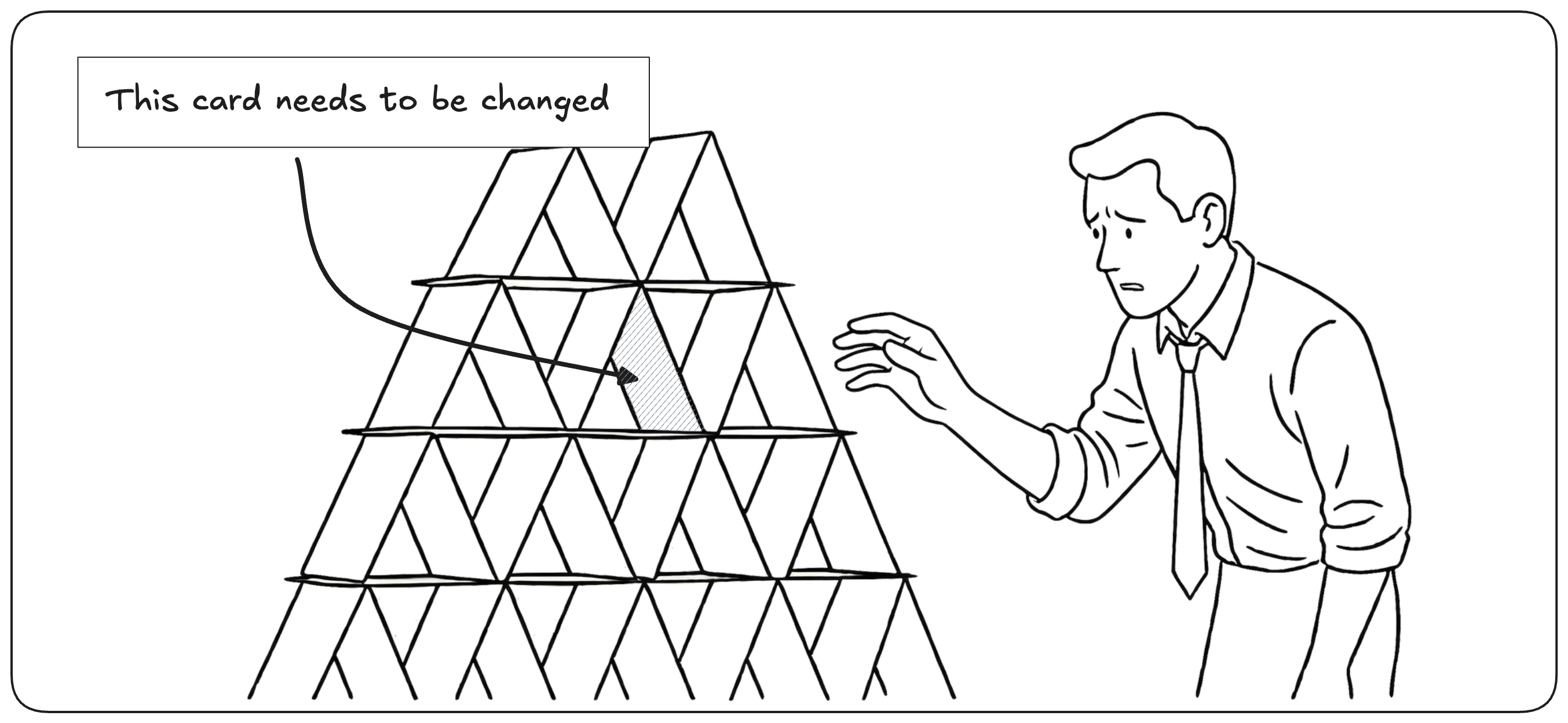
Every change introduces uncertainty. No matter how small, familiar, or well-tested it appears, its real impact cannot be fully predicted before it reaches the environment where it will run. A configuration update, dependency change, DNS modification, or new version can interact with the existing system in unexpected ways.
Identify What Can Go Wrong [What Can Go Wrong]
Effective risk management begins by pinpointing exactly what can go wrong. In software delivery, every change inherently introduces uncertainty. Before discussing tools or practices, we must clearly define the risks we aim to mitigate. Fundamentally, these risks fall into two categories: deployment failures, which leave the system in an unhealthy state, and application failures, where code deploys successfully but functionality is flawed. Safe change practices exist to address both—preserving system stability when deployments falter, and limiting the "blast radius" when the application misses the mark.
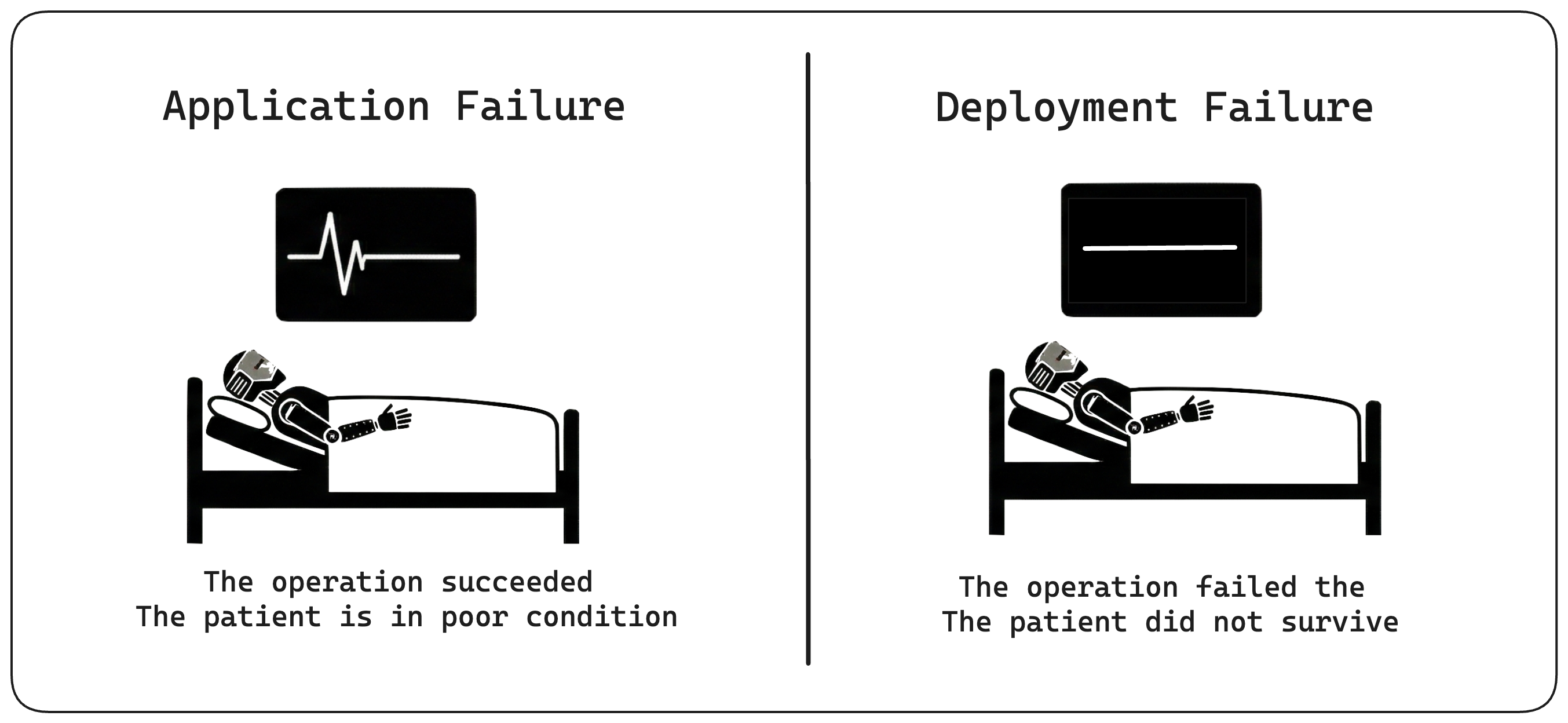
Note: This section focuses primarily on the problems of application failure. Issues related to deployment failure are addressed in the section "Deployment Failures and Recovery".
Risk Management Through Universal Principles [Risk Management] {1}
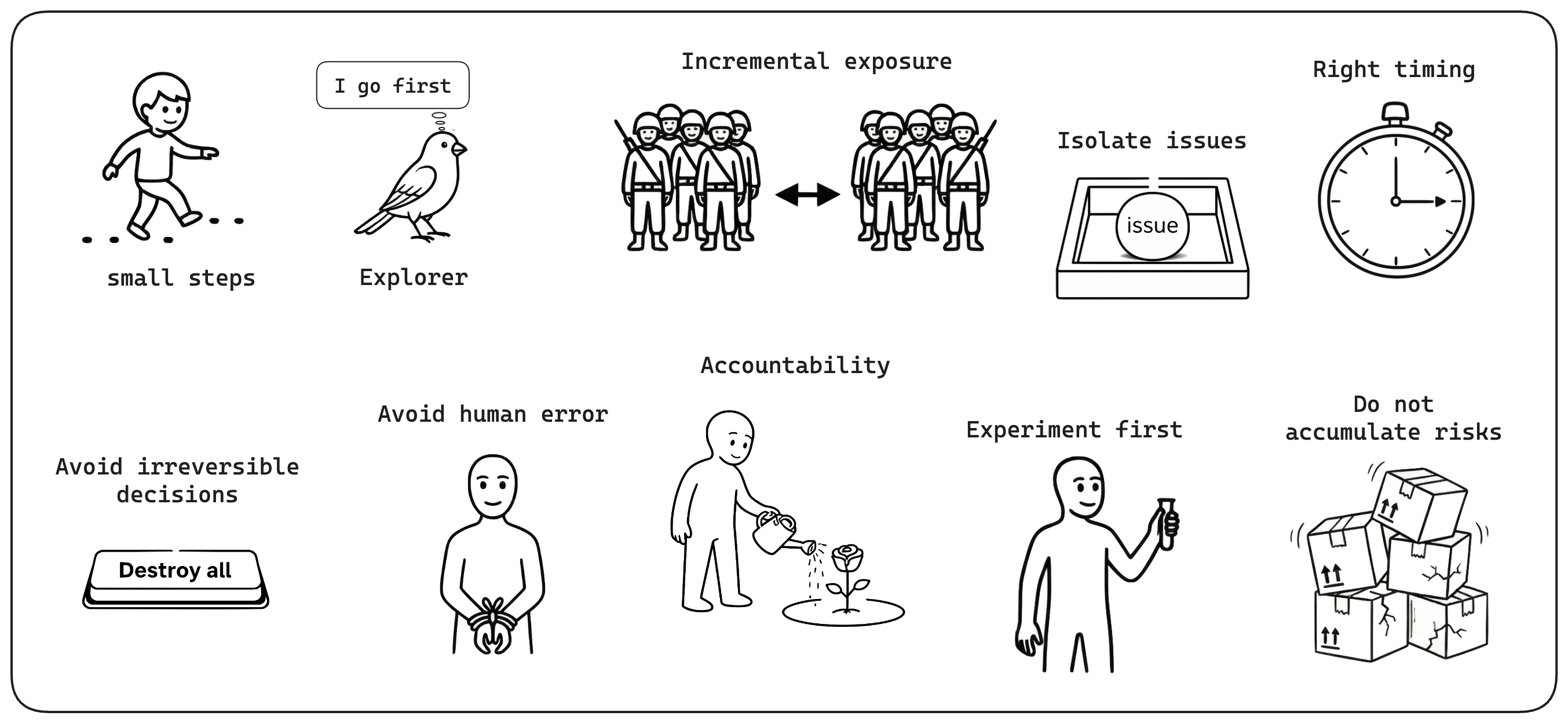
Safe change controls uncertainty through a small set of recurring principles: make changes small, experiment safely, limit exposure, automate execution, maintain clear ownership, observe the result, and preserve reversibility. These principles address both faulty application behavior and failures in the mechanism used to establish the new state.
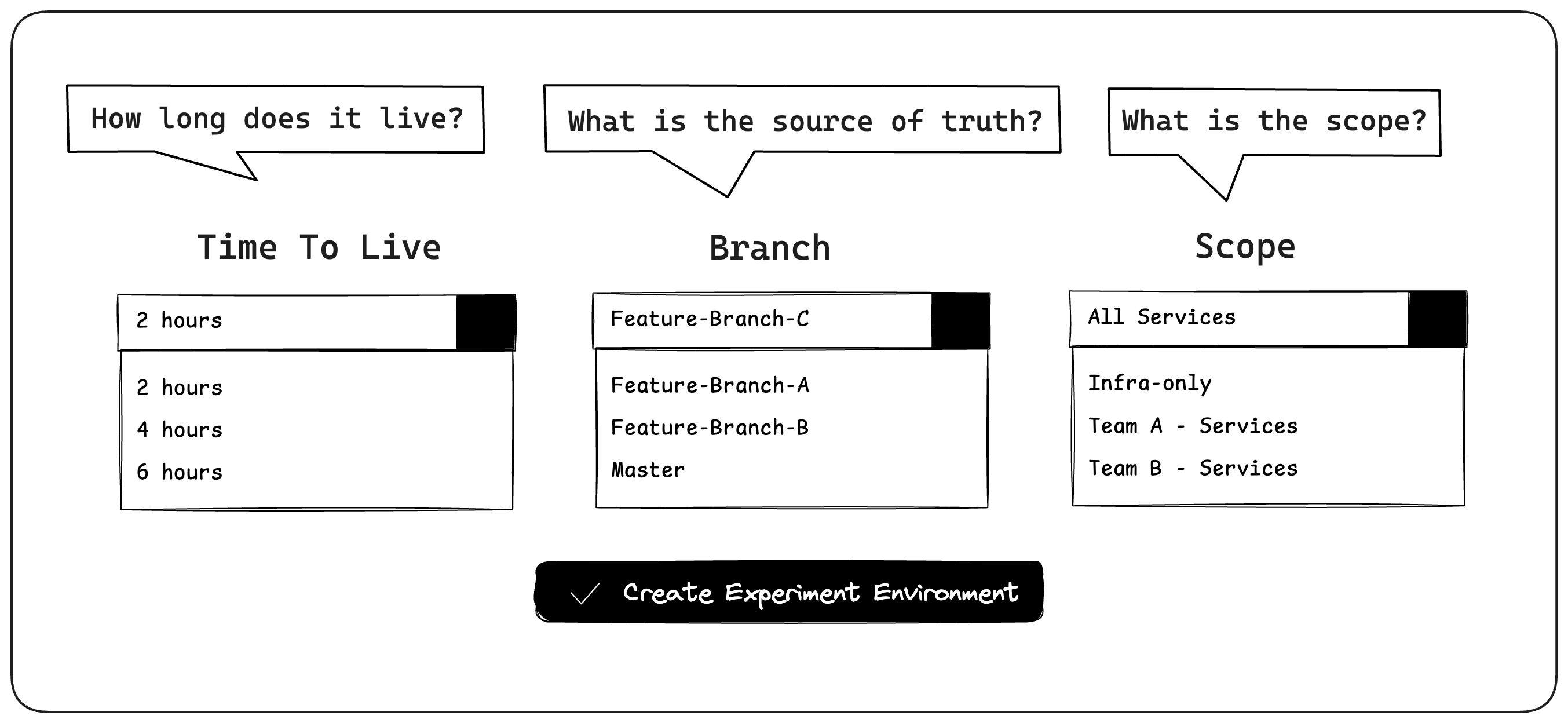
Safe Releases Require Safe Places to Experiment [Experiment]
Experimentation is essential, but it should not happen inside the path to production. Developers need isolated spaces where uncertain ideas, integrations, and risky changes can be explored freely without contaminating the release flow. A safe release system keeps experimentation fast and flexible while ensuring that only controlled, validated changes enter the production path.
Safety Is in Preparation, Not in the Change [Safety in Preparation]
A change is not safe simply because its code looks correct or its tests pass. Safety comes from preparing for failure: detect problems quickly, know who must respond, limit their impact, and maintain a tested recovery path. The objective is not to prove that nothing will fail, but to be ready when something does.

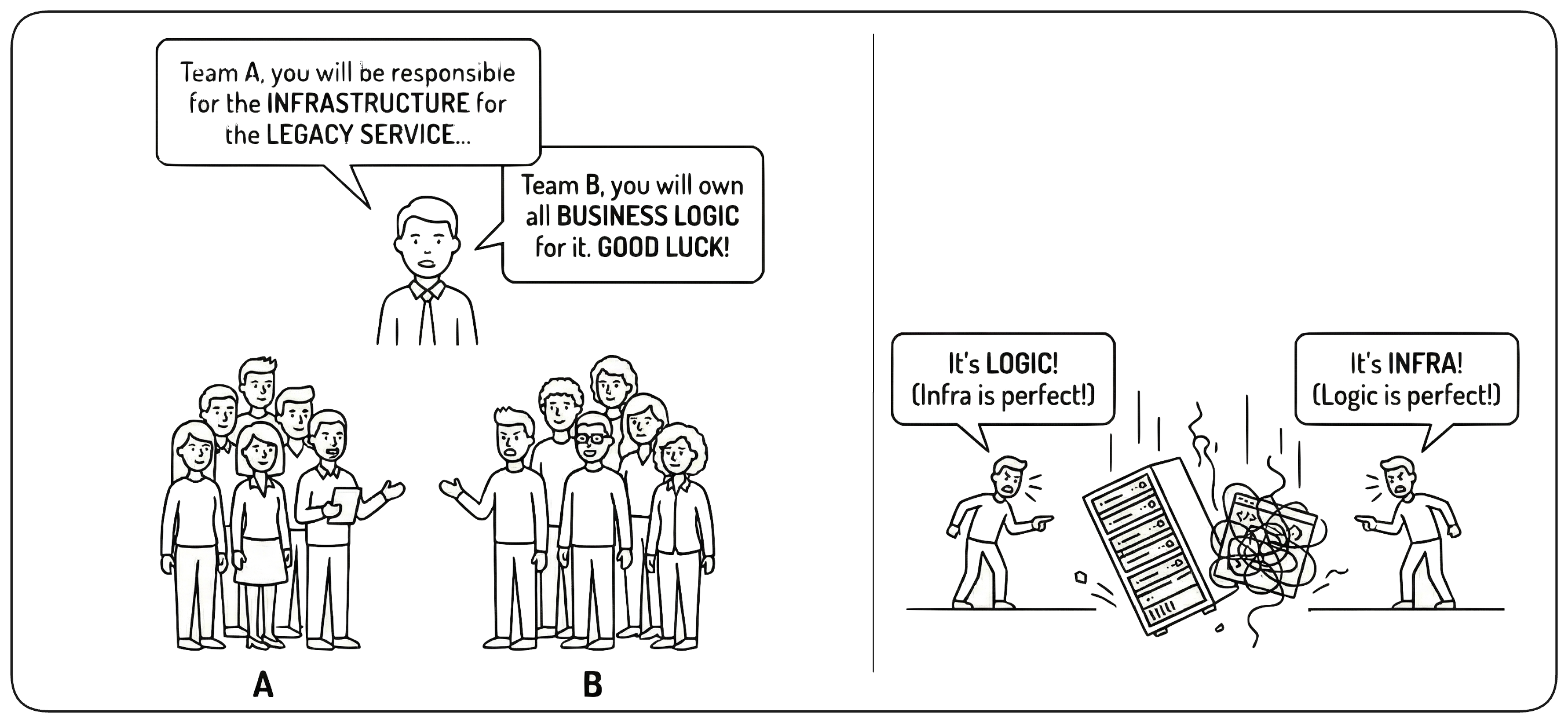
Clear Ownership: The Prerequisite for Safe Changes [Clear Ownership]
Every change needs an identifiable owner who understands its intent and potential impact. That owner follows the release, monitors its outcome, and has the authority to stop or roll it back when necessary. Ownership must be established before the change begins—not discovered during an incident.
Automate the Path to Production [Automation]
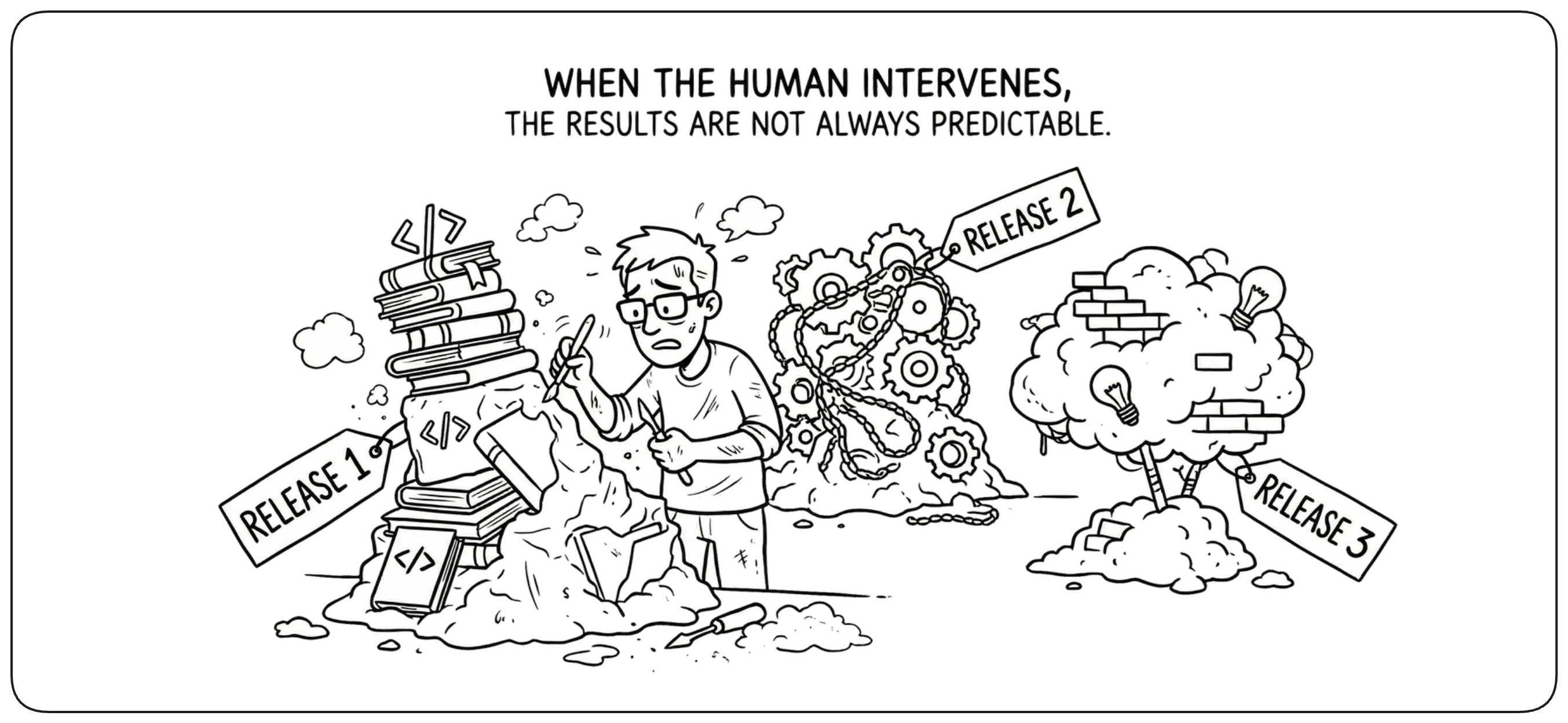
Repeated release operations should be deterministic and automated. Manual execution introduces variability, hidden assumptions, and inconsistent outcomes across environments. Automation makes the path to production repeatable, auditable, and enforceable.
Small Incremental Releases [Tiny Steps] {1}
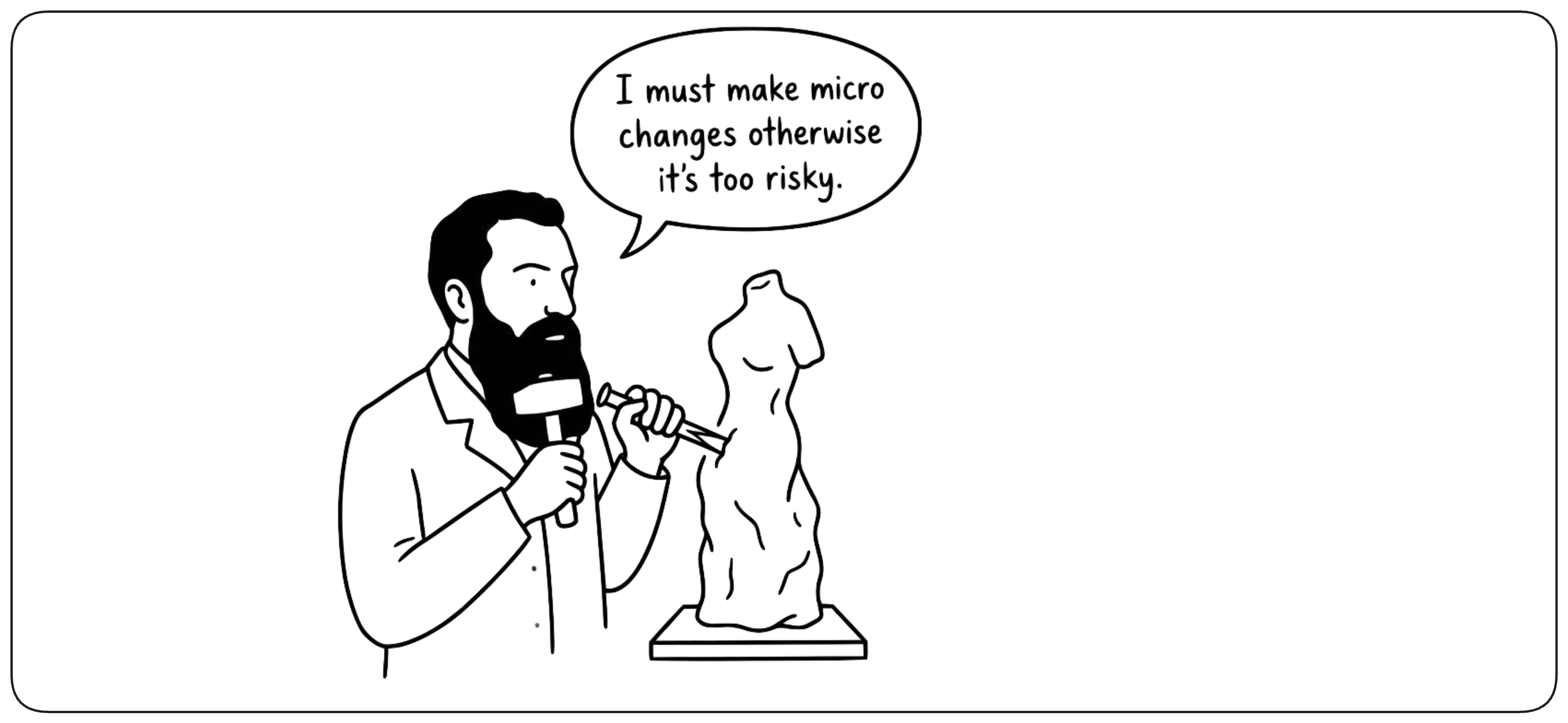
Small changes reduce uncertainty and blast radius. They are easier to understand, validate, observe, and reverse, and when something goes wrong there are fewer possible causes to investigate.
Release Frequently to Learn Faster [Learning Loop]
Frequent releases shorten the distance between a change and real feedback. Small increments reach users sooner, problems are easier to isolate, and teams can adjust before large batches of assumptions accumulate. The goal is not release frequency for its own sake, but a tighter cycle of change, evidence, and learning.
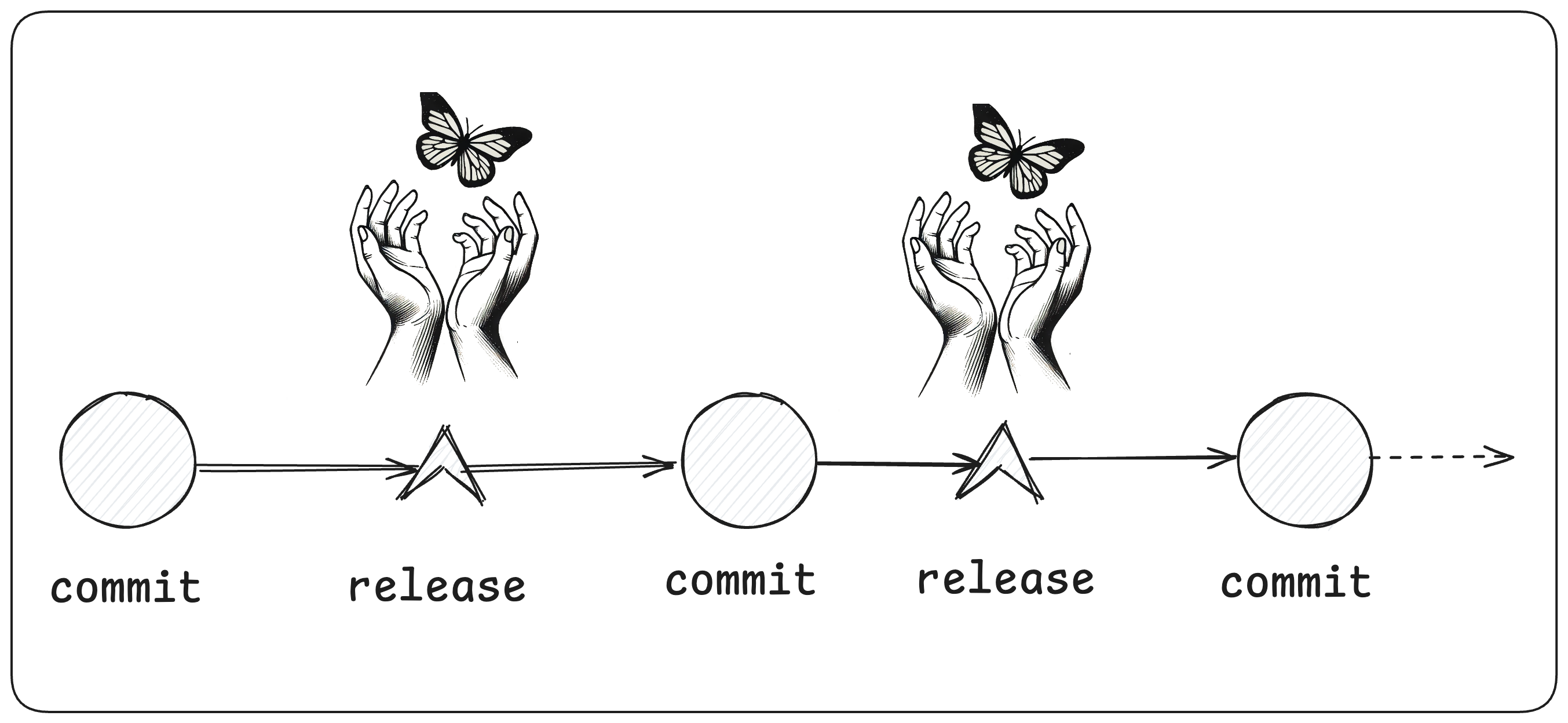
Own the Change Until It Reaches Production [Change Risk]
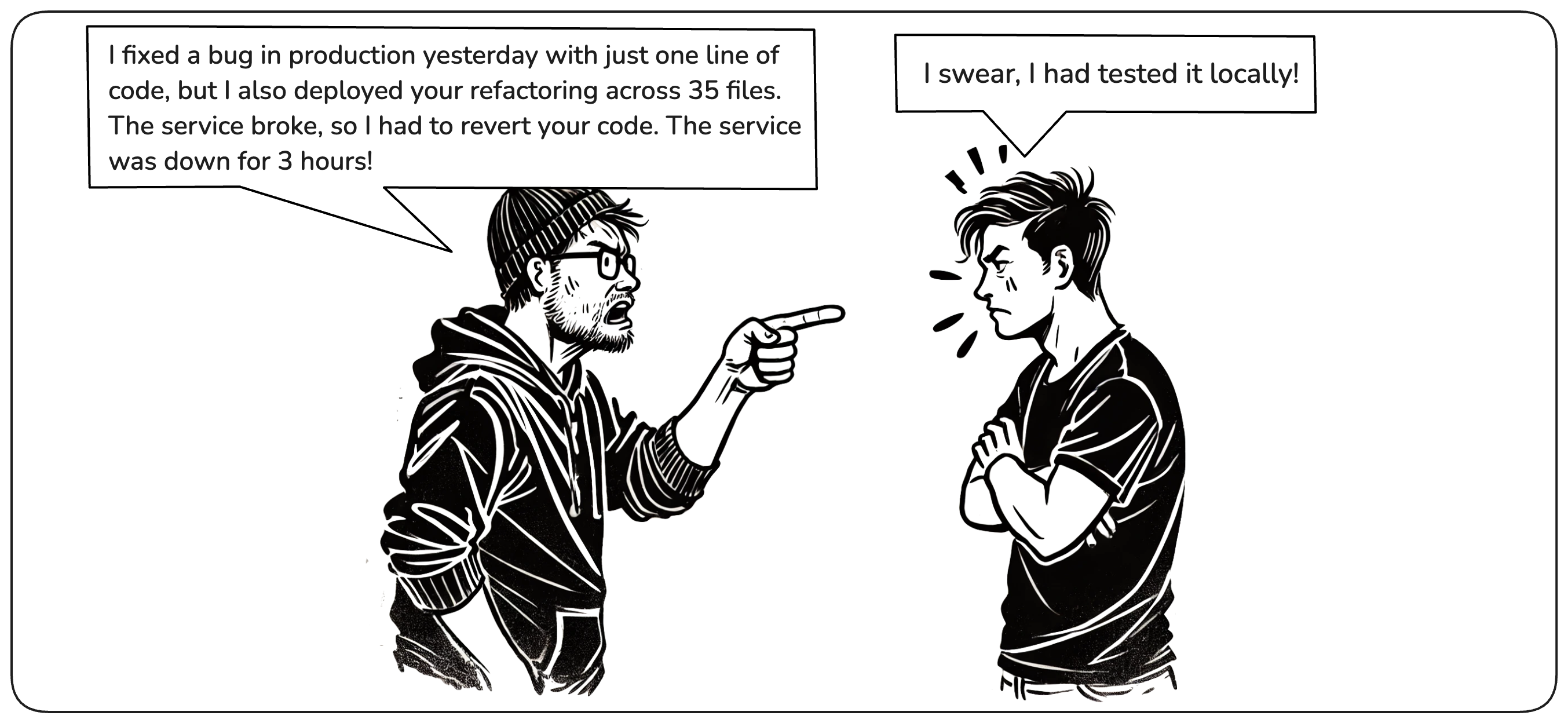
A change is not finished when it is merged, but when it has reached all intended production environments and operates as expected. When manual validation is still required, the developer who introduced the change must follow it through. Otherwise, unfinished changes accumulate and later releases inherit unrelated risk.
Progressive Exposure
Maintain Production Parity [Production Parity]
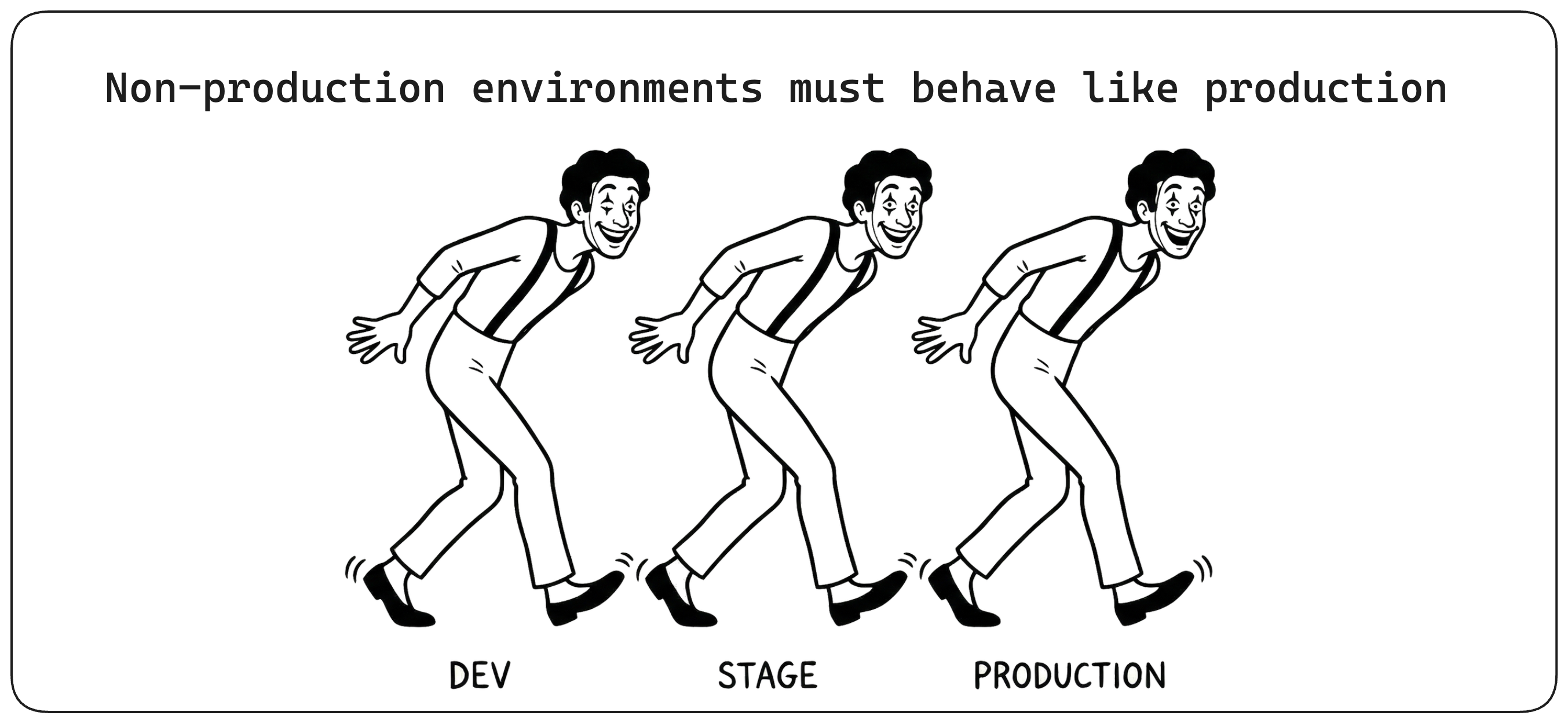
Keep non-production environments close enough to production that earlier validation remains meaningful. Configuration, dependencies, data shapes, deployment mechanisms, and operational behavior should differ only where necessary. The larger the gap, the more risk is deferred until production.
The Limits of Production Parity [Limits of Parity]
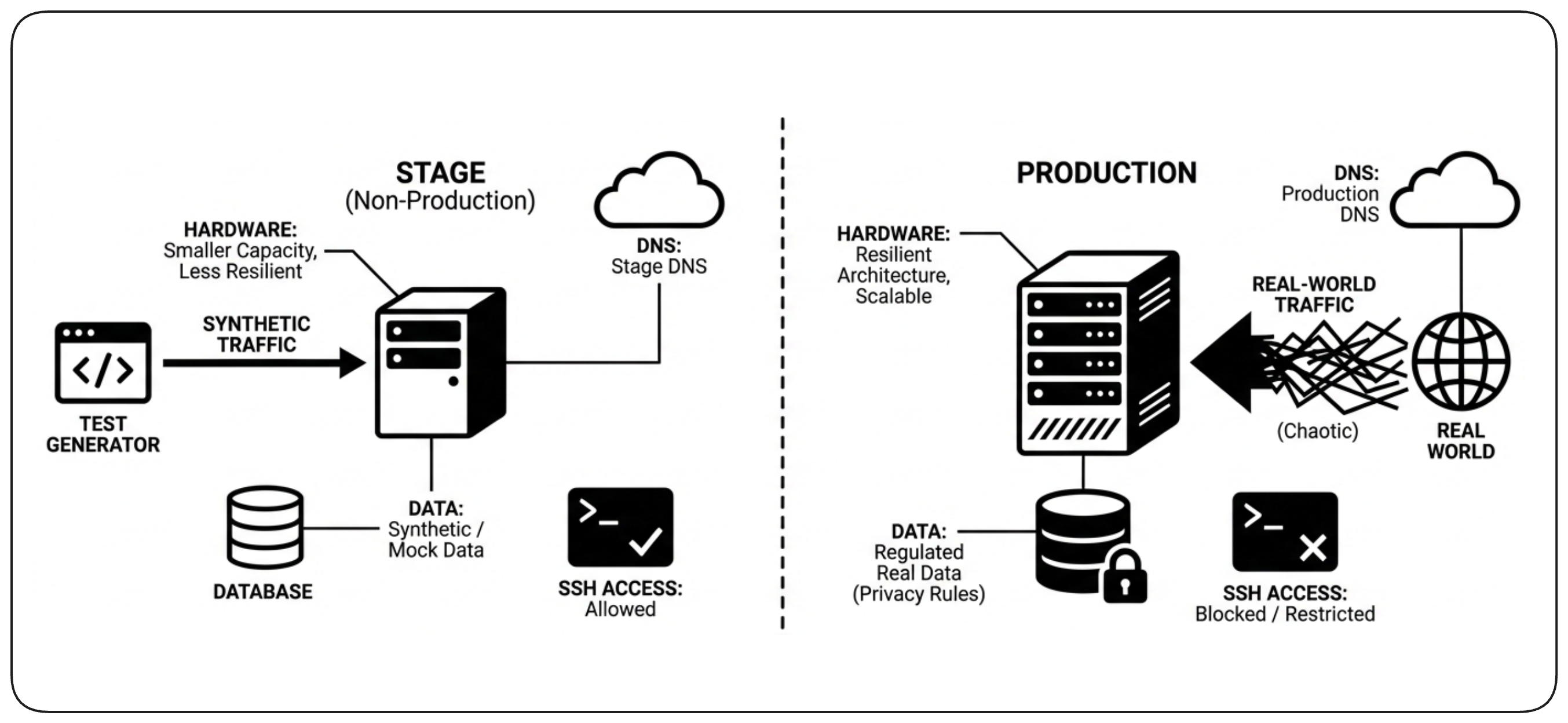
Perfect production parity is neither practical nor economical. Scale, infrastructure, data privacy, live traffic, and real user behavior inevitably differ from non-production environments. Some failures therefore remain invisible until a change encounters the conditions that exist only in production.
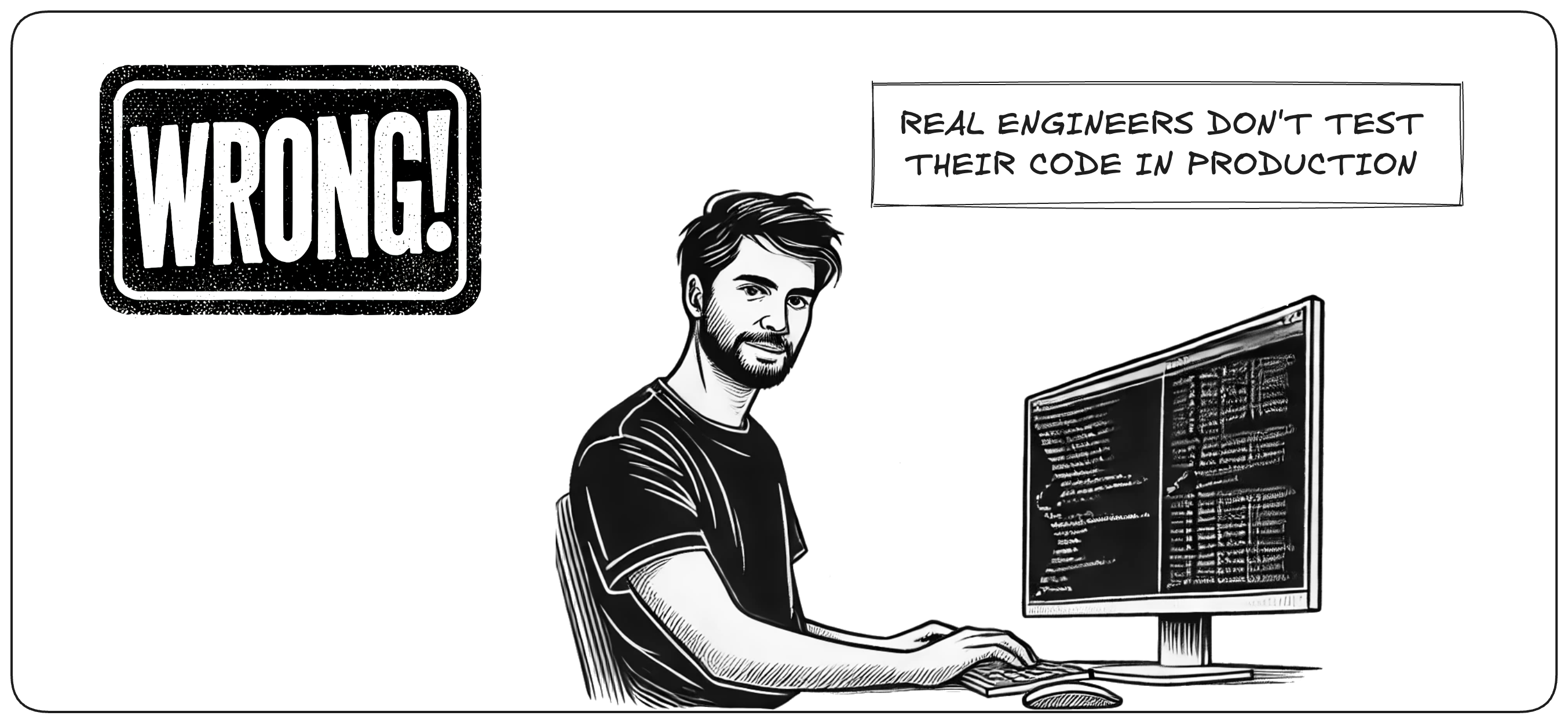
Some Evidence Can Only Come from Production [Production Evidence]
Some properties cannot be fully validated outside production because they depend on real traffic, scale, timing, and data interactions. When production is the only credible environment, exposure must be deliberately constrained and closely observed so uncertainty becomes controlled evidence rather than uncontrolled risk.
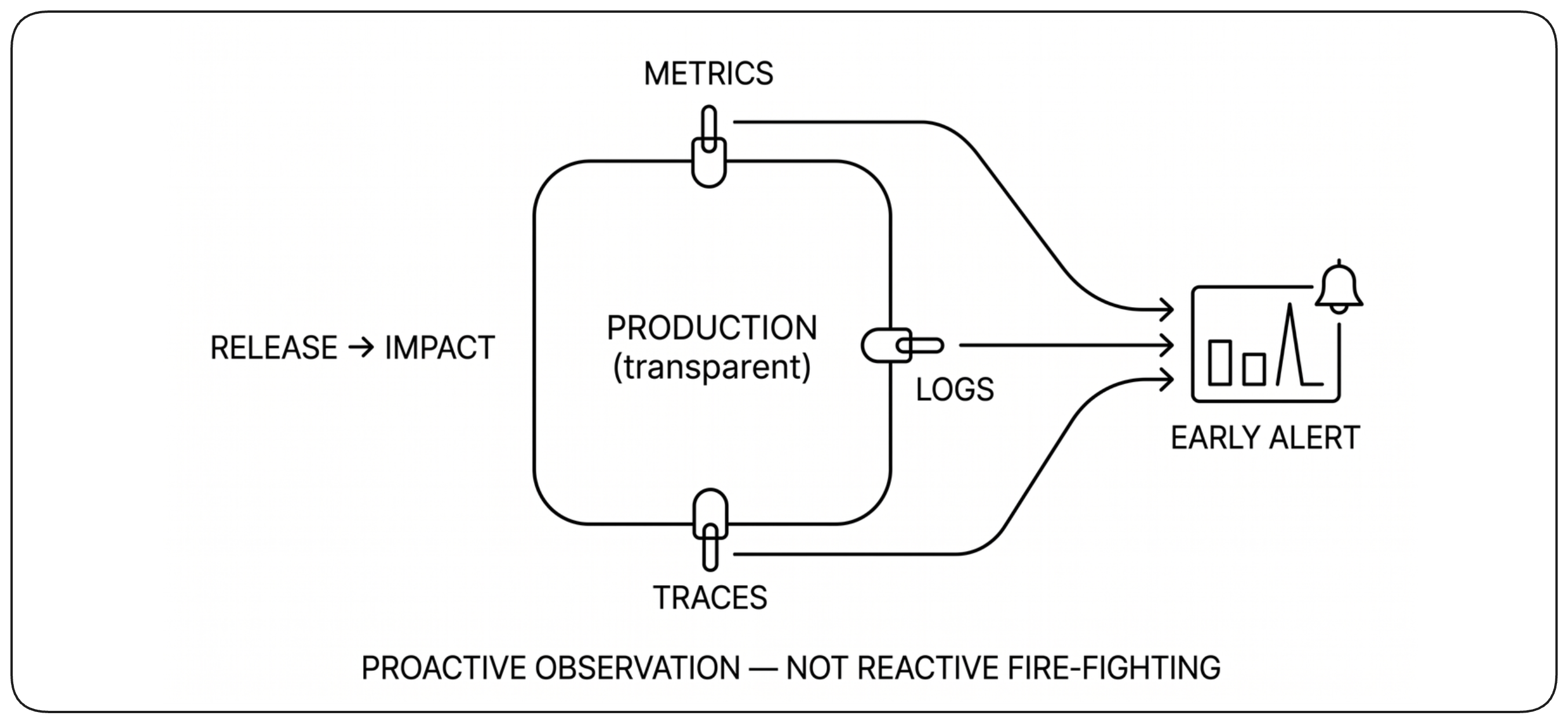
Continuous Monitoring [Production Monitoring]
Once a change reaches production, observation becomes part of the release decision. Metrics, logs, traces, and alerts reveal whether the new state behaves as expected and provide the evidence needed to continue exposure or roll back. Without visibility, progressive delivery is only progressive risk.
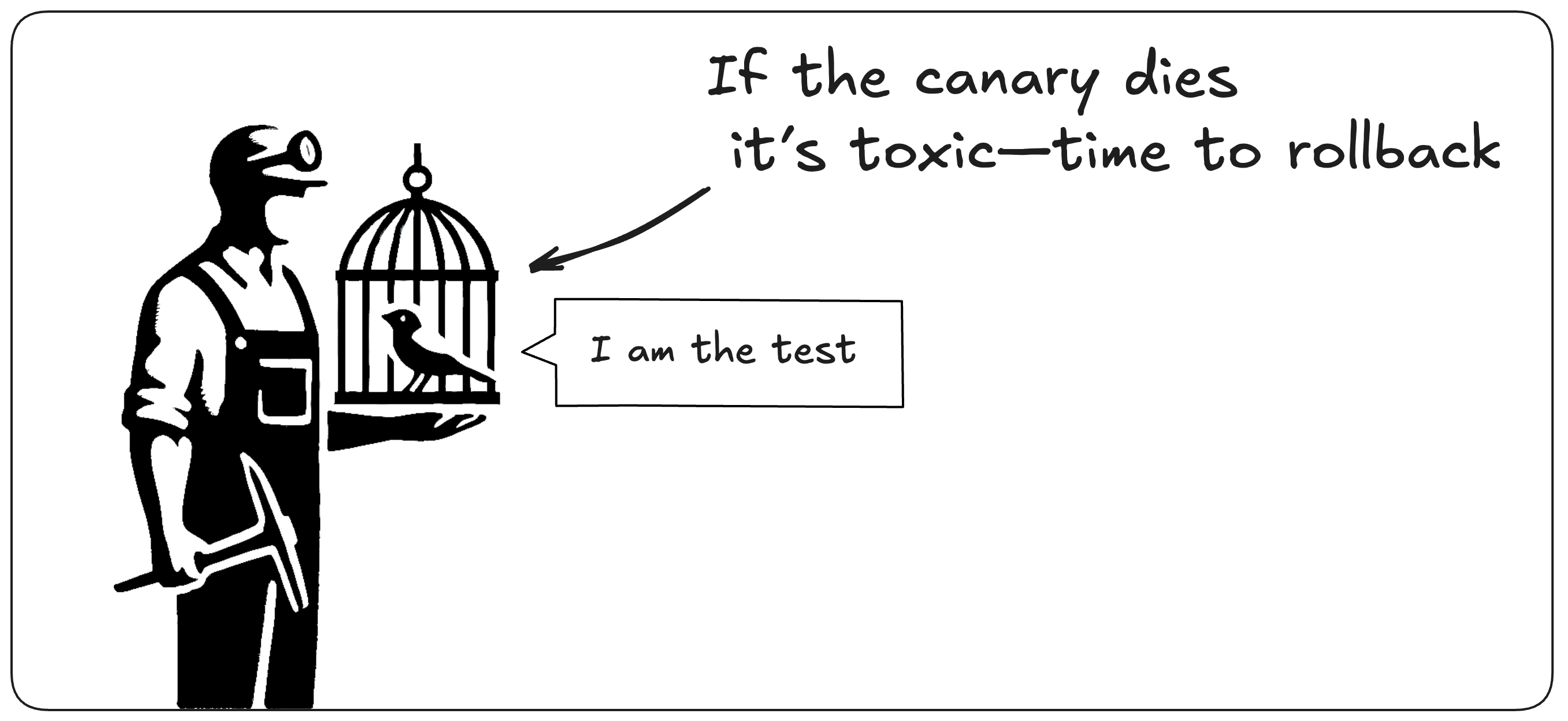
Limit Initial Exposure with a Canary [Canary Exposure]
Canary deployment limits blast radius by exposing a new version to only a small fraction of real traffic. Its behavior is observed before exposure expands. If health degrades, the rollout stops or rolls back while most users remain on the known-good version.
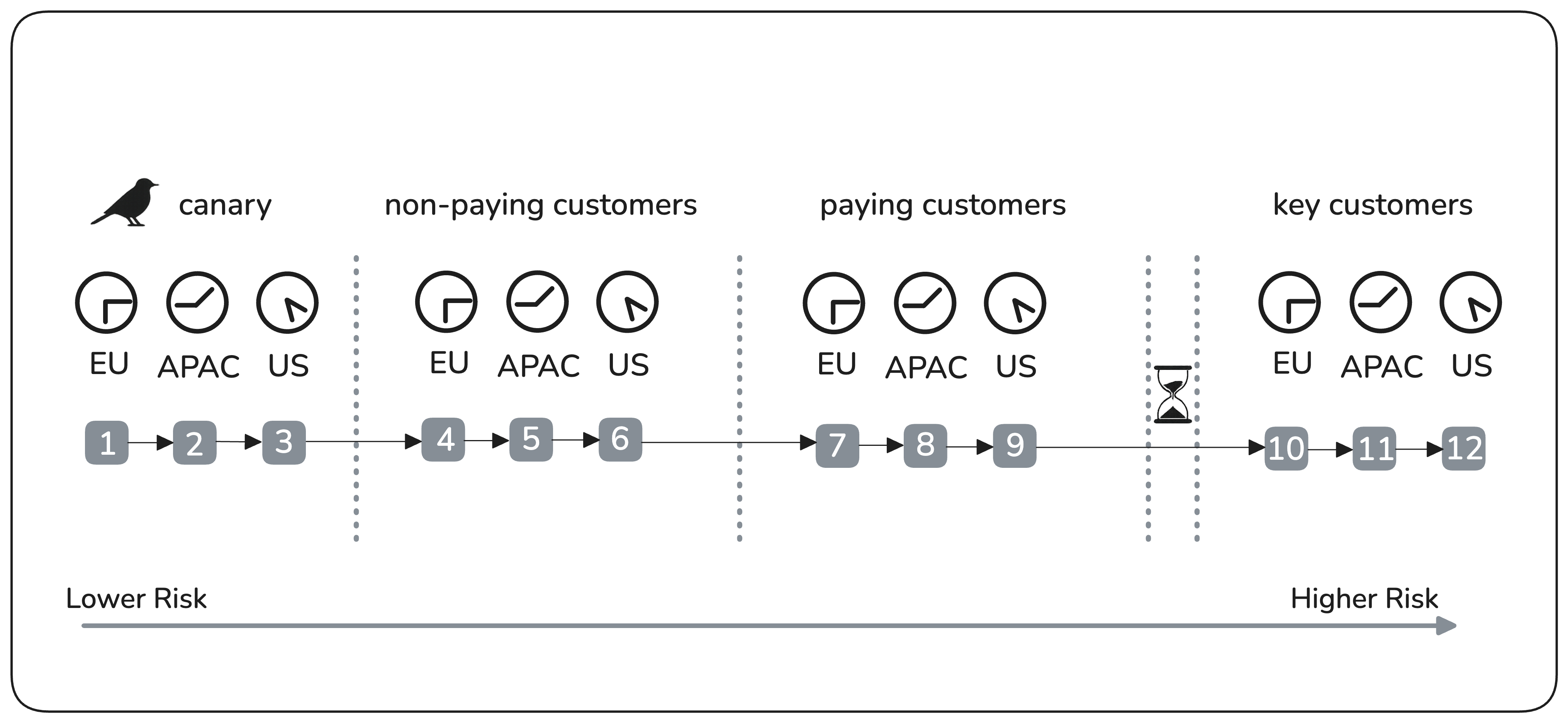
Expand Exposure Gradually [Gradual Exposure] {1}
After the initial canary succeeds, exposure should increase progressively rather than jump directly to 100%. Each stage expands the blast radius only after the previous one has produced sufficient evidence. Segmentation can follow traffic, geography, customer groups, infrastructure, or any boundary that meaningfully contains risk.
The Conflict Between Gradual Rollouts and High-Frequency Releases [Rollout vs. Frequency]
Progressive rollout reduces risk by slowing exposure, while high-frequency delivery depends on keeping changes moving. A long-running rollout can therefore block subsequent changes, causing them to accumulate into larger batches. A safety mechanism can paradoxically increase risk if exposure and deployment cannot progress independently.
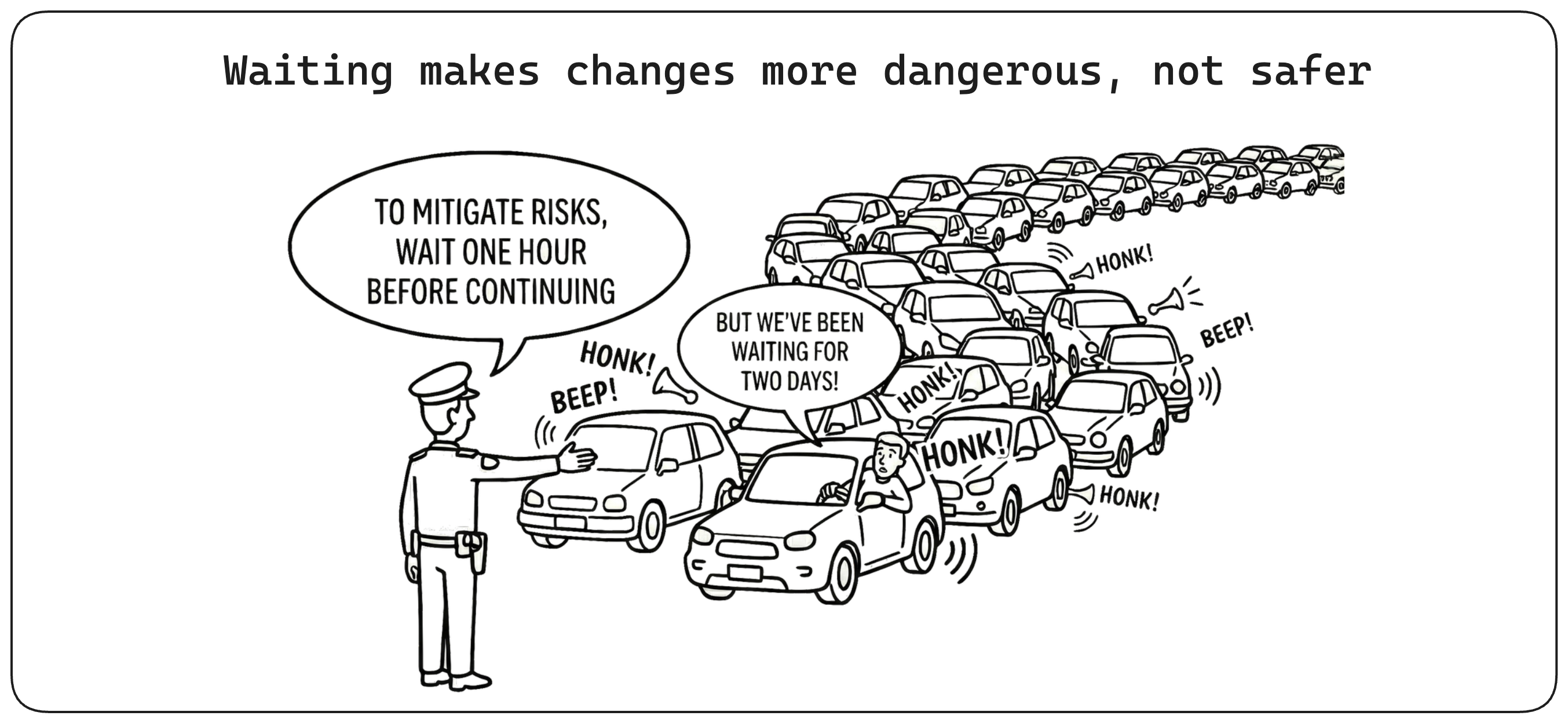
Decoupling Deployment from Release: Feature Flags [Feature Flags]
Feature flags separate deployment from user exposure when behavior can be activated independently. Code can be deployed broadly while new functionality remains dormant, then exposed progressively without blocking subsequent deployments. Infrastructure, schemas, protocols, and migrations may require other compatibility techniques because this separation is not always possible.
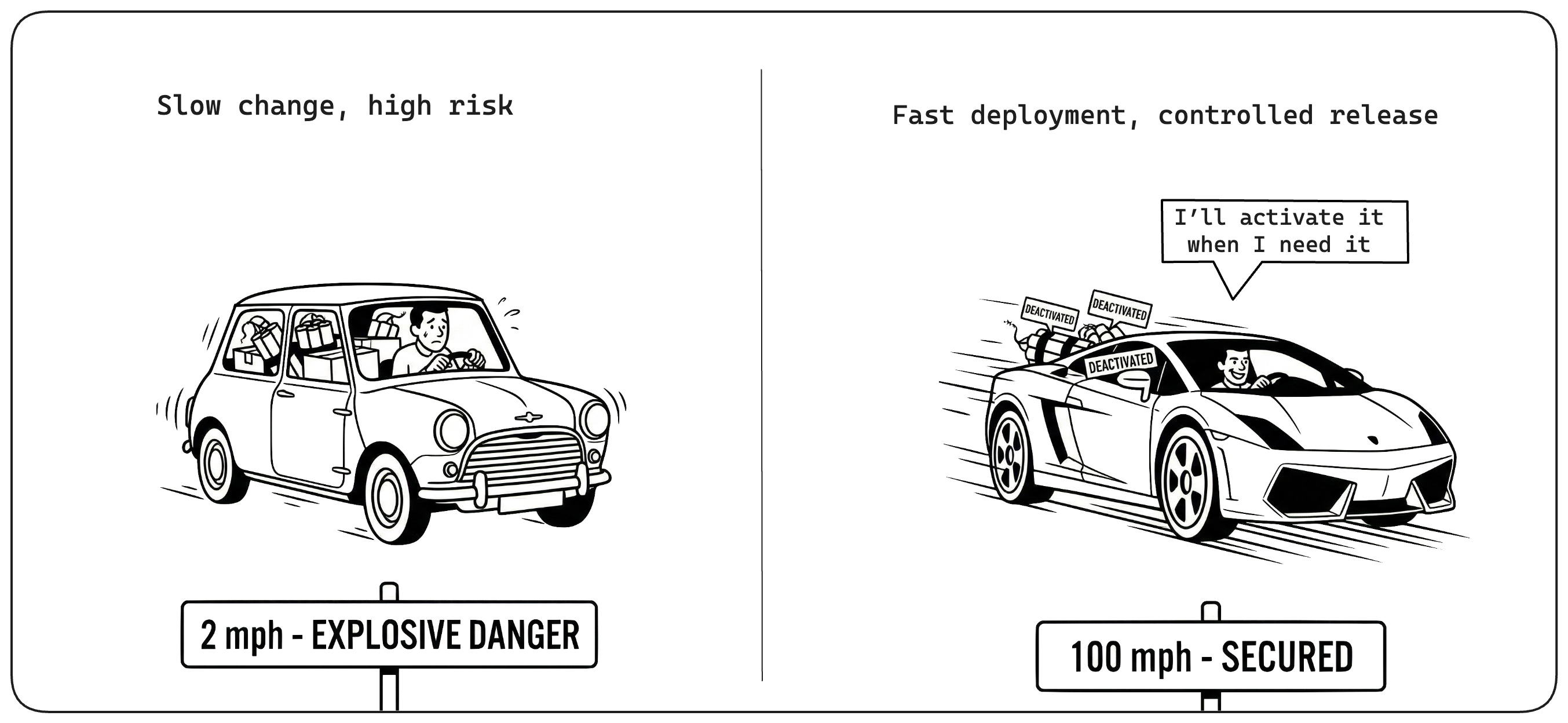
Observing Before Activating: Logging-Only Mode [Logging Only Mode]
New logic can sometimes run against real production inputs without affecting the real outcome. The system keeps the existing behavior authoritative while recording what the new path would have done. Comparing both results exposes edge cases and behavioral differences before activation, turning real traffic into evidence without exposing users to the new behavior.
Reversible Change
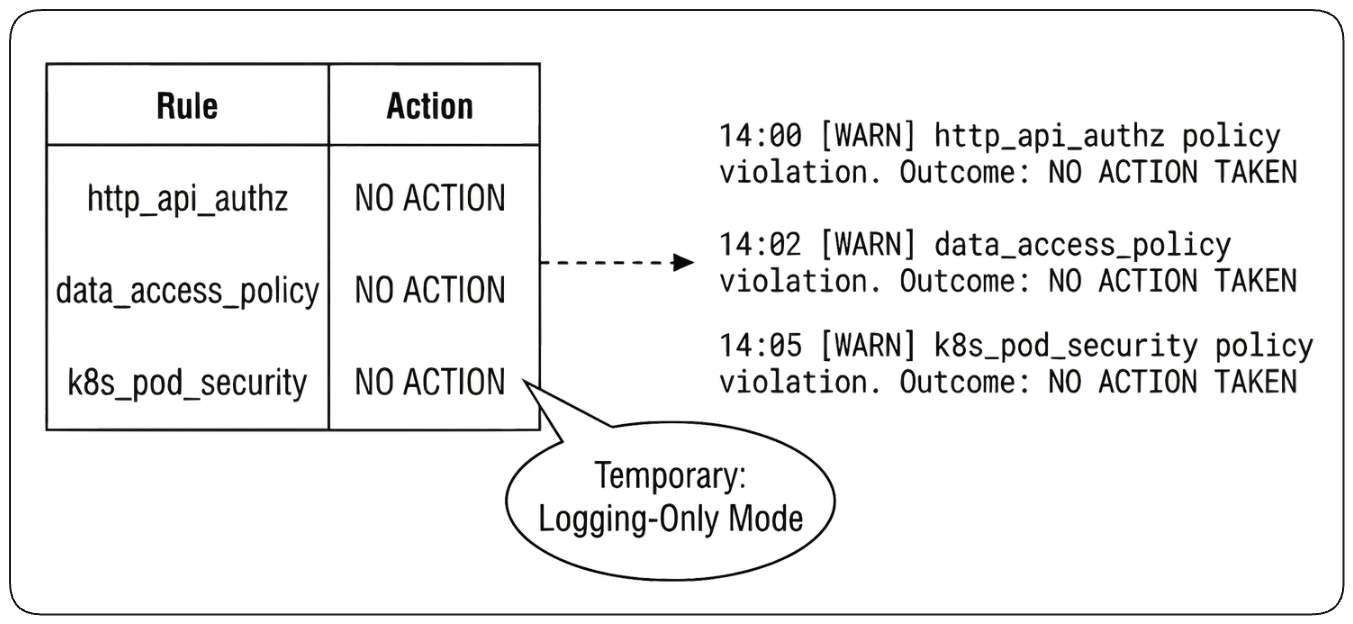
Design Changes for Reversibility [Reversibility]
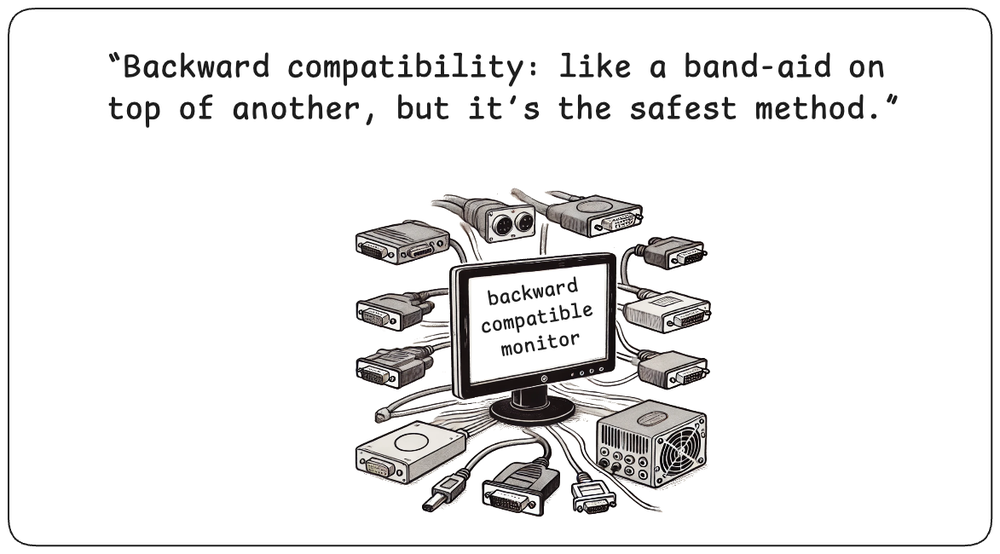
Some changes create irreversible states: incompatible schemas, destructive migrations, or protocol changes that break backward compatibility. Once crossed, these boundaries make rollback risky or impossible. If a change cannot be safely undone, redesign the transition so it can be introduced through reversible steps.

Decomposing Change Into Safe Steps [Release as Migration]
Some changes are too large to remain safely reversible as a single transition. Decompose them into intermediate states where old and new behavior can coexist and each step can be independently validated or undone. The objective is not merely to reach the target state, but to make the path to it safe.
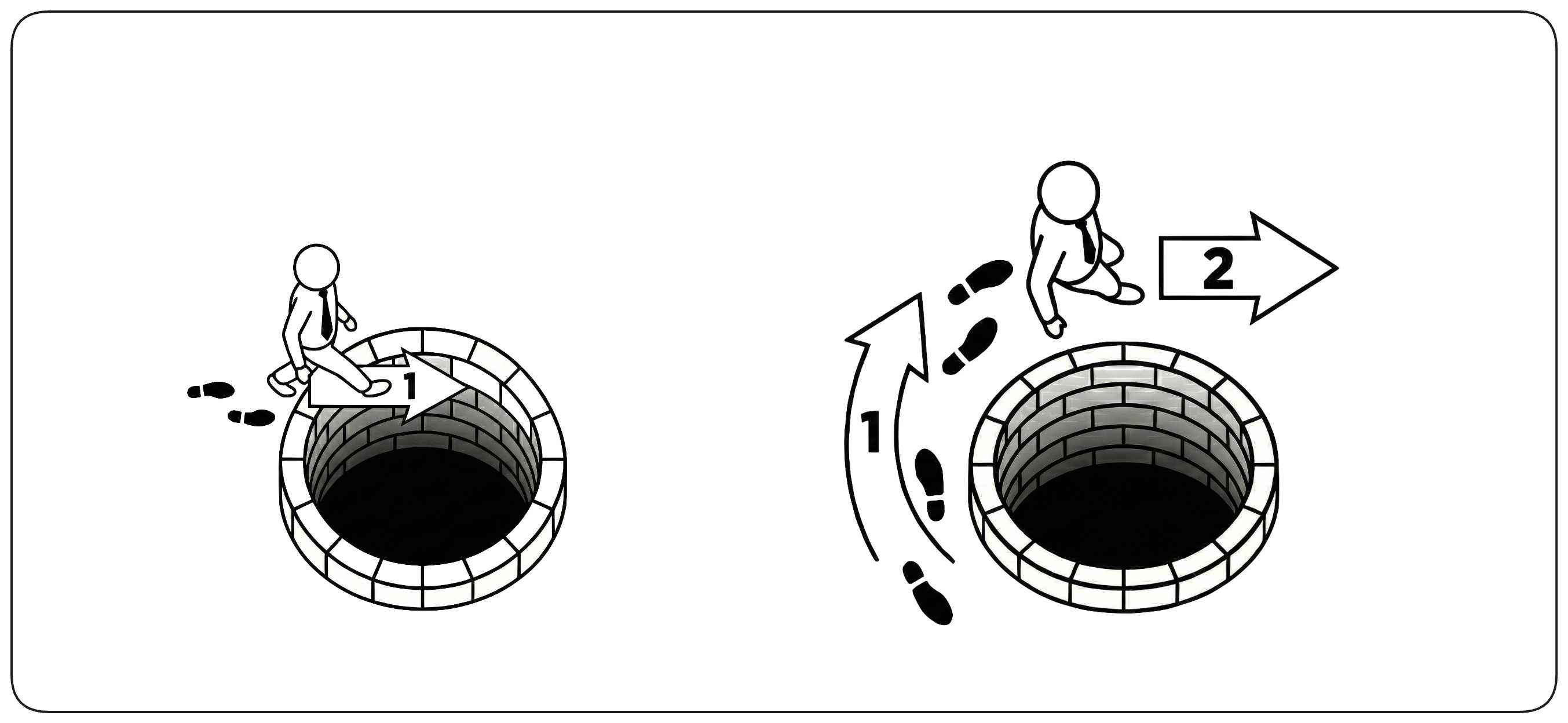
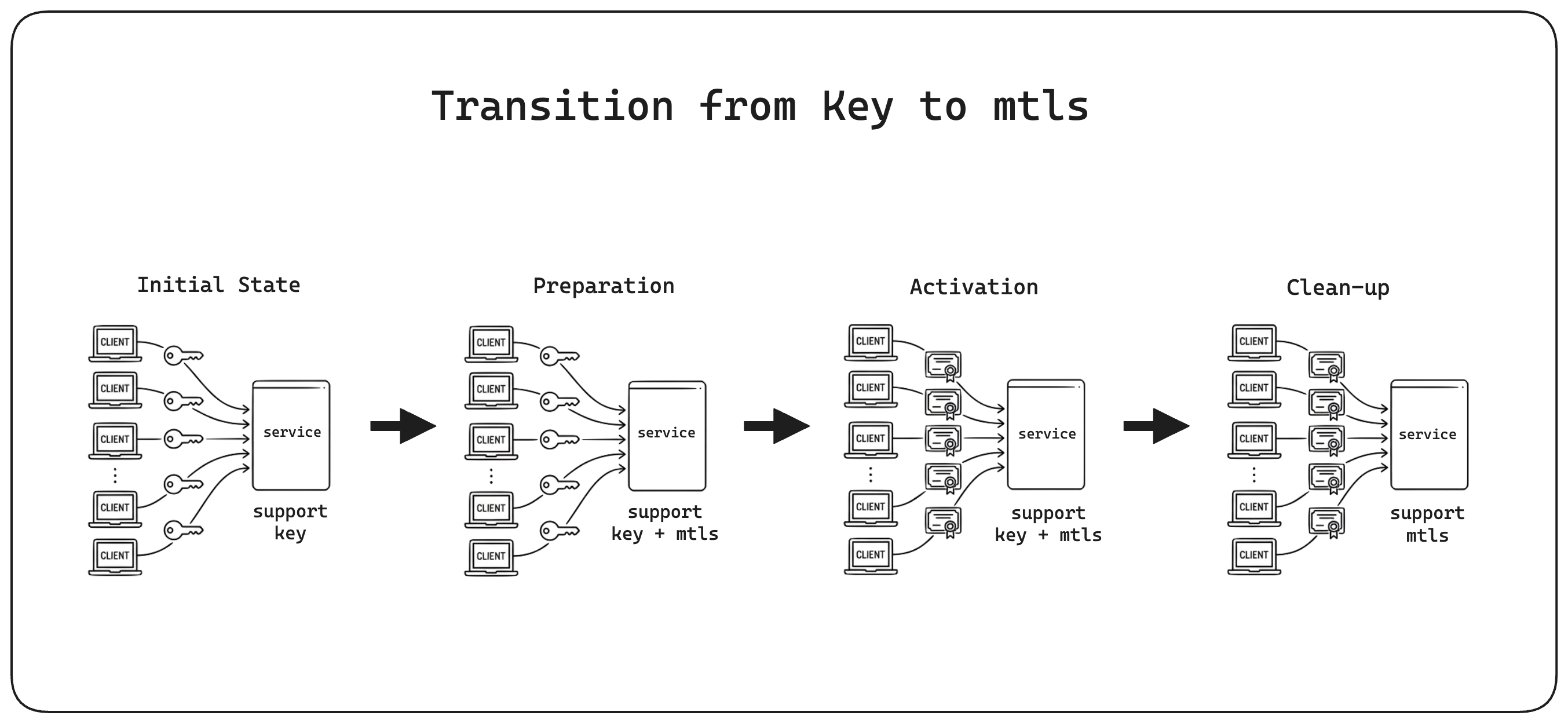
Two-Phase Deployment: Separating Preparation from Activation [Two Phase Deployment]
Two-phase deployment separates preparation from activation. First make the system capable of supporting both the current and future state; only then activate the new behavior. Keeping both states valid during the transition preserves a safe forward and backward path.
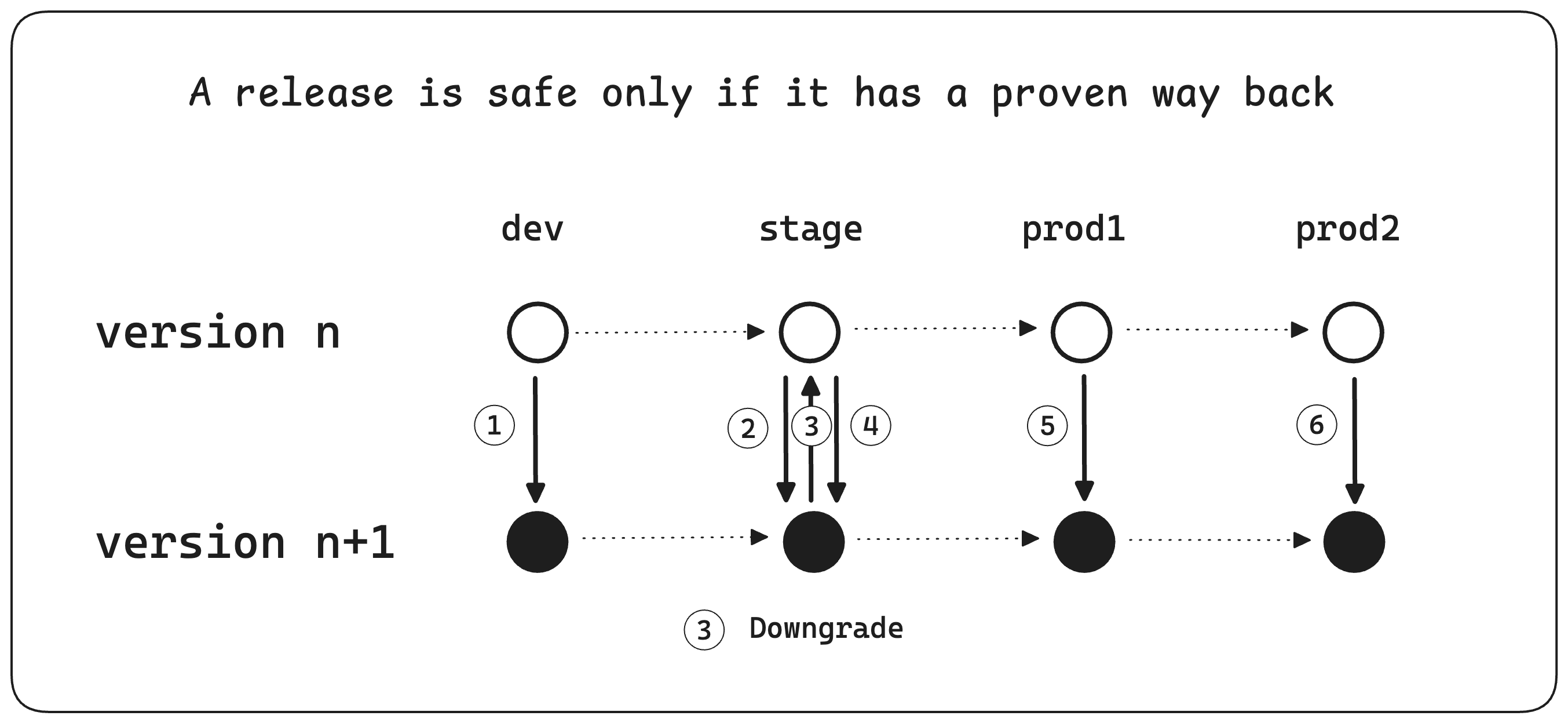
Rollbackability Through Upgrade–Downgrade Testing [Rollbackability]
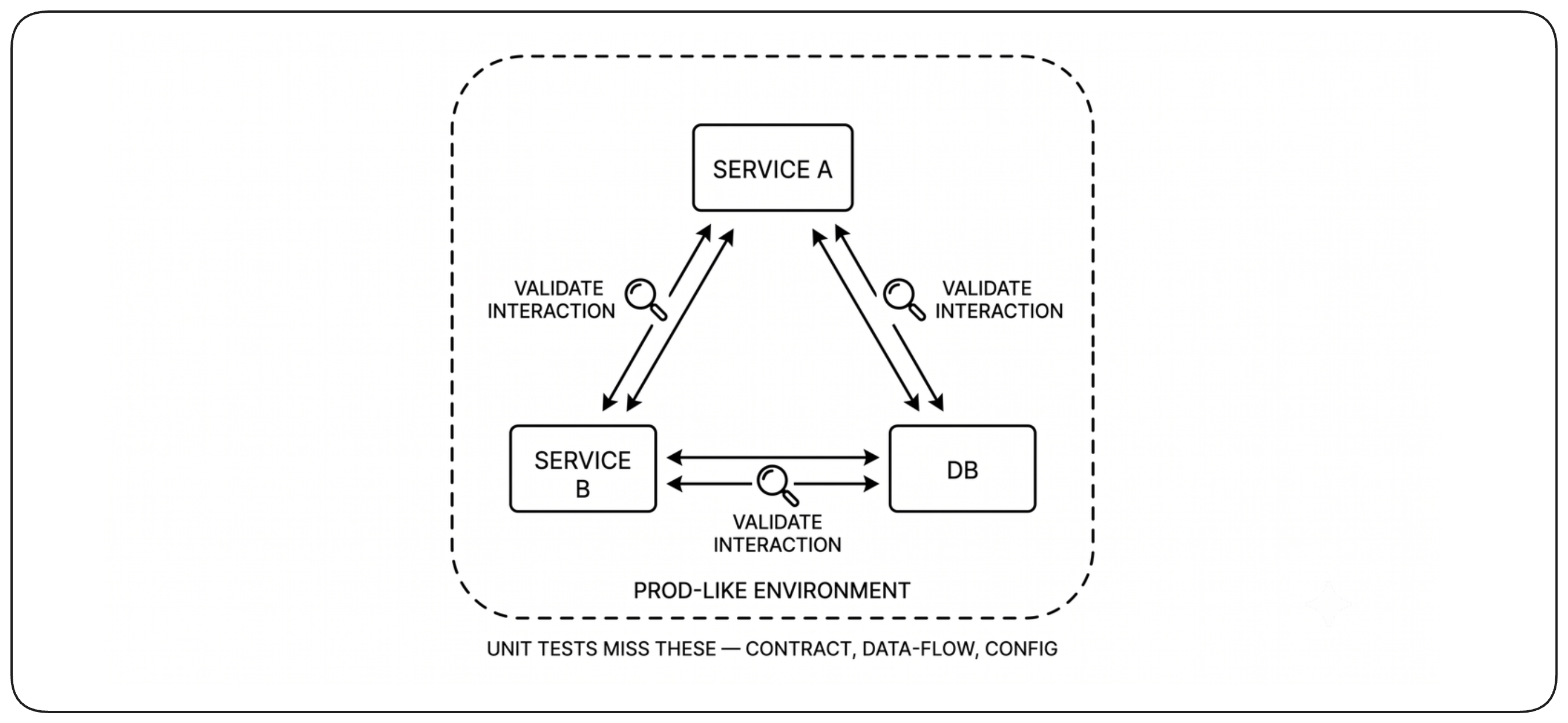
Reversibility should be tested, not assumed. Upgrade–downgrade testing moves the system to the new version and then back to the previous one, validating that both transitions preserve compatibility, availability, and data integrity. A rollback path that has never been exercised is only a hypothesis.
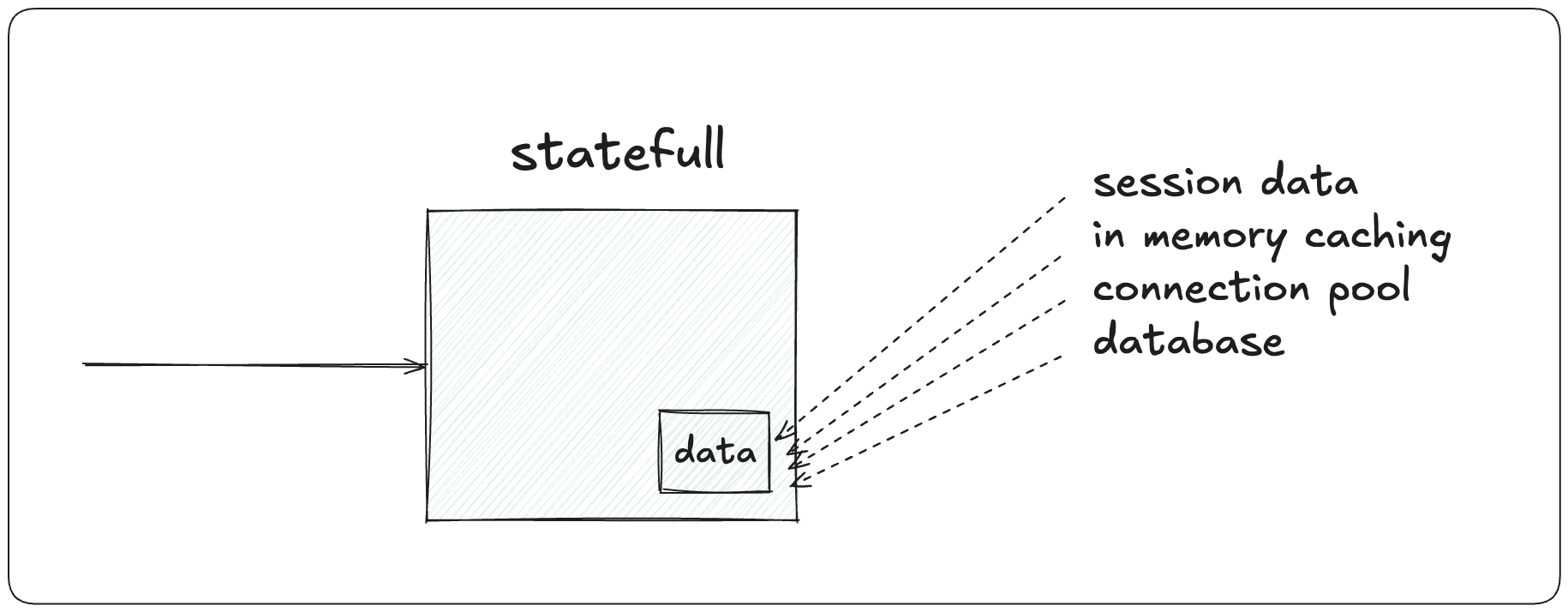
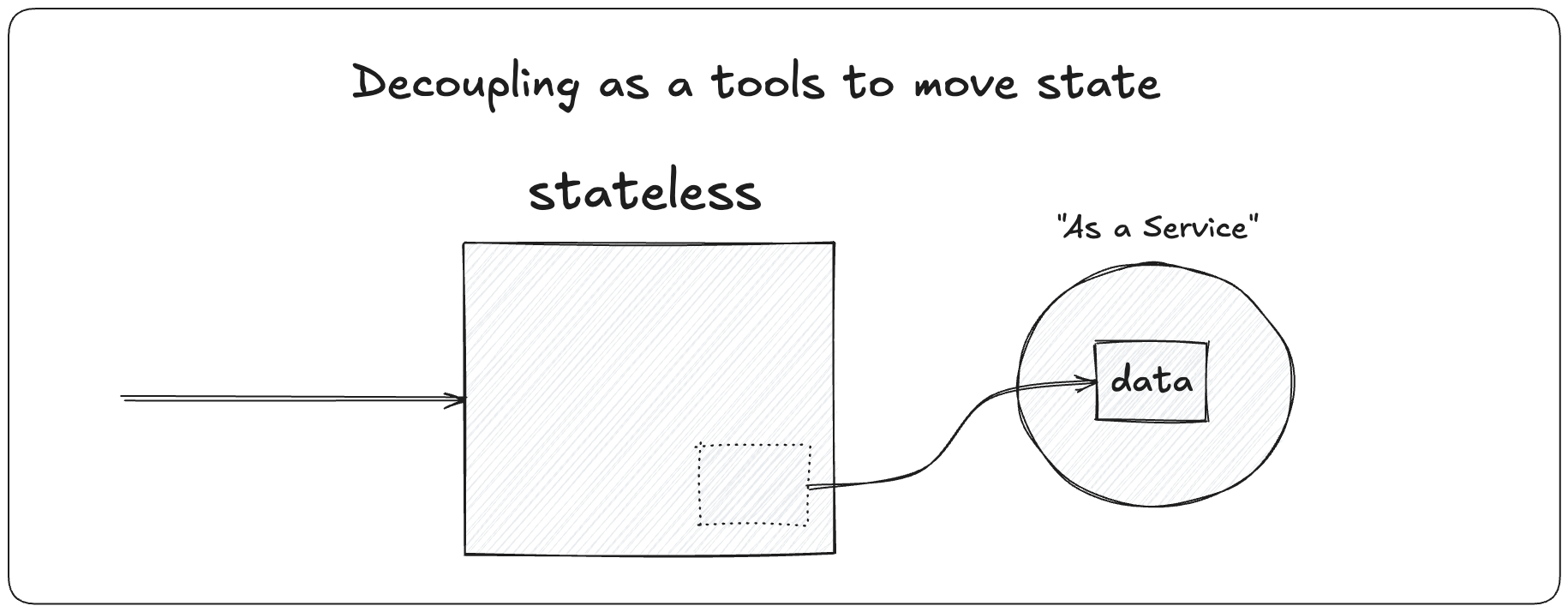
Making Instances Replaceable [Replaceable Instances]
Zero-downtime deployment requires instances to be replaceable while traffic continues to flow. Local state makes replacement difficult because sessions, in-memory data, or active work can disappear with the instance. Keep durable state outside disposable compute whenever possible, and design instances so they can enter and leave service safely.
Preserving Long-Running Work [Long-Running Work]
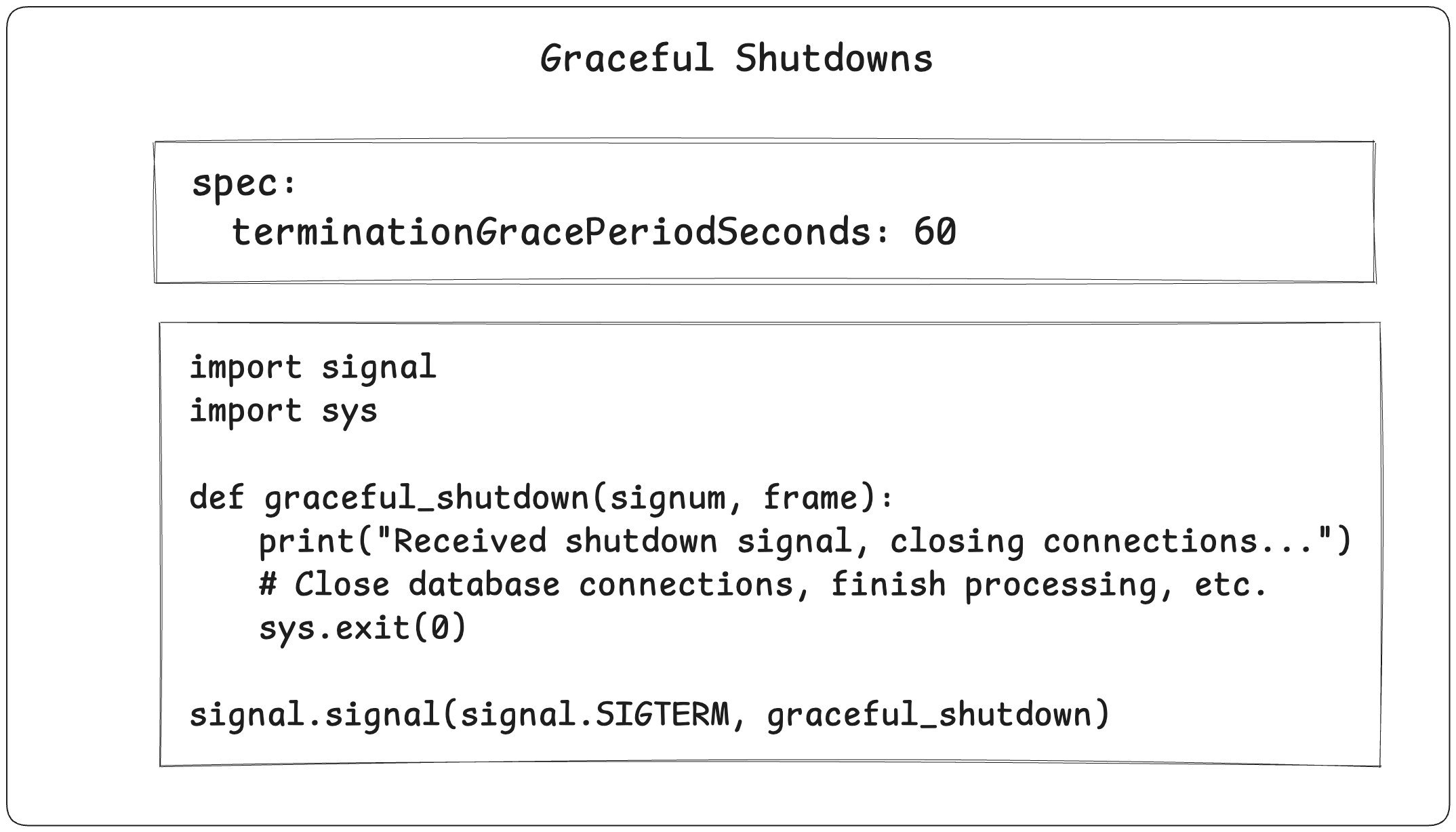
Long-running work must finish or resume safely while instances are replaced. Graceful shutdown lets active work complete before termination, while checkpointing or durable queues allow work to continue elsewhere when completion cannot be immediate.
Replace Capacity Without Interrupting Service [Zero-Downtime Replacement]
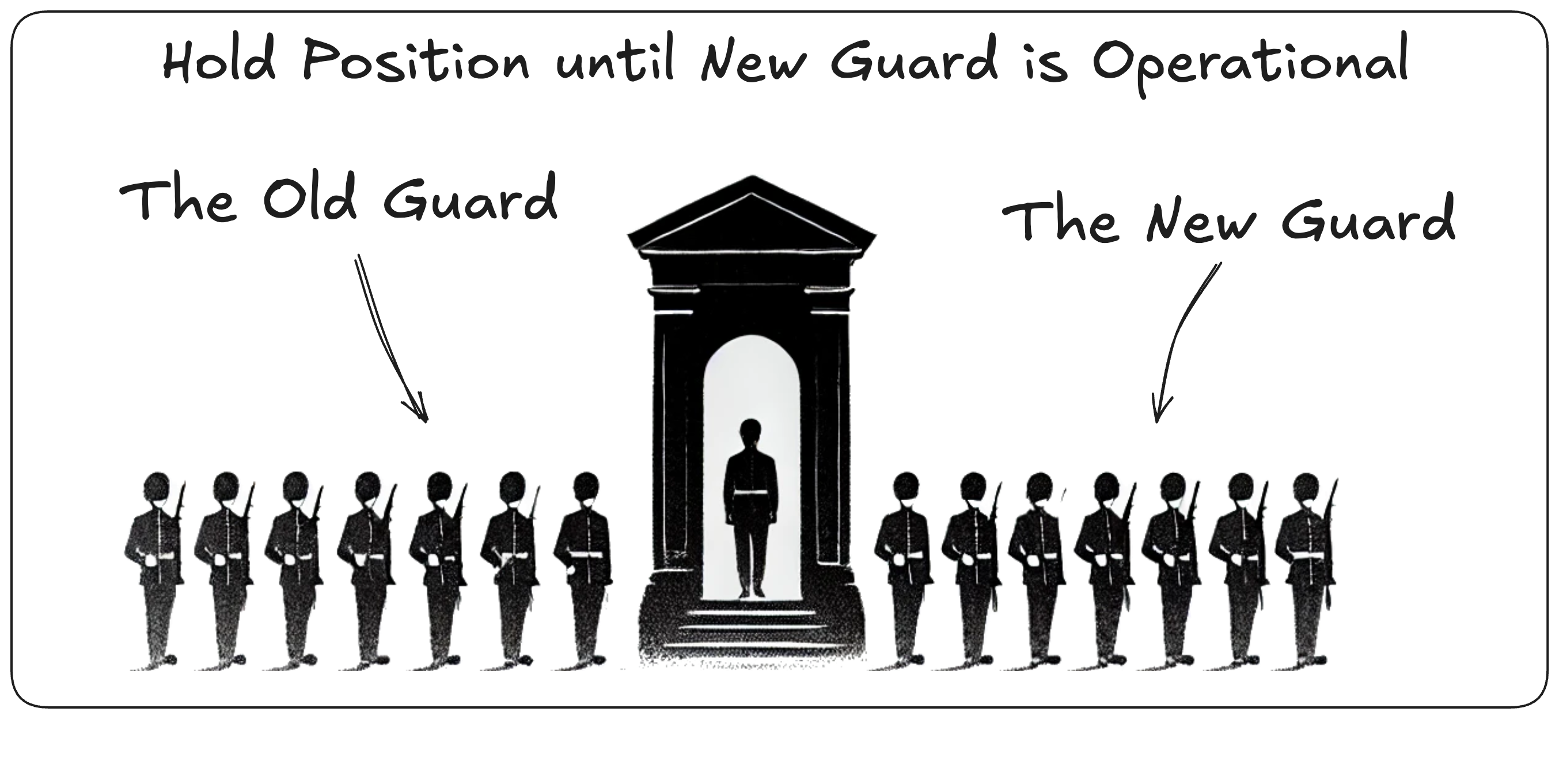
Zero-downtime strategies replace capacity without removing the healthy version too early. Blue-green deployments prepare a complete new environment before switching traffic, while rolling deployments replace instances incrementally. Both require old and new versions to coexist safely during the transition, which makes backward-compatible interfaces and graceful instance replacement essential.
Release Timing
Release Timing: When Time Changes Risk [Release Timing]
The same change can carry very different risk depending on when it is released. Peak traffic, critical business events, or limited operational coverage can make an otherwise routine deployment unsafe. Release policies should therefore incorporate time and business context, with automated guardrails where appropriate.

The Moratorium Paradox: Protection vs. Accumulation [Protection vs. Accumulation]
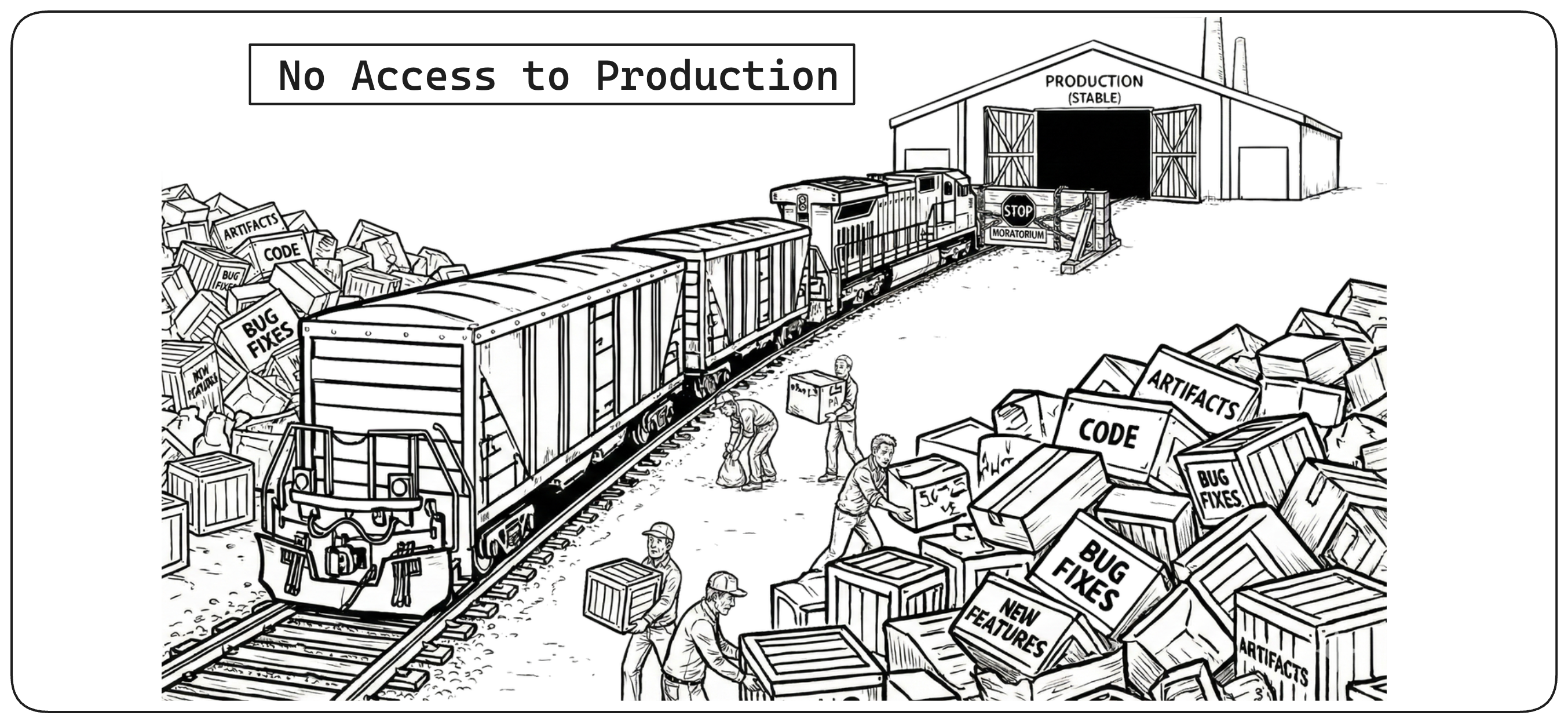
A release moratorium reduces short-term risk by freezing non-essential production changes during critical periods. But development continues, so unreleased changes accumulate and the gap with production grows. The longer the freeze, the larger and riskier the eventual release becomes. Moratoriums therefore trade immediate stability for deferred change risk.
Promotion Gates
A Promotion Gate Is a Decision [Gate Decision] {1}
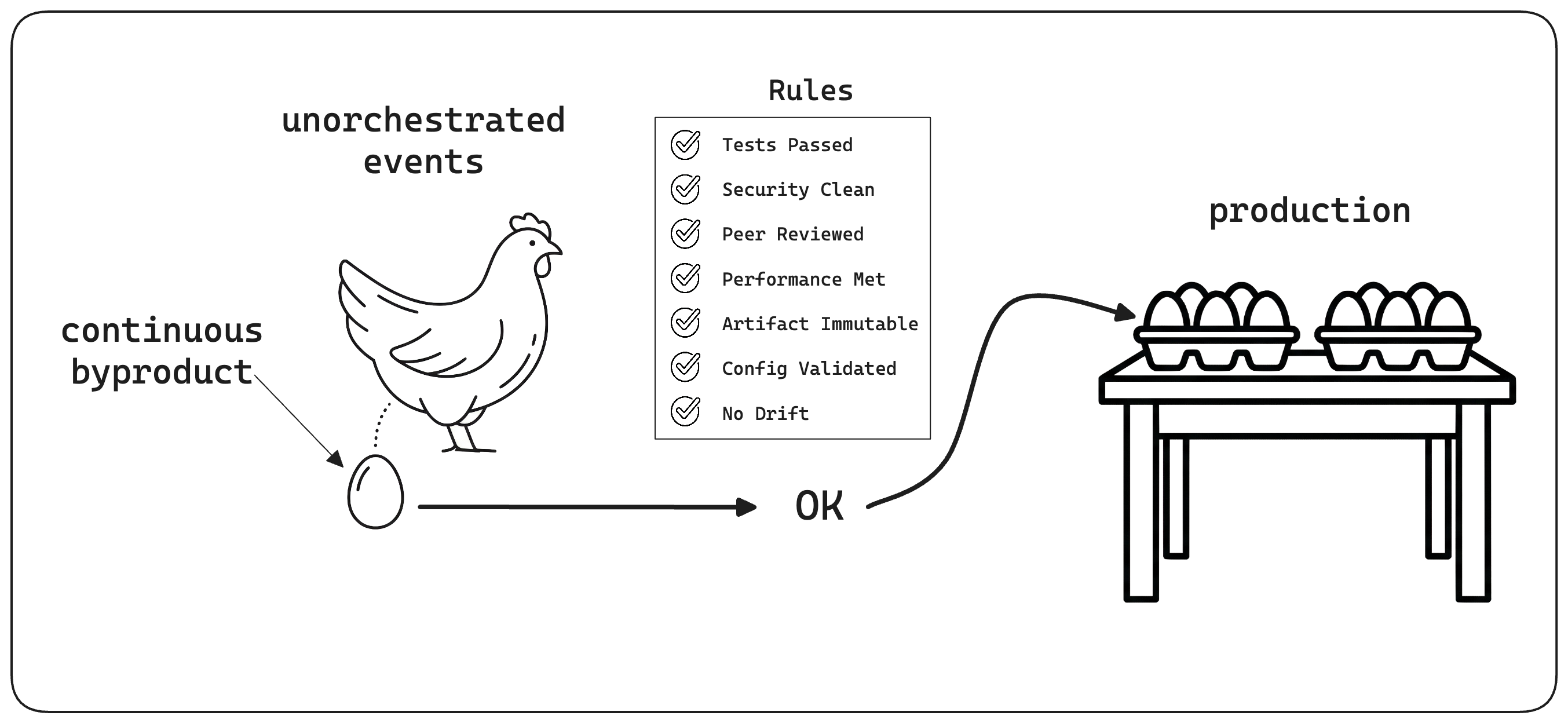
Promotion is a decision to increase a release’s exposure. A gate makes that decision explicit by evaluating three things: evidence about the change, readiness of the target, and organizational policy. Promotion proceeds only when the required conditions for the next level of exposure have been established.
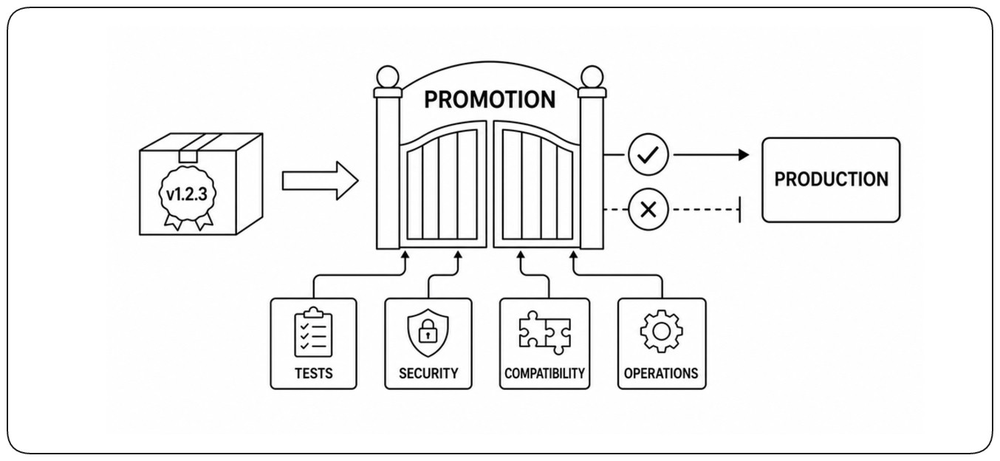
A Gate Blocks Missing Evidence [Evidence] {1}
A release progresses only when sufficient evidence justifies greater exposure. Failed builds or tests, unresolved security findings, and missing validations therefore block promotion. Gates should evaluate this evidence automatically and identify the exact condition that must be resolved.
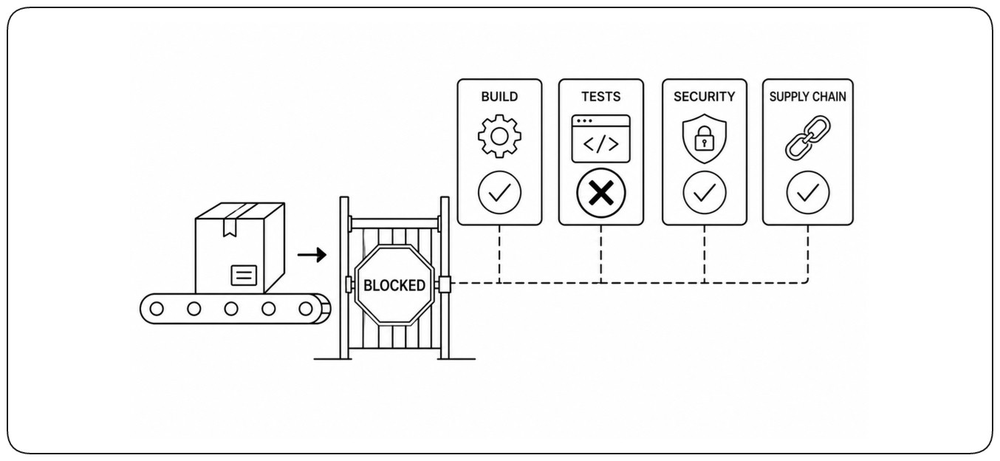
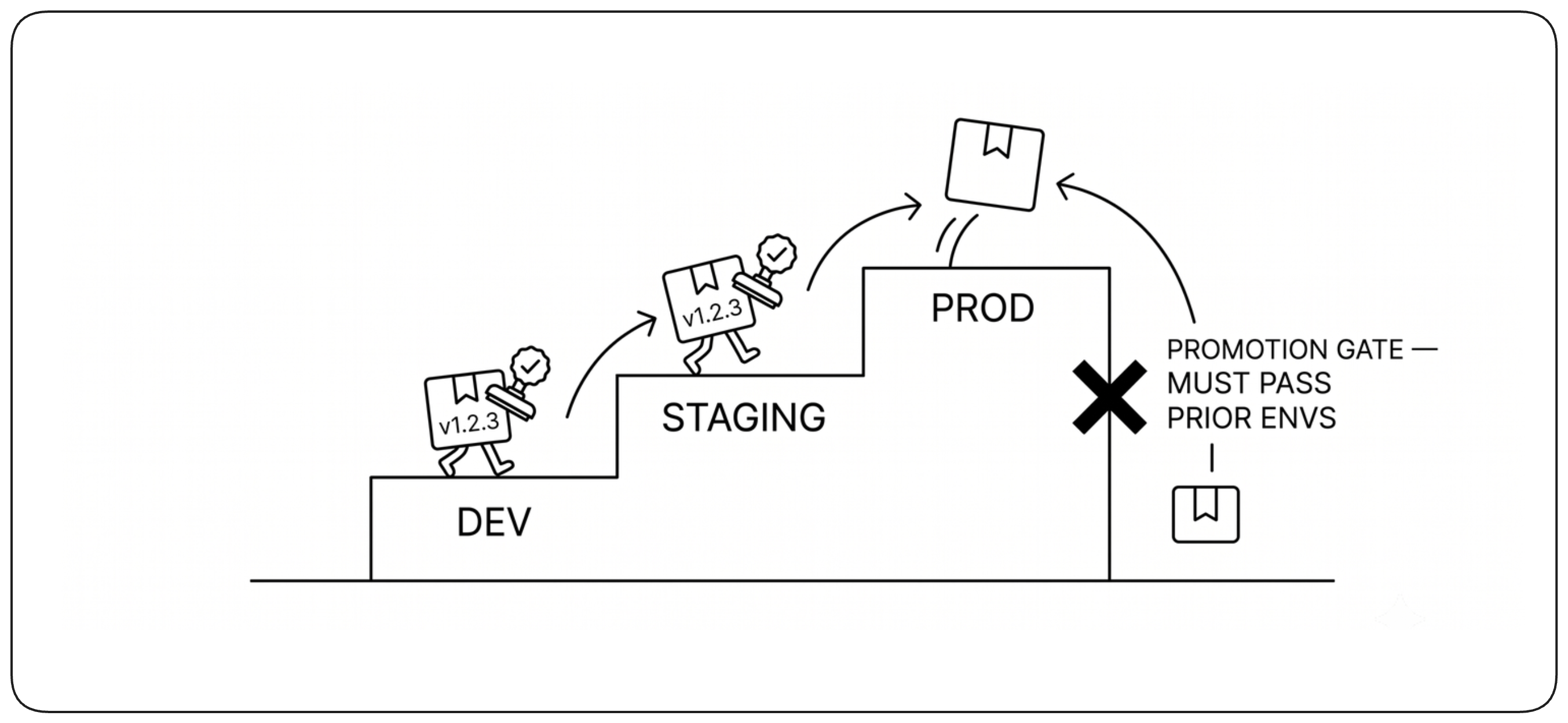
Promotion Requires Prior Evidence [Prior Evidence]
Promotion requires evidence appropriate to the risk of the target. In many systems, successful deployment and validation in a lower-risk environment provides part of that evidence. The important principle is not a mandatory DEV → STAGING → PROD sequence, but that exposure increases only after the required evidence has been established.
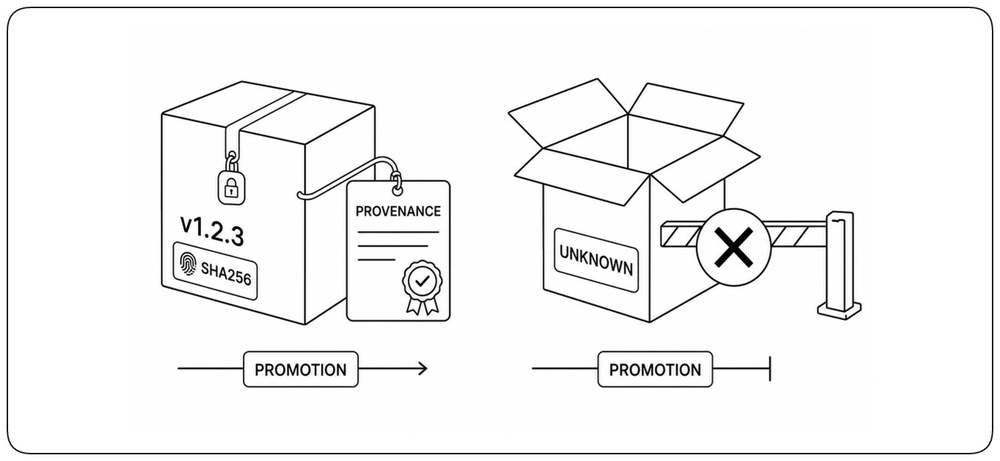
An Artifact Must Be Identifiable and Trusted [Artifact Trust]
Promotion requires the immutable artifact that was built and validated, tied to its digest, provenance, and scan results. Rebuilding for production, using a floating tag, or losing the link to its evidence breaks the chain of trust.
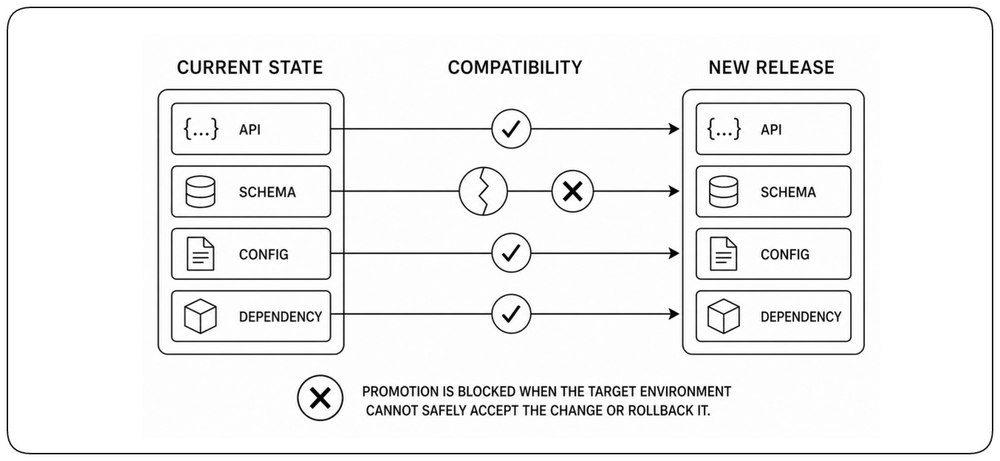
The Target Must Be Ready for the Change [Target Readiness] {1}
An otherwise healthy artifact can still be unsafe for its target. Promotion must validate the transition as well as the artifact: required configuration and dependencies exist, the change is compatible with what runs already, and a viable recovery path remains.
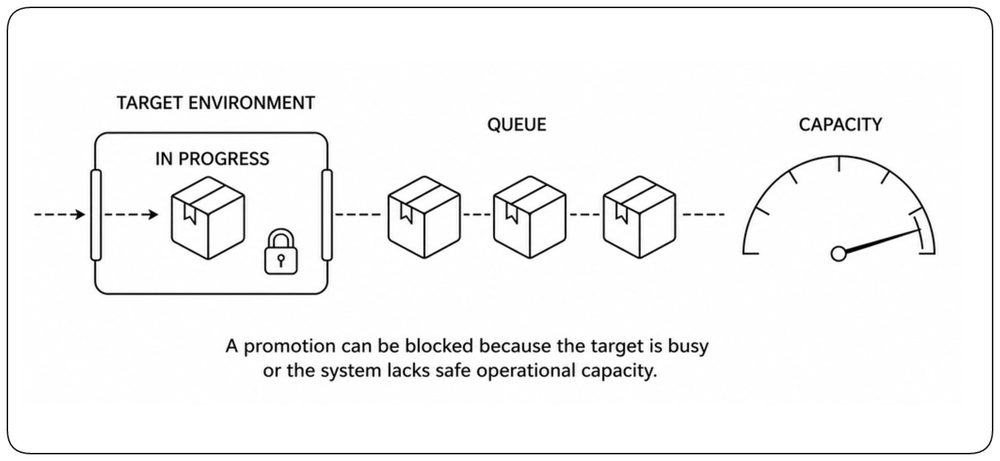
A Busy Target Must Not Be Forced [Concurrency and Capacity]
A target may already have a deployment in progress, a conflicting change may hold its lock, or the platform may lack safe rollout capacity. Serializing incompatible operations prevents overlapping changes from obscuring cause and effect or expanding an incident.
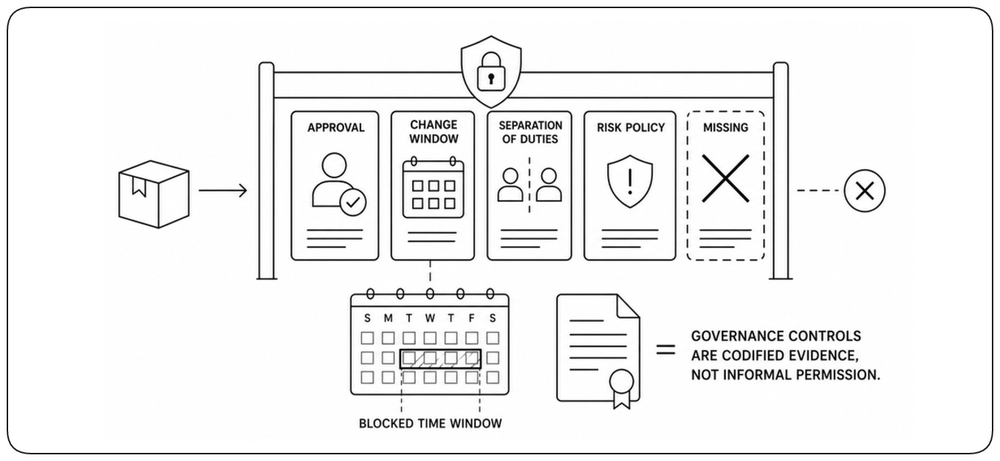
Policy Can Block a Technically Valid Change [Governance]
Technical validity is necessary, but it is not the whole decision. Missing approvals, closed change windows, separation-of-duties rules, or target-specific risk policy can all block promotion. These controls should be explicit, auditable rules and automated where possible.
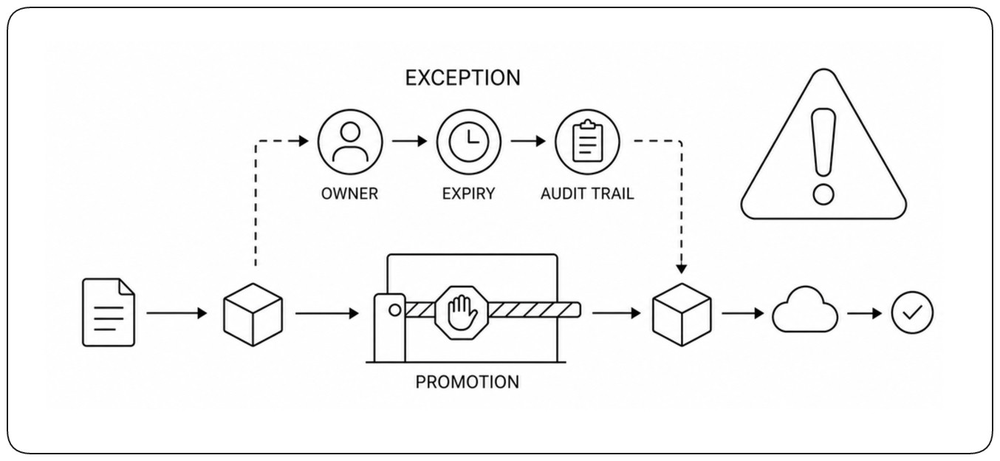
Exceptions Must Be Safer Than Bypasses [Exceptions] {1}
Emergency changes may require an exception, but an exception is a controlled path—not a hidden bypass. It should have an accountable owner, explicit scope, automatic expiry, and a durable audit trail. Frequent exceptions are evidence that the gate or delivery design needs improvement.
Keep Evidence Beyond the Pipeline [Release Evidence]
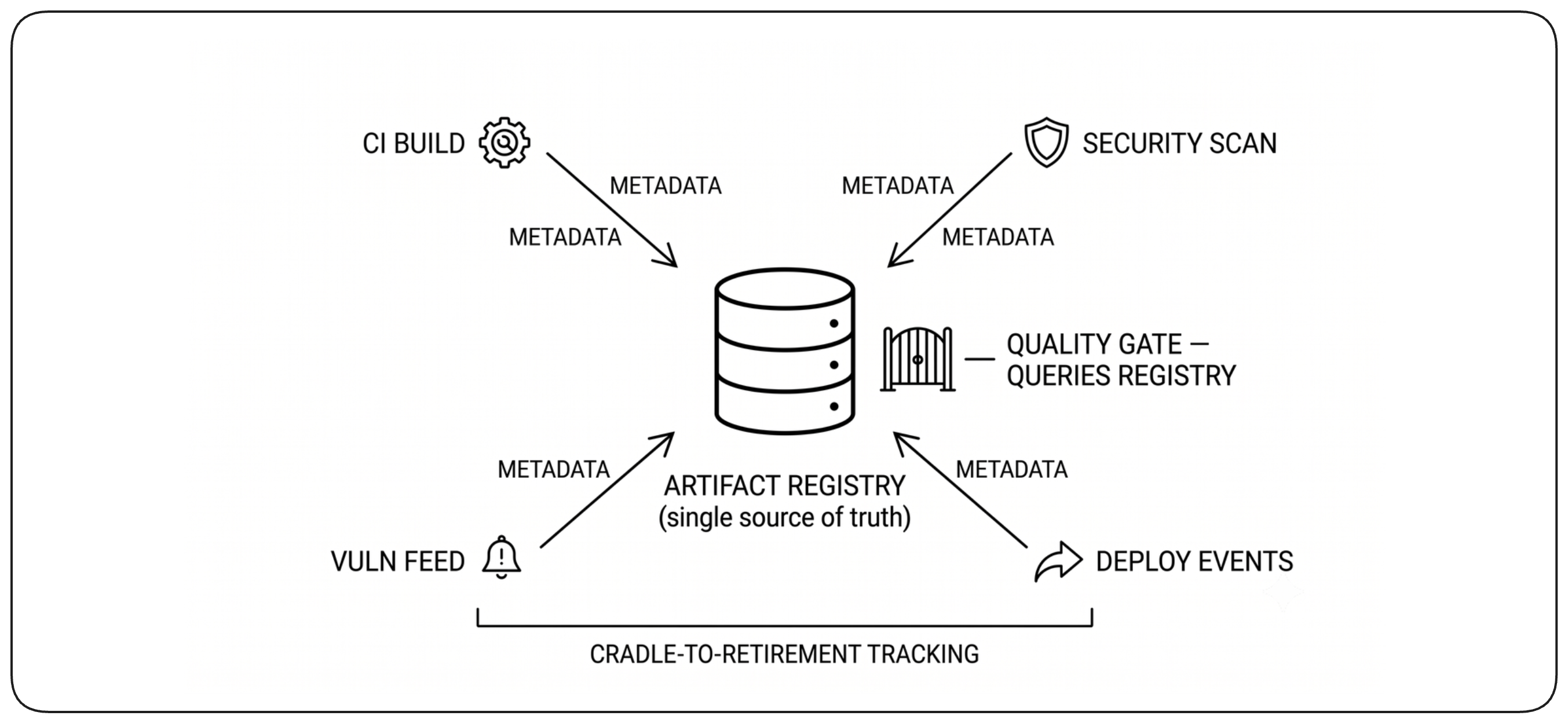
Evidence evolves throughout an artifact’s lifecycle: provenance, security findings, validation results, deployment history, and vulnerability status can change independently. This evidence must remain durably associated with the immutable artifact so future promotion decisions do not depend on transient pipeline state.
Make Changes Traceable [Traceable Changes]
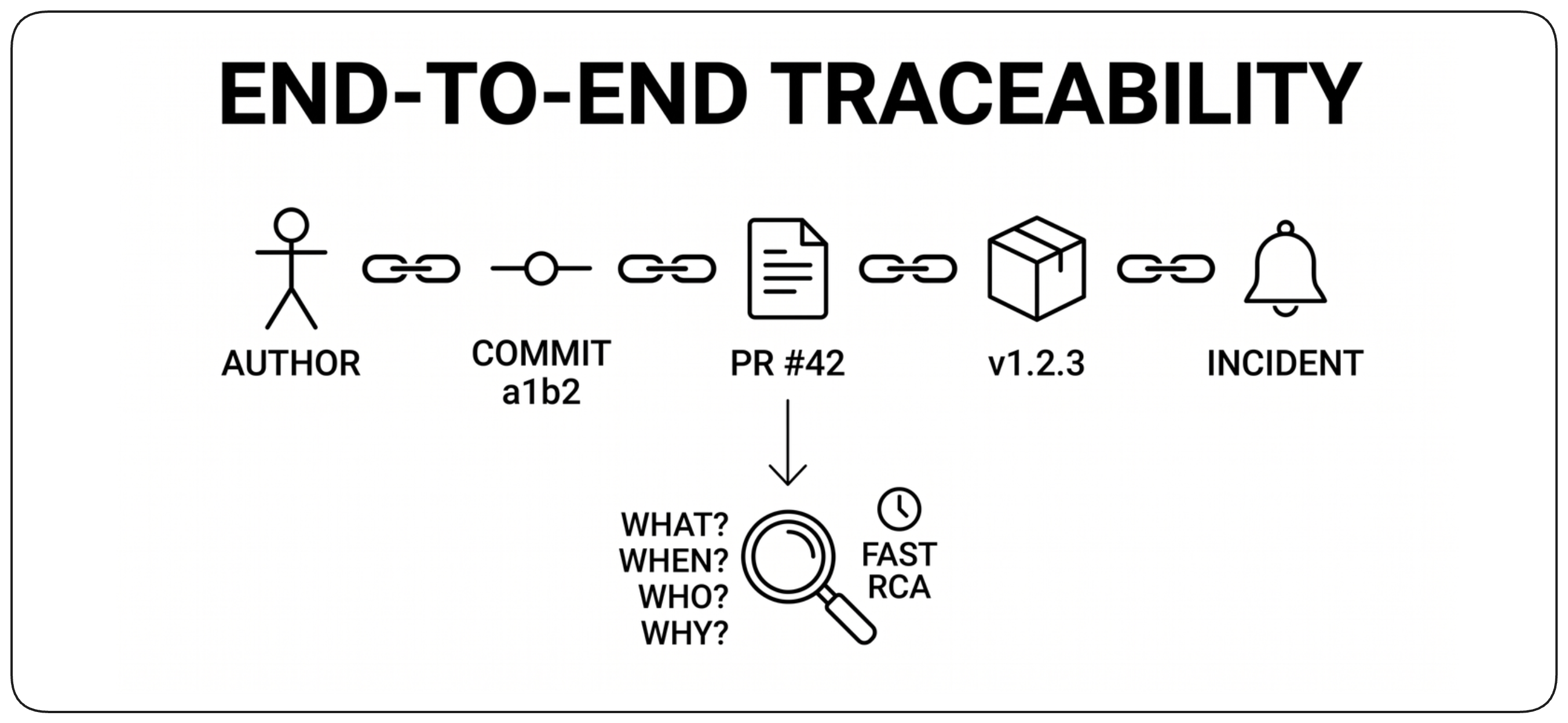
Every production change should be traceable back to its origin: what changed, when, why, by whom, and through which release. Linking the running state to its commit, review, artifact, approvals, and deployment history turns incident investigation from a reconstruction exercise into a direct lookup.
AI in Release Management
AI Needs a Release System It Can Reason About [AI Foundations]
AI cannot safely manage change from scattered scripts, implicit state, and undocumented procedures. It needs explicit release intent, immutable identities, durable evidence, observable outcomes, and deterministic policy boundaries. The same foundations that make releases understandable to humans are what make them operable by agents.
AI Changes the Release Bottleneck [AI Bottleneck]
AI can dramatically increase the rate at which production-ready changes are produced. Deployment execution is rarely the limiting factor; deciding whether each change is safe to expose becomes the harder problem. Release systems must therefore scale decision-making, not just deployment throughput.
From Static Gates to Evidence-Based Decisions [Evidence Decisions]
Traditional release gates evaluate predefined conditions. AI can reason across a broader body of evidence—test results, security findings, deployment history, operational signals, change context, and previous incidents—to help evaluate release risk. Deterministic policies still define hard boundaries; AI adds judgment where the evidence is contextual.
Let Risk Determine the Release Strategy [Risk Strategy]
Not every change needs the same path to production. An AI-assisted release system can evaluate the nature and risk of a change and recommend an appropriate strategy: broader or narrower canaries, slower or faster exposure, additional validation, or stronger approval requirements. The release path becomes adaptive to risk rather than identical for every change.
AI Can Observe the Rollout Continuously [AI Rollout Observation]
Progressive delivery produces continuous evidence as exposure grows. AI can correlate metrics, logs, traces, deployment events, and historical behavior to identify abnormal patterns that individual thresholds may miss. Each rollout stage becomes an opportunity to reassess whether exposure should continue, pause, or reverse.
AI Shortens the Path from Failure to Recovery [AI Recovery]
When a release degrades production, the first challenge is often understanding what changed and which recovery path is safe. AI can correlate the resolved release, recent changes, operational signals, and known failure patterns to rapidly propose likely causes and proven recovery actions. Recovery remains controlled by predefined mechanisms; AI reduces the time required to choose among them.
Release Platforms Become Agentic Control Planes [Agentic Control Planes]
As release systems accumulate structured intent, evidence, policy, operational state, and recovery knowledge, they become natural platforms for release agents. Agents can evaluate risk, recommend promotion, observe exposure, investigate failures, and coordinate recovery—while deterministic control planes retain authority over what actions are permitted. The release platform evolves from an execution engine into an intelligent control plane for change.
Release Platform Architecture
The Monolithic Release Engine [Monolithic]
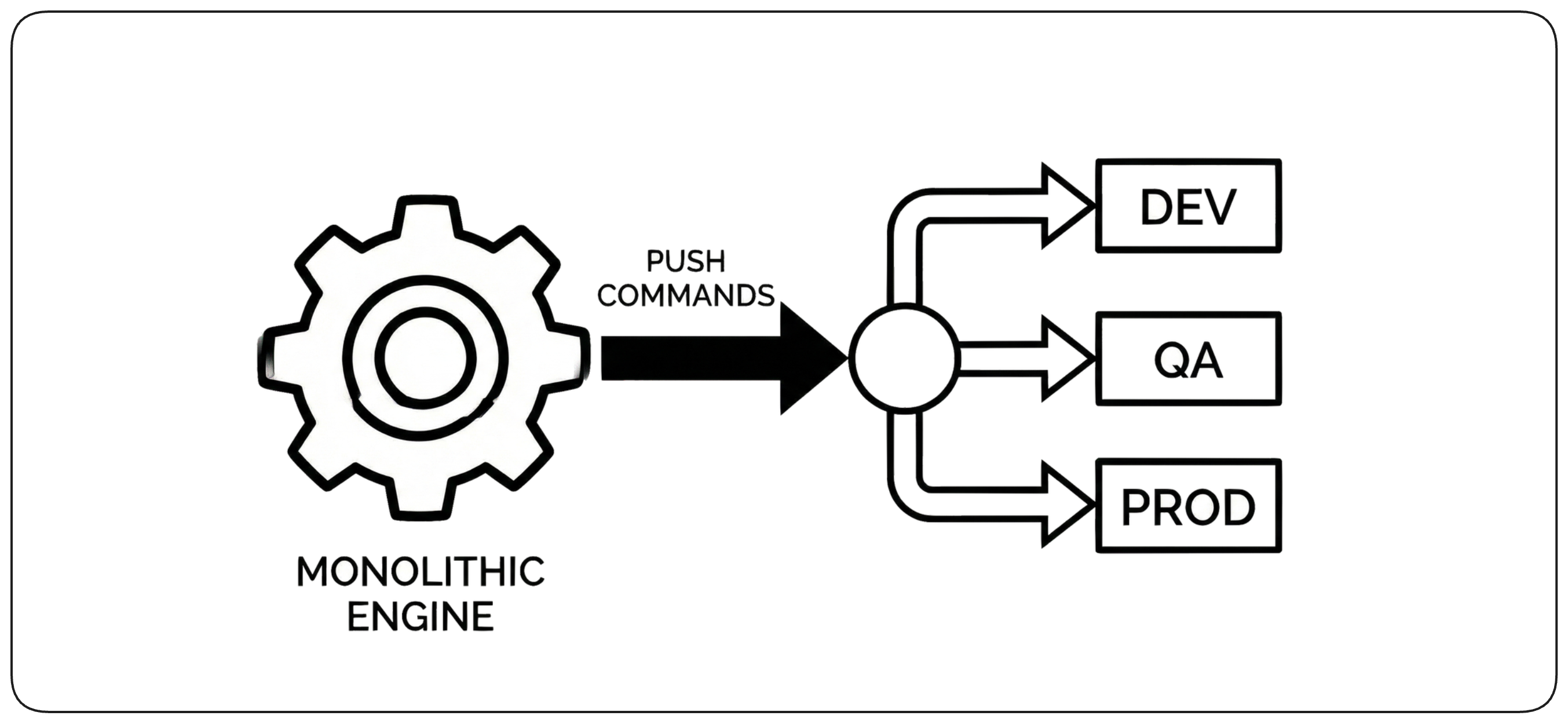
A monolithic release engine centrally pushes changes into every target. This concentrates credentials, execution, and failure handling in one place, creating a scalability bottleneck and a large blast radius. Problems in one target can block unrelated releases, while changes to the engine itself affect the entire delivery system.
The Distributed Control Plane [Distributed Control Plane]
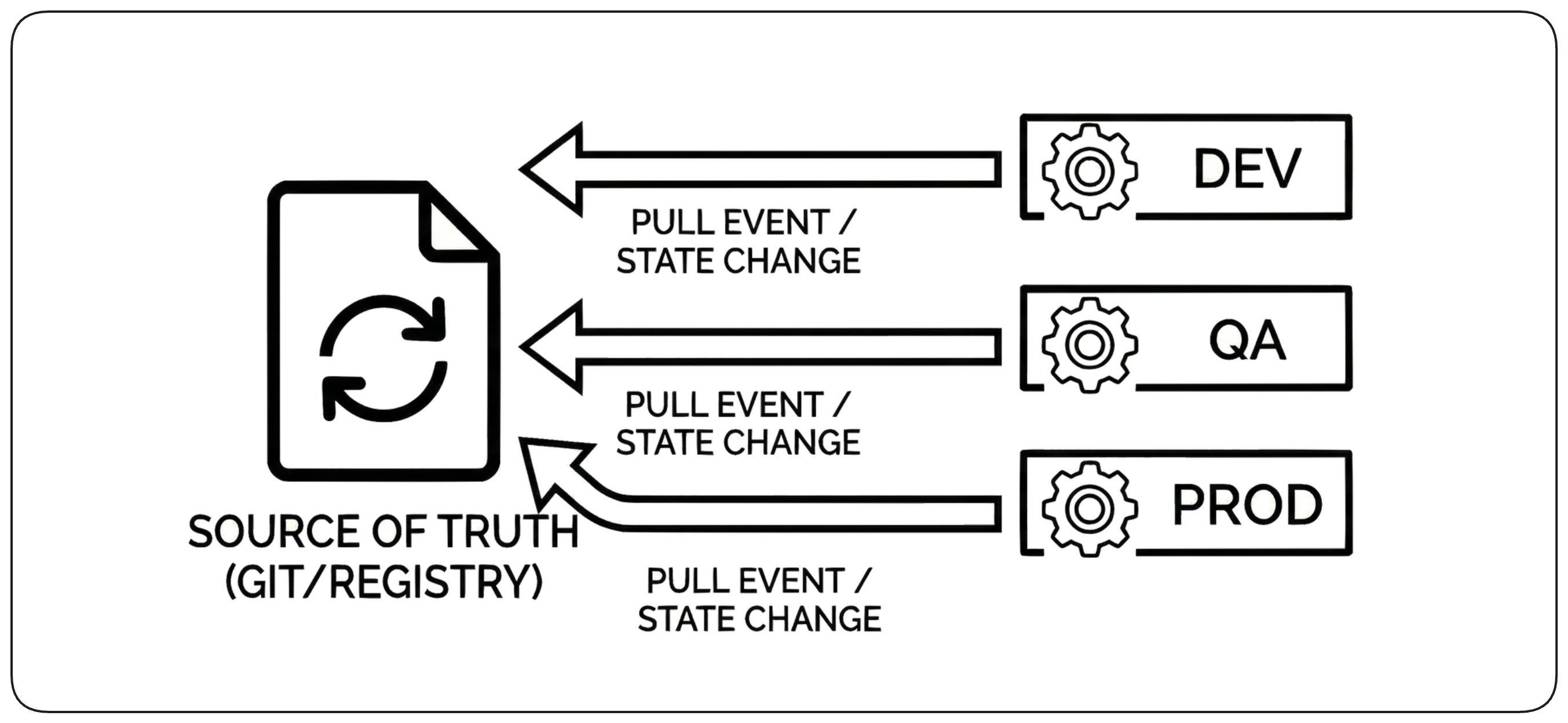
Distributed execution moves release activity closer to each target. Autonomous agents pull desired state and reconcile it locally, allowing execution capacity and failures to remain isolated by environment. The central system no longer needs to perform every deployment itself.
Centralized Governance [Centralized Governance]
Execution can be distributed while authority remains centralized. A governance layer evaluates global constraints—security, compliance, release windows, and business policy—before authorizing a change. Local agents then execute autonomously and report their state and outcomes back, preserving centralized control without centralizing execution.
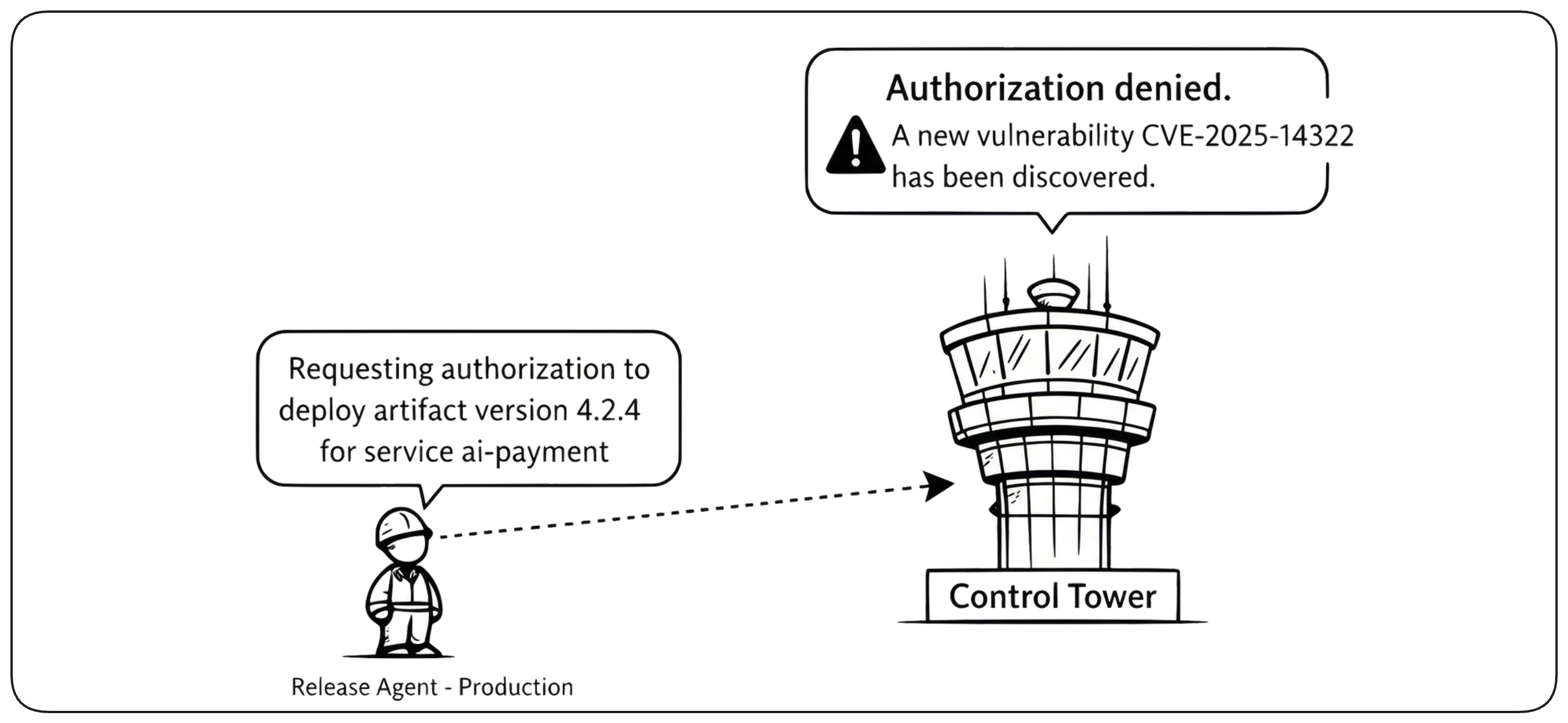
Gradual Rollout Across All Delivery Systems [Rollout for All Systems]
Release infrastructure is production infrastructure. CI/CD systems, CLIs, policies, and platform components should therefore evolve through the same controlled rollout practices used for customer-facing services. A faulty delivery-platform change can affect the organization’s ability to ship or recover, so its blast radius must also be limited.
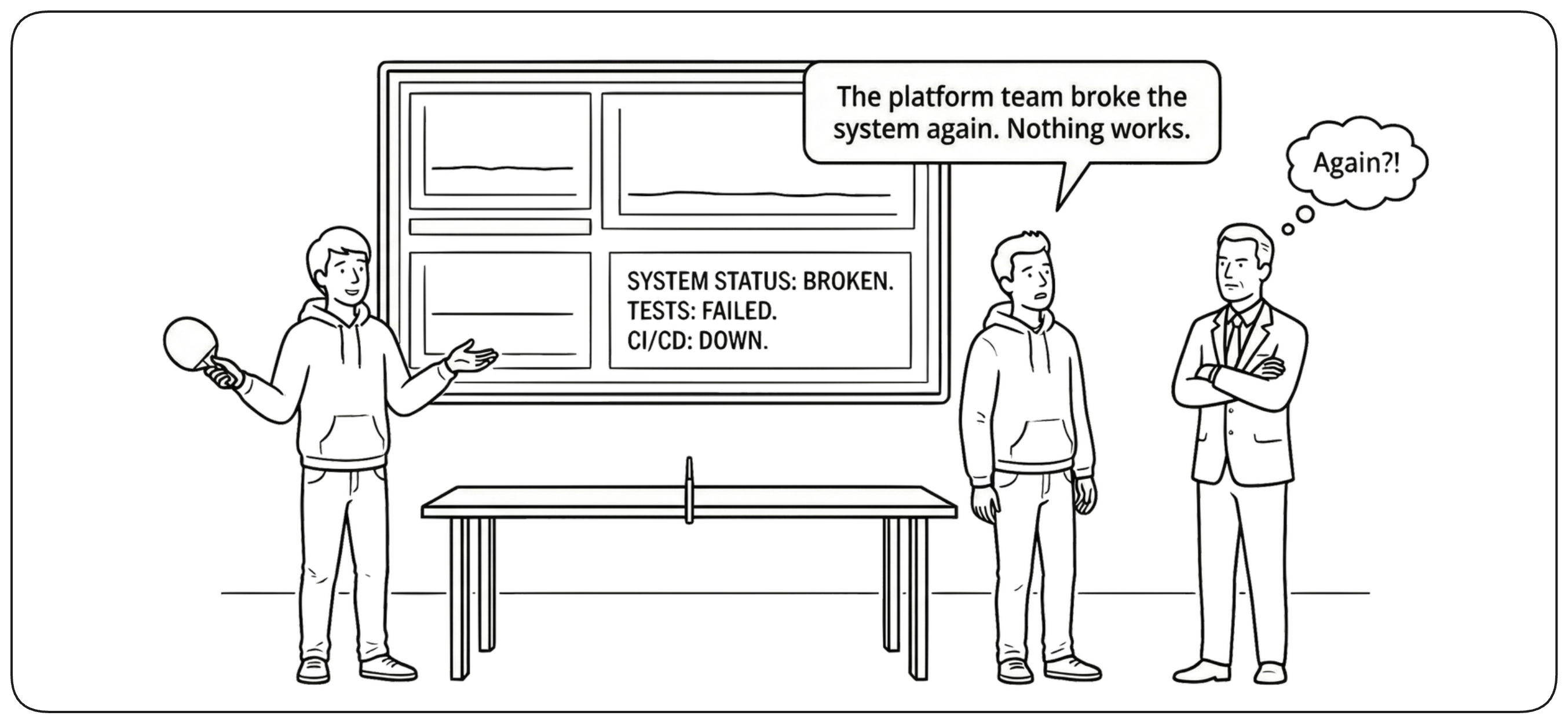
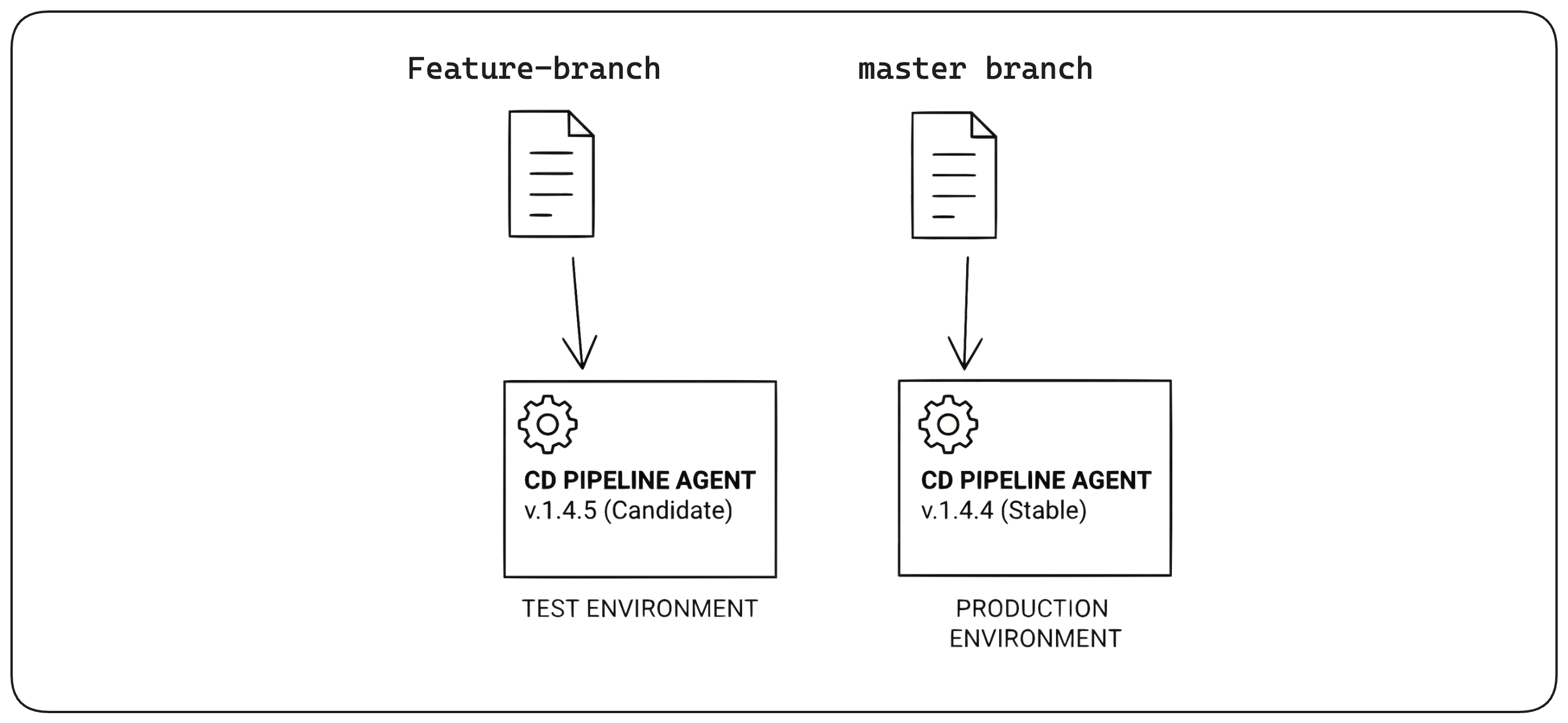
Evolutionary CD: The Pipeline as a Product [Evolutionary CD]
The release platform should evolve through the same lifecycle it provides to applications. Release agents and pipeline components are versioned artifacts that can be validated in lower-risk environments and progressively promoted. The delivery mechanism itself therefore becomes a product that can evolve without changing everywhere at once.
Deployment Failures and Recovery [Failures and Recovery]
Deployment Failures Are Expected [Expect Failure] {1}
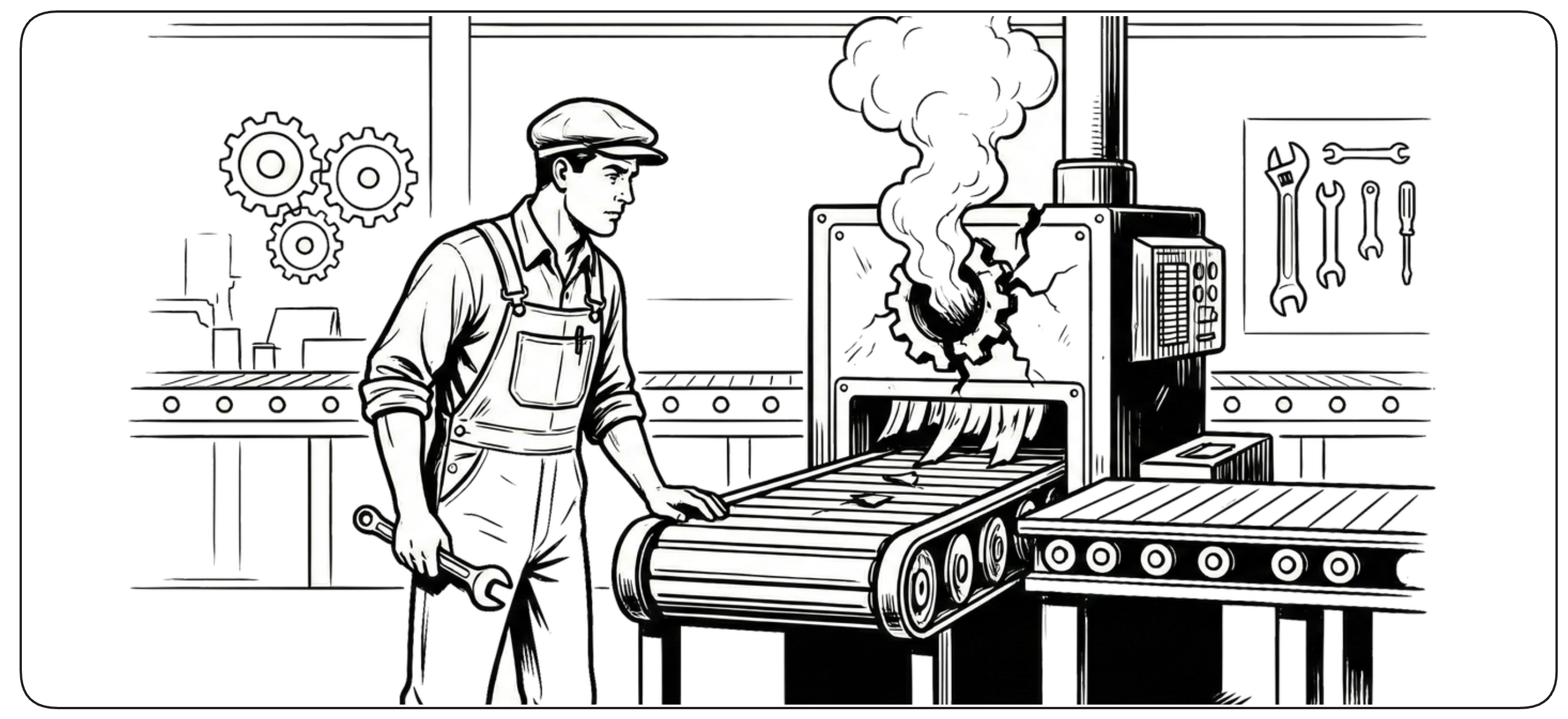
Deployment failures are inevitable, so recovery must be designed before they occur. The objective is not only to reduce failure probability, but to detect unhealthy transitions quickly, stabilize the service, and restore a known-good state with minimal uncertainty.
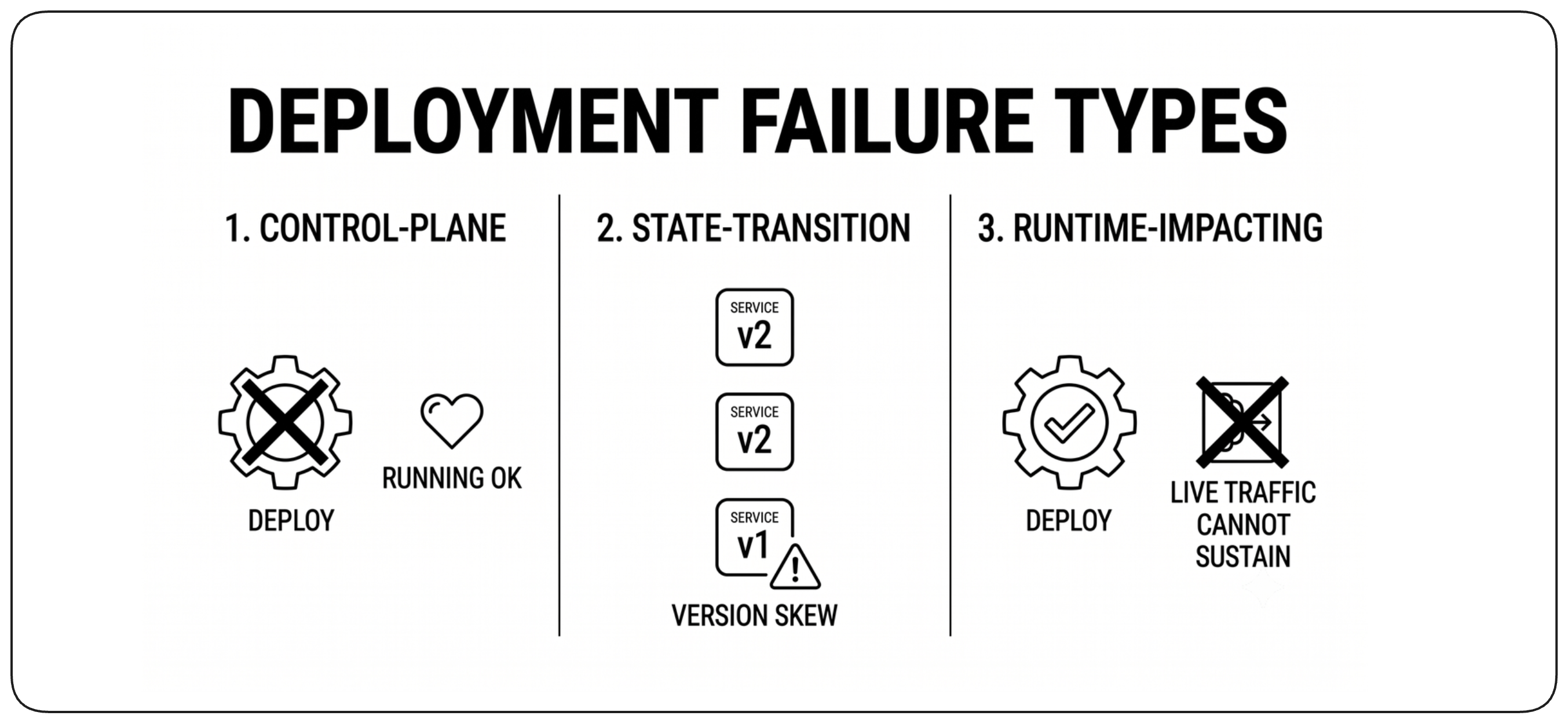
Three Types of Deployment Failure [Failure Types]
Deployment failures fall into three broad categories. Control-plane failures prevent the deployment mechanism from establishing the requested state while the running service may remain healthy. State-transition failures leave the system partially updated or inconsistent. Runtime-impacting failures establish the new state successfully, but that state cannot sustain expected production behavior.
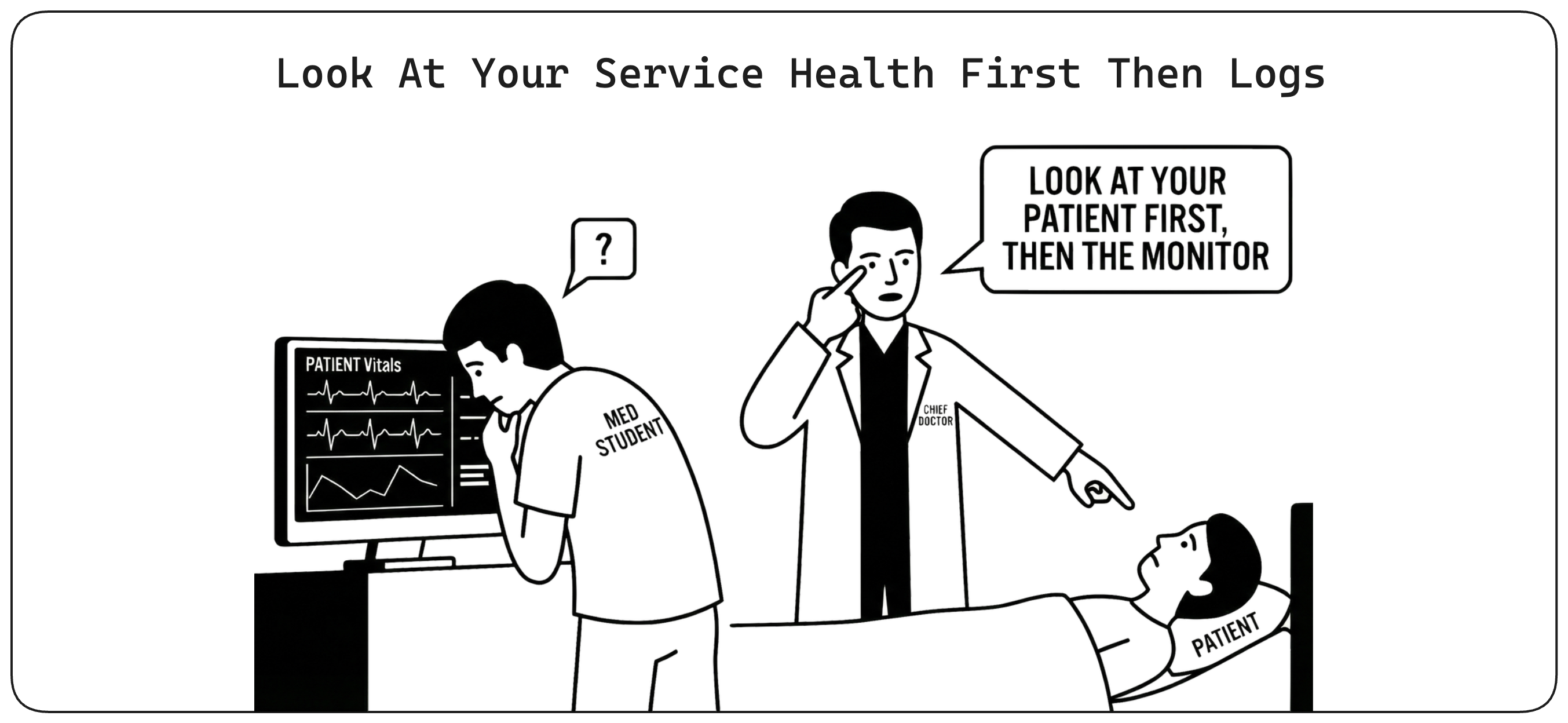
Check Service Health First [System Health First]
Deployment status and service health are not the same thing. A failed deployment step may leave the service healthy, while a successful deployment may introduce degradation. Before deciding what to do next, evaluate actual availability, latency, errors, and saturation—not the deployment result alone.
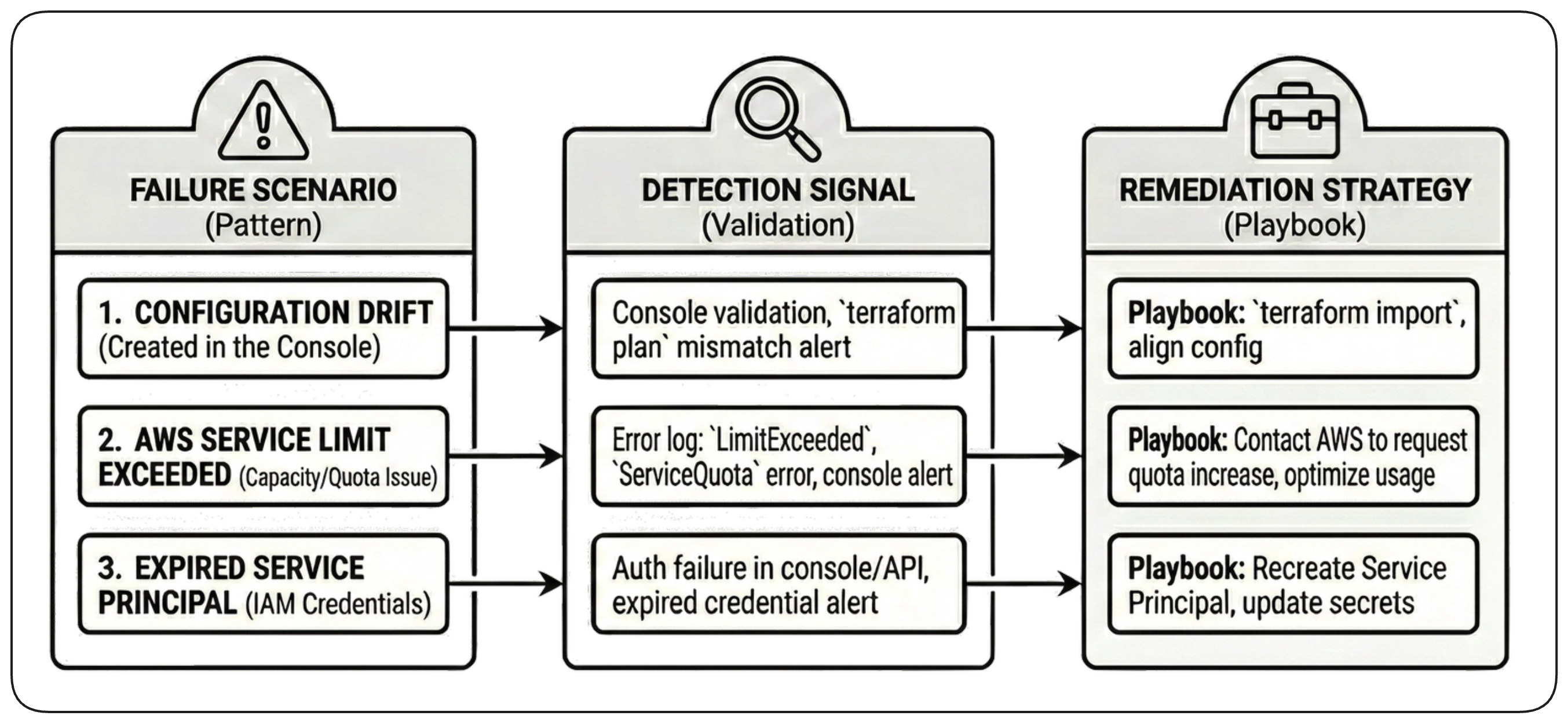
Prepare for Known Failure Scenarios [Failure Catalog]
Recurring failure patterns should become explicit operational knowledge. Record their detection signals, likely causes, and proven recovery actions in maintained playbooks. Every resolved incident should improve this catalog so that known failures become faster and more deterministic to handle.
Stabilize Before You Investigate [Stabilization First] {1}
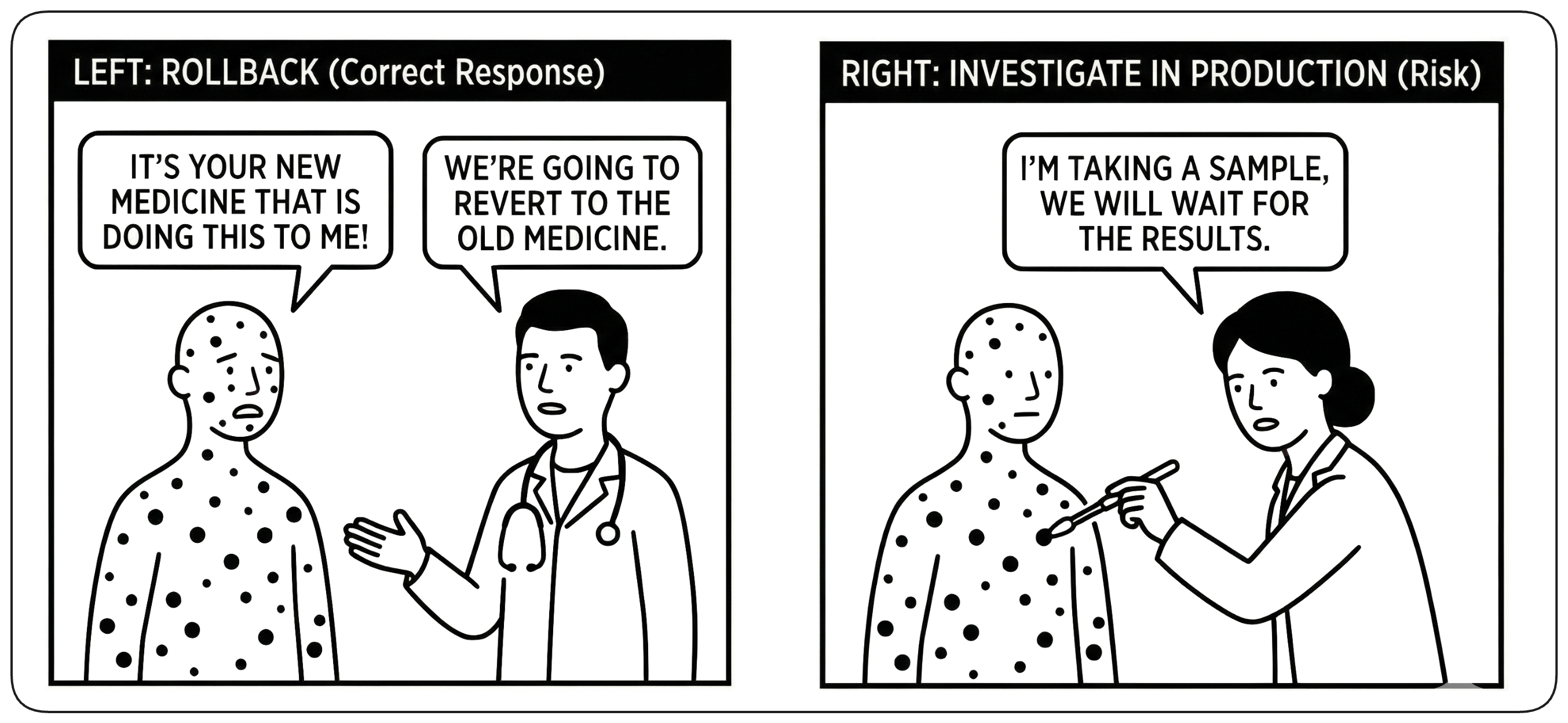
During an incident, restore a known healthy state before investigating root cause. Stabilization protects users and prevents diagnosis from delaying recovery. Once service is restored, investigation can continue without extending the production impact.
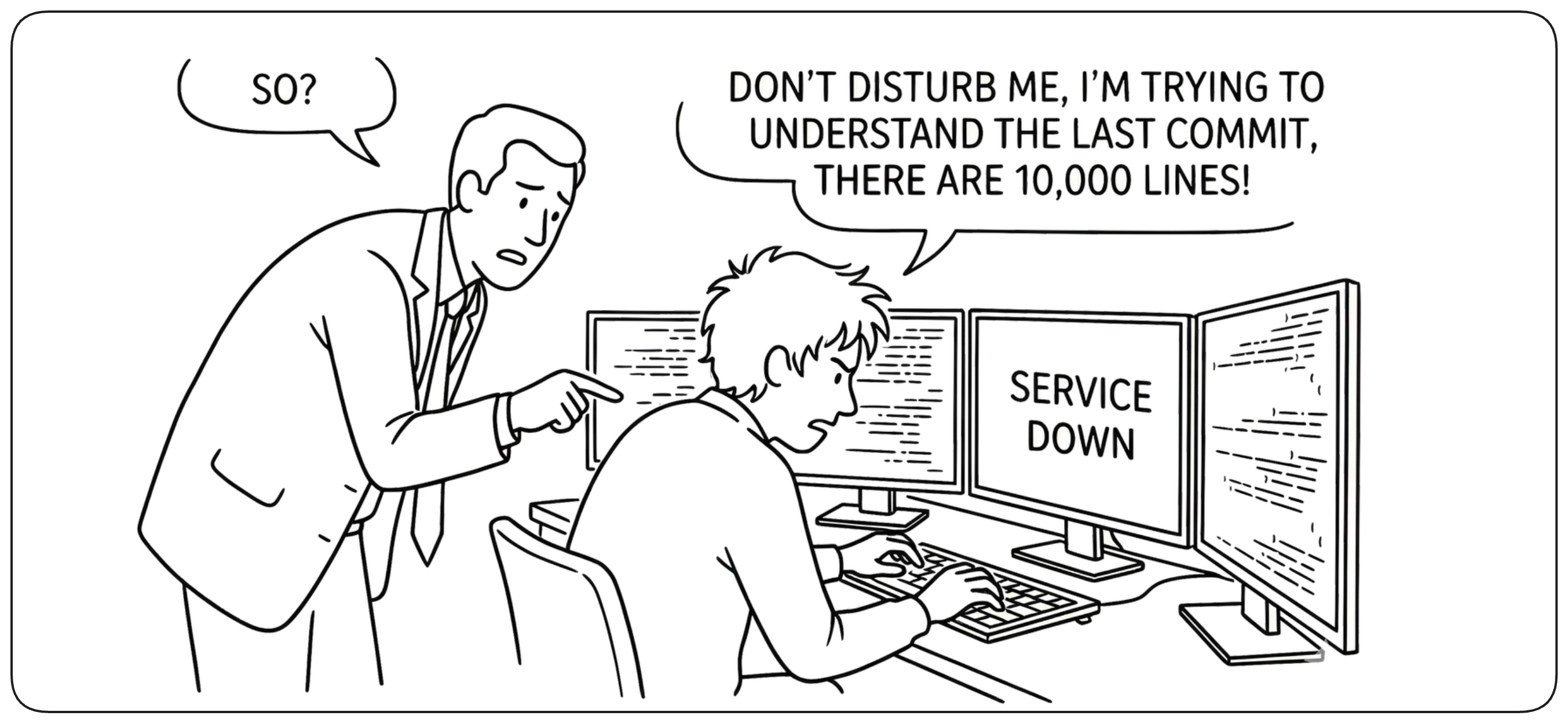
Prefer Proven Recovery Over Debugging Forward [Recovery First] {1}
When a deployment causes degradation, returning to a known-good state should be the preferred recovery path whenever rollback is safe. Avoid debugging or patching forward in production when a proven reversal can restore service faster. When rollback is not viable, use a predefined recovery path rather than improvising under pressure.
Communicate Status Transparently [Incident Communication]
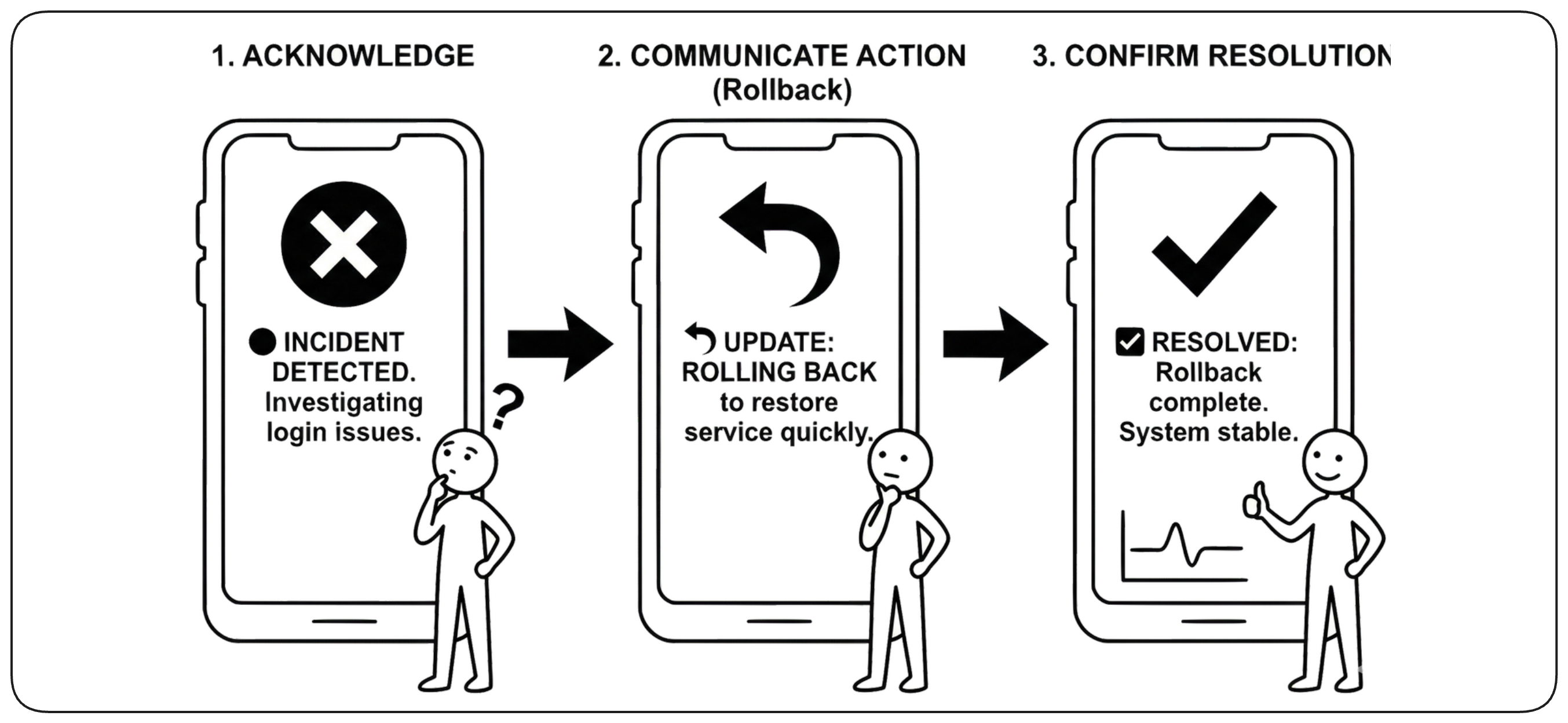
When a release affects users, communicate early and keep updates flowing throughout recovery. Share what is known, the current impact, the action being taken, and when service is restored. Do not wait for root-cause analysis before communicating.
Learn from Failure: Blameless Post-Mortems [Blameless Culture] {1}
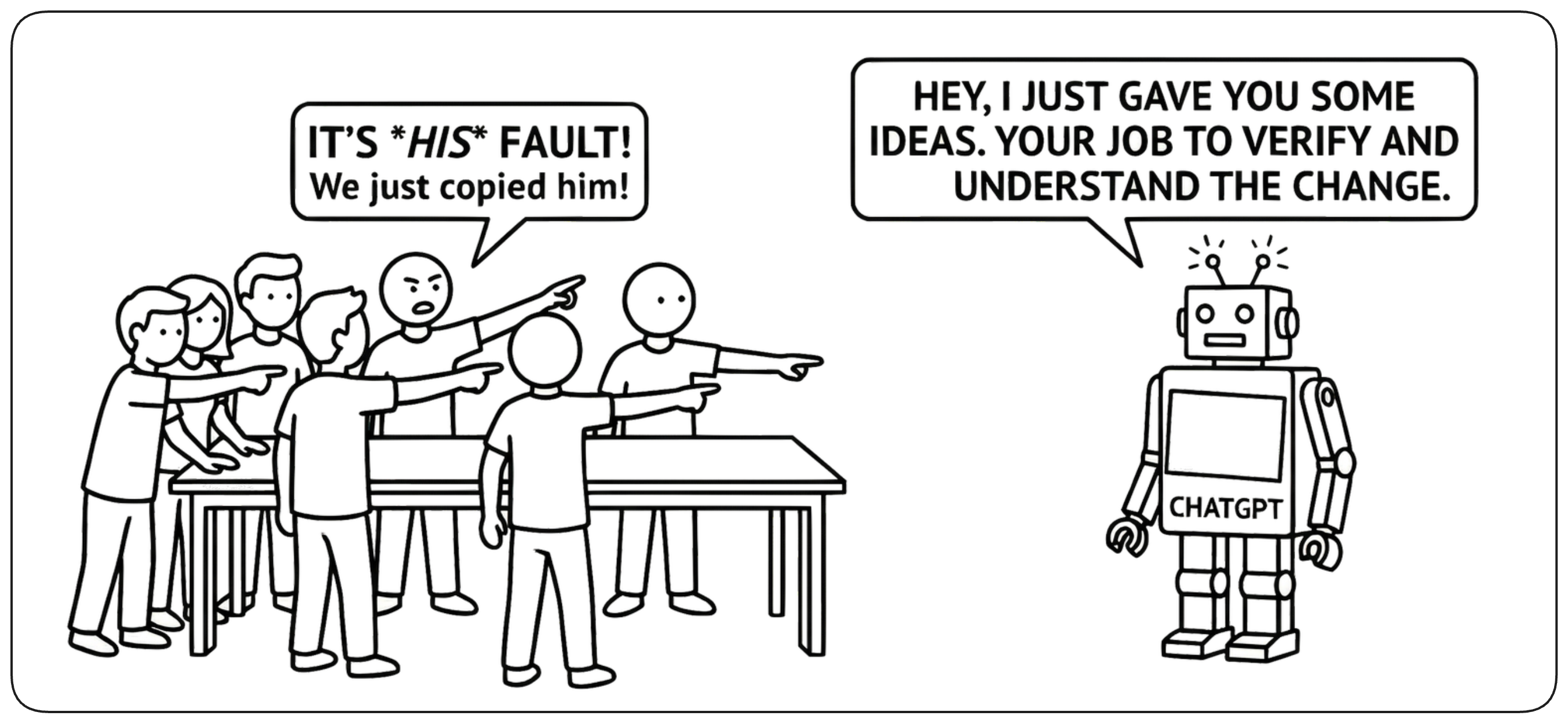
Deployment failures should improve the release system. Post-incident analysis focuses on the conditions that allowed the failure and turns those findings into concrete safeguards—better validation, monitoring, automation, recovery procedures, or architectural constraints. The objective is not to assign blame, but to make the same failure easier to prevent or recover from next time.
Unifying Consumption, Segregating Storage [Unified Consumption]
From a Developer Experience (DX) perspective, the complexity of managing distinct storage backends (Git for config, Vault for secrets) is an unnecessary cognitive burden. The application logic simply requires inputs. The ideal platform resolves this friction by abstracting the storage segregation. Through intermediate operators (like the External Secrets Operator in Kubernetes), data is fetched from secure vaults and projected into the workload alongside standard configuration maps. This creates a Unified Consumption Layer: whether the value is a mundane URL or a critical password, the developer accesses them through the same native interface (e.g., Environment Variables), ensuring strict security on the backend without complicating the frontend code.
Illustation to do: os.getenv('DB_URL') ou os.getenv('DB_PASSWORD') -->
Ensuring Release Quality
Release quality cannot be an afterthought—it must be built in from day one of development. But quality can only be measured through testing. Without tests, there is no objective way to assess whether code meets requirements, performs correctly, or maintains reliability. Testing provides the metrics and evidence needed to validate quality throughout the development lifecycle, making it the foundation of any quality assurance strategy.
Well Defined Criteria [Quality Criteria]
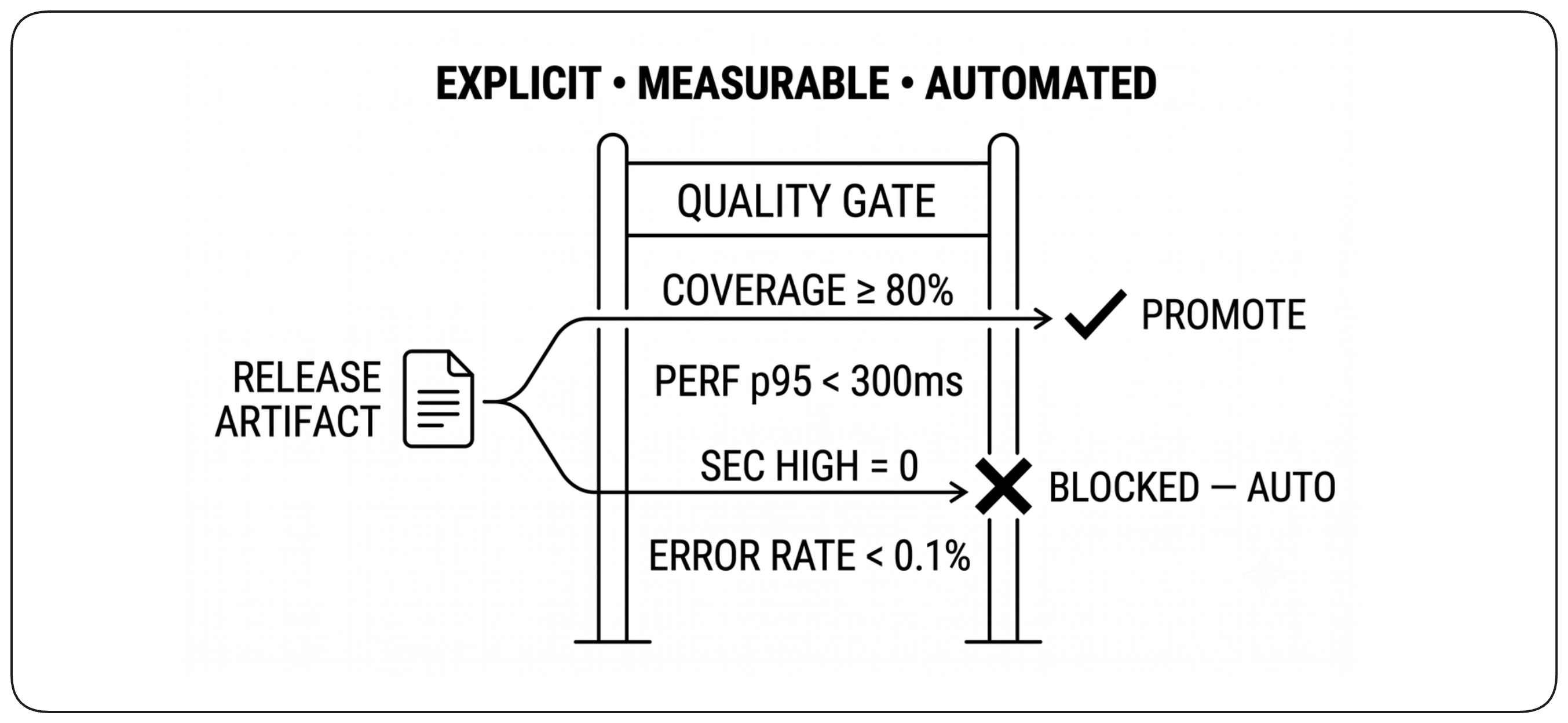
Quality gates must be explicit, measurable, and automatically enforced at the platform level. Manual checks and good intentions are not enough—if criteria are not met, teams must be prevented from deploying to production. Automated gates should block deployments that fail to meet predefined thresholds for test coverage, performance benchmarks, security scans, or other quality metrics. By making criteria mandatory and non-negotiable, organizations ensure that quality standards are consistently applied across all releases, eliminating the risk of exceptions that compromise system reliability.
Ensuring Quality Only Through Robust Testing [Test First]
Investing in testing must precede any investment in DevOps. Many projects mistakenly expect DevOps to compensate for inadequate testing, but this is a fundamental error. If tests are weak, no amount of sophisticated release architecture will save the project. Release quality begins with strong, reliable tests—solid testing processes must be prioritized before diving into complex DevOps implementations. The integrity of any deployment pipeline is only as strong as the tests that validate it.
Code Coverage [Coverage Metrics]
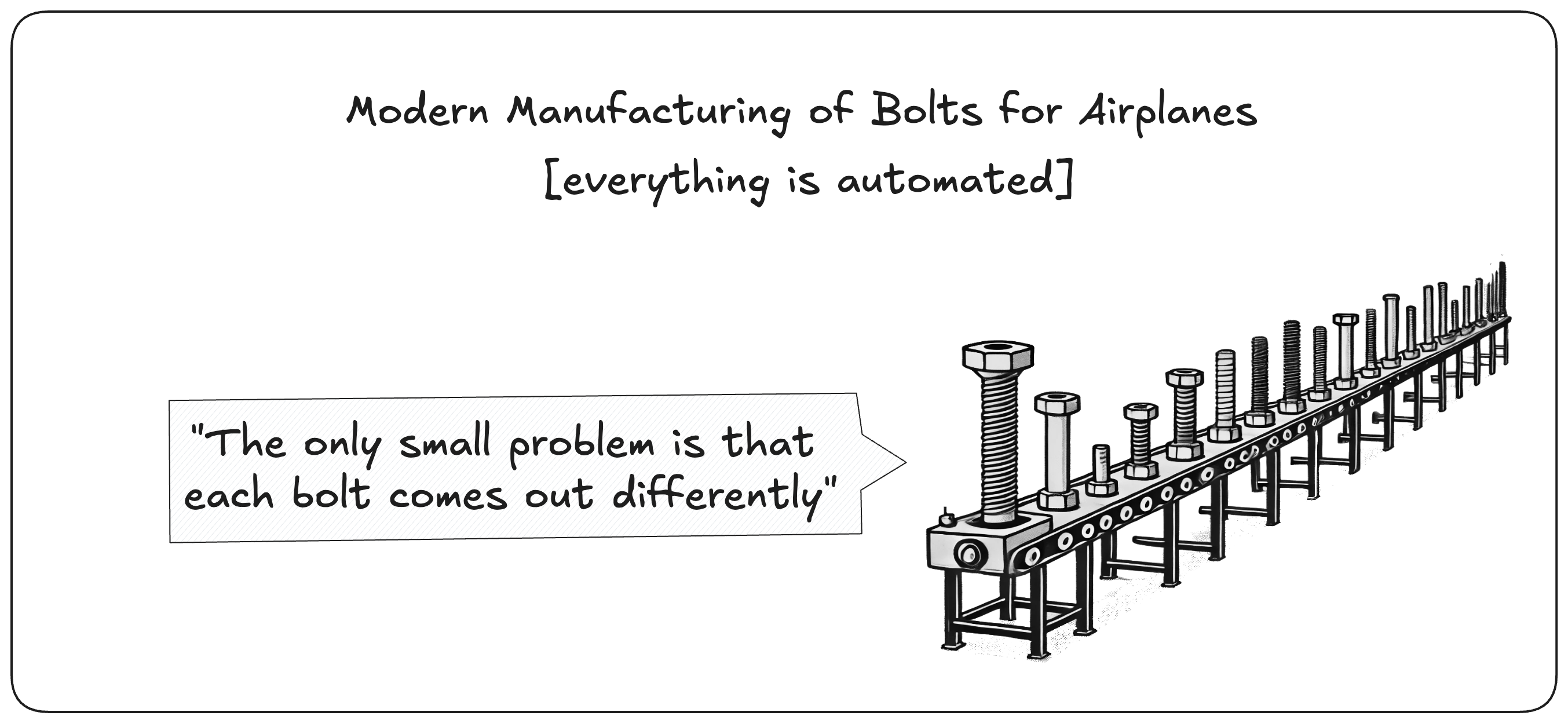
Code coverage metrics reveal how much of the codebase is exercised by tests. While high coverage doesn't guarantee quality, low coverage signals significant risk. Setting minimum coverage thresholds as a quality gate ensures that critical code paths are tested. However, coverage alone is insufficient—what matters is the quality and relevance of the tests, not just the percentage. Coverage metrics should serve as a baseline indicator, combined with other quality measures to ensure comprehensive testing.
Integration Tests [Integration Validation]
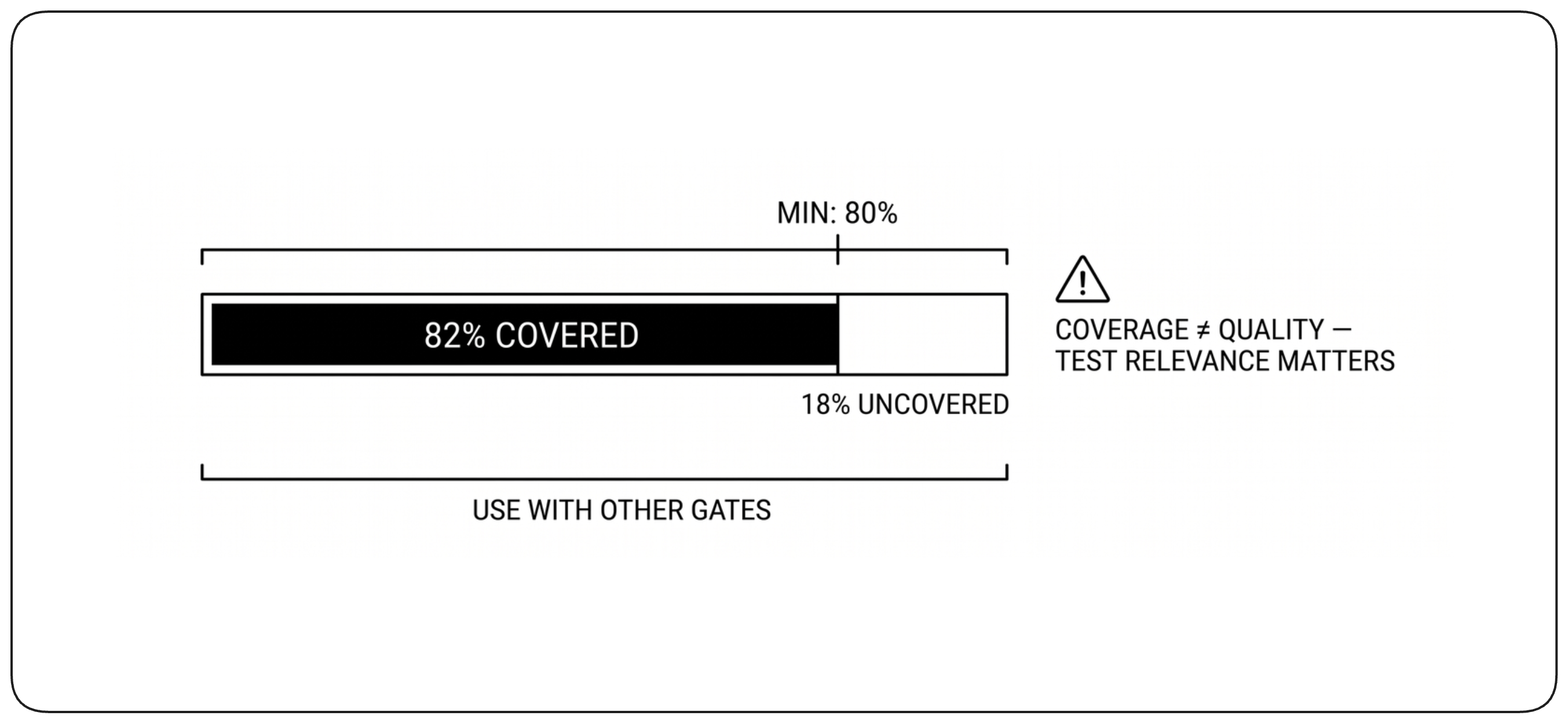
Integration tests validate that multiple components work together correctly. Unlike unit tests that isolate individual components, integration tests verify interactions between services, databases, APIs, and external dependencies. These tests are essential for catching issues that only emerge when components are combined—API contract mismatches, data flow problems, configuration errors. Integration tests must run in environments that closely mirror production, ensuring that the same interactions validated in testing will work in production.
Proving Rollbackability [Rollback Validation]
Rollbackability must be demonstrated, not assumed. The only reliable way to verify it is to deploy a change forward and then explicitly roll it back in an environment that mirrors production. Upgrade–downgrade testing exposes hidden assumptions and unsafe transitions that would otherwise remain undetected. If rollback fails during testing, the release was never safe in the first place.
The Configuration Triad in Depth [Configuration]
This section expands the Configuration Triad introduced earlier, examining static parameters, dynamic parameters, and secrets in depth.
Static Parameters
The Reality: Configuration Sprawl [Configuration Sprawl]
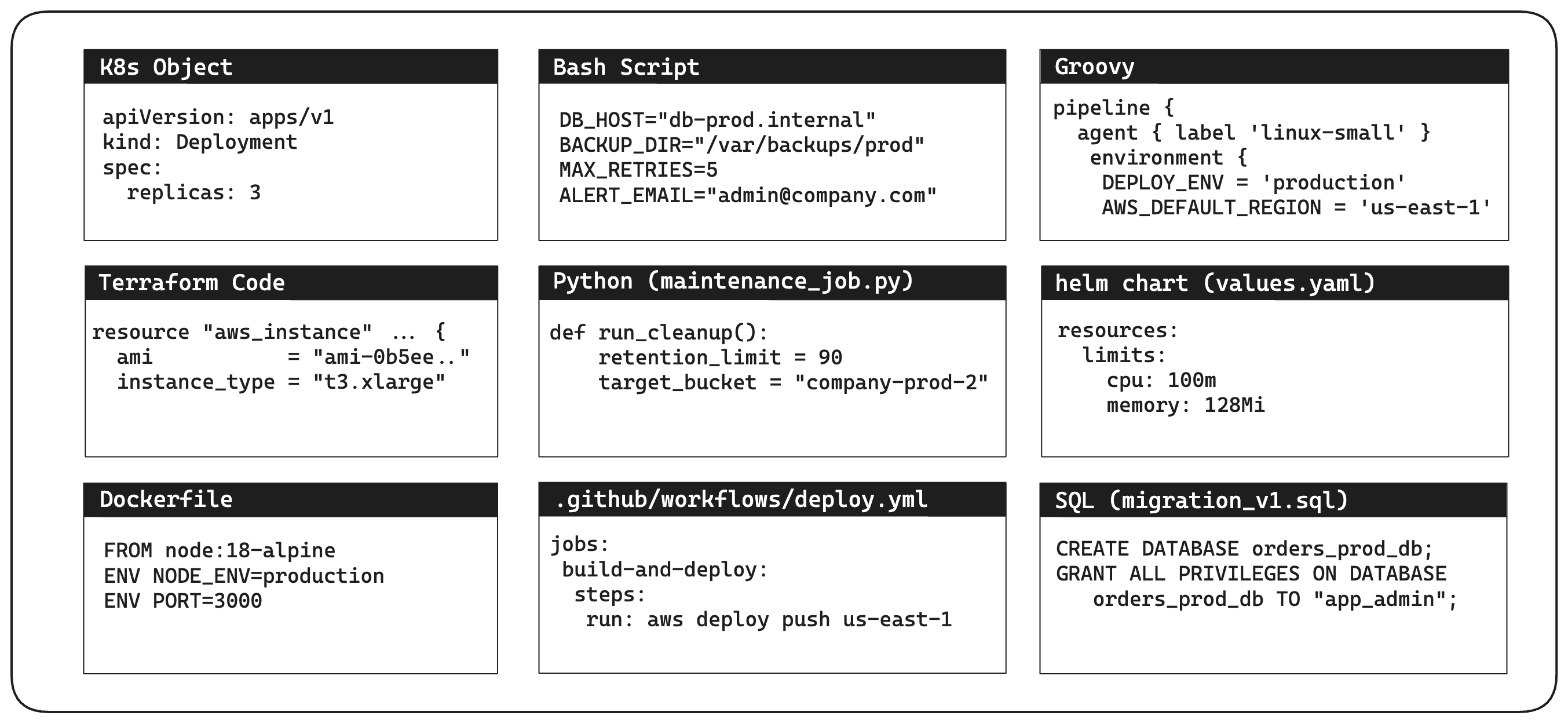
Too often, static parameters are deeply embedded within implementation logic. We find them hardcoded inside Helm templates, buried in Terraform resource blocks, and scattered throughout Bash or Python scripts. This dispersion makes it impossible to have a consolidated view of the environment. Simply asking, "What was the exact state of our variables during last week's deployment?" becomes a forensic project requiring a manual audit of the entire codebase.
Single Source of Truth [Single Source of Truth]
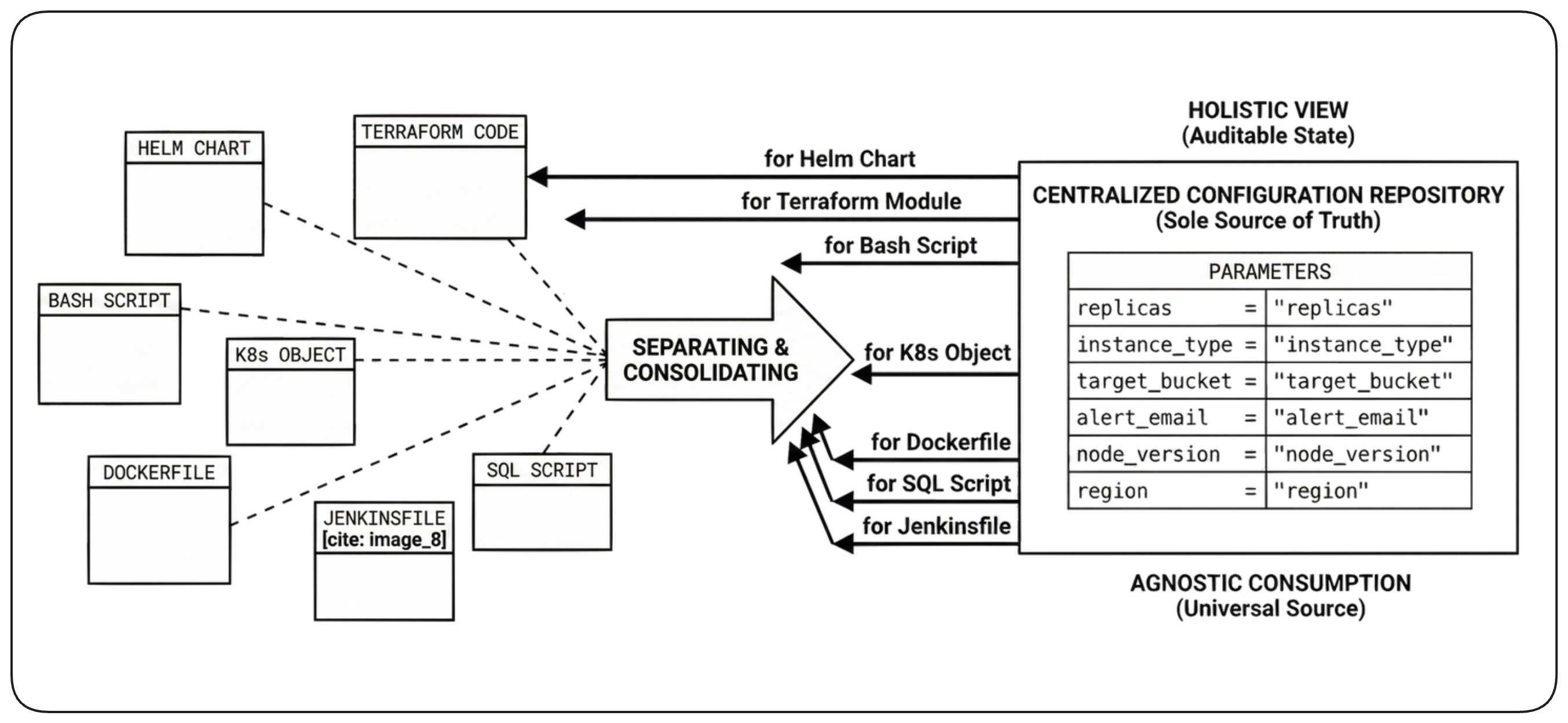
The solution requires a fundamental shift: separating all static parameters from deployment code and consolidating them into a single entity that serves as the sole source of truth. This centralized repository is designed for agnostic consumption; whether the data is required by a Helm chart, a Terraform module, or a script is irrelevant. By centralizing these inputs, we establish a holistic view of the system's intended state, turning configuration history into an accessible and auditable asset.
Runtime Injection of Versioned Configuration [Version & Injection]
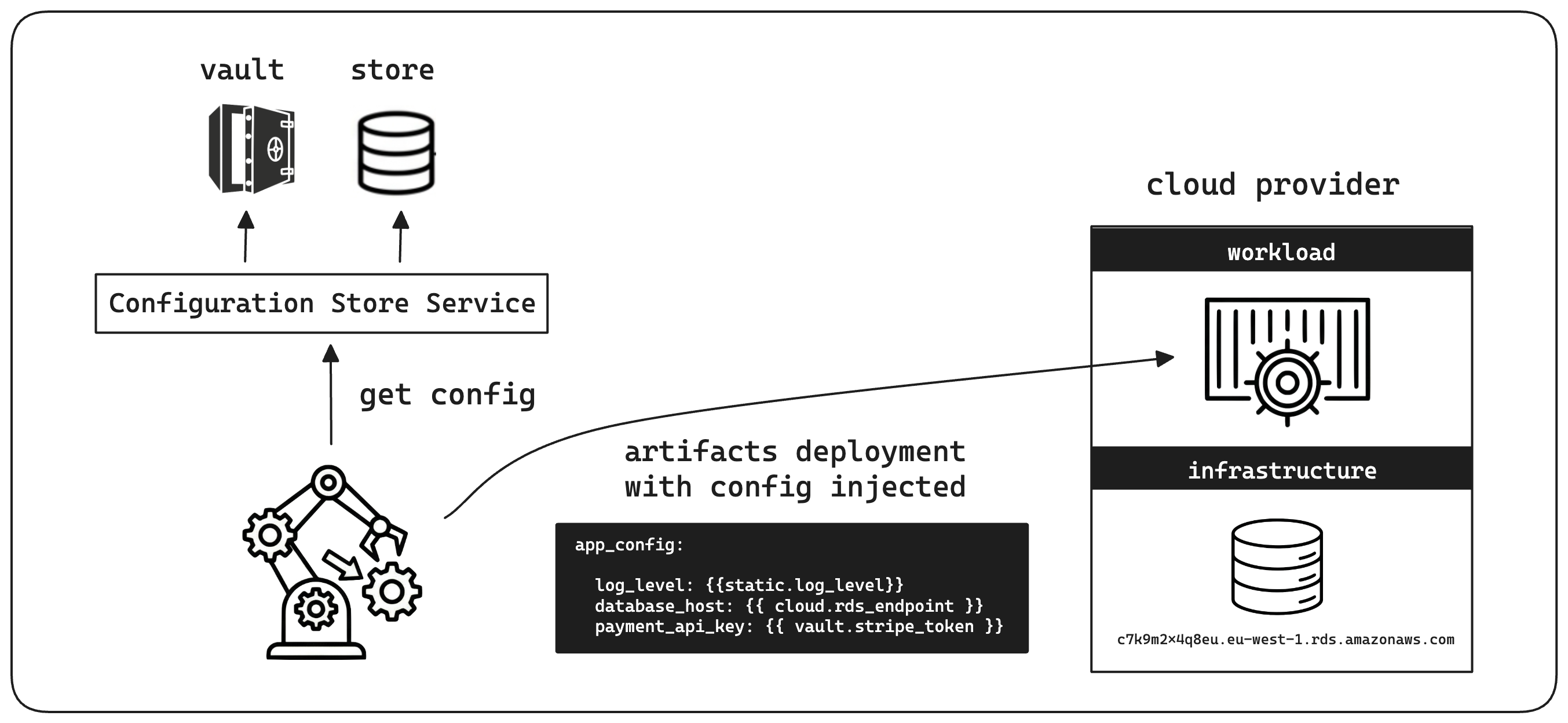
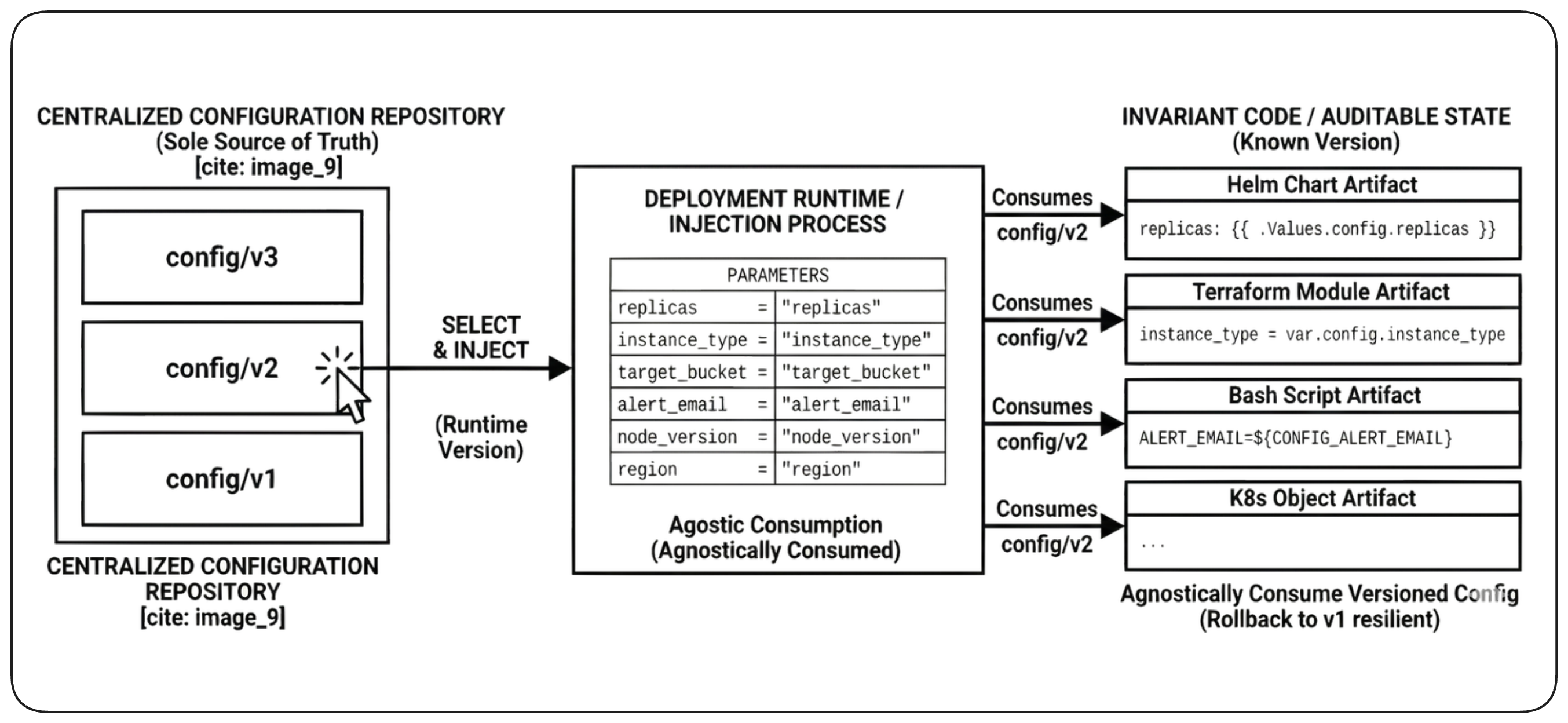
The central repository treats configuration as version-controlled, immutable code. At execution, a specific version is injected into the runtime. This keeps deployment artifacts invariant across environments while ensuring a fully auditable system state. Rollbacks become simple: just pair the previous artifact version with the previous configuration version.
The Override Pattern
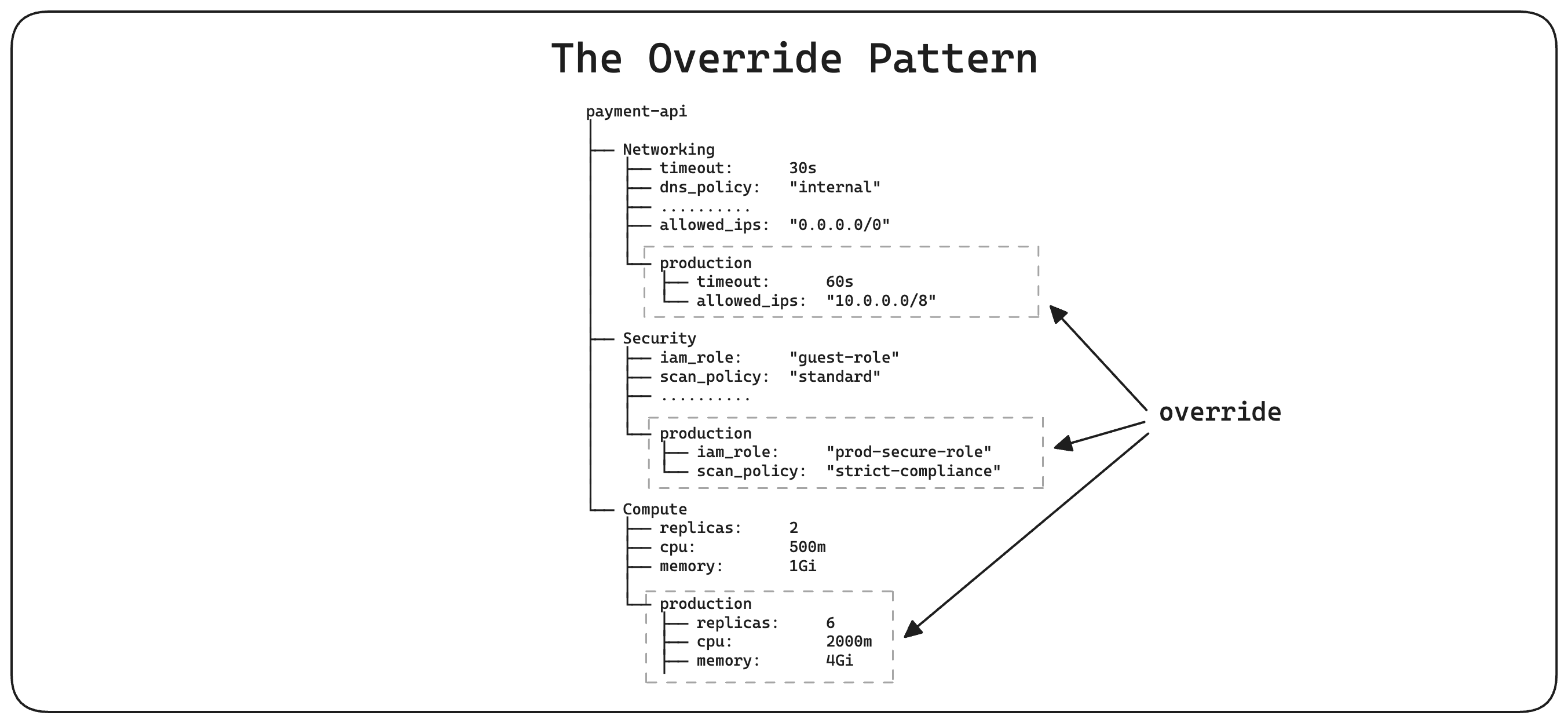
Effective management relies on designing for defaults. By defining a generic configuration file populated with standard values, you establish a baseline for the majority of environments. Specific targets, like Production, are managed through 'deltas'—files containing only necessary overrides. This method isolates critical environment differences, eliminates duplication errors, and accelerates new infrastructure provisioning.
The Principle of Configuration Isolation [Configuration Isolation]
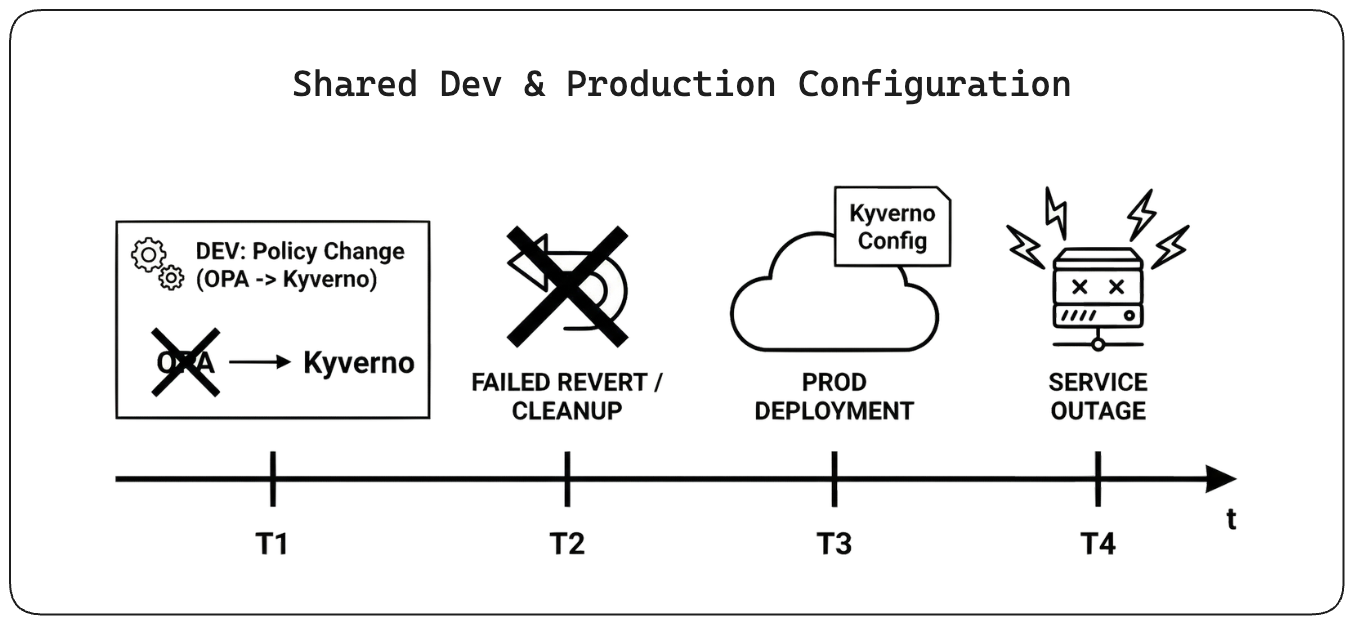
Production and non-production configurations must remain strictly independent to prevent "configuration leakage." It is vital to ensure that settings used for testing new security measures or technical migrations can never inadvertently migrate to the live environment. Without this total separation, a simple failure to clean up after a test can apply blocking restrictions to all legitimate users, turning a minor handling error into a major service outage. We will explore hierarchical configuration patterns that enforce this separation by design in a later section.
Dynamic Parameters
Capturing Reality vs. Defining Intent [Reality vs Intent]
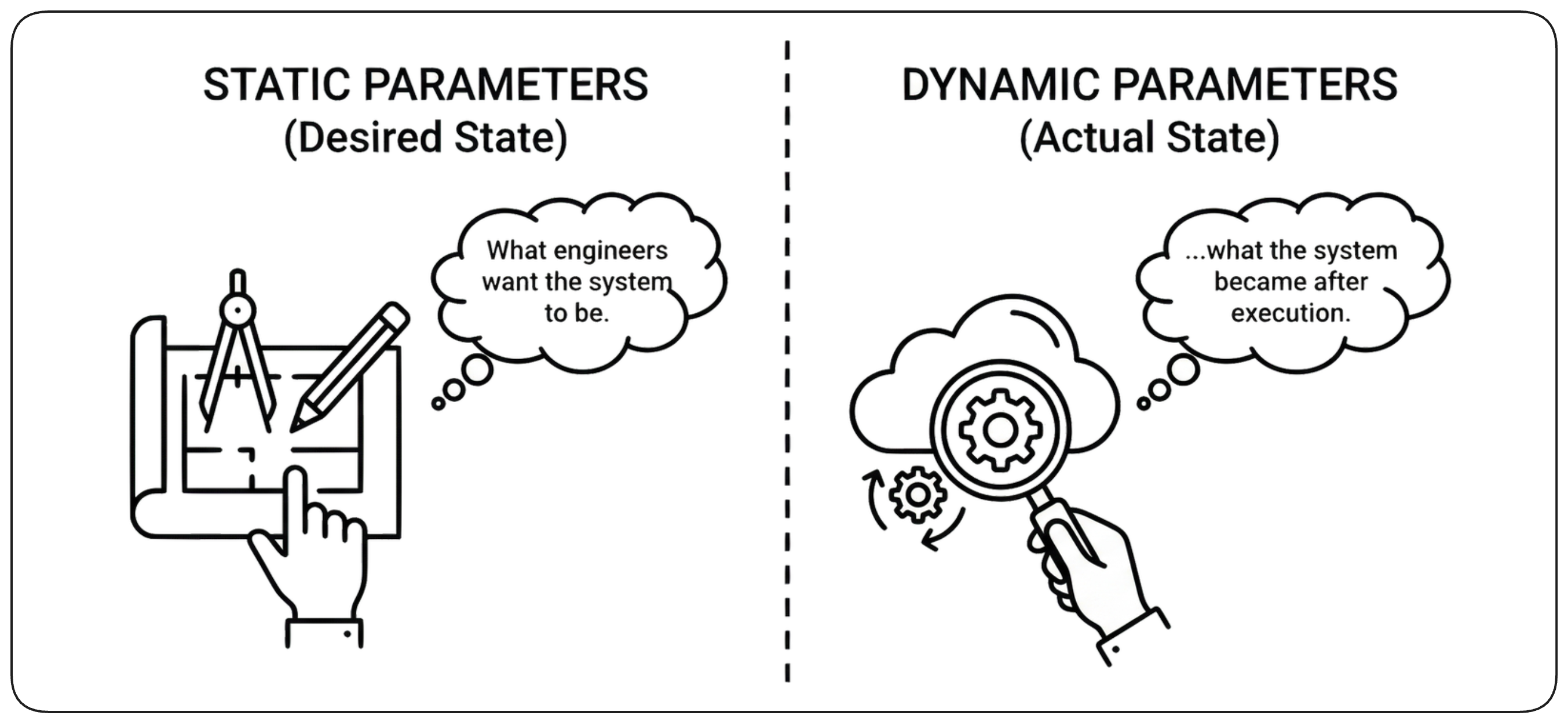
While Static Parameters represent the Desired State (what engineers want the system to be), Dynamic Parameters capture the Actual State (what the system became after execution). You cannot version the future; you can only discover it. A unique Load Balancer DNS name or a VPC ID generated by a cloud provider does not exist until the infrastructure is provisioned. Therefore, these values represent the immutable reality of the live environment.
Strategies for Retrieving Dynamic Context [Retrieving Dynamic]
Since dynamic parameters are generated at runtime, they cannot be stored in Git like static configuration. Consequently, the deployment machinery requires a reliable strategy to retrieve these values and pass them to the dependent workload. We will explore three distinct strategies to address this challenge below.
Strategy 1: Direct Pipeline Handoff (Coupled) [Direct Pipeline]
The simplest method occurs entirely within a single pipeline execution. In step A, a process (like Terraform) creates infrastructure and outputs values (e.g., a database endpoint). These values are passed immediately "on-the-fly" to step B (application deployment) via memory or temporary files.
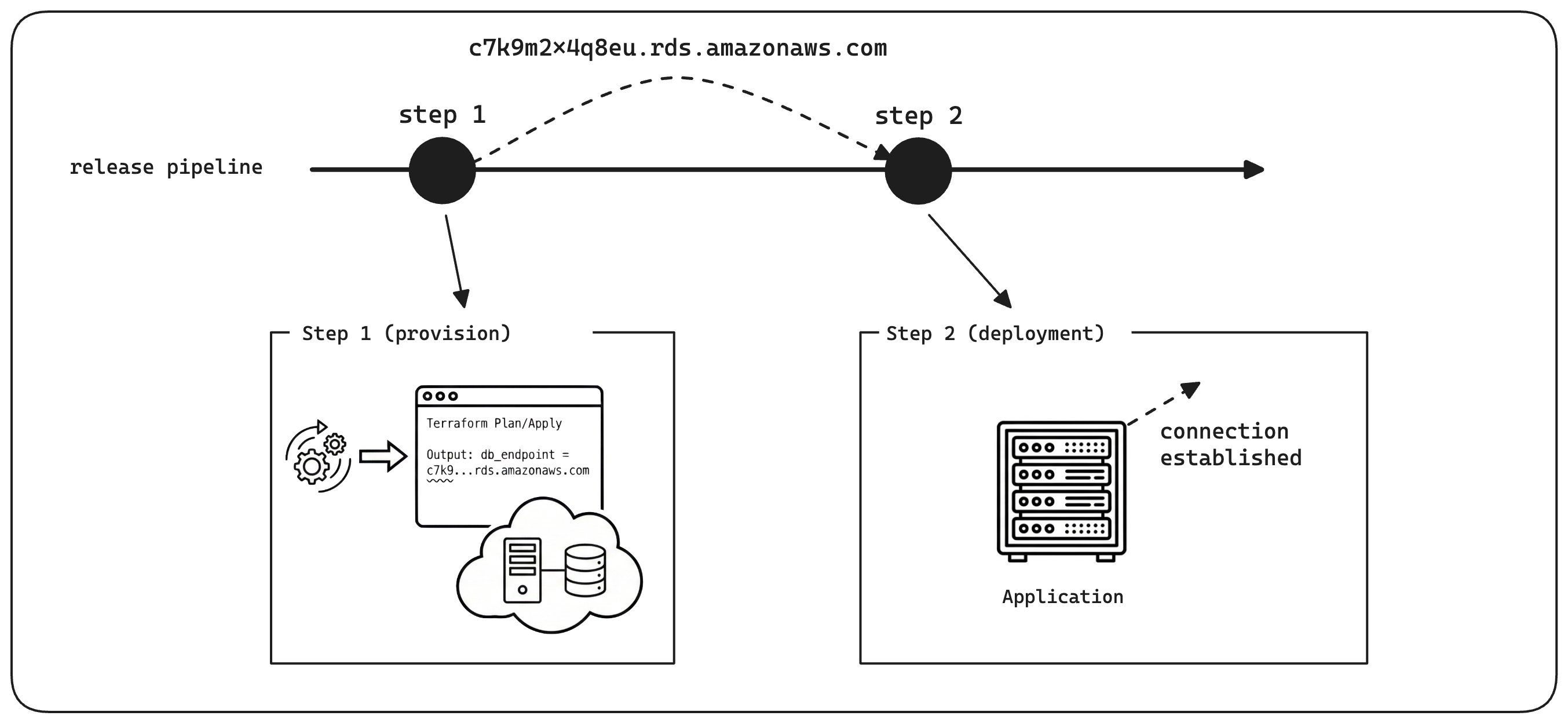
The Downside: This creates tight coupling. You cannot deploy the application without running the infrastructure code. It limits modularity and makes retries difficult, as the data is ephemeral—if the pipeline crashes, the state is lost.
Strategy 2: Live Cloud Interrogation (Discovery) [Discovery]
This approach fundamentally decouples the provisioning lifecycle from the application deployment. Unlike the "single pipeline" strategy, these two processes operate independently, sharing no memory, temporary files, or execution context. To bridge this gap, the deployment pipeline must "discover" its environment. Instead of receiving values passively, it actively interrogates reality by using Cloud APIs to query the live infrastructure, typically filtering for resources by specific Tags assigned during creation.
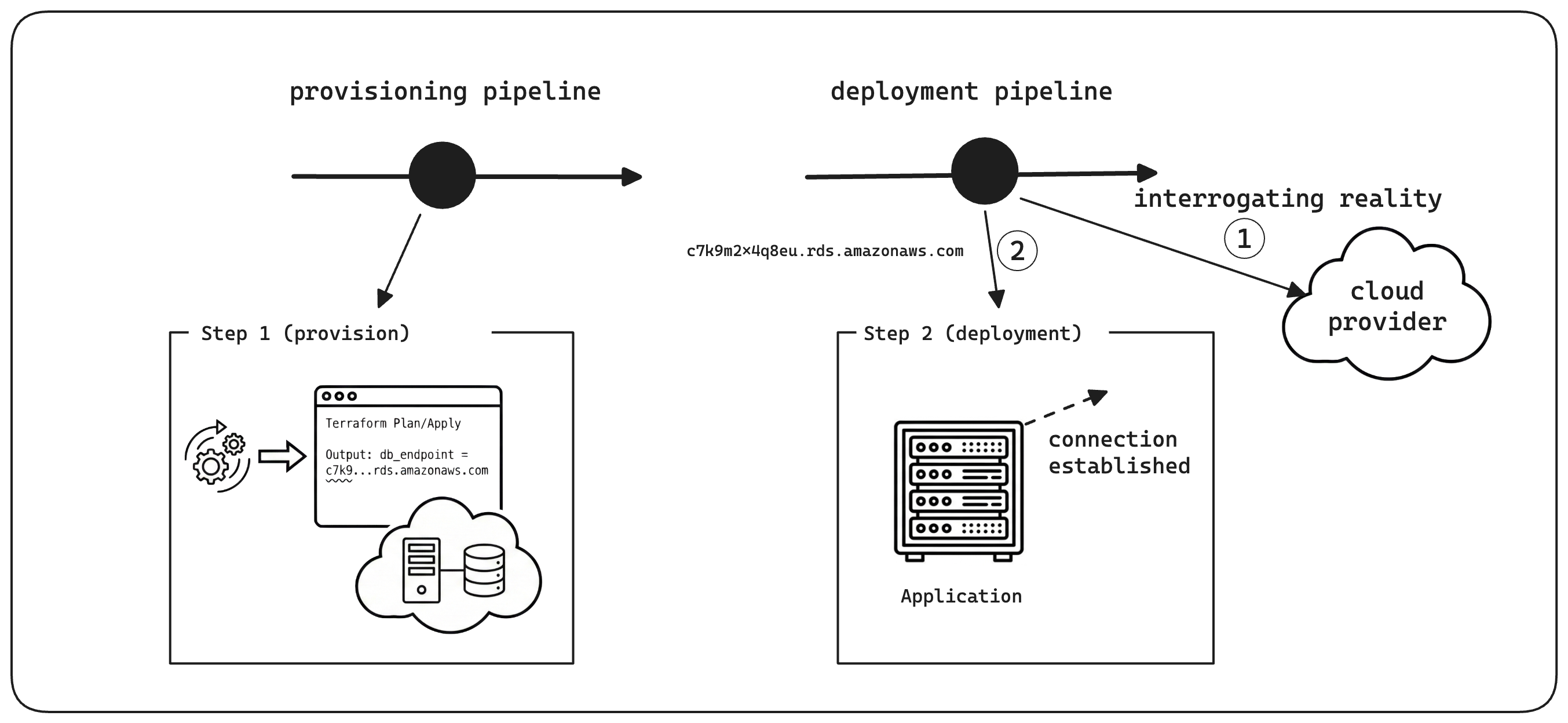
The Downside: This introduces a heavy dependency on external APIs. It suffers from scalability and performance issues (latency, rate-limiting/throttling by the cloud provider) and fragility—if a tag is modified manually, the deployment breaks.
Strategy 3: Dedicated State Persistence (The Recommended Pattern) [Dedicated State]
The most robust method uses a dedicated intermediate storage service. The process responsible for creating resources (e.g., Terraform) explicitly "publishes" only the relevant outputs to a persistent data store (like a Key-Value store or a database). This makes consumption effortless: any downstream system or user simply needs to query the store to retrieve the value, decoupling access from creation.
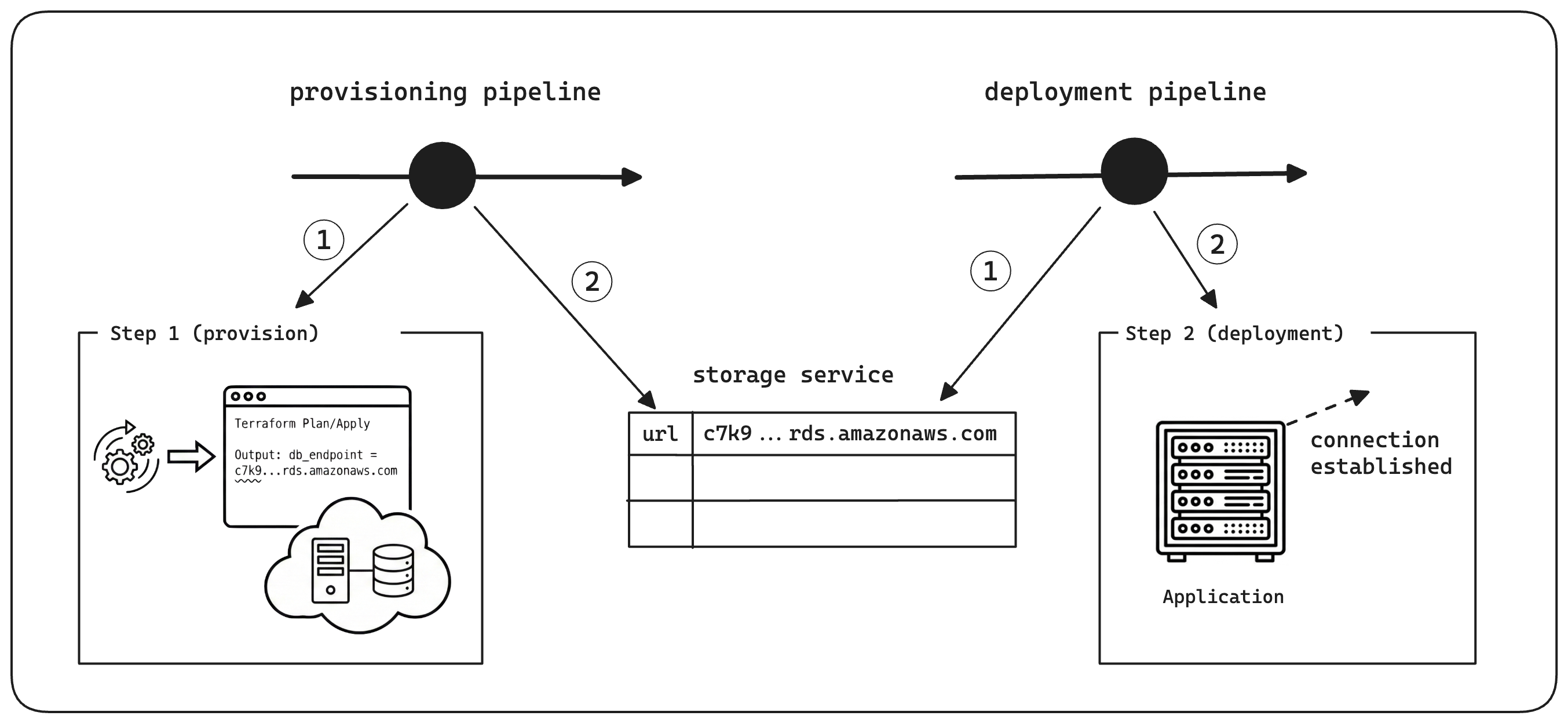
The Advantage: This offers selectivity and decoupling. We choose exactly which data points are exposed to the wider system. Furthermore, as we will see later, this method is the key to the "Unified Store" architecture: it allows us to consolidate these dynamic values alongside static parameters behind a single, consistent API, hiding the complexity of their origin.
Secret [Secret]
Secrets encompass all sensitive data representing identity or authorization. Due to their critical nature, they require specialized lifecycle management that strictly categorizes them by consumer. A robust release architecture must differentiate between the operational credentials required to orchestrate the deployment and the runtime secrets consumed by the application.
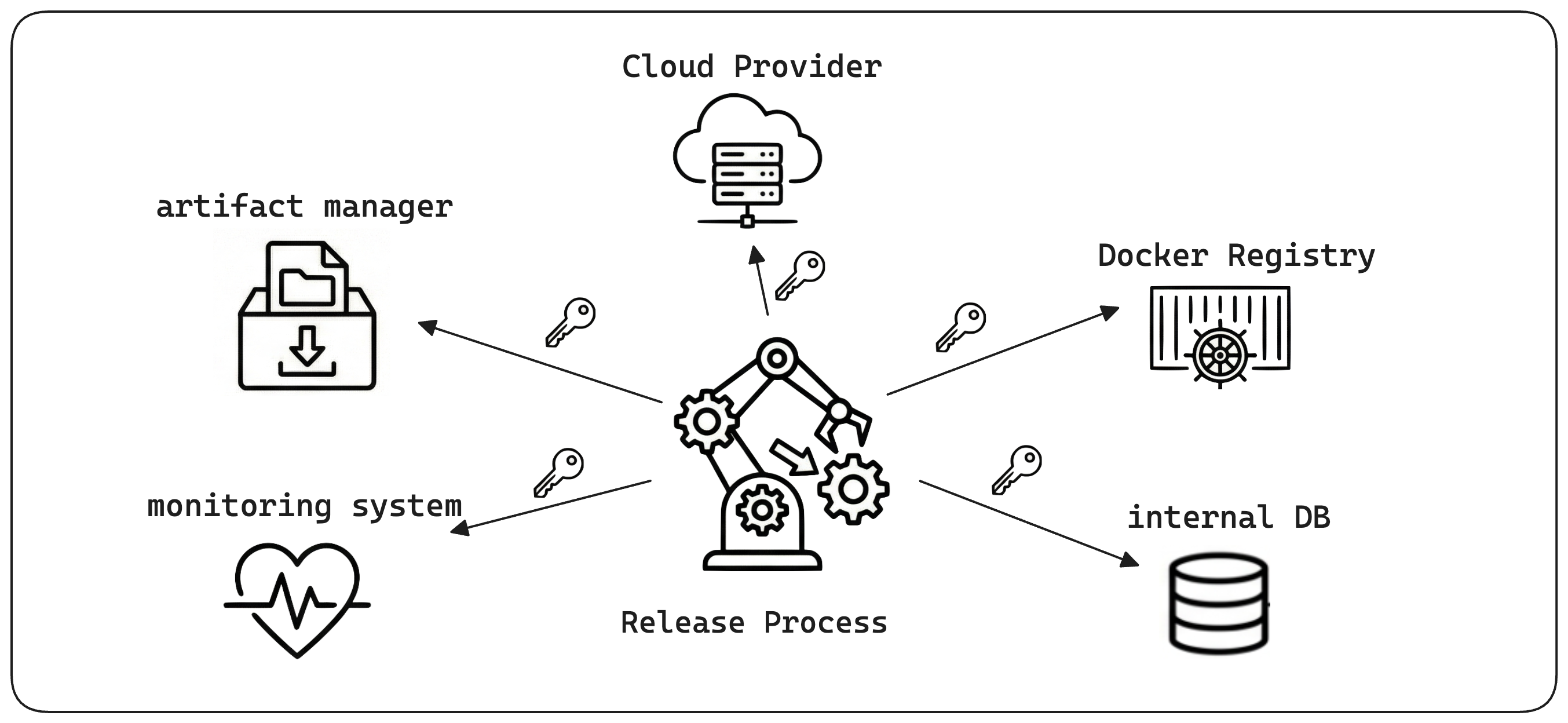
Operational Secrets for the Release Process [Operational Secrets]
The release machinery requires its own credentials to function. "Process Secrets" are keys utilized by the CI/CD infrastructure itself—such as Terraform Service Account keys or Docker Registry tokens. These operate strictly at the infrastructure layer, granting the "deployment robot" authority to orchestrate the release.
Delivering Secrets to the Application [Secrets for Workload]
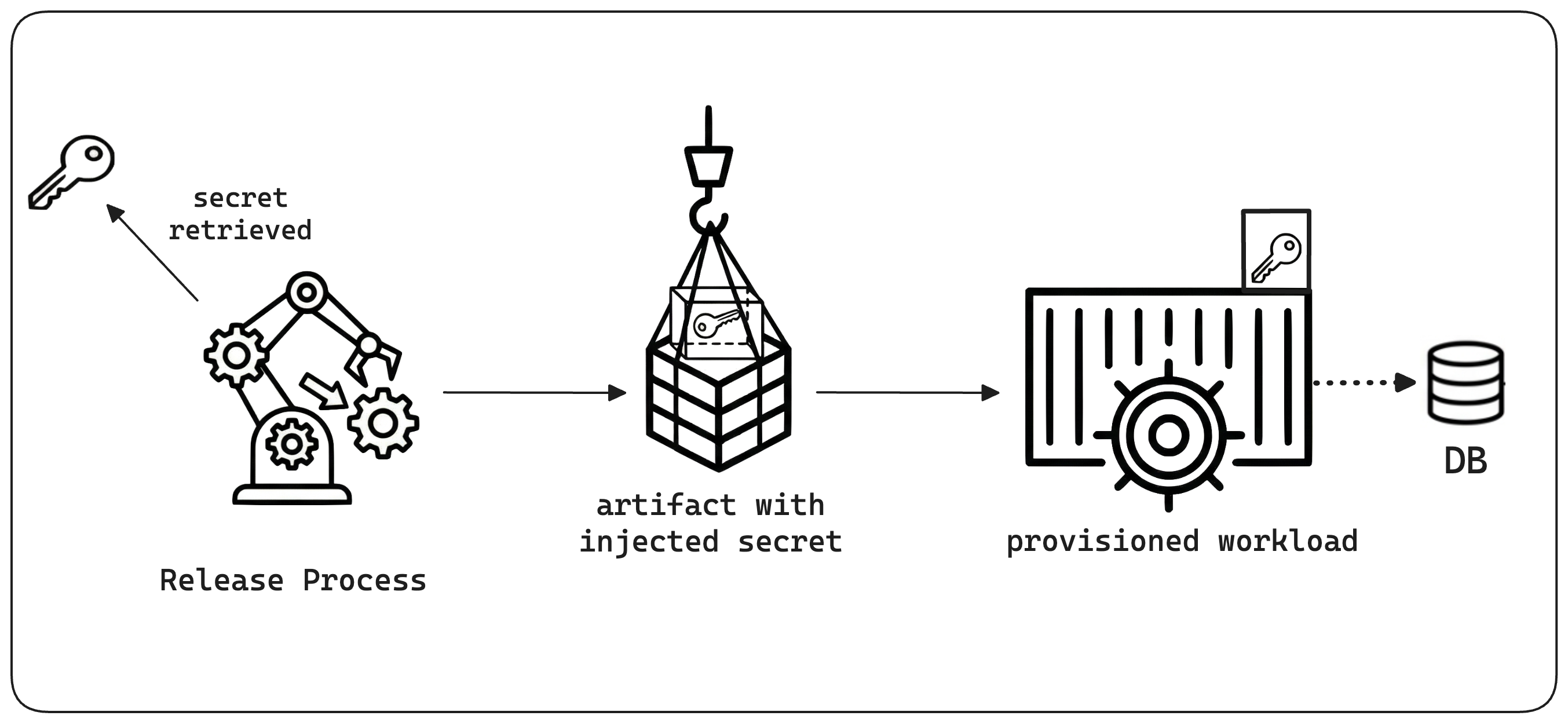
The release pipeline is frequently used to deliver secrets to the application. In this model, the process acts as a courier: it retrieves sensitive data (like DB passwords) and injects them into the workload at deployment time. This ensures the application starts with immediate access to its dependencies. However, this implies that the deployment pipeline itself must handle plaintext secrets. More critically, it creates tight coupling: you cannot deploy the application without running the provisioning logic to retrieve the keys. Furthermore, it binds the secret's lifecycle to the release: for example, to rotate its keys, you are forced to redeploy the entire workload.
Fallback to Ephemeral Credentials [Ephemeral Credentials]
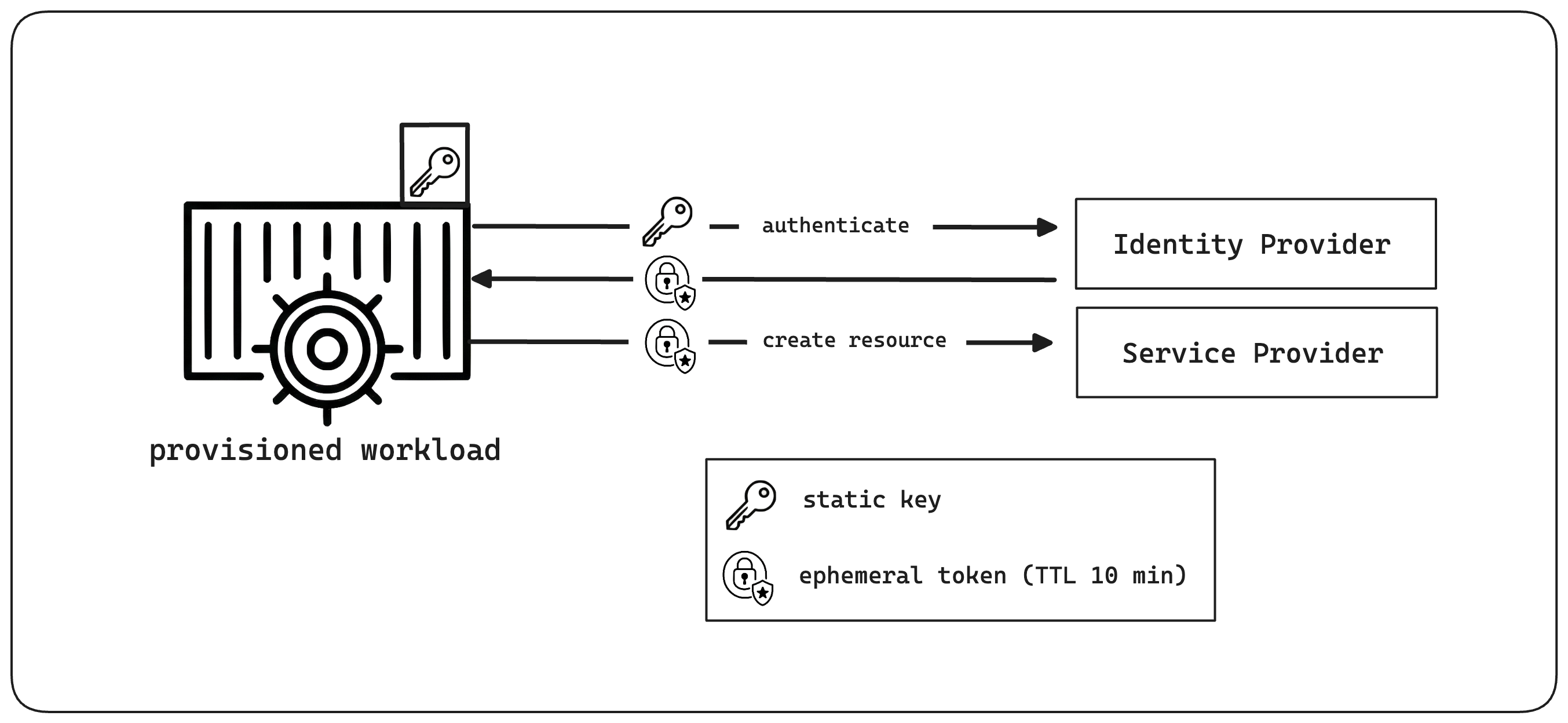
When direct identity-based authentication is technically infeasible—often due to legacy databases or third-party APIs that strictly mandate credential exchanges—the strategy must shift to Ephemeral Credentials. Instead of reverting to risky static keys, the system leverages the workload's identity to mint short-lived tokens or "dynamic secrets" that exist only for the duration of a specific session or transaction. This approach drastically minimizes the security blast radius; even if a credential is leaked, its strictly limited lifespan renders it useless to attackers almost immediately, effectively neutralizing the threat of long-term exposure without manual rotation.
The Fragmentation Challenge: Scattered Truth [Fragmentation Challenge]
The Burden of Assembly In a fragmented architecture, the Release Pipeline is forced to act as a complex integration broker. Because configuration data is hosted in three incompatible systems—Git for static files, Cloud APIs for dynamic resources, and Vaults for secrets—the deployment logic must implement specific connectors for each. This creates a fragile "glue layer" where the pipeline is burdened with the heavy lifting of fetching, parsing, and merging these disparate streams at runtime, merely to construct a usable application state.
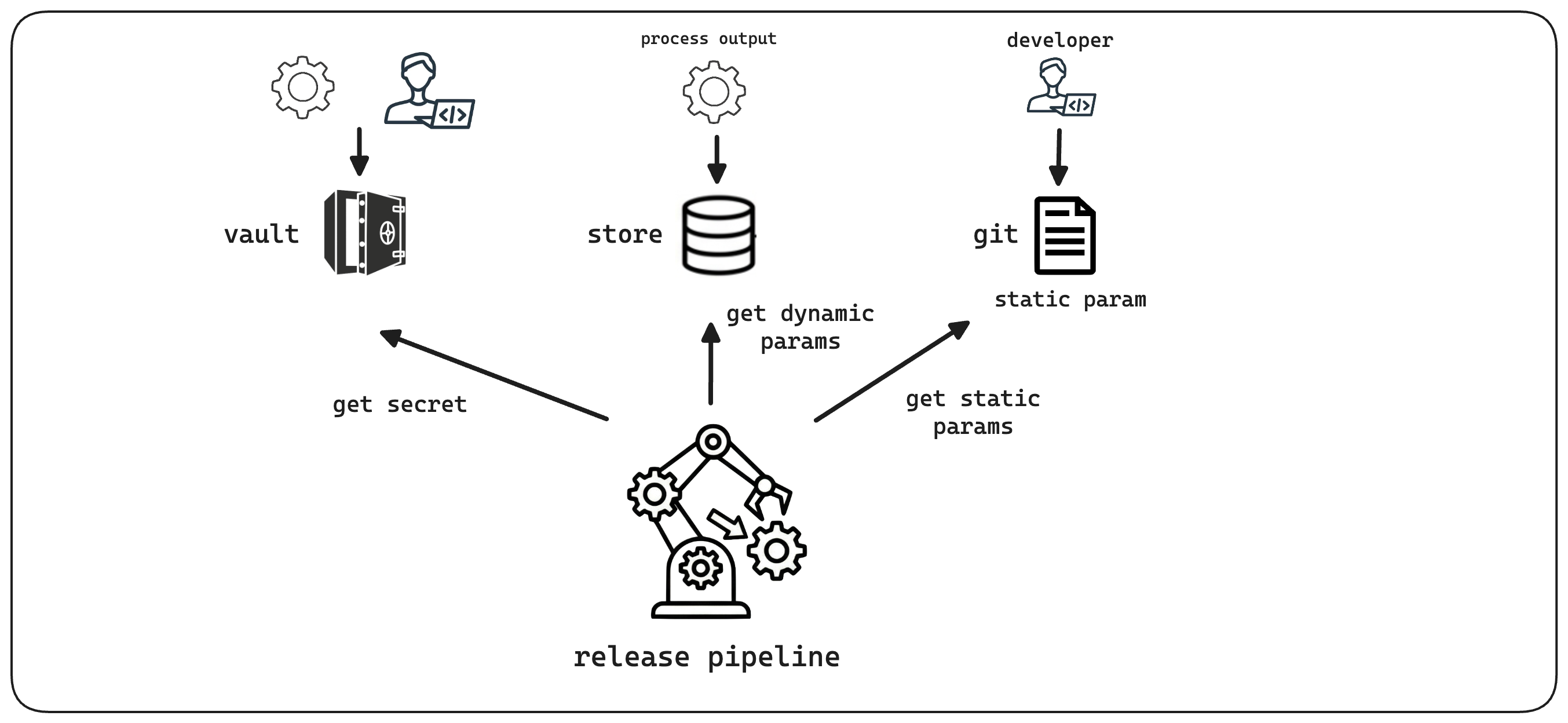
The Unified Configuration Store [The Unified Store]
The ultimate evolution of configuration management is to completely decouple the origin of a parameter from its consumption. By implementing a Unified State Store, we consolidate all three configuration categories—Static, Dynamic, and Secrets—into a single, queryable layer. In this model, Git remains the authoring interface for humans, preserving version history and peer reviews for static parameters; however, a synchronization process immediately replicates these values into the Store upon merge. Simultaneously, infrastructure pipelines inject dynamic values, and security workflows populate the Vault.
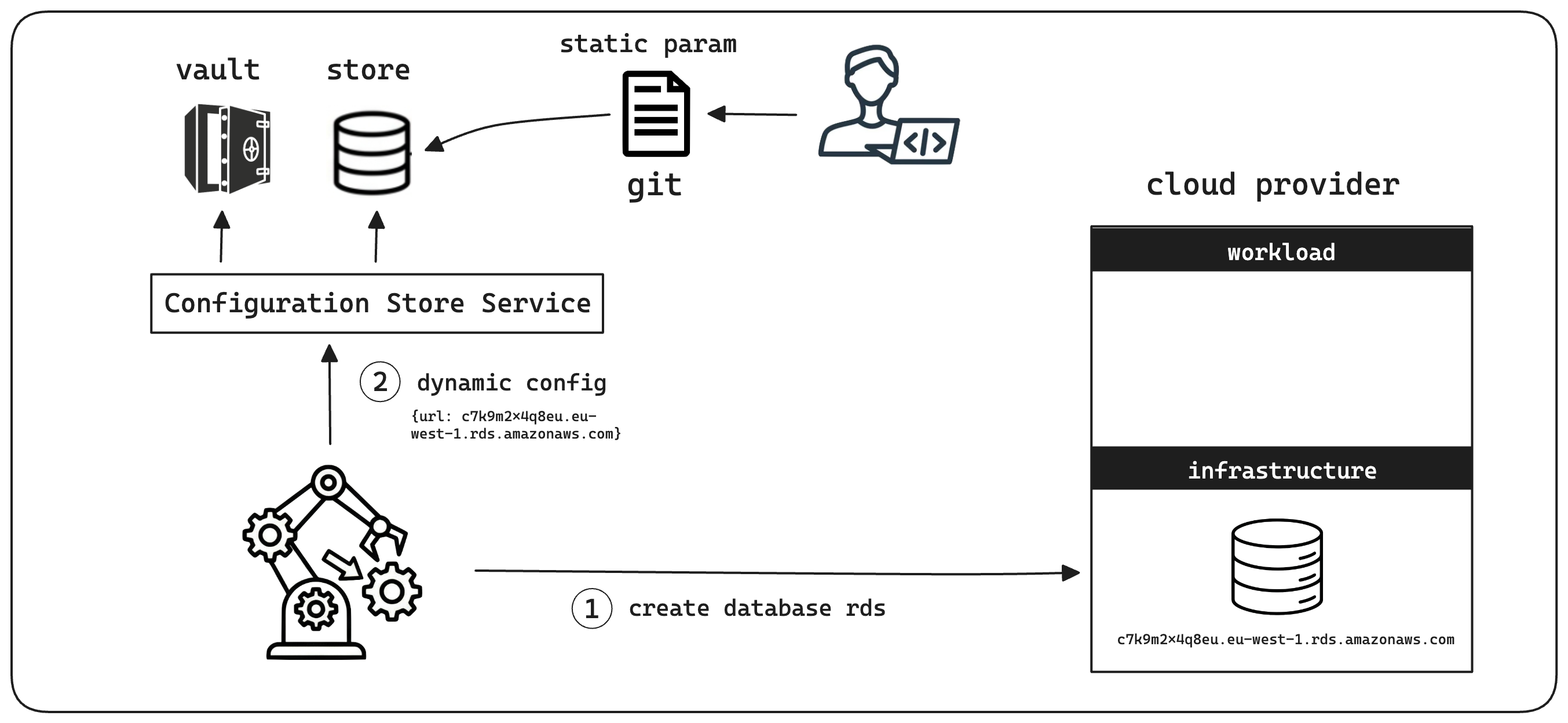
For the release pipeline, this complexity is invisible. It interacts with a single API or abstraction layer to retrieve its entire configuration state, irrelevant of whether a value was typed by a developer in a YAML file, generated by a cloud provider, or encrypted by a security officer.