Design for Testability
Chapter Info
Calculating... Writing Progress: 70%
Testability is an architectural property, not a QA activity added after implementation. The system is shaped so its behavior can be verified continuously and with minimal effort, through clear contracts, controlled inputs, and observable outcomes.
The goal of testability is not to produce more tests. It is to reduce uncertainty about whether a change is safe.
When testability is missing, teams compensate with slow end-to-end setups, fragile fixtures, and manual validation. The cost shows up as flakiness, long feedback loops, and deployments that feel risky. Designing for testability turns verification into a routine capability instead of a recurring project.
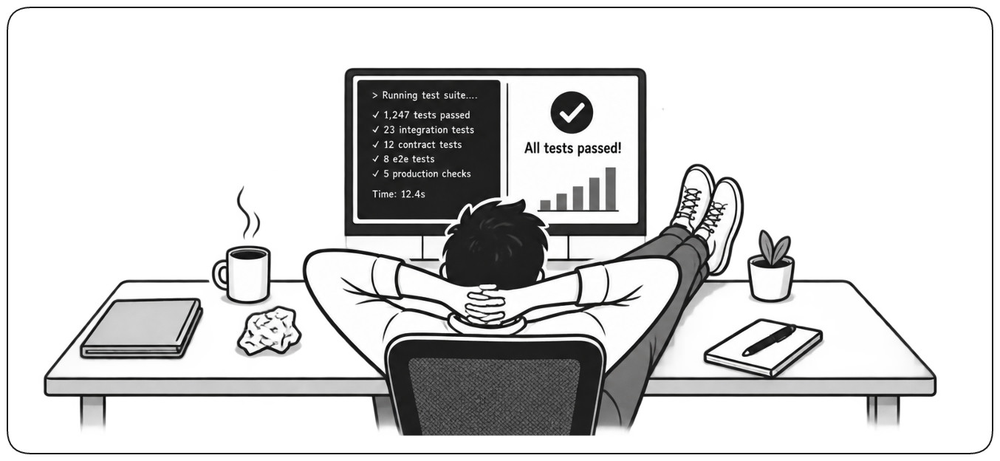
This chapter focuses on how to make software verifiable by construction: design choices that enable isolation, deterministic execution, and meaningful feedback at every level, from unit logic to production validation.
Why Testability Matters [Motivation]
Testability is a multiplier for quality and velocity. When the architecture supports fast, trustworthy checks, teams can refactor safely, ship more often, and detect regressions before users do.
Testability Is an Architectural Property [Architecture] {1}
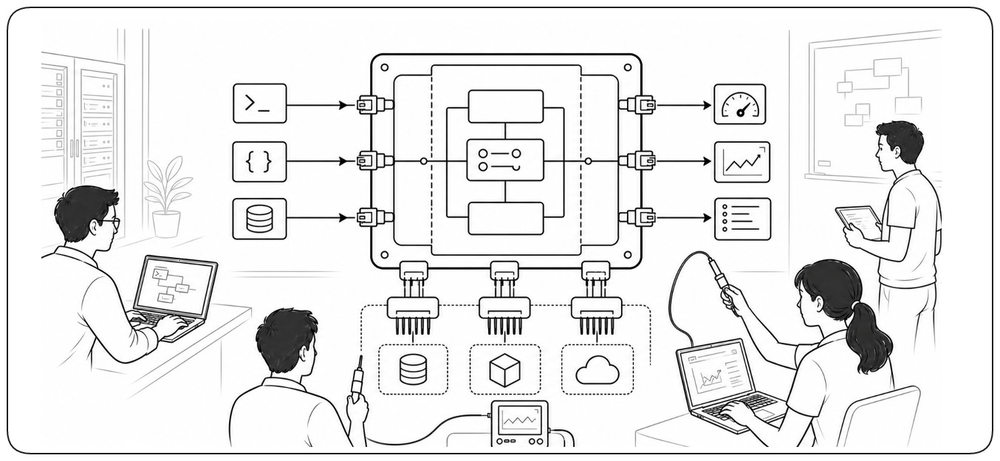
A system is testable when it can be exercised with controlled inputs and its behavior can be observed without guesswork. That requires explicit boundaries, stable contracts, and dependency seams. !!Tests do not create testability; they only take advantage of it.!! When a component is impossible to validate without modification, it is a symptom of tight coupling, not a testing hurdle.
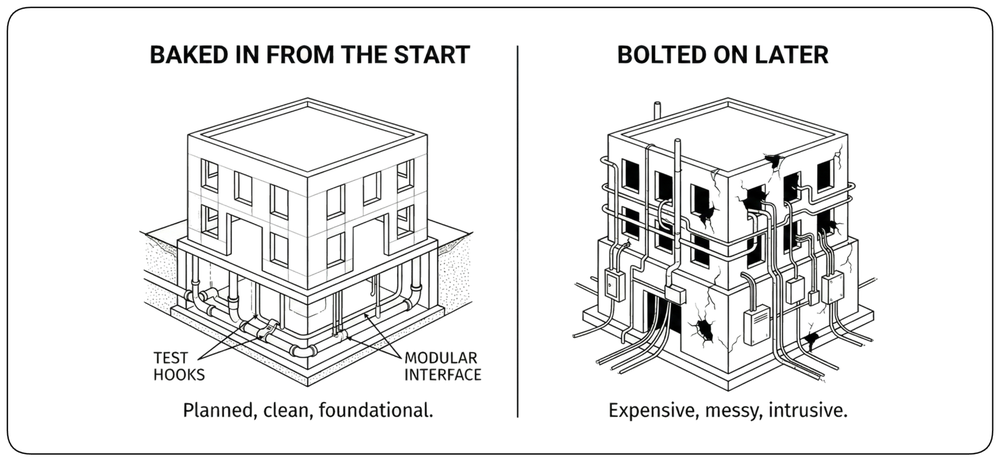
Design for Testability from Day One [Day One]
The structural decisions that make a system testable — clear boundaries, replaceable dependencies, controllable state, observable behavior — cannot be retrofitted cheaply. Design for testability from day one, as a first-class constraint alongside security, scalability, and resilience.
Code Is Not the Spec [Code vs Spec] {1}
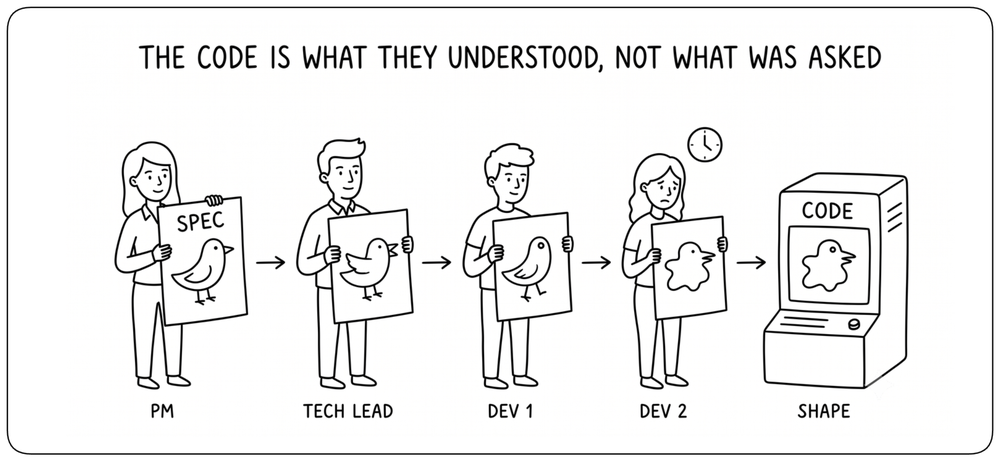
Reading code tells you what a system does, not what it was meant to do. Between the product specification and the running code stands a chain of interpretation: what the PM wrote, what the tech lead heard, what each developer understood, what they had time to build. !!Code is not the specification — it is what the team believed the specification was!!. Reverse-engineering a codebase recovers the developers' understanding, never the product truth, which is why expected behavior must have an independent source of truth: requirements, contracts, SLOs, or other explicit specifications.
Formalize SLOs Explicitly [SLO Testing]
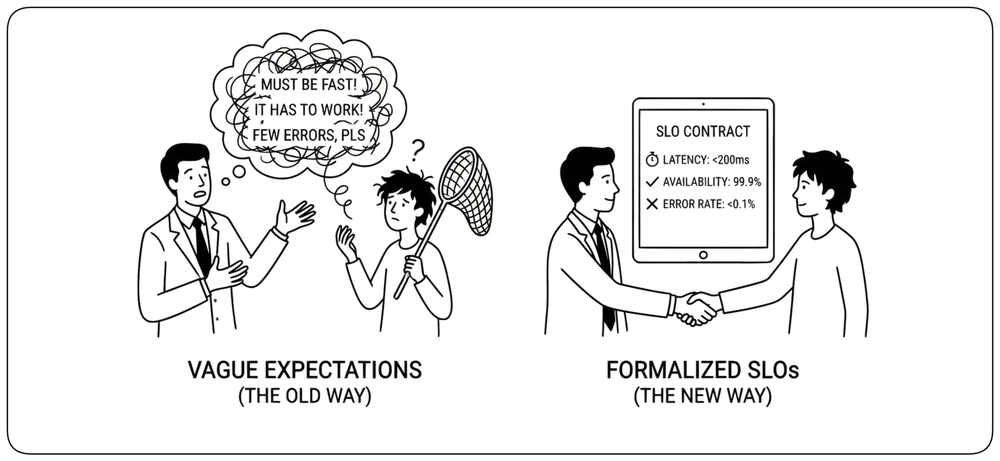
You can't test what you haven't defined. Service Level Objectives (SLOs) turn vague expectations into measurable targets such as availability, latency, or error rates. Each SLO should be verifiable and connected to an explicit contract: if it requires a specific capacity or latency, those requirements should be encoded and verified automatically, so alert thresholds derive from the definition and create a direct line from business requirements to automated validation.
Make the System Lifecycle Visible [Lifecycle]
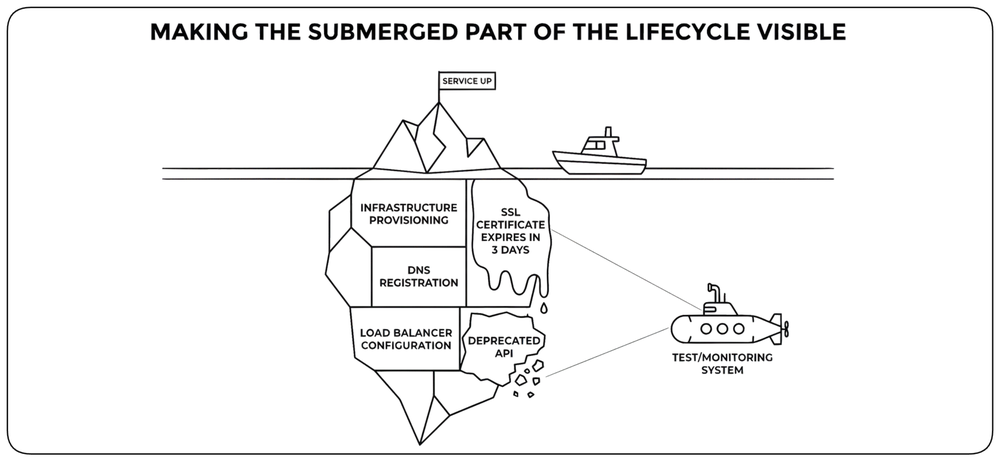
A system is only testable if its lifecycle is observable. When an SLO requires multiple steps to become operational—provisioning, registering endpoints, routing traffic—those steps must be explicit and verifiable. A hidden lifecycle creates hidden test dependencies: a test may fail not because the behavior is wrong, but because the system has not yet reached the state the test assumes. Treat lifecycle drift as a first-class failure mode and build tests that detect when the assumptions your system depends on (model deprecations, certificate expirations) are no longer true, before they fail in production.
Confidence Beats Coverage [Confidence]
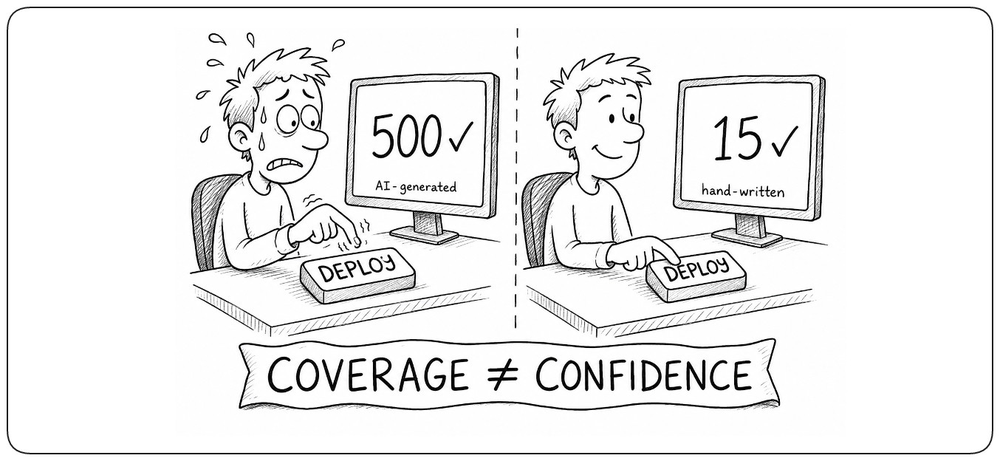
Coverage tells you how much of your code is covered by tests, but high coverage does not mean the important behavior is properly tested. You can have 90% coverage and still be afraid to change the code, because the tests may not catch what you break. The real goal is confidence: when you change something important, will the tests quickly tell you if the system still works as expected? !!Coverage is a measurement. Confidence is the goal.!!
The Value of Fast Feedback [Feedback Loop]
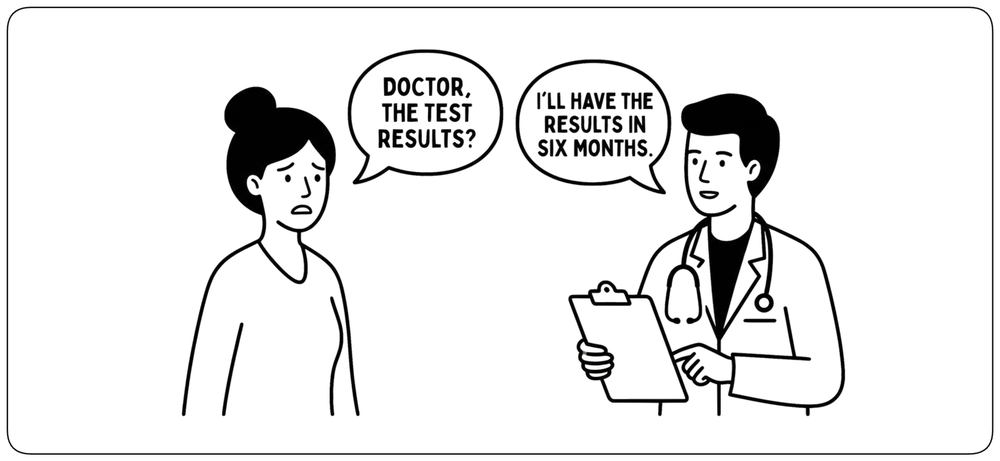
Fast tests change behavior. When validation runs in seconds, developers run it constantly and fix issues at the source; when validation takes an hour, developers defer it, and problems accumulate until they are harder to isolate. Architectural choices determine whether feedback is fast: whether a service can run locally, whether dependencies can be substituted, whether state can be reset cheaply. Testability is the discipline of reducing the cost of verification.
Developer SLO Is Time-to-Confidence [Anxiety as Dev SLO]
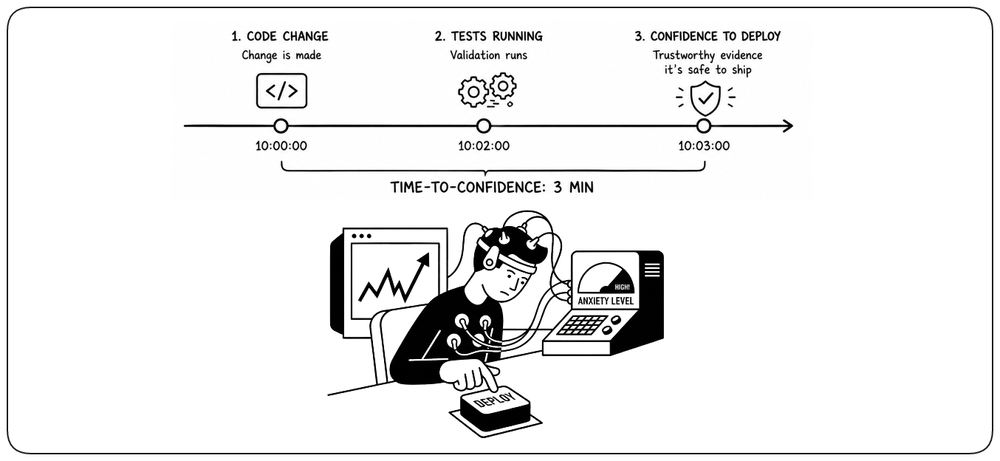
Confidence is only useful if it arrives fast enough to influence the change that produced it. The developer's true SLO is time-to-confidence: how long between a change and trustworthy evidence that it is safe to ship. When this interval is short, deployment becomes routine — a step, not an event. When it stretches, engineers defer changes, batch them, and lose the fine-grained attribution that makes failures cheap to diagnose. !!A test suite creates value only when confidence arrives fast enough to influence the decision to ship.!!
Testability Makes Uncertainty Cheap to Remove [Uncertainty]
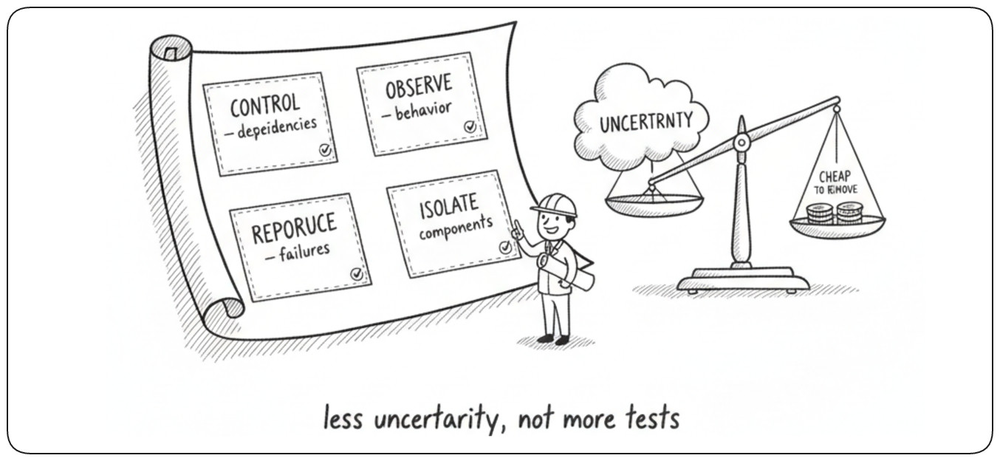
A testable architecture makes uncertainty cheap to remove. Its dependencies can be controlled, its behavior can be observed, its failures can be reproduced, and its components can be verified without rebuilding the entire system. Tests are the mechanism; confidence is the outcome. !!The goal of testability is not more tests. It is less uncertainty.!!
Architectural Foundations of Testability [Foundations]
Design for testability by making dependencies explicit, outcomes observable, and execution repeatable. The goal is to verify behavior without rebuilding the world.
The Two Sides: Controllability and Observability [Two Sides] {1}
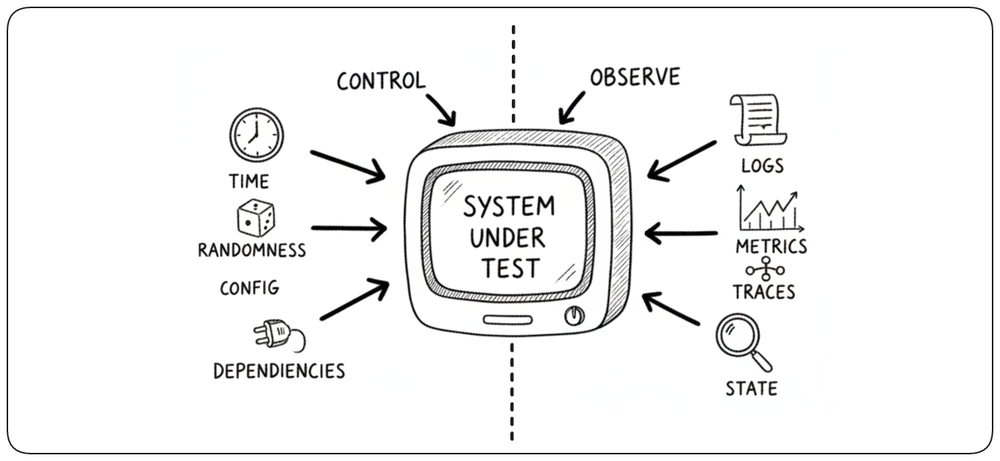
A system is testable when we can both control its conditions and observe its behavior. !!Controllability lets us establish state, time, configuration, dependencies, and failures. Observability lets us determine what happened and why.!! Without control, scenarios cannot be reproduced. Without observation, outcomes cannot be verified. Every technique that follows — dependency injection, side-effect isolation, tracing, test hooks — is ultimately a way to sharpen one of these two axes.
Clear Contracts and Stable Boundaries [Contracts] {1}
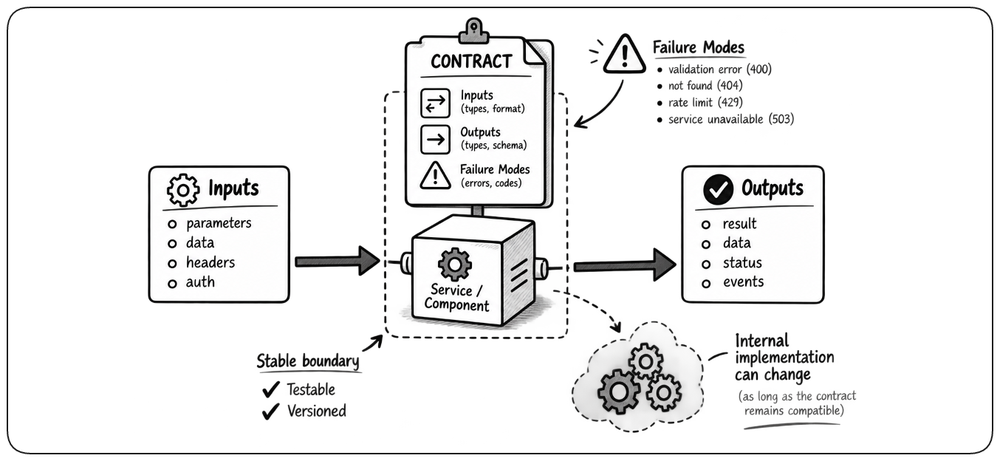
A boundary is testable when it has a clear contract: inputs, outputs, and failure modes are explicit. !!Contracts turn integration into something that can be validated and versioned rather than discovered through runtime accidents.!! Good contracts make tests more resilient because they focus on behavior instead of internal implementation details, and they enable parallel work across teams: changes are safe as long as the contract remains compatible.
Isolate Side Effects Behind a Boundary [Side Effects]
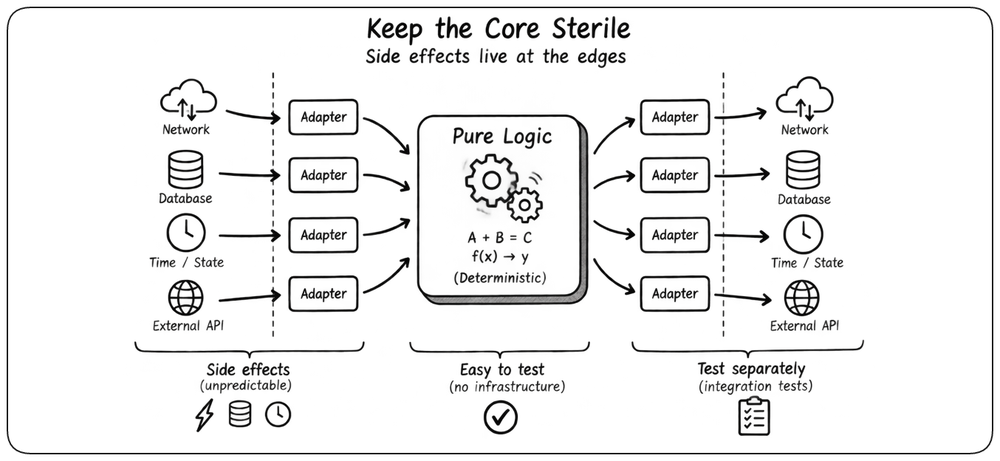
Side effects make tests harder. Network calls, database writes, global state, and time can all introduce unpredictable behavior. Keep the core logic simple and deterministic, and move these side effects behind adapters. This allows most of the system to be tested quickly without infrastructure, while adapters can be tested separately.
Dependency Injection for Easier Testing [Injection] {1}
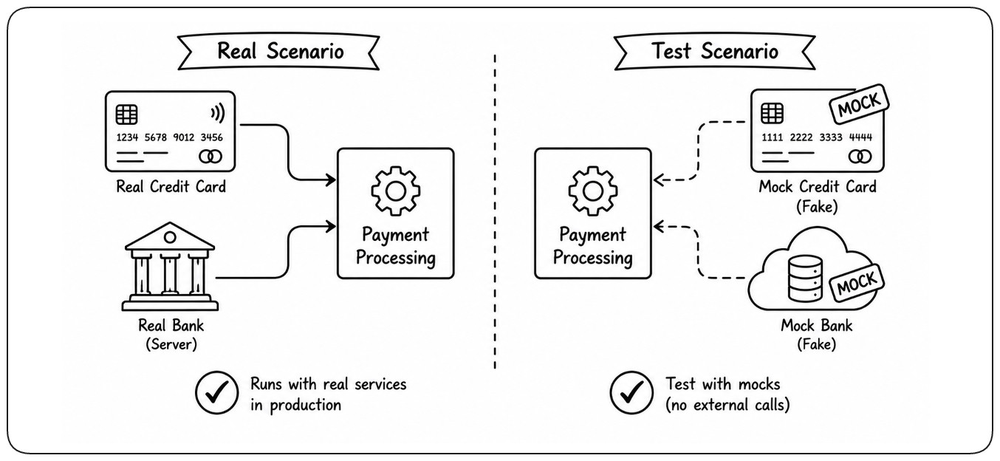
Dependency injection makes dependencies explicit and replaceable. Instead of creating an HTTP client, database connection, or clock internally, a component receives them. !!In tests, those dependencies can be substituted with deterministic doubles.!! This preserves speed and predictability while still validating the business logic, and it improves architecture by forcing a separation between core behavior and infrastructure mechanics.
The Limits of Mocking [Limits of Mocking]
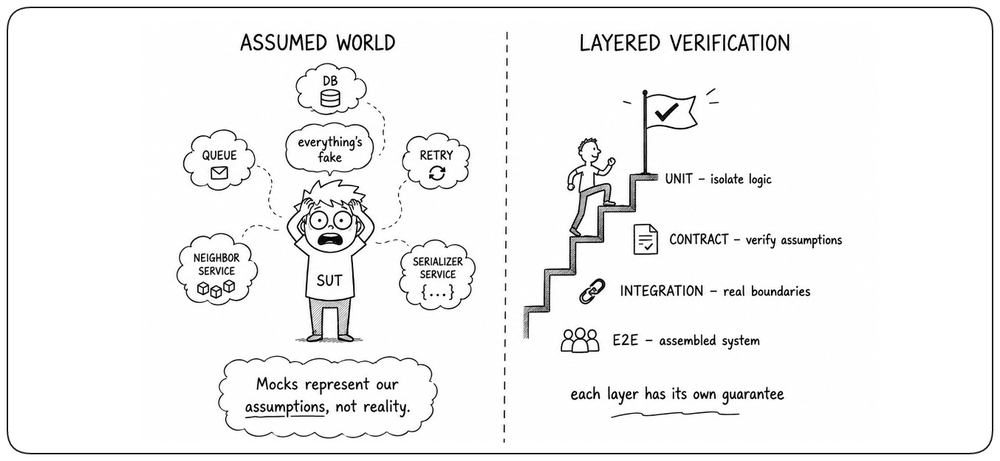
Mocks are useful for isolating logic and keeping tests fast, but they have an important limitation: a mock represents our assumption about how a dependency behaves, not the dependency itself. A test can pass even when that assumption no longer matches reality. The more dependencies we mock, the further the test can drift from the real system. This is why mocks must be complemented by contract, integration, and end-to-end tests that verify those assumptions against real components and boundaries. !!Mocks verify assumptions. Other test layers verify those assumptions against reality.!!
Make Tests Reproducible [Reproducible] {1}
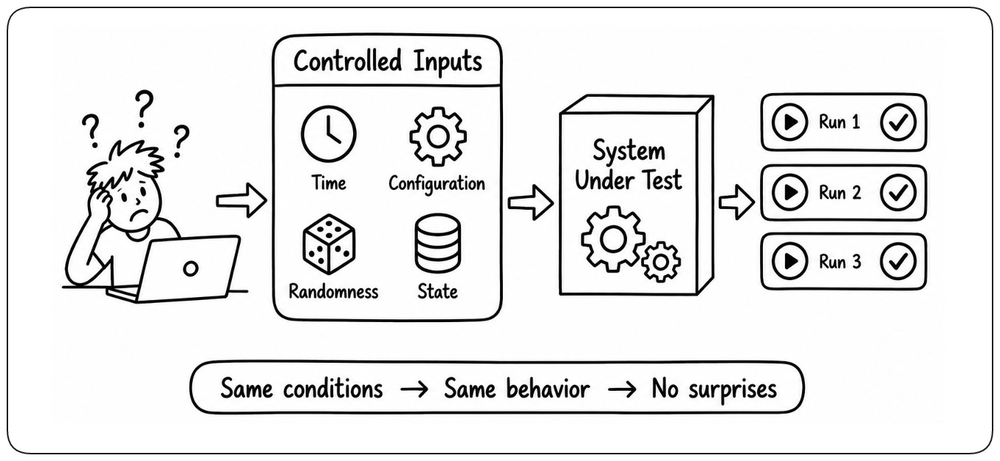
A test is trustworthy only if the same conditions produce the same behavior. !!Control everything that can vary between runs — time, configuration, randomness, state, and external dependencies!! — so the scenario itself is stable and reproducible.
Capture Failures So They Can Be Replayed [Replay Failures]
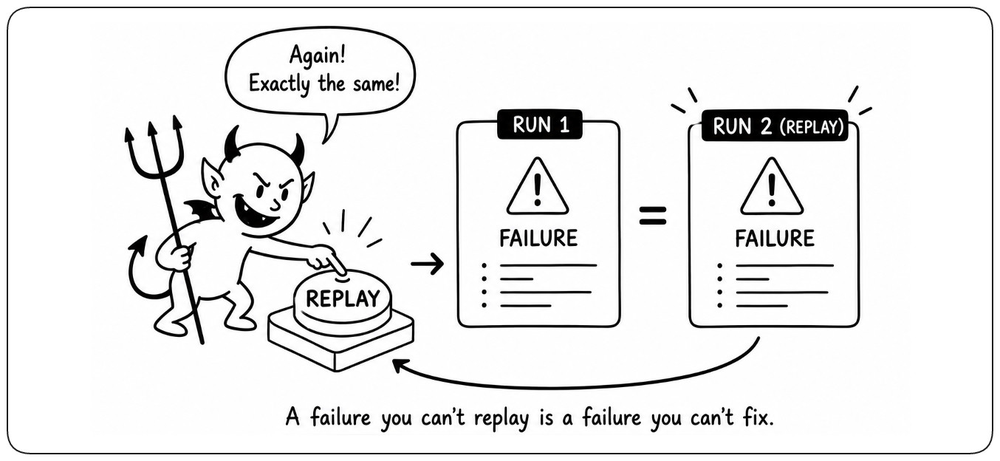
When a test fails, reproducibility becomes a different problem: preserving enough evidence to recreate what happened. Capture the inputs, random seed, dependency versions, environment state, correlation IDs, and relevant event sequence. The goal is not to prevent variation anymore, but to make the failed execution replayable after the fact. !!Before the test: control the conditions. After a failure: preserve the evidence.!!
Make Test Execution Idempotent [Idempotent Execution]
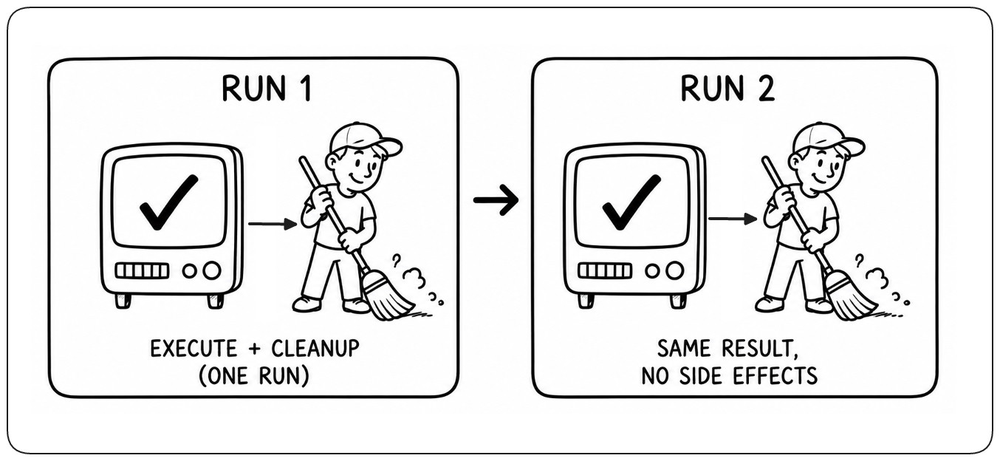
Tests should leave the system exactly as they found it. They must be safe to run repeatedly, sequentially, or in parallel, without one execution affecting another. Setup, execution, and cleanup should therefore be isolated and repeatable, so running the same test twice has no more impact than running it once. !!Running a test twice should have the same effect as running it once.!!
Keep Tests Isolated [Isolation]
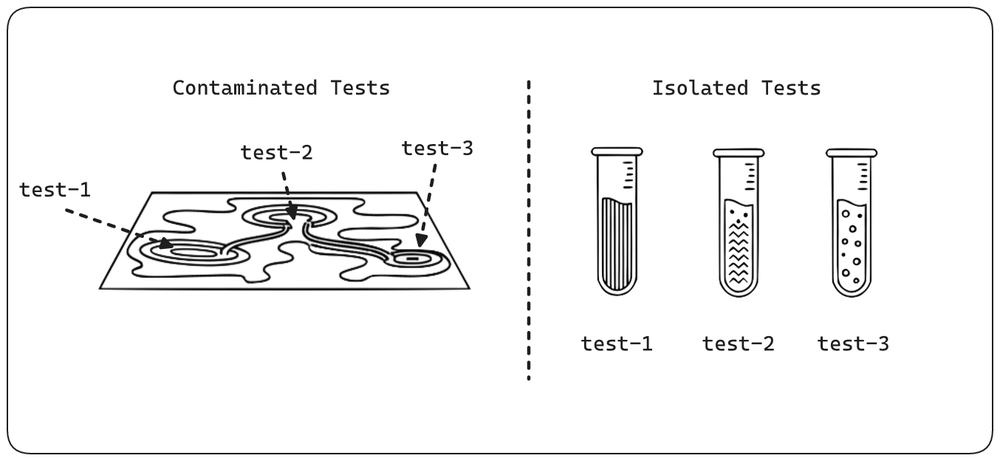
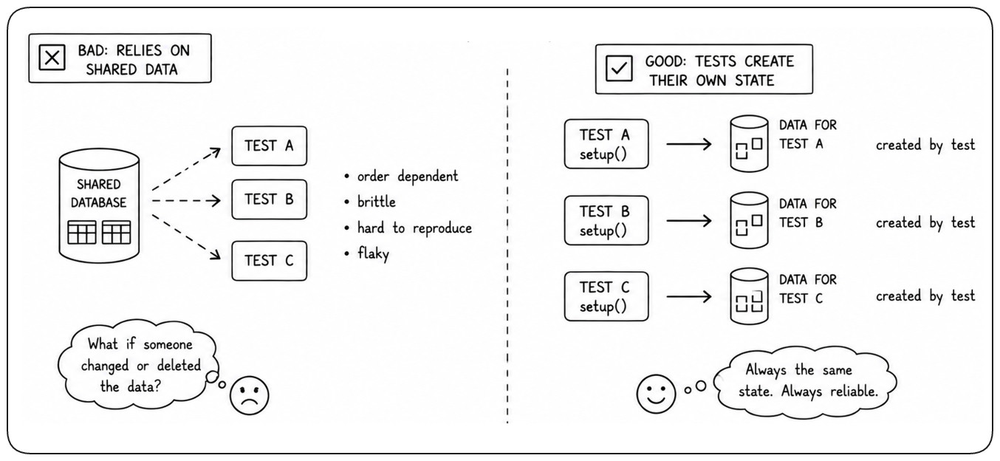
Tests often run in parallel against the same system. If they share users, records, queues, files, or resource names, one test can change the state another test is relying on — even if both clean up correctly afterward. !!Each test should therefore own its data and resources, using isolated datasets, unique identifiers, or dedicated namespaces.!!
Create the Data Your Tests Need
Tests that depend on data should create or seed the state they need automatically rather than rely on pre-existing shared data. The required users, records, configuration, or fixtures should be part of the test setup so the scenario starts from a known state and can run repeatedly in any environment. Test data is part of the test, not a hidden dependency of the environment.
Testing and Observability Work Together [Testing the Why] {1}
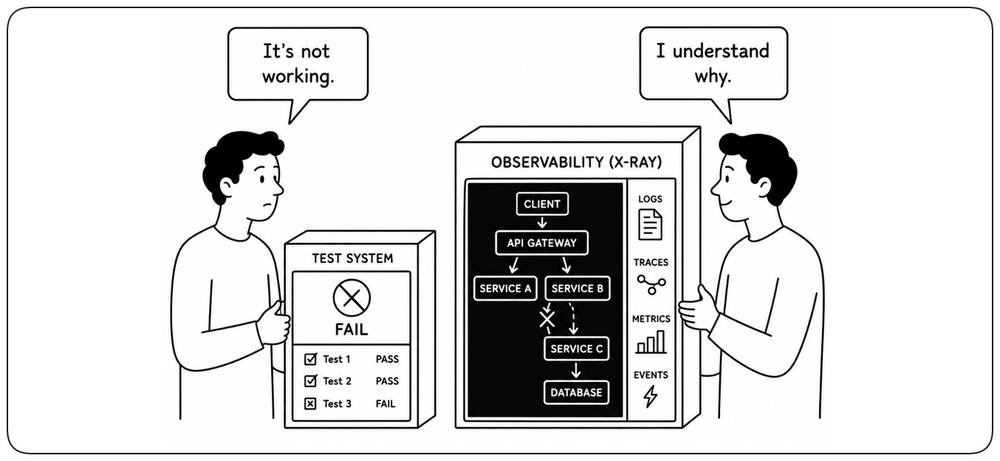
Testing and observability provide two complementary views of system behavior. !!Tests verify whether the system behaved as expected; observability helps explain what actually happened and why.!! Logs, metrics, traces, and observable state make failures easier to diagnose and can also verify important architectural behavior, such as which services were called or which path a request followed. Together, they turn a simple pass or fail into evidence that developers can understand and act on.
Design the System to Make It Testable [Design for Testing]
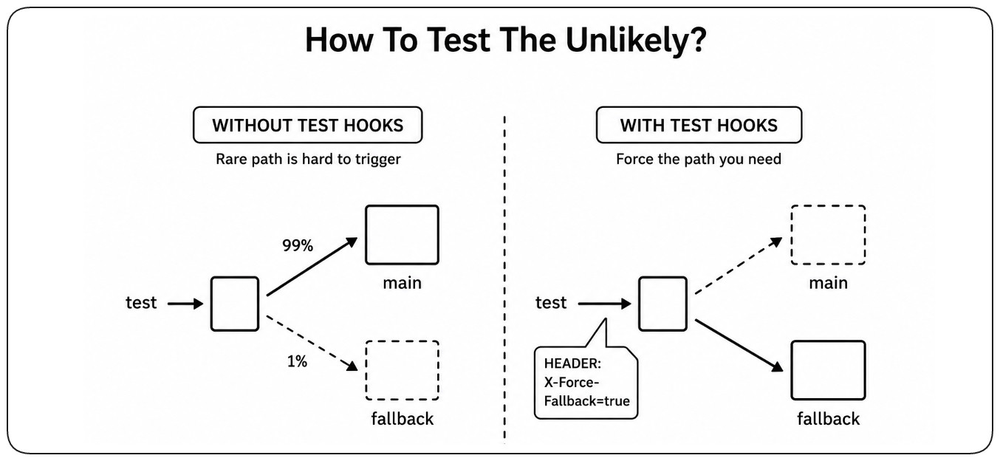
Some behaviors are difficult or unreliable to test from the outside. In those cases, testability may require deliberate changes to the design: controlled fault injection, deterministic modes, debug endpoints, or other test hooks. The architecture should provide safe ways to control conditions that would otherwise be rare, unpredictable, or inaccessible. These mechanisms must be carefully guarded, but the principle is broader: !!sometimes making software testable means designing it to be tested.!!
Test Strategy for Building Confidence [Strategy]
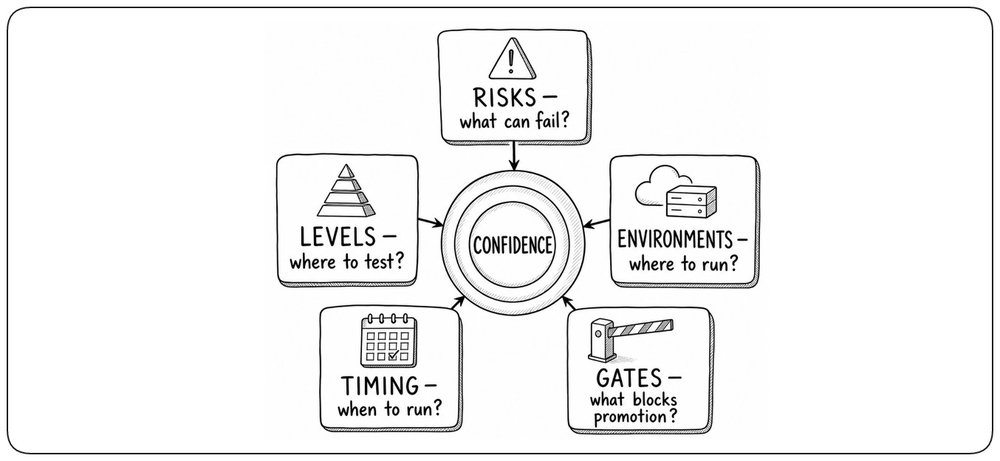
It is impossible to test everything. A test strategy therefore decides which risks matter, which test level can expose each risk, which environment is needed, when each test should run, and which failures should block promotion. The goal is not exhaustive testing, but enough confidence with limited time and resources.
A Strategy Connects Several Decisions [Strategy Dimensions]
A list of tests is not a strategy. A strategy connects each important risk to a test level, an environment, a moment, and a release decision. !!Start with the risk, then choose the cheapest credible evidence.!!
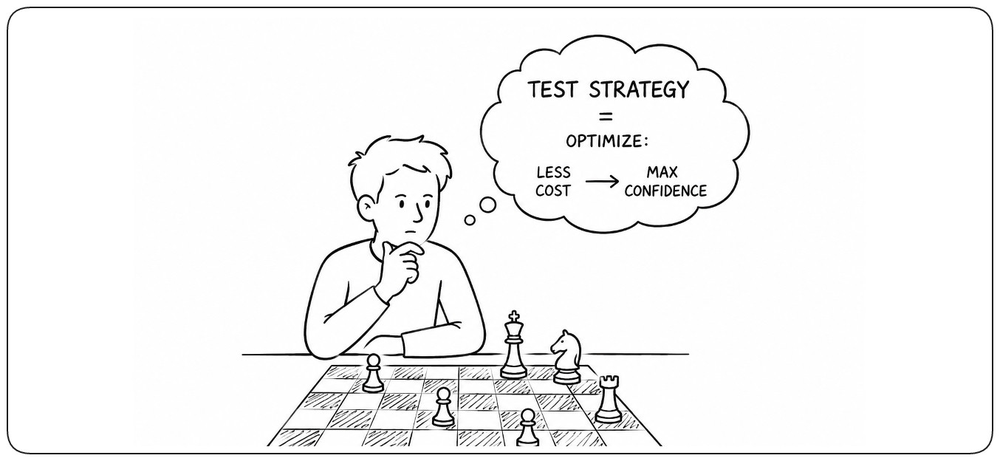
Test Strategy Is an Optimization Problem [Optimization Problem] {1}
A test strategy is not about maximizing the number of tests. !!It is about assigning each risk to the cheapest test capable of detecting it reliably.!! The strategy is successful when important risks are covered without paying for more verification than they require.
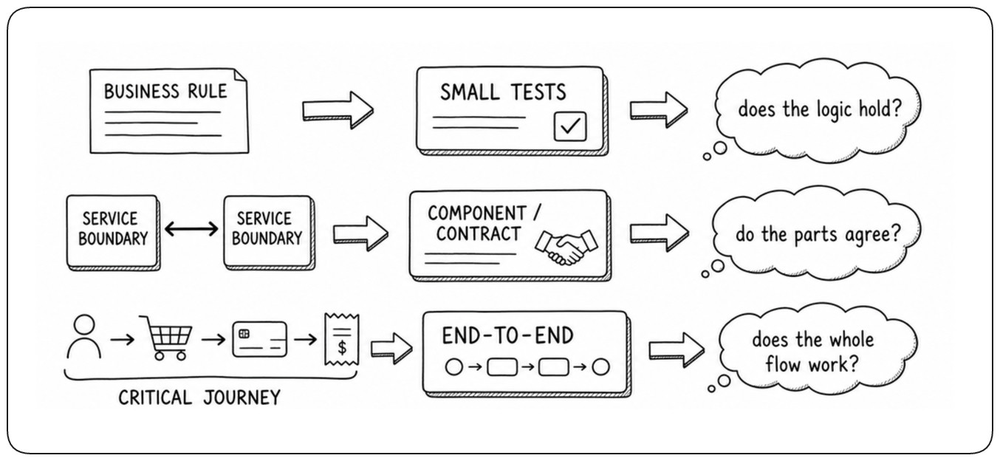
Different Risks Need Different Test Levels [Test Levels]
Use small tests for business rules, component or contract tests for boundaries, and end-to-end tests for critical journeys. Do not repeat the same assertion at every level. !!Use the lowest level that can catch the risk, and broader tests only for risks that appear when parts work together.!!
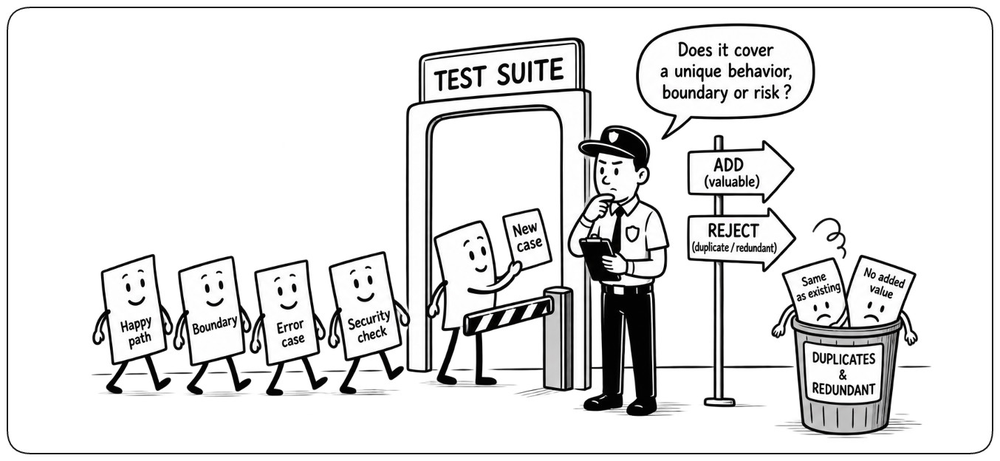
Every Test Case Must Earn Its Place [Case Selection] {1}
Good test selection is not about adding more examples; it is about choosing cases that reveal different behaviors. Group inputs that should behave the same, then pick one representative from each group. Pay special attention to boundaries, where behavior changes and defects concentrate. !!Every test case should cover a behavior, boundary, or risk that no other case already covers.!! A smaller, intentional suite usually provides more confidence than a large collection of redundant examples.
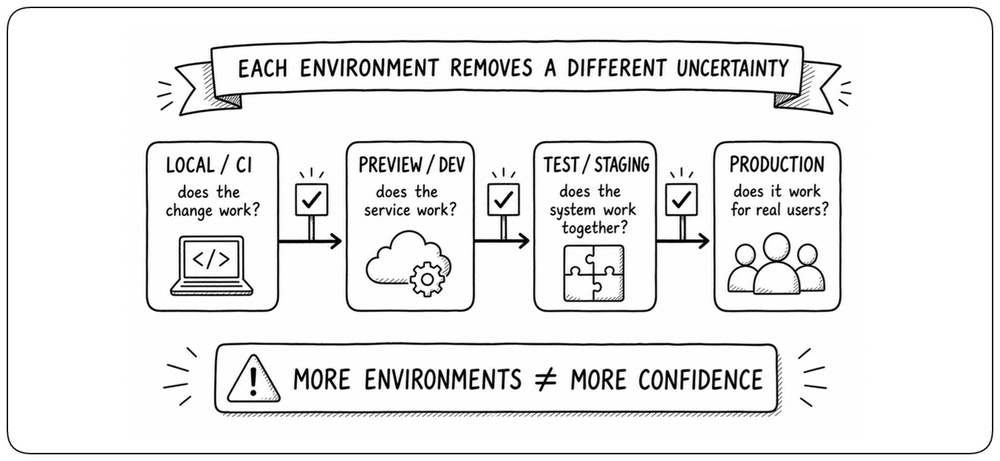
Each Environment Must Remove a Different Uncertainty [Environment Strategy]
A test level says what part of the system is checked; an environment says where the test runs. Local and CI expose problems in the change, preview or development checks the service, staging checks the assembled system, and production checks real routing, permissions, and integrations. !!More environments add confidence only when each answers a different question.!!
Testing Follows the Delivery Lifecycle [Test Timing]
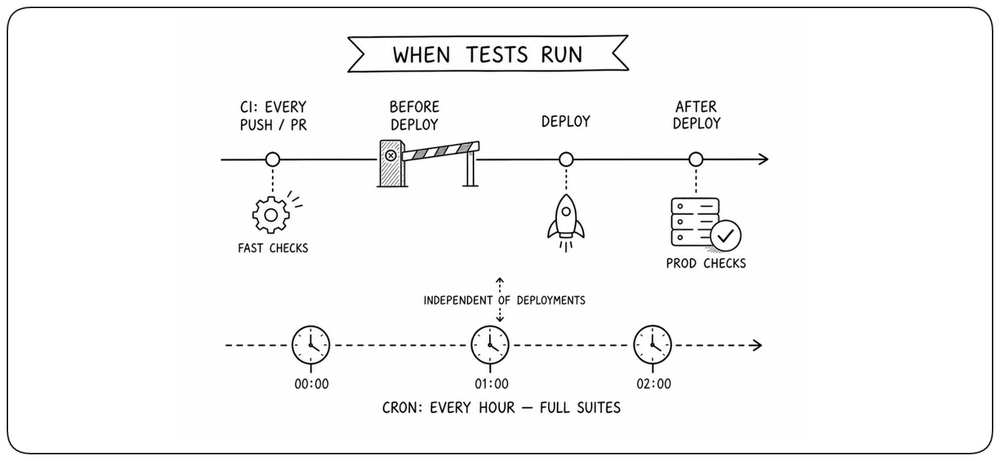
Tests run in CI on each change, before promotion as release gates, after deployment to validate the new environment, and continuously or on a schedule between deployments. These moments are complementary because each reveals different failures. !!Choose the test that can remove uncertainty at that moment.!!
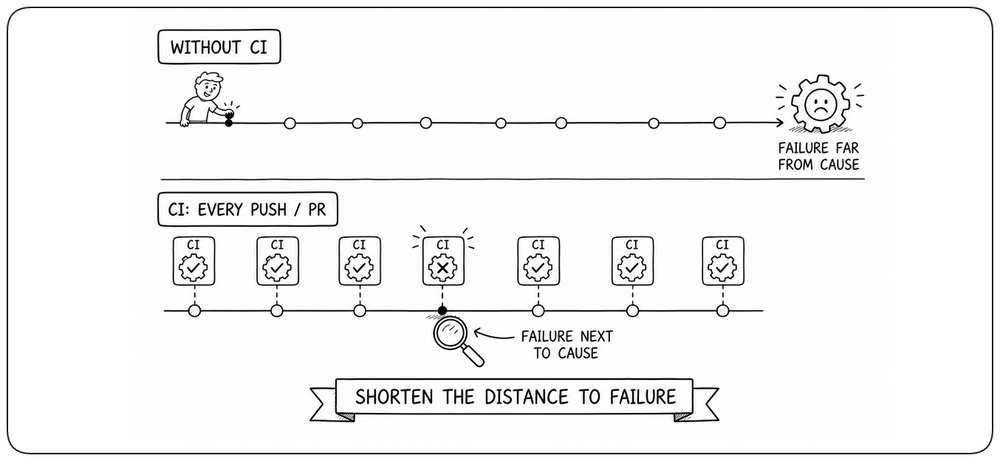
Find Problems Close to the Change [Fast Feedback]
In CI, run fast and reliable tests on every push or pull request. A failure found immediately is easier to link to the change that caused it and cheaper to fix. Broader tests can follow, but the first useful signal should arrive within minutes. !!Shorten the distance between the change and the failure.!!
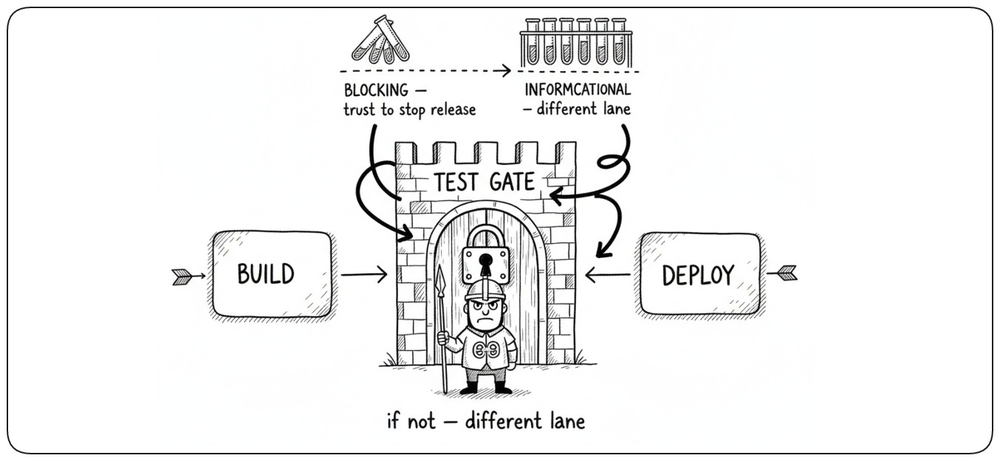
Before Deployment, Use Trusted Gates [Blocking Tests] {1}
Only trusted, critical tests should block a deployment. Ask: !!would we stop a release for this failure?!! If not, run the check in another lane. Load tests, exploratory suites, and informational scans still matter; they should not make every deployment wait. Put the release gate around risks such as security, billing, and data integrity.
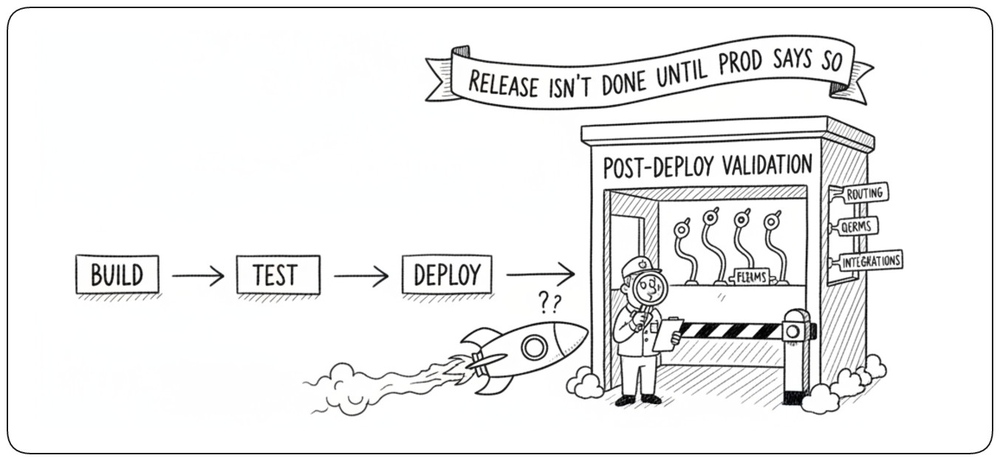
After Deployment, Test What Only the Environment Can Reveal [Post Deploy]
Some problems appear only after deployment: routing, permissions, quotas, and real third-party integrations. !!Deployment is not the end of testing; it makes a new kind of test possible.!! Include these checks in the release process, rather than discovering them later through monitoring or users.
Keep Testing Between Deployments [Scheduled Tests]
Some failures appear over time or without a new deployment. Run expensive suites on a schedule, keep small production checks running continuously, and trigger broader tests when a relevant dependency or configuration changes. !!A quiet delivery pipeline does not mean the system has stopped changing.!!
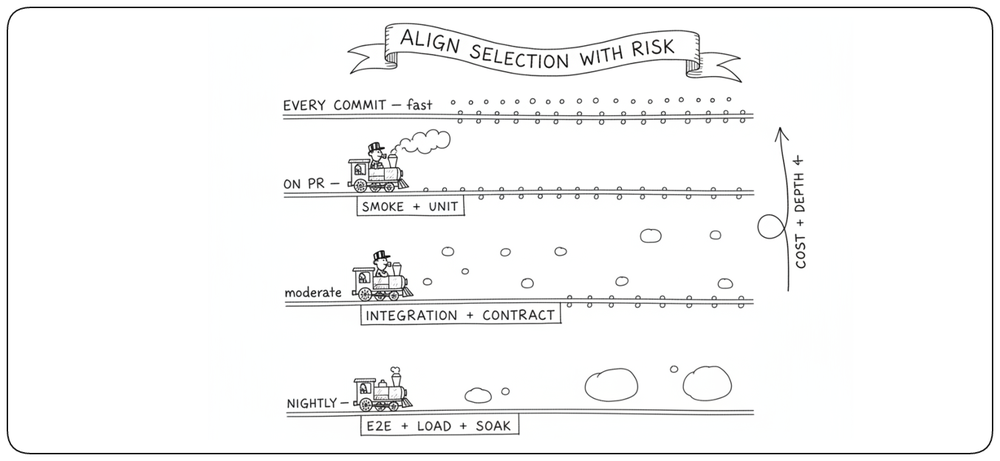
Test Types and Techniques [Test Types and Techniques]
Strategy decides what evidence is needed. Test types are the tools used to produce that evidence. Each one answers a different question, and several can be combined when a risk crosses more than one boundary.
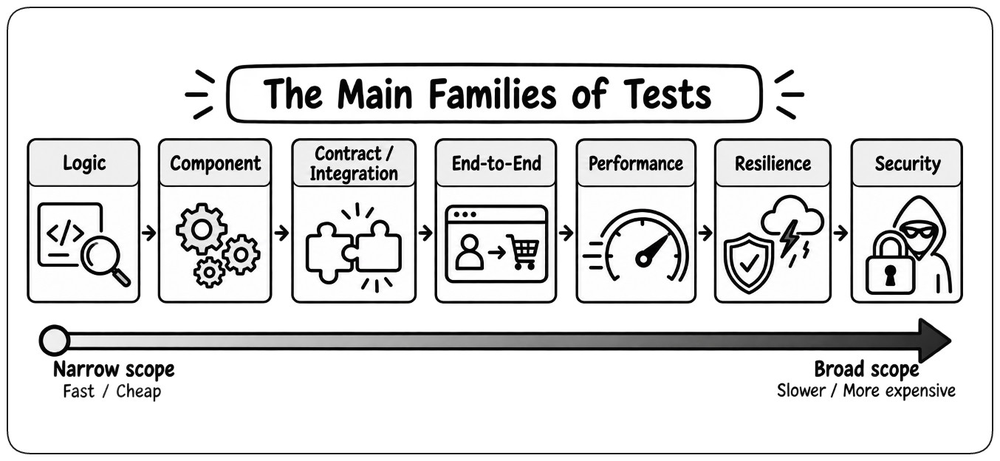
The Main Families of Tests [Test Families]
Tests operate at different levels and target different kinds of risk. Some verify isolated logic, others validate components and their boundaries, complete user workflows, performance under load, resilience to failure, or security against hostile behavior. !!Understanding these families provides a map of the testing landscape before deciding which specific test type to use.!!
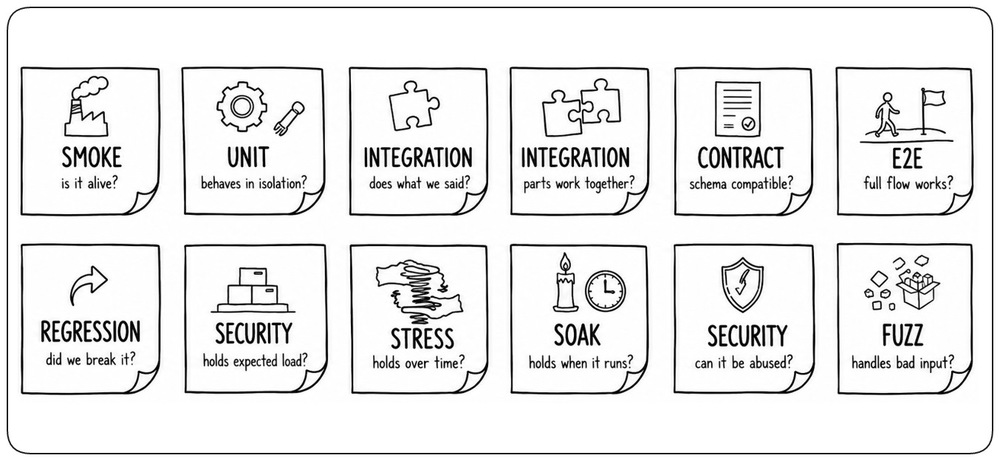
Each Test Type Answers a Different Question [Test Types]
Every test type answers a different question and targets a different risk. Smoke checks liveness, unit checks isolated behavior, contract checks interface compatibility, load and stress check capacity limits, fuzz and security check hostile inputs. !!A test type is valuable because of the question it answers, not because it exists in the suite.!!
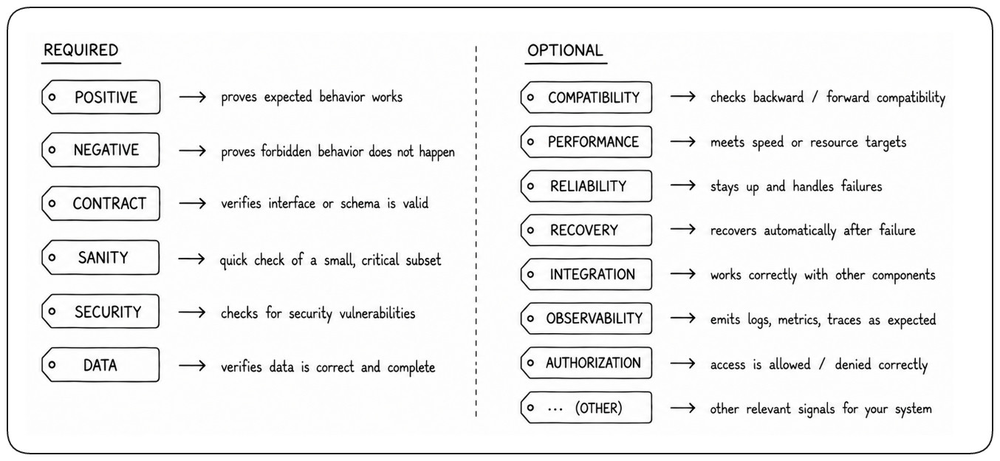
Make Test Signals Explicit [Test Signals]
A test should make clear what behavior, contract, or risk it protects. Tags or metadata can describe the signal it provides — for example, that an expected behavior is present, a forbidden behavior is absent, or a service contract remains valid. Explicit signals make tests easier to understand, select, route, and act on. At organizational scale, they also enable enforcement: teams can define which signals every service must provide and automatically verify that service owners maintain the required tests. When a signal represents a shared guarantee, its ownership should be explicit so someone remains responsible for keeping it meaningful and trustworthy.
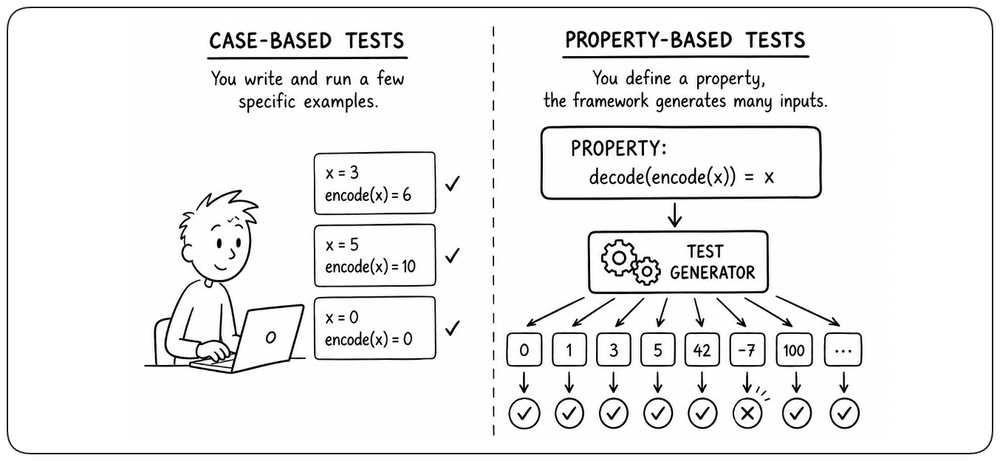
Assert Rules, Not Just Cases [Property-Based Testing]
Traditional tests usually check a set of examples chosen by the developer. Property-based testing goes further: instead of hardcoding every case, you define what must remain true and let the framework generate many different inputs automatically. For example, encoding and then decoding should return the original value, and sorting should preserve the number of items. !!Instead of testing only the cases you thought of, property-based testing explores many cases you did not choose manually.!!
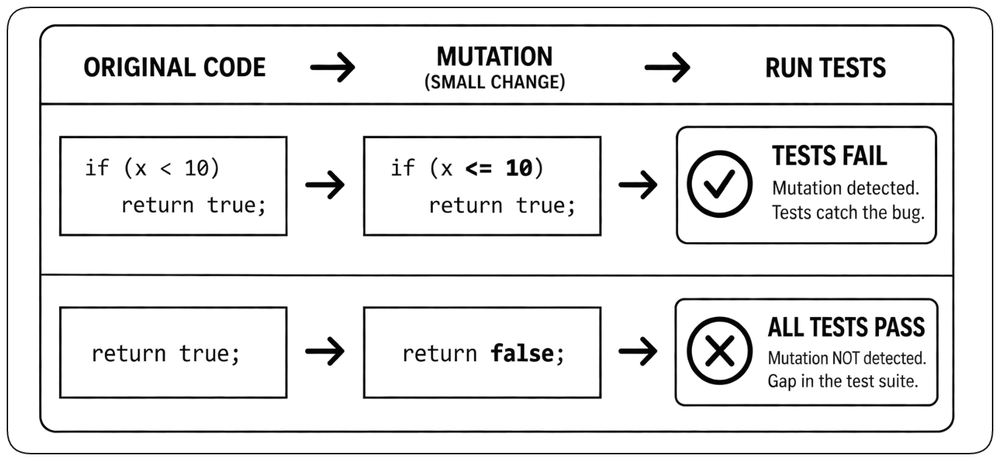
Mutation Testing: Break the Code to Check the Suite [Mutation Testing]
Mutation testing checks whether your tests can actually detect bugs. It deliberately introduces small changes into the code and runs the test suite again. If a test fails, the mutation was detected. If the tests remain green, the suite may be missing an important check. !!Mutation testing asks a simple question: if the code were wrong, would the tests notice?!! Because it is expensive, use it mainly where undetected bugs would matter most.
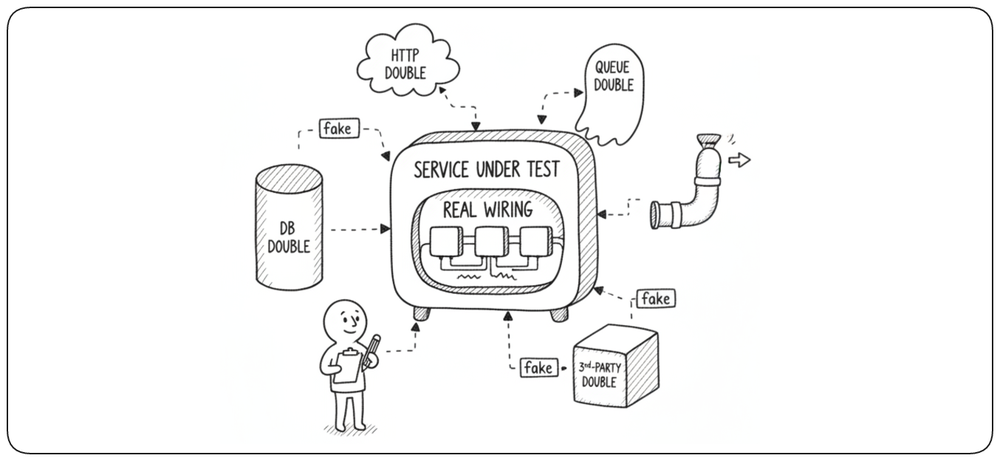
Test Components Without the Full System [Component Tests] {1}
A component test runs a service as a whole, without starting the rest of the system. Its real internal wiring is used, while external dependencies — such as databases, queues, and other services — are replaced with controlled doubles. !!If testing one service requires deploying ten others, its boundary is not isolated enough.!! This gives strong confidence in the service without the cost and complexity of a full end-to-end environment.
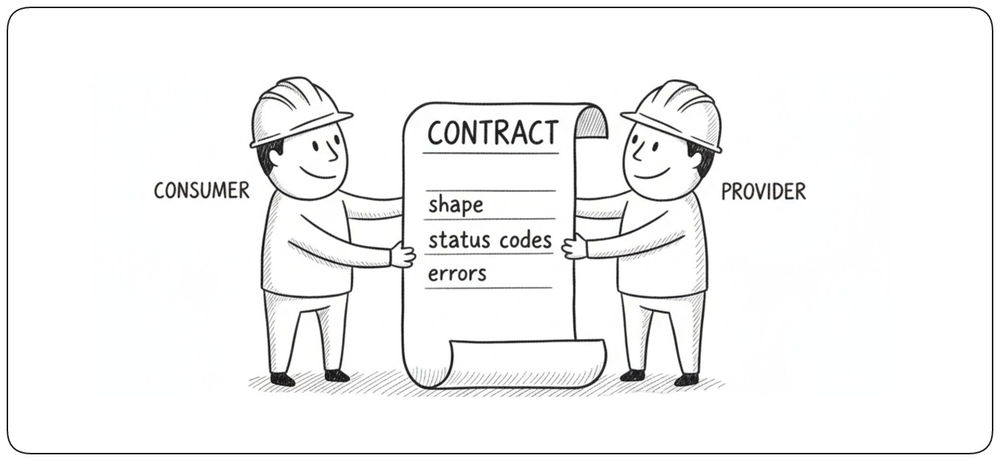
Contract Tests Protect Interfaces [Contract Tests]
A contract test checks that two services still understand each other. It verifies what one service expects from another: the request, the response, and possible errors. This catches breaking changes early — without deploying both services together. Teams can change their services independently, knowing the interface still works.
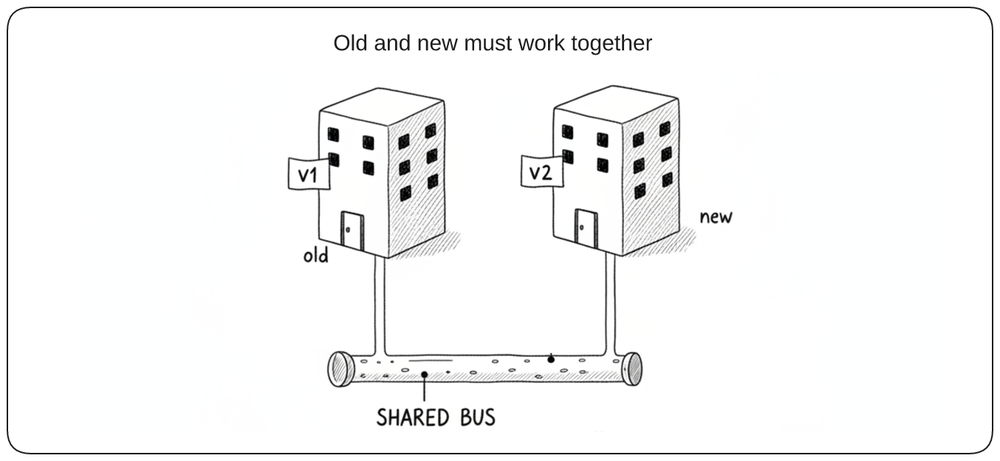
Make Old and New Work Together [Version Compatibility]
Distributed systems are rarely upgraded all at once. During a rollout, old and new versions run side by side. Test compatibility across APIs, events, schemas, and stored data while that transition is happening. A change is not safe just because the new version works on its own; it must also work alongside the old one.
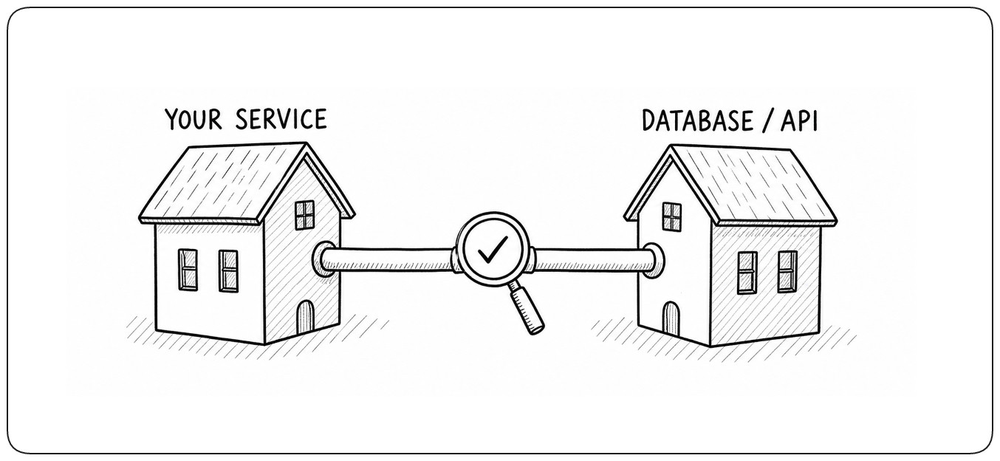
Test Where Components Meet [Integration]
Integration tests check where your code meets another component — such as a database, a queue, or an external API. Keep each test focused on one boundary. When it fails, you should know exactly where to look.
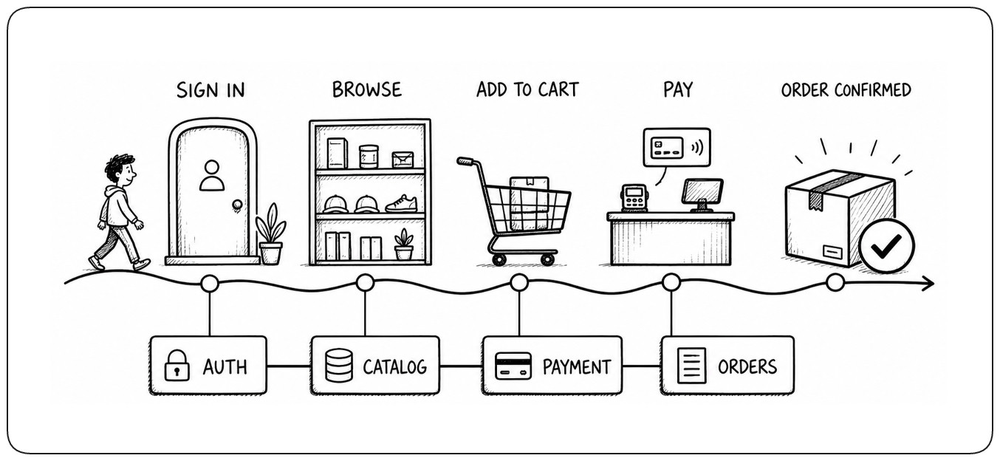
End-to-End Tests Validate Real User Journeys [E2E] {1}
End-to-end tests check that the entire system works from a user’s first action to the final result. Use them for the journeys that matter most—such as signing up, paying, or placing an order. !!They reveal problems that only appear when several parts of the system work together.!! When one fails, smaller tests help identify the cause.
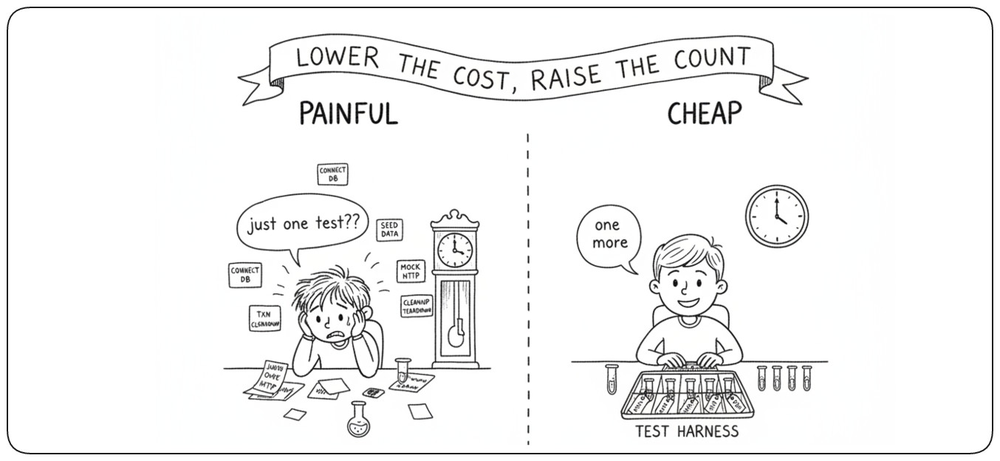
Make Large Tests Cheap to Write [Test Ergonomics]
When integration and end-to-end tests are hard to write, teams skip important scenarios. Do not make developers rebuild setup, test data, cleanup, and teardown for every test. Shared test tools make useful scenarios easier to add. !!Lower cost allows broader testing, but each new test must cover a different risk.!!
Testing Asynchronous Systems [Async Testing]
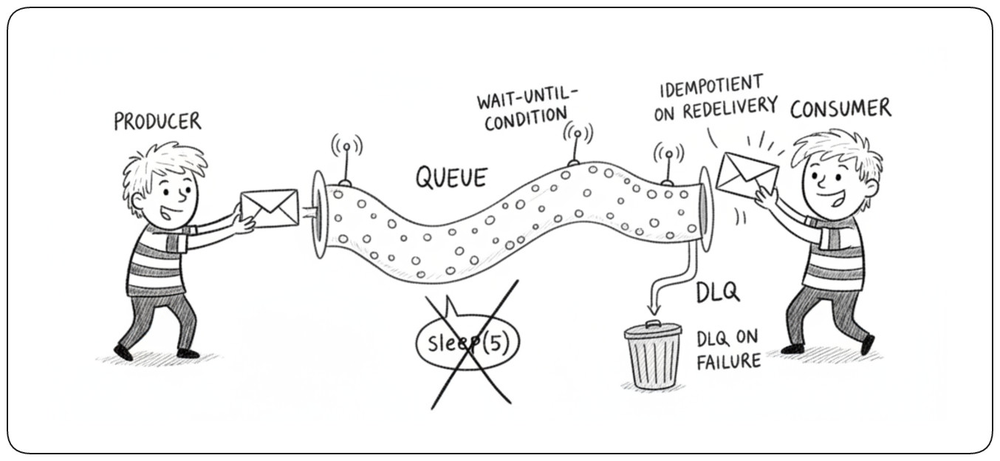
Asynchronous systems pass work between services using messages and queues. The result is not always available straight away. !!Do not wait a fixed number of seconds and hope it is done.!! Instead, wait for a clear result, such as an order being created or a message reaching the error queue. Also test what happens when messages arrive twice, arrive in the wrong order, or keep failing.
Test Performance Over Time [Performance]
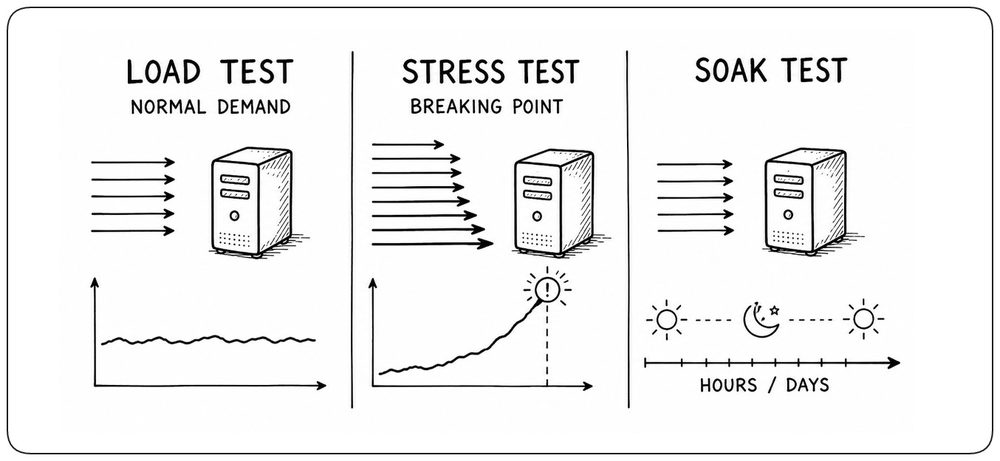
Performance tests answer three questions: can the system handle normal demand, what happens under extreme demand, and does it remain healthy over time? !!Load tests check normal use. Stress tests find the breaking point. Soak tests reveal problems that appear only after hours or days of sustained use.!!
Test How the System Handles Failure [Chaos]
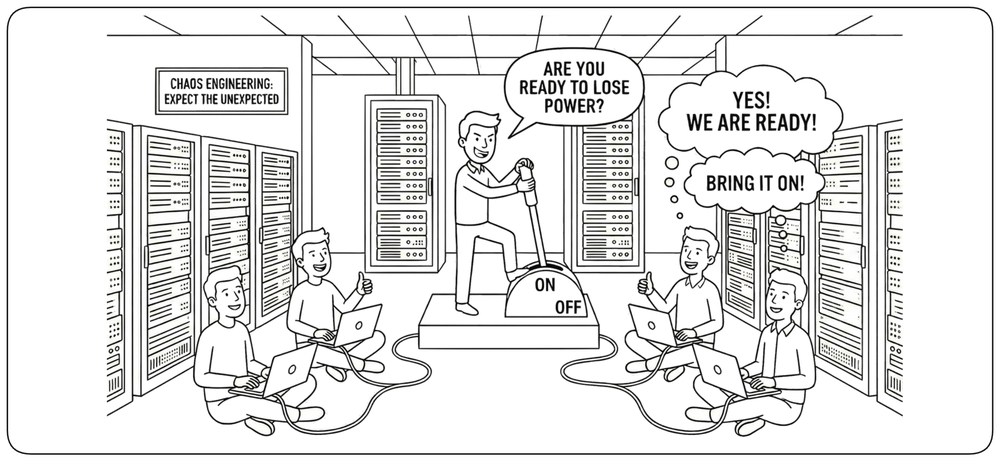
Chaos engineering tests how a system behaves when something goes wrong. Start with an expected result, introduce one controlled failure—such as a slow dependency or a stopped service—and check whether the system still behaves as intended.
Test Recovery, Not Only Failure [Recovery]
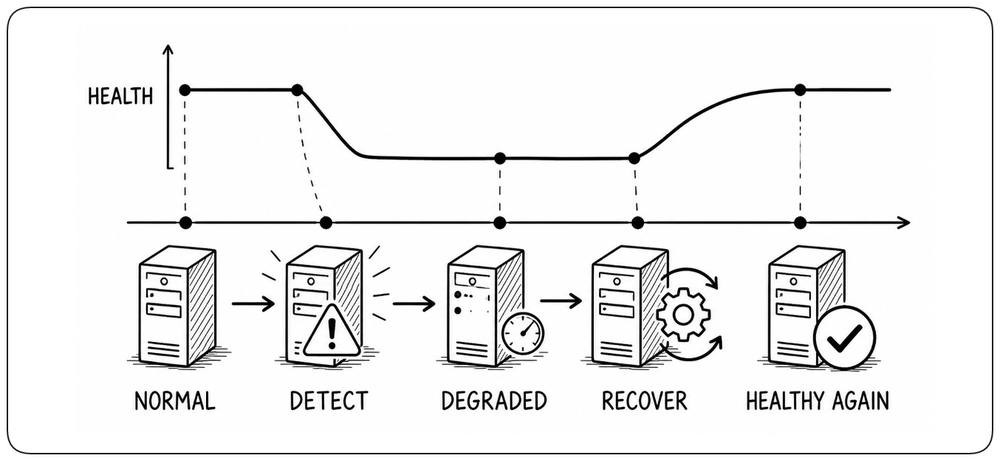
Injecting a failure shows that a system can break. It does not show that the system can recover. A resilience test should follow the full path: detect the problem, keep serving users as well as possible, recover through retries or failover, and return to normal. !!The test is complete only when the system is healthy again.!!
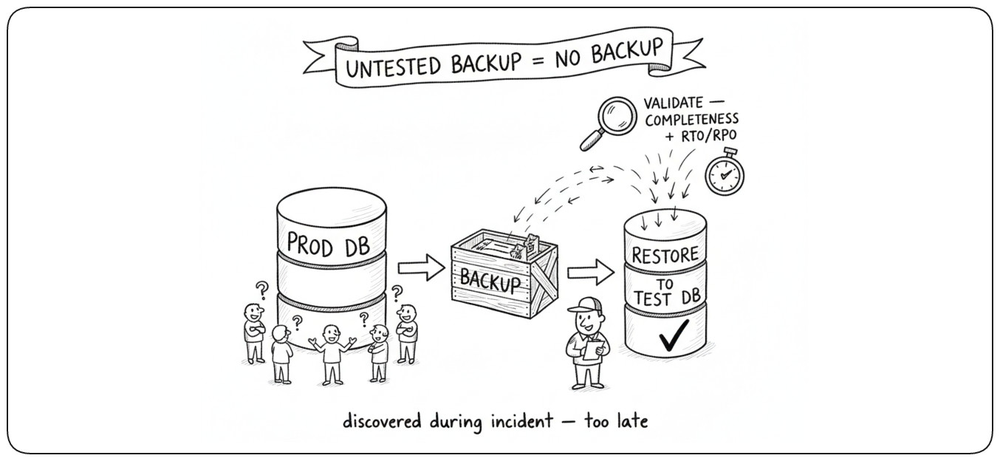
Backup and Restore Testing [Backup]
Backups are useful only if they can be restored. Regularly restore one into a test environment and check that the data is complete and recovery meets the required RPO and RTO. Otherwise, a team may discover a backup problem during a real incident.
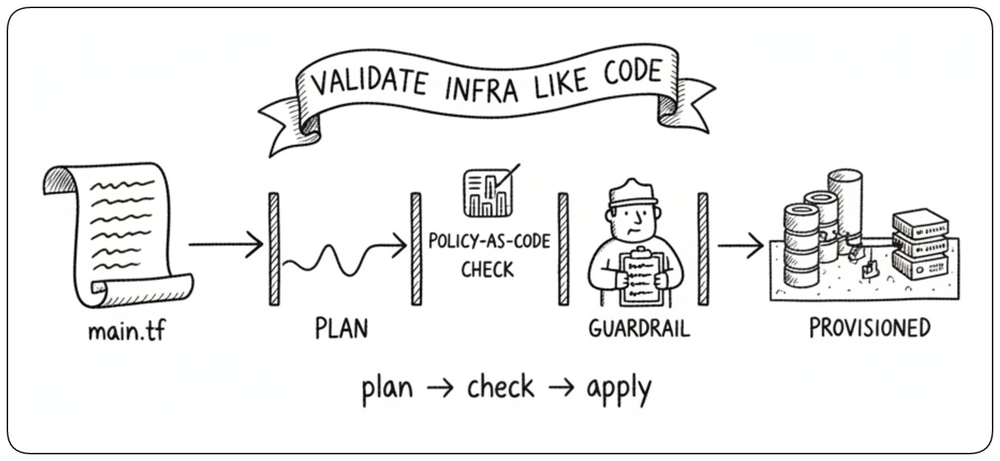
Infrastructure as Code Testing [IaC]
Infrastructure code needs tests too. Check the planned change, verify that required resources and policies are present, then apply it. This catches configuration mistakes before they reach production.
Testing in the Age of AI [AI Testing]
AI can now generate code and tests faster than teams can review them. What work has moved to AI? What still belongs to people? In this section, we examine how testing responsibilities change when machines write, run, and analyze more of the tests.
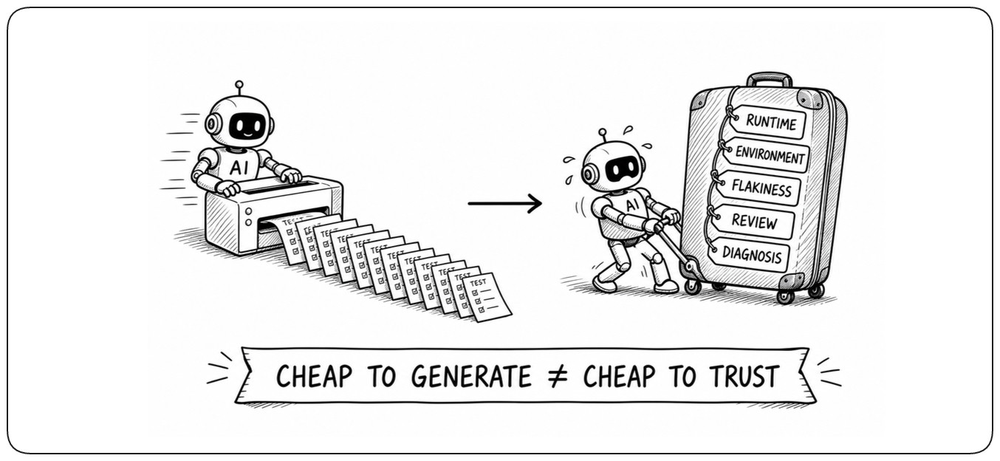
AI Makes Tests Cheap to Write, Not Cheap to Trust [AI Economics]
AI makes tests faster to write, but they still take time to run, review, maintain, and debug. They may also need data and test environments. A test is useful only when we can trust what it checks. !!Cheap to generate is not cheap to trust.!!
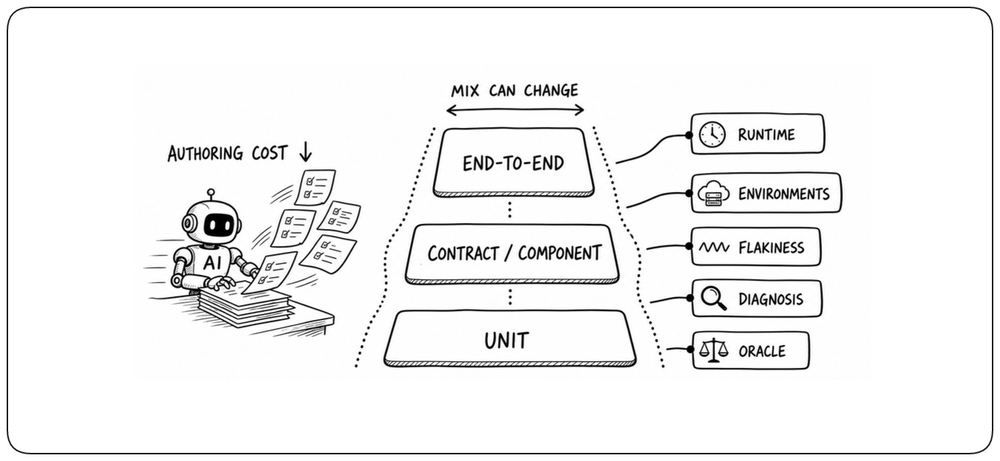
The Test Mix Can Change [AI Test Mix]
The pyramid is a guide, not a fixed ratio. If AI makes reliable end-to-end tests cheaper, use more of them for important user journeys. Keep unit tests for rules and contract or component tests for boundaries. !!Choose the smallest test that can catch the risk.!!
More Tests Require Better Selection [AI Curation]
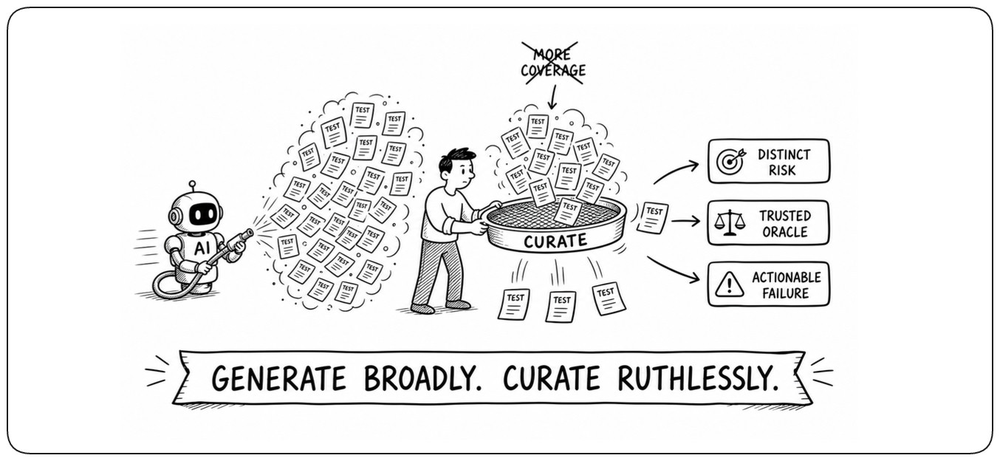
AI can generate hundreds of tests, but more tests do not always create more confidence. Keep a generated test only when it checks a new risk, has a clear expected result, and helps explain the problem when it fails. Mutation testing, known defects, and duplicate detection can reveal weak or repeated tests. !!Generate broadly. Keep only useful tests.!!
AI Can Select Tests, but It Can Miss [Predictive Selection]
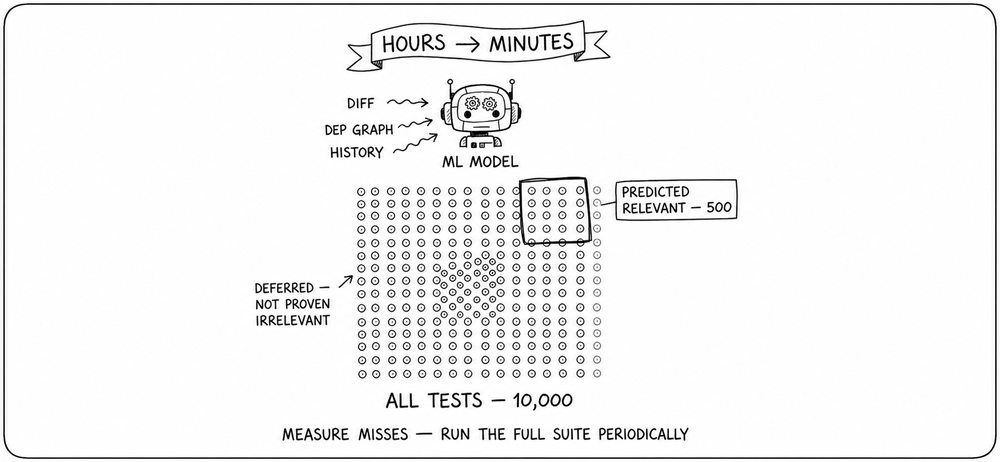
AI can predict which tests are most likely to matter for a change, making feedback faster. But a prediction can be wrong. Always run critical tests, compare its choices with full-suite results, and run the full suite regularly. !!Faster feedback is useful only when we measure what the selection misses.!!
Humans Decide What Correct Means [The What]
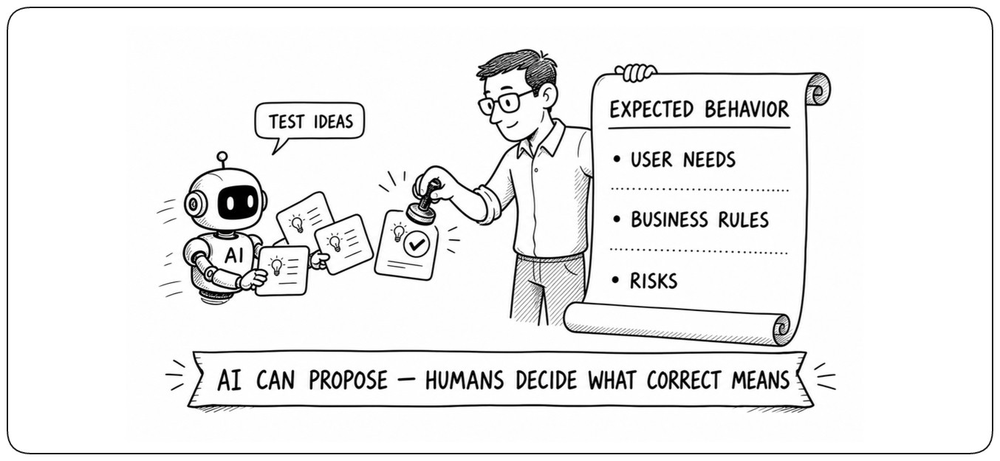
People who understand the product define the behavior the system must guarantee. AI can read code and suggest tests, but it should not decide the expected result because the code may already contain a bug. !!AI can propose. Humans decide what correct means.!!
AI Turns Intent into Tests [The How]
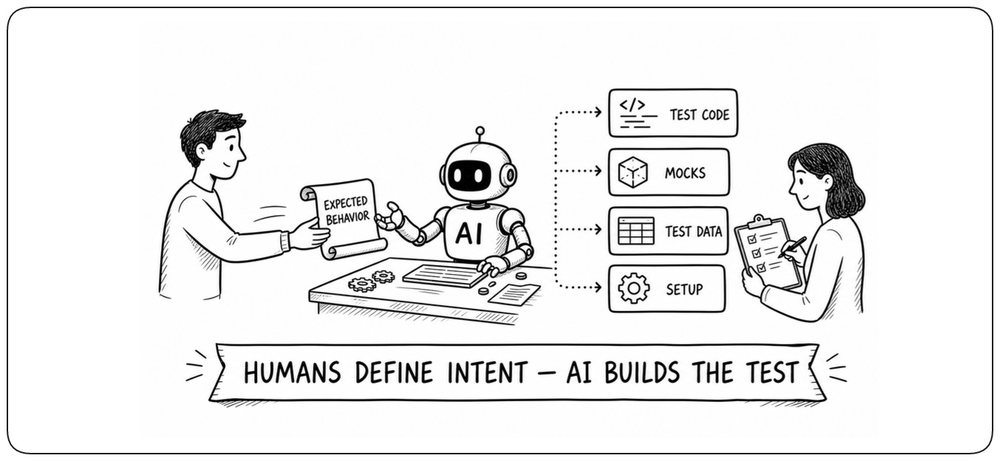
Once the expected behavior is clear, AI can generate test code, mocks, test data, and setup. Humans review the result while AI handles the repetitive work. !!Humans define the intent. AI builds the test.!!
A Test DSL Is the Interface to the Machine [What + How]
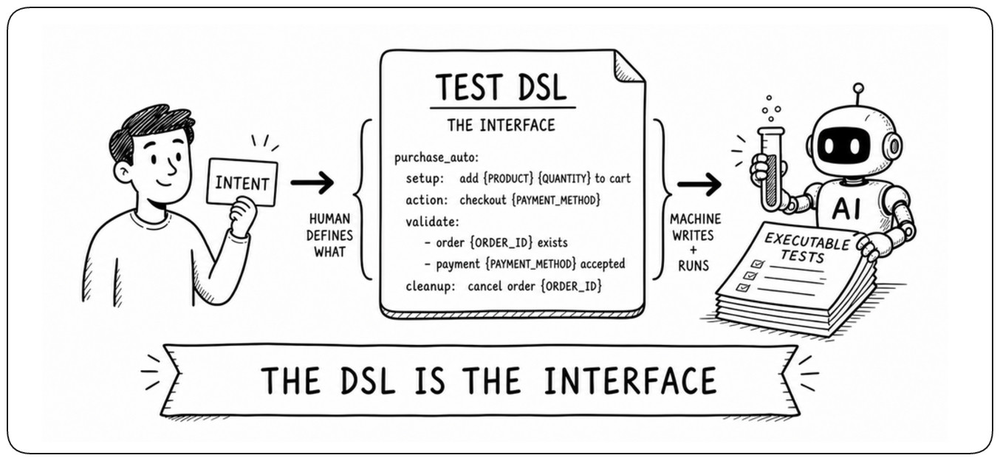
The cleanest way to separate what people define from what the machine does — writing and running the tests — is to create a test DSL as the interface between them. It uses product language to state a scenario, a rule, and an expected result — not selectors, mocks, or setup. People own and review this interface. AI and tooling can change how it becomes executable tests without changing what it declares. !!The DSL is the contract: humans say what; machines decide how to run it.!!
Use AI to Understand Why a Test Failed [AI Diagnosis]
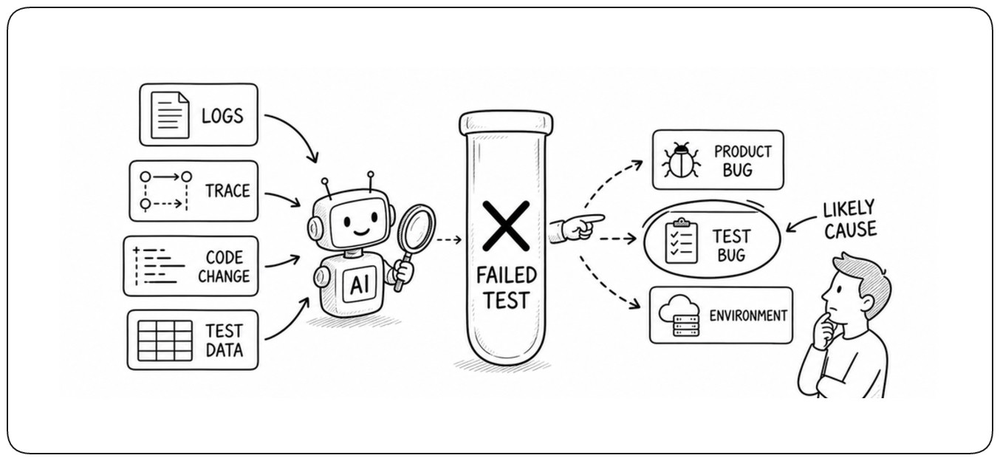
When a test fails, AI can compare logs, traces, code changes, and test data to suggest the most likely cause. It can help show whether the problem is in the product, the test, or the environment. A developer must review the evidence before acting. !!Use AI to understand a red test, not to hide it.!!
AI Can Explore More Paths [Exploration]
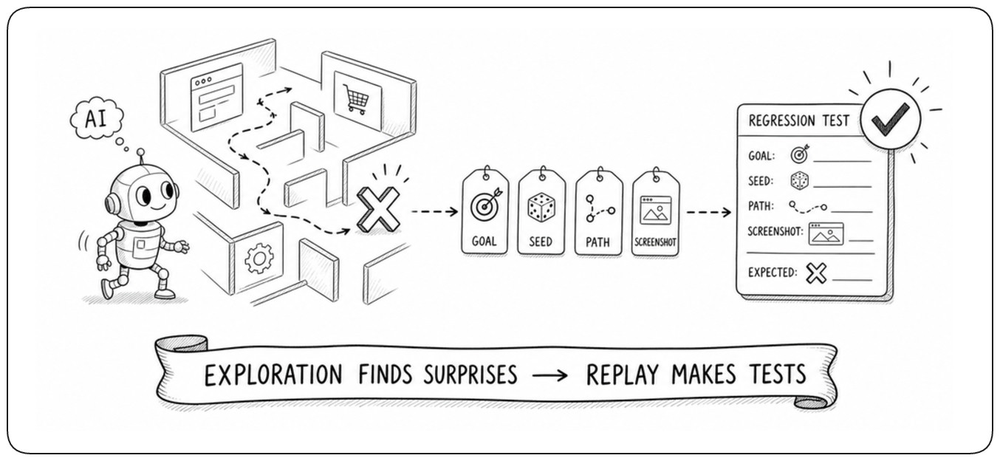
AI can try unusual inputs, explore user journeys, and notice visual problems that scripted tests may miss. When it finds a problem, save the goal, data, path, and screenshots so the failure can be repeated. Then turn the discovery into a normal regression test. !!Exploration finds surprises; replay makes them testable.!!
Give Test Agents Clear Limits [Agents]
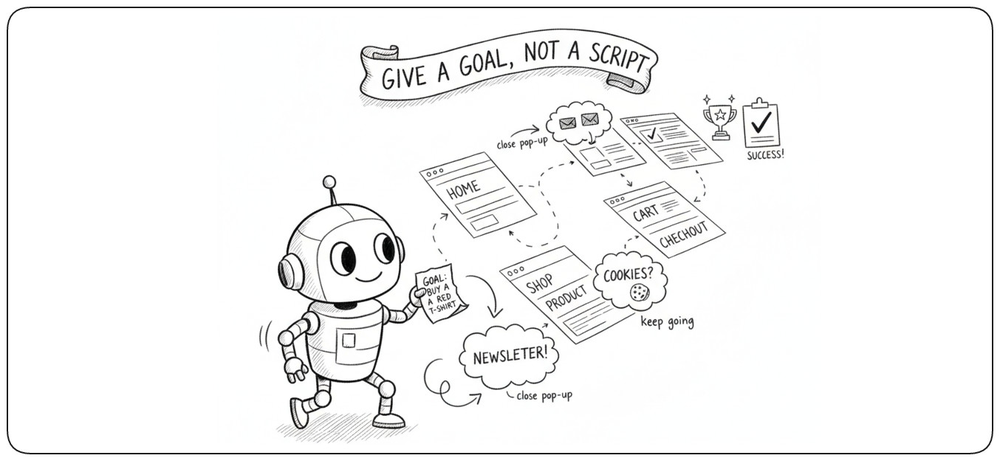
Test agents can discover paths that scripted tests do not cover, but they can also take unexpected actions. Run them in isolated environments with test accounts, limited permissions, time and spending limits, and a full record of their actions. Use them to find problems, not as the only release check for a critical flow. !!Give agents room to explore, but limits on what they can do.!!
Execution at Scale [Execution]
Strategy decides what evidence is needed and when. Execution makes that plan reliable: failures must point to a change, tests must run independently and consistently across environments, and validated releases must reach users with controlled risk.
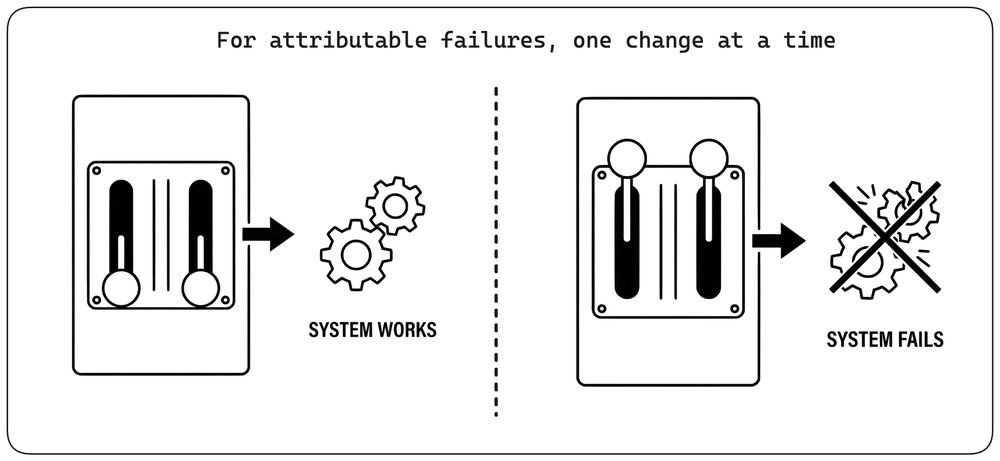
One Change at a Time Makes Failures Attributable [Attribution]
Fast feedback helps only when we can link a failure to a change. If several changes land together, a red build becomes a guessing game. Keep changes small so a failure points to a likely cause and a rollback or fix is clear.
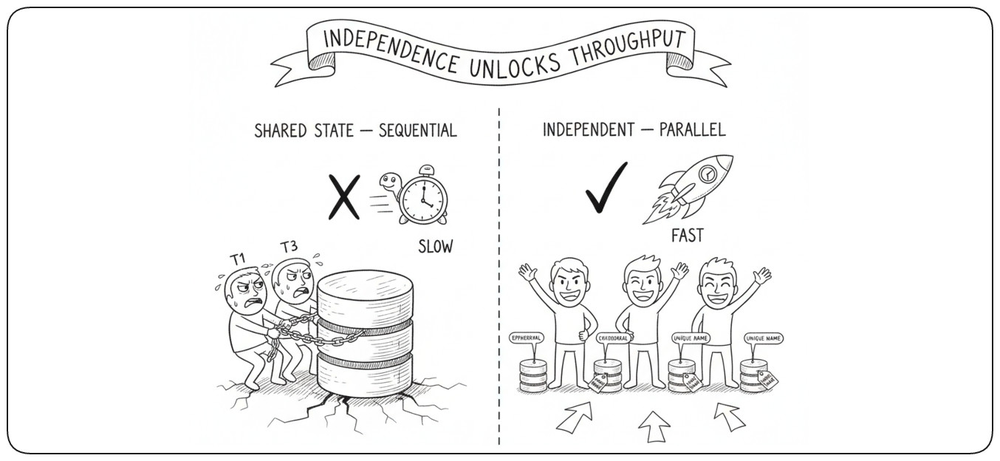
Parallelism Requires Independence [Parallelism]
Parallel tests save time only when they do not affect one another. Do not rely on test order, shared data, or global state. Use isolated data, unique resource names, and short-lived environments so each test can run alone.
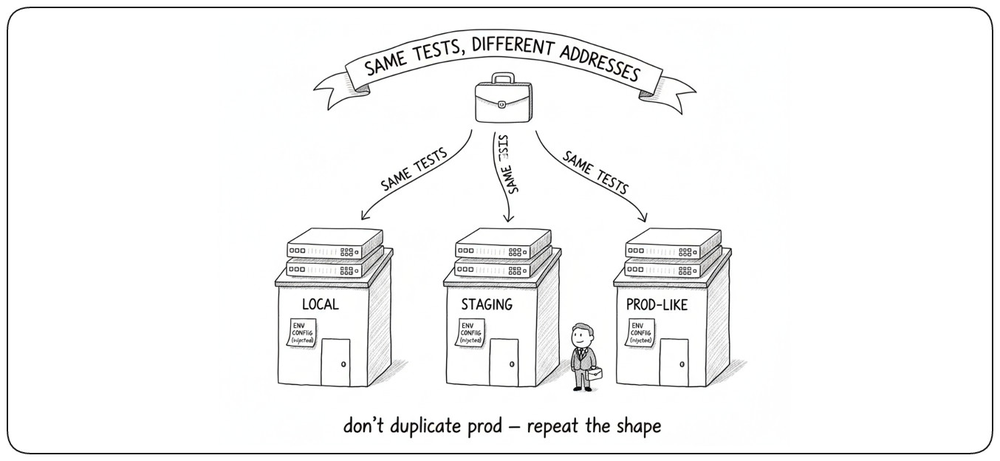
Environment Parity and Portability [Parity]
The same tests should run locally, in staging, and in a production-like environment without being rewritten. Hard-coded endpoints, credentials, and topology make tests fragile. Use configuration and portable test tools. Parity does not mean copying production exactly; it means creating a repeatable environment with controlled data and few collisions between teams.
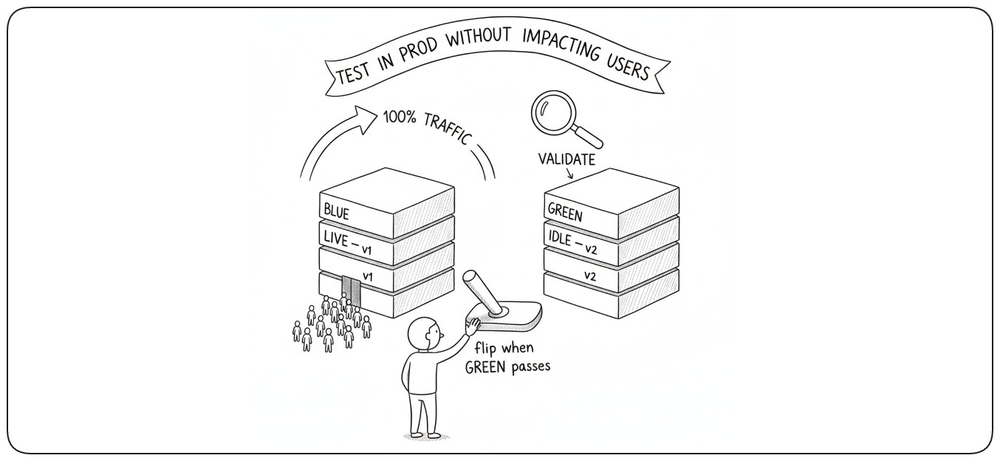
Blue-Green Testing [Blue-Green]
Blue-green deployment uses two equivalent environments. One serves users while the new version is deployed and checked on the other. When it passes, switch traffic. Keep the old version ready so a rollback is quick.
Progressive Delivery Limits Blast Radius [Progressive Delivery]
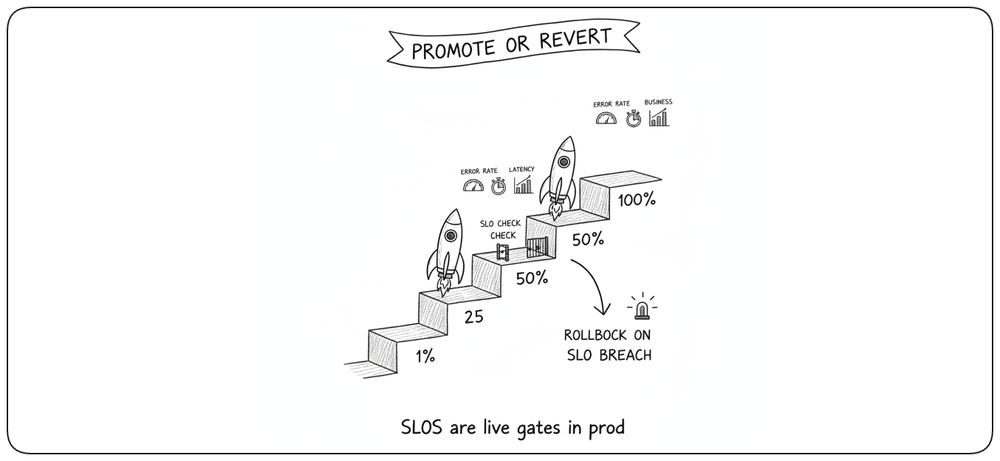
Blue-green switches all traffic at once. Progressive delivery starts with a small group of users and expands only when the signals stay healthy. !!Errors, latency, and business metrics become live gates: promote or roll back.!! The same SLOs defined before release guide the decision in production.
Security Verification Deserves a Dedicated Strategy [Security]
Security deserves its own verification strategy because correctness under expected use does not prove correctness under hostile use. The goal is confidence that critical controls hold, not a pile of reports.
Protect Secrets and Use Scoped Identities [Secrets]
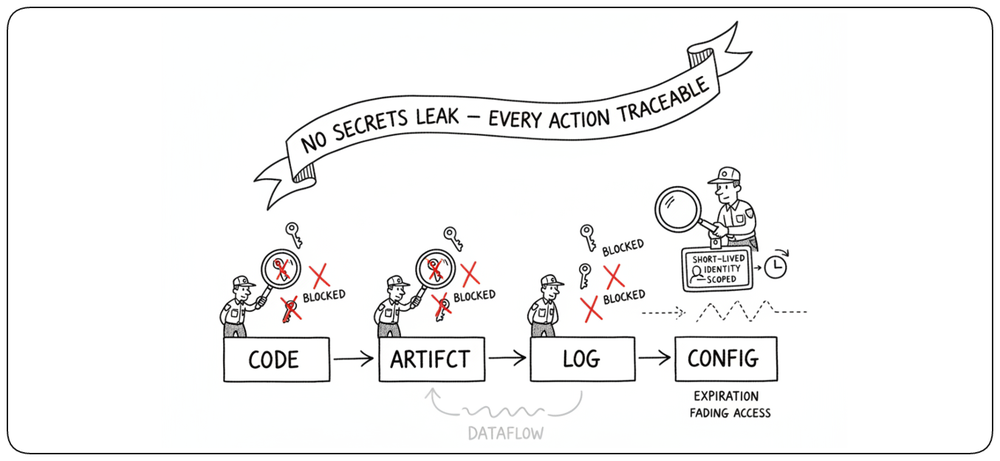
Stop sensitive material from entering code, artifacts, logs, or config: credentials, tokens, keys, and internal endpoints. Prefer short-lived, scoped access and traceability so every action has an accountable identity.
Prove Artifacts and Policies Before Promotion [Artifacts]
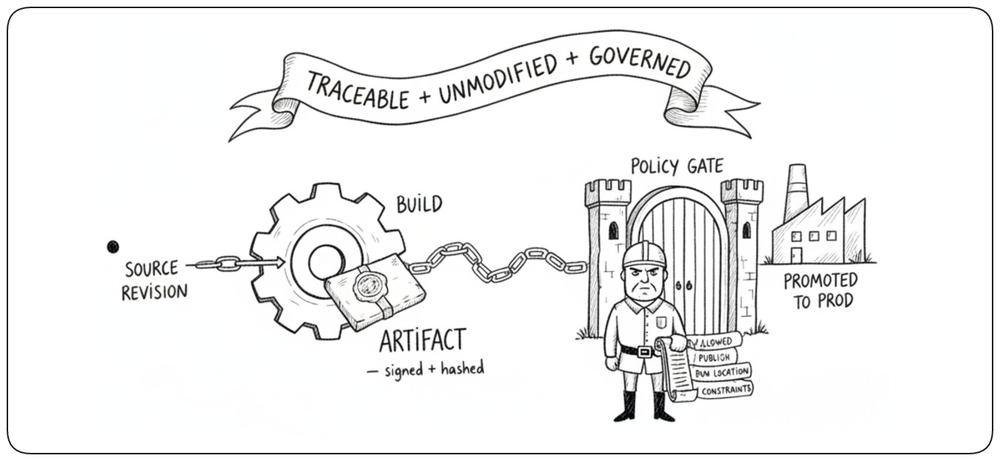
Treat artifacts as governed objects: traceable to a source revision and build, and verifiable as unmodified. Policies must be enforceable at promotion time: what can be published, where it can run, and under which constraints.
Reduce Supply-Chain Exposure and Unsafe Patterns [Supply Chain]
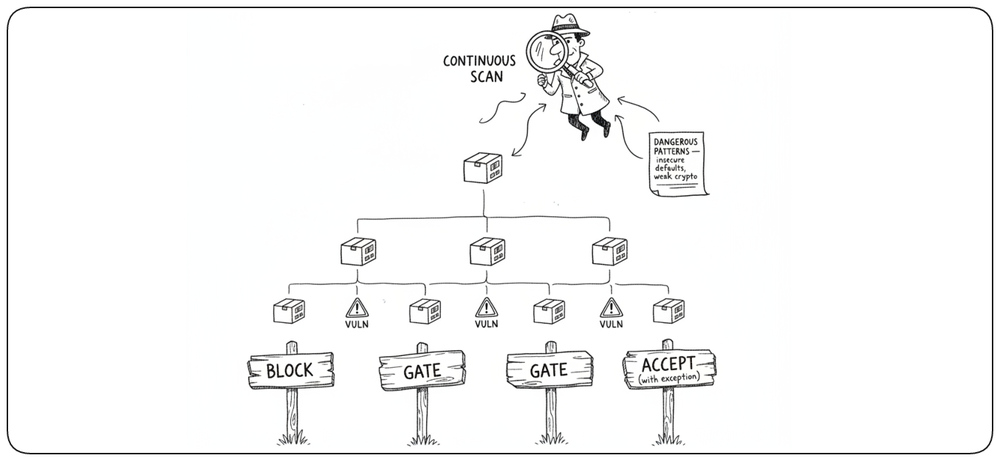
Continuously measure exposure in dependencies and images, and turn findings into decisions: block, gate, or accept with explicit exceptions. Validate code and configuration for dangerous patterns (security hotspots, insecure defaults, export/crypto constraints) without tying the chapter to specific tools.
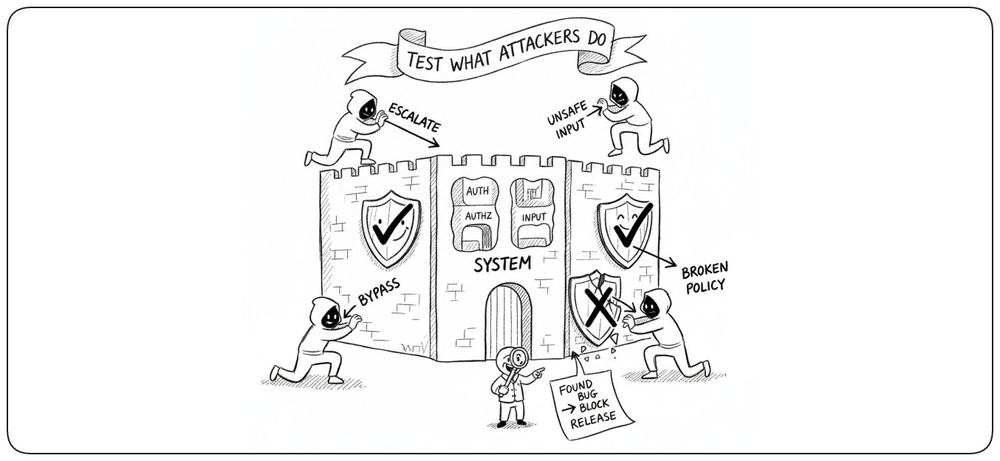
Validate Runtime Boundaries and Abuse Paths [Boundaries]
The highest-risk failures happen at boundaries: authentication, authorization, input handling, and policy enforcement. Test the behaviors attackers exploit: bypasses, privilege escalation, and unsafe inputs that trigger dangerous paths — the checks that matter are the ones you trust enough to block a release.
Maintaining Confidence [Maintenance]
Test suites decay unless maintained. As the system evolves, tests must evolve too, or they become noise that slows teams down.
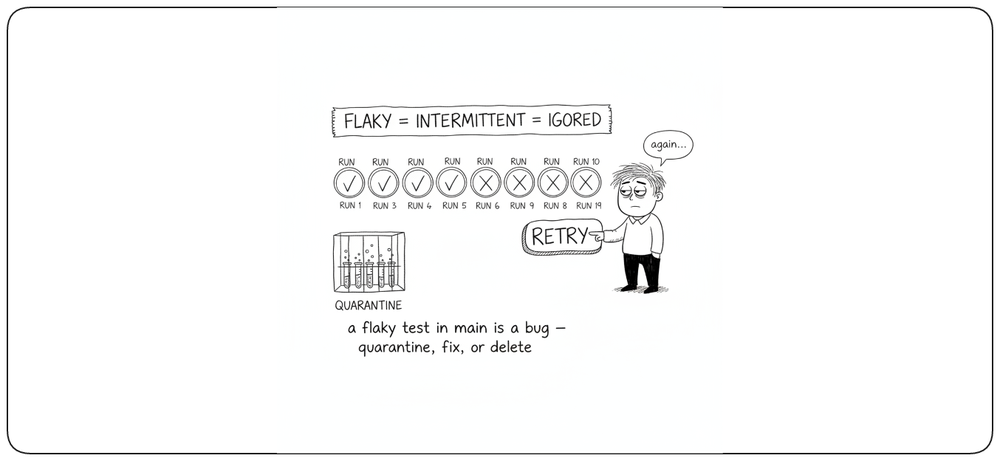
Flaky Tests Erode Trust [Flaky]
A flaky test can be more damaging than a missing test because it teaches teams not to trust failures. When a suite fails intermittently, engineers learn to retry, re-run, and eventually ignore red builds — the very habit the suite exists to prevent. !!Flakiness is a defect, not a nuisance.!! Track flake rate as a first-class metric, quarantine unstable tests immediately, and treat persistent flakiness in critical tests as an engineering defect requiring immediate ownership. The suite is only as trustworthy as its most unreliable check.
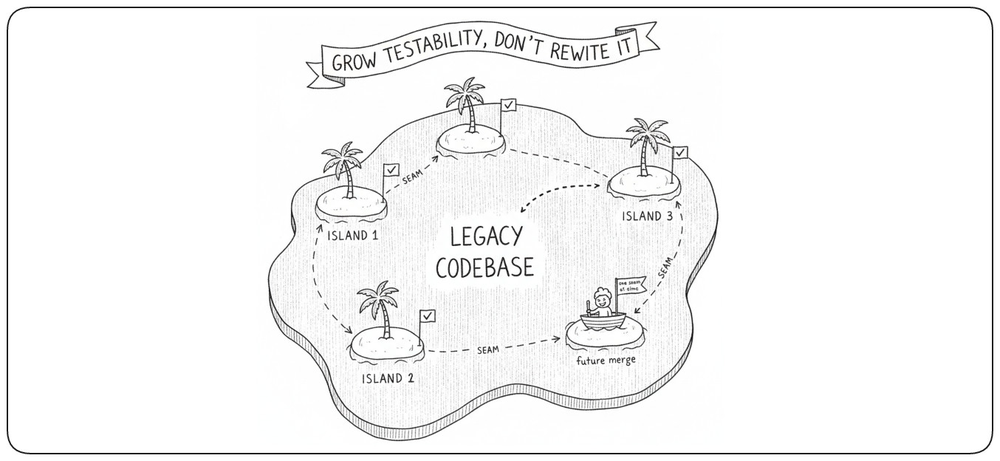
Grow Testability Around Legacy Code [Legacy Islands]
Not every codebase can be made testable in one sweep. In systems that predate current practices, the pragmatic strategy is to grow islands of testability incrementally. When a change touches legacy code, extract the new behavior into a well-bounded unit with explicit inputs and outputs, and have the legacy code call into it. Over time, those islands connect: each modification adds a piece of the system that can be verified in isolation. !!Testability does not have to be introduced by rewriting; it can be grown, one seam at a time.!!
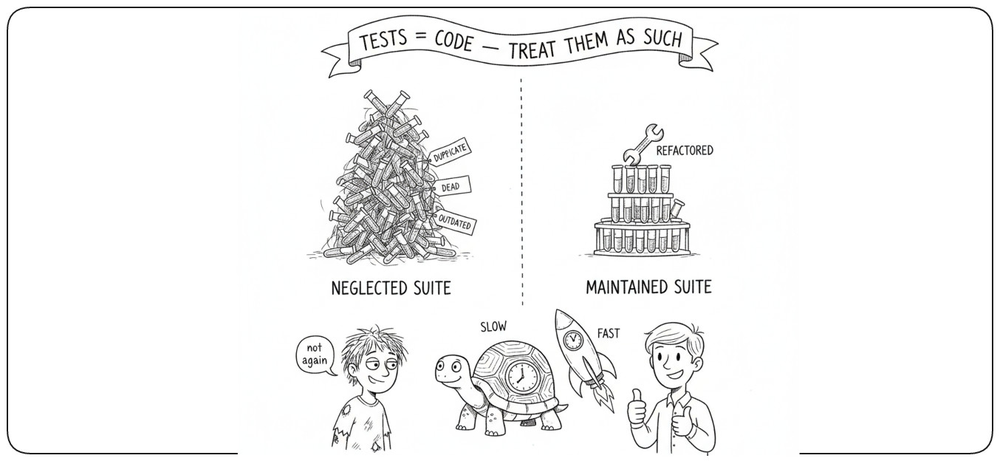
Refactor Tests Like Production Code [Test Refactoring]
Tests are code. They should be reviewed, simplified, and refactored regularly — remove obsolete checks, consolidate duplicates, and keep assertions aligned with current behavior. A well-maintained suite stays fast and high-signal; a neglected one becomes slow and trains teams to distrust results.
Metrics That Drive Improvement [Metrics]
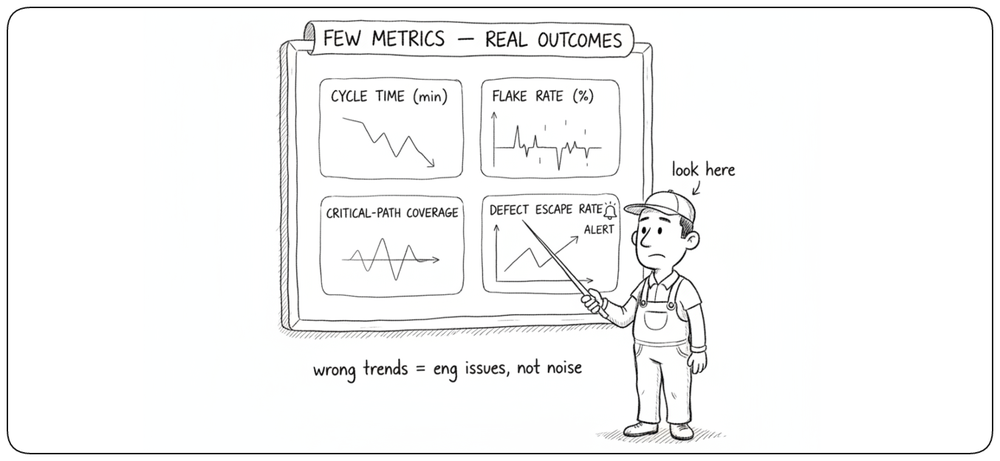
Track a small set of indicators that reflect health: cycle time, flake rate, critical-path coverage, and defect escape rate. These metrics reveal where reliability is degrading and where investment is needed — the goal is not vanity numbers but predictable outcomes. When the data trends the wrong way, treat it as an engineering issue, not as background noise.
Treat Test Failures as Actionable Signals [Alerting]
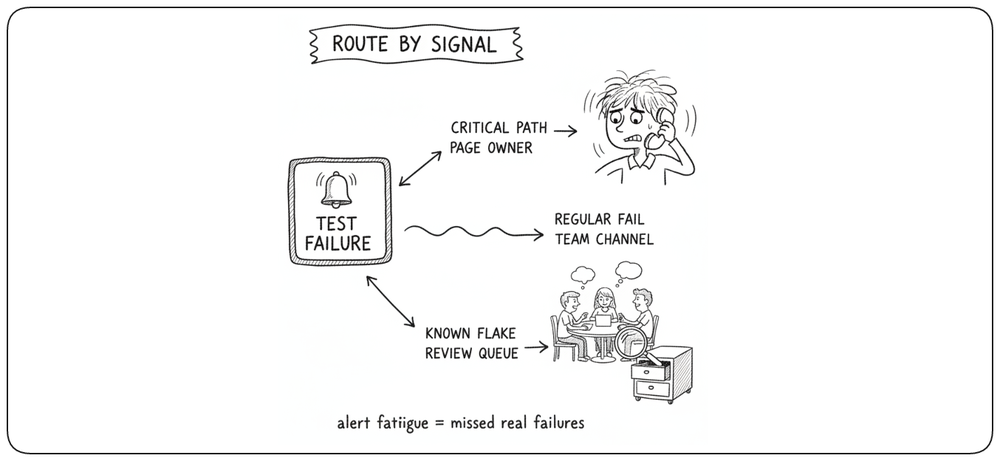
Failures should reach the people who can act, with enough context to triage quickly. Alerts that fire for known flakes or low-signal failures train teams to ignore them — design alerting so that critical-path failures are loud and everything else is routed for review. Treat test failure handling like incident response: clear ownership, fast triage, and disciplined follow-up.
Culture and Process [Culture]
Architecture creates the conditions for testability; culture determines whether those conditions are used. A system may have clean seams, fast pipelines, and rich observability, yet still accumulate unverified changes if validation is treated as someone else’s job or as a phase that follows development. Confidence stays current only when the people making a change also own the evidence that it is safe.
That ownership needs to appear in everyday work: in what a team calls done, the questions reviewers ask, how failures are routed, and how lessons from production reshape the next change. The goal is not a separate testing ritual. It is a development practice in which uncertainty is surfaced early, reduced deliberately, and never silently handed off.
Definition of Done Includes Verification [Definition of Done] {1}
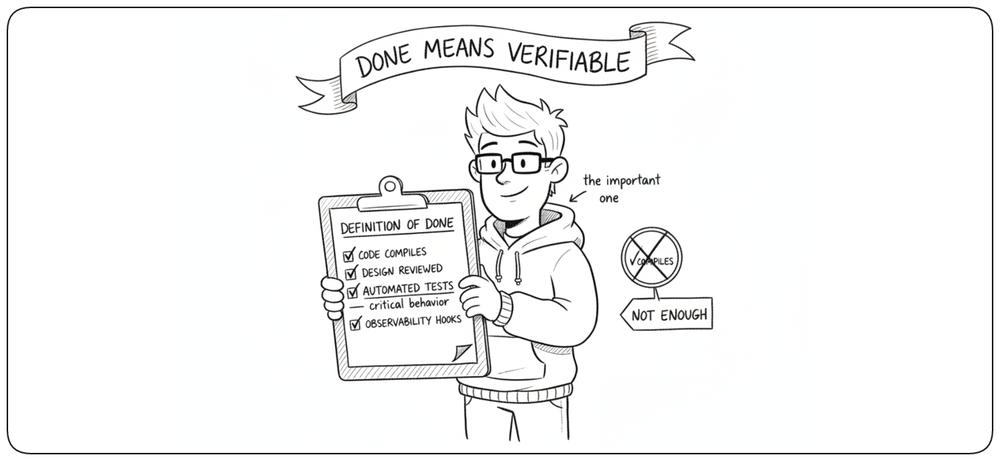
A feature is not done when it compiles; it is done when its behavior is verifiable. !!Make validation explicit in planning and design, and require that critical behavior has automated checks before merge.!! When teams own verification, testability improves naturally because engineers feel the cost of untestable design immediately.
TDD as Design Pressure [TDD]
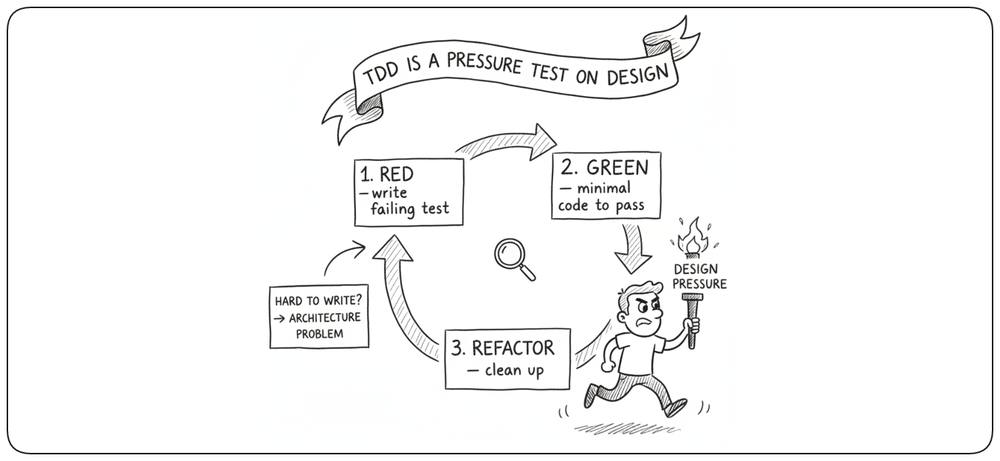
Test-Driven Development is not mandatory, but it is a useful pressure test for design. When it is hard to write a test first, it is often a hint that boundaries are unclear or dependencies are too implicit. TDD works best when combined with an architecture that isolates side effects and exposes seams — in that context, it becomes a practical method for building verifiable behavior by default.
Code Review as a Quality Gate [Code Review]
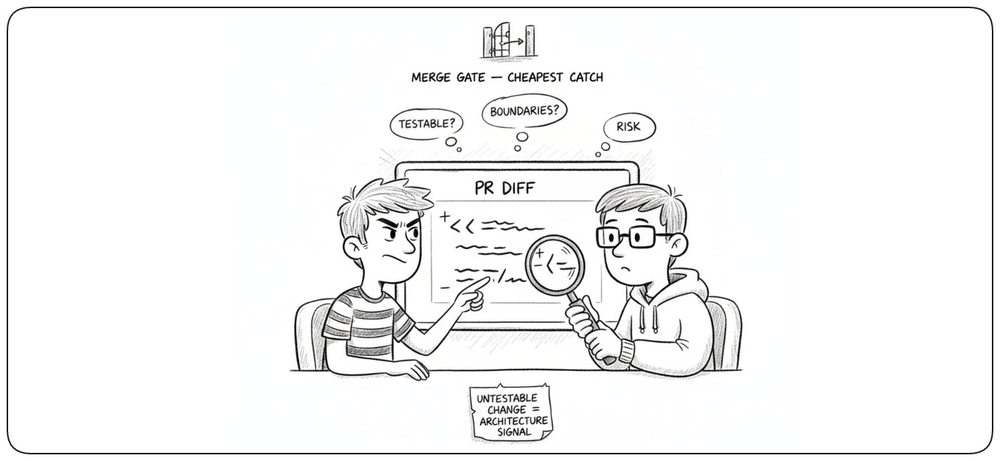
!!Merge is the last inexpensive place to catch many classes of defects.!! Modern systems can be reverted, feature-flagged, or progressively rolled back, but review remains the cheapest moment to catch issues in logic, security assumptions, and design flaws before they become production problems. Use review to validate test strategy as well as implementation — if a change cannot be tested, that is an architectural signal, not a minor inconvenience.
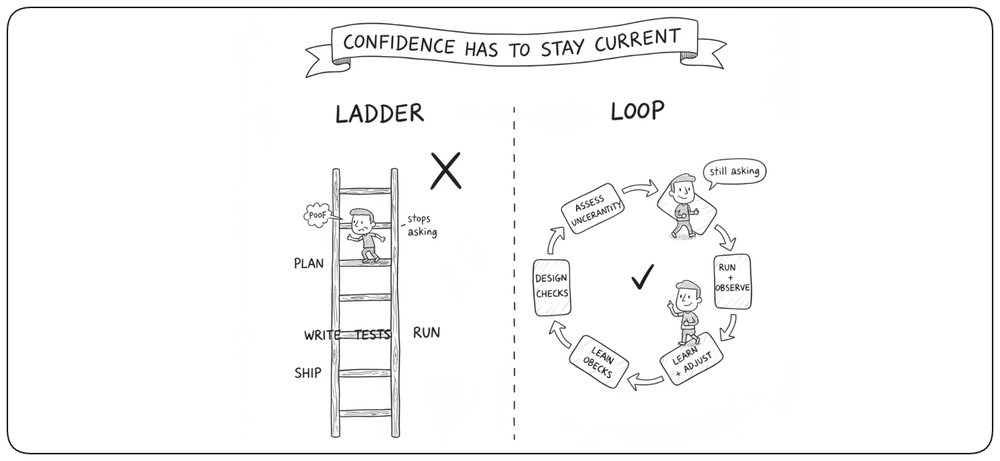
Testing Is a Loop, Not a Ladder [Iterative Testing]
Testing is not a stage you climb through once and leave behind. As the system evolves, so does its risk profile: new features shift where uncertainty lives, and old assumptions quietly age. The healthy pattern is a loop — assess where uncertainty sits today, design checks that reduce it, run them, learn from what they reveal, and re-assess. !!A team that treats testing as a ladder ships once and stops asking; a team that treats it as a loop keeps its confidence current as the system changes.!!