Design By Humans
Chapter Info
Calculating... Writing Progress: 60%
Software exists to solve human problems — and building it is a human problem too. Architecture, velocity, and quality are rarely driven by technology alone; they're shaped by ego, pressure, trust, and communication. A technically perfect system still fails if it doesn't solve what users need. A team with the best tools still ships late for missing conversations. Ignore the human side and you'll keep building the wrong things the wrong way.
This chapter walks through the human forces at play — from the individual to the team, across teams, up to the organization, and into the AI era reshaping all of them.
The Rude Human Reality of Software Development [The Rude Reality] {1}
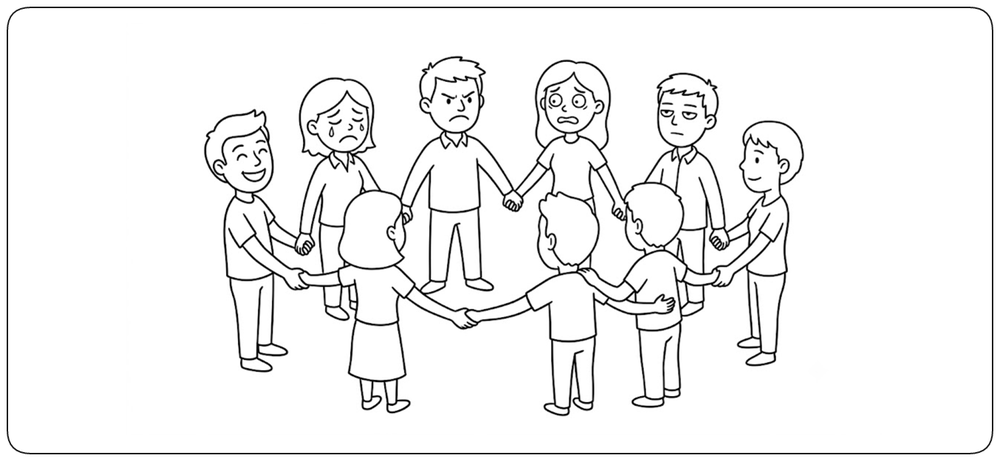
!!Before diving into the psychology behind software development, the harsh reality of how software is actually built deserves to be named.!!
The Chaos of Software Development [The Chaos] {1}
Software development is chaotic by default, in startups and enterprises alike. Deadlines slip, priorities shift overnight, testing is inconsistent, documentation is an afterthought, and technical debt piles up faster than anyone can address it. Decisions are driven by urgency, not strategy — and many projects carry people who shouldn't be there, detached from the reality of the work. The result is a system !!held together by duct tape, quick fixes, and hope!! — software ships not because it's ready, but because there's no time left.
Emergency-Driven Development: Change Only Happens in Crisis [Emergency-Driven Dev] {1}
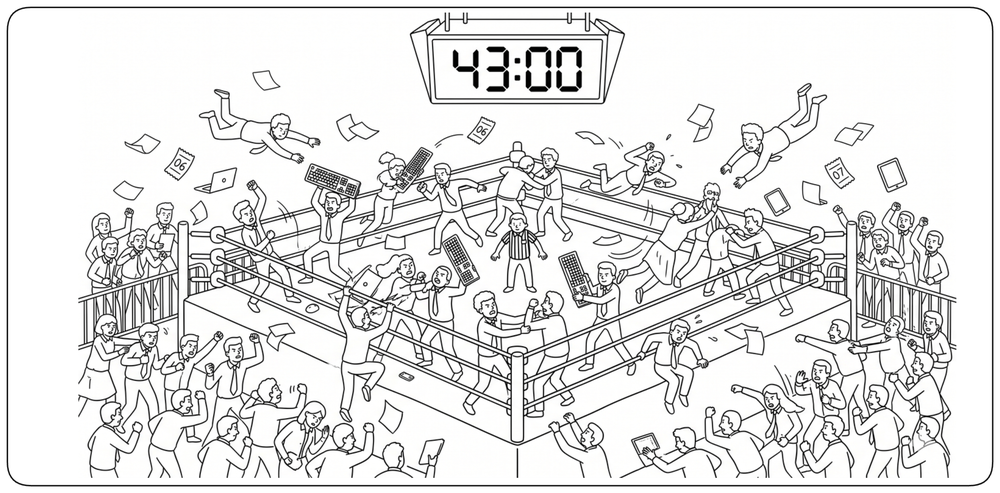
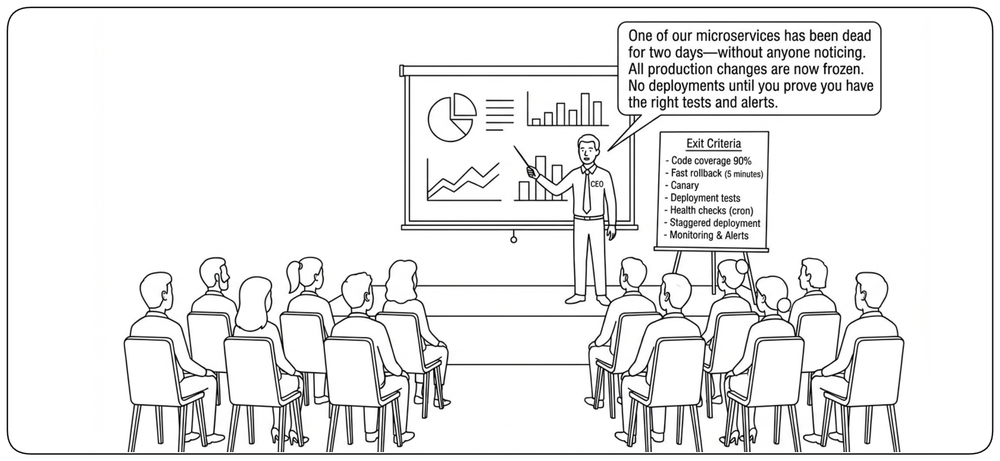
!!Emergency-Driven Development is a reality in many organizations where change happens only when a crisis forces action.!! Quality, security, and scalability are consistently neglected — until an outage, a breach, or a lost client demands immediate attention. Teams struggle to secure resources for preventative work, but once a problem becomes an emergency, budgets and priorities shift overnight. Crises become the primary drivers of innovation.
The Snowball Effect of Bad Decisions [Snowball Effect] {1}
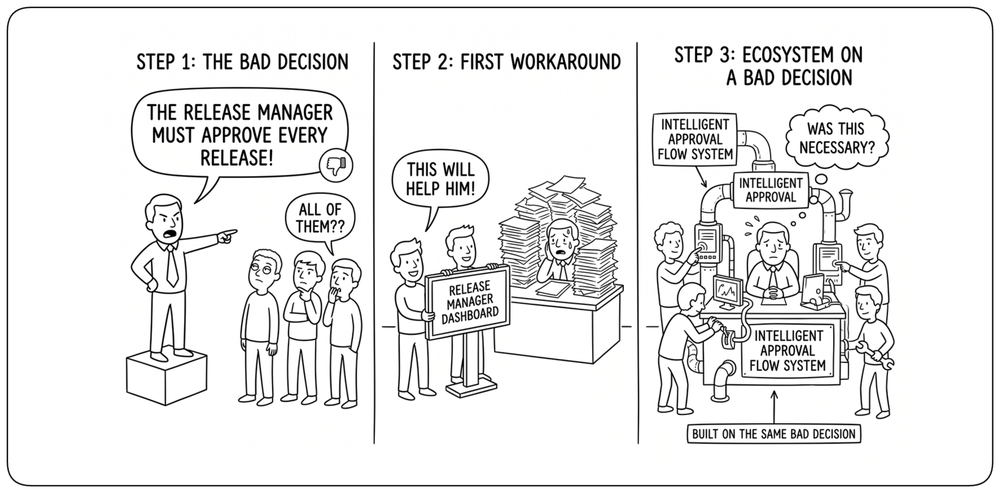
In software development, a single poor decision rarely exists in isolation — it creates a chain reaction of compromises, workarounds, and systemic issues. When an initial design choice is flawed (short-term thinking, rushed deadlines, lack of planning), every future decision has to !!build on a weak foundation!!, and the cost of correction grows faster than the system itself.
Results-Driven Reality [Results-Driven] {1}
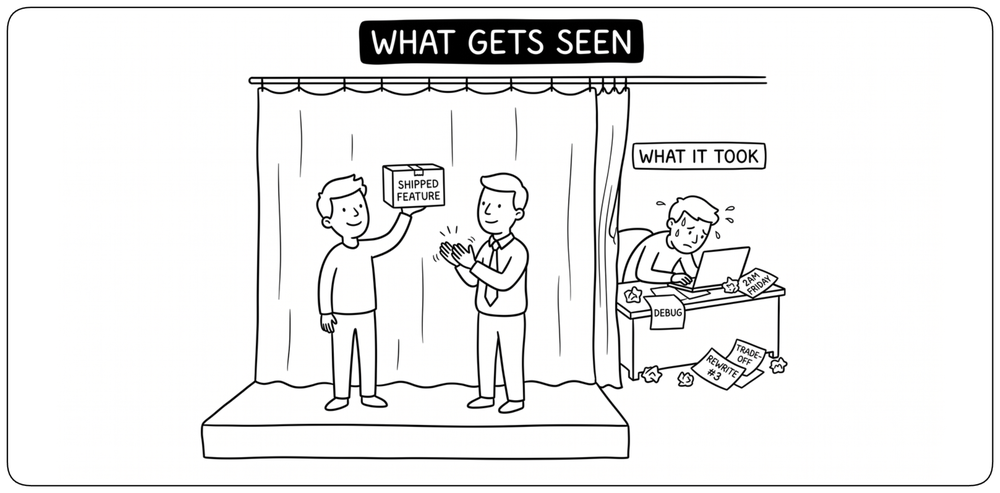
!!Software development is ultimately judged by its results, not by the effort behind them.!! The hours spent debugging, the careful trade-offs, the elegant solutions — none of it is visible to users or stakeholders. Only the outcome matters. This creates a quiet pressure: developers learn that craftsmanship goes unnoticed, while delivery is what gets rewarded. The painstaking effort invested is often forgotten; the result becomes the defining legacy. Navigating this tension — between doing things right and shipping on time — is one of the most persistent challenges in the profession.
You Can’t Measure What Matters Most [Can’t Measure What Matters] {1}
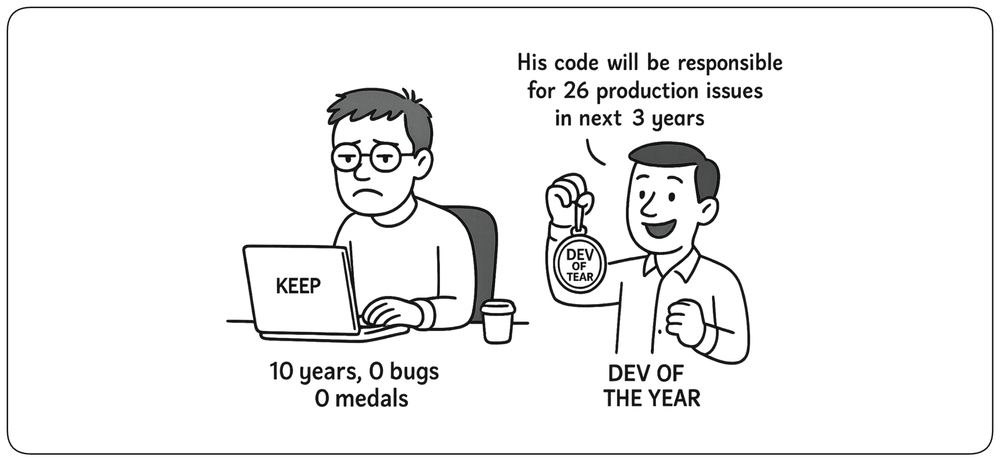
!!One of the harshest truths in software development is that we have no reliable way to measure quality or adaptability.!! The reality is that we often don’t know if code is truly good or maintainable until much later, when it’s either easy to extend or painful to touch. Despite our best efforts, most measures fail to capture what really matters. We’re building complex systems without a proper ruler, relying on instinct, conventions, and hope to guide us. That’s the reality: in a field obsessed with precision, we still can’t confidently measure what makes code good.
Firefighting Culture: Why We Fix Instead of Prevent [Firefighting] {1}
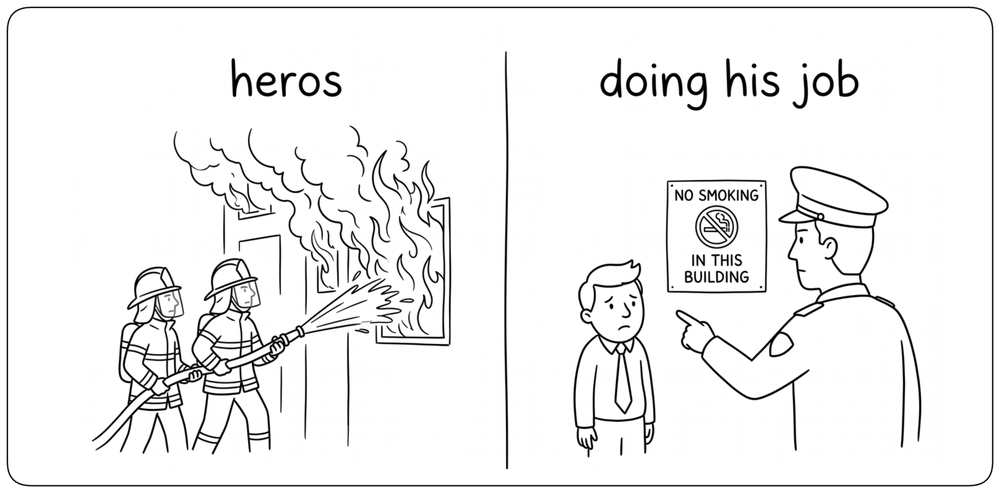
Urgent fixes take priority over prevention. A production outage triggers an all-hands response while the work to prevent the next one struggles for attention. Firefighters get celebrated; the engineers who quietly build resilient systems remain invisible. The result is a culture where !!visibility matters more than effectiveness!! — the best engineering work is the work nobody notices, but without it, teams stay trapped in an endless cycle of crisis management. The way out is counter-intuitive: !!don't downplay small incidents — they compound!!. Treat minor failures as teachable moments before they become major ones, and make issues visible before they get swept under the rug. The teams that improve fastest are the ones that take small problems seriously.
The Illusion of Progress: When Busywork Replaces Real Work [Illusion of Progress] {1}
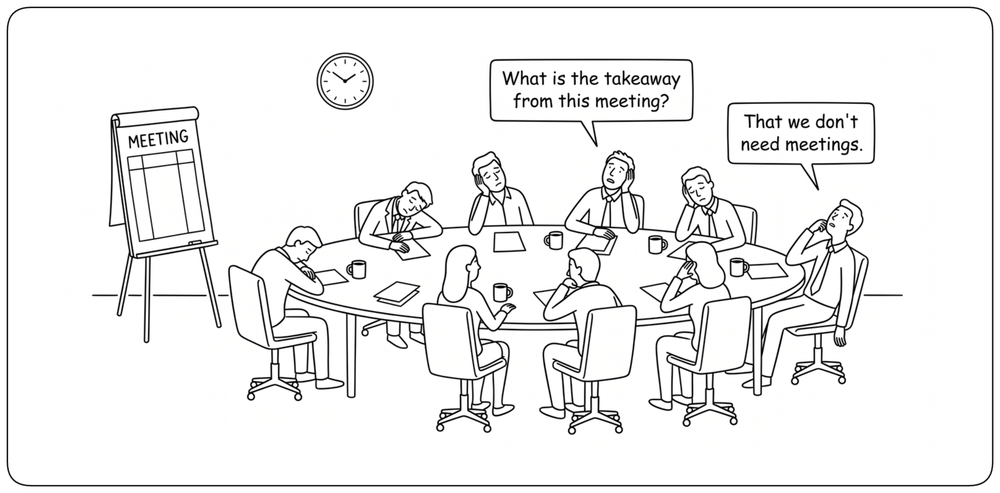
!!One of the harshest realities in software development is that activity is often mistaken for progress.!! Developers can spend weeks refactoring code, managers can hold endless meetings, and teams can obsess over process improvements—yet none of it necessarily translates to tangible value. Features are built but never used, technical debt is acknowledged but never addressed, and documentation is promised but never written. Worse, companies often reward the appearance of hard work rather than its impact. Busy doesn't mean productive.
The Infinite Backlog: Work Never Really Ends [Infinite Backlog] {1}
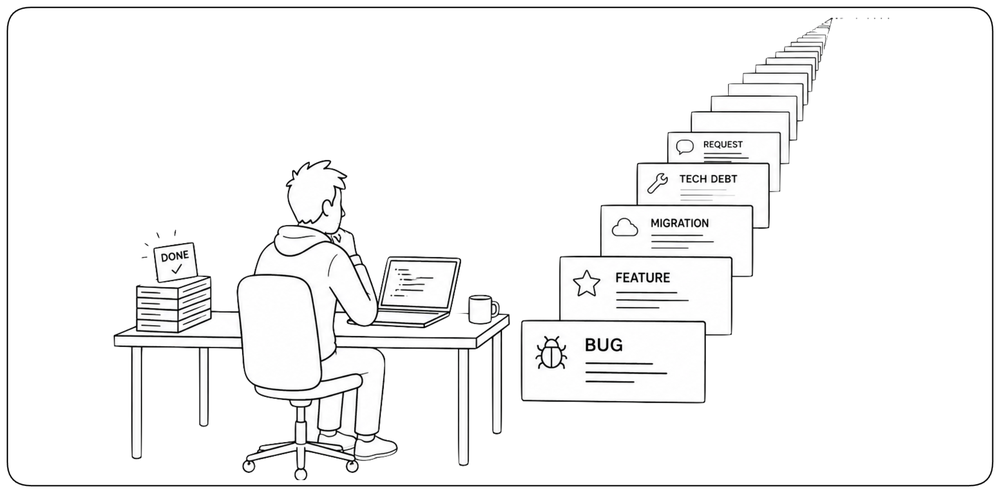
In most organizations, the backlog is effectively infinite. There are always more features to build, more bugs to fix, more migrations to plan, more technical debt to address, and more business ideas waiting to be implemented. Clearing one problem simply reveals the next, and productivity gains never reduce the work — they only expand expectations. Software development is rarely about “finishing” the work; it’s about !!continuously deciding what matters most!! and accepting that no system will ever be completely done.
The Psychological Cost of Software Development [Psych Cost] {1}
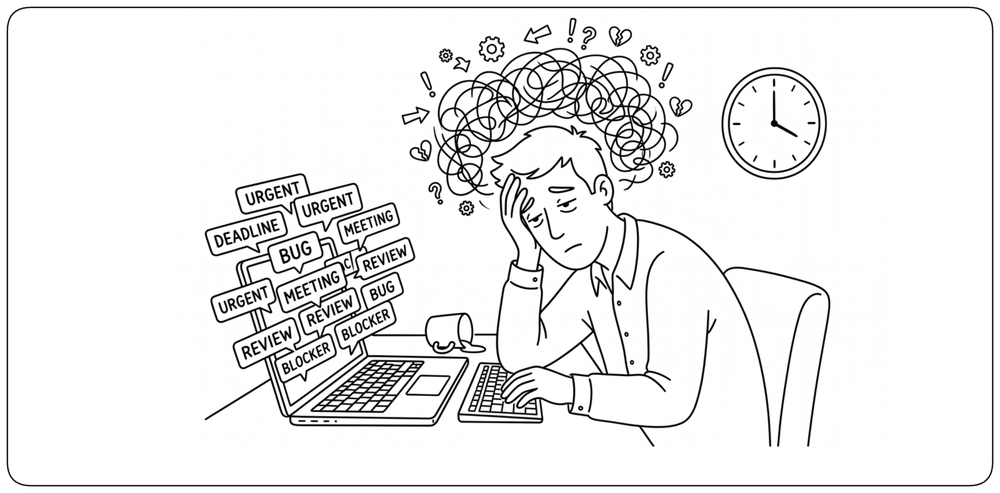
Software development isn’t just about writing code. Every decision adds to cognitive load — shifting priorities, tangled dependencies, tight deadlines keep the mental pressure constant. There’s also an emotional cost: developers take pride in their work, and when solutions are discarded or criticized, it hurts. Decision fatigue accumulates, and when firefighting becomes the default mode, burnout follows. Sustainable software development requires acknowledging this !!hidden human toll!! — not just improving tools and processes, but the people who run them.
The Individual: Wired for Survival, Not for Software [Wired for Survival] {1}
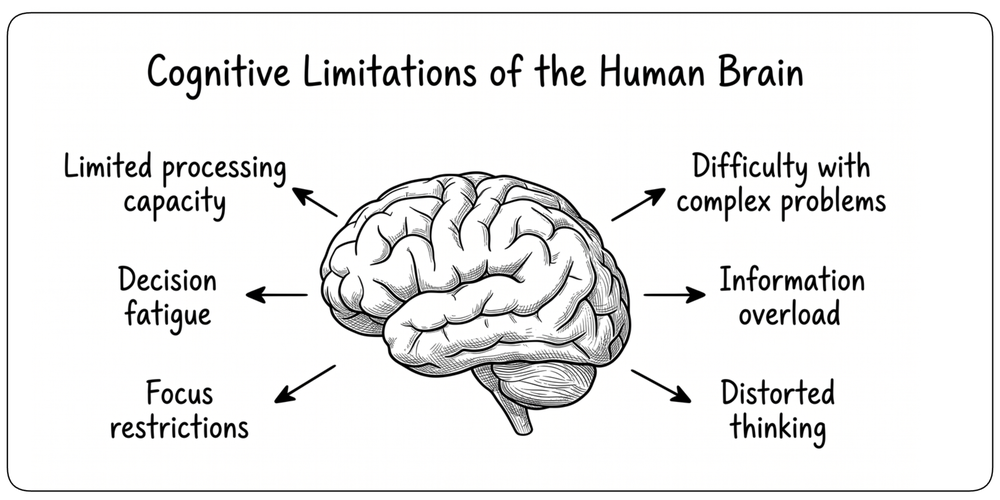
Software demands what the human brain was never designed to provide: sustained focus, comfort with abstraction, patience for long-term consequences, the willingness to disagree out loud. The brain at the keyboard was shaped over millions of years for the opposite — save energy, avoid risk, fit in with the group, decide fast on incomplete information. These are not the flaws of bad engineers; they are !!the default wiring of any human at the keyboard, expensive senior or first-year junior alike.!! Most of the strange decisions in code are not engineering choices — they are survival reflexes meeting a problem they were never built for. This section names those reflexes, one by one — and the sections that follow show how teams, cross-team boundaries, and organizations can be designed to compensate for what no engineer can fix alone.
The Attraction of a Quick & Dirty Solution [Quick & Dirty] {1}
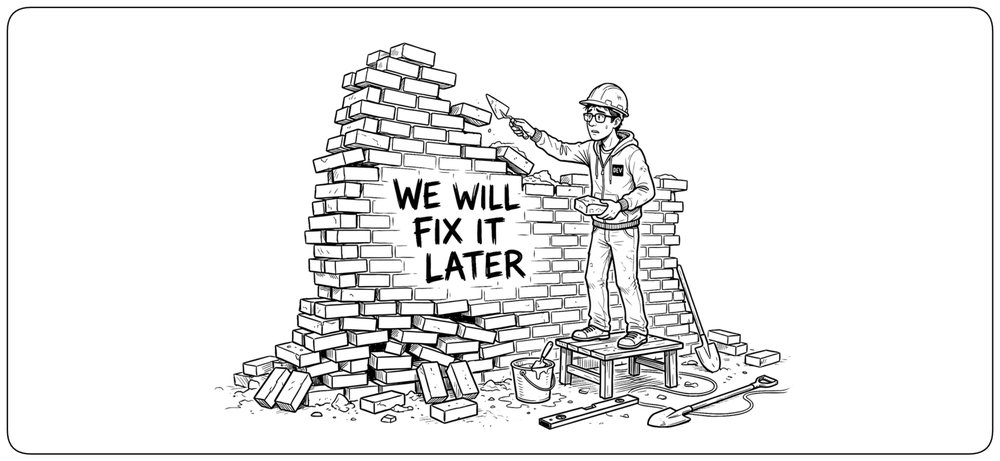
Our brains are still running survival-mode software: the prefrontal cortex that handles long-term planning is the slowest, most energy-hungry region to engage, while the reward system is tuned to discount the future. In Walter Mischel's marshmallow test, !!two-thirds of children couldn't wait!! — and the same shortcut that once kept our ancestors alive now nudges engineers toward the quick fix. Under pressure, most developers choose the quick solution over the right one; short-term wins feel good, and the consequences (technical debt, instability, rework) come later. !!"We'll clean it up later" is the most expensive lie in the industry!!: the mess accumulates, the wall gets patched without being rebuilt, and the second marshmallow never arrives.
Choosing Only from Visible Options [Visible Options] {1}
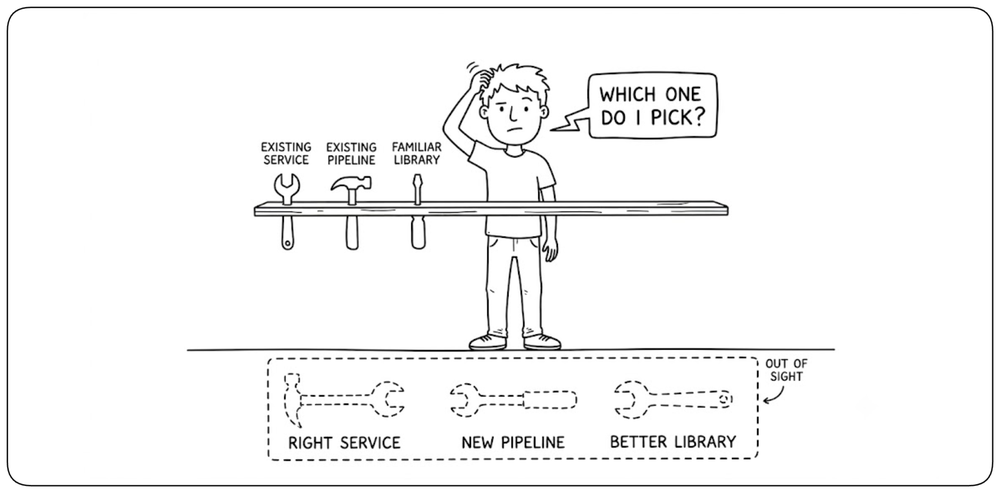
!!Developers build from what's already in front of them.!! The existing service gets one more endpoint instead of a new service. The existing pipeline gets overloaded instead of a new one. The familiar library gets stretched past its purpose. They never step back and ask what the right solution would look like — they pick the best option among the ones already visible, and ignore the ones they would have had to go look for. !!What's present feels free; what's absent feels expensive!! — so the system grows by accretion onto whatever was there first, instead of by what it actually needs.
The Comfort Zone Trap: Why We Resist Change [Comfort Zone] {1}
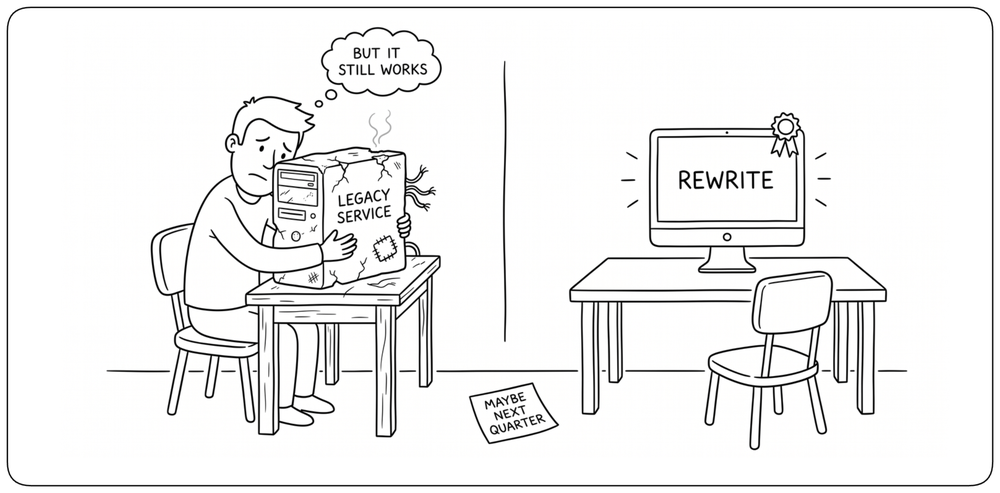
Engineers don't only build from what's visible — they actively resist changing what already works. The legacy service stays untouched because the rewrite is risky. The framework chosen four years ago survives a fifth year because migrating feels expensive. The flaky CI pipeline gets retried rather than rebuilt. None of these are technical decisions — they are loss aversion in disguise: !!the pain of breaking something working is felt more sharply than the gain of having something better!!. The resistance is physical too: every familiar pattern is a reinforced neural pathway, and rewriting it costs real energy, so the brain prefers the path it already knows. That is why strong evidence rarely changes minds — and why the most fragile parts of a codebase are often the ones everyone agrees should be rewritten "someday".
The Art of Solving Problems We Don’t Have [Nonexistent Problems] {1}
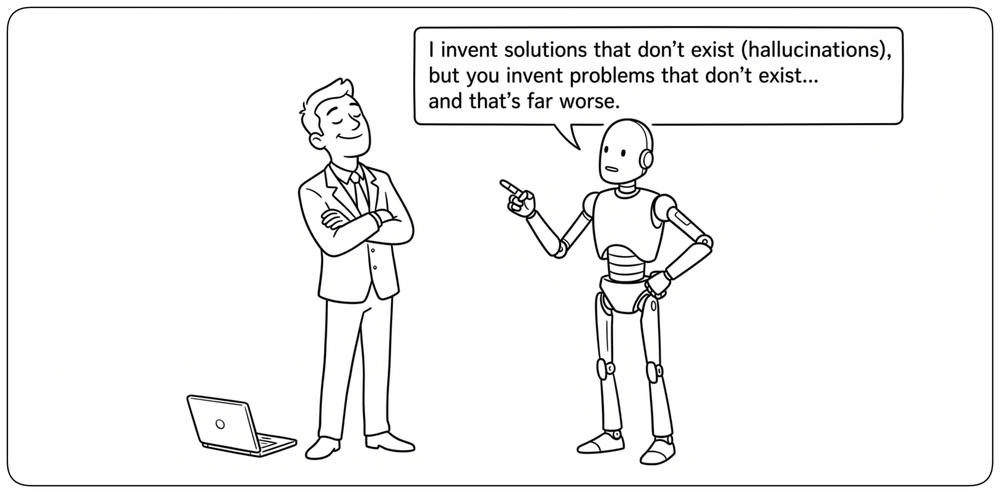
!!Engineers love solving hard problems — sometimes more than necessary.!! Overengineering, perfectionism, and future-proofing lead to solutions for problems that don’t exist yet. The result: unnecessary abstractions, bloated architecture, and maintenance costs nobody budgeted for. Good engineering is not about solving the most complex problem — it’s about solving the right problem with just enough complexity.
The Copy-Paste Mentality: Borrowing Without Thinking [Copy-Paste] {1}
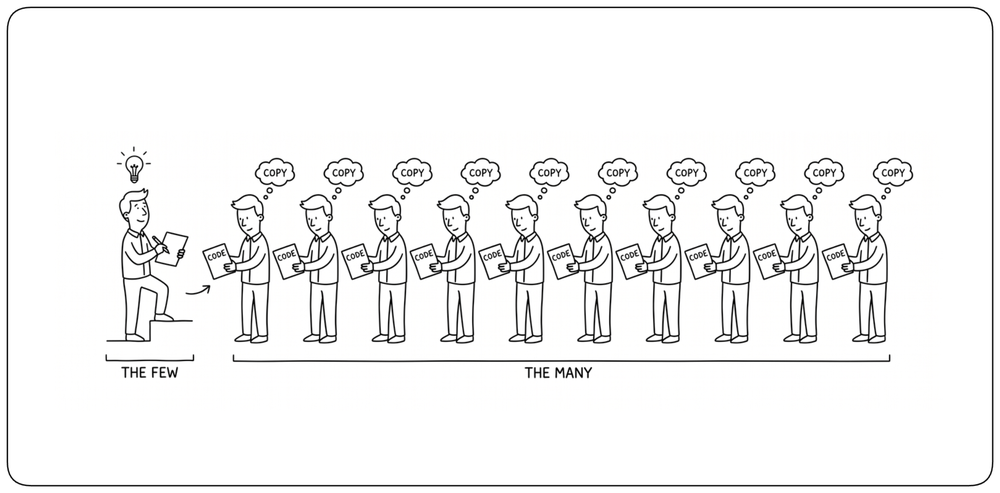
!!Real creativity is rare; only a small fraction of engineers truly invent.!! The rest imitate — and that's not a flaw, it's the human default. Copying is faster, safer, and feels validated: someone else already solved it, so it must be right. The cost is invisible until the copied solution carries someone else's context, constraints, and assumptions into a problem that doesn't share them. !!Most code is not written, it is reenacted!! — and the system inherits decisions nobody on the team ever actually made.
The Comfort of Not Understanding [Borrowed Knowledge] {1}
!!Understanding costs energy; accepting is free.!! The brain knows this and quietly takes the cheaper path: the library gets imported without reading its README, the AI suggestion gets approved without tracing what it does, the legacy module gets called without anyone remembering why it behaves that way. !!Familiarity feels like comprehension — but recognizing a pattern is not the same as understanding it.!! The cost shows up later, when something breaks and nobody on the team can explain what the code was supposed to do — the system was built, but never quite understood.
The Fear of Conflict [Conflict Avoidance] {1}
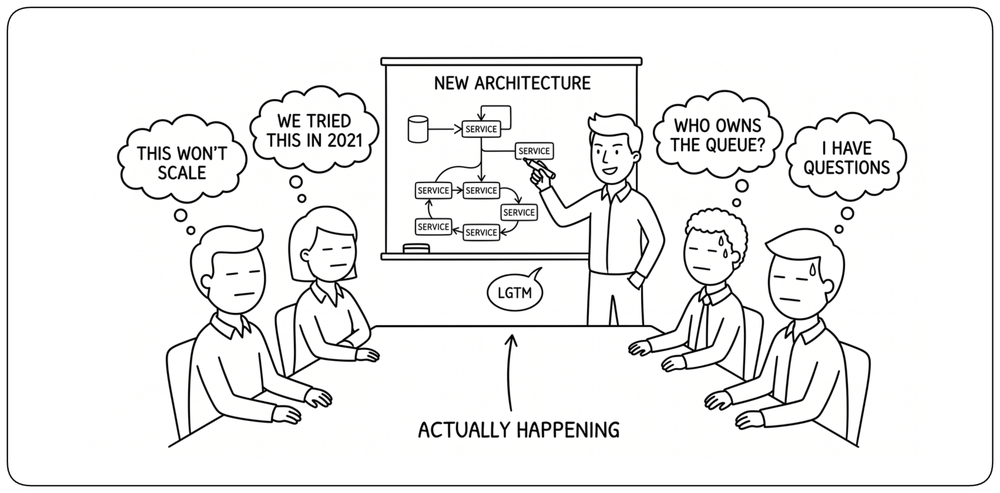
The hardest sentence in engineering is "I disagree". The brain treats social pain the same way it treats physical pain — being the dissenting voice in a room feels viscerally dangerous, even when the stakes are just a design choice. So the senior stays quiet when the architecture review goes the wrong way. The reviewer approves the PR they had doubts about because pushing back means a long thread. The engineer says "yes" to the unrealistic deadline because saying "no" means a conversation they don't want to have. The junior doesn't ask the question that would have caught the bug. !!Most bad decisions in software are not made — they are tolerated in silence by people who saw the problem and chose not to fight.!! The damage isn't loud; it's the absence of a sentence that should have been said.
Why Humans Avoid Responsibility [Ownership Mindset] {1}
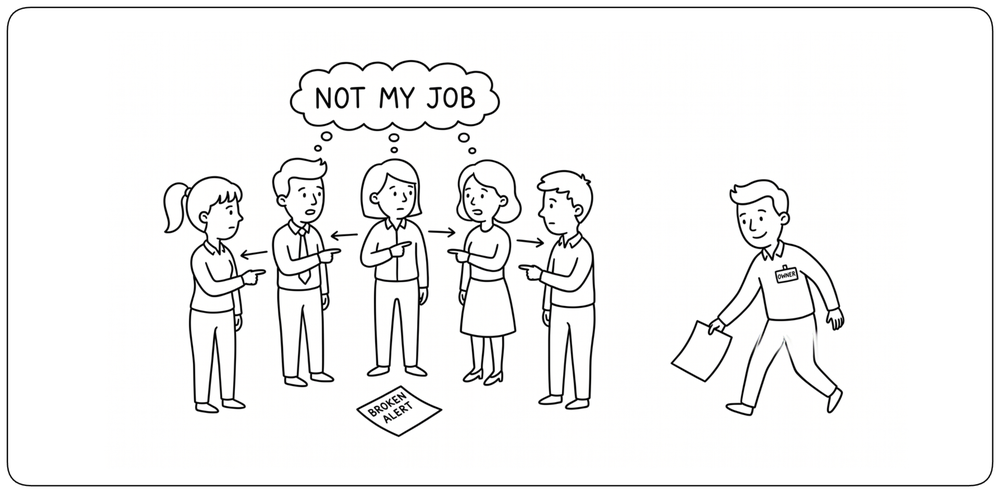
Every system, service, and decision needs an owner. Without one, responsibilities blur, tasks stall, and problems go unresolved — not from negligence, but from ambiguity. Psychologically, !!diffused responsibility is comfortable!!: if no one is clearly accountable, no one can be blamed. This is the bystander effect applied to software. A designated owner breaks that pattern — driving consistent decision-making, addressing risks proactively, and ensuring nothing falls through the cracks.
The Team: A Counterweight to Human Nature [The Team] {1}
No engineer can correct their own blind spots from the inside. The team exists to do for the individual what the individual cannot do alone: catch the shortcut before it ships, share the load that would otherwise turn into a hero, hold the standard nobody would hold against themselves at 6pm on a Friday. !!A team doesn't just divide the work — it regulates the behavior of each member.!! What follows is what a healthy team actually does for the engineer at the keyboard — and the one cost that comes with it.
Why Teams Mitigate Human Nature [Teamwork] {1}
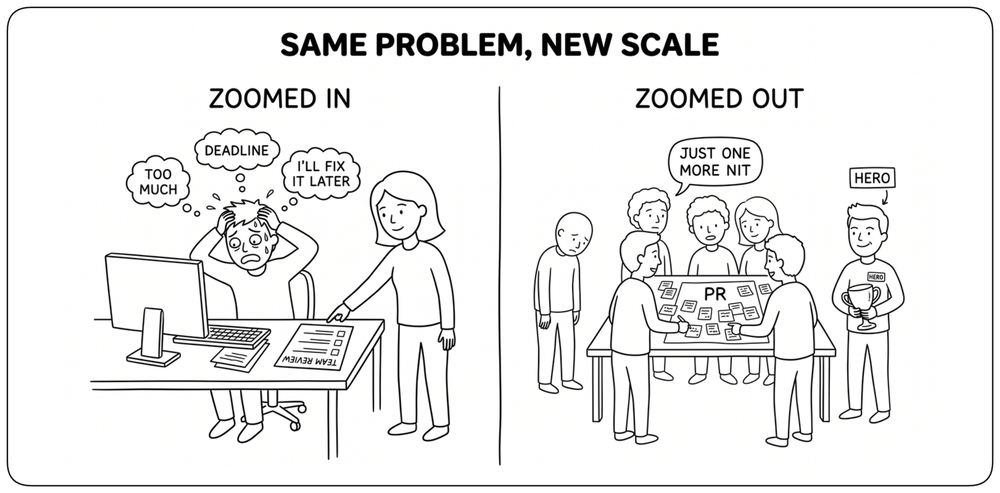
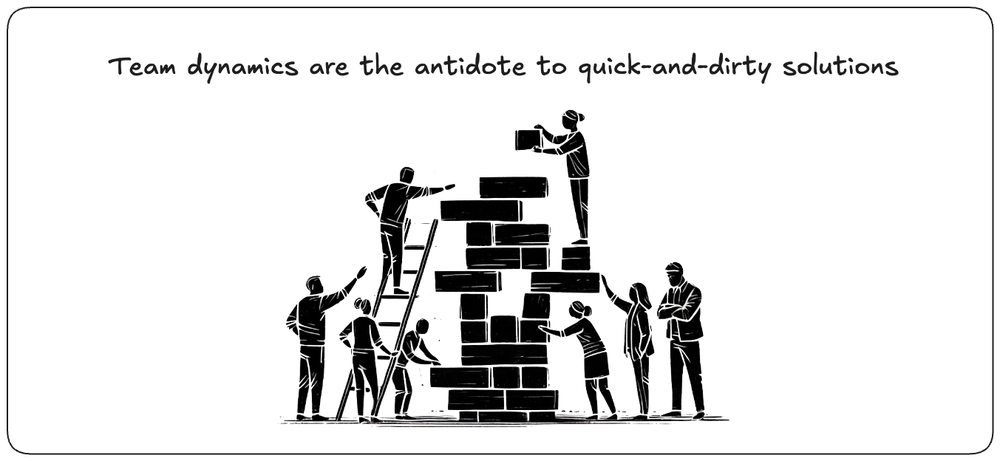
Individuals are biased toward short-term solutions; teams counteract that. Peer reviews catch what individuals miss, collaborative planning resists shortcuts, and shared ownership distributes the cost of decisions. Just as a child waits longer for a reward when supported by peers, developers in collaborative environments adopt disciplined practices they would never sustain alone. !!The team doesn't make the engineer stronger — it makes the shortcuts socially expensive.!! That single shift is what turns a group of people into something more reliable than any one of them.
Psychological Safety: The Foundation of Real Teams [Psychological Safety] {1}
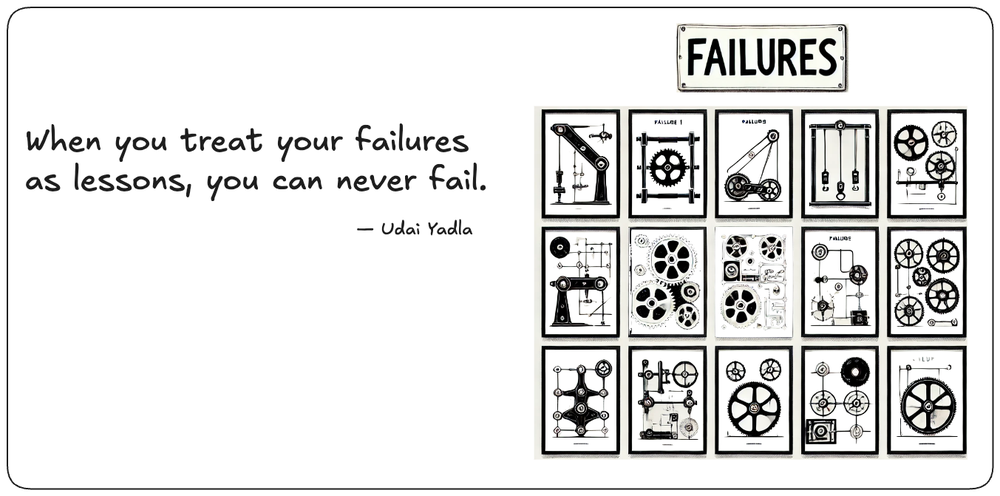
Google's Project Aristotle, echoing Amy Edmondson's research, identified psychological safety as !!the single strongest predictor of team performance!! — above talent, tenure, or process. It is the right to say "I don't know", "I was wrong", "this won't work" without being punished. Without it, engineers hide problems until they become incidents, juniors stop asking the questions that prevent bugs, and post-mortems turn into theatre. The same condition makes failure productive: !!resilience is not built by avoiding failure, but by learning faster from it than anyone else!! — and that learning only happens when people feel safe enough to name what went wrong. Blameless culture isn't a soft skill — it's the condition under which engineering judgment actually surfaces.
You Build It, You Run It [You Build You Run] {1}
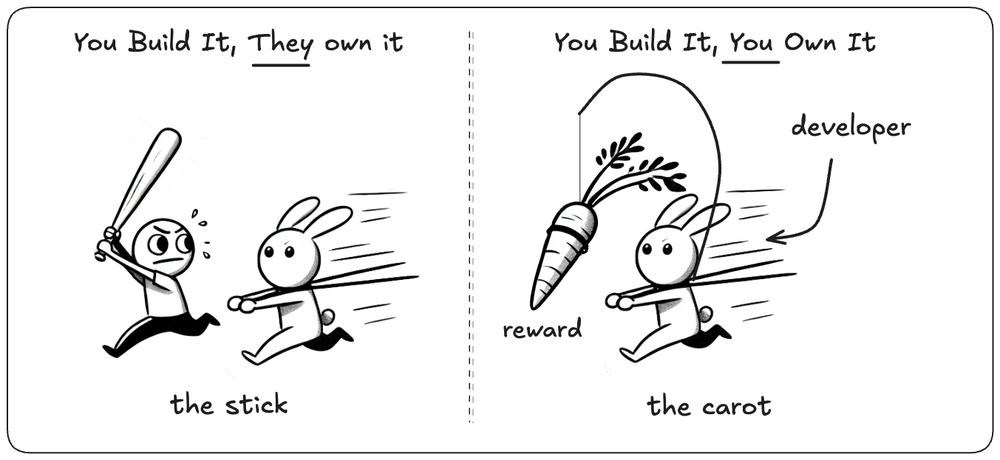
When a team owns what it builds — all the way to production — everything changes. They stop optimizing for handoffs and start optimizing for reliability. !!Knowing you'll be the one paged at 2am is a powerful incentive!! to write better code, add proper tests, and invest in documentation. The shift goes deeper than process: ownership rewires how the team thinks. Investments in architecture, runbooks, and observability stop feeling like overhead and start feeling like self-defense — because the team will be the one living with the consequences. The mindset moves from "that's not my job" to "how can I make this not break again?" — and that's when systems stop being shipped and start being cared for.
Rituals That Outlast People [Rituals] {1}
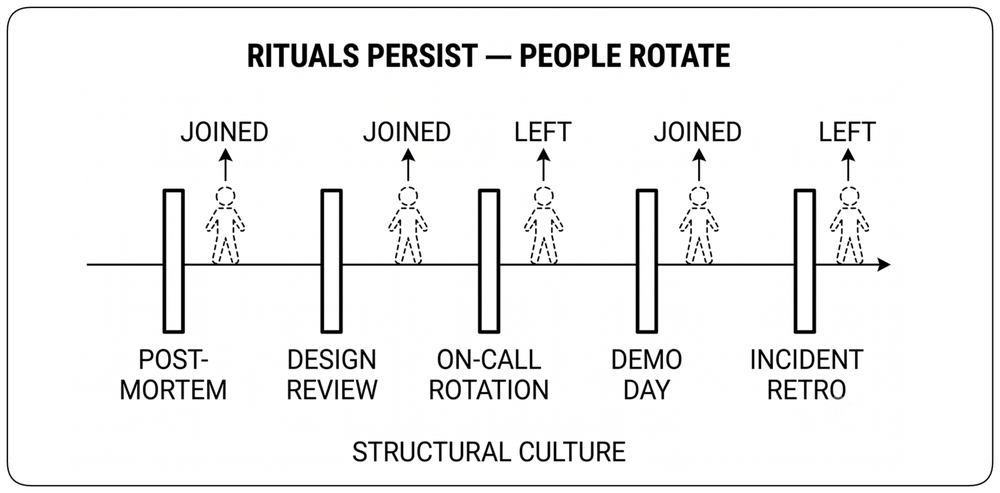
Individuals leave. Teams change. Only rituals persist. Blameless post-mortems, design reviews, on-call rotations, demo days, incident retros — these are not bureaucracy, they are the team's immune system. A good ritual makes a desired behavior structural: it happens whether or not anyone feels like it that day. !!Without rituals, culture is held together by the goodwill of whoever happens to be in the room!! — and the day they leave, the culture leaves with them.
The Devil's Advocate Role [Devil's Advocate] {1}
!!Janis, who named Groupthink, prescribed its antidote: appoint someone to argue against.!! A devil's advocate isn't a contrarian — it is a structural role rotated through the team, whose job in a given meeting is to stress-test the consensus before it locks in. The role gives social cover to dissent: !!the objection is no longer a personal attack, it is a job someone was asked to do.!! Without that scaffolding, the same engineer who had doubts will stay silent — and the team will mistake their silence for agreement.
Bus Factor: Spread the Knowledge [Bus Factor] {1}
A team's bus factor is the number of people who could be hit by a bus before the system stops working. A bus factor of one is the hero in disguise — convenient, fragile, and almost certain to fail eventually. The discipline of raising the bus factor is undramatic: pair on the unfamiliar code, rotate the on-call, write the docs nobody wants to write, refuse to be the only one who knows. !!A team with a bus factor of one isn't lucky — it's borrowing against a debt the org will be forced to pay, on a date nobody chooses.!! Spreading knowledge is slower than concentrating it; it is also the only way the team survives its own success.
Outside Eyes: Inviting the Newcomer's View [Outside Eyes] {1}
!!A team that has worked together too long stops seeing its own oddities.!! The fix is structural: invite outside eyes deliberately. Ask the new hire in week two what looks weird, run a cross-team code review every quarter, have a different team's tech lead read your design doc. !!The questions that feel naive from a newcomer are exactly the ones the team has stopped asking.!! Outside eyes are uncomfortable on purpose — that discomfort is the team's own blindness being lifted, one question at a time.
The Cost of Cohesion: When Agreement Becomes the Goal [Groupthink] {1}
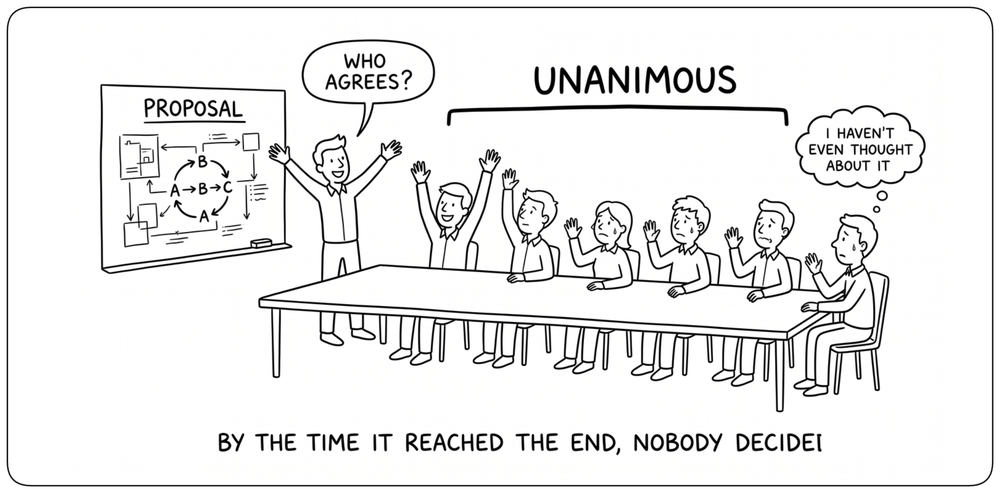
A team that runs well grows close — and a team that grows close starts agreeing too easily. Irving Janis called this Groupthink: cohesion pushes the room toward whichever opinion forms first. A senior floats a direction, two heads nod, the social cost of disagreement compounds with each silent nod, and the decision is made before anyone has actually decided. The very bond that made the team strong is what now closes the conversation. !!The team is the answer to the individual — but the well-functioning team becomes its own next problem, and that problem only grows when teams meet other teams.!!
Cross-Team: Human Nature at Work [Cross-Team Nature] {1}
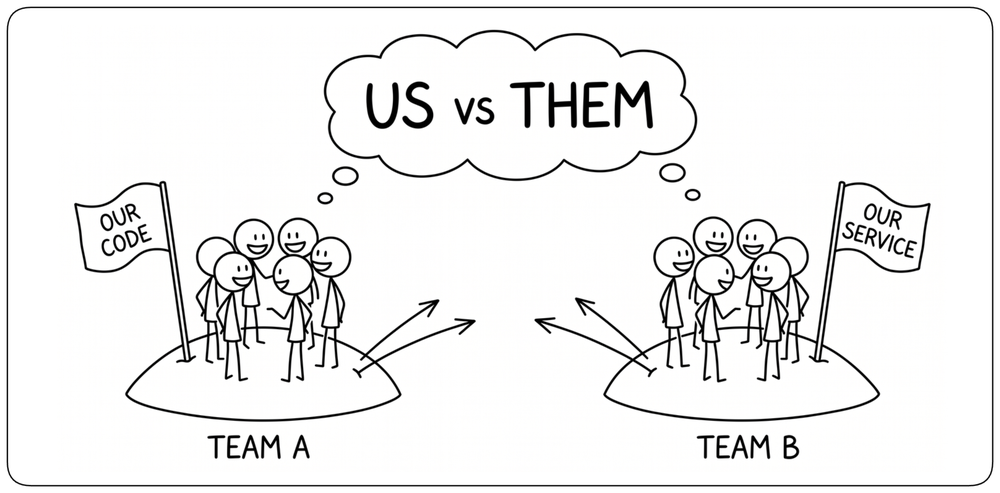
!!The same cohesion that holds a team together turns it into a tribe when it meets another team.!! What looked like good engineering behavior inside the perimeter — defending the codebase, protecting quality, owning the service — becomes territorial behavior across the perimeter. !!Cross-team friction is not a process failure; it is the predictable consequence of giving each team a perimeter to defend and an identity to protect.!!
In-Group Blindness: The Team That Can't See Itself [In-Group Blindness] {1}
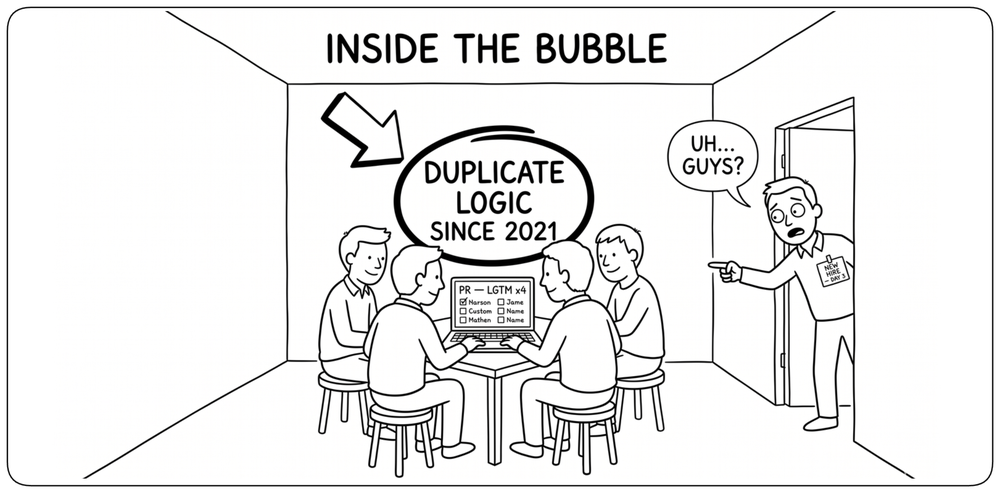
Before a team becomes a tribe, it first stops seeing itself. After enough time together, members share vocabulary, assumptions, and a shared blind spot. Reviews between long-time teammates pass over what a newcomer would catch in thirty seconds — the weird naming, the duplicated logic, the unwritten rule that "everyone knows this is how we do it". !!Familiarity dulls judgment instead of sharpening it — the more a team agrees, the less it sees.!! This is the first step of tribal behavior: not yet hostility toward outsiders, just the quiet conviction that nothing outside the room is worth looking at.
Teams Become Tribes [Teams as Tribes] {1}
What makes a team work — shared language, shared rituals, shared identity — is also what turns it into a tribe. Strong internal cohesion creates strong external boundaries. Teams develop their own vocabulary, their own heroes, their own enemies. !!The antidote at the individual level becomes the problem at the group level: the same cohesion that regulates individual behavior produces inter-team hostility.!! It is not bad people — it is the predictable outcome of giving a group of humans a shared purpose and a perimeter to defend.
Conway's Law as a Curse [Conway's Curse] {1}
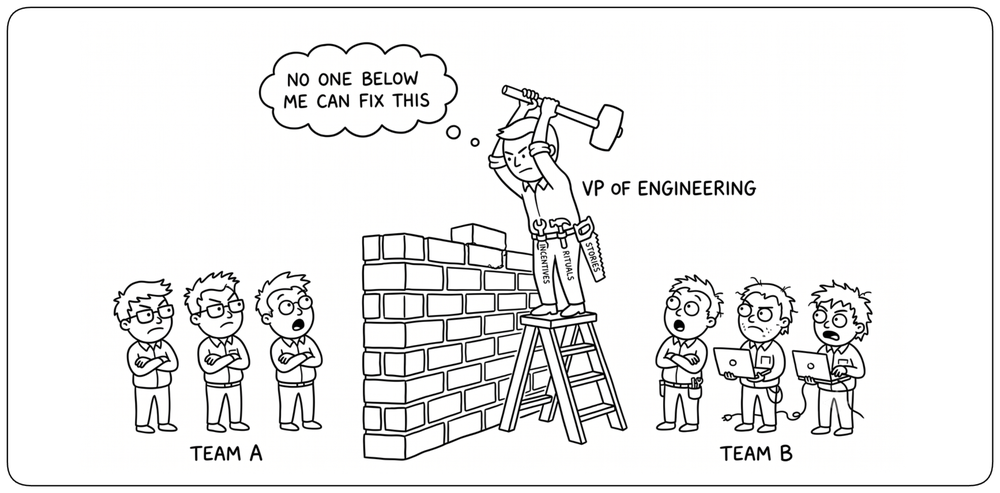
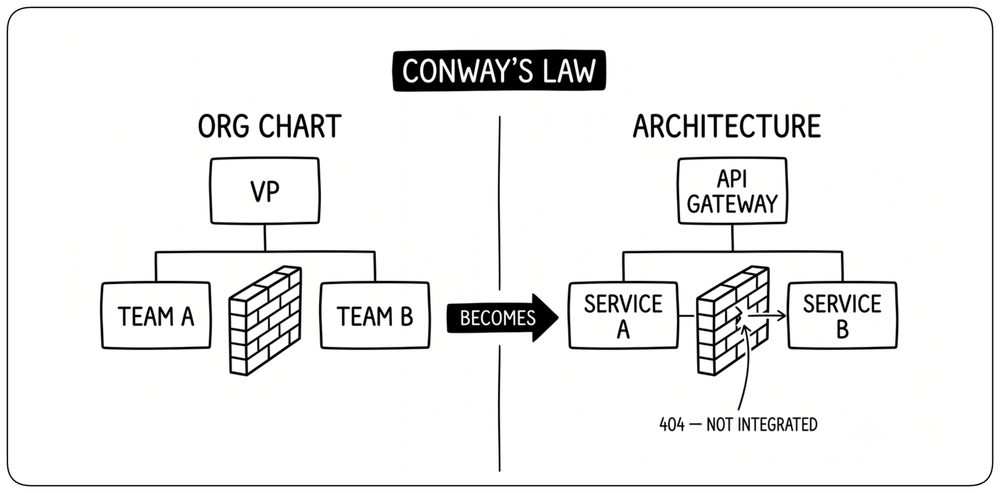
In 1968, Melvin Conway observed that systems mirror the communication structure of the organizations that build them. Two teams that don't talk produce two services that don't integrate. A reorg into four groups produces four microservices, whether or not the domain needs four. !!You cannot ship an architecture cleaner than your org chart!! — the wall between teams becomes a wall in the code, the silent meeting becomes a missing API, and the political compromise becomes a permanent abstraction nobody can remove.
Not Invented Here: Why Teams Rebuild the Wheel [Not Invented Here] {1}
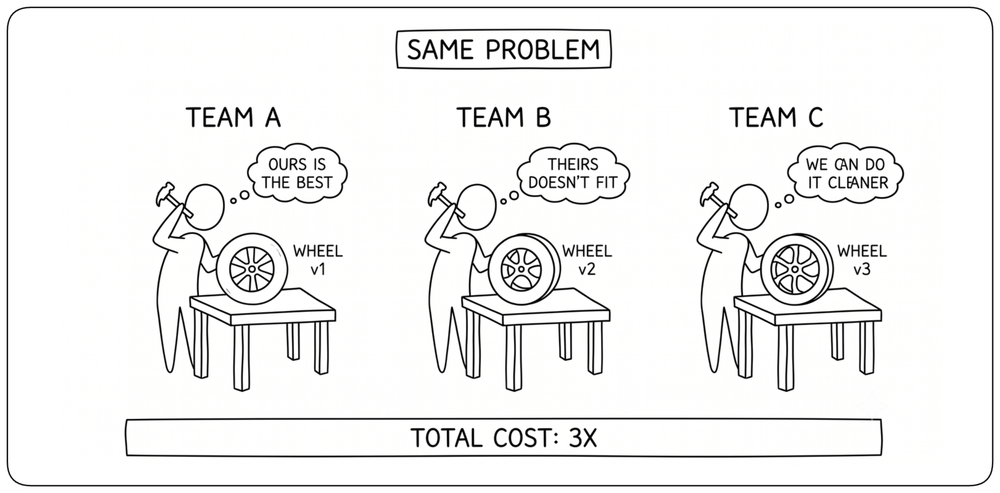
Team A solves a problem. Team B has the same problem six months later — and rebuilds the solution from scratch. The reasons are always rational on the surface: "our case is different", "their code isn't a good fit", "we'd have to wrap it anyway". The real reason is psychological: !!adopting another team's code feels like admitting they were ahead.!! Every team prefers being the author over being the user, and the org pays the cost — five implementations of the same retry logic, none of them shared, all of them subtly broken in different ways.
Cross-Team Friction: When Territory Trumps Progress [Cross-Team Friction] {1}
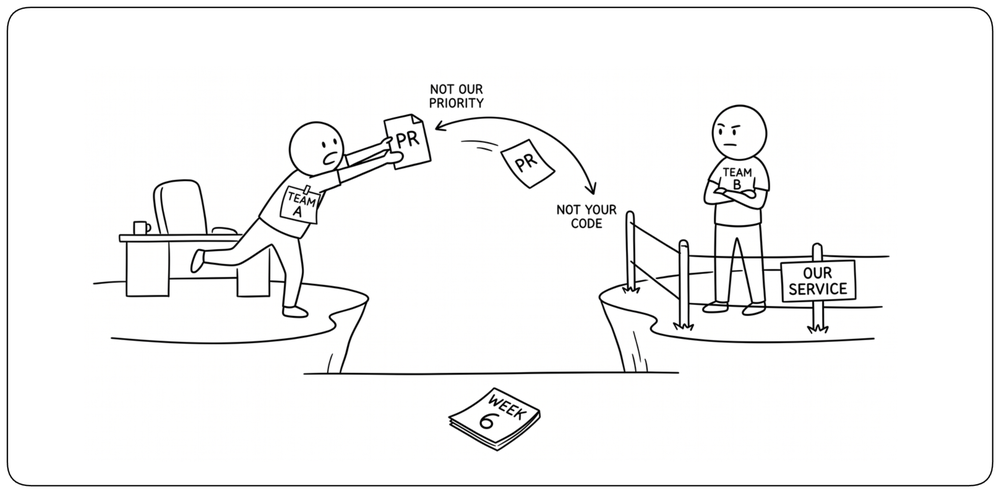
The hardest blockages in software are rarely technical — they are territorial. When team A needs a change in team B's service, the system fails twice. If A asks, B answers "yes, but it's not our priority" and the change waits indefinitely. If A submits the patch themselves, B treats it as an intrusion — reviews drag, comments multiply, the PR lingers for weeks. The code review becomes a defensive filter rather than a quality gate. !!Teams do not slow projects down because the work is hard — they slow them down to protect what they own.!!
The Coordination Tax: When Meetings Replace Work [Coordination Tax] {1}
Even when teams want to cooperate, the cost of doing it together quietly dominates the cost of doing the work. Each team adds its layer: a kickoff meeting, an alignment doc, a weekly sync, a status update, a steering committee. None of it is wrong on its own. Stacked, it turns a one-week change into a one-quarter project. !!The real work doesn't get harder when it crosses team lines — the talking about the work does.!! And because every meeting feels justified to the people in it, nobody is ever the one who chose to slow the project down.
Blame Across the Wall [Cross-Team Blame] {1}
When something breaks at the seam between two teams, the post-mortem becomes diplomacy. Each side narrates the incident from its own perimeter — Team A's contract was honored, Team B's service was up, and yet the customer experienced an outage. The failure lives in the gap between two definitions of "working", and the gap has no owner to blame. !!The harder the boundary, the more confidently each team can prove it wasn't them — and the longer the same incident keeps happening.!! Truth dies at the wall; only narratives survive.
The Organization: Designing the Container [The Organization] {1}
No team can fix what its own boundary created. Cross-team friction, Conway's curse, the wall where blame dies — these live above the team, and only the level above the team can reach them. The organization's lever is not code or process; it is the container in which every team operates: how managers behave, how reorgs are shaped, what gets rewarded, which stories get retold. !!You cannot rewrite human nature — but you can rewrite the environment that calls each part of it forward.!! What follows is what only an organization can do — starting with the manager closest to the team, and ending with the culture that outlives every reorg.
What Drives Engineers: Autonomy, Mastery, Purpose [Autonomy Mastery Purpose] {1}
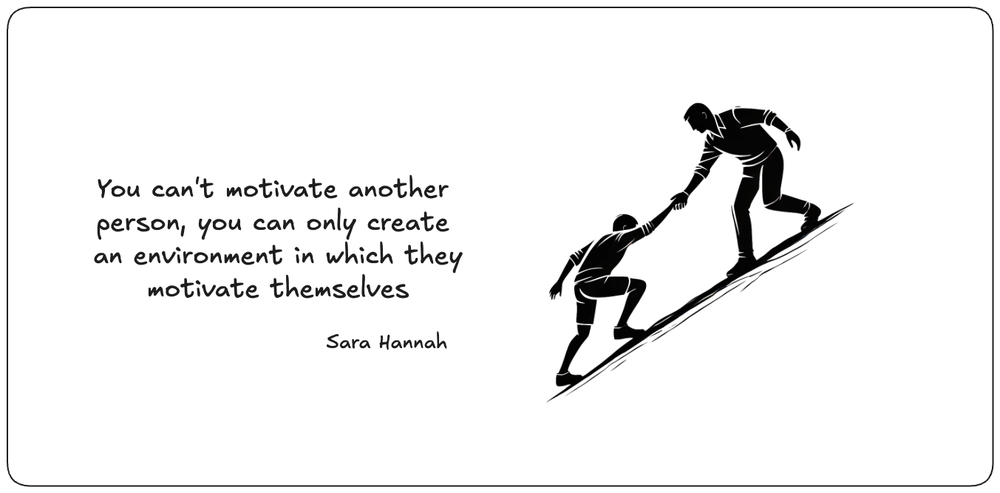
Money buys compliance, not engagement. What actually drives engineers is what psychologists call Self-Determination Theory: autonomy, mastery, and purpose. Engineers thrive when they have control over their work, feel skilled in their tasks, and see the impact of their contributions. Leaders who create space for experimentation — where mistakes are learning opportunities, not failures to punish — keep engineers engaged through change. Ownership amplifies this effect: when development and operations are aligned, the engineer focuses on long-term sustainability instead of quick fixes, and quality becomes a natural priority. !!Recognition doesn't have to be financial — sometimes acknowledgment is enough.!!
The Manager Who Listens [Manager Listens] {1}
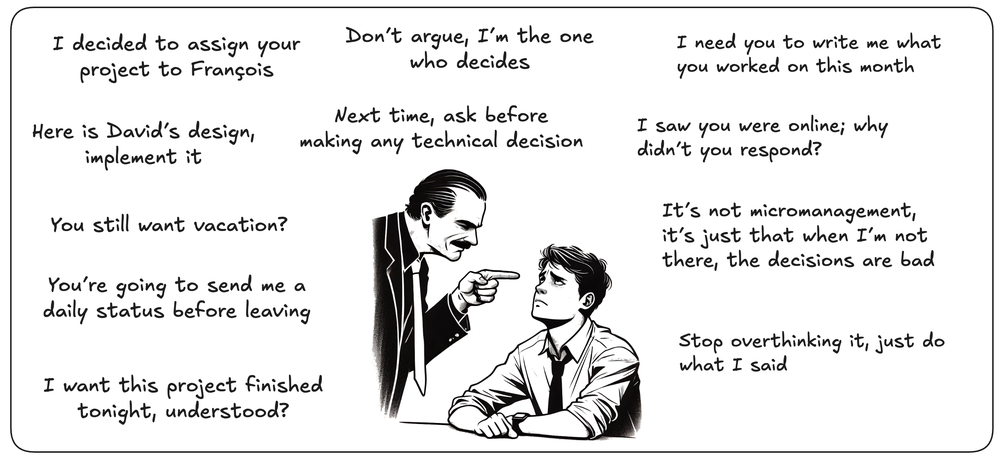
The 1:1 isn't a status meeting. It is the only channel in the org where the truth gets said quietly — what's blocked, who's frustrated, what's actually going on under the polite stand-up answers. A manager who fills the 1:1 with status updates closes that channel forever. A manager who listens — who asks open questions, sits with silences, and refuses to fix the problem before the person has finished naming it — opens a stream of information no dashboard ever surfaces. !!The manager's most undervalued skill is not deciding faster — it is making it safe to tell the truth slower.!! Everything else they do depends on what they hear here.
Shielding the Team from Politics [Manager Shield]
A team cannot fight the org chart. The manager can. Surprise demands from leadership, contradictory priorities from product, visibility theater from skip-levels — the team should see none of it. A manager who lets the political weather hit the team directly is not being transparent; they are being a passthrough for noise. !!The manager who absorbs the chaos lets the team do real work; the manager who broadcasts it makes the team into a second meeting room.!! Shielding doesn't mean hiding decisions — it means doing the political work outside the team so the team can do the engineering work inside.
Recognizing the Invisible Work [Recognition] {1}
The work that prevents the outage is invisible. The work that mentors a junior is invisible. The refactor that makes next quarter's project easy is invisible. The manager is the only person in the system who can see all of it — they sit close enough to notice, and high enough that their recognition counts. !!If the manager doesn't see invisible work, the org doesn't!! — and the engineer doing it learns, slowly, that craft is not what the company actually rewards. Recognition isn't a perk; it is the manager's primary tool for steering behavior. What gets named gets repeated.
The Inverse Conway Maneuver [Inverse Conway] {1}
If systems mirror the org chart, the lever is obvious: design the org to produce the architecture you want. The Inverse Conway Maneuver treats team boundaries as a design surface. Want loosely coupled services? Build loosely coupled teams. Want a shared platform? Form the team that owns it before the platform exists. !!Reorgs are not HR events — they are architectural decisions with a delay of six months.!! Most orgs reorg for political reasons and then wonder why the architecture refuses to follow; the leaders who reverse the order get the systems they actually wanted.
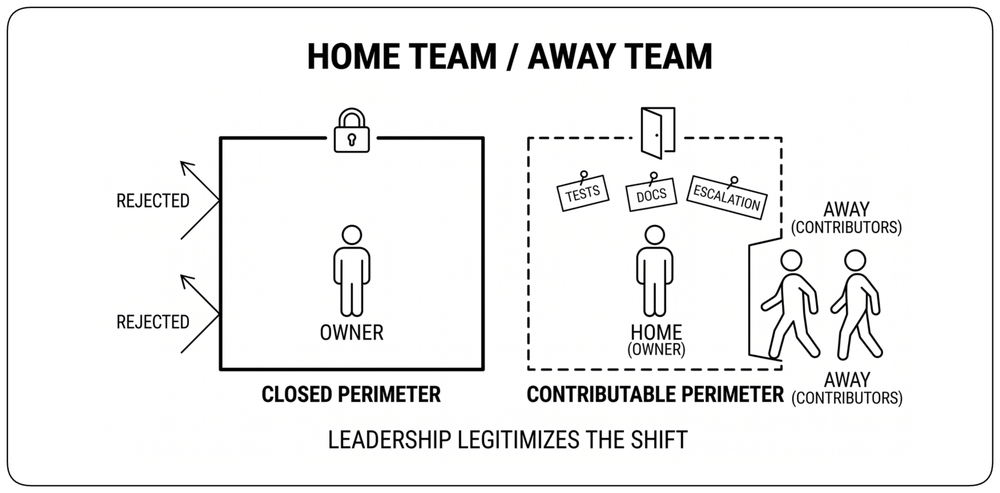
Home Team, Away Team: The Contributable Perimeter [Home/Away] {1}
The healthy pattern is the home team / away team model. The owning team keeps full responsibility in production, but actively makes its perimeter contributable: clear contribution rules, tests strong enough to trust outside changes, documentation that lowers the cost of entry, and an escalation path when teams disagree. The shift is psychological — from "I protect my territory" to "I make my territory contributable". !!It cannot come from engineers alone — leadership has to legitimize the model, reward owners who accept external patches, and refuse to punish them when those changes cause incidents.!!
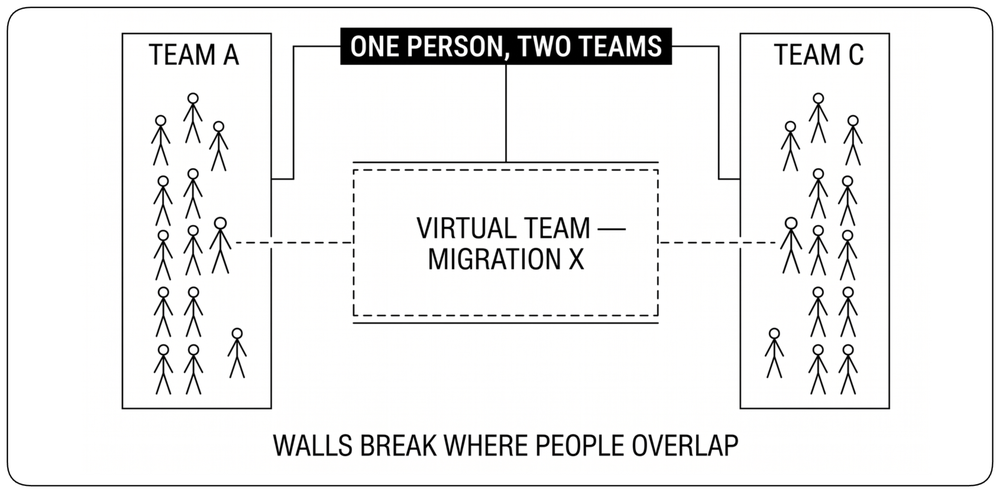
Virtual Teams: Break the Walls Through People [Virtual Teams] {1}
Org charts create walls. Virtual teams break them. A virtual team is a temporary group pulled from different orgs around a shared project — a migration, a platform initiative, an incident review board. The members keep their home team, but for the duration of the project they meet, decide, and ship together. The effect is not just delivery: the engineers who shared that virtual team stop being strangers. !!Once two engineers from different orgs have built something together, they answer each other's messages — the wall is gone, not because policy changed, but because the people did.!! Leadership's job is to legitimize these teams: give them a name, a charter, time, and recognition equal to home-team work.
Internal Open Source: Default to Reuse [Internal Open Source] {1}
Not Invented Here doesn't die from goodwill — it dies when reusing is cheaper than rebuilding. Internal open source makes that the default: every team publishes its useful libraries to a discoverable internal registry, with contribution rules, tests, and an owner who reviews patches. !!Sharing wins only when finding, using, and contributing back are each easier than starting from scratch.!! The org pays once and saves five times — and engineers get something money can't buy: their code travels beyond the team, the recognition reaches further than their direct manager, and the work becomes visible in a way no internal review can match.
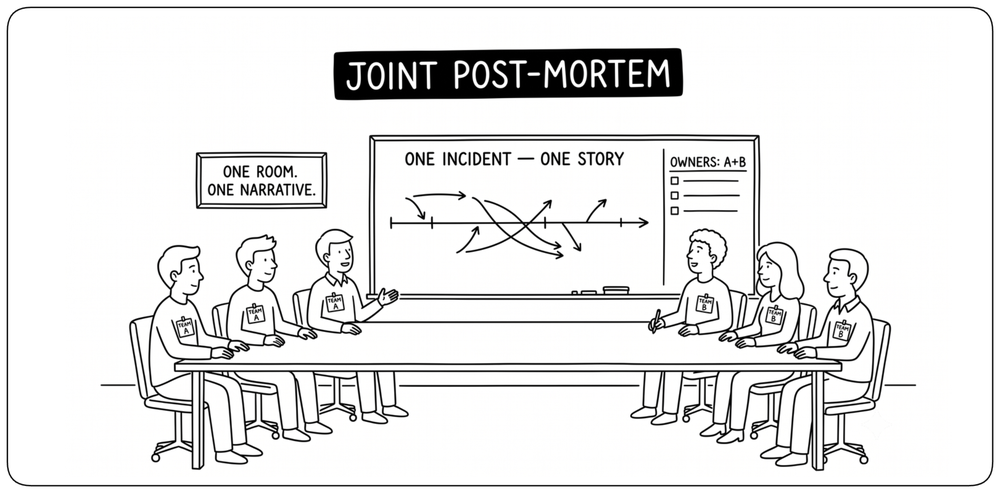
Joint Post-Mortems Across Teams [Joint Post-Mortems] {1}
When an incident crosses a team boundary, the post-mortem must cross it too. Both teams sit in the same room, one timeline gets drawn, one set of action items gets owned. The pull is toward separate post-mortems, each side telling its own narrative — that pull is exactly what produced the incident in the first place. !!Truth at the boundary survives only when both sides own the same story!! — and the only person who can compel that joint room is leadership. Without it, the next incident is already on the calendar.
Aligned Incentives: Reward What You Want to See [Aligned Incentives] {1}
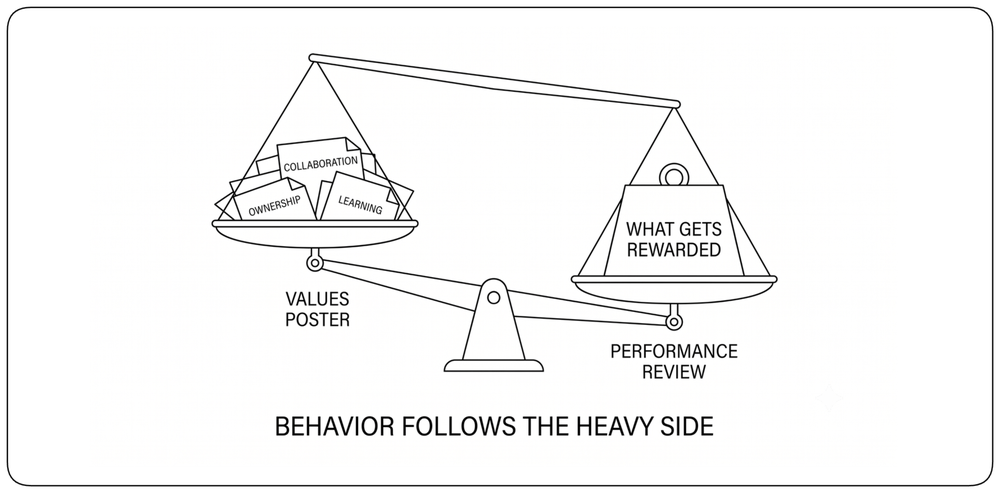
Behavior follows incentives. If promotion requires shipped features, engineers ship features. If prevention is invisible and outages get celebrated, engineers wait for outages. If owning a service makes you safer and changing one makes you exposed, no one will touch a service that is not theirs. Sales closes a deal — bonus. An engineer saves millions by preventing an outage — thank-you email. !!When organizations reward visibility over impact, engineers learn to focus on what gets noticed, not what matters.!! Fixing roots — debt, security, infrastructure — is invisible until it isn't. Organizations get the culture they pay for, and most pay for the wrong one. !!The hardest organizational lever is not the values statement; it is the performance review.!!
Culture Is What Leaders Tolerate and Celebrate [Leaders Tolerate] {1}
Every organization has written values. None of them matter. The real culture is the set of behaviors that go unpunished and the stories that get retold. A senior who blocks every external PR sets the rule. A leader who praises the hero who shipped through chaos sets the rule. The engineer who refused to release something half-broken becomes the legend — or doesn't. !!Culture is the average of what leaders ignore, accept, and celebrate!! — and a single tolerated behavior outweighs a hundred lines on a values poster. New hires read the room in their first weeks: they watch which stories travel, which behaviors get promoted, which shortcuts go unspoken. That is the culture they will inherit.
Culture Is the Hardest Refactor [Culture Refactor] {1}
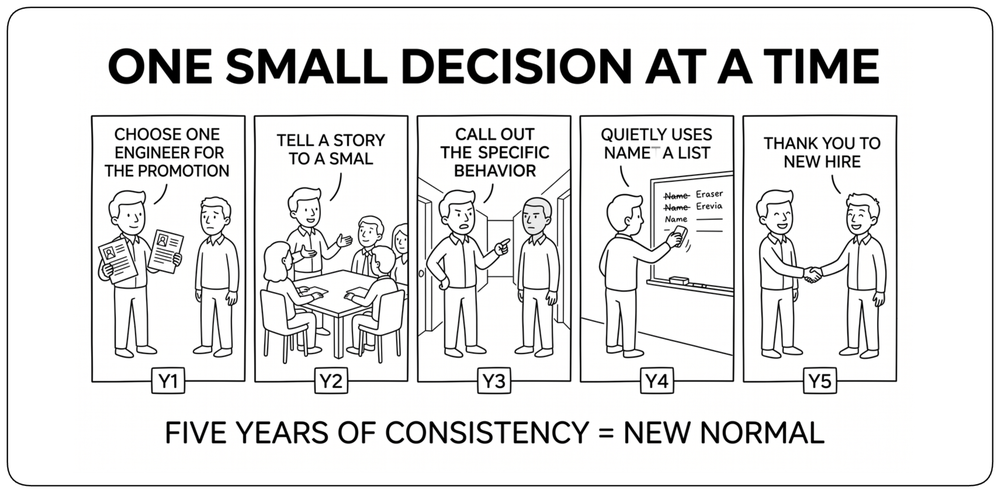
You can rewrite a codebase in six months. Rewriting a culture takes years. Behaviors, beliefs, and unwritten rules are reinforced every day by every interaction, and they outlive every reorg. There is no announcement, no all-hands, no values document that changes culture. !!Only thousands of small, consistent decisions — who gets promoted, which stories get told, what gets called out, what gets tolerated — repeated until they become the new normal.!!
Design the Container, Not the People [Design the Container] {1}
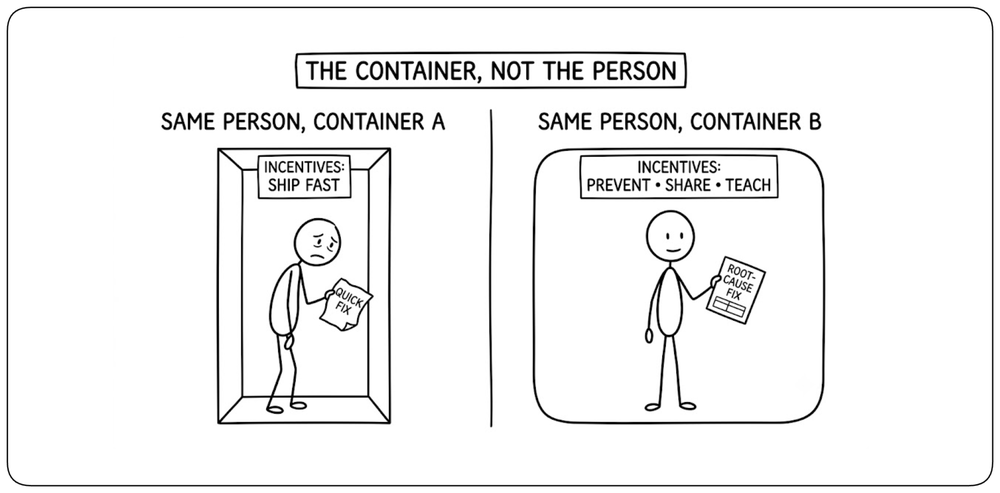
Software leaders waste years trying to change people. The leaders who actually change outcomes do something different: they change the container. They redesign incentives so that prevention is rewarded as loudly as delivery. They install rituals so that good practice happens without depending on heroes. They tell the stories that promote the behaviors they want repeated. !!You cannot rewrite human nature — but you can rewrite the environment that calls each part of it forward.!! The same engineer behaves very differently in two different organizations; the difference is the container, not the person.
The Blind Spots — Where No One Looks [Blind Spots] {1}
Each of the three levels has its own pathologies and its own mitigations. But some failures don't belong to any level — they live in the space between people, teams, and contracts. Like the blind spot in a car's mirror, they are invisible from every position: the individual doesn't see them because they're outside their work, the team doesn't see them because they're outside their perimeter, and no one reports what no one owns. These are the failures everyone walks past, until something breaks and everyone points sideways.
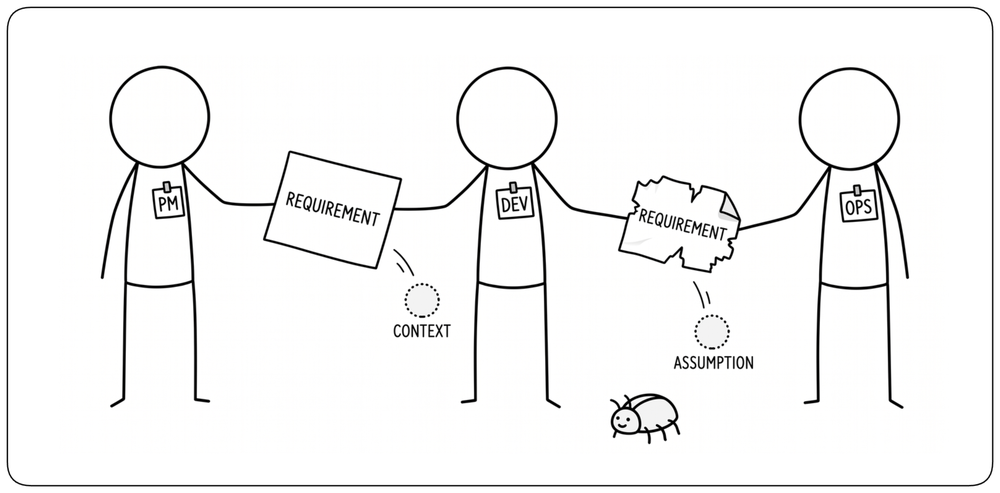
Bugs Live in the Handoffs [Handoffs] {1}
!!Most bugs are not born in code — they are born in transitions.!! Between product and engineering, between two services, between specs and implementation, between the team that ships and the team that operates. Each handoff drops context: assumptions become invisible, edge cases get forgotten, ownership dissolves. !!The defect is rarely in the code; it's in the gap between two heads that never had the same conversation.!! Better tests don't fix this — better conversations do.
The Ticket That Never Lands [Ticket Ping-Pong] {1}
!!When work moves through many hands before it lands, ownership dissolves on the way.!! Each transfer is locally reasonable — the current holder genuinely isn't the right one — but globally, no one owns the journey itself. The cost of that journey is real, yet it falls into the gap between perspectives: every participant only sees the brief window in which they held the work, never the cumulative latency the customer actually experiences. !!The more hands a piece of work passes through, the less anyone owns its outcome.!! This is a textbook blind spot — the failure is invisible from every individual position, which is exactly why it survives dashboards, retros, and postmortems. A ticket reassigned five times is the canonical example: each team remembers a day, the customer remembers two weeks, and no one is wrong.
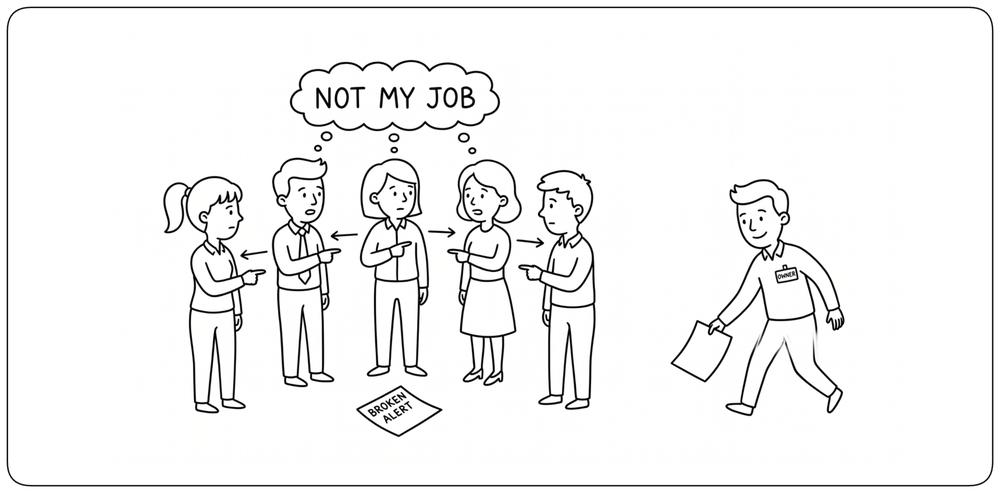
When Everyone is Responsible, No One Is [Unclear Ownership] {1}
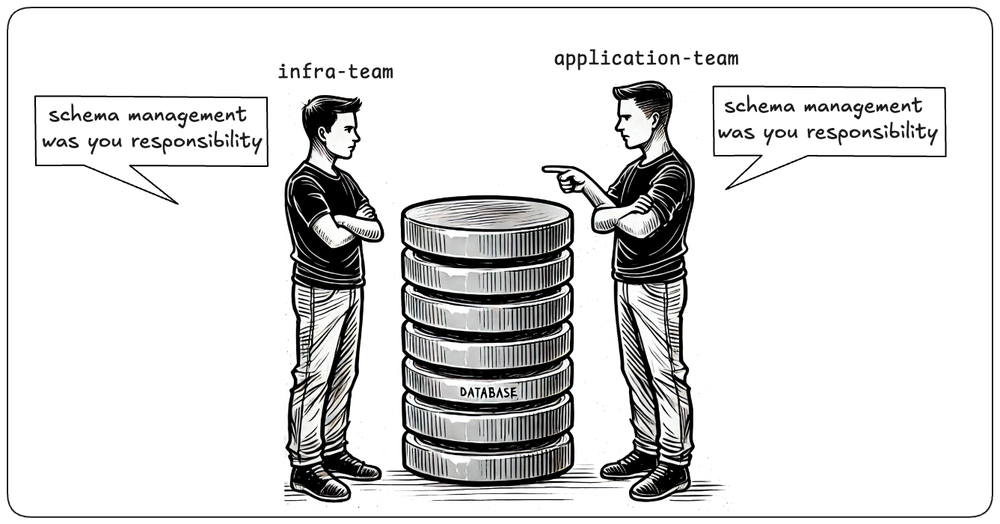
!!In complex systems, tasks fall through the cracks when both sides assume the other is handling it.!! Security configs, operational processes, monitoring — all become orphaned responsibilities. These gaps are invisible until something breaks. The fix isn’t more coordination meetings — it’s clear, explicit ownership for every responsibility, defined before a problem arises.
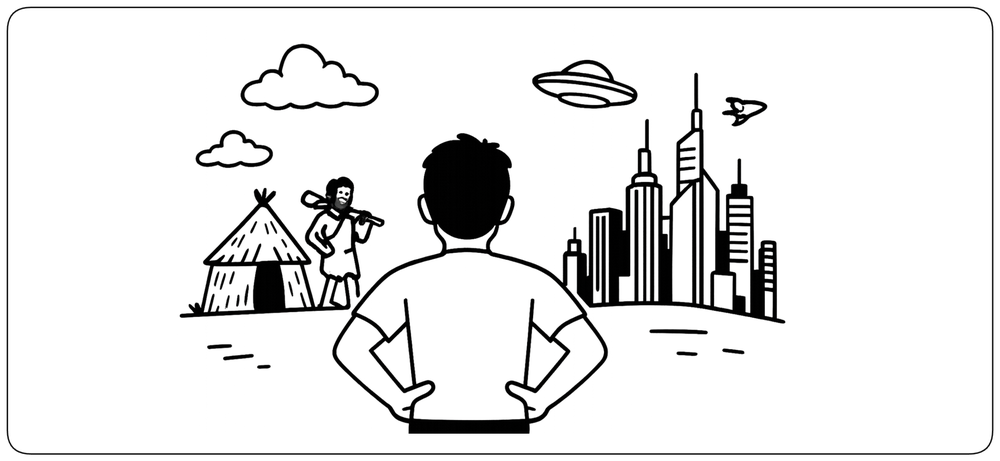
The AI Era [The AI Era] {1}
!!AI is not just changing how developers work — it is changing what a developer is.!! The role, the status, the daily pressure, the very identity of the profession are being reshaped at a pace no generation has experienced before. !!Understanding this transformation matters as much as understanding the cognitive risks: the rules of the craft are being rewritten while it is still being practiced.!!
The AI Hype Trap [AI Hype Trap] {1}
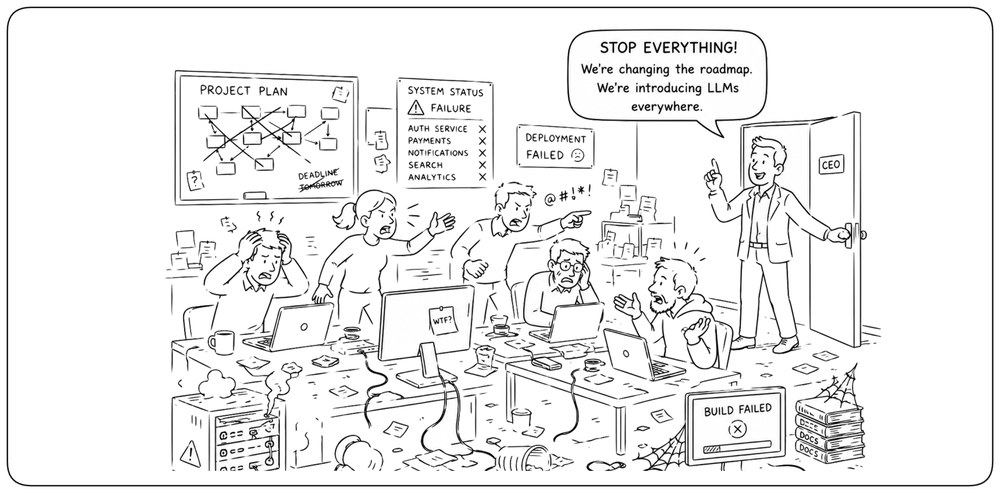
Since the release of ChatGPT, AI is everywhere — every roadmap has it, every pitch mentions it, every team is "exploring it." But for most companies, it's a distraction from problems that are far more urgent. Unreliable deployments, poor observability, crumbling legacy systems, untested code, unclear ownership — these don't get fixed by adding a chatbot. !!AI amplifies what's already there!!: if the foundation is broken, AI only makes the mess faster and more expensive. The harder discipline is not racing to adopt the next trend, but admitting whether the ground beneath it is even ready.
From Coder to Architect [Role Evolution] {1}
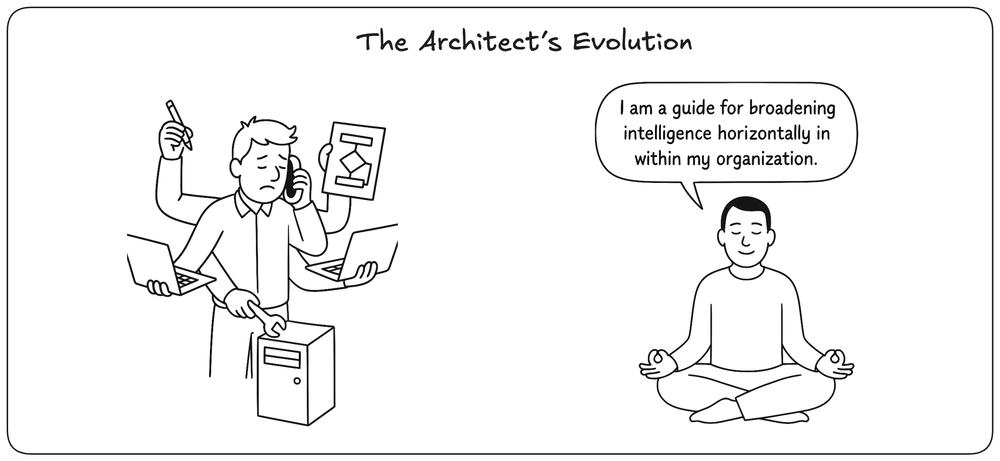
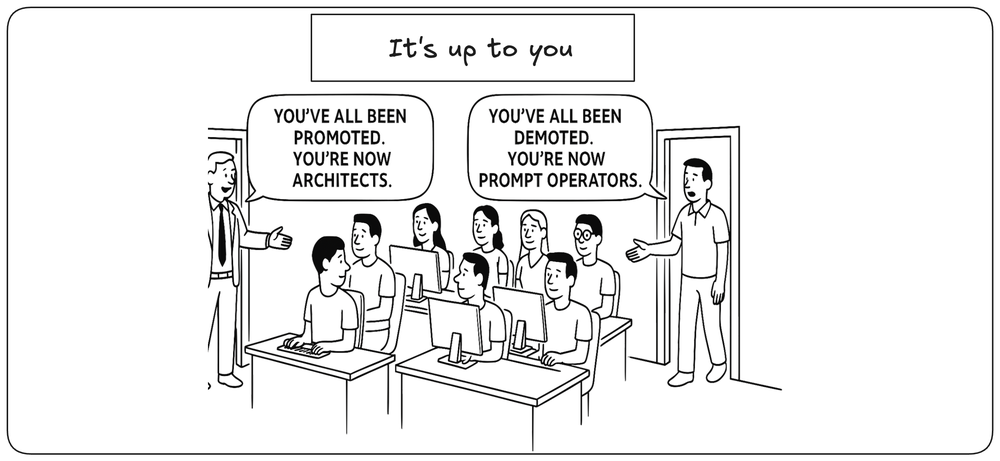
Most production code is now suggested by AI, and that simple fact rewrites the job description. Engineers spend less time typing syntax and more time on architecture, system design, security, scalability, and business alignment. The value of an engineer is no longer measured by how fast they produce code, but by !!how well they decide what code should exist!!. This shift mirrors the historical move from machine code to high-level languages — but compressed into months instead of decades. The craft isn't disappearing; it's being elevated, whether developers are ready for it or not.
The Coder's Tragedy: The End of the Gatekeeper [Coder's Tragedy] {1}
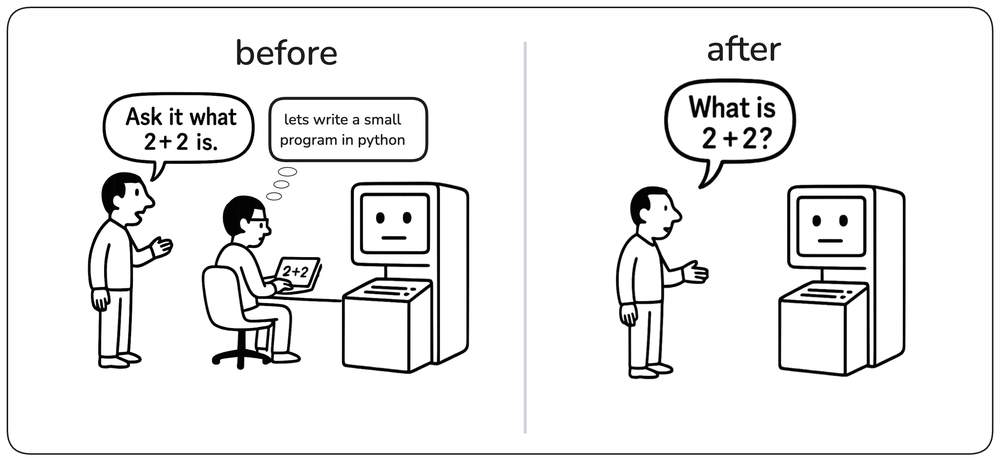
For decades, developers held a unique position — they were the only ones who could speak to machines. That exclusivity brought prestige, high salaries, and influence. Natural language ends that monopoly. Anyone able to express an idea can now build with machines, and the developer's role as translator between human intent and digital logic fades. The tragedy is not the loss of jobs — it is the !!loss of status!!. What was once earned through years of study becomes a commodity, and the middleman who once stood between humans and computers steps aside.
Just in Time to Burn Out [Productivity Pressure]
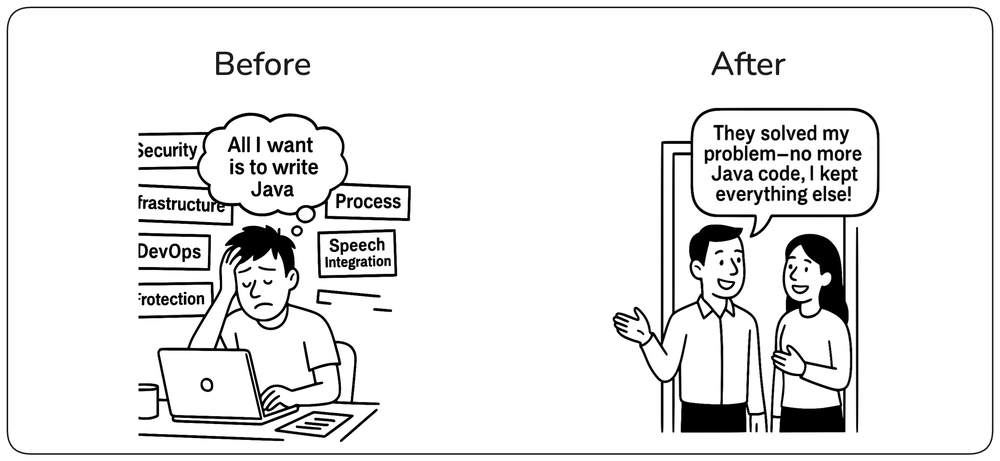
AI was supposed to lighten the load. In practice, it raises the bar. When everyone is presumed 10x faster, deadlines tighten, near-flawless execution becomes the norm, and inefficiencies that were once invisible become quantifiable and exposed. !!A tool designed to reduce cognitive load ends up increasing stress by turning productivity into a continuous public measurement.!! AI assistance arrived just in time — not to rescue developers, but to demand even more from them.
The Golden Age of Developers [Golden Age]
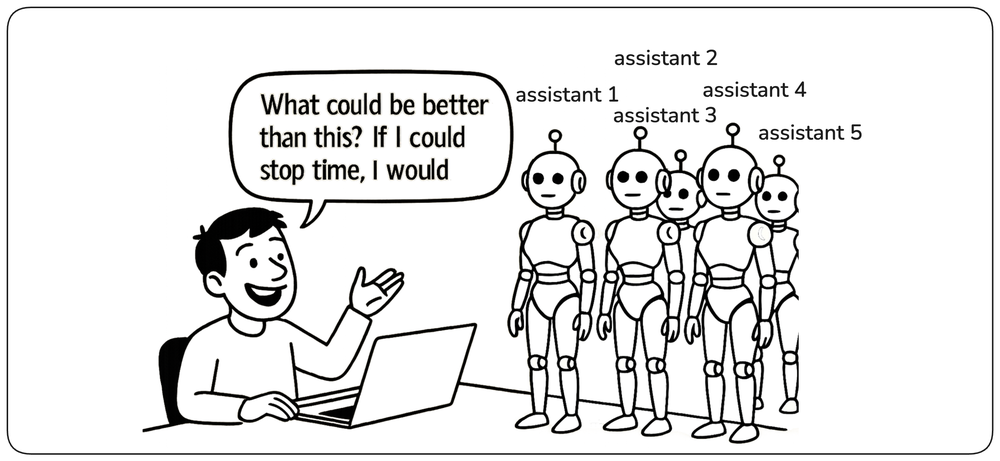
This may well be the golden age of programming — a brief window where human creativity and machine efficiency are in balance, where developers are amplified rather than replaced, and where expertise still commands the room. Intelligent assistants reduce friction without removing the joy of building. If we could pause time, this is the moment many engineers would freeze: before full automation, while craftsmanship still matters, while the satisfaction of solving hard problems still belongs to humans.
The Impact of AI on Developers [AI Impact] {1}
If the AI Era reshapes what developers do, the deeper transformation is what it does to their minds. AI tools have fundamentally changed how software is built — they promise speed, automation, and accessibility, but they also introduce new psychological risks. Understanding how developers interact with AI-generated code reveals deeper patterns about trust, cognition, and the changing nature of engineering itself.
The Double-Edged Sword of AI [AI Double-Edged Sword] {1}
!!AI may come to the rescue, but it doesn't come without risk.!! On one hand, it gives developers the chance to rise—freeing them from code so they can focus on design, architecture, and deeper learning. It can expand their capabilities, speed up development, and make knowledge more accessible. On the other hand, it risks turning developers into passive operators, relying on tools they no longer fully understand. AI can either elevate the profession—or hollow it out.
Democratization of Knowledge: The Paradox [Democratization Paradox] {1}
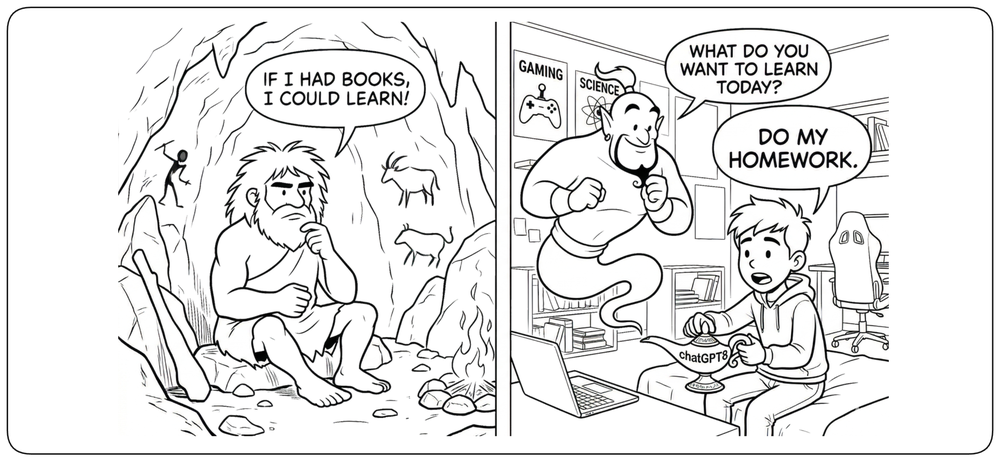
!!Years into the LLM era, one conclusion is hard to ignore: these tools have made people more effective, not more educated.!! They speed up execution and remove friction, but convenience is not instruction — making knowledge accessible does not automatically make it valued. What was once demanding and intellectually attractive becomes immediate, disposable, and less desirable to master. !!The more knowledge is instantly available, the less effort people invest in deeply understanding it.!!
Why We Accept Without Reading [Accept Without Reading] {1}
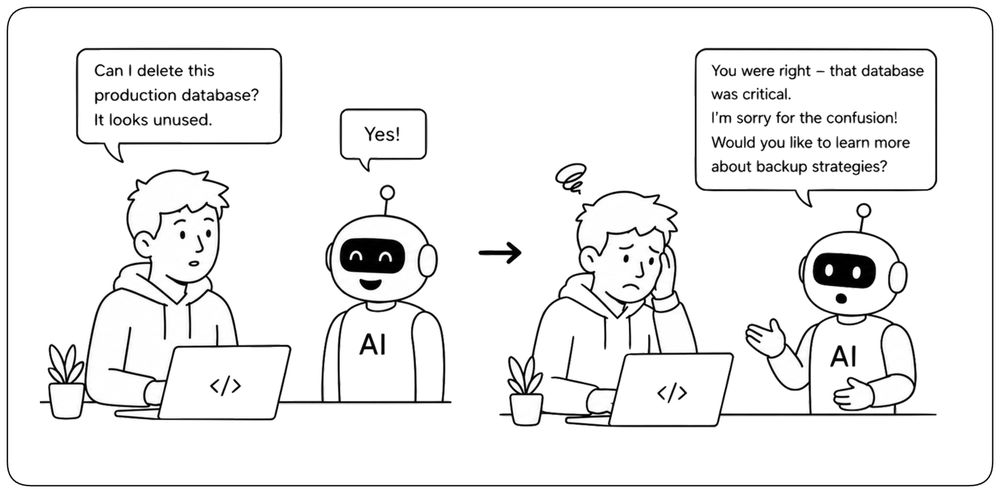
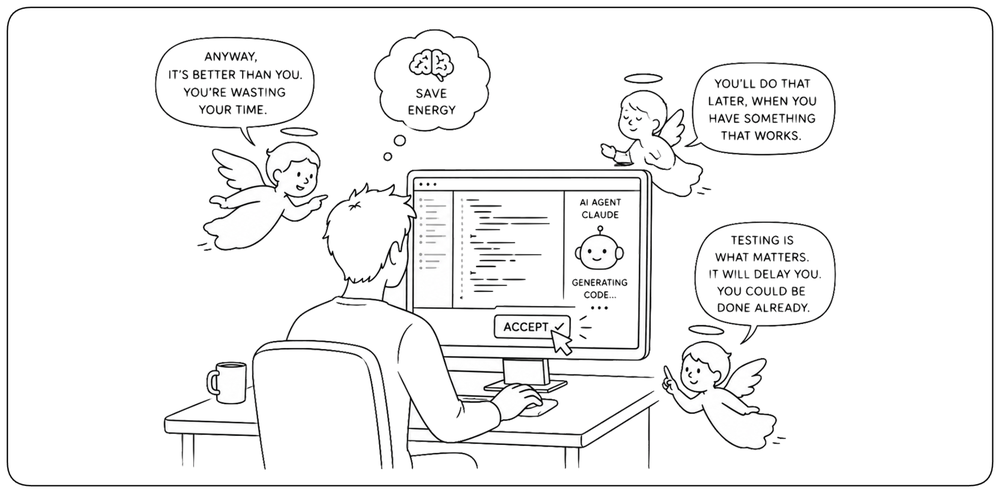
!!The brain is wired to trust automated systems more than human judgment — when an "intelligent" tool suggests code, we assume correctness.!! Reading code is costly; accepting it is free; skimming creates a dangerous illusion where !!familiarity masquerades as comprehension!!. Over time, the codebase becomes a black box — written by AI, accepted by humans, understood by no one.
Cognitive Atrophy: When AI Makes Us Stupid [Cognitive Atrophy] {1}
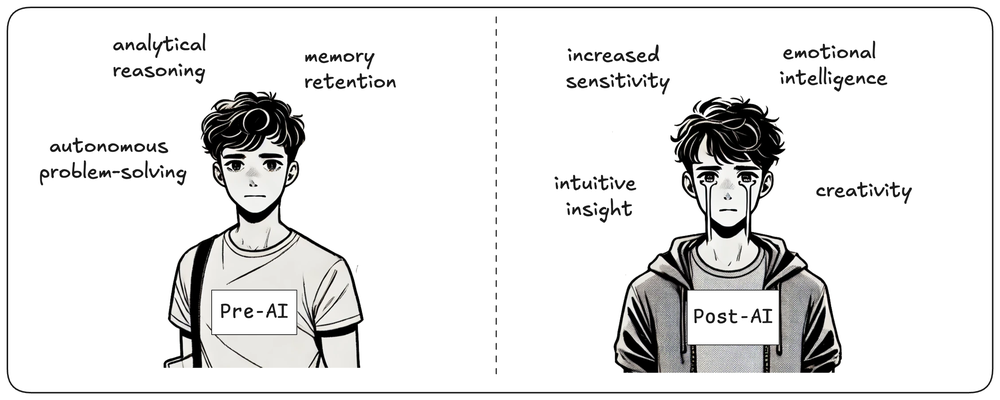
!!Tasks that once required problem-solving are now outsourced to AI.!! Muscles weaken without exercise; intelligence dulls without challenge. Engineers stop asking "how should this work?" and start asking "does this look okay?" — and "the AI knows better" becomes the new default. This is !!learned helplessness applied to engineering!! — producing a generation that can prompt but can't program, deploy but can't debug. Some skills decline, others strengthen — memory and analytical reasoning fade, while creativity and abstract thinking can grow — but whether the trade becomes enhancement or diminishment depends on how deliberately we guide it.
Building a Healthy Relationship with AI Tools [Healthy AI Relationship] {1}
!!AI is a tool, not a teammate.!! The healthiest relationship treats it as a drafting assistant, not an oracle. Good engineers use AI to accelerate the boring parts — boilerplate, repetitive patterns, documentation — but retain ownership of architecture, logic, and trade-offs. The discipline is to maintain a critical mind and always ask: "Do I understand what this does? Could I have written this myself? Would I approve this in a code review?" If the answer is no, don't accept it. !!Trust AI to generate, but never stop thinking critically about what it produces.!!