Design by Process
Chapter Info
Calculating... Writing Progress: 10%
Processes are the operating system of an engineering organization. They determine how quickly decisions are made, how consistently quality is maintained, how smoothly work flows across teams, and how well the organization scales without solving the same coordination problems again and again. This chapter explains how to design processes that make engineering faster, safer, and more autonomous by turning repeated decisions and interactions into explicit, lightweight, measurable, and increasingly automated workflows.
Introduction
What Is a Process? [Process Definition] {1}
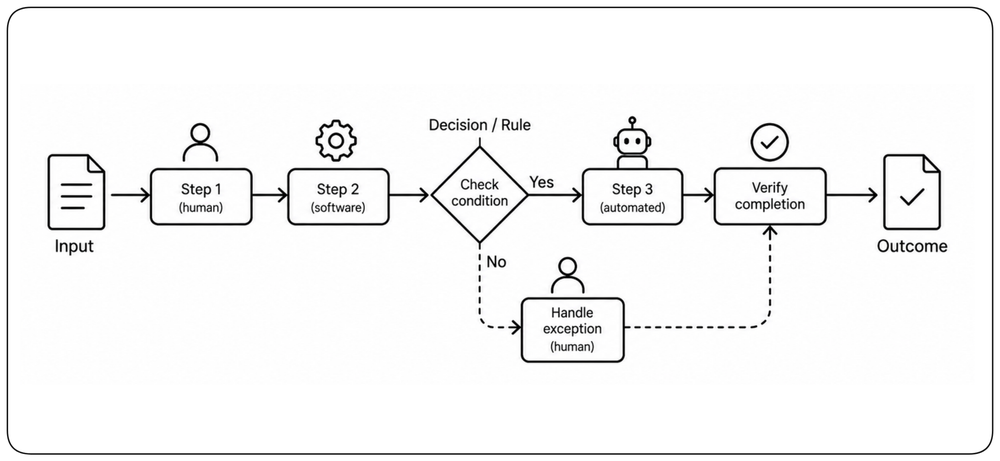
A process is a repeatable sequence of steps, with defined roles and decision criteria, that transforms an input — a need, problem, or event — into a predictable outcome without requiring each occurrence to be reinvented or debated from scratch. A good process is explicit, repeatable, and improvable: responsibilities and decision authority are clear, and the process continues to work consistently even when the people involved change.
What Process Makes Possible [Process Value] {1}
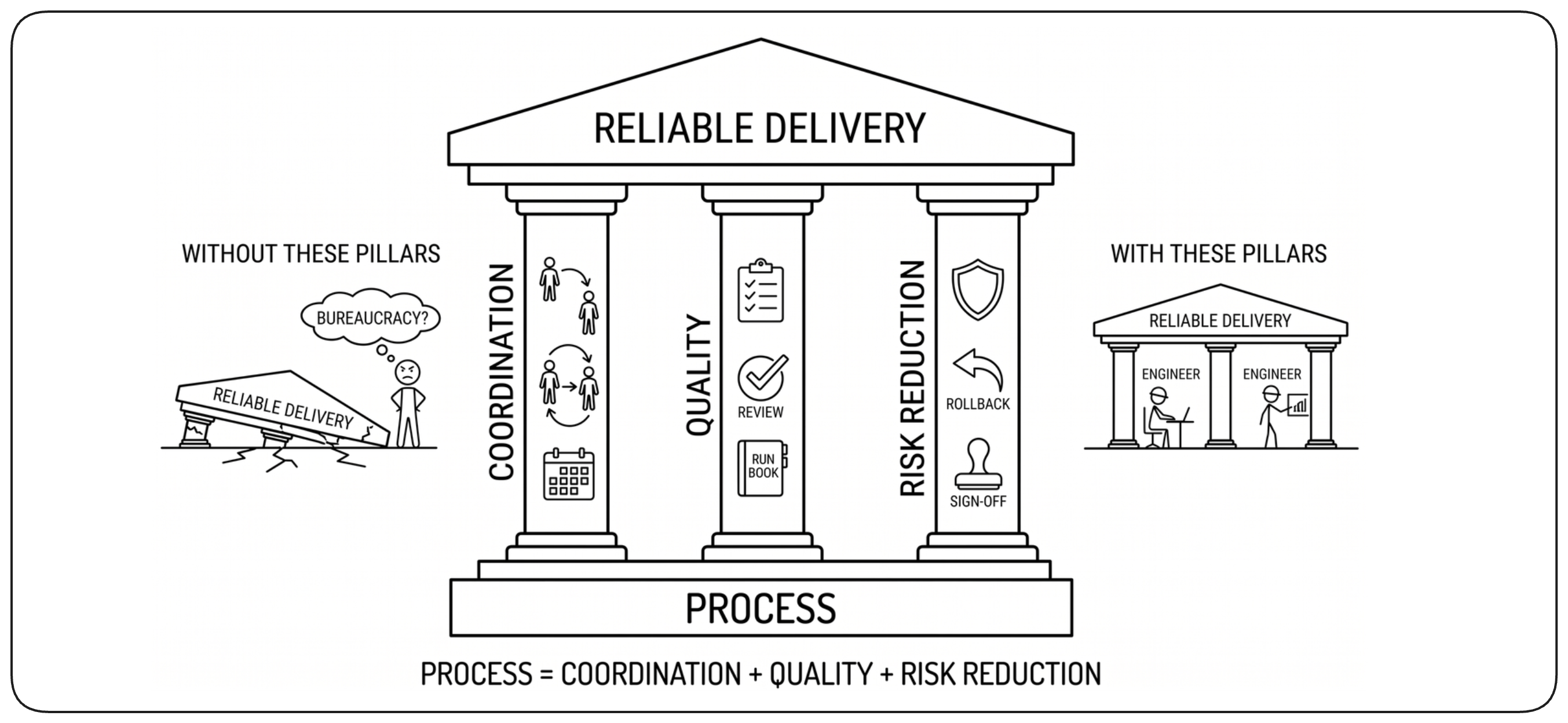
Process exists for three concrete reasons. !!It coordinates people and teams!! so that collaboration does not have to be renegotiated every time. !!It establishes a repeatable quality baseline!! through checks, reviews, and shared standards. !!It reduces risk!! by surfacing decisions, preserving context, and ensuring that rare but important safeguards happen. When a workflow provides none of these benefits, it is probably bureaucracy; when it does, process becomes a high-leverage way to improve reliability at organizational scale.
Process Coordinates Across Boundaries [Process Coordination]
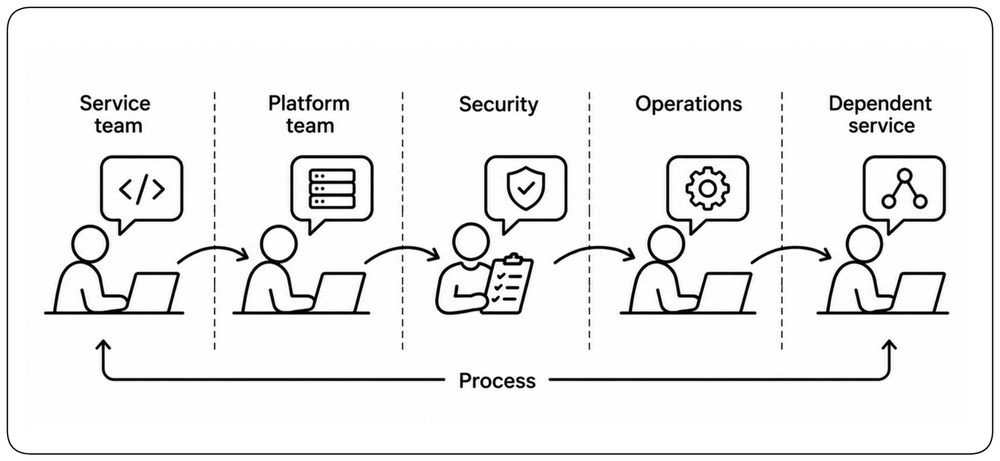
Process becomes most valuable where ownership crosses boundaries. A change may involve a service team, a platform team, security, operations, and another dependent service. Without an explicit handoff, escalation path, and decision owner, each boundary becomes a place where work can stall or context can disappear. Good process defines how work crosses those boundaries without requiring people to rediscover the coordination model every time.
Design the End-to-End Flow [End-to-End Flow] {1}
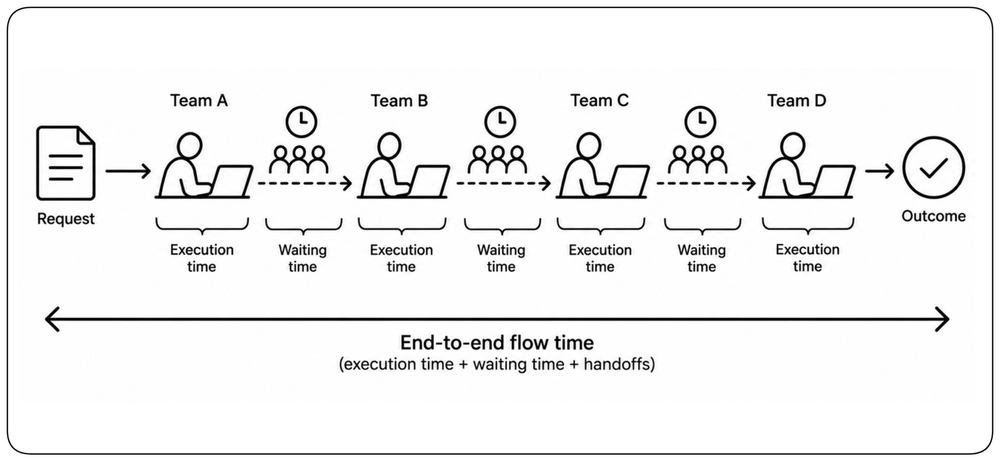
A process should be optimized for the outcome, not for the convenience of each individual step or team. Local efficiency can still create global delay when work waits in queues, crosses too many boundaries, or repeatedly changes ownership. Measure and improve the end-to-end flow from request to outcome, including waiting time and handoffs, not only the execution time of each activity.
Process Reduces Cognitive Load [Cognitive Load]
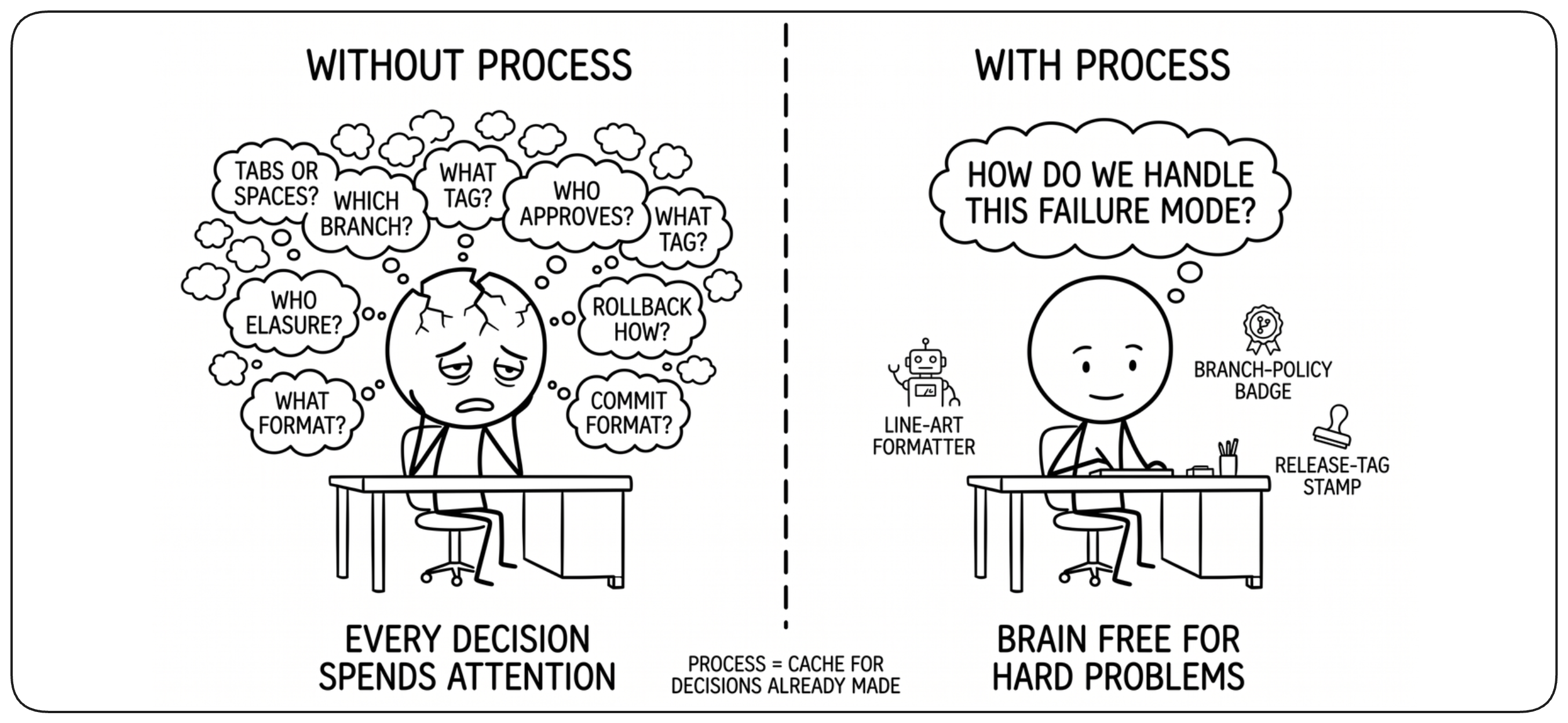
Engineers have a finite budget of attention, and every repeated decision spends some of it. Good process absorbs those decisions into defaults, rules, tooling, or agents: formatting, branch policy, approval paths, and standard recovery actions should not require fresh thought each time. This leaves people free to focus on novel, ambiguous, or high-consequence problems. Process is a cache for decisions already made, preserving scarce attention for the work that still requires it.
Process Is the Invisible Architecture [Invisible Architecture]
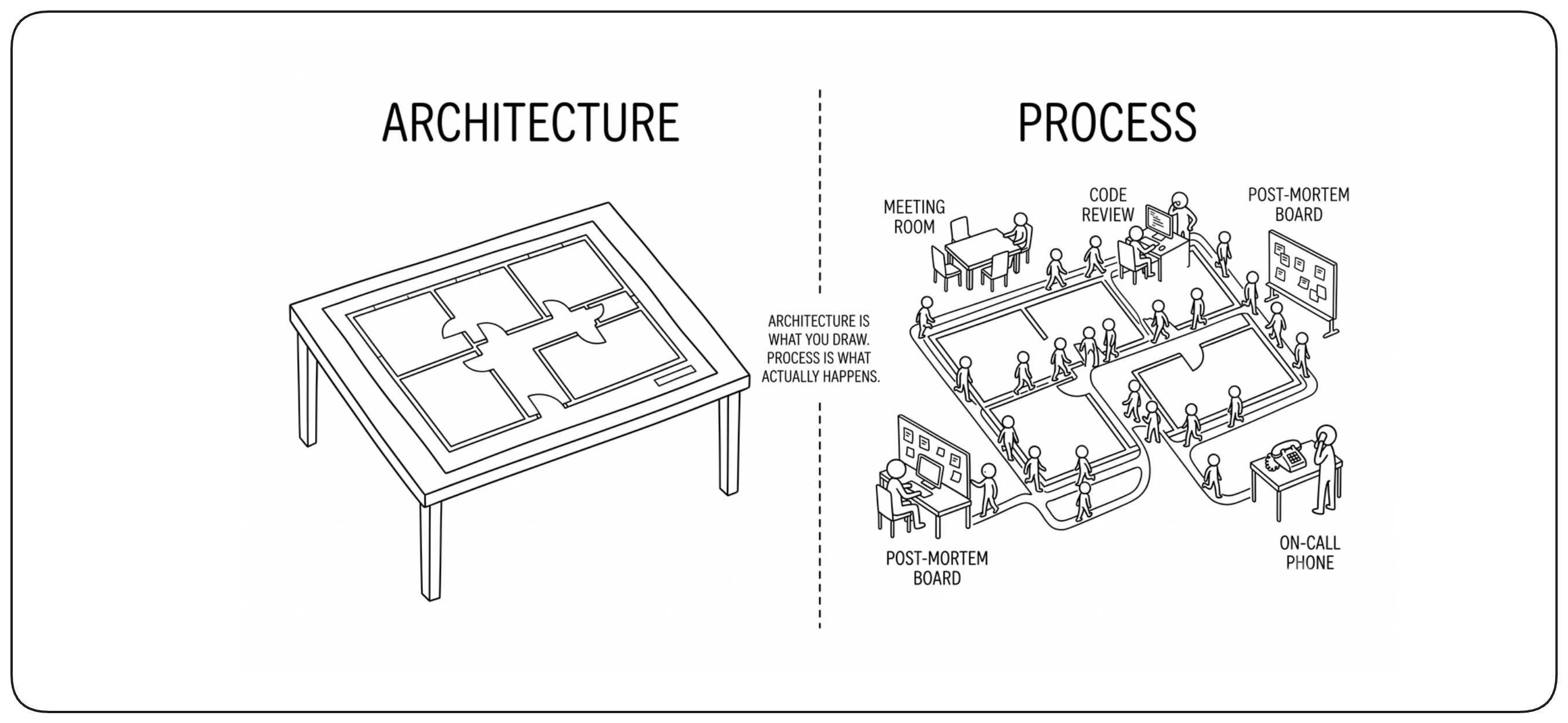
Two teams with the same architecture, the same stack, and the same headcount can produce wildly different systems. The difference is process: how decisions get made, how reviews happen, how incidents are handled, how knowledge is passed on. Architecture defines what the system is; process defines what the team does — and the team's behavior, repeated thousands of times, becomes the system's reality. Bad process can undermine strong architecture; good process reduces dependence on exceptional individuals.
Organizations Scale Through Process [Organizational Scale] {1}
An organization cannot scale if every action requires a person to remember what to do, coordinate a handoff, ask for approval, or manually execute the next step. As the organization grows, those dependencies become queues and bottlenecks. Scalable organizations turn repeated work into explicit, self-service, and increasingly automated processes. The goal is not to remove human accountability, but to keep routine execution and bounded decisions from requiring synchronous human coordination. Teams can then operate independently without the organization becoming proportionally slower.
Process Exists Across the Engineering Organization [Process Landscape]
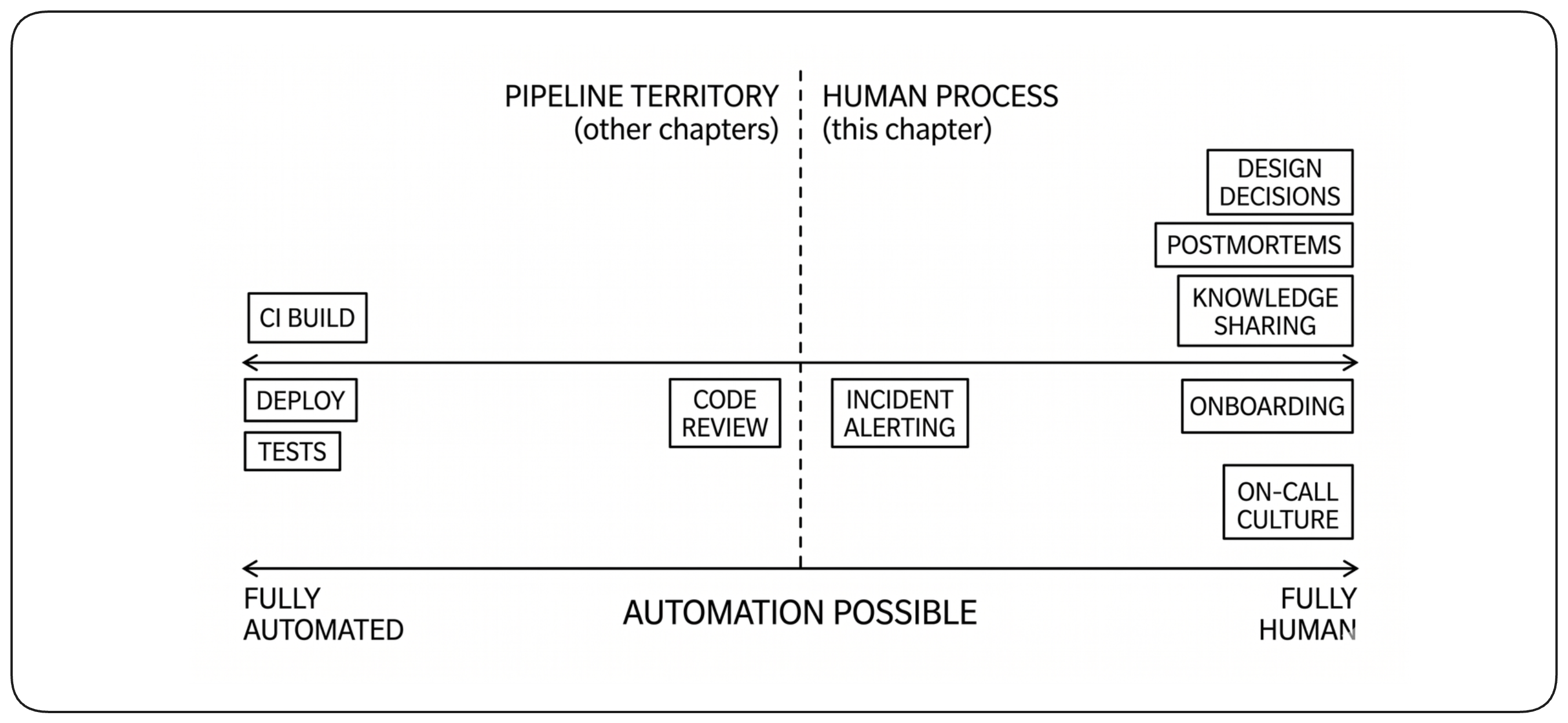
Engineering process spans the entire organization: planning, development, release, reliability, security, people, knowledge, and governance. Together, these processes form the operating system of engineering. Many domains are covered in dedicated chapters; this chapter focuses on the cross-cutting principles that make processes effective across all of them.
DevOps Engineers Are Process Engineers [DevOps as Process]
DevOps is fundamentally about improving the processes that move software from idea to production and keep it running. CI, CD, provisioning, release workflows, incident response, self-service, approvals, and operational automation are all process problems. DevOps engineers turn manual handoffs into reliable workflows, remove unnecessary friction, automate repeatable work, and make engineering delivery safer and faster.
Process Fundamentals [Process Fundamentals]
These fundamentals describe the properties a good process should have, regardless of the domain in which it is used.
Treat Process as a First-Class Engineering Artifact [First-Class Process] {1}
A process is part of the engineering system, not an informal layer around it. Important processes deserve the same rigor as software: they should be deliberately designed, reviewed, owned, observable, tested against failure cases, versioned when they change, and simplified or removed when they no longer serve their purpose. A broken deployment workflow, approval path, or incident process can damage engineering just as surely as broken code. Treating process as a first-class engineering artifact means engineering it — not merely documenting that it exists.
Bolt-On Doesn't Work [Bolt-On Fails]
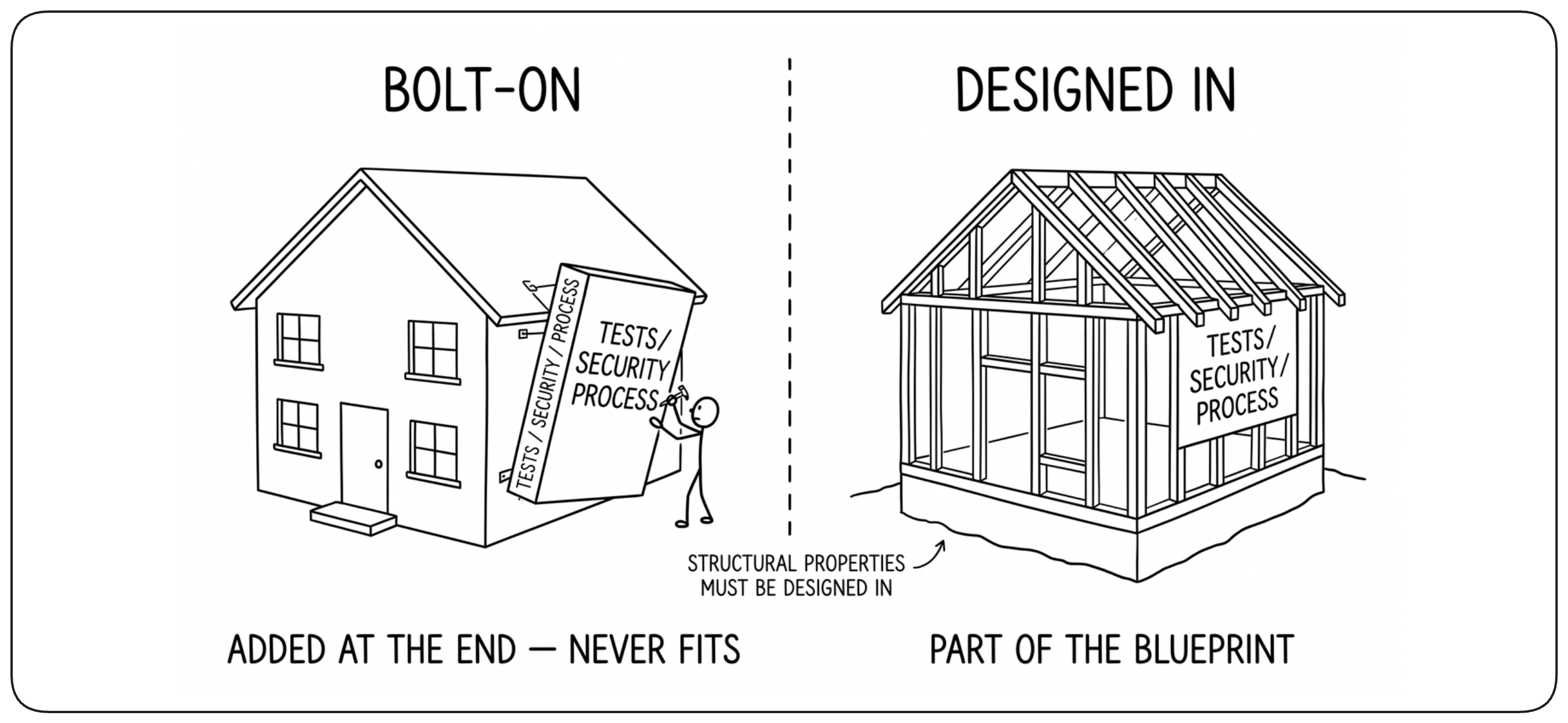
Some properties become much harder and more expensive to add when they were ignored in the original design. Security, testability, observability, deployability, and operational process all shape structure: interfaces, boundaries, dependencies, tooling, and team habits. They can be improved later, but retrofitting them often requires redesign rather than a final review step or a new checklist. The principle is simple: properties that affect the structure of the work should be considered from the start, because postponing them turns design decisions into migration work.
Make the Safe Path the Easy Path [Safe Path] {1}
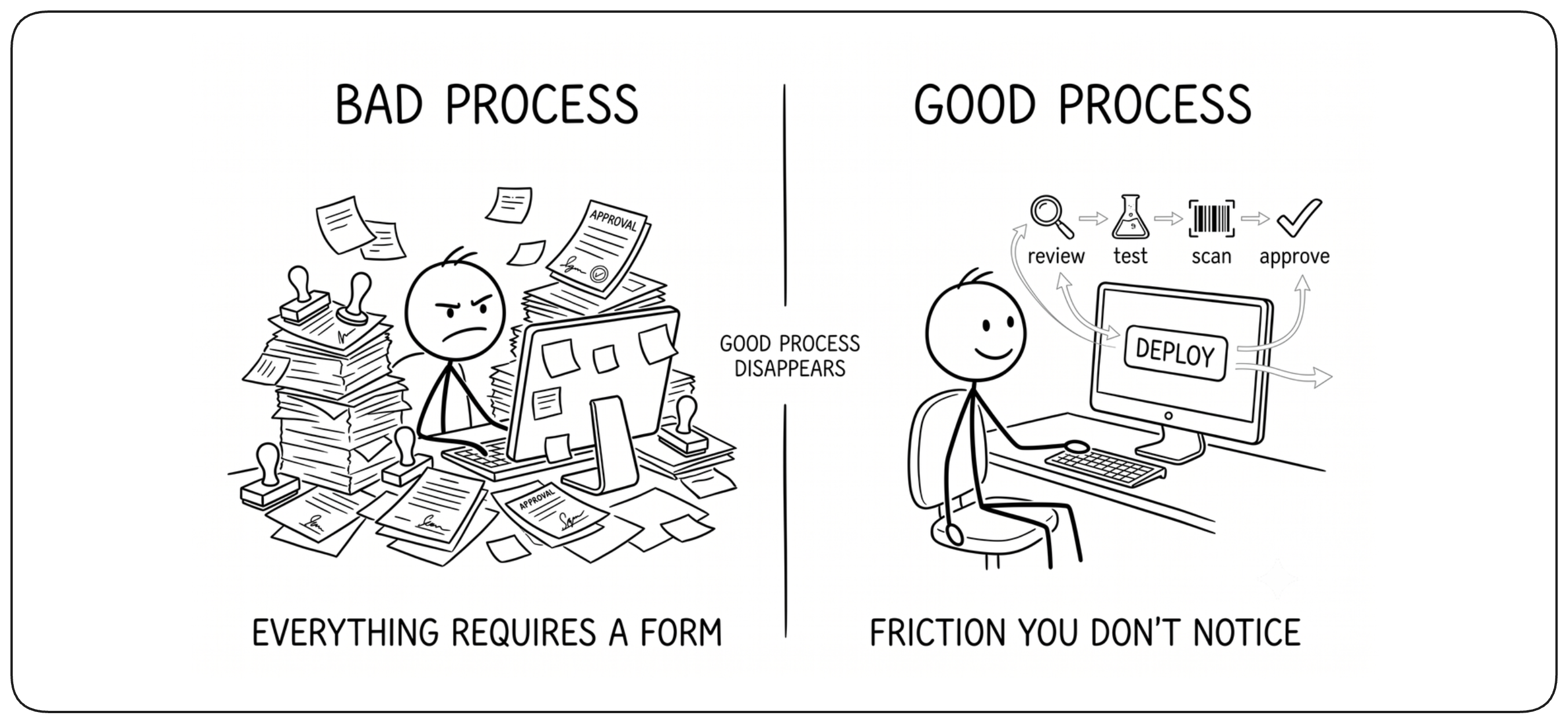
The safe path is the normal workflow that satisfies the required checks, permissions, and safeguards. A good process should make the safe path the easiest path to follow. The common workflow should be obvious, fast, and preferably built into the tooling and defaults. Engineers should not have to remember the process or repeatedly decide how to follow it. When the right behavior becomes the path of least resistance, the process disappears into the way the work is done.
Keep Process as Light as the Risk Allows [Risk-Based Process] {1}
Process has a cost, so its weight should be proportional to the risk it controls. Low-risk work should move with little ceremony; higher-risk work deserves stronger safeguards. The goal is the minimum process that still protects the outcome.
Process Accelerates, Bureaucracy Slows Down [Not Bureaucracy]
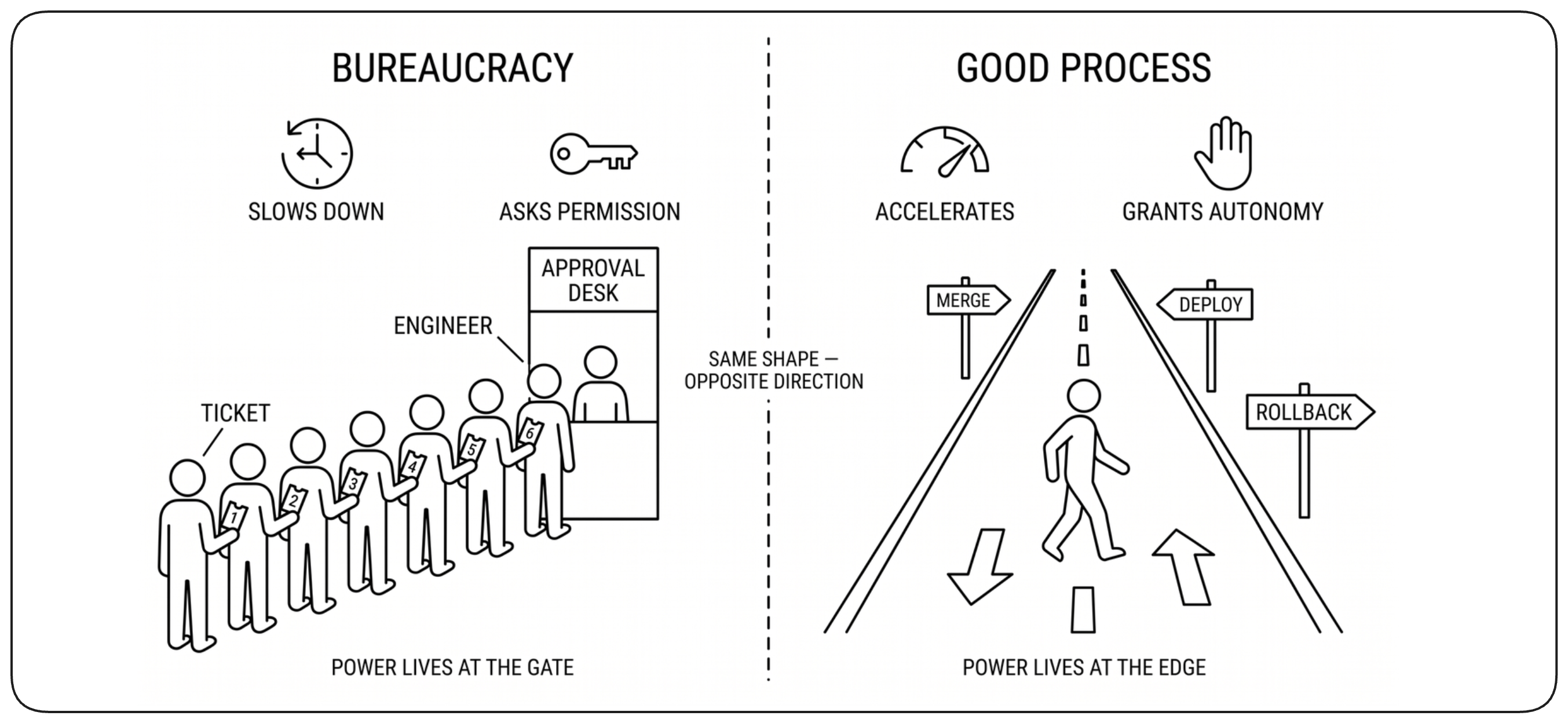
Process and bureaucracy can both contain rules, gates, and workflows, but they create different outcomes. Bureaucracy adds friction without enough corresponding value. Good process removes ambiguity, pre-approves the common path, reduces repeated coordination, or controls a risk that justifies its cost. The test is not whether a step makes one action faster, but whether the workflow creates more value than friction and improves autonomy and overall flow.
Minimize Human Intervention, Preserve Accountability [Human Accountability] {1}
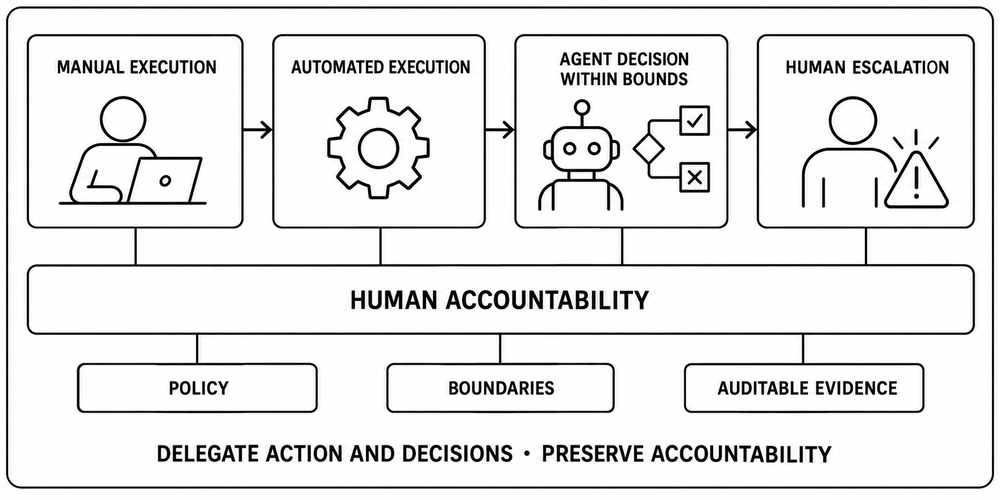
Human intervention should be reserved for the places where it adds value. Routine execution should be automated, but increasingly, AI agents can also analyze context, evaluate alternatives, and make complex decisions within defined boundaries. A well-designed process delegates as much execution and decision-making as can be done safely to software and agents, while preserving clear human accountability, escalation paths, and control over the rules. The goal is not to keep humans in every loop — it is to use human attention only where human judgment is still necessary.
Separate Policy from Execution [Policy and Execution]
A scalable process separates the rules that define what is allowed from the machinery that carries them out. Policy expresses constraints, authority, risk thresholds, and required evidence; execution applies those rules through software, agents, or people. Keeping the two separate makes the process easier to change, automate, audit, and reuse across tools without burying organizational policy inside implementation details.
Make Process Explicit [Explicit Process]
A process that exists only in people’s heads cannot scale. Important workflows should make their steps, responsibilities, inputs, outputs, and exceptions explicit enough to be understood and repeated without relying on tribal knowledge. Once a process is explicit, it can be taught, measured, automated, debugged, and improved. Implicit process depends on memory and heroics; explicit process becomes an engineering artifact.
Design the Exception Path [Exception Path] {1}
The normal path is only part of the process. Real systems encounter incomplete information, unavailable approvers, failed automation, urgent changes, and cases the rules did not anticipate. A good process defines what happens when the happy path cannot continue: who may decide, how work escalates, what evidence is required, and how the exception is recorded and reviewed. Exceptions should be explicit rather than improvised under pressure.
Process Must Earn Its Cost [Process Hygiene]
Every process should answer a real, observed problem — a recurring incident, a costly mistake, a slow review cycle. Process added without a concrete risk, failure mode, or measurable objective is likely to become bureaucracy. The same discipline applies in reverse: process whose original justification no longer applies should be removed, not preserved out of habit. A process should continue to exist only while the value it creates justifies the friction it introduces.
Decision-Making [Decision Making]
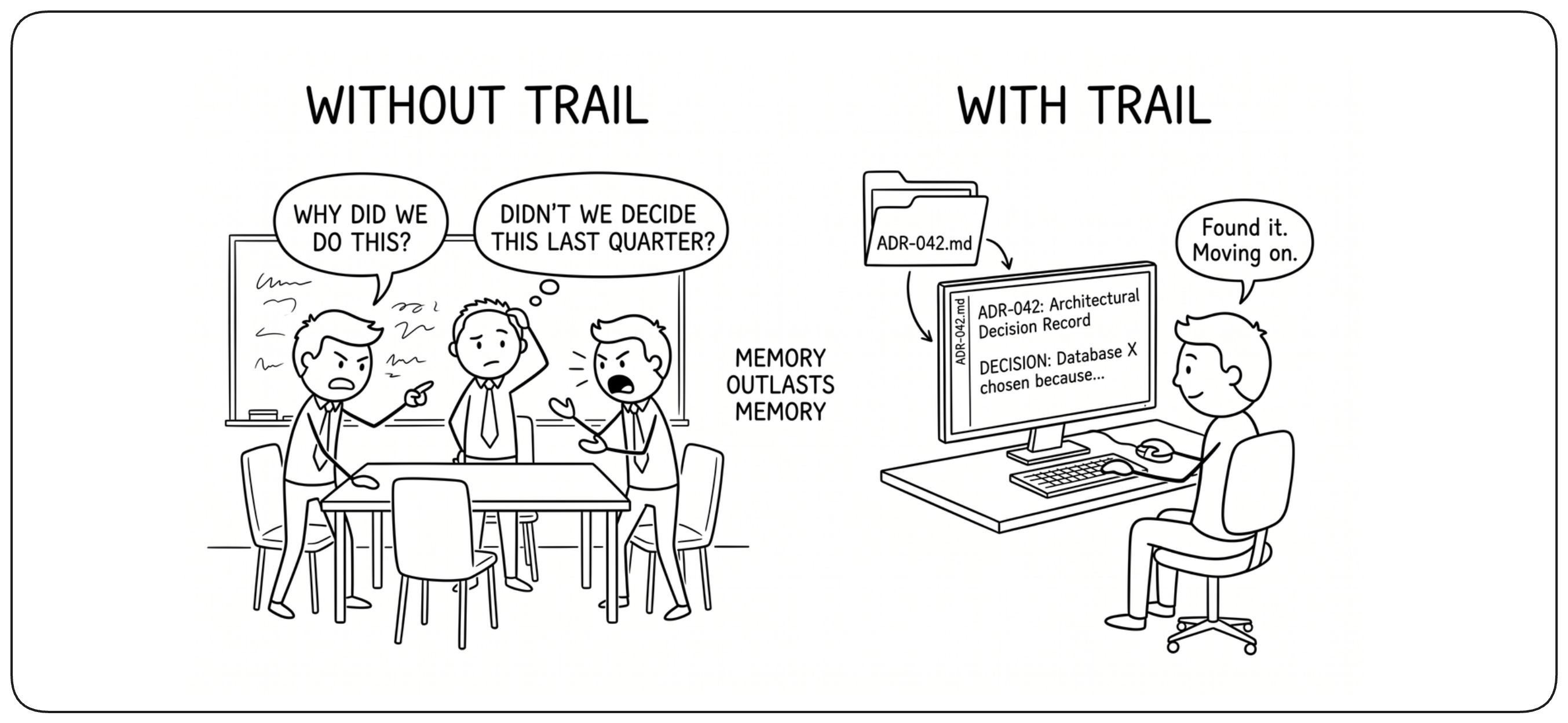
Decisions Need a Trail [Decision Trail] {1}
Every non-trivial engineering decision should leave a written trace: what was decided, why, which alternatives were considered, and what trade-offs were accepted. Without it, old debates return and new engineers cannot understand why the system is the way it is. Architecture Decision Records (ADRs), Requests for Comments (RFCs), and design docs give the organization durable memory so that decisions can be revisited with evidence rather than reconstructed from folklore.
RFCs and Design Docs [RFC Design Docs]
A Request for Comments (RFC) or design doc is a written proposal for a non-trivial change — a new service, a major refactor, a protocol decision, a security boundary. It forces the author to think before coding, surfaces objections early when they are cheap to address, and gives reviewers a single place to engage. Good RFCs are short, concrete, and biased toward decision; they include context, the proposal, alternatives considered, and explicit trade-offs. The cost of writing an RFC is small; the cost of not writing one — when a senior engineer disagrees three weeks into implementation — is enormous.
Architecture Decision Records (ADRs) [ADRs]
An Architecture Decision Record captures a single architectural decision: the context, the choice, and the consequences. ADRs are intentionally lightweight — a few paragraphs in a markdown file in the repo — because the goal is trail, not paperwork. Six months later, when someone asks "why did we pick Postgres over DynamoDB?", the ADR answers in 30 seconds. Without ADRs, the answer is either lost, distorted by retelling, or known only to the original author who has since left.
Reversible vs Irreversible Decisions [Reversibility]
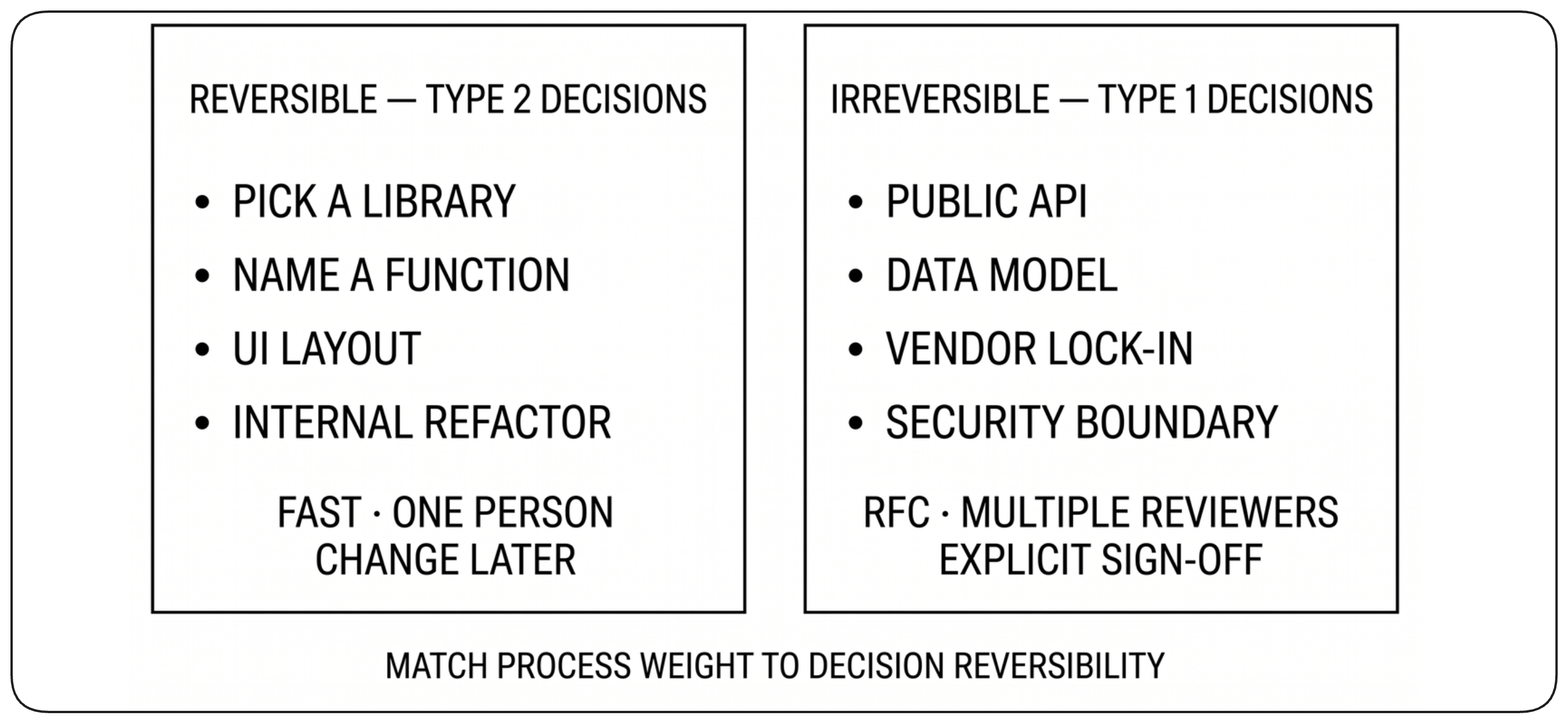
Not all decisions deserve the same process. Reversible decisions — pick a library, name a function, design a UI — should be made fast, by whoever is closest, and changed when needed. Irreversible decisions — public API surface, data model, security boundary, vendor lock-in — deserve stronger process: an RFC, broader review, and explicit decision authority. Confusing the two is the most common process failure: teams either over-engineer trivial choices into months-long debates, or rush irreversible choices that cost years to undo.
Make Decision Authority Explicit [Decision Authority]
A process for making decisions also needs a rule for ending disagreement. Before a decision starts, make clear who is responsible for deciding, who must be consulted, and who is informed. Discussion should improve the decision, not make unanimity a requirement. Once the responsible decision owner has heard the relevant arguments and made the call, the team should commit to the decision and move forward unless new evidence changes the assumptions. Without explicit decision authority, RFCs create discussion but not necessarily decisions.
Code Review as a Process [Code Review Process]
Code Review Is About More Than Bugs [Review People]
Code review can catch bugs, but its broader value is human: spreading knowledge, building shared ownership, mentoring, enforcing consistency, and creating a culture where being challenged is normal. Teams that treat review as a checkbox produce code that compiles but no one understands; teams that treat review as conversation produce engineers who grow. The reviewer is not a gatekeeper — they are a teacher and a learner at the same time.
Review Latency Is a Process Metric [Review Latency]
A pull request that sits unreviewed for three days is a process failure, not a developer failure. Long review latency kills momentum, causes context switches, encourages reviewers to rubber-stamp because the diff has grown stale, and pushes engineers to bundle changes together to "save review effort" — which makes the next review even slower. Healthy teams treat review latency as a first-class metric and define targets appropriate to their workflow, time zones, and risk level. The important signal is not a universal threshold, but whether reviews arrive quickly enough to preserve context and keep changes small.
Incident Response and Learning [Incident Process]
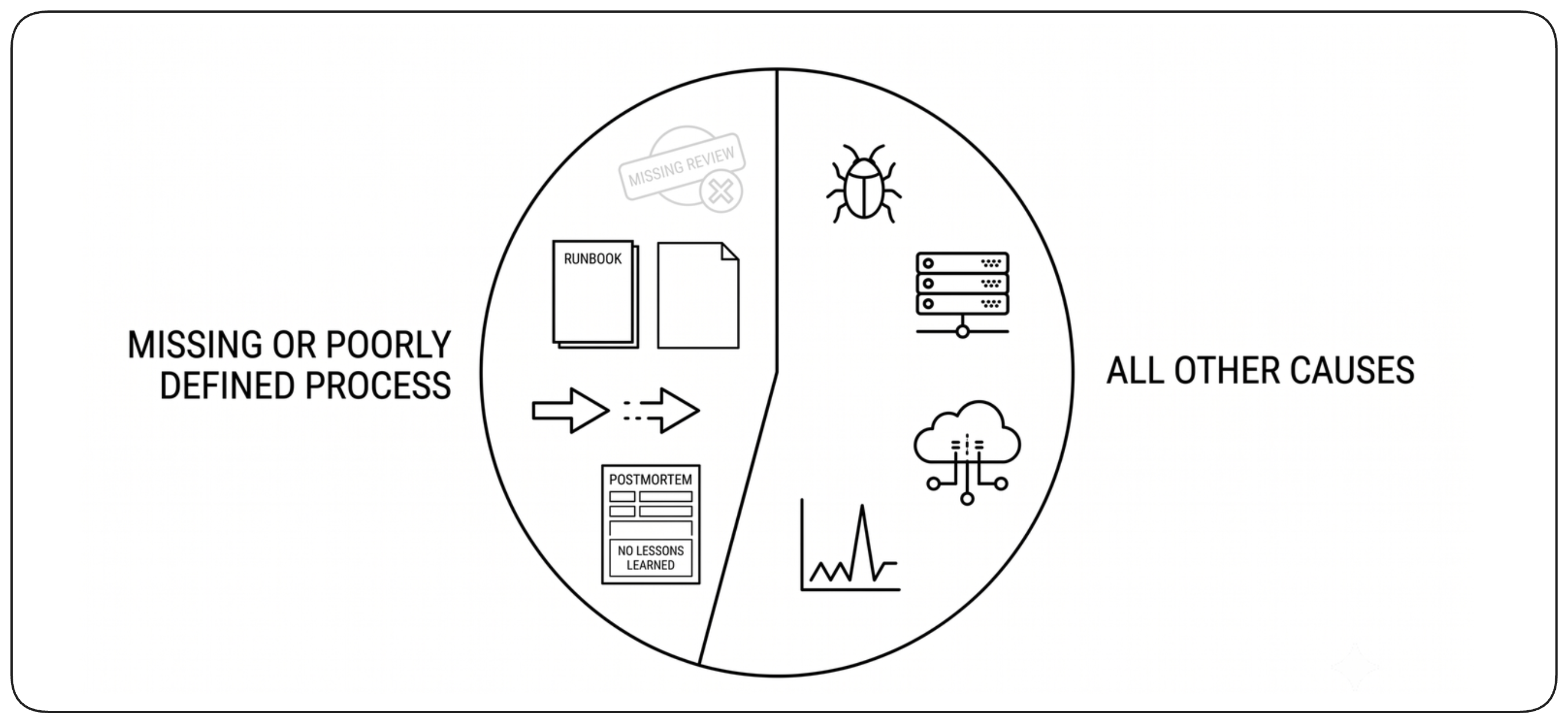
Many Incidents Expose Process Failures [Process Failures] {1}
Production incidents rarely come from code or infrastructure alone. They often expose a process weakness around the technical failure: a risky change bypassed review, ownership was unclear, a handoff was incomplete, a rollback path was untested, or a known operational step lived only in someone’s memory. The useful question is therefore not only what component failed, but also what process allowed that failure to reach or persist in production? Treating process as part of the system turns incidents into improvements in review, release, ownership, documentation, and recovery — not just another code fix.
Postmortems Must Be Blameless [Blameless]
When a production incident happens, the question is never "who screwed up?" — it is "what made the screw-up possible?" A blameless postmortem assumes that everyone involved acted reasonably given the information they had, and asks how the system, tooling, and process allowed the mistake. Blame culture produces cover-ups and hidden failures; blameless culture produces honest reports and durable fixes. The same person who caused yesterday's outage is your best source of insight into how to prevent tomorrow's.
Action Items Must Have Owners and Deadlines [Action Items]
The most common postmortem failure is not the analysis — it's the follow-through. Beautiful incident reports with twelve action items, none of which are owned, none of which have deadlines, none of which ever ship. Every action item must have a single named owner, a deadline, and a tracking ticket. Action items without owners are wishes, not commitments — and wishes do not prevent the next outage.
Knowledge and Onboarding [Knowledge Process]
Documentation Is a Deliverable [Doc Deliverable]
Documentation is not what you write after the work is done — it is part of the work. A feature without a doc is a feature only its author can use, debug, or extend. Treat documentation like code: reviewed, versioned, tested (does the example still run?), and owned. The team that says "we don't have time to document" is the same team that will spend three weeks reverse-engineering its own system in six months.
Onboarding Is a Process, Not a Person [Onboarding]
If a new engineer's onboarding depends on which buddy they get, the onboarding is broken. A good onboarding process is documented, repeatable, and time-boxed: a checklist of accesses to obtain, systems to read about, small tasks to complete, people to meet. Time-to-first-commit and time-to-on-call are measurable and should be tracked. Every new joiner who struggles to ramp up is a free audit of how much your team relies on tribal knowledge.
Measure and Own the Process [Measure and Own]
Watch the Queue, Not Only the Work [Queues and WIP]
The work that takes the longest is often work that is waiting. A fast activity can still produce a slow outcome when requests accumulate in queues, wait for a handoff, or compete with too much work already in progress. Measure queue time and work in progress alongside execution time, then reduce unnecessary waiting and limit how much unfinished work enters the system at once.
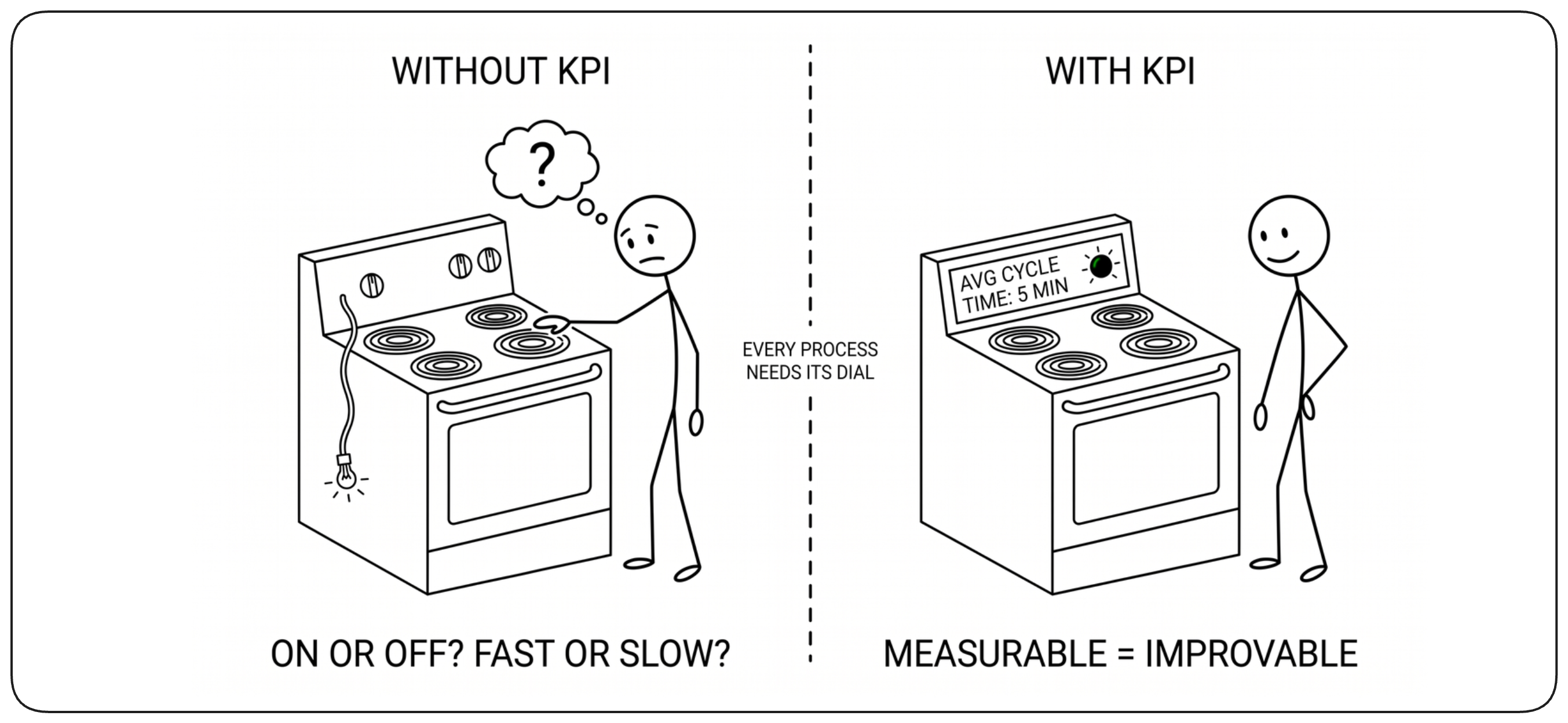
Important Processes Need a Signal [Process Signal] {1}
A process that matters should provide enough signal to tell whether it is working. For important or costly workflows, that usually means an explicit metric: cycle time, latency, success rate, error rate, or time-to-first-response. The amount of measurement should match the importance of the process. The objective is not to instrument every workflow, but to avoid operating important processes blindly. If a process cannot show whether it is achieving its purpose, it is difficult to improve or justify.
Important Processes Need an Owner [Process Ownership] {1}
A process that belongs to everyone often belongs to no one. Every important process should have a clear owner responsible for its purpose, rules, metrics, tooling, and continued relevance. Ownership does not mean manually executing every step; it means watching whether the process still solves the problem it was created for, improving it when it does not, and removing it when its justification disappears. Processes should have maintainers just as production systems do.
Critical Processes Need Operational Support [Process Reliability]
Some processes are themselves production dependencies. If engineers cannot merge, deploy, obtain access, approve a change, or recover from an incident because the supporting workflow is broken, the process has become an operational outage. Critical processes therefore need the same discipline as critical systems: clear ownership, a support path, observable health, documented failure modes, escalation, and a fallback when practical. The more work a process can block, the more deliberately its failure must be handled.
Design a Bypass for Process Failure [Process Bypass]
Operational support includes a safe bypass for normal workflow failure. A critical process should not become an unbreakable gate. When the normal workflow is unavailable, define an emergency path with explicit authority, auditability, and follow-up. The bypass should be exceptional, but it should exist before the failure happens. This matters most for the processes that can block everything else: continuous integration, deployment approvals, access management, change management, and incident tooling.
Principles for Designing Process [Process Design Principles]
Once the fundamentals are clear, the following principles describe practical techniques for turning them into workflows, tooling, and organizational defaults.
Asymmetric Friction [Asymmetric Friction]
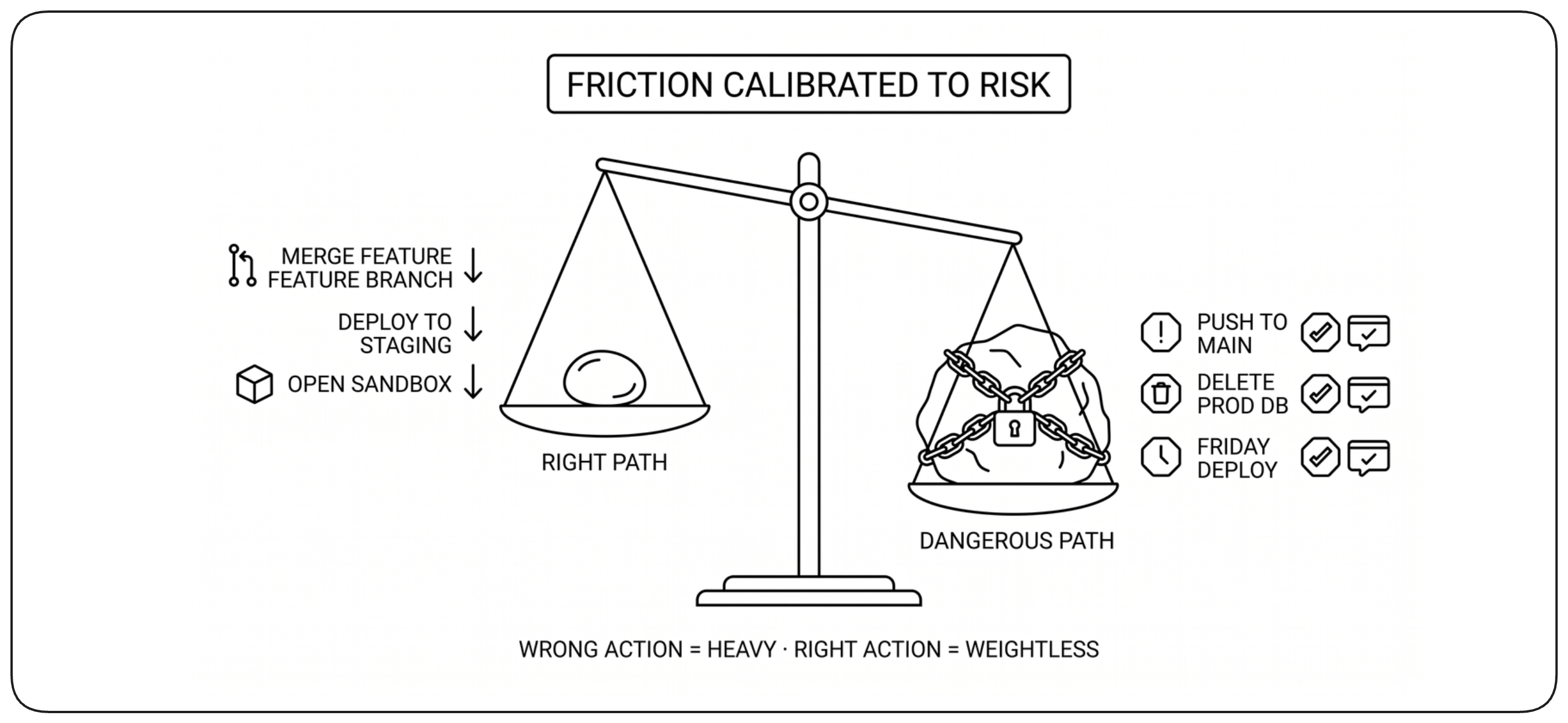
Some actions should not be frictionless. When an operation has a high blast radius or is difficult to reverse, deliberate friction can prevent accidental execution: explicit confirmation, additional review, stronger authorization, or a written reason. The goal is not to slow normal work, but to make dangerous actions require conscious intent.
Process Scales Opinions [Opinionated Process]
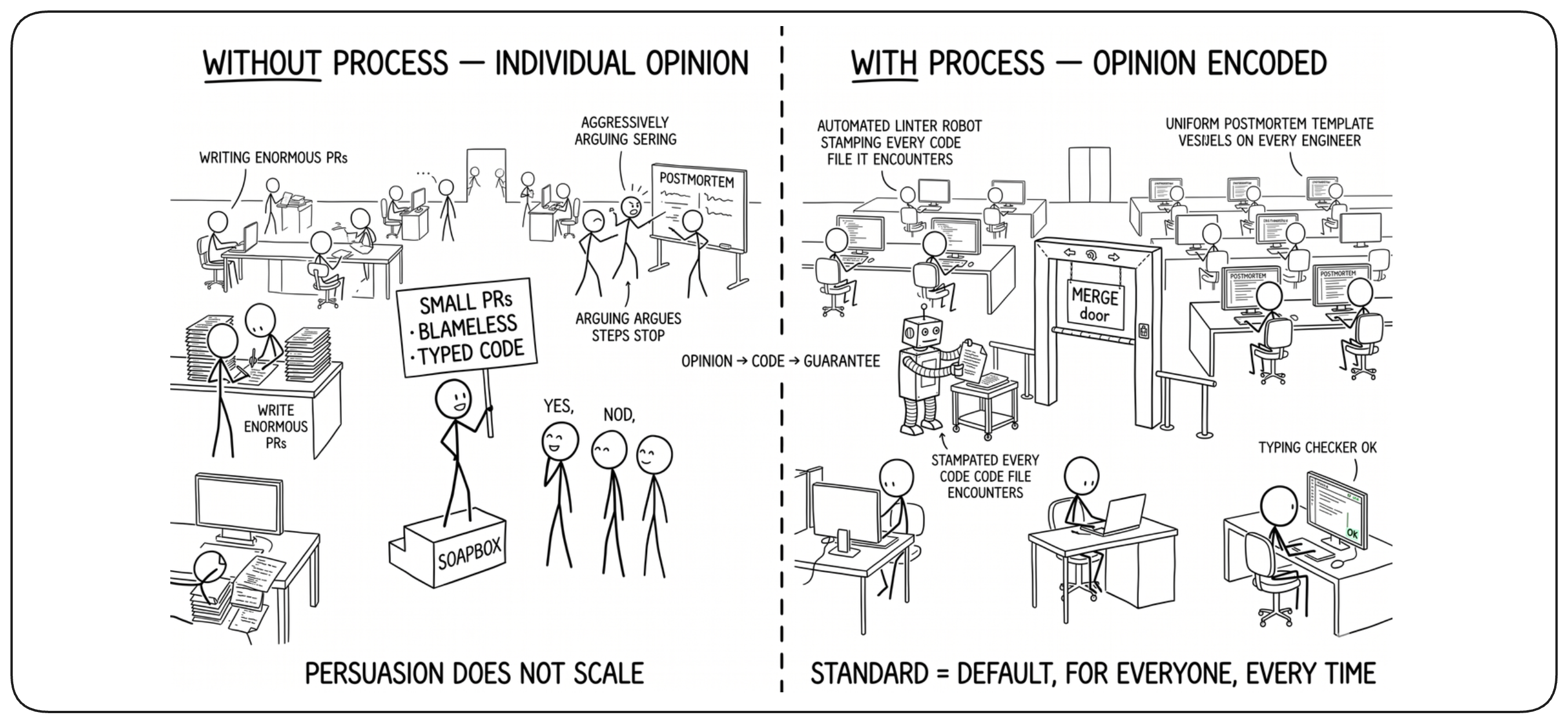
Individual conviction does not scale. A senior engineer can advocate for small pull requests, blameless postmortems, or strict typing, but cannot personally enforce the standard across an organization. !!Process turns an opinion into an enforced default!!: linters apply style rules, branch protections require review, pipelines require tests, and templates shape design documents. The standard no longer depends on who is present or paying attention; it is applied consistently by the engineering system.
Process Beats Tools [Process Beats Tools]
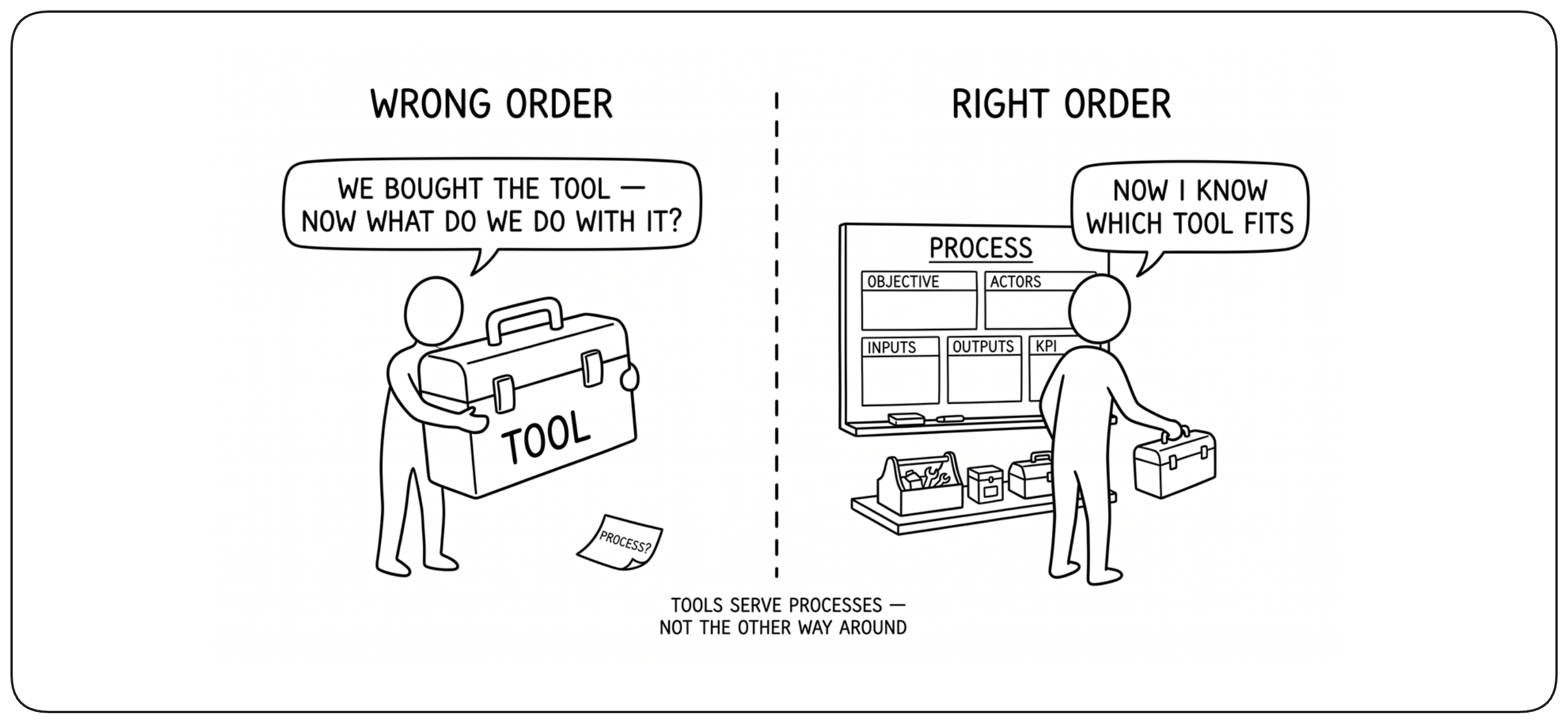
Engineering teams love to start with the tool: pick Jenkins, pick ArgoCD, pick Backstage, then design the process around what the tool happens to support. This is backwards. Tools are opinionated; they encode someone else's compromises. Starting with the tool means inheriting those compromises without ever asking whether they fit. The right order is the opposite: define the process — its objective, actors, inputs, outputs, constraints, performance indicators — then pick the tool that fits, accepting its compromises consciously. A team that adopts a tool without understanding the process it implements is not automating its work; it is automating someone else's idea of its work.
Prefer the Lightest Tool That Preserves the Process [Lightweight Process]
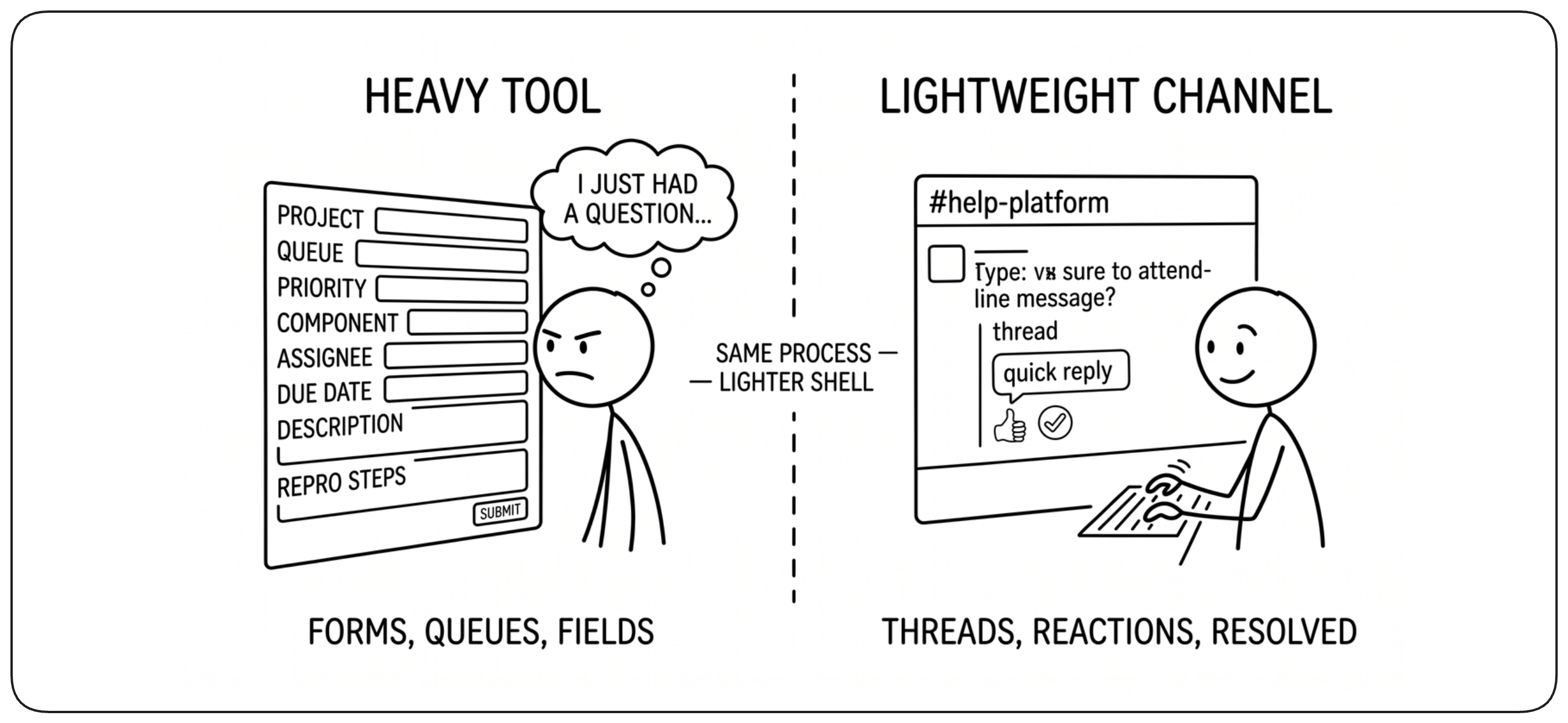
A process should use the lightest interface that preserves the information, visibility, durability, and control it requires. A Slack thread can provide a fast entry point for a platform question or request, while durable machinery behind it records ownership, policy, status, and audit history when those guarantees matter. The goal is not conversation instead of systems; it is a lightweight interface backed by the durable machinery the process needs.
Process Health Check [Process Health Check] {1}
For an important process, ask: Is the outcome clear? Are the normal path and exceptions explicit? Is its weight proportional to risk? Is the interface as lightweight as possible? Is human intervention limited to where it adds value? Are delegated decisions bounded and supported by evidence? Is there an accountable owner? Can we tell whether the process works? What happens when it fails? Is there a safe bypass? Does it still earn its cost?
Process in Practice [Process in Practice]
A Process in Practice: Database Access [Process Example] {1}
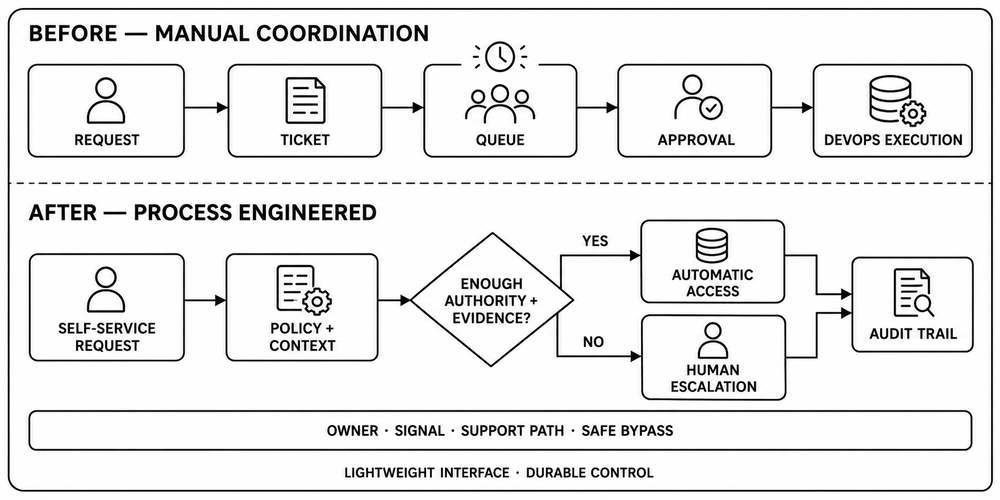
Consider a request for database access. A manual workflow turns each request into a ticket, an approval queue, and a DevOps intervention. A stronger process accepts a lightweight self-service request, evaluates policy and context, grants access automatically when policy allows it and the required evidence is available, and escalates the rest. Every decision and action leaves an audit trail. The owner can see latency and failures, a support path handles outages, and an emergency bypass covers urgent exceptions. Humans remain accountable for the policy and its boundaries; software and agents execute and decide within them.
The AI Era [AI Era]
Don't Automate the Old Process [Rethink Process] {1}
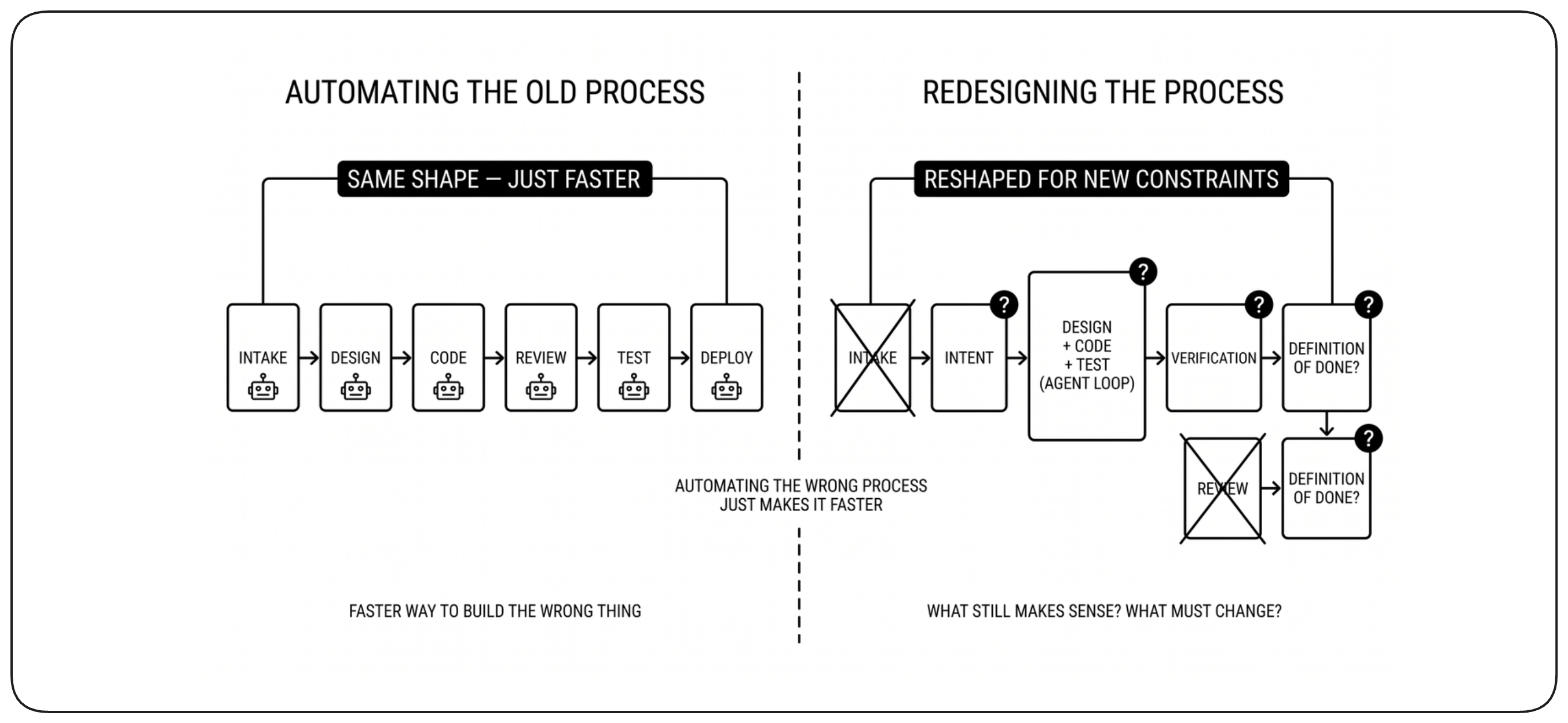
AI maturity requires more than handing each step of the existing workflow to an agent. The old process was shaped by constraints such as human execution speed, communication cost, and limited working context. When those constraints change, the workflow should be reconsidered. Teams must decide which parts still protect a real outcome and which should be redesigned — including intake, testing, review, ownership, infrastructure, and the definition of done. Automating the wrong process only makes it fail faster.
AI Moves the Bottleneck from Execution to Validation [Validation Bottleneck]
When producing code, documents, tests, and operational changes becomes dramatically faster, execution stops being the scarce resource. Validation becomes the bottleneck: is the output correct, safe, aligned with intent, and consistent with the surrounding system? Processes designed around scarce implementation capacity must be redesigned around scarce attention and trust. The question shifts from how fast we can produce to how fast we can establish confidence in what was produced. In AI-heavy workflows, verification capacity becomes a first-class design constraint.
Design Processes for Humans and Agents [Humans and Agents]
AI introduces a new actor into engineering workflows. Processes can no longer assume that every change, request, analysis, or operational action was produced directly by a human. Design the workflow explicitly for human and agent participants: define what agents may initiate, what they may decide, what evidence they must produce, where human approval is required, and how ownership remains assigned. Agents should enter the process through the same clear contracts as people — inputs, permissions, outputs, limits, and escalation paths — rather than operating as an invisible layer around the workflow.
Move Human Attention to Intent, Oversight, and Exceptions [Intent and Oversight]
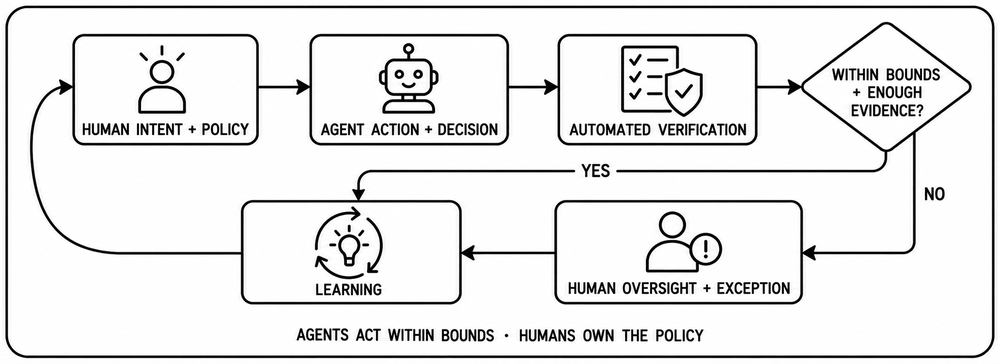
As agents take on more execution and decision-making, the human role moves toward intent, policy, constraints, acceptance criteria, oversight, and exceptions. Complexity alone does not require a person in the loop when an agent can act reliably within explicit boundaries and produce sufficient evidence. Human intervention belongs where authority is exceeded, evidence is insufficient, policy must change, or accountability requires a deliberate judgment. The goal is not a human in every loop; it is human attention where it adds value.
Trust Evidence, Not the Agent [Trust Evidence] {1}
AI-generated work should not be trusted because the agent sounds confident or because it usually succeeds. Trust should come from evidence produced by the process: tests, policy checks, static analysis, diffs, simulations, approvals, runtime signals, or other verifiable outputs appropriate to the change. Agent permissions should be bounded, important actions should remain traceable, and higher-risk operations should require stronger evidence. As execution becomes cheaper and faster, evidence becomes the foundation of trust.
The AI Era Will Not Save You from Process [AI Process]
AI makes execution dramatically cheaper, but it does not remove the need for decision-making, accountability, verification, incident response, or organizational memory. It increases their importance. When agents can generate changes continuously and act across systems at machine speed, weak processes fail faster and at larger scale. AI does not eliminate process — it raises the standard for process design. The organizations that benefit most from AI will be those whose processes can safely absorb the volume, speed, and autonomy it creates.