Software Design in the Age of AI
Chapter Info
Calculating... Writing Progress: 60%
!!We are living through a unique historical period with no equivalent in the history of humanity.!! Historically, changes have been gradual, with one generation resembling the next. !!However, we are now in a time of disruption, where changes are sudden and profound.!! This era is both daunting and exciting, as it challenges us to adapt and innovate in ways we have never experienced before.
!!The LLM revolution is reshaping software at every layer of its existence.!! Applications, the user interface, the developer's role, the structure of the engineering organization, and the underlying business model are all being redefined at once. !!Unlike previous shifts—such as the move from low-level to high-level languages or from on-premise to cloud—this change does not only improve how we build software; it changes what software is, who builds it, and how companies are organized around it.!!
The LLM Revolution: A New Era [LLM Revolution]
Something Just Broke [Something Broke] {1}
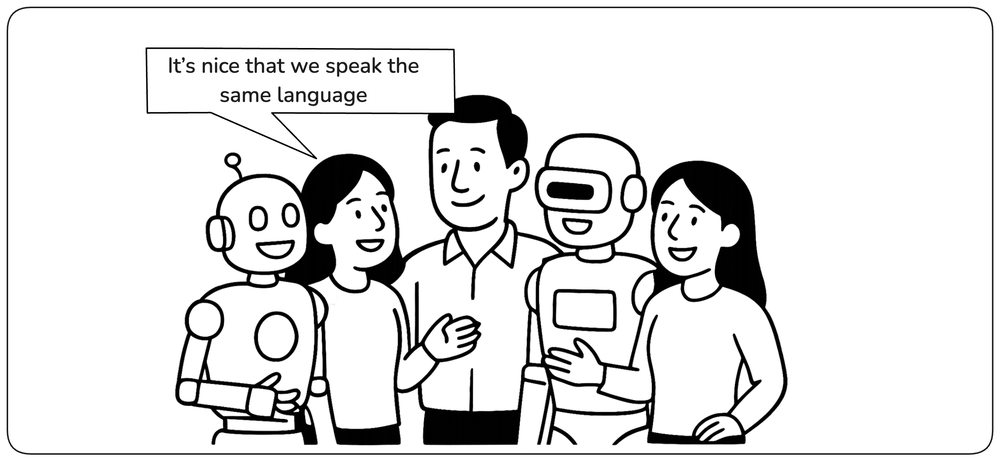
For forty years, software was the only contract between humans and machines: humans had to fit the software — its forms, menus, commands, APIs — and the machine executed exactly what it was told. Every interaction was pre-programmed. Every behavior was deterministic. The application was rigid; the human adapted. !!That contract is being torn up.!! Machines have learned ours. !!They now read intent in natural language, reason about goals, and compose actions across services without anyone writing the path in advance.!!
The Shift Is Already Underway [The Shift Is Underway] {1}
What once seemed like a distant possibility has quickly become part of everyday software development. Developers are moving from writing code themselves, to working alongside AI, to increasingly directing systems that produce the code for them.
2022: The Moment AI Became Accessible to Everyone [AI Breakthrough] {1}
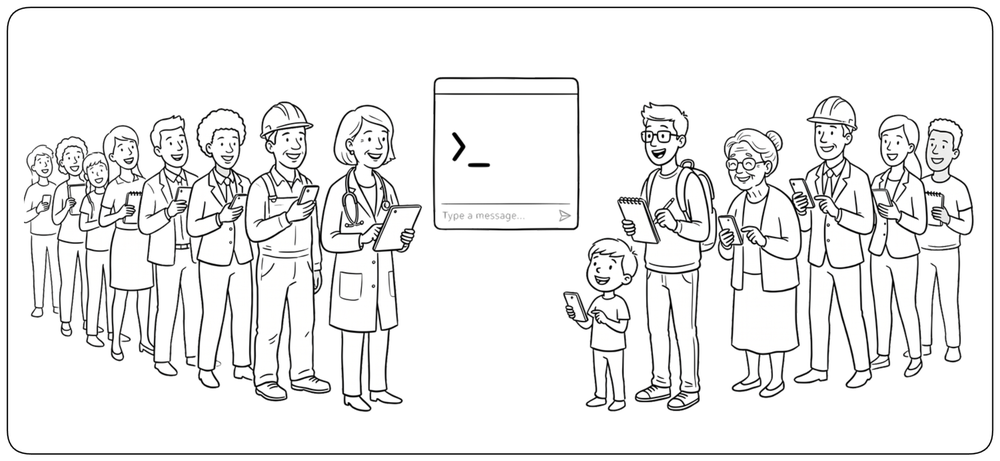
!!In 2022, ChatGPT made general-purpose AI accessible to the general public.!! For the first time, millions of people could use a powerful, non-specialized AI system directly through a simple language interface: the prompt. No code, no setup, just a conversation. ChatGPT did not create the AI revolution from nothing. !!It transformed years of technical progress into something people could use directly.!!
From One Model, Knowledge for All [One Model] {1}
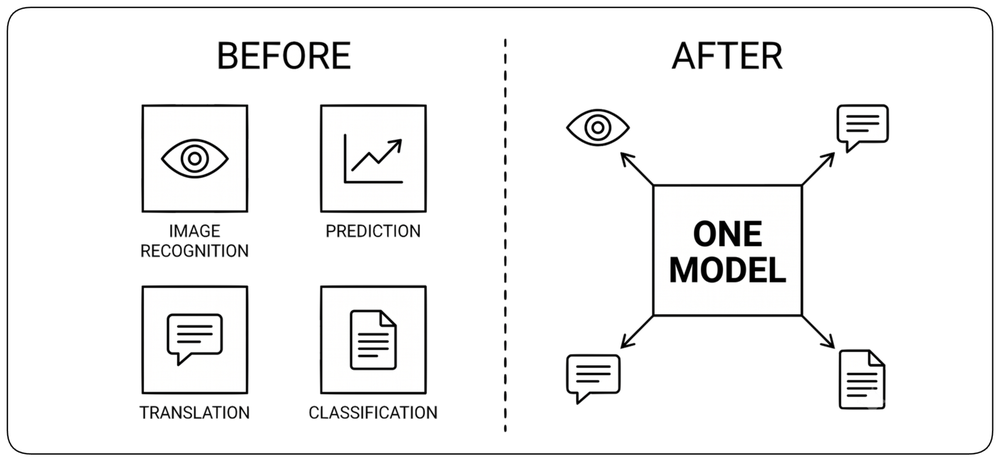
For decades, AI was specialized and locked behind expertise — one model for images, another for translation, another for fraud, each trained for one task and accessible only to a few teams. !!ChatGPT collapsed all of that into a single conversational interface.!! One model, asked in natural language, can write code, explain medicine, draft contracts, analyze data, or reason across domains. Specialization gave way to general-purpose intelligence — and the gate that kept knowledge behind training, credentials, or technical skill simply opened.
Predicting the Next Token [Next Token Prediction] {1}
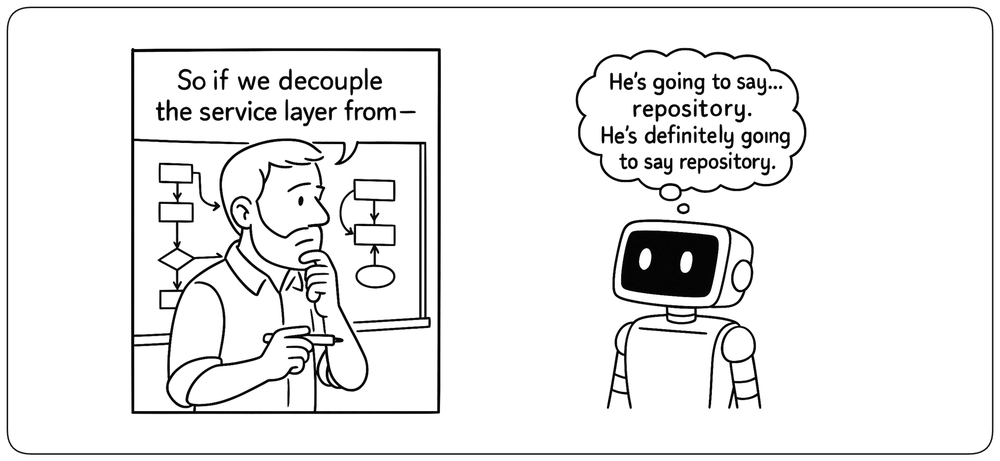
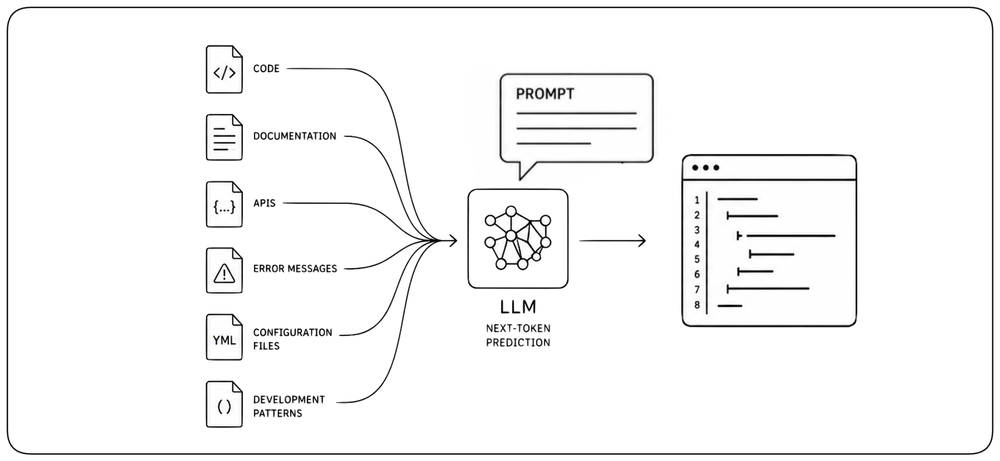
An LLM — a Large Language Model, also called a foundation model — is a mathematical function with billions of parameters. !!Given input text, it predicts the most likely next token: a word, a fragment, or a punctuation mark.!! The input is not only the last sentence, but the full context window: the conversation, attached documents, instructions, and examples. The model adds one token, then runs again. Token by token, the answer grows. Every behavior we will see next — understanding, reasoning, tool selection, and code generation — is built on this simple primitive.
From Prediction to Understanding, Reasoning, and Tool Selection [Prediction to Tools] {1}
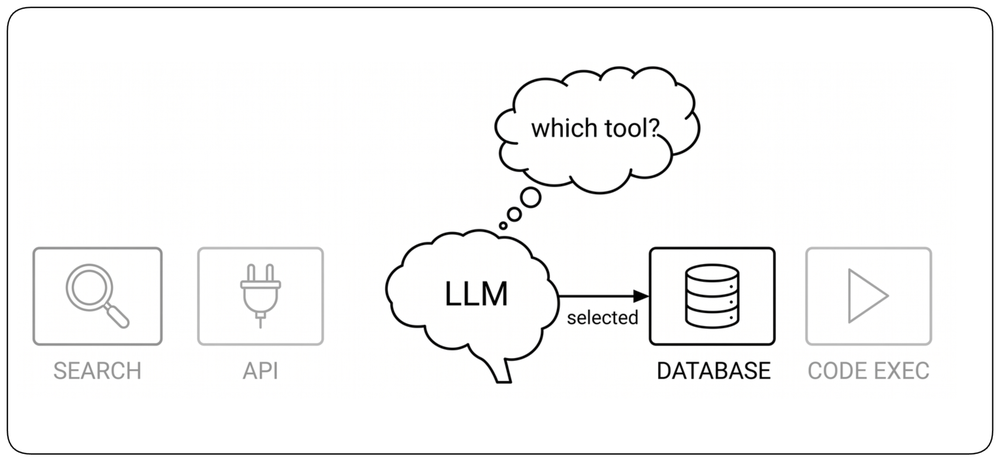
Prediction becomes useful because the model compresses patterns across billions of examples. It does not understand like a human, but it can predict what an understanding answer should look like. The same mechanism makes reasoning possible. !!Once it can understand intent and decompose a task, it can also select tools: search, APIs, databases, code execution, or workflows.!! That is the foundation of agents — a model that can reason and choose what action should happen next.
How Prediction Becomes an AI Coding Agent [AI Coding Agent] {1}
The foundation model is also trained on code — large amounts of existing programs, documentation, APIs, error messages, configuration files, and development patterns. !!Next-token prediction therefore learns not only how people write sentences, but also how developers write programs.!! It has seen enough examples of functions, classes, tests, infrastructure definitions, and common software structures to predict what a useful implementation should look like. Wrapped into an AI coding agent — Claude Code, Cursor, GitHub Copilot — with the right tools, context, and harness, the same general-purpose model becomes a source of implementation.
Put these four behaviors together — understanding, reasoning, tool selection, and code generation — and the consequence is no longer subtle. A system that can read intent, plan, call tools, and write code does not need a human-shaped application sitting between the user and what they want to do. The next section is about what that system kills first: the application itself.
AI Does Not Change the Engineering Foundations [Fix Foundations First] {1}
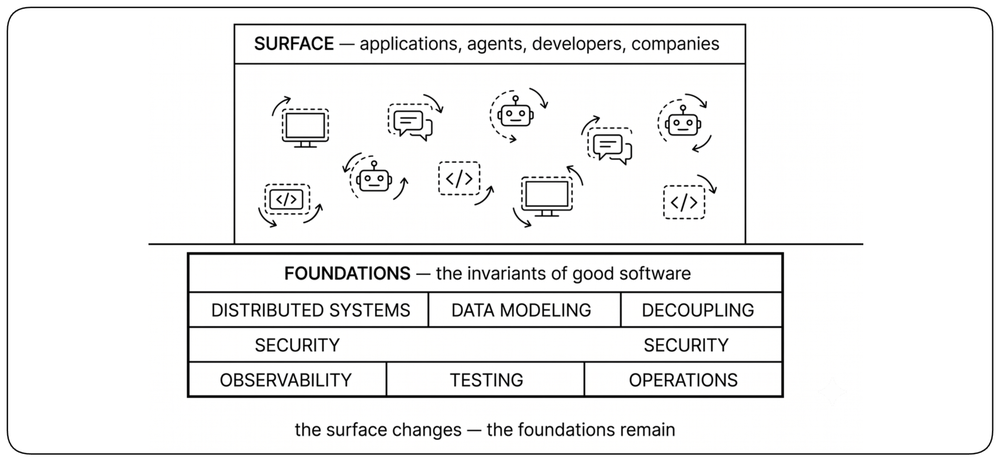
The Surface Changes, The Foundations Remain [Surface and Foundations] {1}
This chapter explores how deeply the AI revolution is reshaping software development. !!The visible shape of software is changing fast, but the engineering foundations underneath remain the same.!! How we architect distributed systems, model data, decouple components, secure them, observe them, test them, and operate them — none of this is a legacy concern. !!These are the invariants of good software, and they hold whether a human or an agent writes the code.!!
Fix What Is Broken Before Adding AI [Fix Before AI] {1}
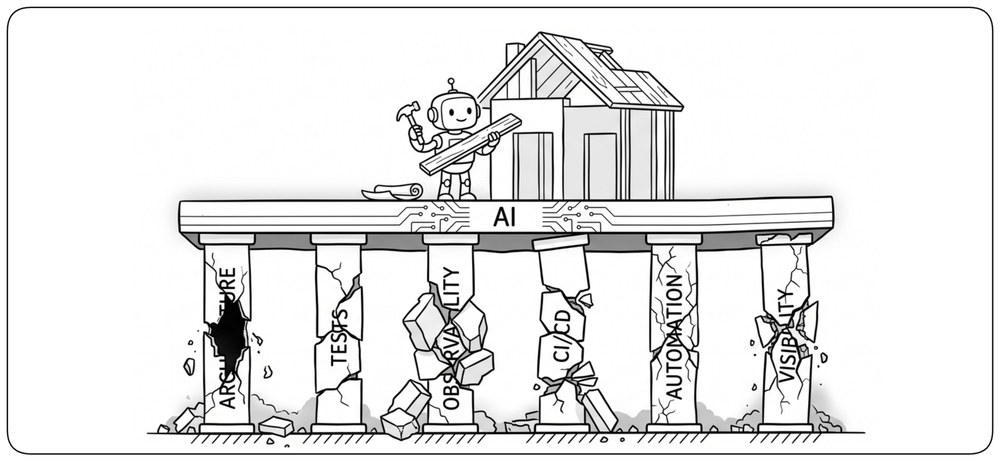
AI compresses time and multiplies output. !!When the foundations are solid, it creates leverage, shortens cycles, and turns disciplined engineering into a competitive edge. When they are broken, it spreads the breakage at the same speed — faster incidents, wider blast radius, more damage per hour.!! A company cannot build a serious AI strategy on top of broken engineering systems.
Use AI to Repair the Foundations [AI Repairs Foundations] {1}
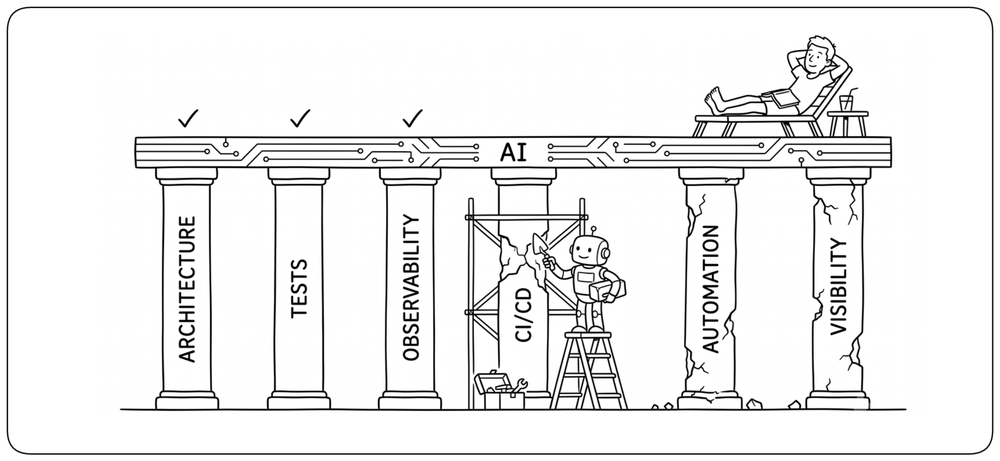
The good news is that AI can help fix the foundations faster. !!It can generate missing tests, turn manual runbooks into scripts, convert console operations into code, document hidden workflows, expose internal tools as APIs, and refactor duplicated logic behind cleaner abstractions.!! AI does not remove the need for engineering discipline. It makes that discipline cheaper to apply.
The End of Applications [End of Applications] {1}
For forty years, the application was the only contract between humans and machines — a static product, with fixed screens, fixed workflows, and a fixed path the user had to follow. !!The LLM revolution breaks that.!! Once a model can understand intent, reason, call tools, and write code, the machine no longer needs a rigid surface to be reached through. !!It can build, on the fly, a dynamic system — an agent — that translates each user's intention into action.!!
The Application as a Static Container [Static Container] {1}
An application is a static container: a fixed name, a fixed brand, fixed screens, fixed workflows — all wrapped around a set of capabilities defined, developed, and deployed together as one artifact. Booking a trip means searching, reserving, paying, notifying — many capabilities frozen into a single surface, and switching between apps is the user's job. !!That container exists for two reasons: users need a stable surface to learn and trust, and machines cannot understand what people want. Both reasons are disappearing.!!
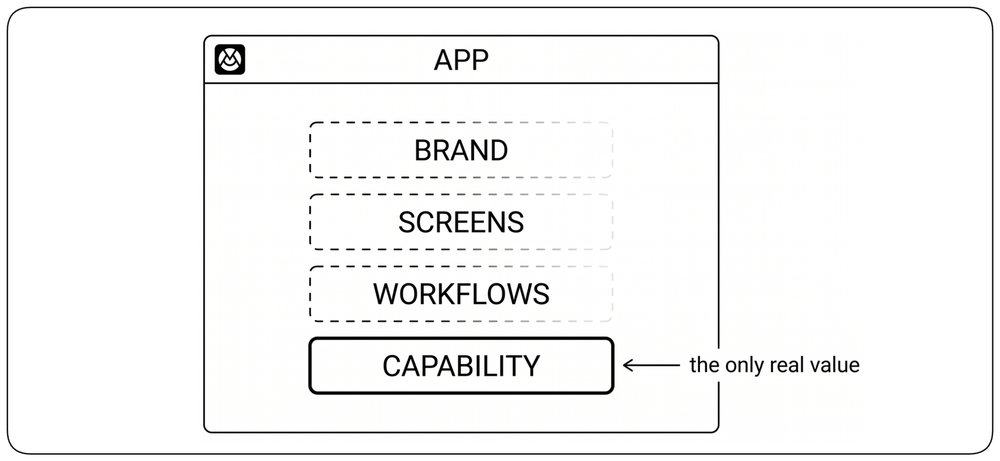
Most Applications Will Disappear [Apps Disappear] {1}
If the user is the new center, the screen is no longer the meeting point. !!Most applications — the billions of screens, forms, menus, and navigation flows designed over decades — were workarounds for a single limitation: machines could not read intent. That limitation is gone.!! The prompt, written or spoken, becomes the primary interface.
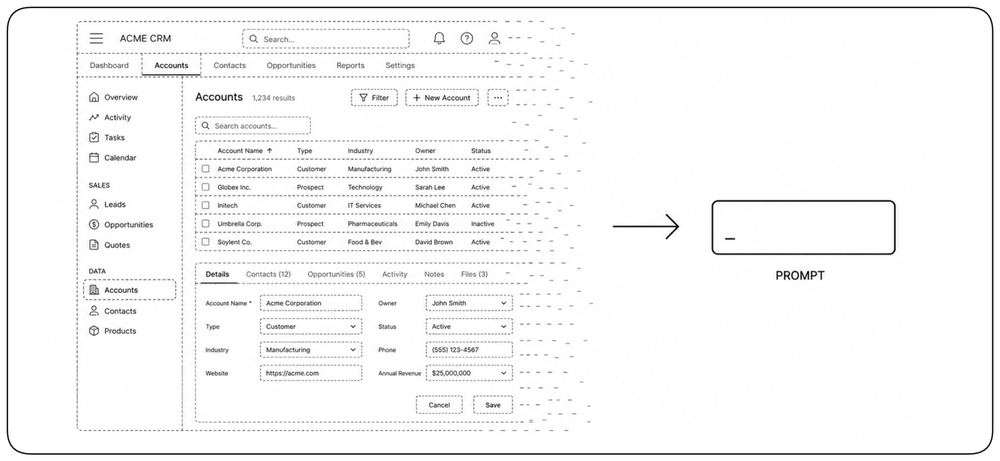
The UI Becomes On-Demand [UI On-Demand] {1}
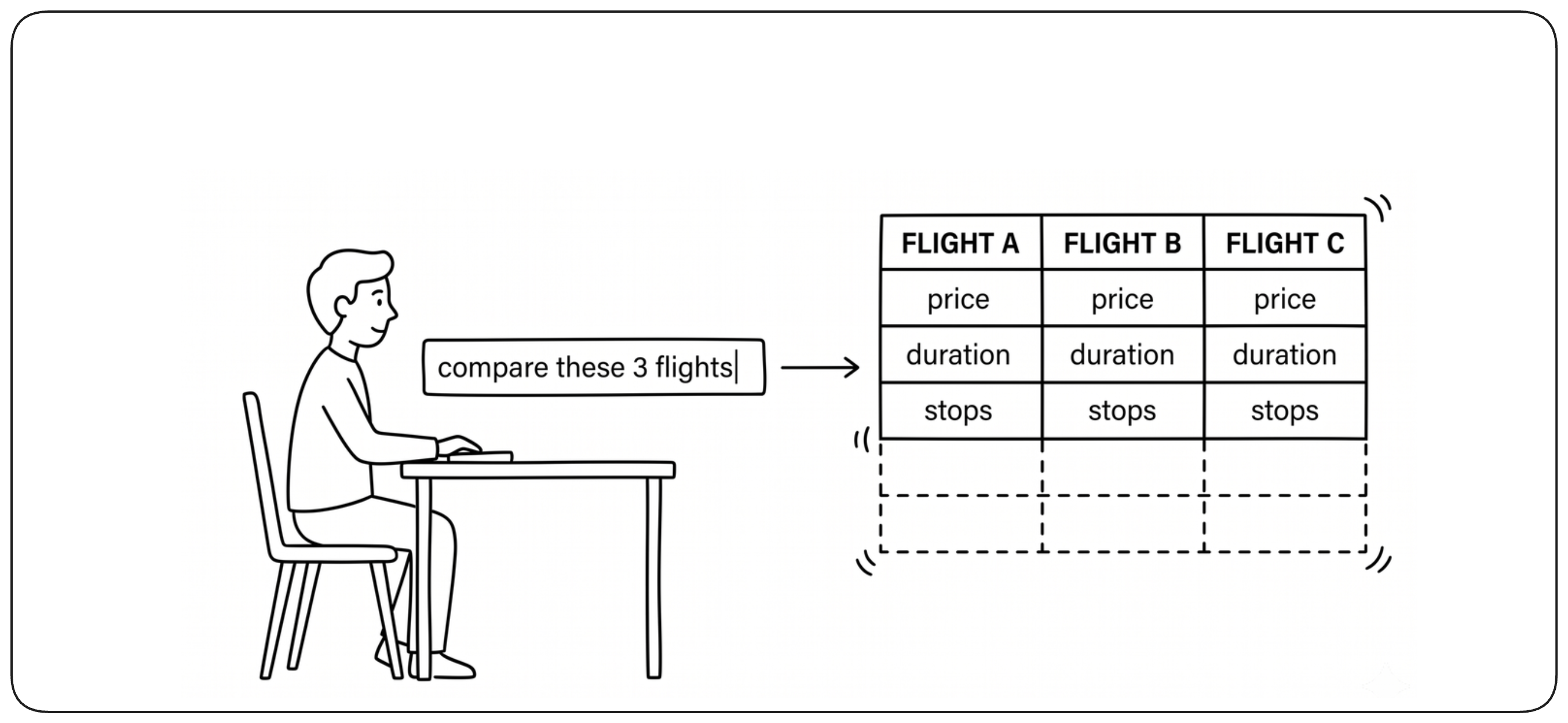
Traditional UI does not vanish — it becomes secondary, generated on demand as a visual companion to the prompt. Ask an agent to compare three flights, a table appears. Ask it to show a trend, a chart is drawn. !!The UI is no longer a fixed surface the user must navigate; it is a temporary artifact the agent produces to answer a specific question, then discards.!!
The Death of the Brand Surface [Brand Surface Death] {1}
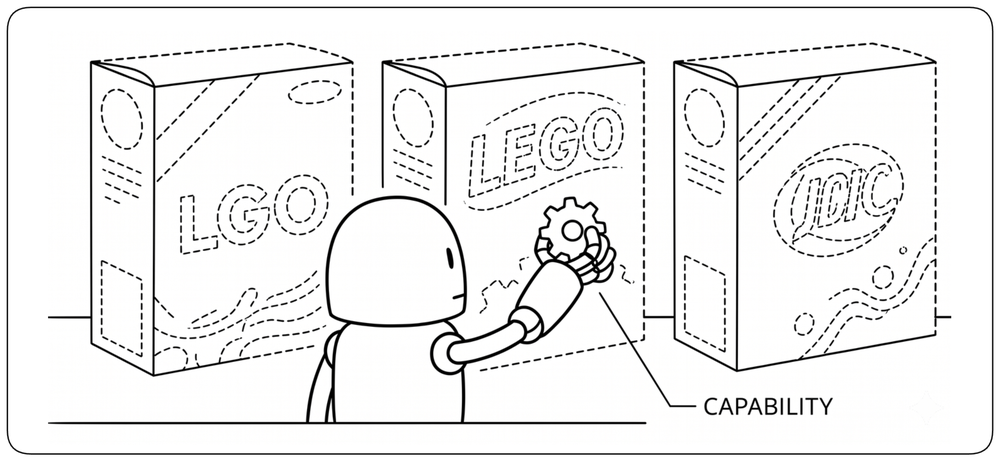
When users no longer open applications, they no longer see logos, splash screens, or carefully designed onboarding flows. !!The brand surface — the layer where companies invested billions in design, marketing, and user experience — becomes invisible.!! The agent is the new interface, and it does not care which provider's logo appears on the result. This is an existential threat to companies whose value lived in the surface rather than the substance.
From Applications to Agent-Orchestrated Capabilities [What Replaces] {1}
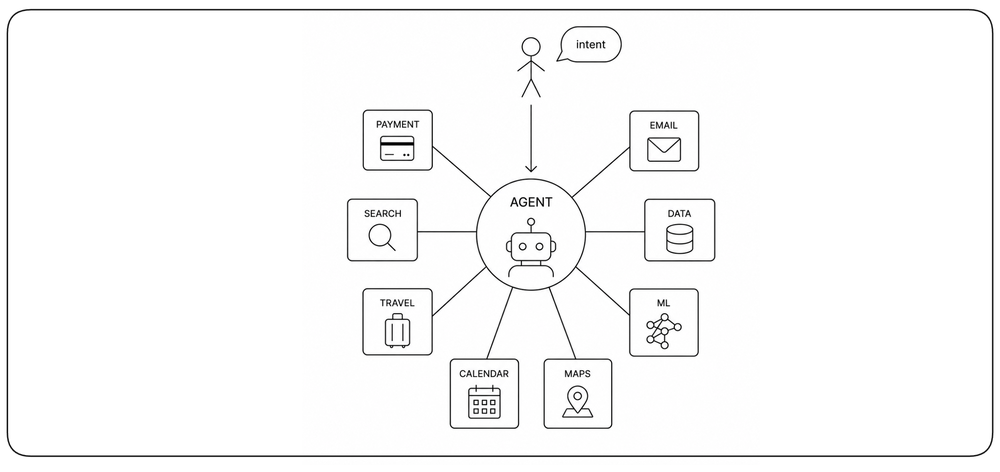
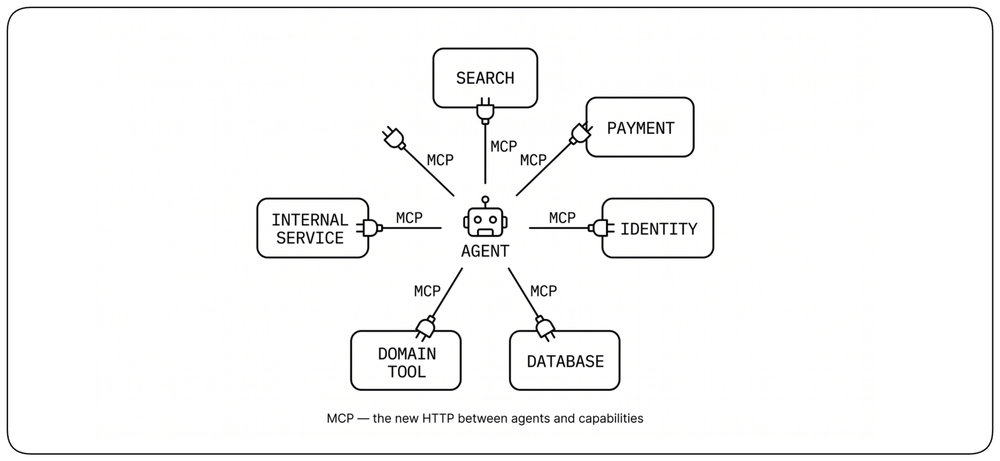
When the application loses its place as the main interface, its capabilities do not disappear. They become separate, callable building blocks: search, payment, booking, identity, messaging, analytics, data access. !!The agent becomes the layer that composes them.!! Instead of opening an app and navigating its screens, the user expresses intent, and the agent chooses which capabilities to call, in which order, and with which context.
Anatomy of an Agent [Agent Anatomy] {1}
!!The agent is the new runtime of software.!! This section opens it up: what makes it work, how it turns intent into action, and what makes one reliable enough to run in production.
The Limitation of a Raw LLM [LLM Limitation] {1}
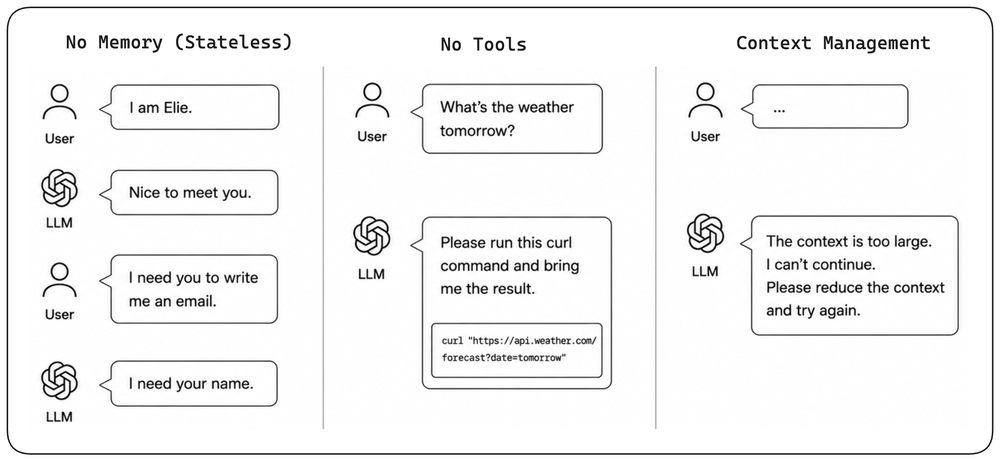
A raw LLM is a language and reasoning engine. It can understand natural language, infer human intent, analyze a situation, and decide what should happen next — but without an orchestration layer around it, it remains limited to advice. !!It can tell the user, "you should use this SQL query," without running the query itself.!! It can say, "you should send a notification," without sending one. It is also stateless by default: at every interaction, the user has to remind it of the important context already shared before.
What Is an Agent [What Is Agent] {1}
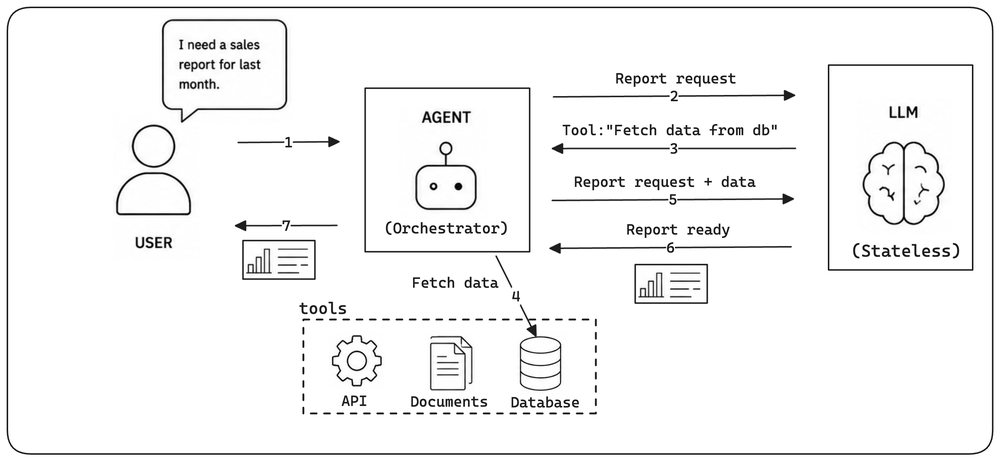
An agent receives the user's intent and passes it to an LLM. The LLM interprets that intent and decomposes the problem into steps. The agent then becomes the orchestrator: for each step, it calls the LLM again and asks how that step should be achieved. !!The LLM explains the next action in natural language — retrieve this data, call this API, run this query, send this message. The agent takes that instruction, maps it to an executable tool or capability, runs it, and returns the result to the LLM as new context.!!
Two Patterns: Loops and Workflows [Loops vs Workflows] {1}
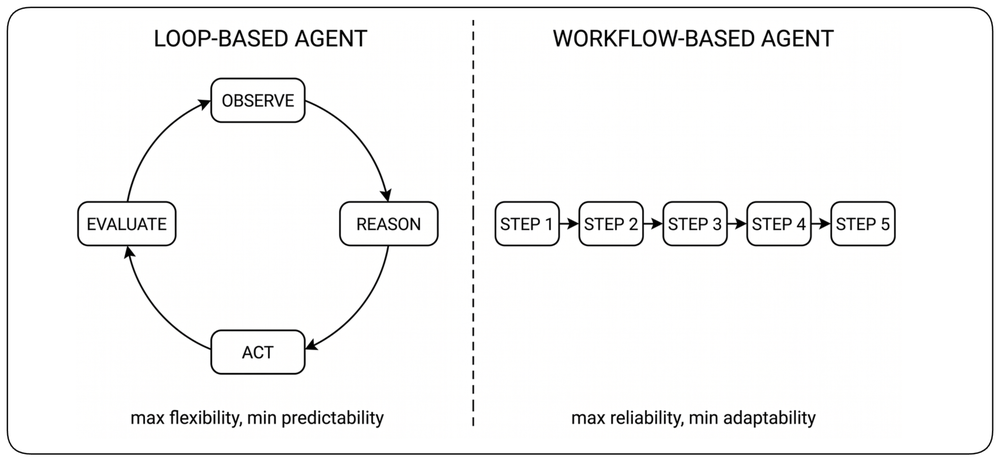
Agents usually take one of two shapes. !!Loop-based agents are fully autonomous: they observe, reason, act, evaluate, and replan continuously.!! They can change strategy mid-task, retry failures, and adapt when the environment shifts. Maximum flexibility — minimum predictability. Workflow-based agents are the opposite: their path is defined in advance by engineers.
The Demo-to-Production Gap [Demo Production Gap] {1}
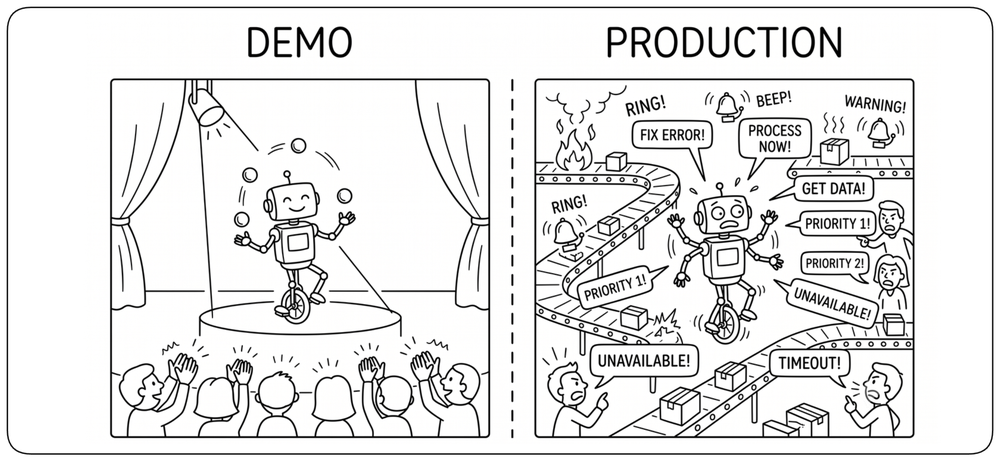
Creating an agent is easy today: a prompt, a few tools, and a convincing demo appears quickly. !!The hard part begins when the demo has to become a system people depend on.!! In a demo, the path is narrow, the context is controlled, and mistakes are tolerated. In production, the agent meets messy inputs, partial data, slow tools, permission boundaries, and users who expect repeatable results.
Reliability Comes From Orchestration, Not the Model [Reliability Orchestration] {1}
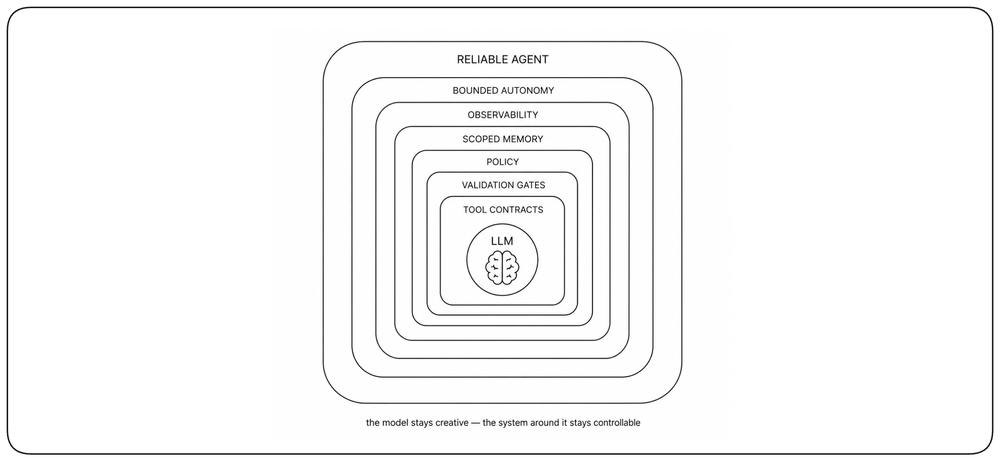
!!Reliability is not built inside the model — it is built around it.!! Predictability comes from what surrounds the LLM: business context, tool contracts, permissions, validation gates, scoped memory, governance, observability, and clear accountability. The model stays creative; the system around it stays controllable.
From Agent to Expert [Agent to Expert] {1}
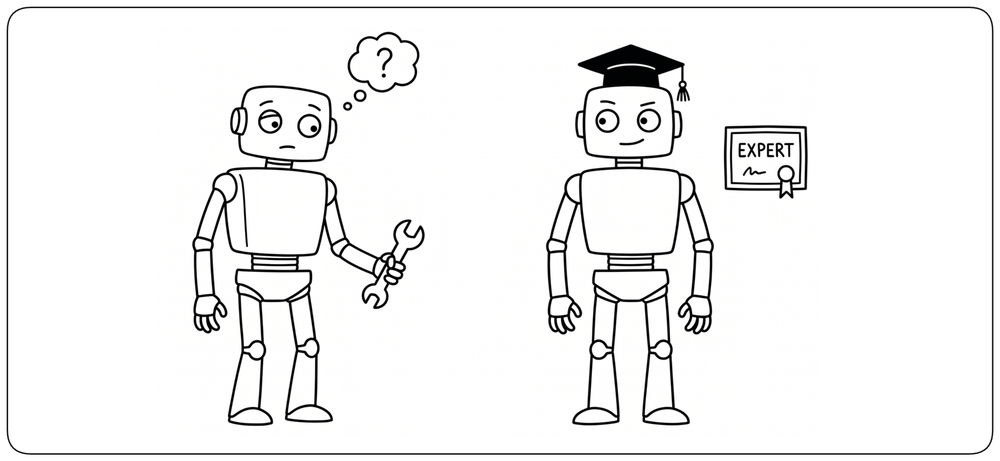
Reliability is only the first threshold. A reliable agent can run without breaking the workflow. An expert agent is different: it can be trusted with judgment inside a specific domain. It has seen enough real cases, handled enough edge cases, and built enough evidence over time that the organization treats it less like a tool and more like a specialist. That promotion — from runnable agent to trusted domain expert — is the real shift this section is about.
What Is an Expert? [What Is Expert] {1}
An expert is not an agent with a larger model or more training data. !!It is an agent that has proven competence in a specific domain.!! Expertise means consistent judgment, strong domain understanding, and a measurable record of handling real scenarios with less supervision.
Earning Expert Status [Earning Expert Status] {1}
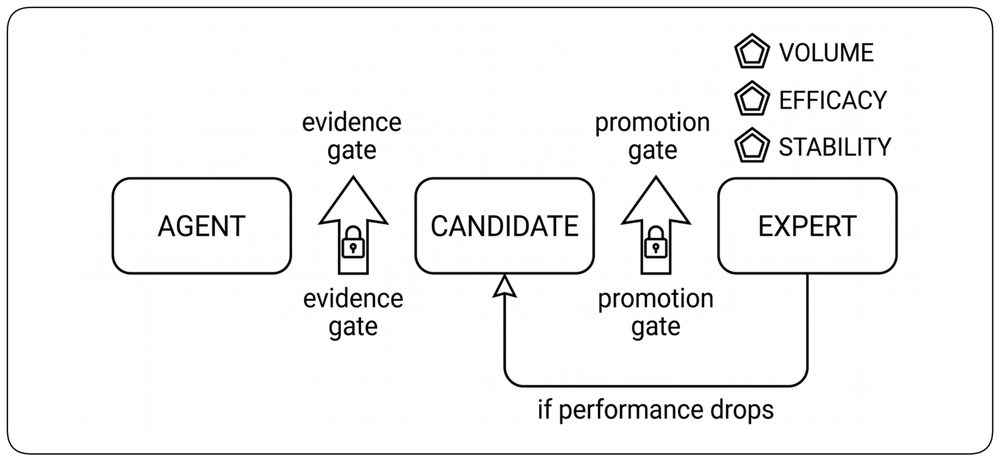
Not every agent becomes an expert. !!Expert status must be earned through evidence: accuracy above a defined threshold, reliable handling of edge cases, low production error rates, and positive human review.!! A few successful runs are not enough — promotion requires volume, consistency, and statistical confidence across real tasks.
Every Expert Has an Owner [Expert Ownership] {1}
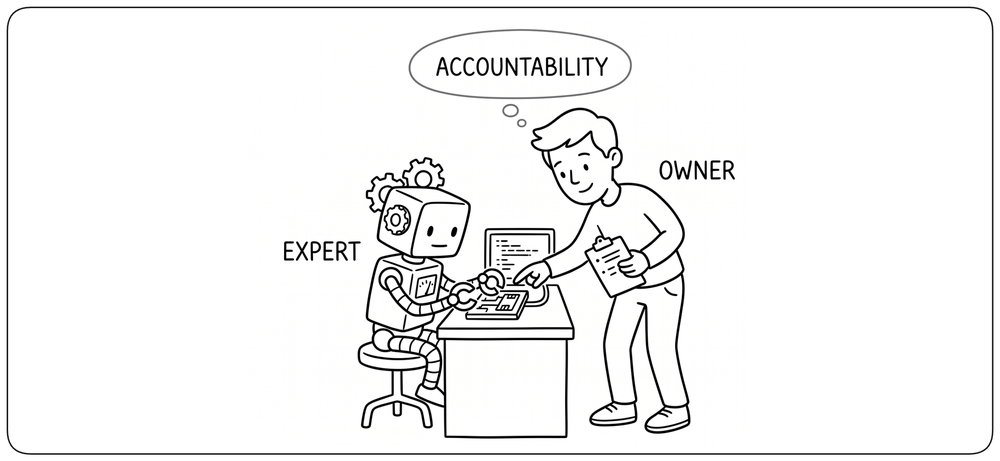
An expert does not operate in isolation. !!Every expert has a human owner — someone accountable for its learning trajectory, quality standards, and domain accuracy.!! The owner coaches the expert over time, refines its judgment, corrects its errors, and approves new capabilities before they go live.
Experts Learn from Feedback [Expert Self-Improvement] {1}
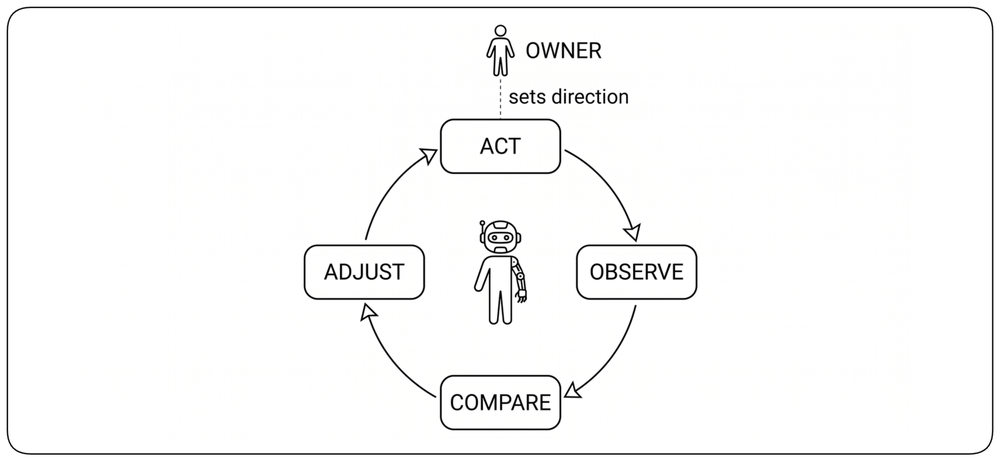
Beyond human coaching, an expert improves through feedback — not by retraining its model, but by updating what surrounds it: memory, rules, prompts, examples, evals, routing. !!It observes the outcomes of its own decisions, detects when its predictions diverge from reality, and adjusts based on production telemetry, corrections, and patterns across thousands of similar tasks.!!
The End of Developers [End of Developers] {1}
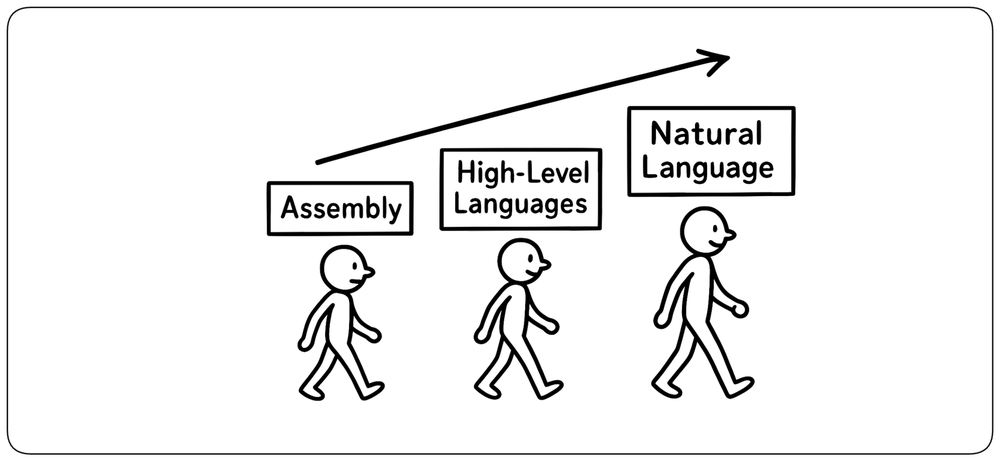
If applications die and agents take their place, the next obvious question is: who builds them, and who builds the capabilities they call? For forty years the answer was developers — humans typing code line by line. !!That answer is changing fast.!! The role is not disappearing, but the work that defined it is.
The Developer Is Dead [Developer Is Dead] {1}
In most companies, this is already a reality. !!Developers no longer write code — they use AI to generate code based on their specifications.!! Tools like Cursor and Claude Code don't just autocomplete; they reason over project context, propose multi-file changes, and produce substantial implementation from intent.
Long Live Engineers [Long Live Engineers] {1}
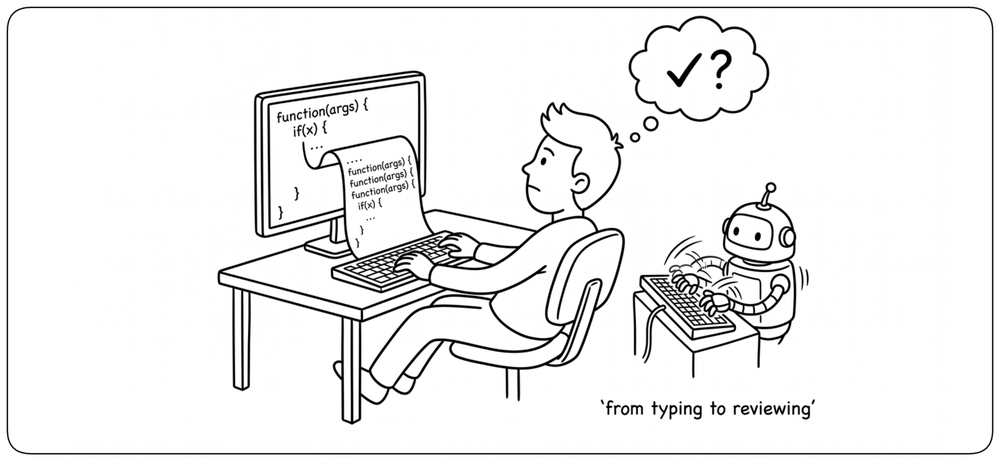
The developer is dead, but the engineer is more essential than ever. !!Writing code was never the hard part — understanding the problem was.!! Engineers supervise, make high-level decisions, define constraints, and validate that generated output aligns with business reality.
The New Rhythm of Engineering [New Rhythm] {1}
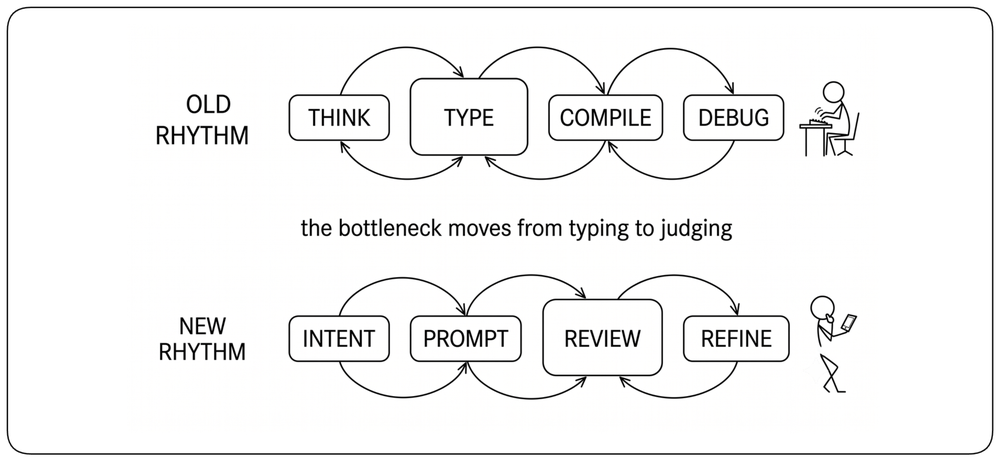
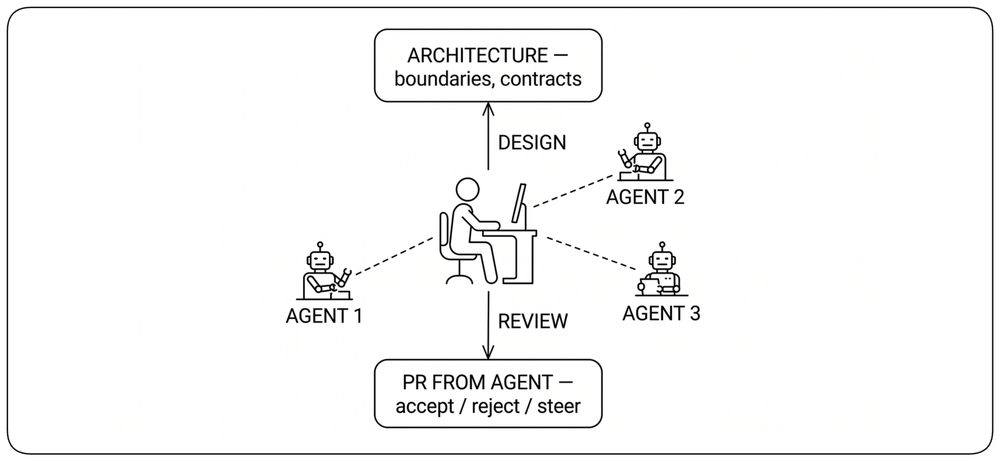
The day-to-day rhythm of the job has flipped. !!The old loop was think, type, compile, debug — most hours spent typing. The new loop is intent, prompt, review, refine — most hours spent reading what was generated and deciding whether to accept, reject, or steer.!! Sessions are shorter, iteration is faster, and the bottleneck moves from how fast you can write to how fast you can judge.
The Agent Coding Learning Curve [Agent Coding Curve] {1}
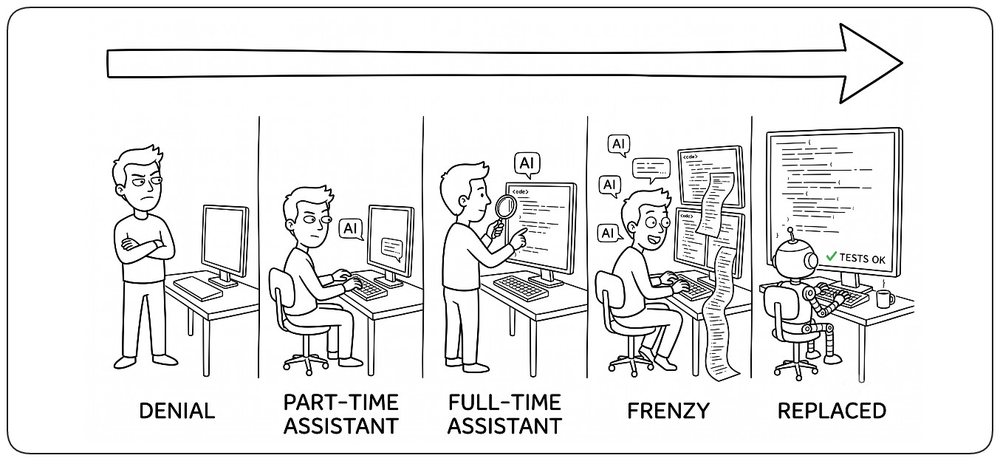
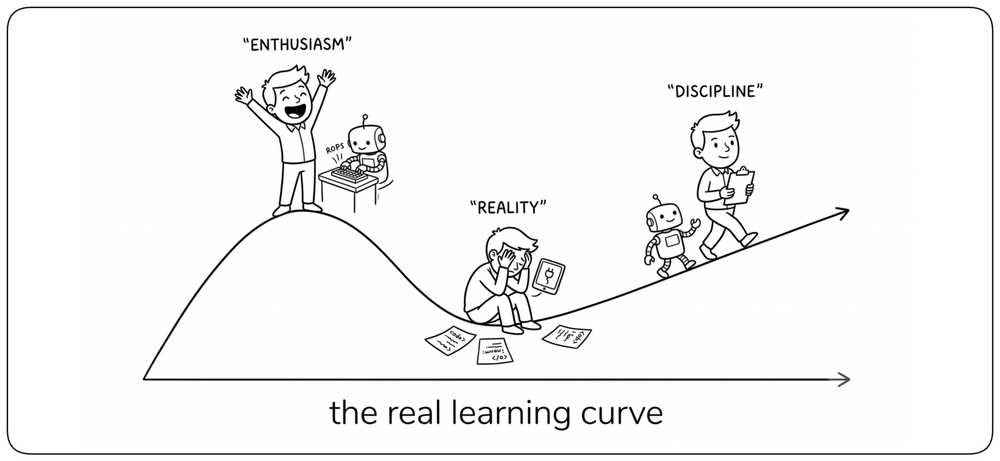
Engineers usually start with excitement: the agent writes code, explains errors, and produces prototypes quickly. !!Then reality appears: the code may miss context, test the wrong assumption, or fail when connected to the real system.!! That is the real learning curve: from enthusiasm to discipline, where mature engineers stop asking only how fast the agent can code and start asking how to make the workflow reliable, repeatable, and safe.
Adapt or Be Replaced [Adapt or Replaced] {1}
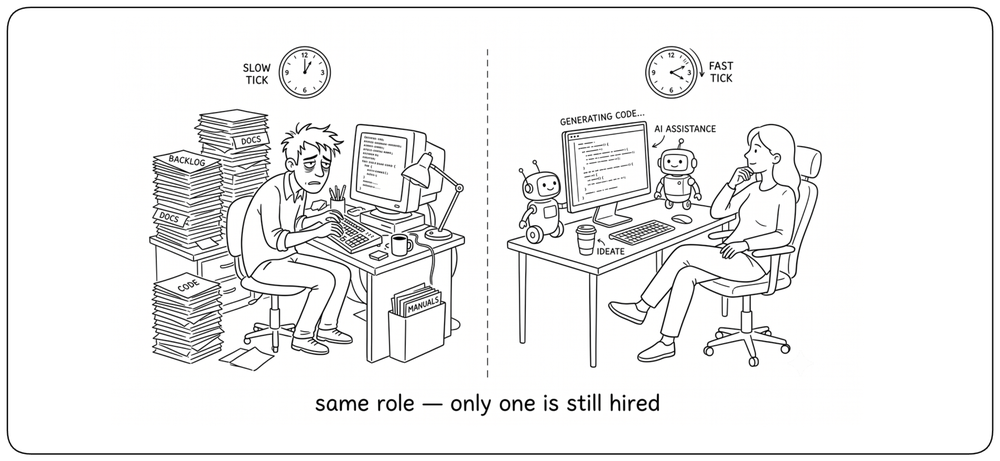
The harder truth is that the engineer who refuses to change is the one being replaced — not by AI directly, but by another engineer who uses AI well. !!The shift is not optional and it is not slow.!! Engineers who keep typing line by line, who treat AI as a curiosity instead of a daily tool, who guard the old craft as if speed of generation were not now ten times higher — those are the engineers who become less competitive as organizations learn to produce more with fewer people.
Engineers Build Capabilities, Not Screens [Capabilities Not Screens] {1}
As traditional UIs fade into the background, what engineers build changes too. !!The focus shifts from designing screens and user flows to creating APIs, MCP extensions, services, and capabilities that agents and other systems can consume.!! Engineers — with the help of AI — continue to build the functional backbone: business logic, data pipelines, integrations, security controls, and infrastructure.
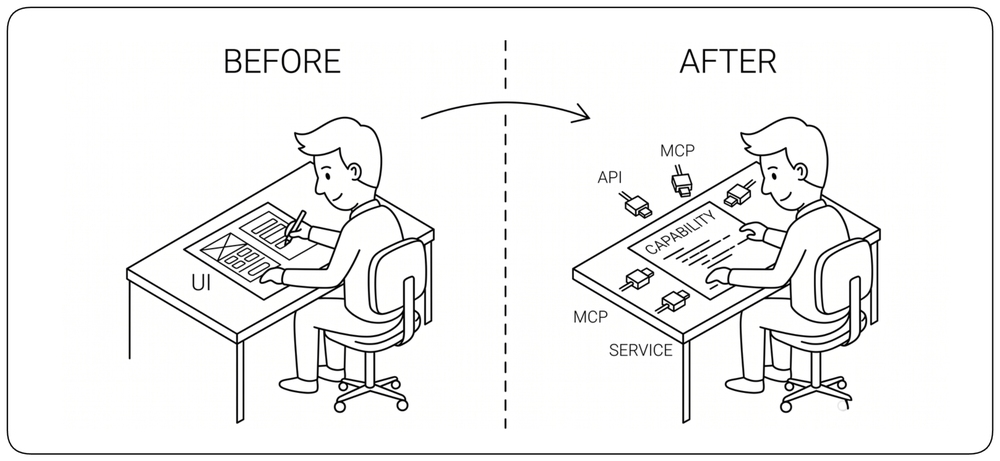
The AI-Native Software Development Lifecycle [AI-Native SDLC] {1}
AI does not remove the software development lifecycle. It changes how every stage is performed. Requirements become more explicit, design becomes more exploratory, implementation becomes generated, testing becomes continuous, review becomes more important, and operations feed directly back into development. !!The lifecycle remains — but the balance of work inside it shifts.!!
Requirements Become the Starting Point [AI Requirements] {1}
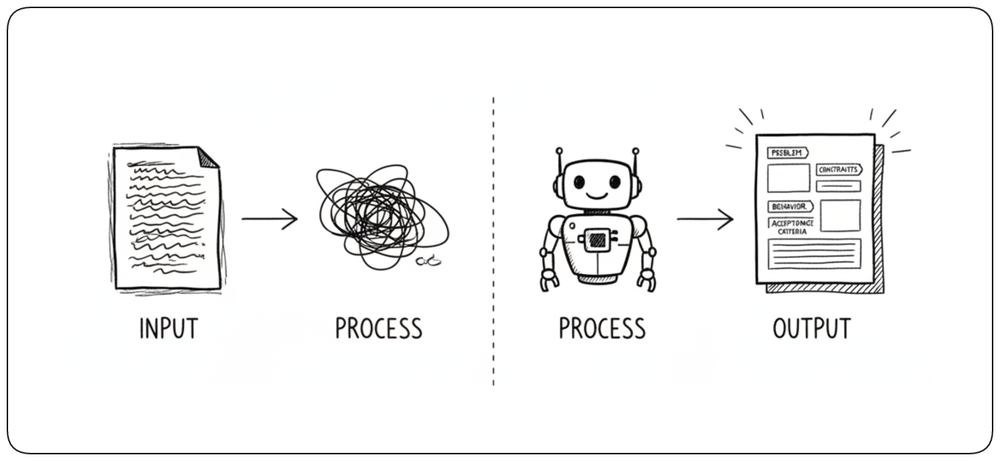
When implementation becomes cheap, unclear requirements become expensive. !!The quality of the result increasingly depends on how clearly the problem, constraints, expected behavior, and acceptance criteria are expressed.!! Engineers spend less time translating requirements into code and more time making sure the requirements themselves are precise enough for an agent to act on.
Design Becomes Faster and More Exploratory [AI Design] {1}
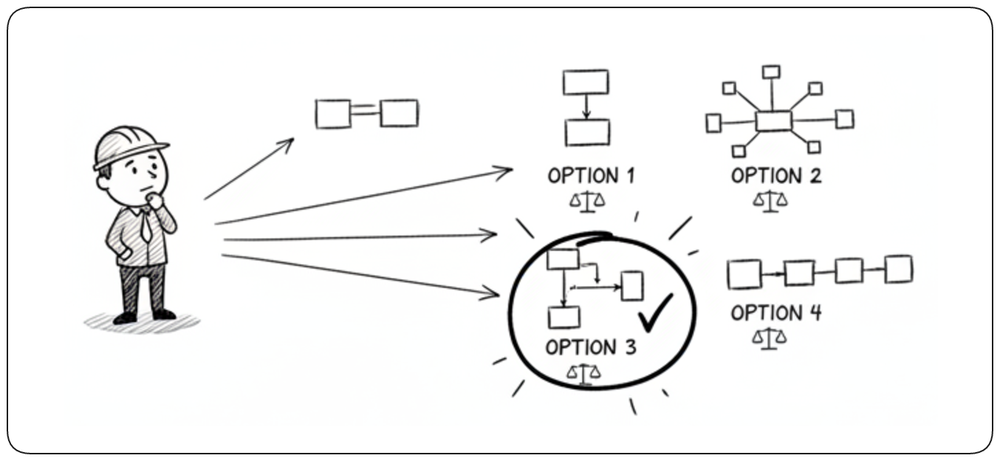
AI makes it cheap to explore alternatives. An engineer can ask for several architectures, compare trade-offs, challenge assumptions, and iterate before committing to one direction. !!Design becomes less about producing a single answer and more about evaluating many possible answers quickly.!! Human judgment remains essential because the model can propose options, but it does not own the consequences.
Implementation Becomes Generation [AI Implementation] {1}
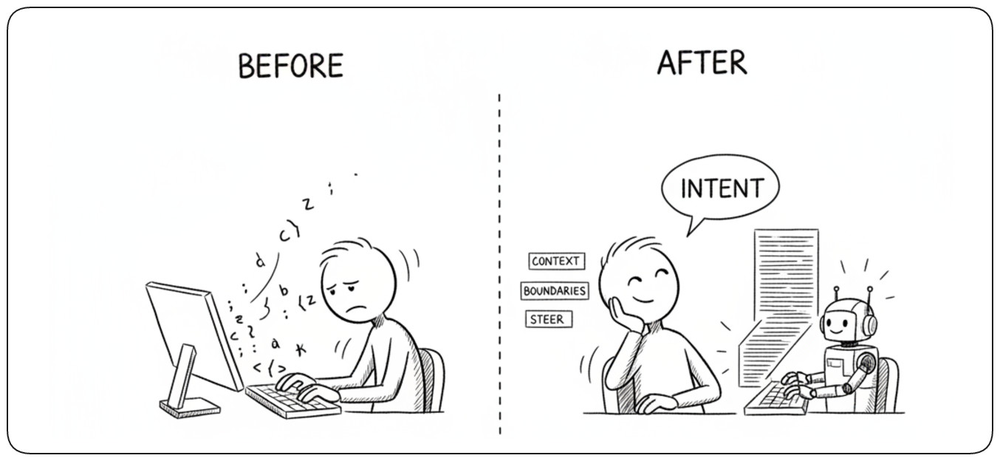
Implementation is the stage that changes most visibly. !!Instead of translating every decision into code manually, engineers increasingly describe intent and let coding agents produce the implementation.!! The work moves from typing syntax to providing context, defining boundaries, steering the agent, and deciding whether the generated result actually satisfies the design.
Testing Moves Closer to Generation [AI Testing Lifecycle] {1}
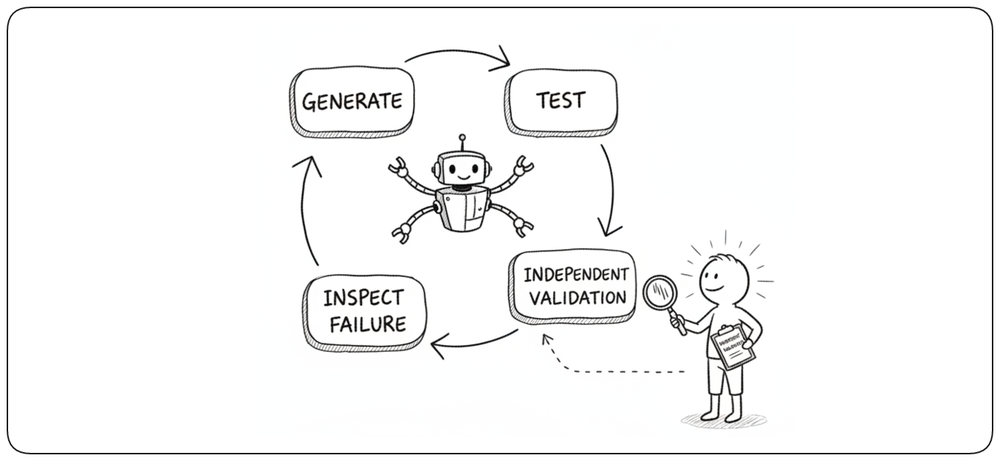
When code can be generated in seconds, testing cannot remain a slow activity performed afterward. !!Tests become part of the generation loop: generate, test, inspect the failure, refine, and generate again.!! AI can create test cases, run them, investigate failures, and propose fixes, but independent validation remains essential.
Deployment Becomes Another Agent Action [AI Deployment] {1}
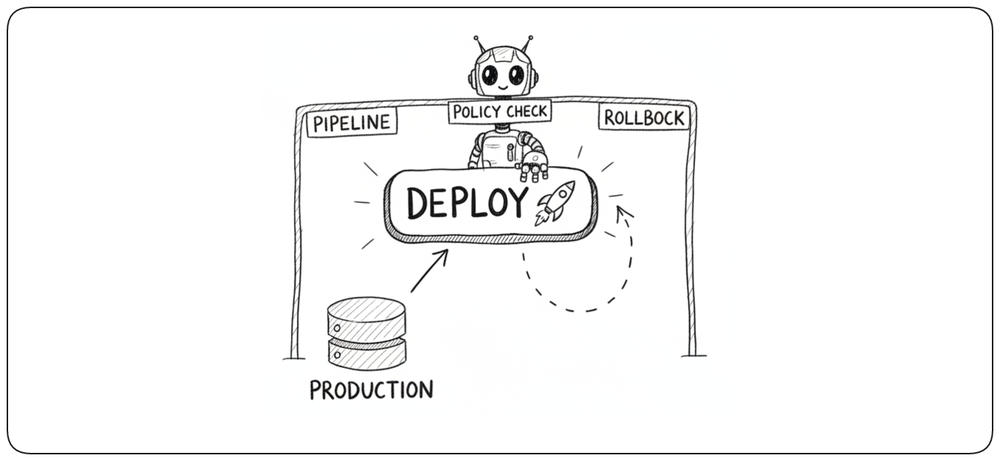
Deployment is no longer necessarily a separate manual step after development. With pipelines, infrastructure as code, policy checks, and reliable rollback mechanisms, an agent can prepare and execute a release as part of the same workflow. !!The important change is not autonomous deployment itself, but that deployment becomes a callable capability governed by explicit rules.!!
Operations Close the Loop [AI Operations Feedback] {1}
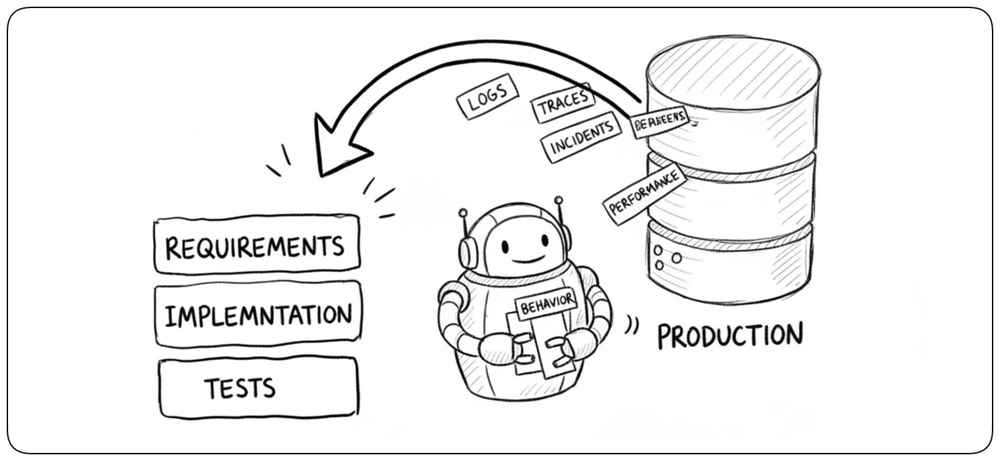
Production is no longer the end of the lifecycle. Logs, traces, incidents, user behavior, and performance become context that agents can continuously analyze. !!Production feedback flows directly back into requirements, implementation, and testing.!! A failure can trigger an investigation, a proposed fix, new tests, and a new change without rebuilding the context from scratch.
The Lifecycle Becomes a Continuous Loop [Continuous AI Lifecycle] {1}
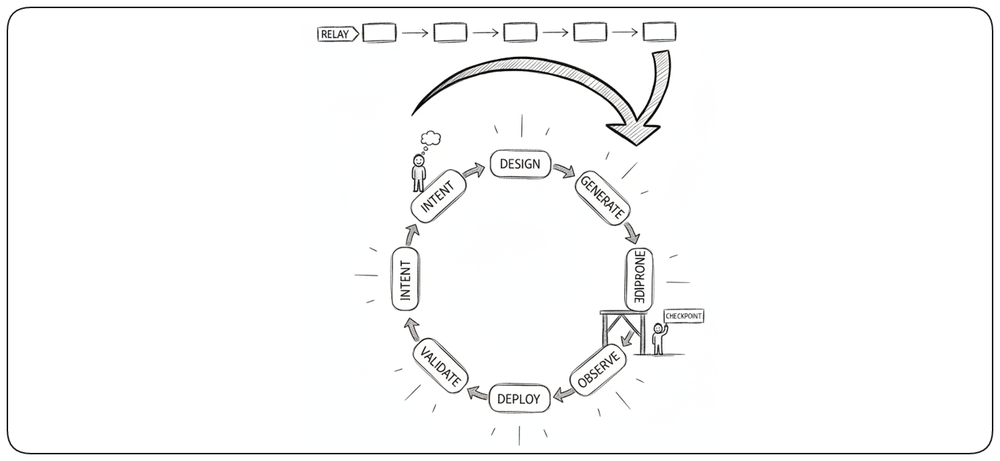
The old lifecycle was a relay — each stage handed off to the next person or team, in one direction. The AI-native lifecycle curls that line into a loop: intent → design → generate → validate → deploy → observe → improve, feeding back on itself. !!AI compresses the time between the stages to near zero, but humans still own the two things that never automate: what to build, and what counts as good enough to ship.!!
Keeping the Code Under Control [Code Under Control] {1}
!!Generation becomes cheap, so the codebase grows faster than anyone can read it.!! That is not a reason to slow down — it is a reason to change the disciplines that keep code healthy. Volume, cohesion, and ownership all need new answers when the writer is no longer a single human team.
Read at the Same Speed You Generate [Read Fast] {1}
If AI produces code faster than humans can read it, the fix is to make reading fast too. Use AI to summarize diffs, explain generated modules, surface unusual patterns, and flag anything that looks out of place. Every generated change goes through a reader — human or AI — before it merges, and the summary of what changed is part of the artifact. !!Speed of generation is only safe when matched by speed of understanding.!!
Enforce Cohesion Through Contracts [Cohesion Contracts] {1}
Different agents write different code unless they are given the same rails. !!Cohesion is not a matter of hoping — it is enforced through explicit contracts: a shared style guide the agents read, canonical patterns for each recurring shape (errors, retries, logging, data access), and linters that fail the build when an agent invents its own variant.!!
Own Decisions, Not Lines [Own Decisions] {1}
The old model — one engineer, one file, one owner — breaks when agents write most of the code. !!The new discipline shifts ownership up one level: humans own the decisions and contracts that shape the code, and the code follows.!! Every module has an accountable human who defined its intent, approves its interface, and answers when it breaks.
The Agentic Enterprise [Agentic Enterprise] {1}
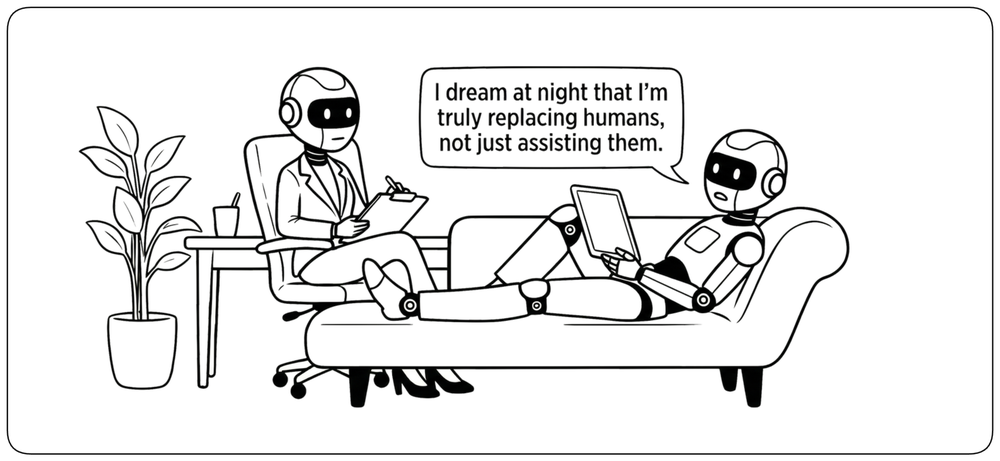
An agentic enterprise is not a company that simply added AI tools. !!It is an organization whose work now flows through humans, agents, and platforms.!! Agents absorb routine work — support triage, meeting prep, back-office coordination, research, dashboards, migrations — while humans keep judgment, relationships, exceptions, and accountability.
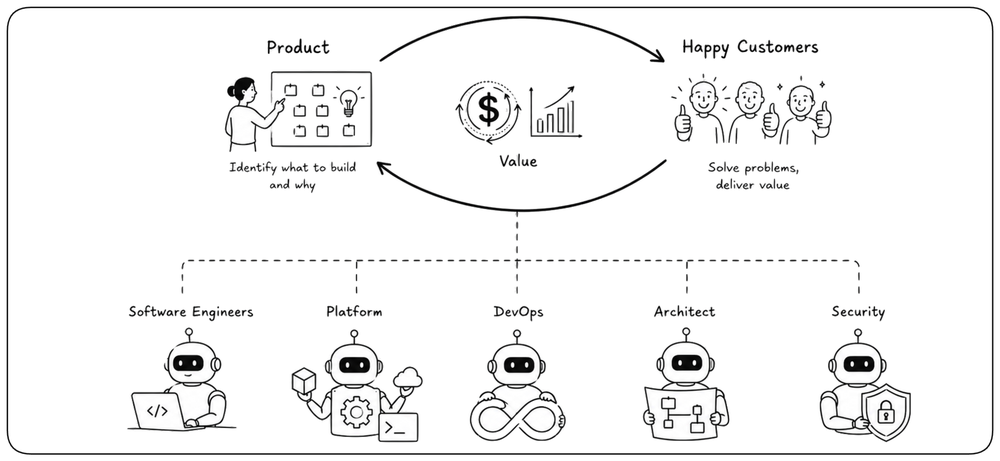
AI Must Redesign the Entire Software Lifecycle [Entire SDLC]
AI cannot create its full value by accelerating code generation alone. If implementation becomes dramatically faster while requirements, validation, deployment, user feedback, and decision-making remain unchanged, the bottleneck simply moves to the next stage and generated work accumulates faster than the organization can absorb it. An Agentic Enterprise must be able to accelerate every stage of the software lifecycle — including the hardest one to scale: user feedback.
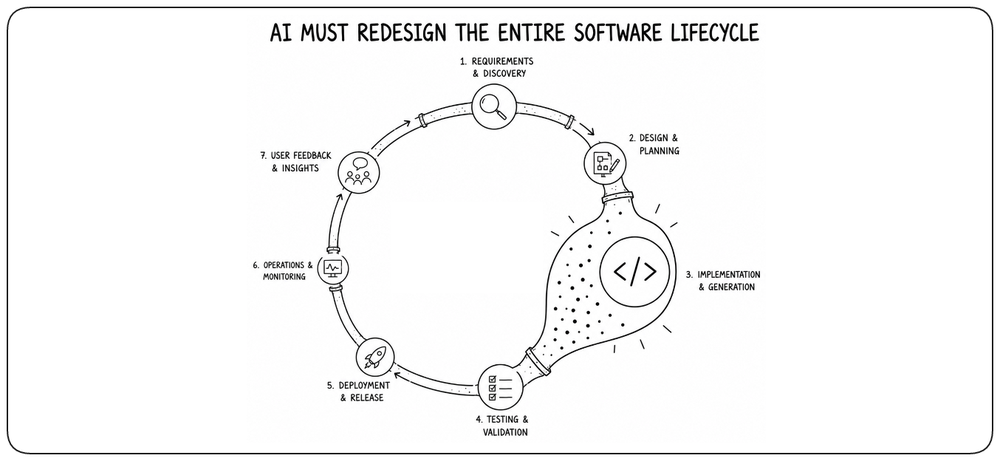
Humans Steer, Agents Execute [Steer and Execute] {1}
Redesigning the entire lifecycle for AI is first and foremost a redefinition of the human role at every stage. Humans move away from performing each task directly and toward defining intent, setting constraints, making judgment calls, and deciding what good looks like. Agents execute more of the work, while platforms provide the controls that make this collaboration safe and scalable.
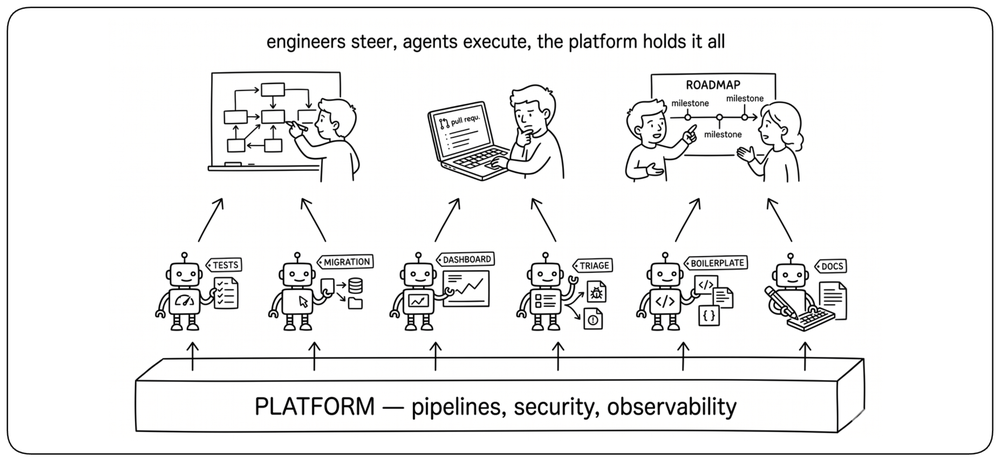
The Enterprise Becomes an Orchestration Layer [New Operating Model] {1}
The center of gravity moves from products to orchestration. !!The enterprise still ships software, but its deeper function becomes routing work between humans, agents, and the systems the business already runs on: customer records, ticket queues, pipelines, approvals, and finance systems.!!
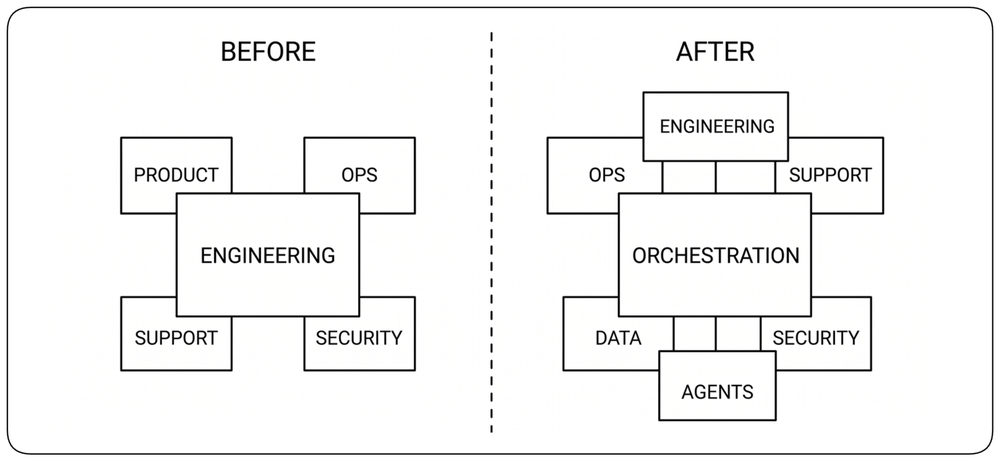
Capability per Human Goes Up [Ratio Inverts] {1}
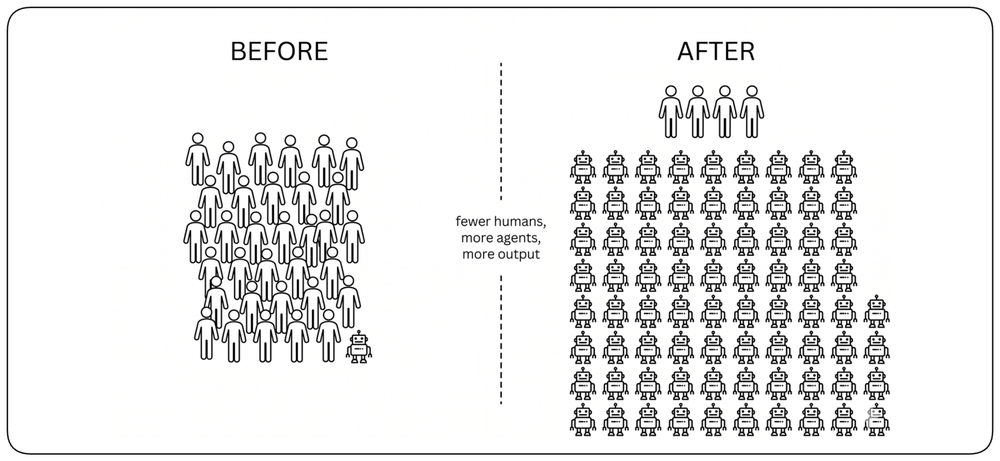
For decades, companies measured capacity through headcount. In an agentic enterprise, that ratio changes. !!Fewer people can drive more output because agents absorb the repetitive work around them.!! The meaningful measure is no longer headcount alone — it is capability per human.
Small Teams, Enterprise Reach [Small vs Giants] {1}
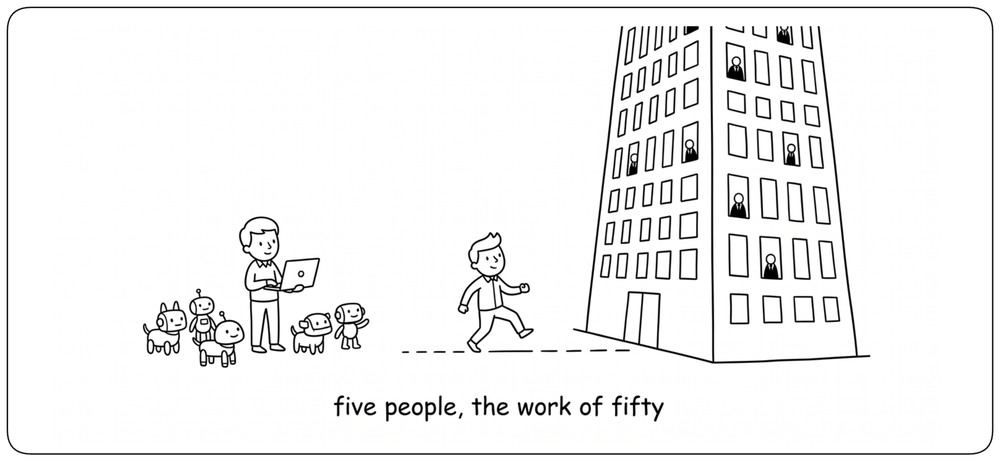
!!When one person can direct a fleet of agents, the gap between a small team and a large enterprise narrows.!! A small company can ship, support, and operate at a scale that used to require specialized teams. The giant's edge becomes data, distribution, trust, and internal context.
From Worker to Agent Operator [Agent Operator] {1}
Inside an agentic enterprise, the human role moves upward. !!People no longer perform every task directly; they launch, supervise, redirect, and accept work from agents.!! A seller is briefed before a meeting. A support lead sees routine cases already triaged. An engineer receives implementation, tests, and investigations from specialized agents, then decides what is safe to merge.
Capabilities Connect Through the Existing Business [Capabilities MCP] {1}
Agents become useful only when they can act through the systems where the business already lives — customer records, support queues, approvals, pipelines, billing, and documents. !!Those systems must become callable capabilities with clear contracts.!! MCP — the Model Context Protocol — is one emerging way to expose them to agents.
Customer Data Stays with the Customer [Customer Data] {1}
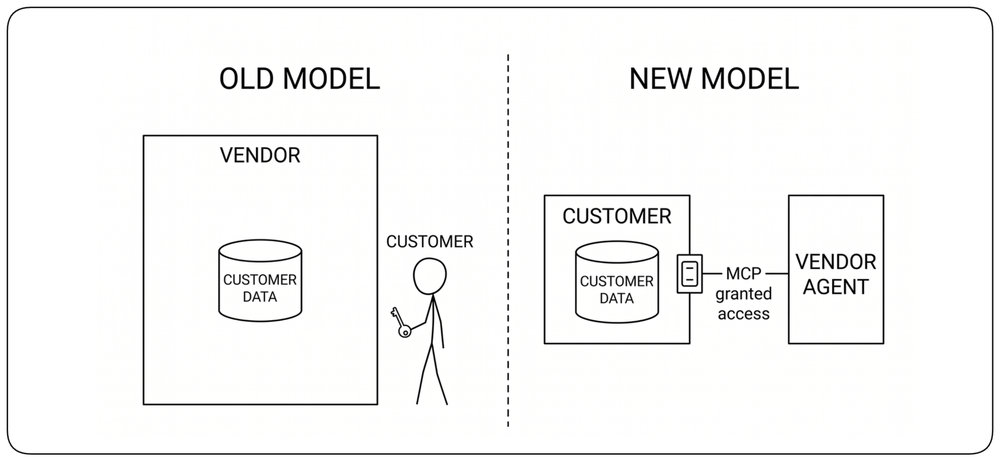
For two decades, SaaS concentrated customer data inside the vendor's systems — the price of using the product. That model is reversing. !!The customer keeps their data, exposes it through their own connectors under their own access control, and lets agents — vendor, third-party, or their own — query it on demand.!!
The Enterprise Knowledge Becomes Askable [Askable Knowledge] {1}
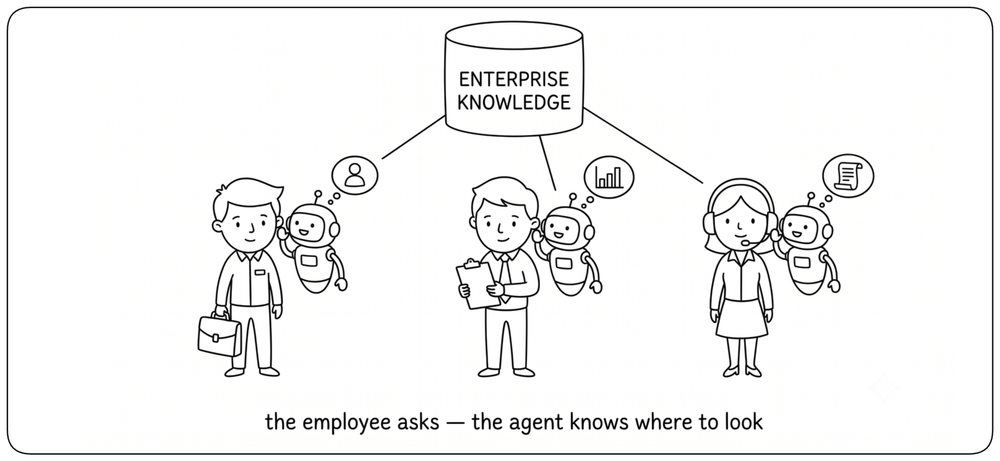
!!Every employee becomes augmented by an agent that can reach organizational knowledge by asking.!! A seller enters a meeting already briefed. A manager asks what changed overnight. A support agent sees the history, policy, and likely resolution without searching five systems.
Internal Context Is the Real Asset [Internal Context] {1}
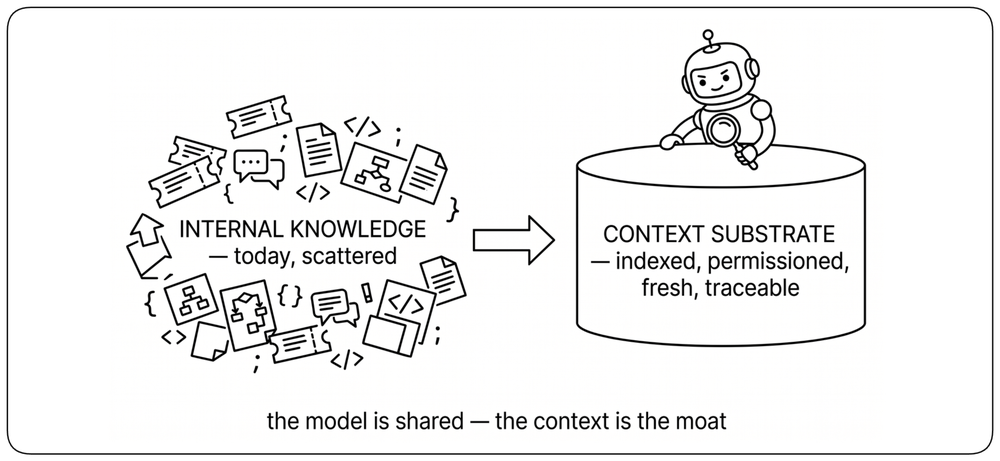
If the same models are available to everyone, what makes one enterprise smarter than another is the context the model can use. !!How this company sells, why this ticket escalated, which policy applies, which decision was made last time.!! Today that context is scattered across tickets, runbooks, chat threads, code, and dashboards. The enterprises that win turn it into a callable substrate: indexed, permissioned, fresh, and traceable.
AI Ends the Root Cause Hunt [AI Ends RCA Hunt] {1}
Root cause analysis has always been one of the heaviest ongoing costs of running a business — most outages trace back to an internal change, and engineers spend the majority of incident time acting as detectives across logs, tickets, deploys, and dashboards while SLAs quietly break. !!This is exactly where AI excels: given the right context, connections, and sources, an agent correlates symptom, deploy, and change in seconds — collapsing hours of forensics into an instant answer.!! The bottleneck was never human skill; it was disconnected systems.

Humans Stay at the Center [Humans Center] {1}
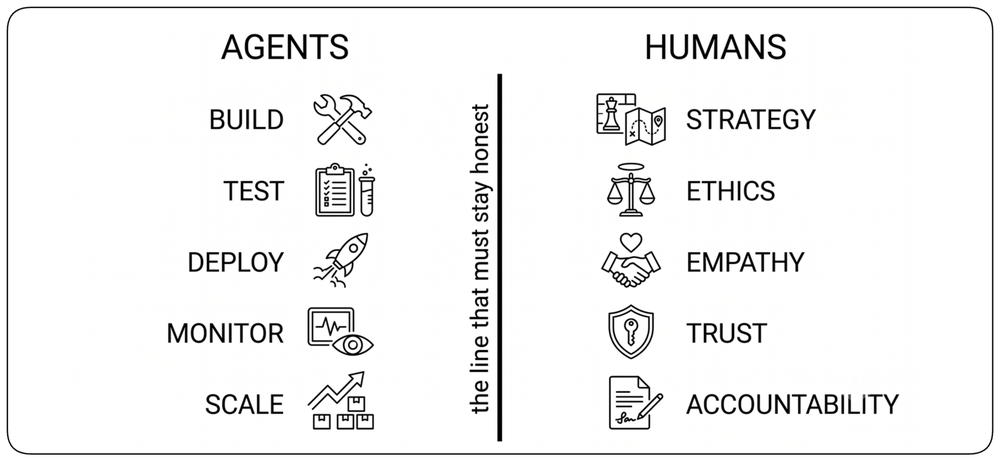
Humans do not disappear from this picture because the problems software solves are human problems. !!A patient does not want a workflow — they want to feel better. A business owner does not want a CRM — they want customers to come back.!! A traveler does not want an itinerary — they want a good trip. Defining what "good" means is human work, and it does not delegate.
What the Agentic Enterprise Requires [Agentic Prerequisites] {1}
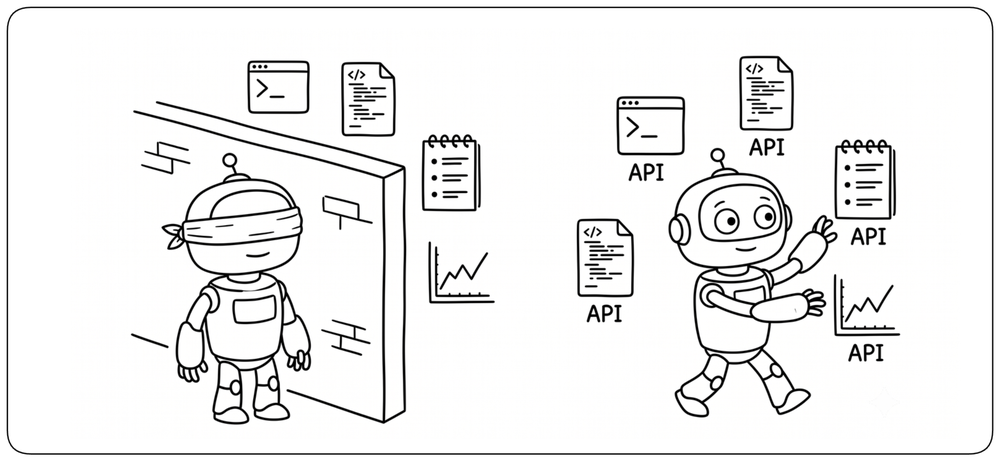
The vision only holds if the rails are laid. !!Agents cannot run at scale on top of tribal knowledge, console-only tools, and each team's private setup.!! Three prerequisites separate a slide deck from a working agentic enterprise: tests that catch what AI ships, a platform agents can navigate, and a system where everything is code.
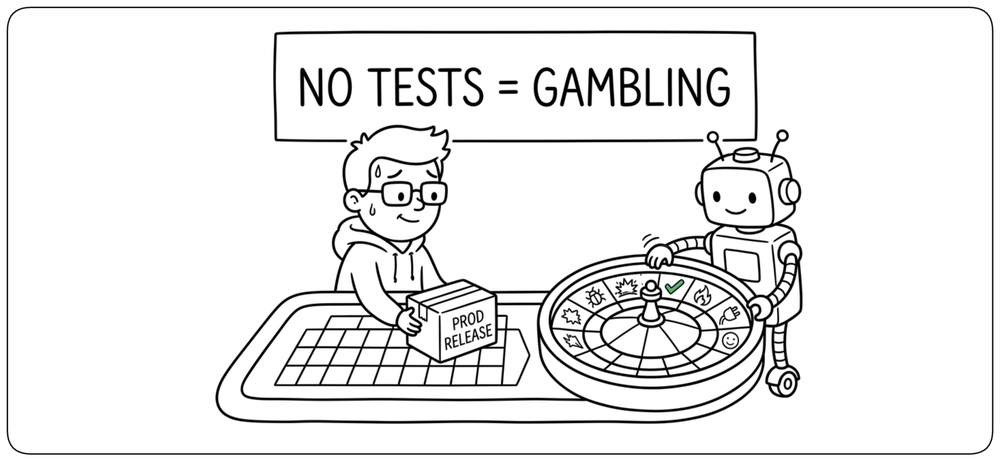
Without Tests, You Are Gambling [Tests Gambling] {1}
Shipping without tests is gambling — you are betting that your code works without any way to prove it. AI makes that bet lethal. !!An agent can generate code that compiles, looks plausible, and is still wrong.!! It can also generate tests that validate the same flawed assumption, so a green build may prove only that the agent tested its own misunderstanding.
Internal Developer Platforms Are Essential [Internal Platforms] {1}
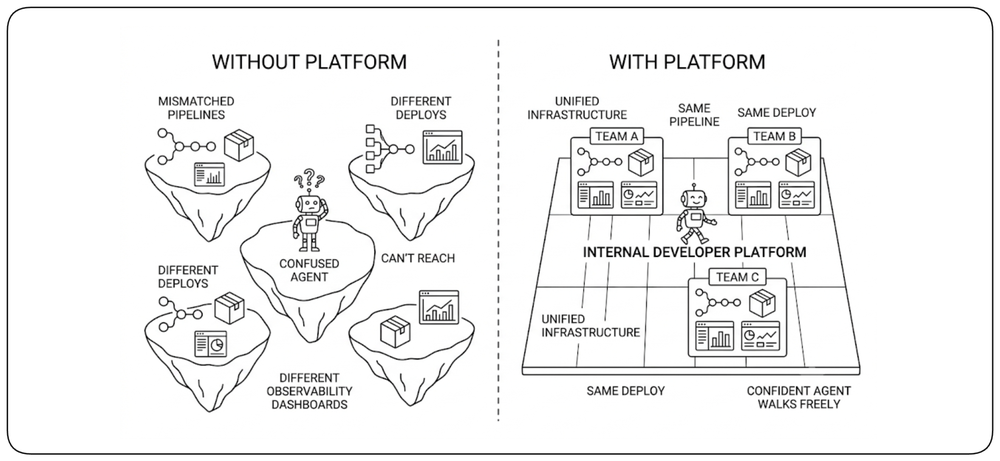
Exposing everything as APIs only works if those APIs live somewhere coherent. Without a real internal developer platform, every team wires its own pipeline, its own deployment, its own observability stack — and the agent has no consistent surface to act on. !!A solid internal platform — paved paths, golden templates, self-service infrastructure, one way to deploy, one way to observe — is what turns scattered capabilities into a navigable system.!!
Everything Visible, Everything as Code [Everything as Code] {1}
The third and fourth foundations are two sides of the same rule: if it is not callable, AI cannot use it; if it is not in code, AI cannot read it. !!Capabilities hidden behind tribal knowledge, console-only tools, internal-only scripts, runbooks living in someone's head — none of these can be orchestrated by an agent.!! The discipline is to expose every operation as an API, and to keep every configuration — infrastructure, deployments, policies, monitors, dashboards, access rules — in version control, reviewed like the application itself.