Design for Scalability
Chapter Info
Calculating... Writing Progress: 60%
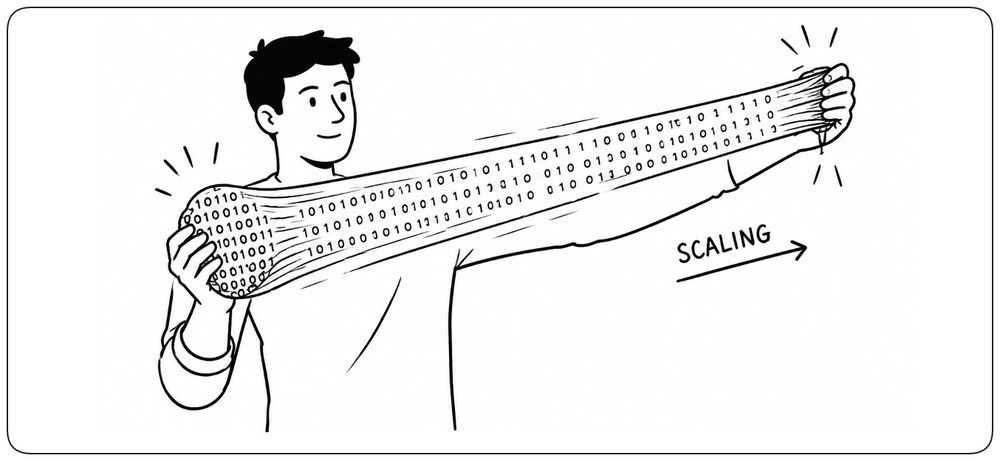
Every successful system eventually faces the same challenge: growth.
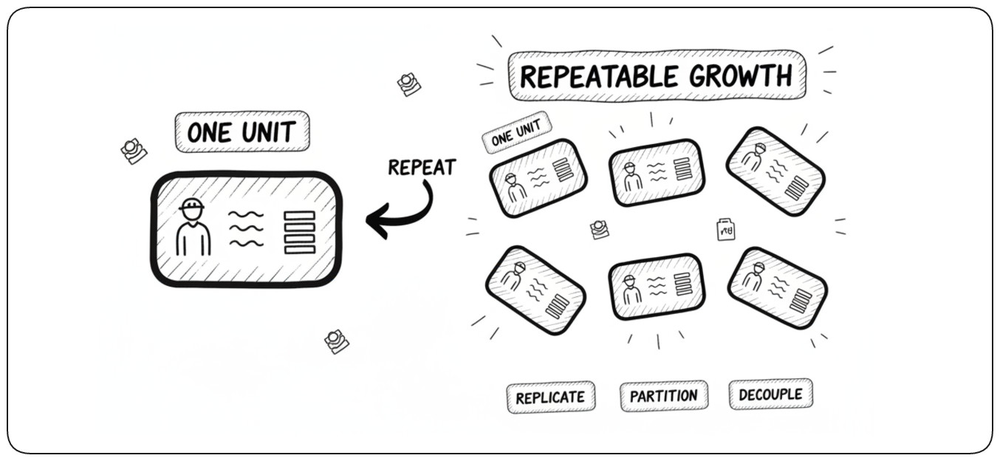
The real challenge is making that growth repeatable rather than fragile. If the foundations are right, adding capacity becomes a matter of repeating what already works. If they are wrong, every shortcut eventually breaks under load, and the rewrite arrives when the system is already under pressure.
In this chapter, scalability is treated as an architectural property: clear boundaries, automation, and repeatable units of work. We will distinguish scalability from performance, review the main scaling strategies, and explore how work, data, and teams must be shaped so the system can grow sustainably.

Introduction
What Scalability Is [What scalability is] {1}
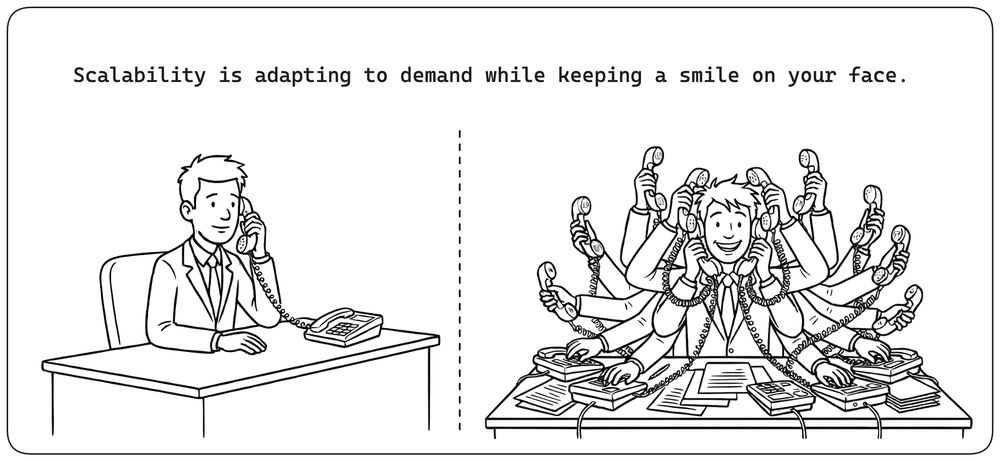
Scalability is a system's ability to handle increasing demand without collapsing under performance, cost, or operational complexity. It is not a feature you "turn on" later, but !!the result of architectural choices that make growth possible!!. A scalable system handles more users, data, and transactions by adding resources predictably. By the time the system is built, many scaling constraints are already baked into the architecture—stateful components that cannot be replicated or tightly coupled dependencies that cannot be distributed. !!Scalability must be designed in, not bolted on.!!
A Timeless Engineering Challenge [Timeless Challenge] {1}
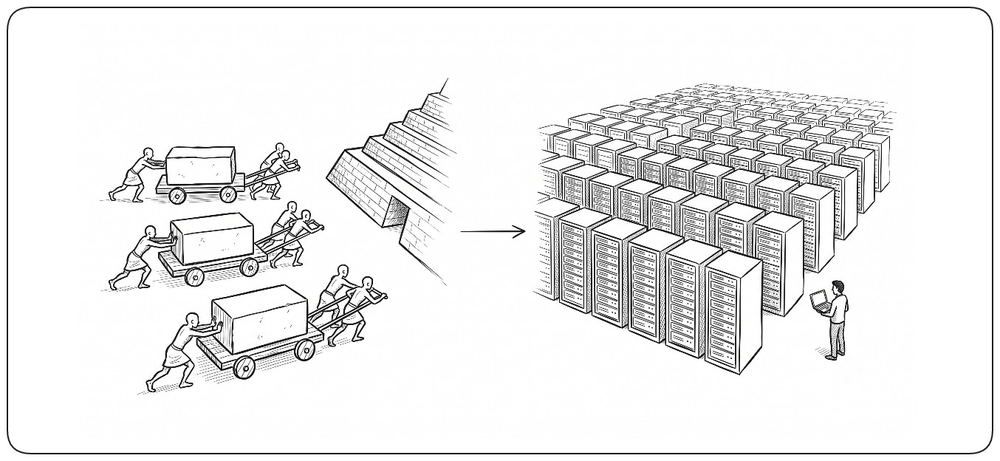
Scalability is not a child of the digital age; it is an ancient engineering problem, from the Great Pyramids to the Industrial Revolution. Across eras, the challenge remains the same: !!increase throughput without collapsing under coordination overhead!!. The solutions are equally timeless. Whether moving stone blocks in Giza or handling millions of cloud requests, scale depends on the same principles: !!standardization to reduce complexity and automation to overcome the limits of human intervention!!.
Scalability vs Performance
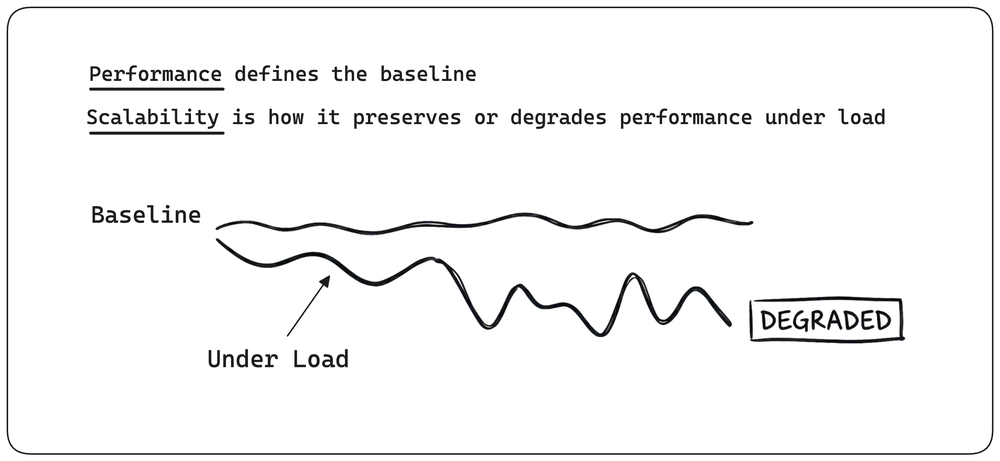
Performance and scalability address two different dimensions of system architecture: performance defines the speed and efficiency of individual operations, such as latency and response time, while scalability defines the system's ability to maintain those standards as workload increases. A scalable system is not inherently fast—scaling an inefficient process simply yields a higher volume of slow requests.
Going further: performance
Latency, throughput, caching, and optimization techniques are covered in depth in the Design for Performance chapter.
Scalability vs Elasticity [Scalability vs Elasticity]
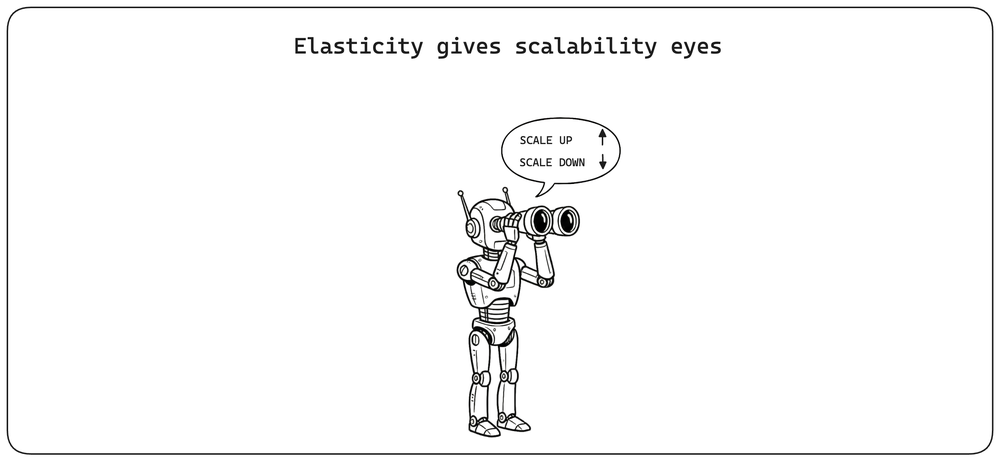
Scalability is a system's ability to handle growth by adding resources, from hundreds of users to millions over time. Elasticity is the ability to adjust those resources automatically as demand rises and falls. A system can be scalable without being elastic, but elasticity depends on scalable foundations. Elasticity is explored later in this chapter as a scaling strategy.
Trade-offs: There Are No Free Lunches [Compromises] {1}
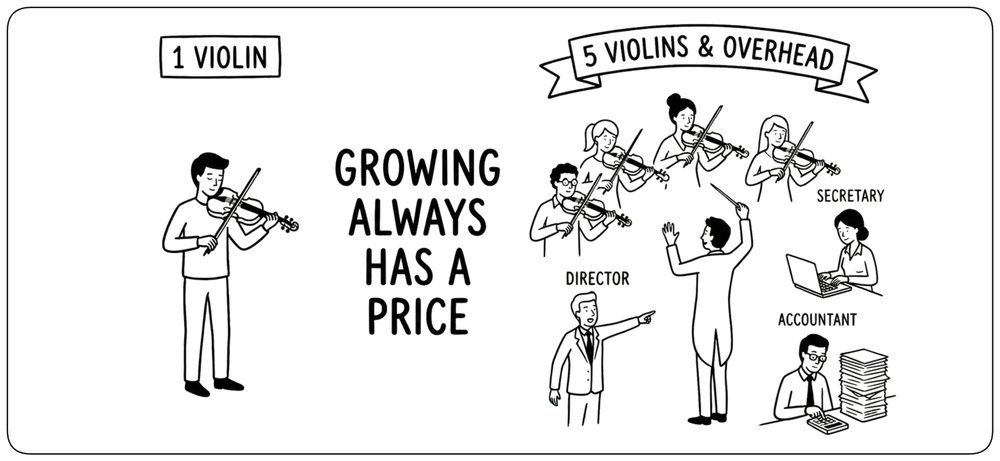
Scalability always increases complexity and cost. Growing from one server to hundreds introduces load balancers, queues, monitoring, coordination, and more operational tooling. Each adds moving parts, failure modes, and overhead. There is !!no best architecture—only one that fits your constraints and growth trajectory!!. Understand the trade-offs, make explicit choices, and revisit them as your needs evolve.
The Moving Bottleneck [Bottleneck] {1}
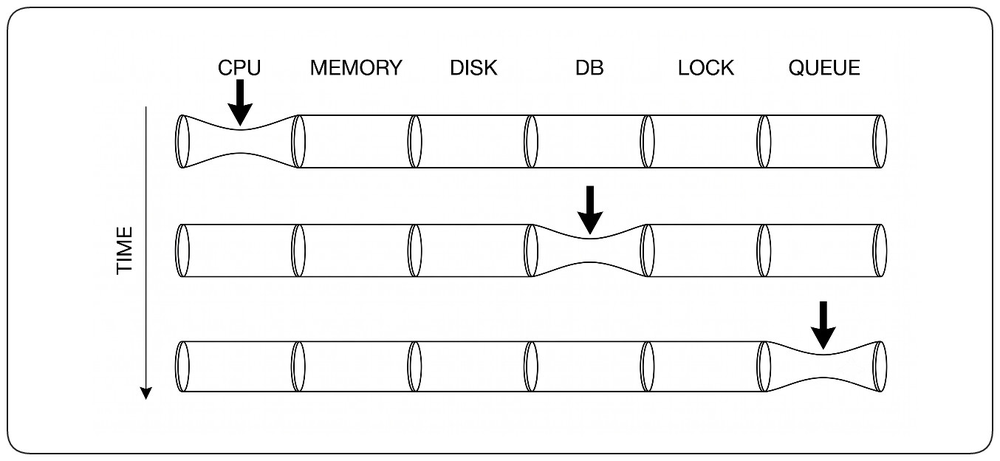
At any moment, a system's capacity is constrained by its dominant bottleneck—CPU, memory, network, disk, database, lock contention, queue depth, or even human decision-making—and !!scaling is the discipline of identifying that constraint, relieving it, and then finding the next one!!. Fixing the wrong constraint wastes money and time: adding servers when the database is the limit only starves it faster; adding disk when the network is saturated changes nothing. The bottleneck always moves once relieved, so scaling is never "done"—it is a continuous negotiation with whichever resource is currently the slowest link!!.
Core Scalability Principles [Core Principles]
If scalability is not about buying bigger machines, what makes a system scalable? The answer lies in a handful of design principles that remain the same regardless of technology.
The Unit of Work: Multiply Workers [Compute Units] {1}
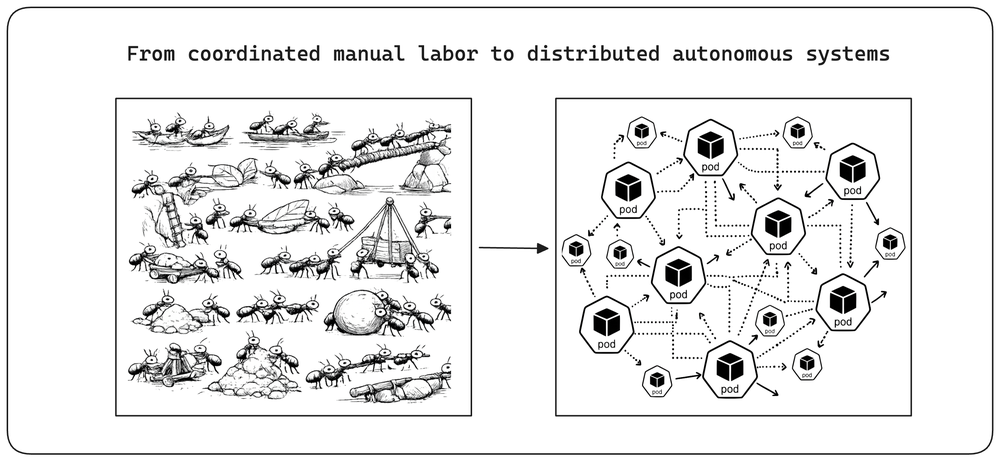
Scalability is fundamentally about !!multiplying a workforce that can process work in parallel!!. Over time, the "worker" evolved from people and machines to digital compute: virtual instances, containers, Kubernetes pods, and serverless functions. Modern workers usually take one of these forms—instances (stable, long-lived compute with dedicated resources), containers or pods (lightweight, portable units that start quickly and scale in granular steps), or serverless functions (event-driven compute that scales automatically per request).
Interchangeable Workers: Stateless Compute [Interchangeable Workers] {1}
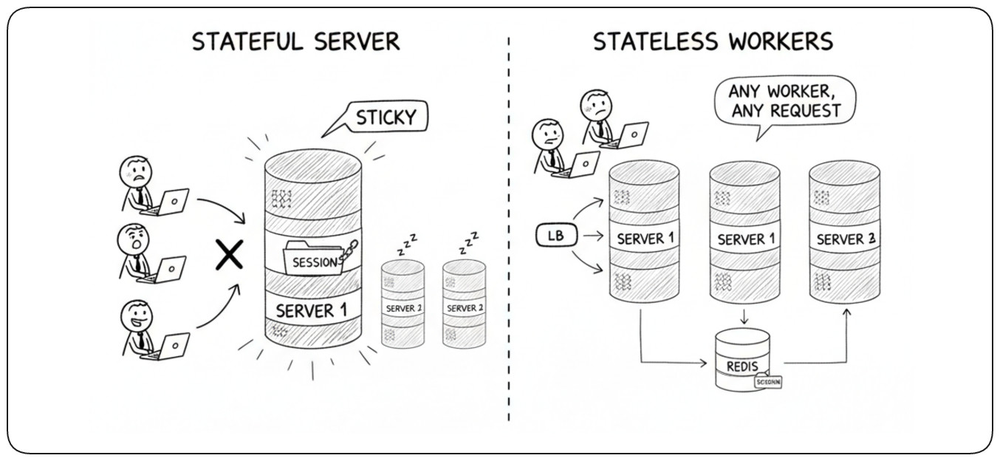
The most important design rule is to keep workers interchangeable: !!a worker should not retain prior request state!!. If state is required, externalize it—databases, object storage, Redis, durable queues—so that stateless workers can be multiplied horizontally, replaced on failure, and autoscaled safely. When any worker can serve any request, scaling becomes a matter of adding copies; when workers hold local state, every failure or scale-down loses information and every scale-up requires warm-up.

Optimize Before You Scale [Optimization] {1}
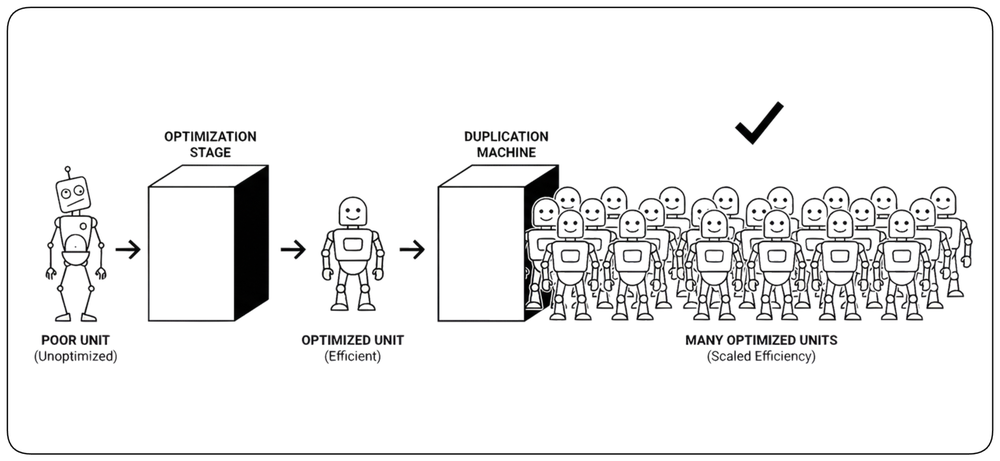
Focus on efficiency before scaling: refine the unit of work first—through algorithmic improvements, query optimization, and payload reduction—so you minimize the resource footprint of every operation. !!Scaling should be a tool for handling growth, not a mask for poor performance!!; perfecting the unit of work beforehand ensures that when you expand, you do so with maximum cost-effectiveness and minimal technical debt.
Automation: Manual Work Does Not Scale [Automation] {1}
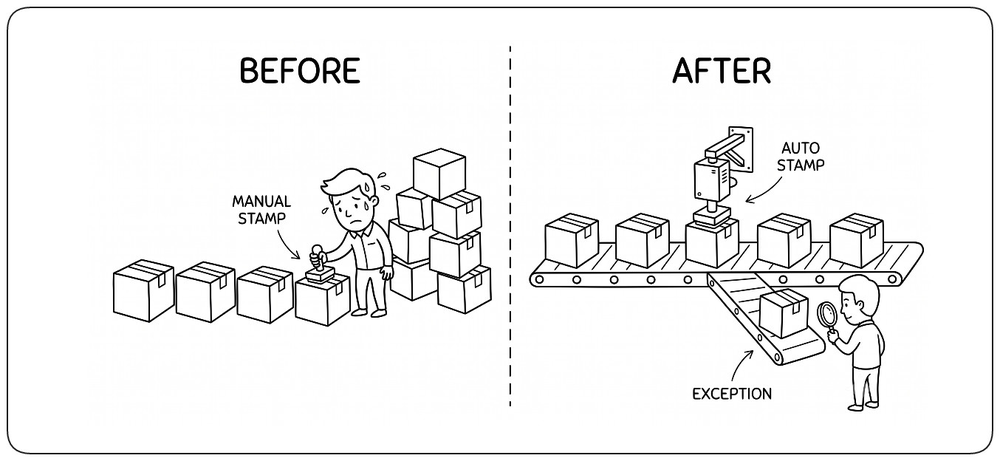
!!Manual work does not scale.!! If provisioning, deploying, configuring, recovering, approving, or coordinating routine work requires people every time, operational overhead grows with the system. Automation, conventions, and clear ownership turn repeated actions into predictable processes. !!Every repetitive task that depends on human intervention becomes a scalability bottleneck!!. The goal is not to remove people, but to reserve human judgment for situations that genuinely require it.
Modularity: Scale Only What Needs Scaling [Components] {1}
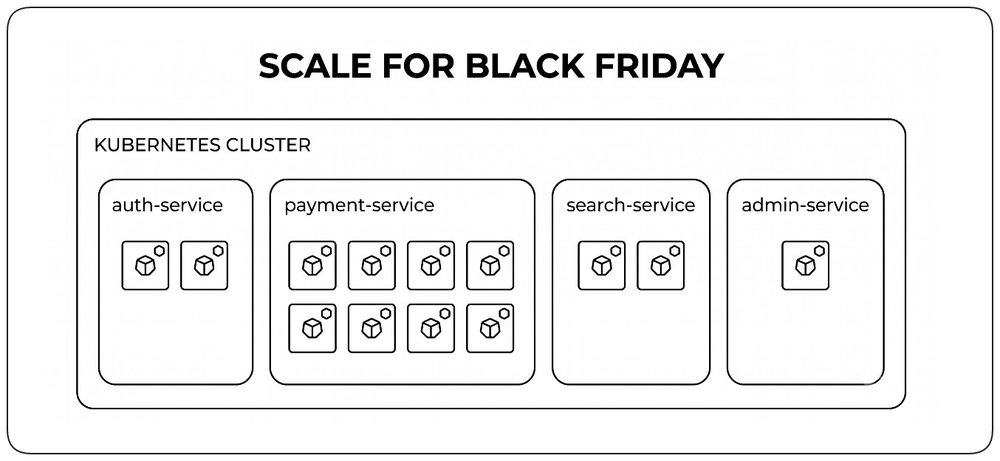
Modular systems scale differently than monolithic ones. Instead of scaling everything together, !!you scale only what needs scaling!!. The payment service handling Black Friday traffic can grow independently while the rarely-used admin dashboard stays small. This granular control over resources is only possible when the system is properly decomposed into independent, loosely coupled modules—whether microservices, containers, or serverless functions. Modularity is the principle; microservices are one architectural expression of it, while event-driven and serverless architectures build on the same idea in different ways.
Failure Is Part of Scale [Failure] {1}
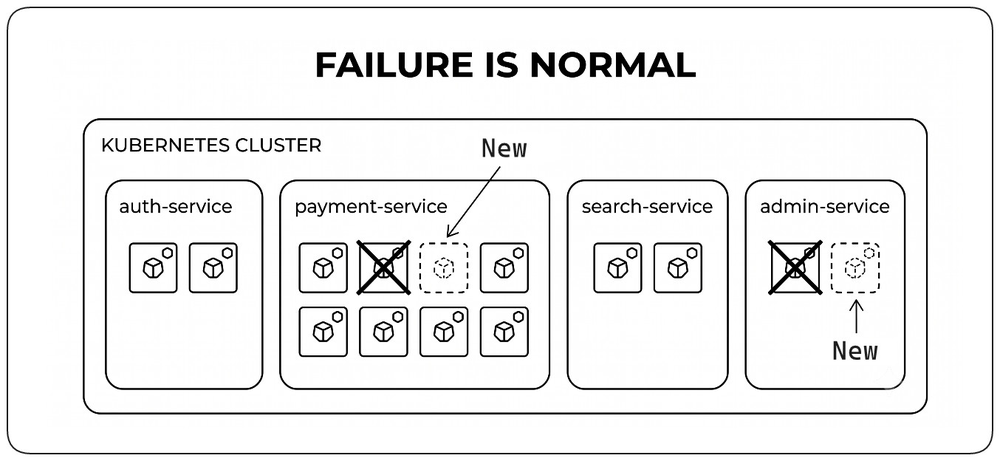
!!As systems grow, failures become a normal operating condition!!. More servers, more services, more networks, and more dependencies inevitably mean more components failing every day. !!Scalability is therefore not only about handling more work, but also about continuing to operate while parts of the system are constantly failing!!. The mechanisms that make this possible—redundancy, health checks, failover, and graceful degradation—are covered in the Design for Resiliency chapter.
Capacity for Failure [Capacity for Failure] {1}
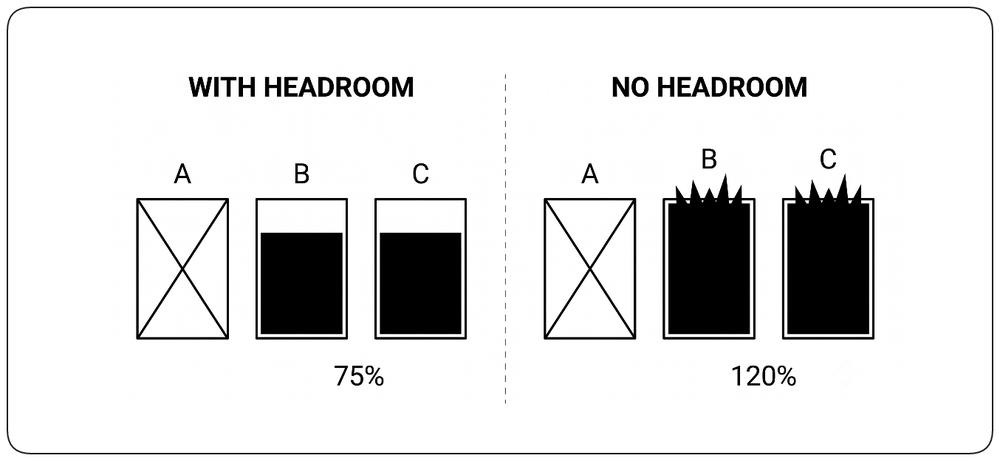
Redundancy only works if the surviving parts of the system can absorb the load left by a failure. !!Even when failed instances are replaced automatically, recovery takes time, and the remaining capacity must carry the extra load in the meantime!!. A second zone, cluster, or network path is useless if it is already near capacity. !!Capacity planning must account for degraded operation, not just normal operation!!.
Standardization: The Language of Scale [Uniformity] {1}
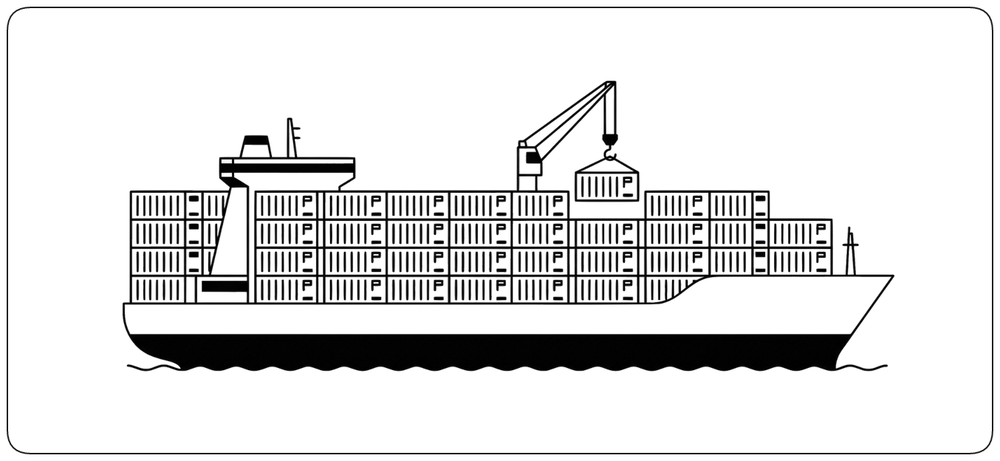
Standardization enables composition. !!When every service speaks the same language, every container follows the same conventions, and every API adheres to the same patterns, systems can be assembled from interchangeable parts!!. From the standardized screw threads that enabled mass production in the 1800s to today's REST APIs and Docker containers, standardization is the secret to building systems that scale not just in size but in complexity.
Scaling Strategies [Strategies]
These principles explain what makes a system scalable. The next question is how capacity is actually increased.
Understand What Is Growing [Growth Dimensions] {1}
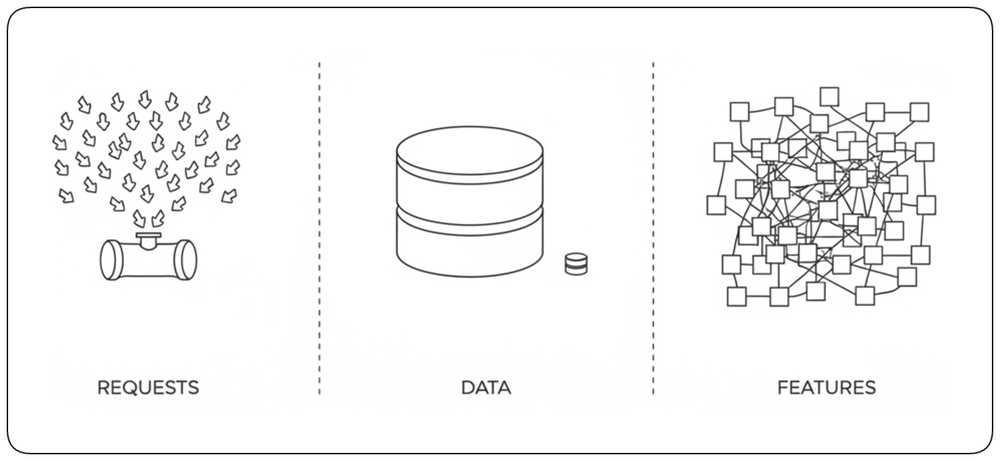
Systems can grow in different ways. For example, !!more requests create a throughput problem, more data creates a storage and access problem, and more features create a complexity problem!!. A scaling technique is useful only when it addresses the dimension that is actually growing. Replicating workers may absorb additional traffic, but it does little when the real constraint is an oversized dataset or an application that has become too complex to evolve efficiently. !!Before scaling, identify the constraint you are trying to remove!!.
Vertical Scaling: Growing Upward [Scale Up] {1}
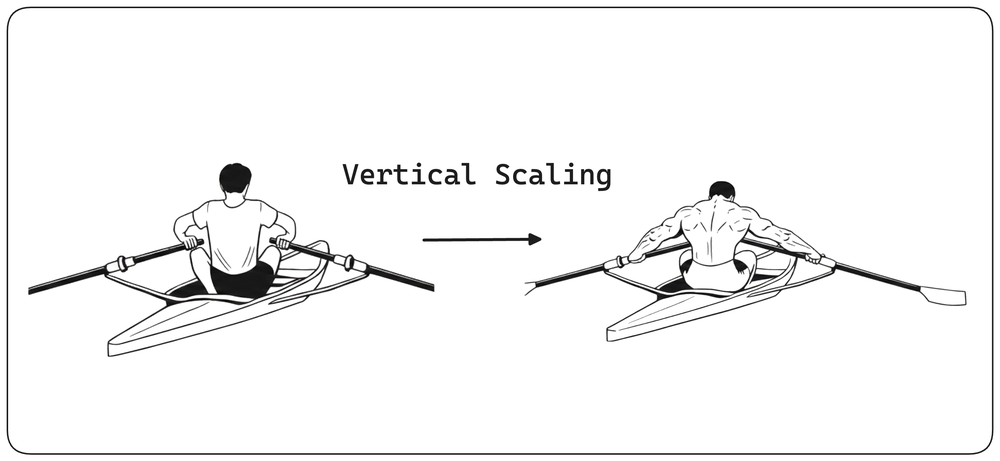
Vertical scaling increases the power of a single server by adding CPU, RAM, or storage. It is the simplest scaling model: when you need more capacity, use a bigger machine. This works well for applications that are difficult to distribute, but it has clear limits: hardware eventually reaches a ceiling, the server remains a single point of failure, and larger machines become increasingly expensive.
Horizontal Scaling: Growing Outward [Scale Out] {1}
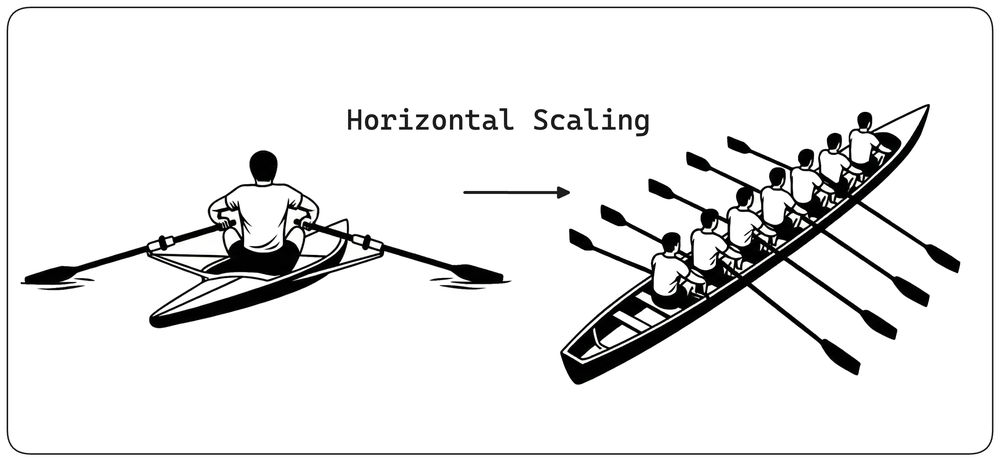
Horizontal scaling, or !!scaling out, means adding more machines or instances to handle increasing load!!. Work is distributed across multiple nodes, improving capacity and fault tolerance. This approach scales well for large systems and can be more cost-effective than relying on increasingly powerful hardware. The trade-off is !!greater complexity: distributed coordination, data partitioning, network overhead, and more failure modes!!.
Scale Only When Needed [Scaling Decisions] {1}
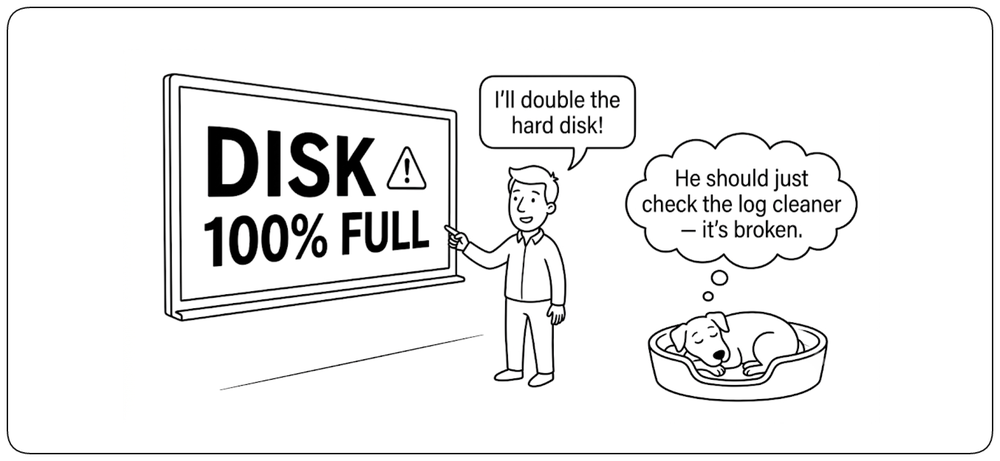
!!Scaling is not always the right answer!!. Before adding more machines, first eliminate inefficiencies: a better algorithm, query, or cache often delivers greater improvements at lower cost. When additional capacity is needed, vertical scaling is usually the simplest option until a single machine reaches its practical limits. Horizontal scaling introduces more complexity and should be used when the workload requires it. The important distinction is between !!designing for horizontal scaling and actually scaling out!!: a system can be designed so that workers are stateless and replicable long before multiple instances are needed.
Scaling Does Not Remove Single Points of Failure [Failure Domains] {1}
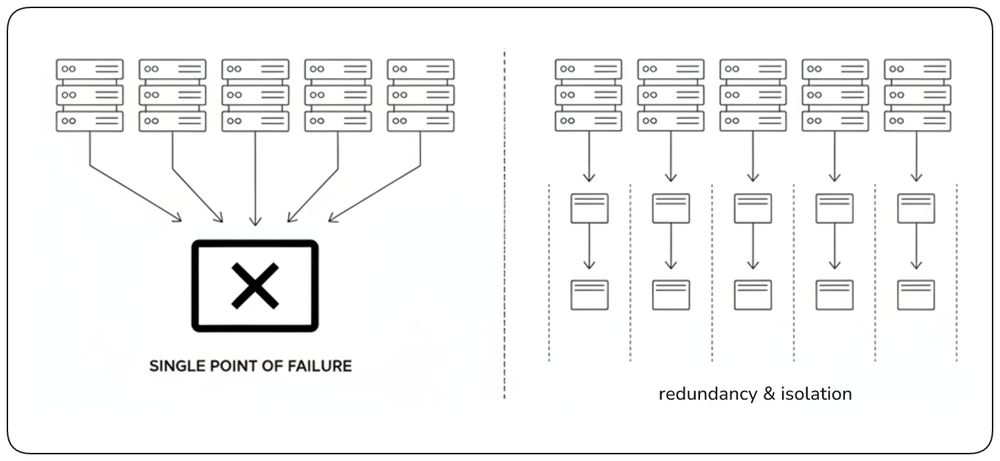
Adding nodes increases capacity, but it does not remove shared points of failure. A hundred servers can still fail as one system if they all depend on the same database, control plane, network path, or shared state. !!Horizontal scaling only improves system robustness when those shared dependencies are also distributed or isolated!!. Otherwise, you have multiplied capacity without removing the failure domain that can stop everything at once.
The Scale Cube: Three Dimensions [Scale Cube] {1}
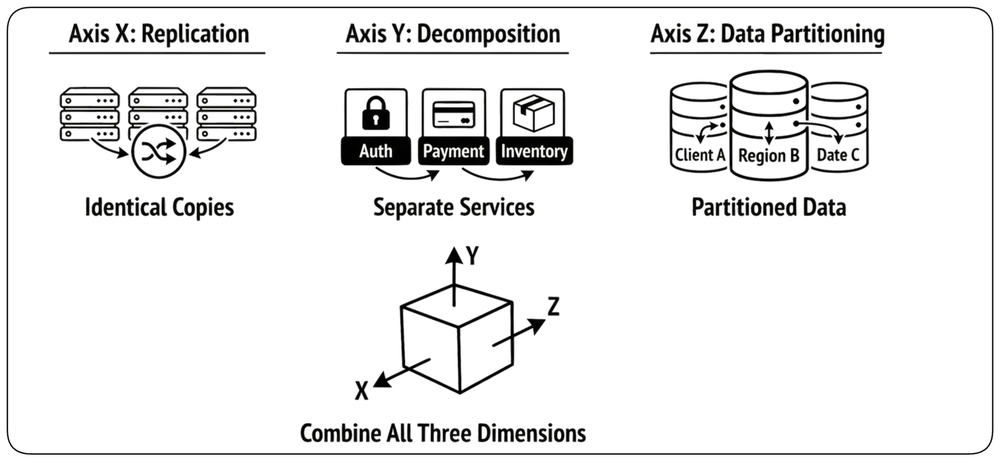
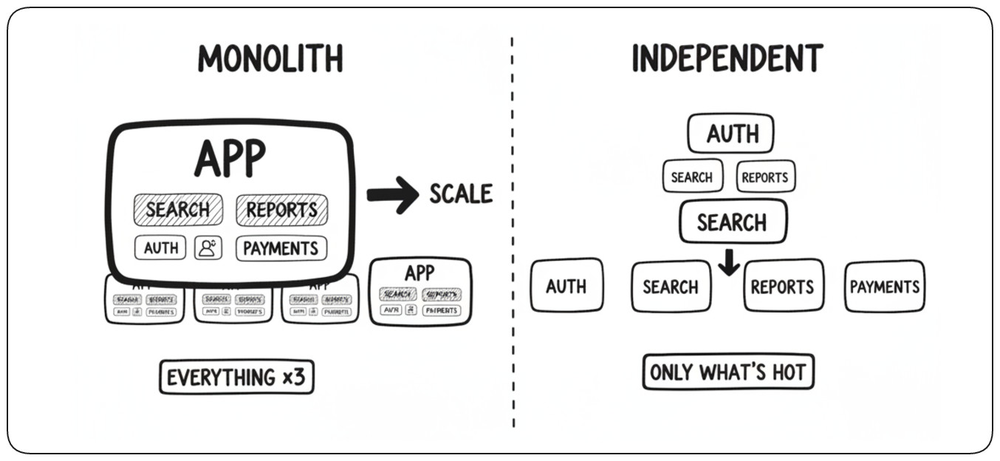
When a system needs to scale, three fundamental dimensions apply, known as the Scale Cube. !!X-axis: duplicate!!—clone the entire application across identical instances behind a load balancer. Every instance runs the same code and handles any request. Simple, but every instance carries the full application weight even if only parts are under heavy load. !!Y-axis: split!!—decompose the application by function or capability so each part scales independently based on its own load. !!Z-axis: partition!!—shard data by some attribute (customer ID, region, date) so each partition handles a subset of users or data. Most scalable systems combine all three: duplicate the parts, split the whole, and partition the data.
Elasticity and Auto-Scaling [Elasticity] {1}
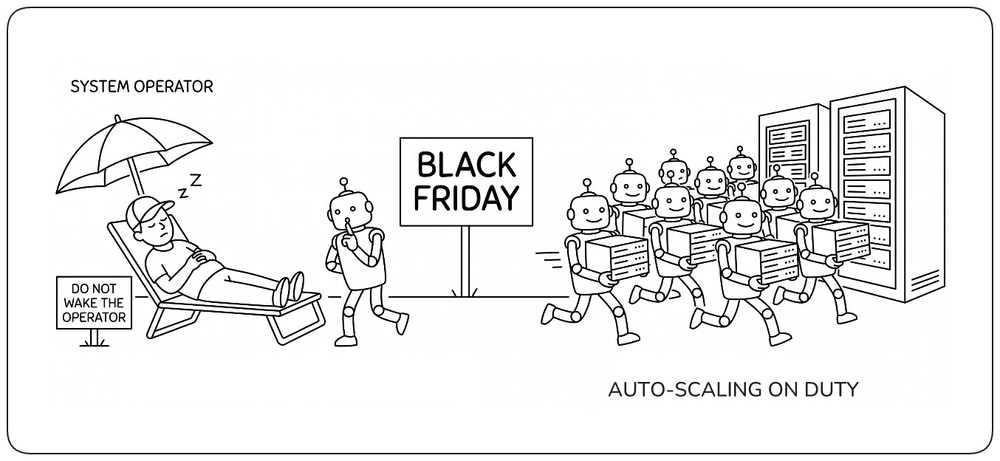
Elasticity is the ability of a system to !!automatically adjust its capacity as demand rises and falls!!. Auto-scaling is the mechanism that makes elasticity possible: it monitors signals such as CPU, queue depth, or application metrics and adds or removes instances accordingly. Effective policies depend on the right trigger and timing: !!scale up quickly during spikes, but scale down gradually to avoid flapping!!. Elasticity is especially valuable for uneven workloads, where paying only for active capacity avoids the cost of idle resources.
Evolve by Design, Not by Panic [Architectural Freedom] {1}
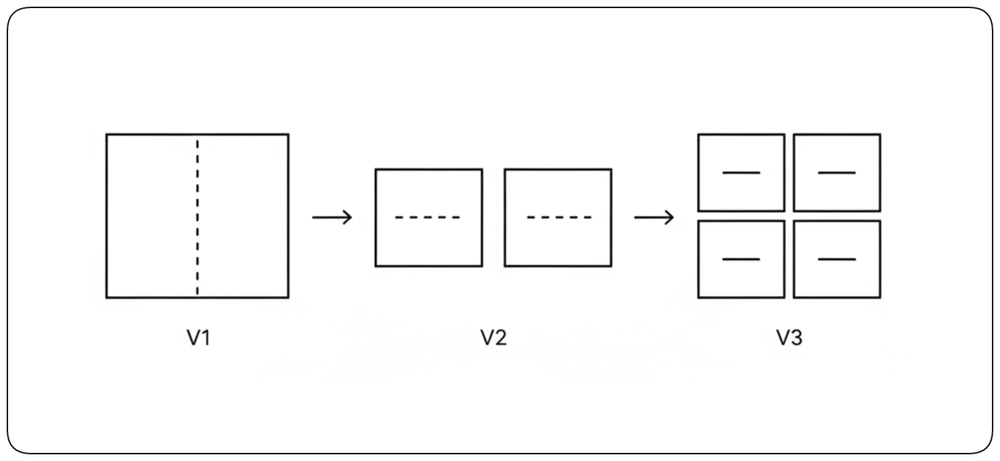
A scalable architecture does not need every scaling mechanism from the beginning. What it needs is !!a clear path for what happens when the current design reaches its limits!!. The goal is not to predict future growth perfectly, but to preserve enough architectural freedom to make the next change without rebuilding everything. !!Good boundaries, replaceable components, and clear migration paths turn future growth into a planned engineering task instead of an emergency!!.
Distributing Work [Distribution]
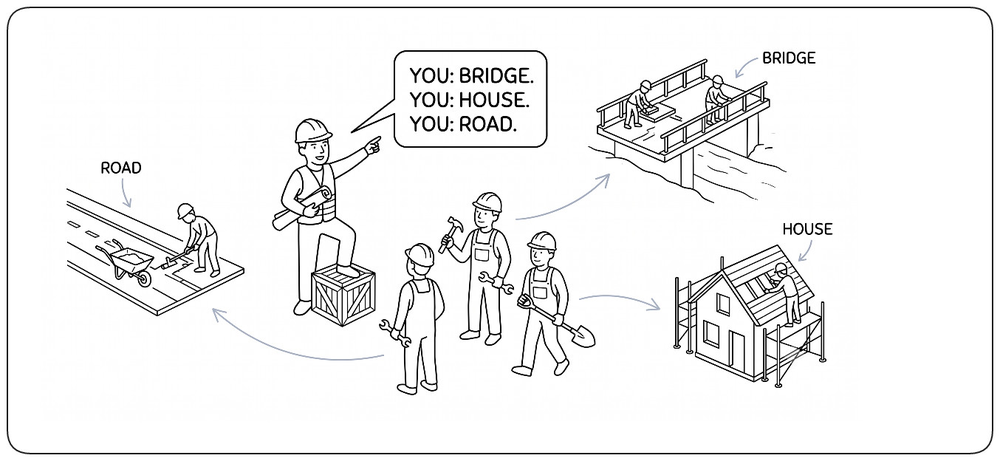
Adding workers creates capacity, but capacity is useful only if work is distributed efficiently. Some work must be processed immediately, while other work can safely wait. These two situations lead to two complementary distribution strategies: immediate distribution and deferred distribution. Both aim to keep workers busy without overloading any single one.
Synchronous Request Distribution [Synchronous Work] {1}
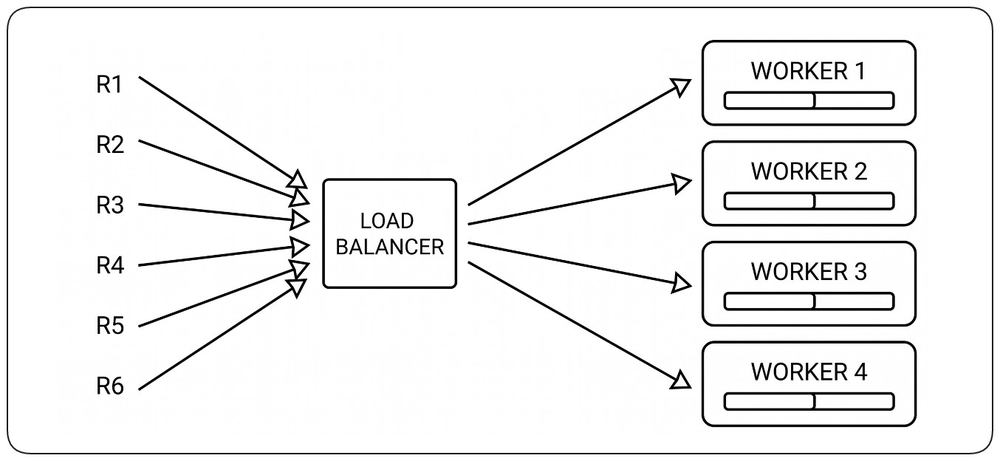
Short-lived requests that require an immediate response are typically dispatched directly to an available worker. The goal is to spread the load evenly so that no worker becomes the bottleneck while others remain idle. A load balancer is the most common mechanism used to implement this distribution, routing each incoming request to an appropriate worker. Common policies include round-robin (rotating through workers in order), least-connections (favoring the least busy worker), and latency-based (favoring the fastest responder). Regardless of the policy, the principle remains the same: !!keep workers evenly utilized so that no single worker becomes the bottleneck!!.
Queue-Based Distribution [Queued Work] {1}
When work takes longer to process, arrives in bursts, or does not require an immediate response, it is often better to decouple submission from execution. Instead of assigning each task directly to a specific worker, producers place work into a shared queue, and available workers pull tasks as they become ready to process them. This allows workers to process work at a controlled rate, absorbing bursts without overwhelming any single worker. !!The queue becomes the coordination point between incoming work and available processing capacity!!.
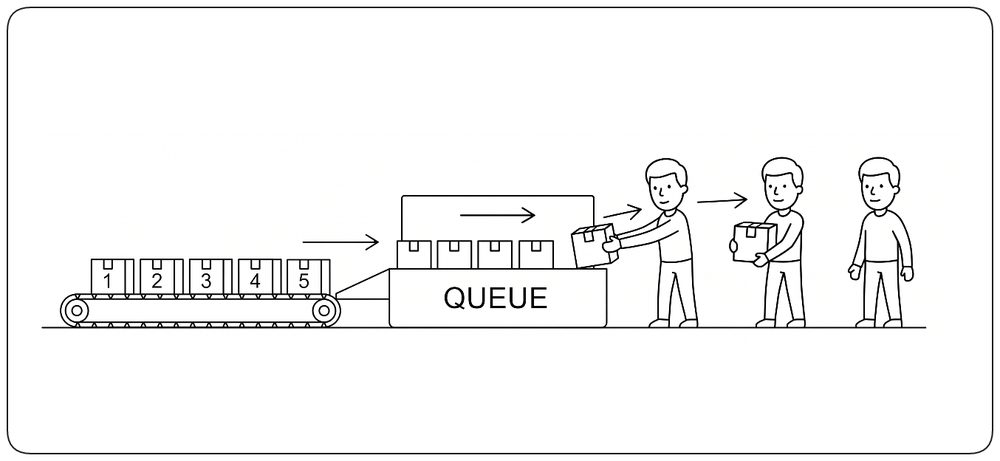
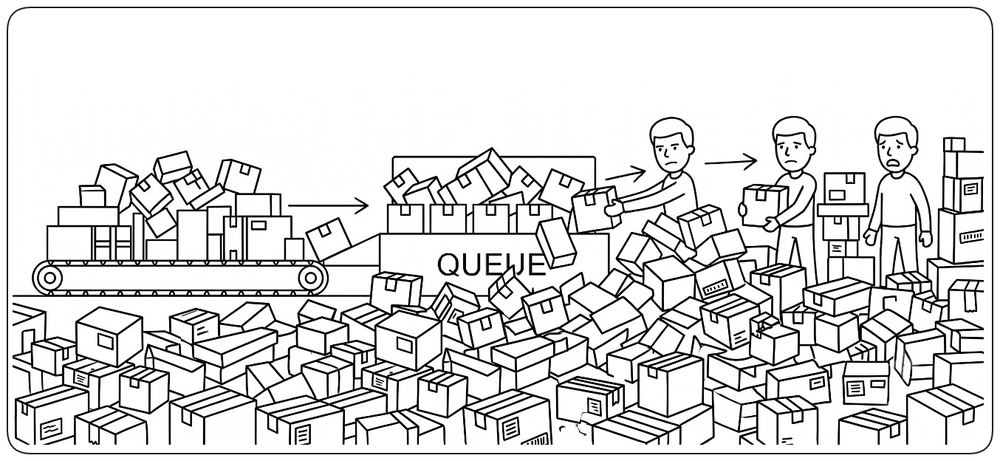
Growing Queues: When Deferred Becomes Overload [Growing Queues] {1}
A queue is useful only as long as it remains under control. When tasks arrive faster than workers can process them, unfinished work continuously accumulates. A growing queue is therefore a direct indication that processing capacity is lower than incoming demand. The longer work remains in the system, the more work accumulates behind it. The practical lesson is simple: !!a queue can absorb temporary bursts, but it cannot compensate for a permanent capacity shortage!!. Eventually, you must process work faster, add more workers, reduce incoming work, or reject excess load.
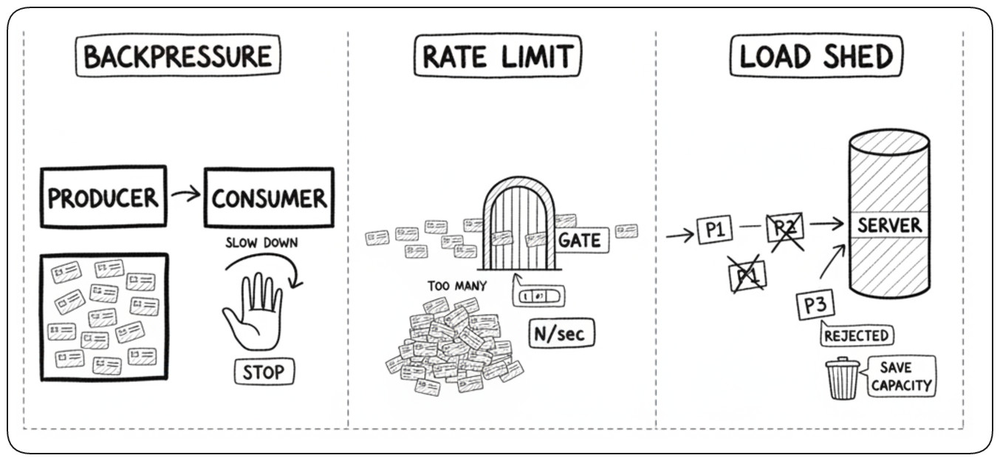
Protect the System Under Overload [Backpressure] {1}
A scalable system must also know what to do when demand grows faster than capacity can be added. !!Backpressure!! slows producers when consumers cannot keep up, !!rate limiting!! controls how much work enters the system, and !!load shedding!! rejects lower-priority work when capacity is exhausted. Without these mechanisms, overload propagates from one component to another until the entire system becomes unstable. Sometimes !!the most scalable response is to refuse work rather than accept more than the system can safely process!!.
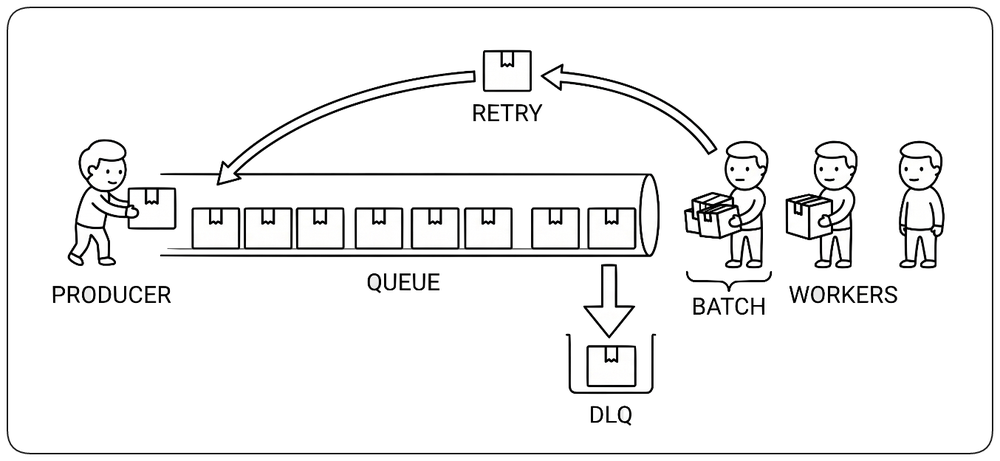
Making Queues Reliable [Async] {1}
Deferred distribution provides the architectural choice; several mechanisms make it robust in practice. !!Retries with exponential backoff!! handle transient failures without losing work. !!Dead-letter queues!! isolate permanently failing tasks so they do not block healthy processing. !!Batching!! amortizes per-task overhead when latency permits. And because the queue provides decoupling—not infinite capacity—!!queue depth and processing latency must always be monitored!!.
Distributed Batch Processing [Batch Processing] {1}
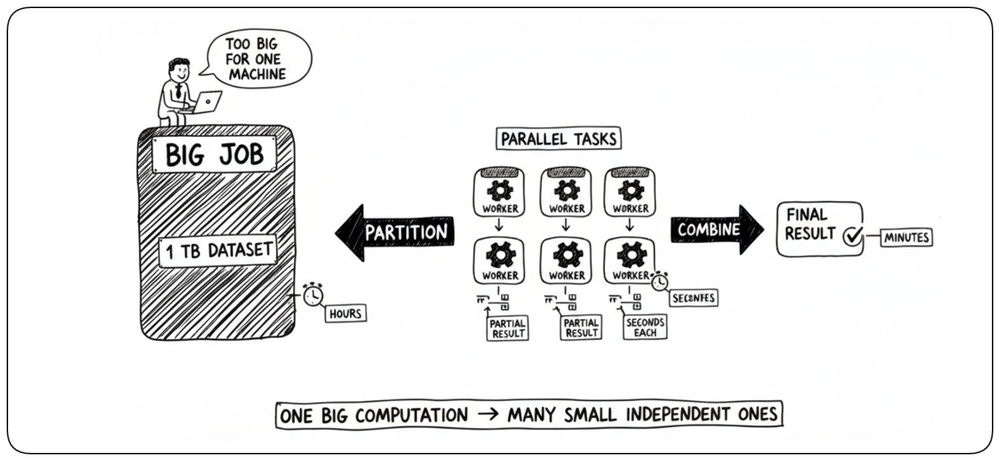
Some work is too large for a single worker and too structured to treat as independent queue messages. Distributed batch processing splits a dataset into partitions, runs parallel tasks across many workers, and then combines the partial results. !!It scales by turning one large computation into many small independent computations that can run in parallel!!. Two generations of engines have shaped this approach: MapReduce, which established the model, and Spark, which made multi-step processing much faster.
MapReduce: Divide and Combine [MapReduce] {1}
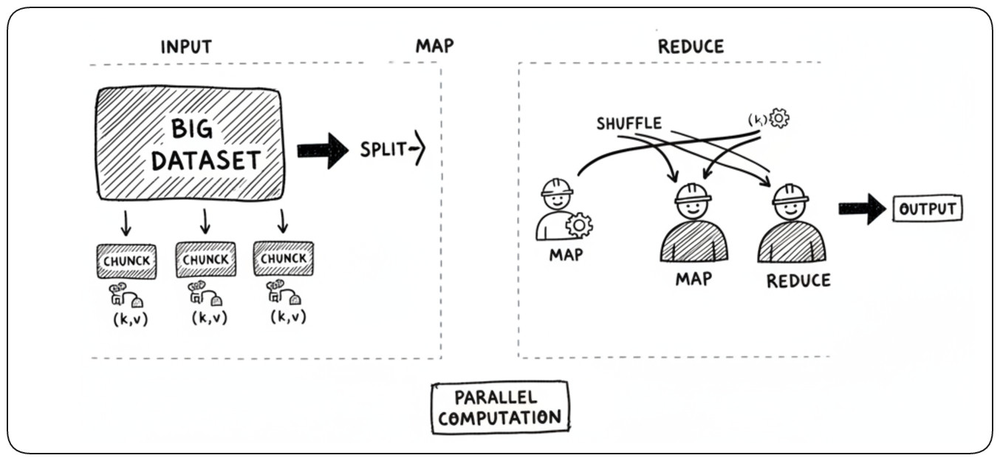
MapReduce was popularized by Google in the early 2000s as a way to process extremely large datasets across thousands of machines. The idea was deliberately simple: !!split the data, process each part in parallel, then combine the partial results!!. The map phase transforms pieces of data independently, and the reduce phase aggregates the intermediate results into a final answer. This model made large-scale batch processing practical on clusters of ordinary machines and strongly influenced systems such as Hadoop.
Spark: Keep the Data Close to the Computation [Spark] {1}
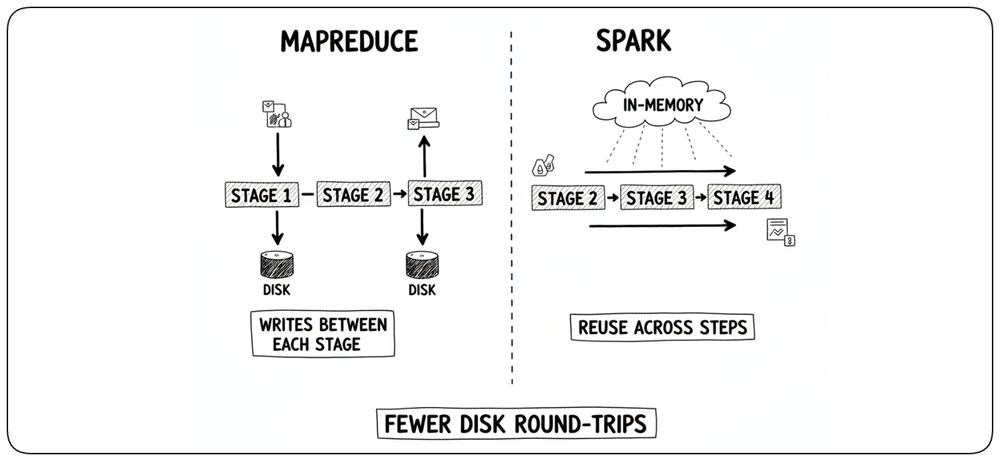
Apache Spark appeared later to overcome some of the limitations of the MapReduce model. In MapReduce, intermediate results are often written to disk between stages, which makes multi-step workloads expensive. Spark introduced a more flexible execution model that !!keeps intermediate data in memory and reuses it across several operations!!. This makes it much better suited to iterative algorithms, interactive analytics, machine learning, and complex processing pipelines. Spark keeps the same distributed computation model, but reduces the cost of repeatedly moving and reloading intermediate data.
Orchestrating Work [Orchestration]
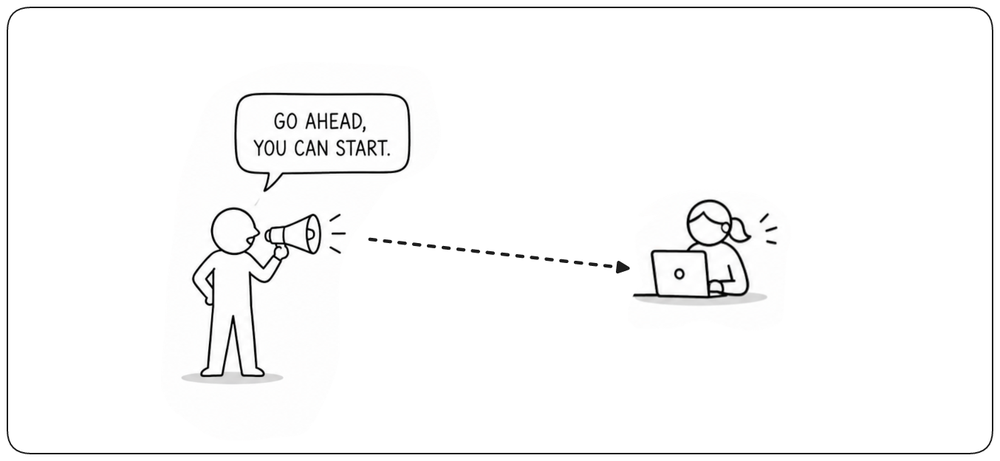
As work is distributed across more workers and services, coordination itself becomes a scalability problem. Individual tasks must be assigned, failed workers replaced, and multi-step processes kept moving without relying on manual intervention. !!Distribution determines where work runs; orchestration ensures that distributed work continues to progress correctly!!.
Keeping Workers Healthy [Runtime Orchestration] {1}
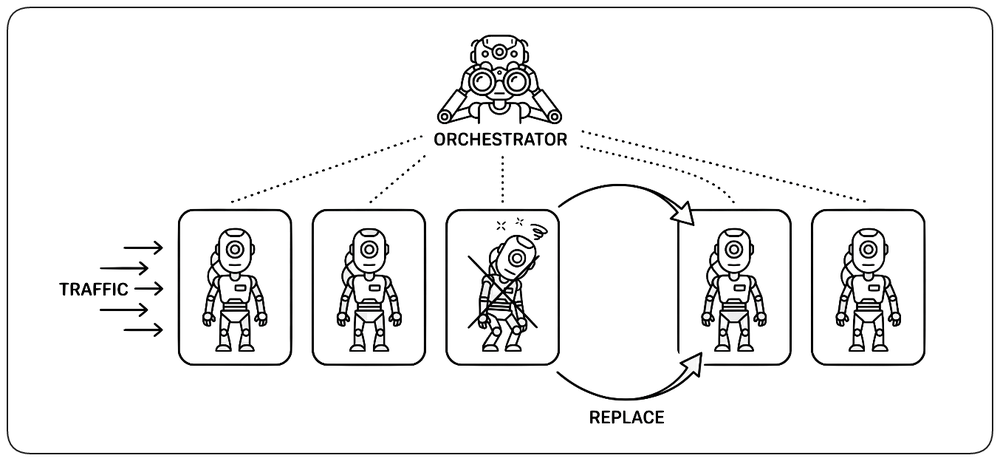
Some workers run continuously for days, weeks, or months while serving traffic. Over time, they may crash, become unhealthy, or stop responding correctly. At scale, manually monitoring and replacing them is impossible. A runtime orchestrator monitors worker health, removes unhealthy instances from traffic, restarts or replaces failed ones, and maintains the desired capacity. Kubernetes is a common example. !!Long-lived workers need continuous orchestration to remain healthy, available, and safe to receive traffic!!.
Coordinating Multi-Step Workflows [Workflow Coordination] {1}
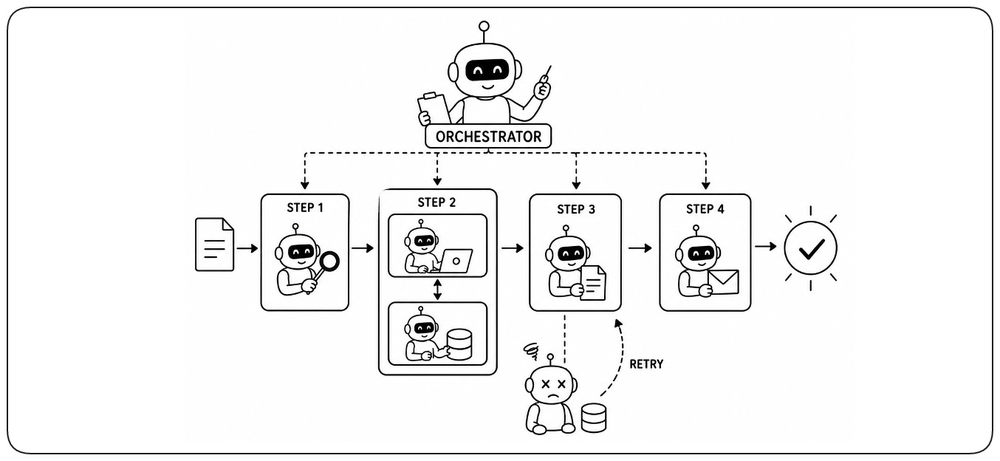
Some operations are not a single task but a sequence of dependent steps. One step may need the result of another, some steps may wait for external events, and failures may require retries or compensating actions. In these cases, the system must keep track of the workflow's progress and decide what should happen next. An orchestrator provides this coordination by maintaining workflow state and driving the process from one step to the next. !!Distribution assigns individual tasks; orchestration coordinates the workflow they belong to!!.
Orchestration vs Choreography [Coordination Styles] {1}
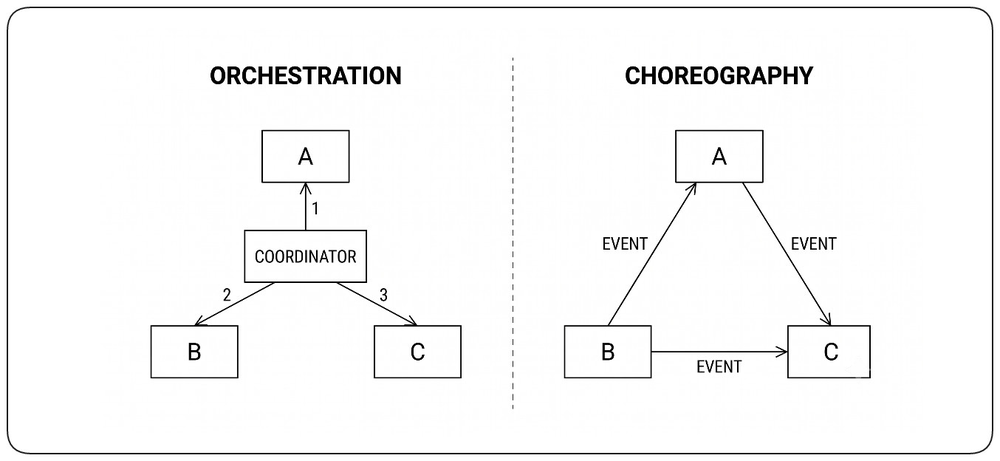
Distributed workflows can be coordinated in two main ways. In !!orchestration!!, a central coordinator decides which step runs next and keeps the overall workflow state in one place. This makes the process easier to understand, monitor, and audit, but introduces a central coordination component that must remain reliable and lightweight. In !!choreography!!, services react to events emitted by other services without a central coordinator. This reduces direct coupling and lets services evolve more independently, but the overall workflow becomes implicit and harder to trace across many components. !!Use orchestration when the workflow needs explicit state and control; use choreography when independence and loose coupling matter more than centralized visibility!!.
The Cost of Workflow Orchestration [Orchestration Cost] {1}
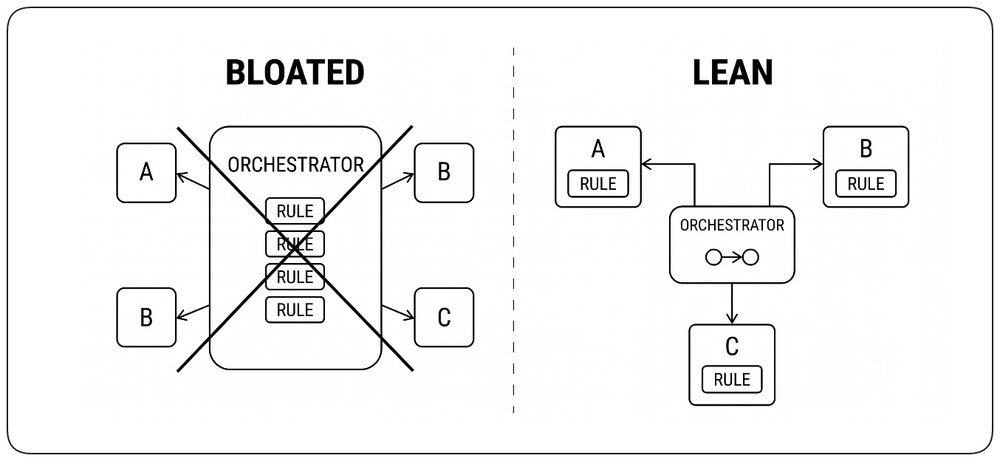
Orchestration simplifies complex workflows, but it introduces another coordination component. If too much business logic accumulates inside the orchestrator, it becomes a bottleneck, a single point of failure, and a central brain that tightly couples otherwise independent services. A good orchestrator coordinates workflow state and transitions while leaving business decisions inside the services that own them. !!Use orchestration when coordination is genuinely required, not as a substitute for well-defined services!!.
Data Scaling [Data Scaling]
Scaling compute is mainly about adding more workers to handle more work. Data is different: it persists, must survive failures, and must remain available as both volume and traffic grow. Across every architecture in this section, three mechanisms dominate: !!replication distributes reads and improves availability, partitioning divides the dataset so storage and writes can grow horizontally, and separating compute from storage lets each resource scale independently!!. Different database families combine these mechanisms differently: operational SQL emphasizes transactions and consistency, NoSQL emphasizes distribution and access patterns, and analytical platforms emphasize large scans, columnar storage, and elastic processing.
Design Data for Scale from Day One [Data Model Choice] {1}
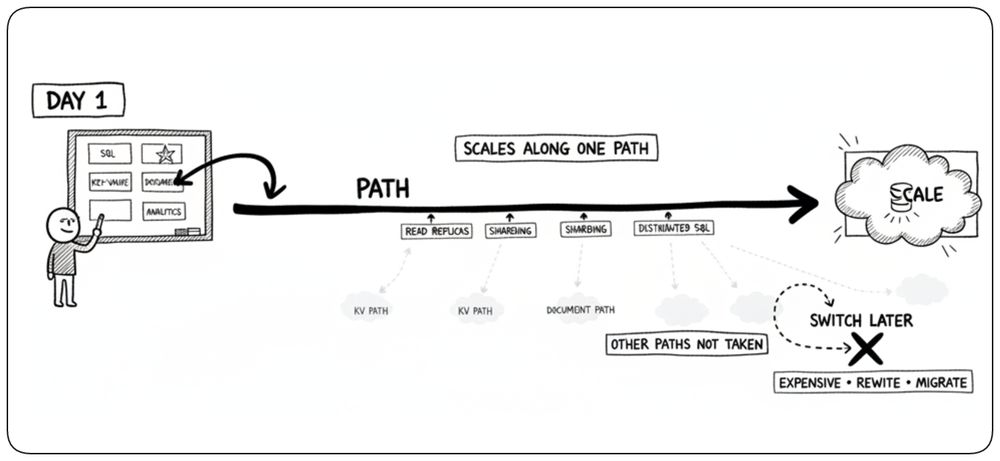
Data choices made early strongly influence how a system can scale later. A transactional SQL database, a key-value store, a document database, or an analytical platform each has different strengths and different scaling paths. Scalability should therefore be part of the data decision from day one. !!Changing the data model later is possible, but often expensive and disruptive!!.
Scaling Traditional SQL Databases [Traditional SQL] {1}
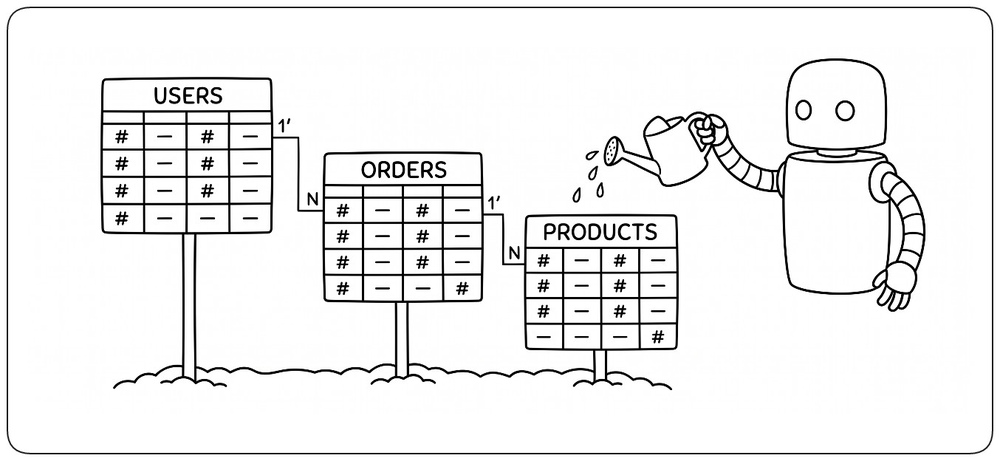
SQL databases organize data into structured tables with explicit relationships and strong transactional guarantees. !!As demand grows, different scaling strategies can be introduced depending on whether the pressure comes from reads, writes, or storage!!. The following sections explore how SQL databases can evolve from a single primary to increasingly distributed architectures.
Traditional SQL: Scaling the Primary [Single Primary] {1}
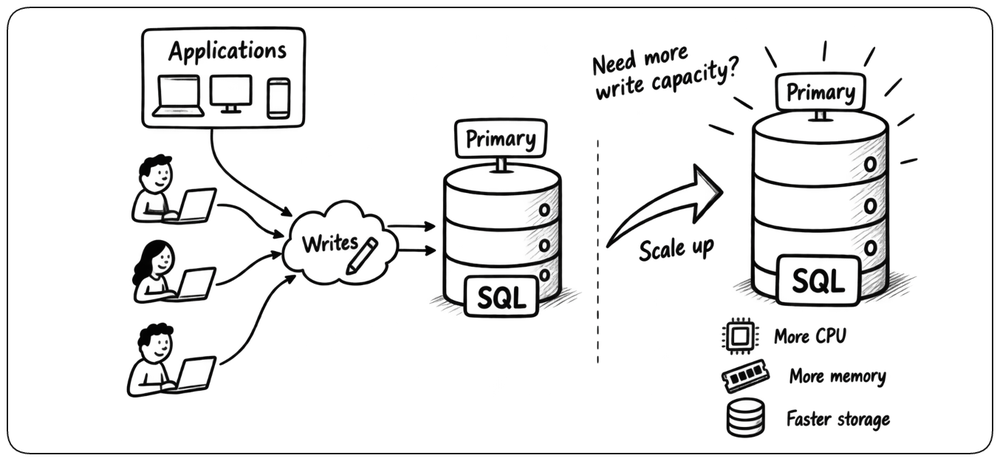
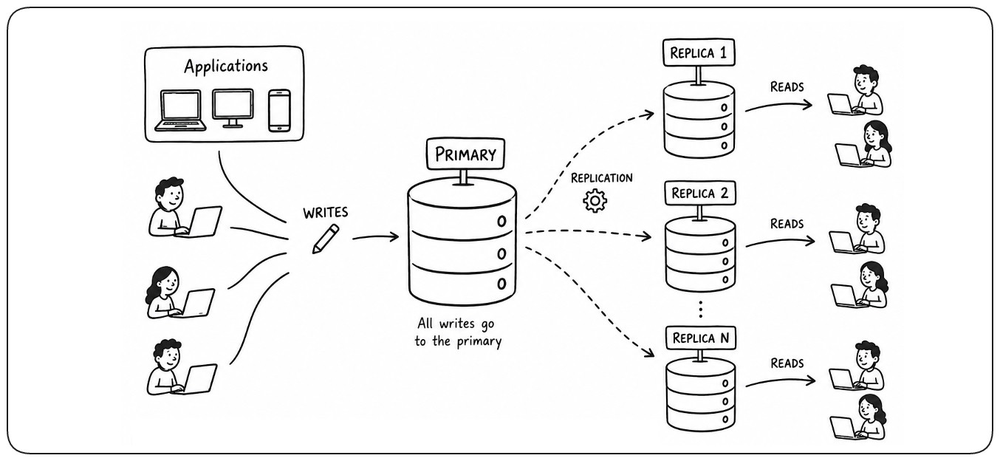
Traditional SQL databases typically rely on a single primary node for writes. This keeps transactions and consistency simple, but !!write capacity is limited by the capacity of that primary!!. As demand grows, the primary can be given more CPU, memory, or faster storage. Modern managed SQL services can automate some of this growth, especially storage expansion, but the architectural limit remains the same: writes still depend on a single primary. In other words, !!the natural way to increase write capacity is vertical scaling!!.
Read Replicas: Scaling Reads [Replication] {1}
Many applications read far more than they write. Read replicas exploit this asymmetry by sending writes to a primary database and spreading reads across replicated copies. Replication to those replicas is usually asynchronous, which increases read throughput without changing the write path. The trade-off is replication lag: replicas may briefly return stale data, so consistency-sensitive reads may still need to go to the primary. !!Read replicas scale read capacity, not write capacity!!.
Scaling Compute and Storage Independently [Decoupled Architecture] {1}
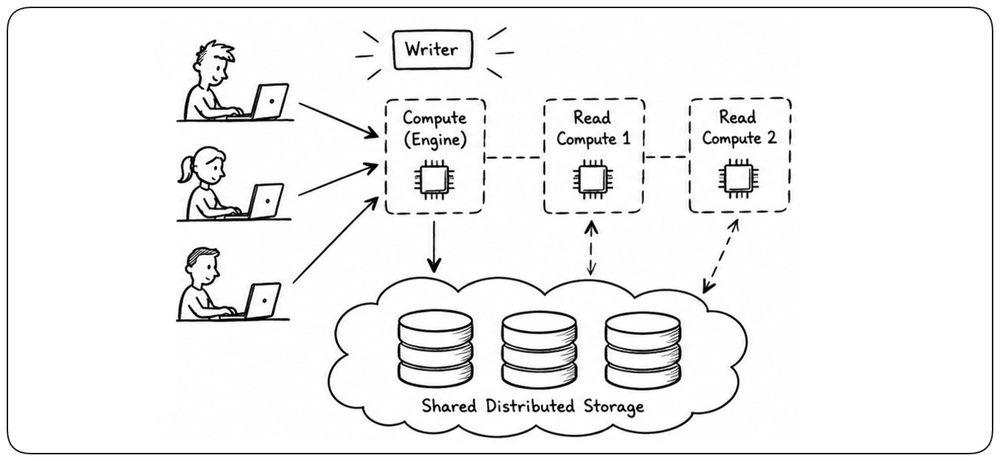
Some modern SQL databases, such as Amazon Aurora, separate compute from storage. The database engine runs in the compute layer, while persistent data lives in a shared distributed storage layer. !!Compute can be resized or replaced without moving the full dataset!!, and multiple reader instances can use the same underlying storage—though they may still see a small amount of replication lag as they apply changes from the writer. Aurora still uses a single-writer model: one instance handles writes, while additional instances scale reads and can take over during failover.
Manual Sharding: Scaling SQL the Hard Way [Manual Sharding] {1}
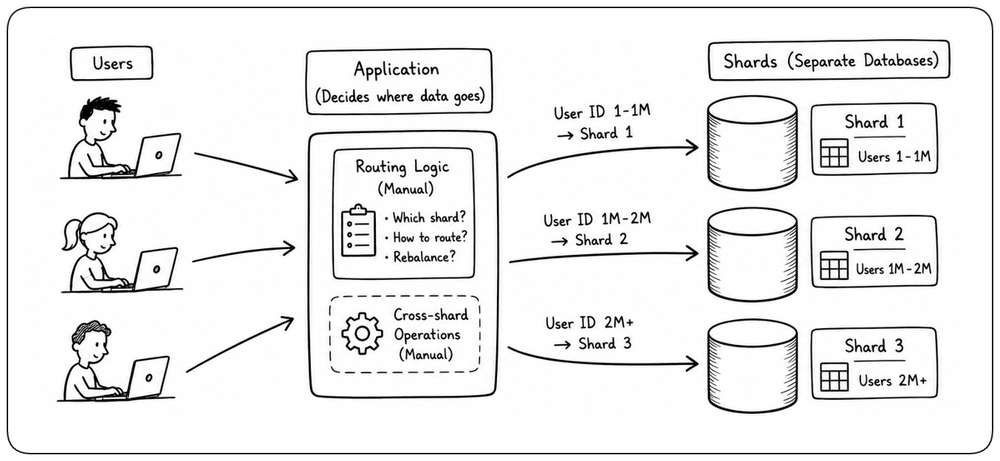
Traditional SQL databases can scale horizontally through manual sharding: the application decides which database owns each piece of data and routes requests accordingly. This removes the single-database limit, but pushes partitioning, routing, rebalancing, and cross-shard operations into the application. !!Manual sharding scales the database by moving distributed-system complexity into the application.!!
Distributed SQL: Sharding Without Giving Up SQL [Distributed SQL] {1}
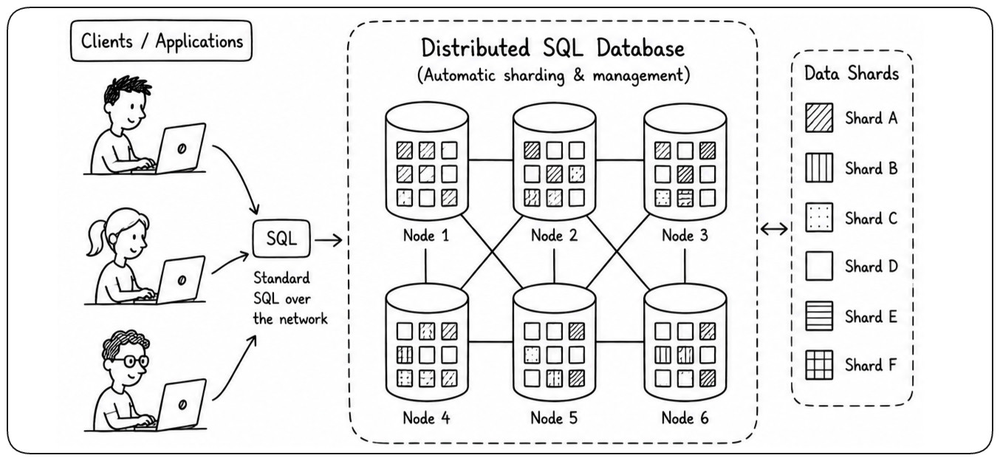
In recent years, advances in distributed storage and cloud infrastructure have made a new generation of SQL databases practical. The database splits data into shards across multiple nodes and replicates each shard for availability. !!Routing, replication, and rebalancing are handled automatically, allowing reads, writes, and storage to scale horizontally while preserving SQL and transactional guarantees!!. This convenience does not remove the cost of distributed coordination; it moves much of that complexity inside the database.
NoSQL Databases [Distributed Data] {1}
NoSQL databases include several data models, such as key-value, document, wide-column, and graph, designed around different access patterns. Many were built with distribution as a first-class concern, allowing data and traffic to be spread across multiple nodes. !!NoSQL is not one architecture, but a family of data models with different scaling and consistency trade-offs!!.
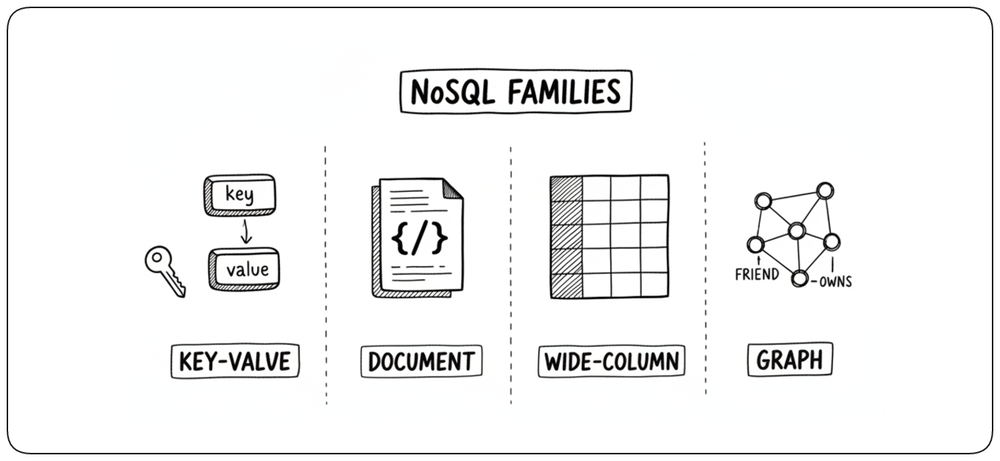
Choosing the NoSQL Model [NoSQL Models] {1}
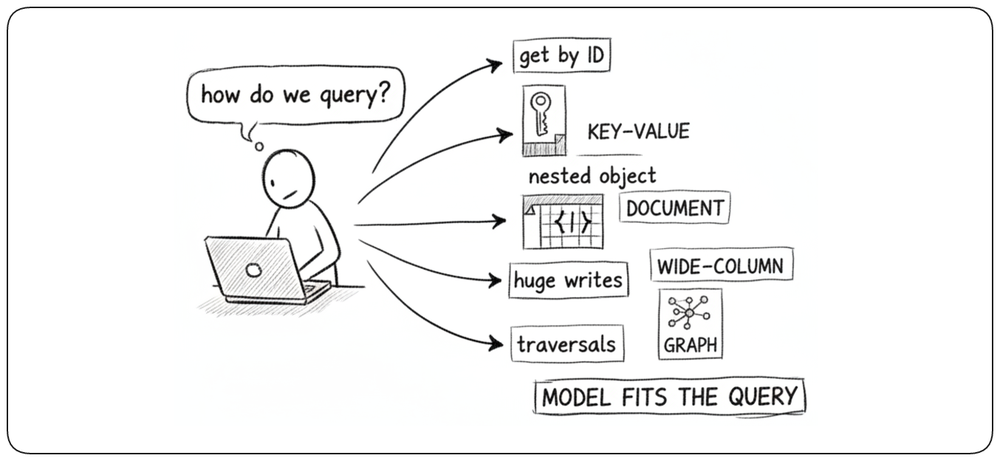
Different models optimize different access patterns. Key-value stores favor direct lookup by identifier, document databases keep flexible structured objects together, wide-column stores target very large distributed datasets and high write throughput, while graph databases optimize relationships and traversal across connected entities. The right choice usually follows the shape of the queries the application must serve, not the other way around. !!Choose the model around how the data will be accessed!!.
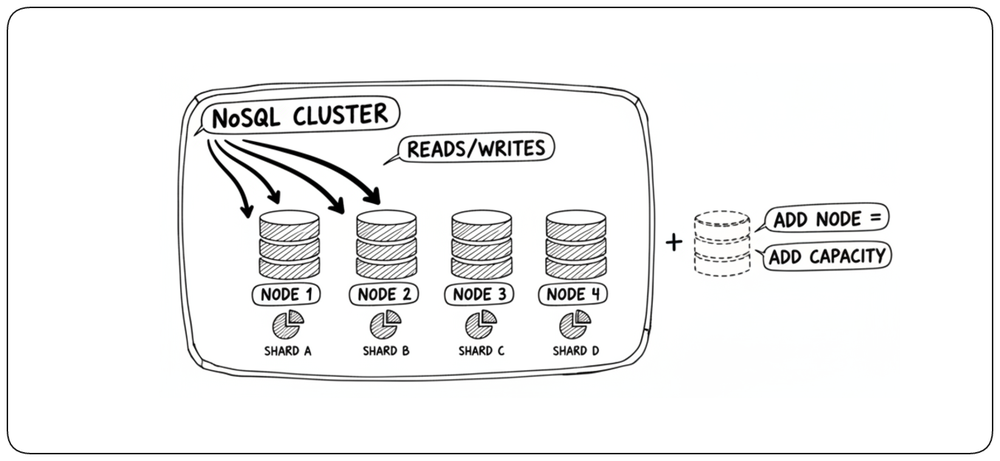
Native Distribution [Distributed by Design] {1}
Many NoSQL systems are designed to spread data across multiple nodes from the beginning rather than starting from a single primary. !!Data is partitioned across the cluster, usually with replicas spread across several nodes!!, so adding nodes generally adds both storage and processing capacity while giving the database more places to distribute the load. This model favors horizontal growth, but it also means the database itself carries more coordination and topology logic than a traditional single-node system. !!Horizontal distribution is often built into the database architecture itself!!.
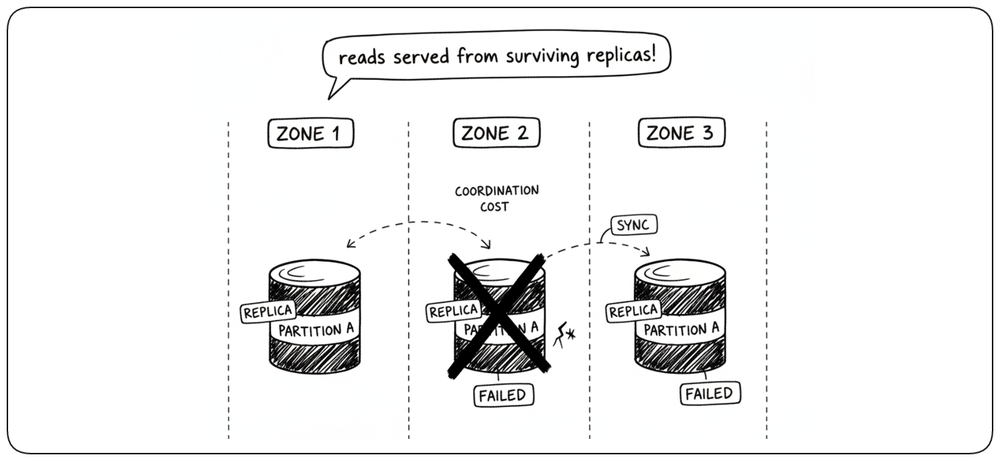
Replication and Availability [Replication] {1}
Distributed NoSQL databases typically keep multiple copies of each partition across nodes or zones so the system can survive individual failures. If one node or zone goes down, another replica can continue serving requests for the same data. The trade-off is that keeping several copies aligned requires coordination, and stronger guarantees between replicas generally cost latency or availability. !!Replication keeps data available when individual nodes fail, at the cost of coordination!!.
Partition Keys and Hotspots [Partition Keys] {1}
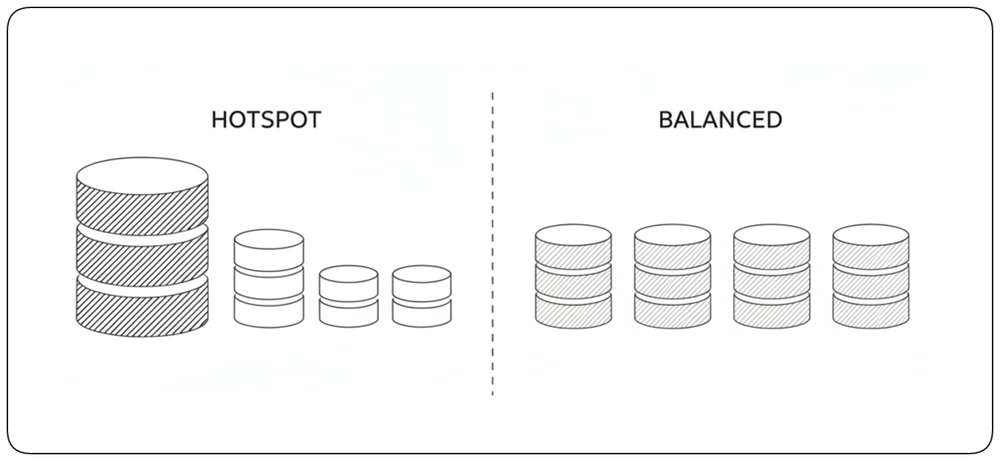
In distributed NoSQL databases, the partition key determines where each piece of data lives and which node serves it. A poorly chosen key concentrates traffic on a few nodes, creating hotspots where some replicas are overloaded while others sit idle. A good key spreads both storage and workload evenly, while keeping related data close enough for efficient queries. !!The partition key is one of the most important scalability decisions in a distributed database!!.
Analytical Data Platforms [Analytics Data] {1}
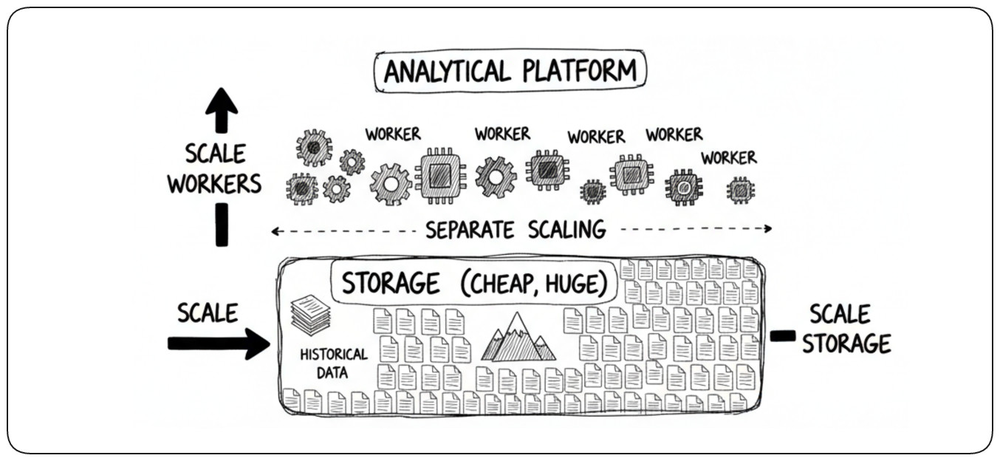
Analytical data platforms are designed for large scans, aggregations, reporting, and offline processing rather than low-latency transactional reads and writes. Their scalability problems are different: they must store large historical datasets cheaply, read only the columns needed for a query, and add compute capacity for heavy analytical jobs. !!Analytical scaling is about volume, scan efficiency, and elastic processing more than transactional write throughput!!.
Object Storage and Columnar Files [Data Lake] {1}
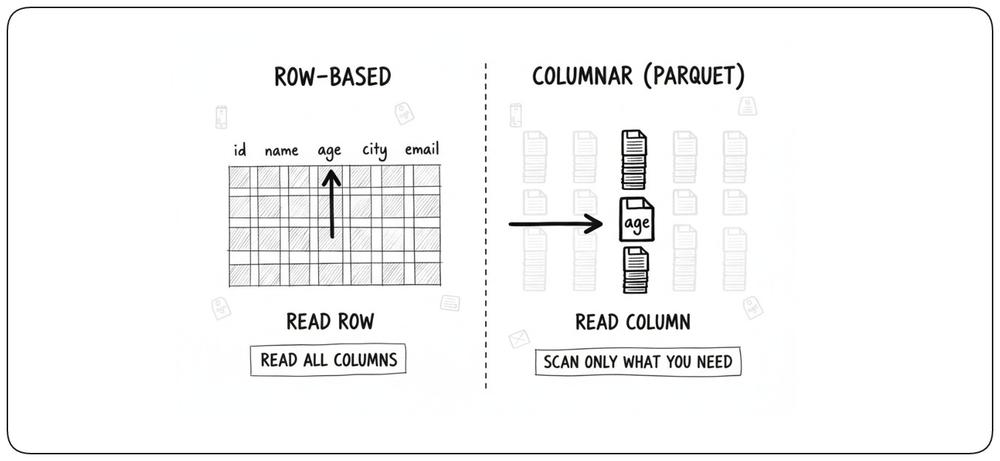
Large analytical datasets are often stored in object storage using columnar file formats such as Parquet. Object storage provides durable, low-cost capacity, while columnar files let query engines read only the columns and partitions needed for a workload. This makes storage scale independently from the systems that process the data. !!A data lake separates durable storage from the engines that analyze it!!.
Partitioning and Pruning [Scan Efficiency] {1}
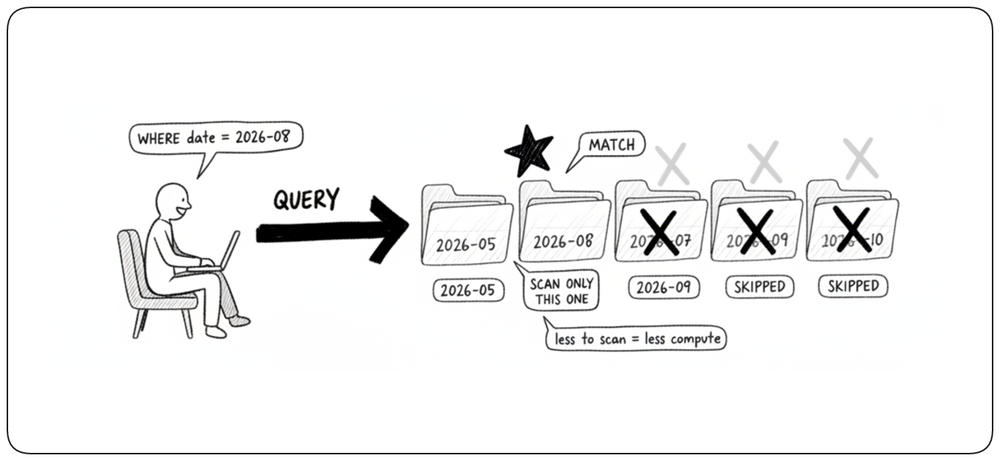
Analytical systems often organize large datasets by time, tenant, region, or another query-friendly partition key. When a query filters on that key, the engine can skip entire files or partitions instead of scanning everything. This does not just make queries faster; it reduces the amount of compute required as data volume grows. !!Analytics scales better when queries can prune data before they scan it!!.
Analytical Databases [Analytical DBs] {1}
Analytical databases organize data for scans, joins, aggregations, and reporting over large datasets. They often use columnar storage, compression, distributed execution, and query planners optimized for throughput rather than single-row latency. These systems may still expose SQL, but their scaling goal is analytical processing, not serving transactional application writes. !!Analytical databases scale complex queries over large datasets!!.
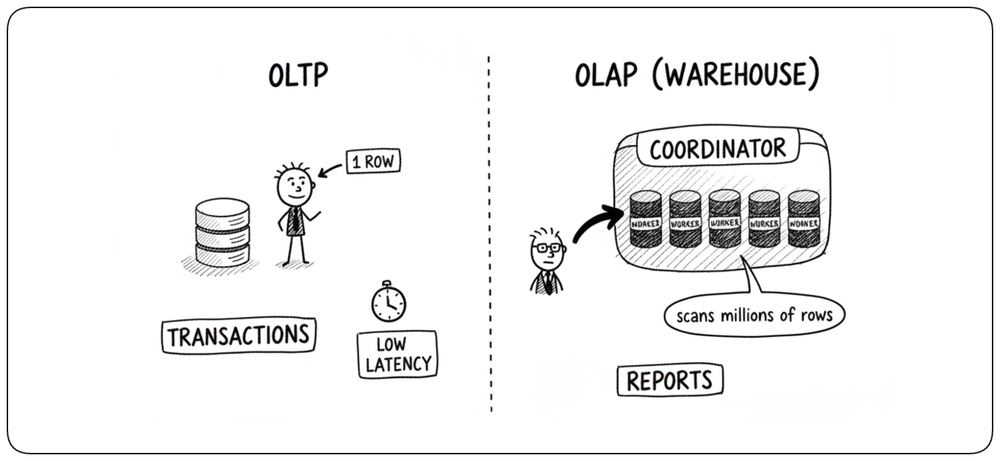
Elastic Query Execution [Elastic Compute] {1}
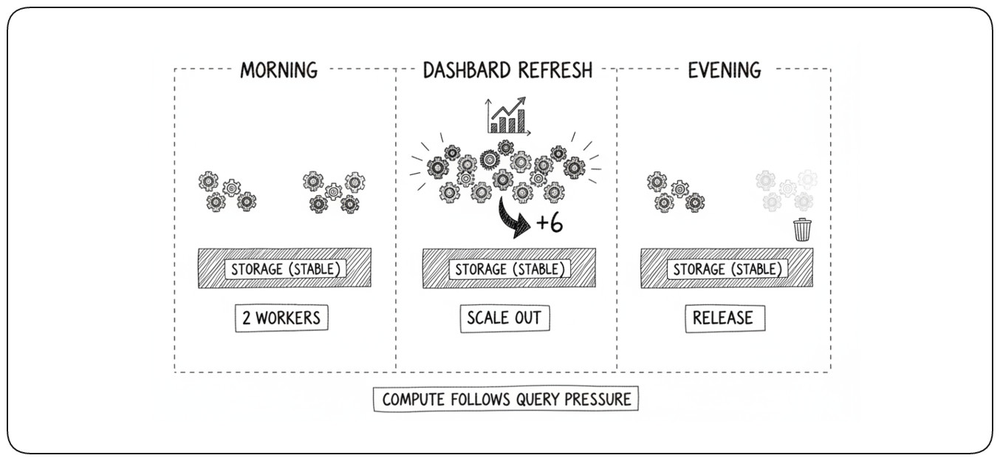
Analytical workloads are often bursty: a large report, dashboard refresh, or batch job may need far more compute for a short period of time. Elastic query execution lets the platform add workers for heavy scans and aggregations, then release them when the workload drops. This keeps storage durable while allowing compute capacity to follow demand. !!Analytical compute should scale with query pressure, not with stored data size!!.
Distributed Consistency [Consistency]
Distributing data solves one scalability problem but creates another: coordination. Once state is partitioned or replicated across machines, nodes must agree—or sometimes temporarily disagree—about what the current state is. The more widely state is distributed, the more the system must balance consistency, availability, and coordination cost.
The Truth Distribution Problem [Data Distribution]
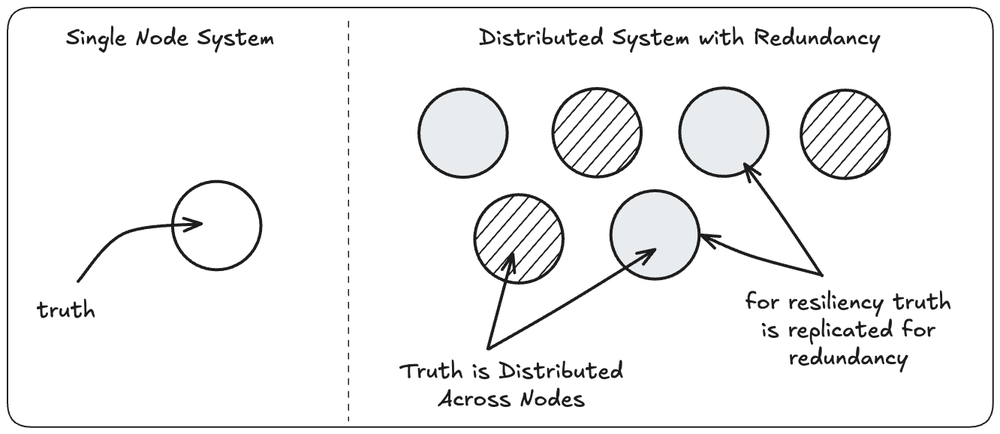
In a simple system, all "truth" resides in one node. This setup works well at small scale, centralizing data management and minimizing synchronization delays. But scaling means moving from a single-node system to a multi-node system where the truth is distributed across nodes. To ensure resilience in case of failures, redundancy is added: if one node fails, other nodes can still maintain access to the truth. Duplication of state enables fault tolerance, but it also introduces complexity. The need to distribute truth is both a strength and a weakness: the strength lies in replicating and safeguarding data, but the weakness comes from the challenges of synchronization.
The CAP Theorem [CAP Theorem] {1}
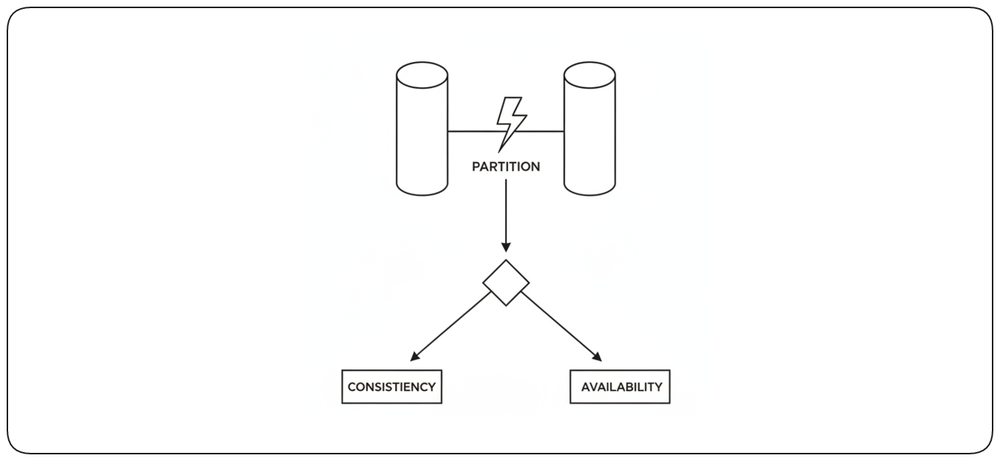
The CAP Theorem explains what happens when a distributed system is split by a network failure. During that partition, the system must choose between !!consistency—all nodes agree on the latest data—and availability—every request still gets a response!!. Because network partitions cannot be completely avoided in a distributed system, this trade-off is unavoidable in practice: some systems prioritize consistency and refuse to serve requests they cannot answer correctly, while others prioritize availability and accept temporary divergence. CAP is therefore !!a trade-off between consistency and availability during a partition!!—bank account balances usually demand consistency, while social media feeds tolerate temporary staleness.
Eventually Consistent Systems [Eventual Sync]
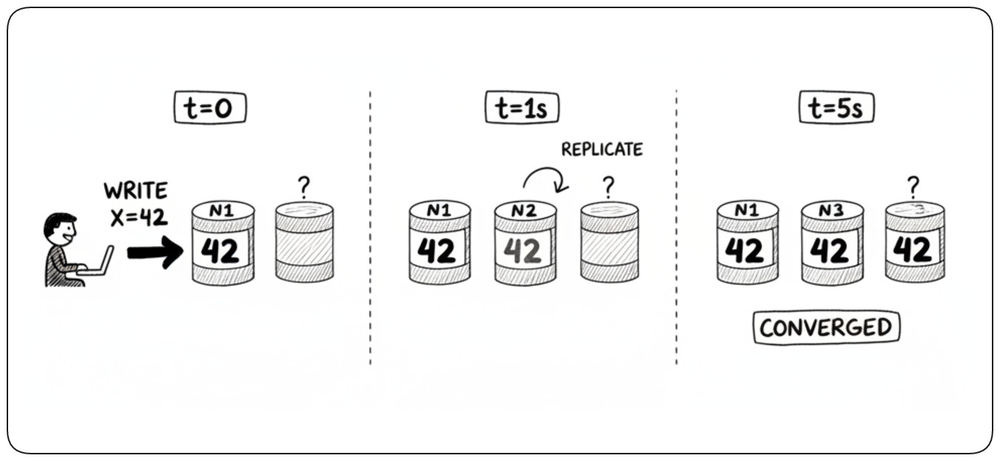
Each state update requires coordination across nodes, which takes time—especially with slow writes, node failures, or network problems. This is where eventual consistency emerges. Data across nodes is not instantly synchronized but will eventually reach consistency, ensuring global coherence over time despite potential delays and failures. Eventually consistent systems trade immediate consistency for availability and partition tolerance. When a user writes data, that data might not be immediately visible to all readers. But given enough time without further updates, all replicas will converge to the same state. This model works well for many applications where perfect consistency is less important than availability and responsiveness.
Read Your Own Writes [RYOW Guarantee]
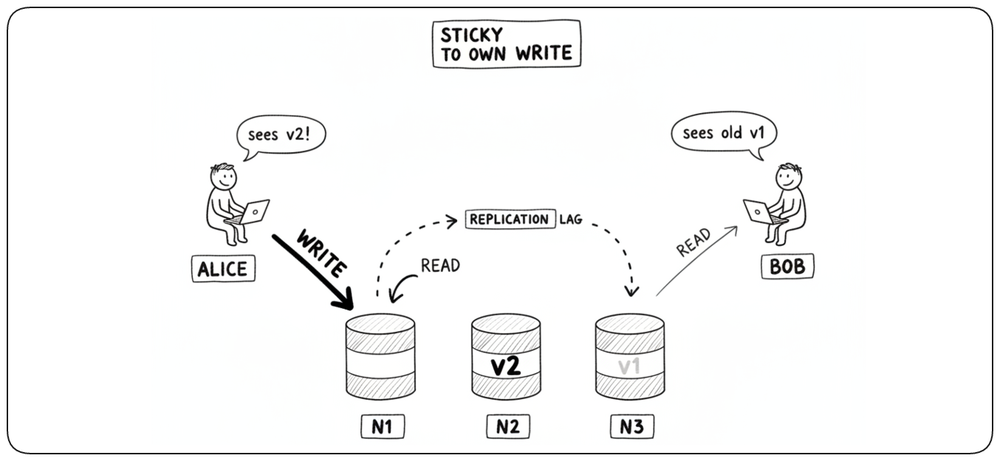
In an eventually consistent system, a user may read stale data right after making a change because the update has not yet reached every replica. RYOW (Read Your Own Writes) prevents this: !!after a successful write, the same user must see that write—or a newer value—on the next read!!. The system can implement this in different ways—routing the read to an up-to-date replica, tracking versions the user has already seen, or using timestamps to select a replica. Other users may still see older data on other replicas, but each user gets a consistent experience with their own changes.
Consistency as a Cost of Growth [Practical Takeaway] {1}
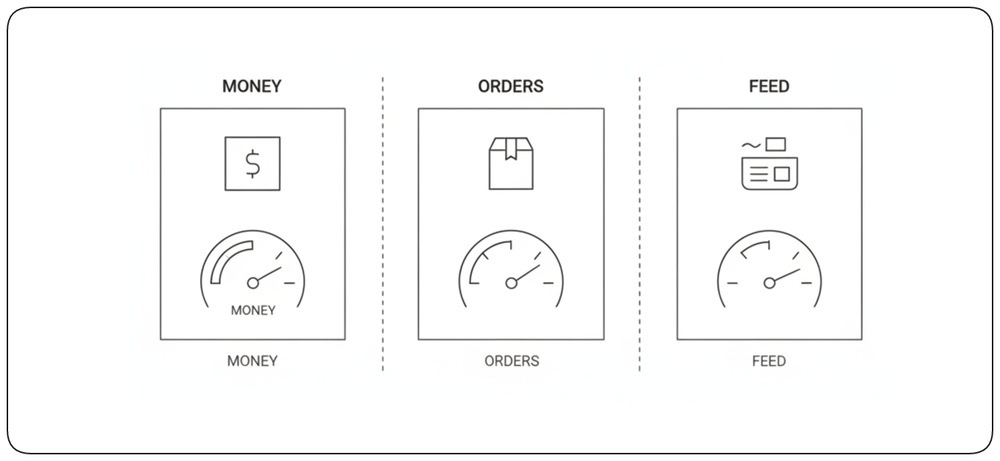
Distributing data increases capacity and resilience, but it also introduces coordination cost, staleness windows, and operational complexity. The architectural goal is not to "maximize consistency," but to !!choose guarantees that match the business risk!!—money movement and inventory correctness often need stronger guarantees, while feeds, analytics, and recommendations often tolerate staleness. Keep the principle high-level: !!every time you distribute truth, you buy a permanent coordination problem!!. Spend that complexity only when scale requires it.
Architecture Styles for Scalability [Architecture Styles]
Data consistency determines how distributed data behaves. But scalability also depends on how the application itself is structured. Several architecture styles make it easier to distribute work, isolate growth, and scale different parts of the system independently.
Scalability does not depend on a specific architecture, but some architectural styles are particularly well suited to it. They create boundaries that make it easier to distribute work, replicate components, isolate bottlenecks, and scale different parts of a system independently. Microservices, event-driven architectures, and serverless are common examples. They do not make a system scalable by themselves, but they provide architectural foundations that make scaling easier to implement and evolve.
Microservices: Bounded Context and Ownership [Microservices] {1}
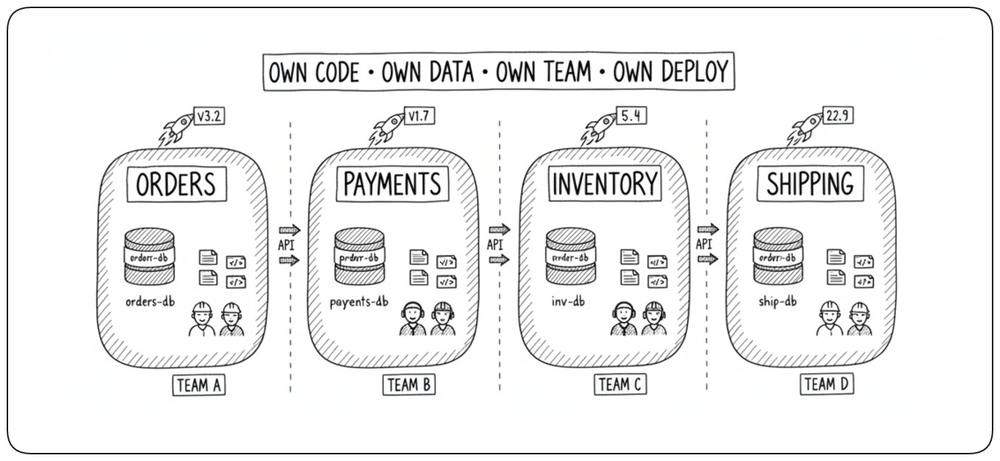
Microservices decompose the application into !!independently deployable services, each aligned with a bounded context!!—a distinct business capability with its own data, language, and rules. The scalability benefit is real but secondary; the primary benefit is !!ownership and independent lifecycle!!. Each service has one accountable team that can deploy on its own cadence, evolve its internal design without coordinating with the rest of the organization, and take responsibility for its reliability. Services communicate through well-defined APIs, keeping changes local. That independence—of code, data, deployment, and team—is what makes the architecture sustainable at scale; horizontal scaling of individual services is the natural consequence, not the motivation.
Event-Driven: Connecting Systems Loosely [Event-Driven] {1}
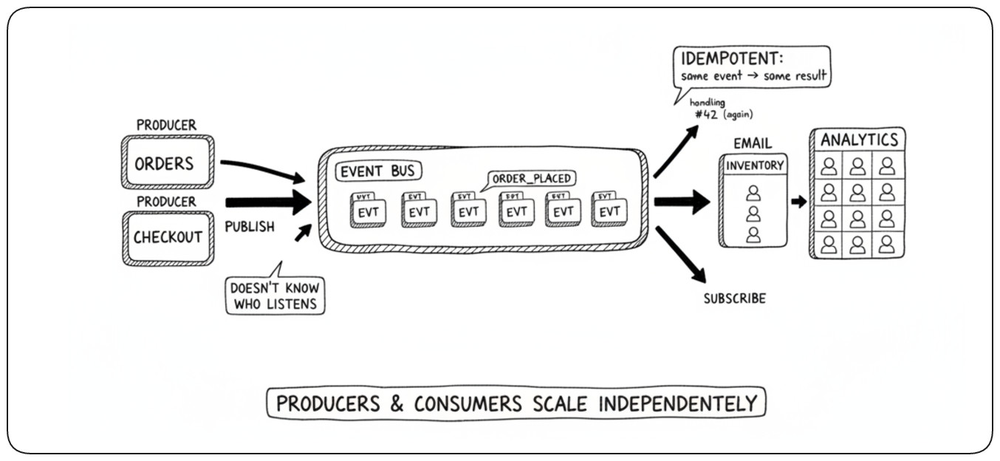
Event-driven architecture separates producers from consumers in both space and time. A publisher emits an event when something interesting happens; one or more subscribers react, without the publisher knowing they exist. This means !!producers can generate work without knowing which consumer will process it, while consumers can scale according to their own workload!!—different parts of the system can operate and scale at different rates, with queues or event streams absorbing temporary differences in capacity. Event-driven systems must also handle duplicate delivery safely. !!Deduplication detects whether a specific event has already been processed, while idempotency ensures that processing the same operation multiple times has the same effective result as processing it once!!. These techniques are complementary: deduplication avoids repeated processing, while idempotency makes repeated processing safe.
Serverless Architecture [Serverless] {1}
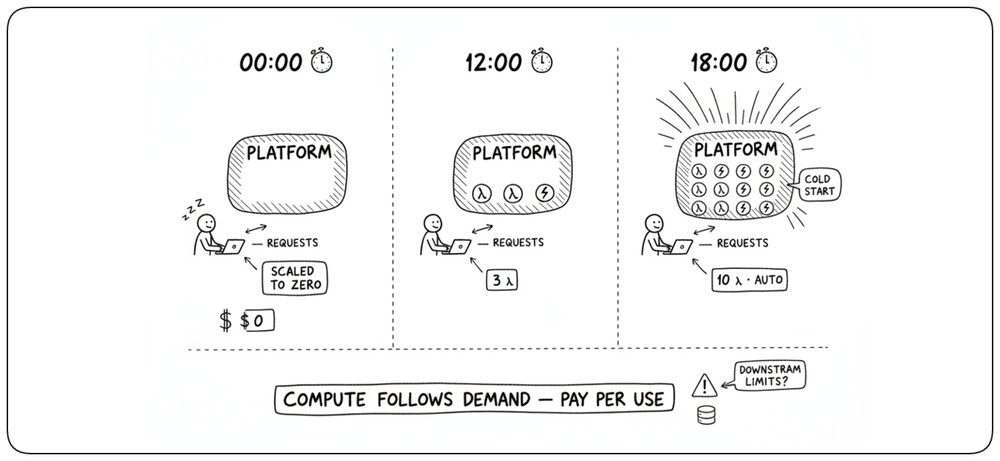
Serverless !!pushes elasticity into the execution platform itself!!. Instead of managing a fixed pool of workers, functions or services are instantiated on demand as load varies, and some services can scale down to zero when idle, often with consumption-based pricing. This makes serverless especially suitable for variable and event-driven workloads (API backends, file processing, webhooks). But !!automatic compute scaling does not automatically make the whole system scalable!!: downstream limits, cold starts, concurrency limits, and cost still matter.
Customer Scaling [Customer Scaling]
As platforms grow beyond a single customer, another dimension of scalability appears: serving many tenants efficiently while keeping them isolated.
Going further: multi-tenancy
Isolation models, tenant identification, database strategies, and multi-tenant security are covered in depth in the Multitenancy Models section of the Design for Cloud chapter.
Tenant Isolation Strategies [Isolation Spectrum] {1}
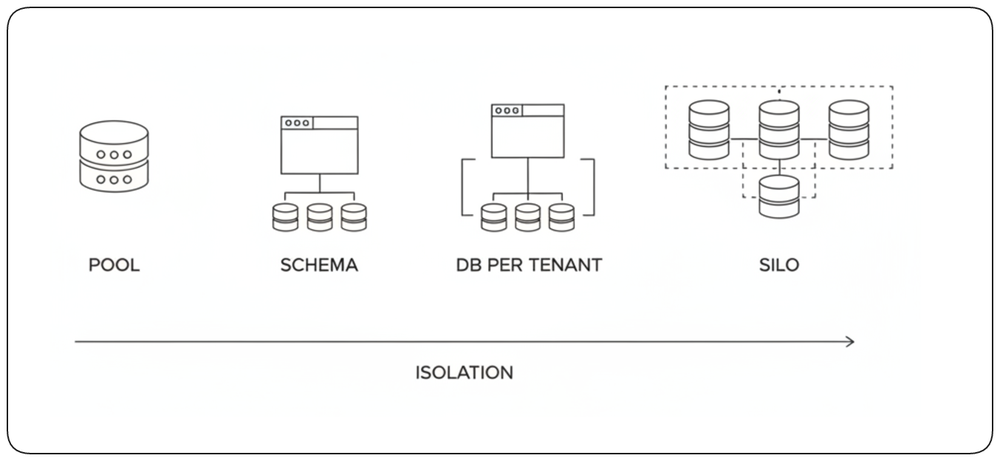
Multi-tenant systems exist on a !!spectrum of isolation!!. At one extreme, all tenants share everything—same database, same schema, same application instances—maximizing efficiency but requiring careful security to prevent leakage. At the other extreme, each tenant gets dedicated resources, maximizing isolation but sacrificing the efficiency of shared infrastructure. Between these extremes: shared instances with separate schemas, or shared schemas with row-level security. The right point on the spectrum depends on security, compliance, and unit economics.
The Noisy Neighbor Problem [Tenant Scaling] {1}
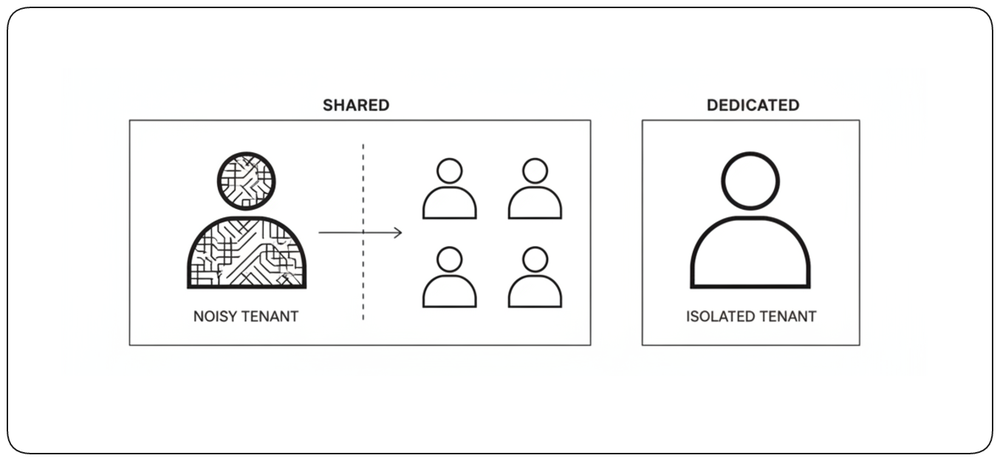
Tenants vary dramatically in resource consumption—!!one tenant may generate 50% of the load while paying 5% of the revenue!!. Effective multi-tenant scaling requires tenant-aware controls: per-tenant rate limiting, noisy-neighbor detection, and tiered isolation that lifts heavy tenants onto dedicated infrastructure. The goal is to !!keep one tenant's usage from degrading everyone else's experience!! while still capturing the efficiency of shared infrastructure.
Organization Scaling [Organization Scaling]
Scaling also applies to organizations. As a company grows, adding more engineers does not automatically increase delivery capacity: communication, dependencies, and coordination grow too. Organization scaling is about increasing the capacity of an organization without letting coordination grow at the same rate.
Shared Vision: The Prerequisite to Scale [Shared Vision] {1}
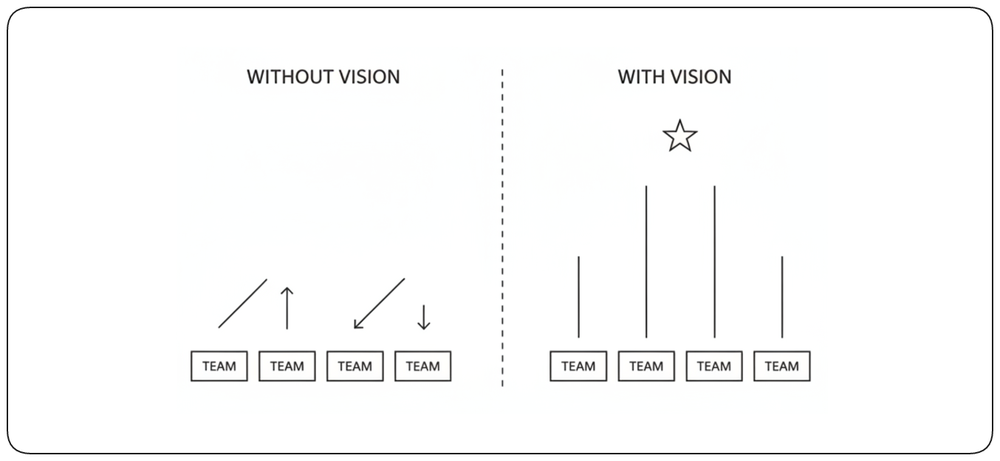
A growing organization needs one thing above all else: a shared vision. Without it, every team optimizes for its own local goal, decisions get relitigated at every level, and coordination cost explodes. !!A shared vision is what lets independent teams make aligned decisions without central approval — it is the invisible mechanism that makes everything else scale!!.
Platforms: Scaling Teams Through Self-Service [Platforms] {1}
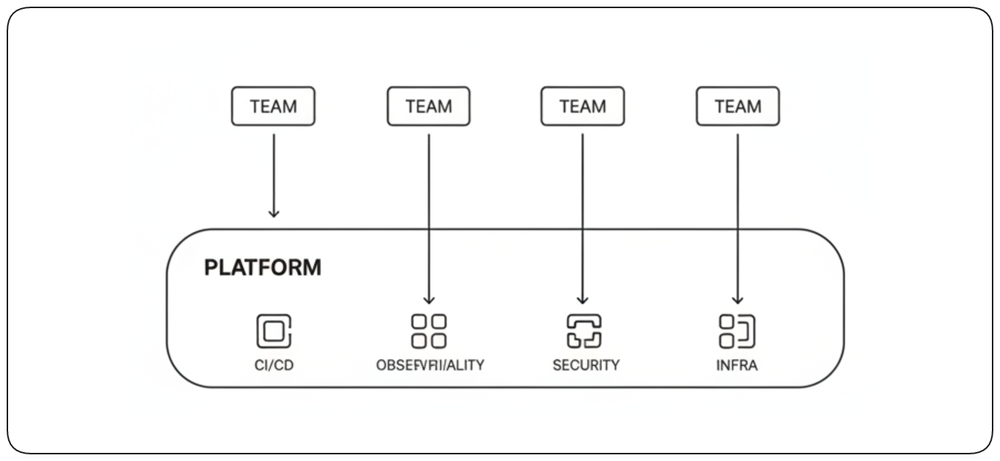
As an organization grows, teams should not repeatedly solve the same infrastructure, deployment, security, and operational problems. A shared platform turns these common needs into reusable self-service capabilities, allowing teams to move faster without depending on a central group for every change. !!Platforms scale engineering capacity by reducing repeated work and coordination between teams!!.
Going further: platforms
Platform design, self-service capabilities, and the developer-experience mindset are covered in depth in the Designing Developer-Centric Platforms chapter.
Team Boundaries: Scale Through Ownership [Team Boundaries] {1}
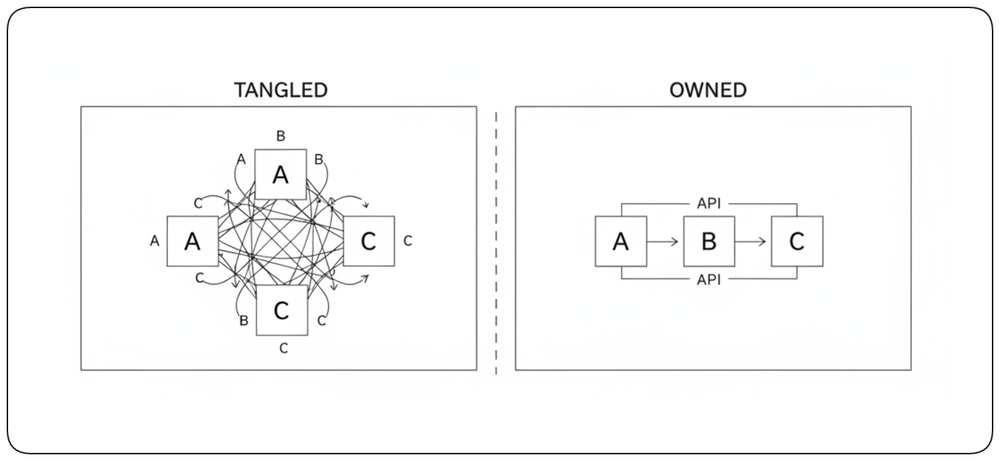
Adding more engineers does not automatically increase delivery capacity. As teams grow, unclear responsibilities and constant cross-team coordination can become the new bottleneck. Clear ownership, well-defined boundaries, and stable interfaces allow teams to work independently. !!Team scaling means increasing organizational capacity without increasing coordination at the same rate!!.
Anti-Patterns [Anti-Patterns]
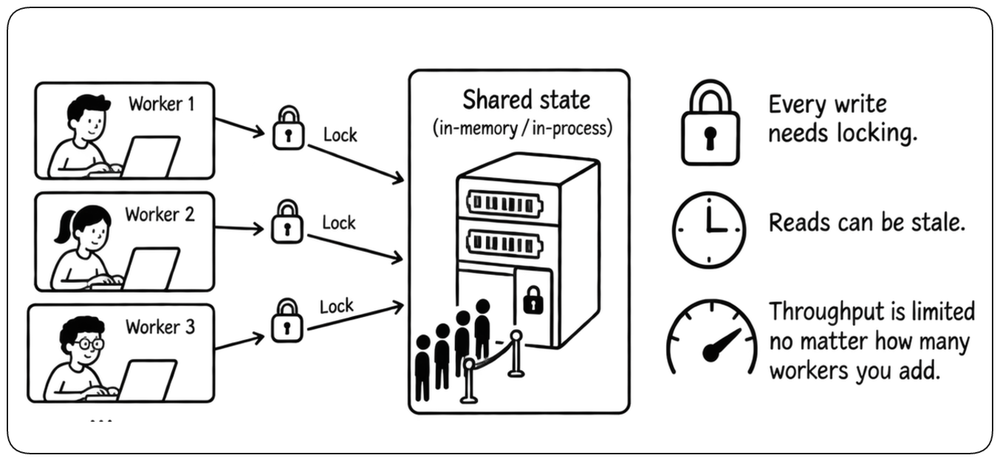
Not every design that looks scalable actually is. Certain choices destroy scale as surely as good patterns enable it. Every anti-pattern below has one common trait: !!it creates a coordination or coupling point that must be crossed on every operation!!, and no amount of horizontal scaling relieves it.
Shared Mutable State [Shared State] {1}
When multiple workers share the same state, they must coordinate every change. As more workers are added, this shared state becomes a bottleneck and limits scalability. !!Keep workers stateless and store shared state in a database, cache, or queue designed for concurrent access!!.
Stateful Servers [Stateful Servers] {1}
Keeping application state inside a server makes that server special: future requests may need to return to the same instance, failed instances can lose state, and scaling becomes harder because workers are no longer interchangeable. !!Sticky sessions are a common symptom of this design!!—they route a user back to the server that already holds their state, but they do not remove the underlying coupling. Scalable systems keep workers stateless and move durable state to shared systems so any instance can handle any request.
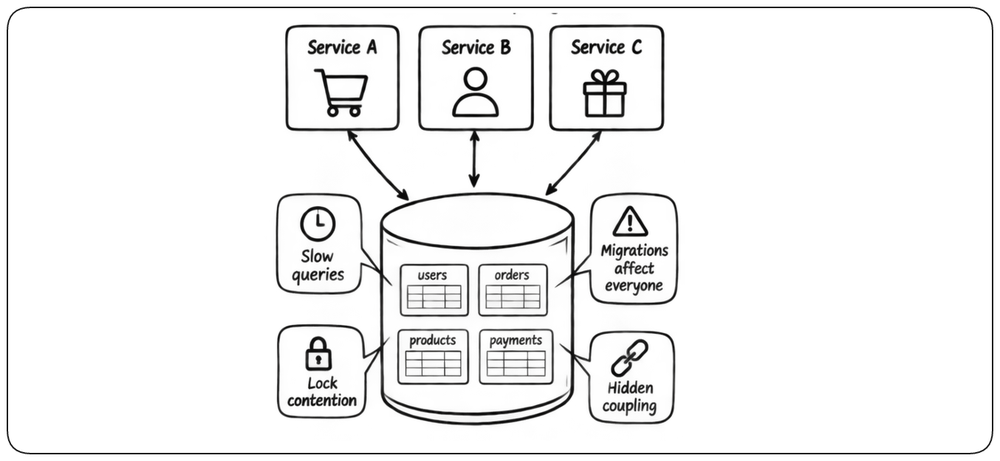
The Shared Database [Shared Database] {1}
When multiple services all read and write the same database schema, the database becomes a hidden coupling point: !!every service is affected by every other service's queries, migrations, and lock contention!!. What looks like microservices is really a distributed monolith. Each service should own its data; cross-service reads happen through APIs or events, not shared SQL.
Further reading
Martin Fowler describes this pattern in Integration Database.
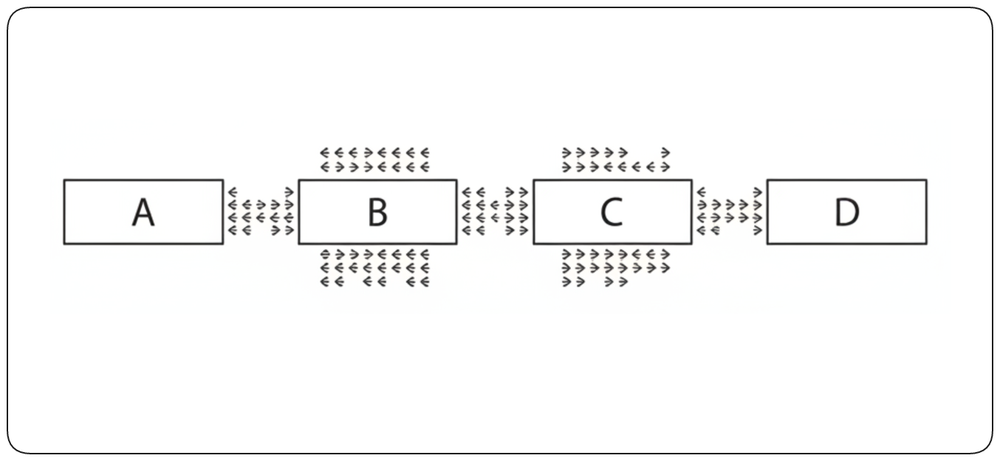
Chatty Services and Synchronous Chains [Chatty] {1}
When Service A calls B synchronously which calls C which calls D, !!latency compounds and failures cascade!!. A single user request becomes ten network round-trips; one slow service degrades every caller upstream. Fixes: batch operations to reduce round-trips, cache aggressively, break chains with asynchronous messaging, and use circuit breakers to fail fast rather than block on a sick dependency.
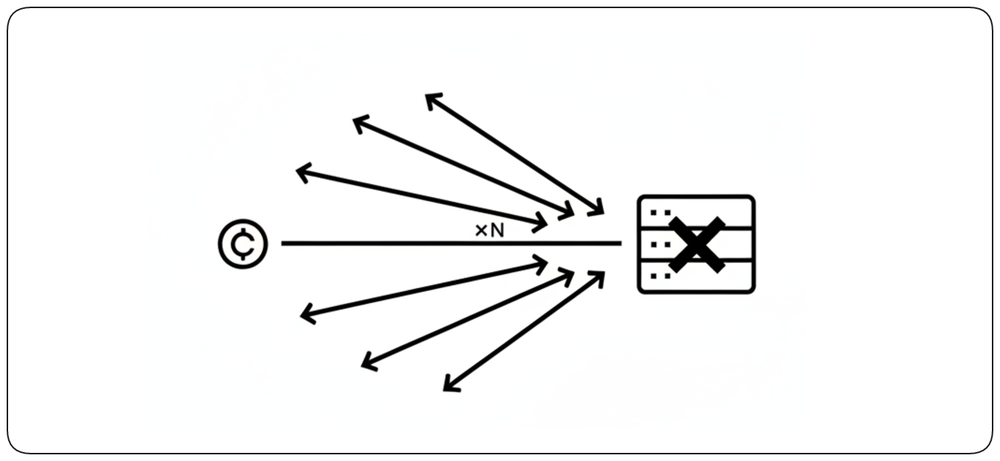
Retry Storms [Retry Storm] {1}
When a downstream service starts failing, naive clients retry immediately—and !!the retries amplify the load exactly when the downstream is least able to handle it!!, turning a brief hiccup into a full outage. Every retry policy needs !!exponential backoff with jitter!!, a hard retry budget, and a circuit breaker that stops calls once failure rate crosses a threshold. Retries without backpressure are a denial-of-service attack you launch against yourself.
Distributed Transactions [Distributed Txn] {1}
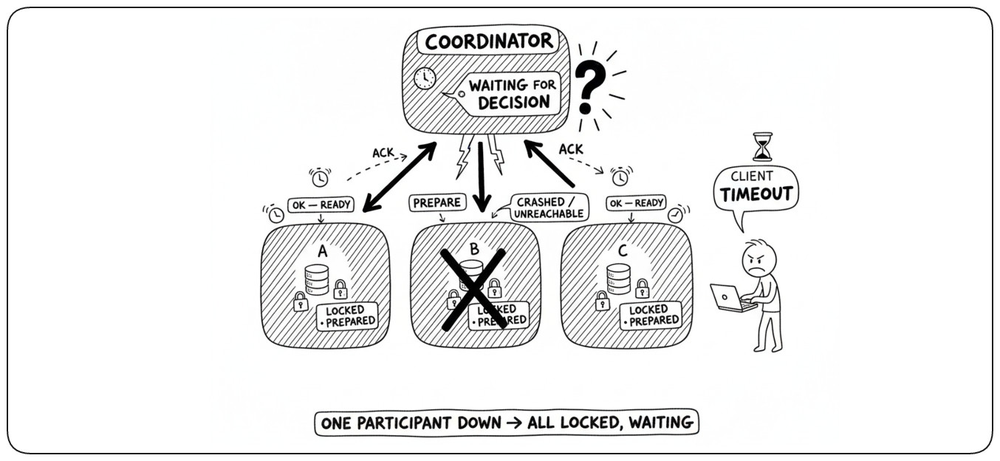
Distributed transactions require several services or databases to agree before a change can complete. !!This coordination adds latency and creates failure cases where a participant may be left waiting for the others!!—a well-known blocking failure mode of two-phase commit. Prefer local transactions, sagas (compensating actions), and idempotent operations when possible. If a business flow repeatedly needs atomic updates across several services, question the service boundary first—it may be drawn in the wrong place.
Distributed Locks [Distributed Locks] {1}
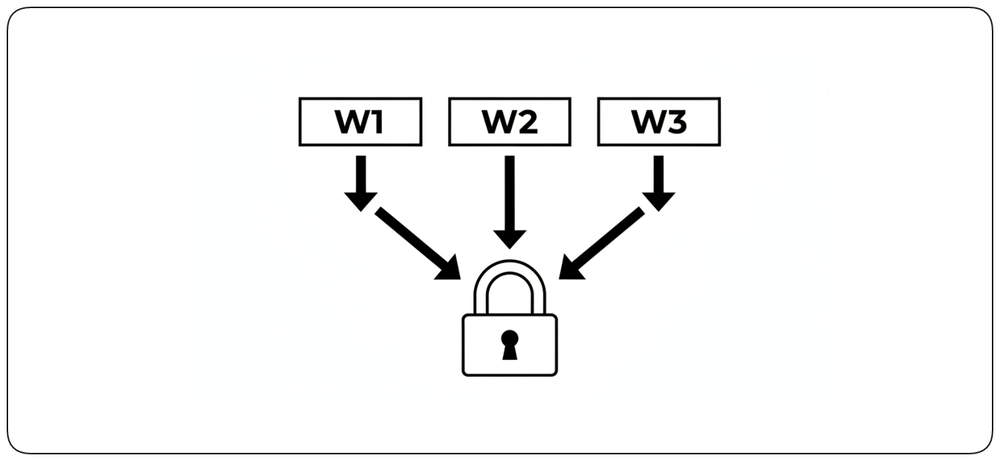
Distributed locks look like a clean solution to concurrent updates, but they are !!a single point of contention wearing a distributed disguise!!. Lock services become the bottleneck; leases expire under GC pauses and produce split-brain; failure modes are subtle. Prefer optimistic concurrency (version checks on write), event sourcing (append-only log), or single-writer partitions where one worker owns a slice of the key space and no lock is needed.
Scaling Everything Together [Monolithic Scaling] {1}
When a system can only be scaled as a single unit, every hot component drags the cold ones along with it. Doubling the fleet to relieve one heavy endpoint doubles the memory, disk, and cost of everything else. !!Scalable systems are made of pieces that can be scaled independently!!—by service, by workload, by data partition—so capacity can be added exactly where the pressure is.
Autoscaling as a Cure-All [Autoscaling] {1}
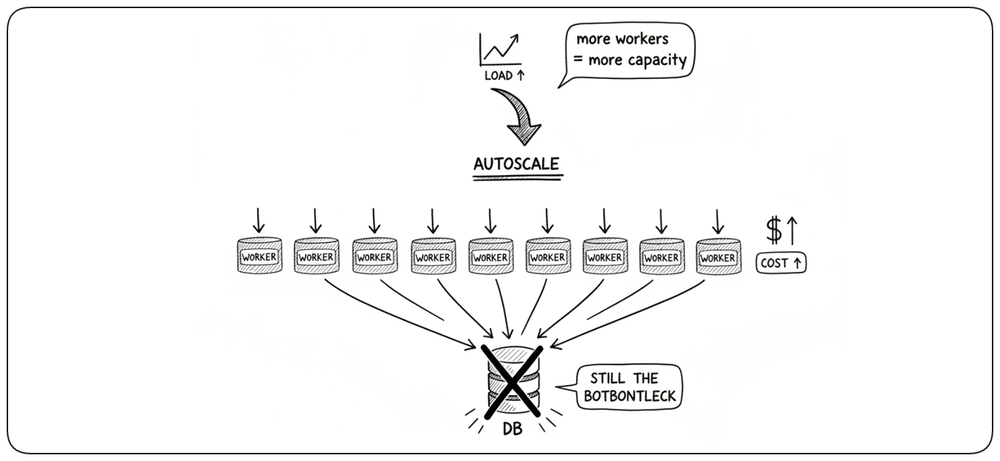
Autoscaling looks like the answer to every capacity problem: add nodes when load rises, remove them when it drops. In practice, it only relieves the resources it can grow—stateless workers, mostly. It cannot save a saturated database, a locked shared resource, a hot partition, or a downstream that cannot itself scale. Worse, it can !!hide the real bottleneck by absorbing symptoms with more instances until cost explodes!!. Autoscaling is a tool for elastic compute, not a substitute for identifying and relieving the actual constraint.
Takeaway [Takeaway]
Scalability Is About Repeatability [Repeatability] {1}
A scalable system is built from units that can be replicated, distributed, or partitioned without redesigning the whole system. !!Stateless workers make compute repeatable, modular boundaries make components independently scalable, queues decouple rates of work, partitioning distributes data, automation removes human bottlenecks, and overload protection keeps the system stable when capacity is exceeded!!. Scaling is ultimately not about making machines bigger—it is about !!making growth repeatable!!.