Design for Evolvability
Chapter Info
Calculating... Writing Progress: 60%
The industry faces a fundamental paradox: software is immaterial and theoretically immune to physical wear, yet it degrades inexorably over time. Physical infrastructure—bridges, railways, power plants—is often planned for forty to sixty years of operation. In contrast, the typical lifespan of a software system is five to fifteen years before a major overhaul is deemed necessary. The question is not whether code will age, but how to build systems that can cross decades without succumbing to obsolescence or operational paralysis.
This chapter is about evolvability: the capacity of a system to absorb new requirements and paradigm shifts without the cost of change growing out of control. It is distinct from maintenance—keeping the system running, fixing defects, and applying patches—which is necessary but not sufficient. A system that is only maintained and never evolved will eventually fall behind; one that is designed for evolvability can last. Evolvability is not immutability: software frozen in time is dead software. We embrace incremental change, end-to-end automated safety nets, and the rigorous isolation of business logic from ephemeral implementation details. The outcome is longevity—systems that outlive the technologies they were built upon.
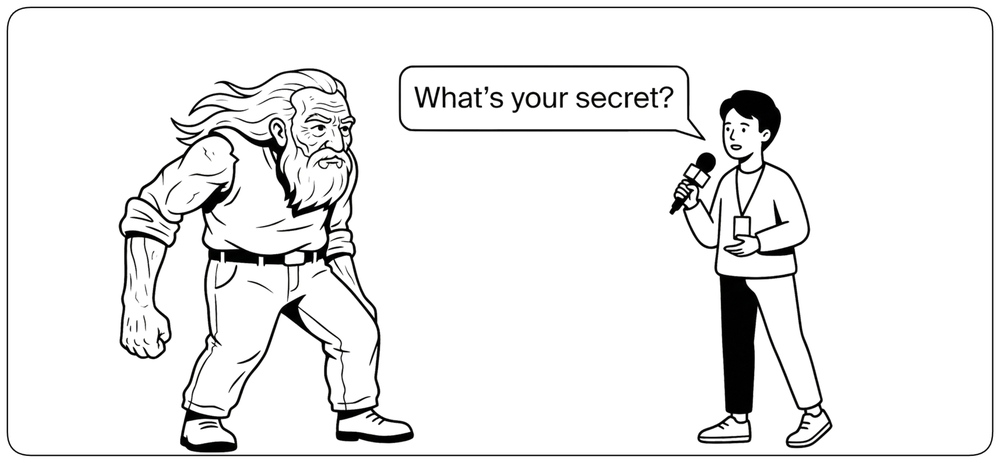
We will first understand the mechanics of decline—why software erodes and how technical debt and legacy take hold—then how to architect for replaceable components and decouple core logic from external forces. From there we examine how to contain vendor lock-in, impose automated guardrails through evolutionary architecture and fitness functions, and structure systems with strategic models such as Domain-Driven Design and the modular monolith. We then look at minimizing code, declarative and codeless approaches, and preserving institutional memory through ADRs and living documentation, before closing with case studies of systems that have stood the test of time.
The Anatomy of Software Decline [Anatomy of Decline]
To build durable software, we must first understand how it declines. Unlike physical objects, unmodified code does not erode materially. Its decline comes from the growing divergence between its static state and an environment in constant flux: changing business requirements, security patches in dependencies, and updates to operating systems and platforms.
The Paradox of Immaterial Erosion [Immaterial Erosion]
Software erosion suggests a natural process of decay—like rust on metal. Yet a program left untouched does not wear out. Its obsolescence stems from the widening gap between what the system does and what the world expects. To resist that divergence, design must embrace platform-independent, language-neutral, and technology-agnostic principles: abstract interfaces, universal data formats, and clear boundaries between layers so that architectures remain resilient to technological change.
Maintainability vs. Evolvability [Maintainability vs Evolvability]
ISO/IEC 14764 defines software maintenance as all activities required to provide cost-effective support to a system, including planning, corrections, and adaptation to the environment. A crucial distinction must be drawn between maintainability and evolvability.
| Aspect | Maintainability | Evolvability |
|---|---|---|
| Primary goal | Preserve existing behavior and fix defects. | Integrate new business capabilities and adapt to paradigm shifts. |
| Trigger | Bug reports, security fixes, minor environment updates. | Strategic market changes, new regulations, business process redesign. |
| Structural impact | Localized changes, minor refactoring, limited architectural impact. | Potential domain model changes, new bounded contexts. |
| Time horizon | Short to medium term (day-to-day, minor versions). | Long term (system survival over decades). |
Maintainability keeps the system running as-is. Evolvability is what allows it to survive when requirements and technology fundamentally change. Both are necessary; architecture must support both.
How Maintainability Affects Evolvability [Maintainability and Evolvability]
Maintainability has direct repercussions on evolvability. If you do not absorb maintenance continuously—fixing defects, updating dependencies, refactoring hotspots—debt accumulates until it blocks business change. The effort of adaptation becomes so high that any evolution—new features, new domain models, new integrations—becomes risky or impossible. In practice, that is maintenance driven by crisis: you only act when something breaks or a deadline forces your hand. By then, the cost is already paid in compound interest. Neglecting maintainability is therefore a major risk to evolvability: the system may still run, but it can no longer evolve.
Taxonomy of Technical Debt [Technical Debt Taxonomy]
Technical debt is the future cost incurred by choosing a quick or easy solution now instead of a better design that would take longer. It appears in distinct forms that require different mitigation strategies.
- Deliberate debt arises when teams consciously take architectural shortcuts to meet deadlines, trading structural soundness for time-to-market. It can be commercially justified but demands rapid repayment or it will block future development.
- Accidental debt stems from misunderstood requirements, skill gaps with a given technology, or poor communication within teams.
- Environmental debt (often called "bit rot") is the most insidious for evolvability. Even flawless code that works perfectly at delivery will accumulate debt over time because of external change. Security patches, library upgrades, and platform migrations can make existing code incompatible. Like a house built perfectly on shifting ground: if the environment changes, the structure suffers regardless of how well the bricks were laid.
TODO
- Environment Debt is maintenance.
The Five Horsemen of Legacy [Five Horsemen]
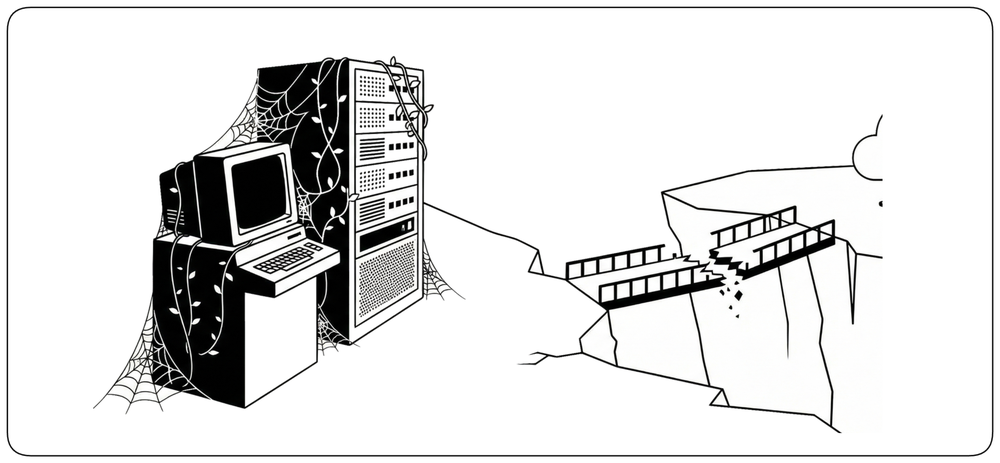
Certain factors turn manageable debt into the dreaded "legacy" state: poor code quality, absent or decaying documentation, obsolete technology, insufficient or missing automated tests, and a culture of quick fixes. Together they make the cost of change exceed the will to change. The system is no longer understood; any modification is seen as dangerous. It becomes frozen in time.
Cybersecurity and Operational Paralysis [Cybersecurity Legacy]
In critical or government environments, maintaining obsolete software consumes large budgets, requires constant workarounds, and exposes organizations to major cybersecurity risk. Modern intrusion detection, advanced telemetry, and automated remediation depend on updated libraries and kernel features that simply do not exist on legacy systems. The result is growing attack surface, shrinking operational visibility, and minimal response capacity. Incidents such as the 2021 exploitation of Accellion's legacy file-transfer appliance show how attackers can persist undetected for months on old systems where a modern architecture would have contained the threat in hours.
Architecting for Apoptosis [Architect for Apoptosis]
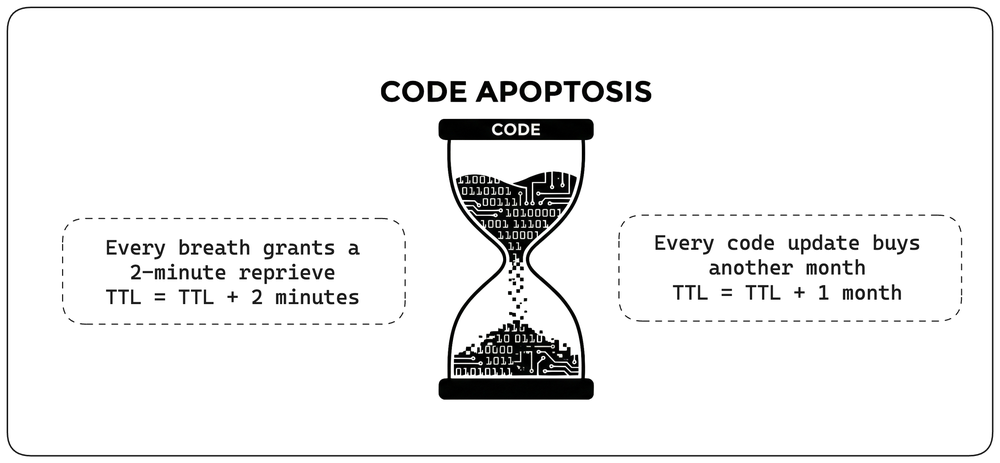
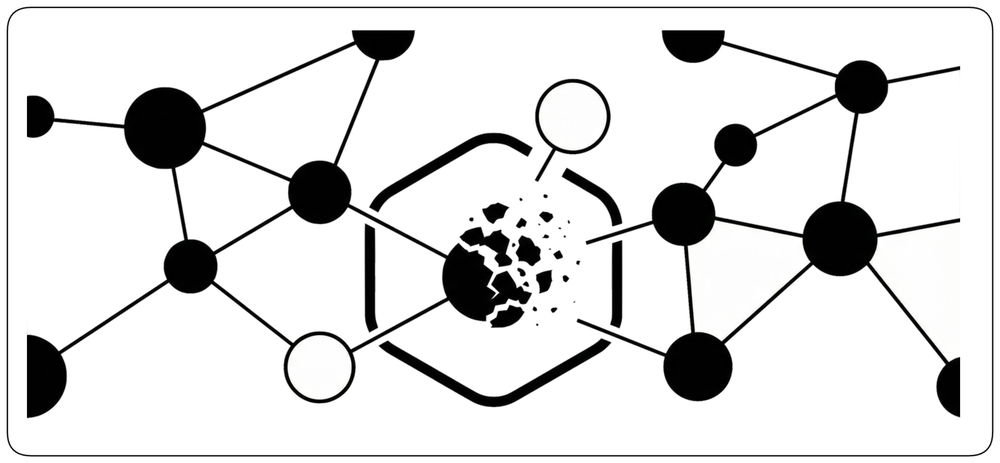
Because software decay is inevitable, an uncomfortable truth must be accepted: code is ultimately a liability, not an asset. The industry builds systems intended to last using fundamentally ephemeral parts. Every new dependency shortens the countdown. The response is not to avoid writing software or to search for immortal components—it is to design for evolvability by aggressively decoupling core business logic from external forces. When a module expires, replacing it must be a routine swap, not a system-wide rewrite.
The Birth of Legacy and Its Antidote [Legacy Creation]
Legacy is not created by age alone but by neglect. The shift from "current" to "legacy" happens when the cost of change exceeds the will to change, when teams stop investing in the system's future, and when the gap between the code and modern practice becomes too wide to bridge incrementally.
A system that is continuously maintained, refactored, and updated does not become legacy regardless of when it was first written. The antidote is continuous care: regular refactoring, up-to-date dependencies, and treating technical debt as part of normal development. This is as much a management challenge as a technical one—shifting from reactive maintenance to proactive evolution.
When It's Too Scary to Change [Legacy Fear]
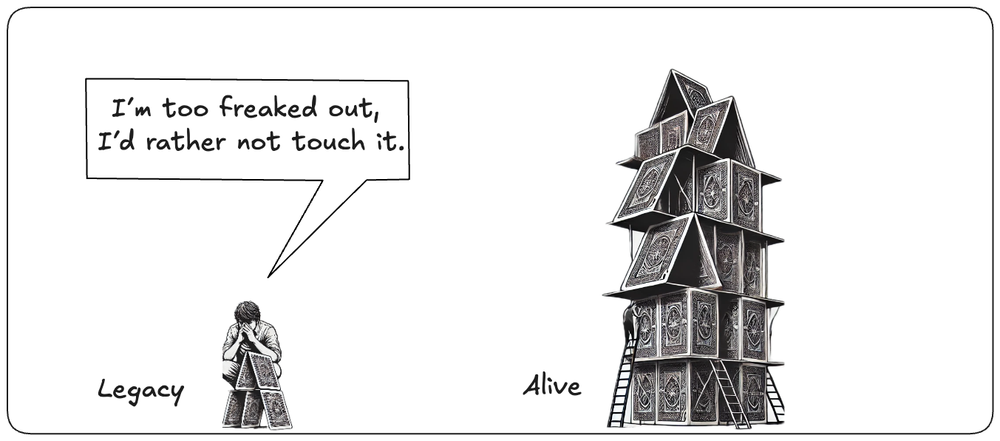
A cruel twist: once a system is labeled legacy, the organization often stops applying that care. Nobody dares to touch it—accumulated complexity, undocumented changes, and fragile dependencies make every change feel risky. The system freezes; any modification is seen as too dangerous. Breaking this spiral requires the same prescription as prevention (team ownership of the whole system, incremental change, treating the codebase as something to evolve rather than to avoid), but the psychological and political barrier is higher once the "legacy" stigma has set in.
Complexity, Not Length, Is the Enemy [Complexity Cost]
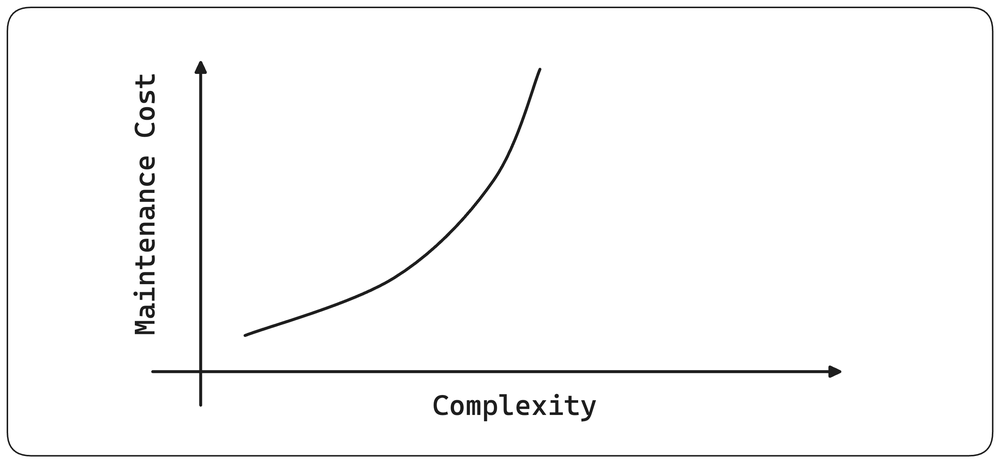
Length is a metric; complexity is the real enemy. A thousand lines of simple, explicit code will outlast a hundred lines of clever, tangled abstraction. Every tightly coupled module and opaque dependency increases cognitive load and makes future change risky. For evolvability, simplicity is essential: the system that outlasts technological shifts is the one that is easiest to understand and safest to change.
The Proprietary Trap and the Standard Path [Proprietary Trap]
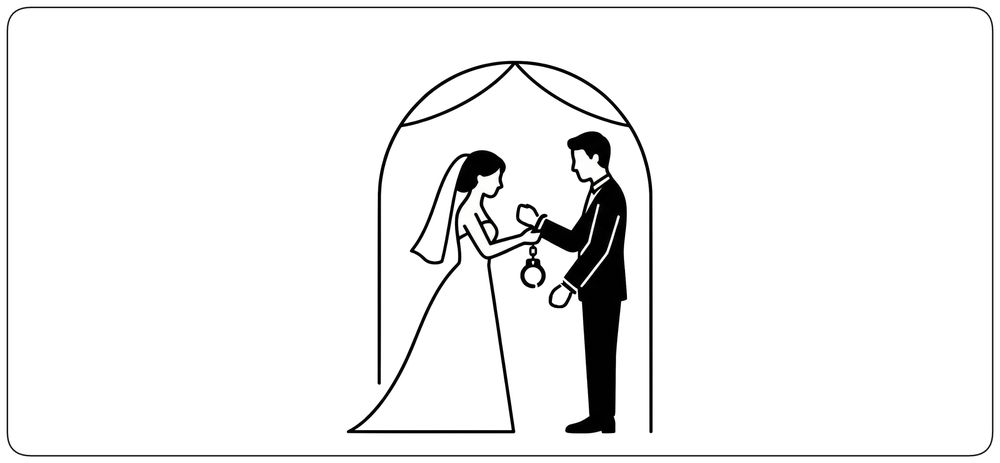
Building on proprietary technology hands control of your expiration date to someone else. Vendor lock-in or closed ecosystems can speed initial delivery but outsource your survival. If a vendor pivots, deprecates a core API, or disappears, your system is at their mercy. To design for evolvability, maintain technical sovereignty: rely on open standards, portable data, and transparent infrastructure. In the fight against decay, "boring" is an asset. Standard libraries, established protocols, and native features are tested, maintained, and protective of backward compatibility. Default to the standard; resist trendy frameworks and custom cleverness. Build with tools that have already stood the test of time.
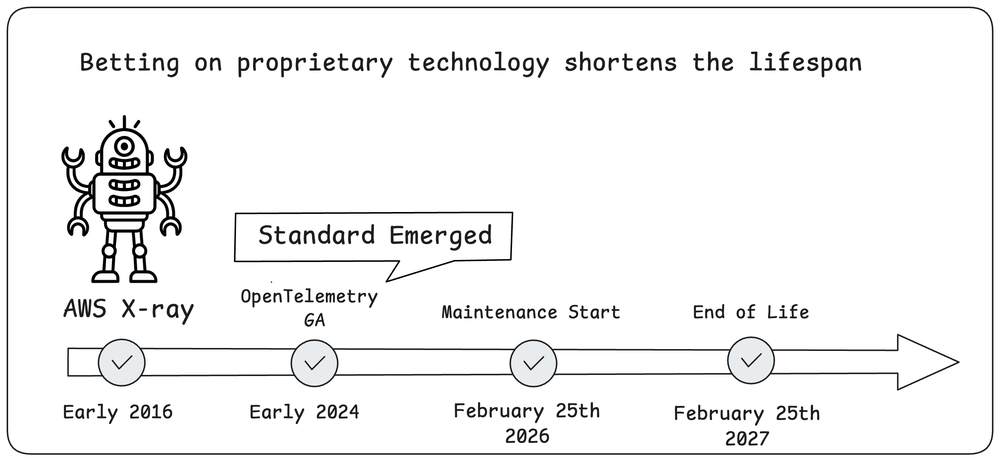
The Velocity Trap [Developer Velocity]
Developer velocity—how fast features ship—is a common metric, but optimizing for it alone undermines longevity. Fast development with proprietary tools can feel productive until migration is necessary; quick solutions with deep dependencies can ship until security or platform updates force rewrites. True velocity must include maintenance cost. A solution that ships in one day but needs a week of maintenance every year is slower than one that ships in two days but requires none. Design for how long what you build will last, not only how fast you can build it.
Vendor Lock-In [Vendors Lock-In]
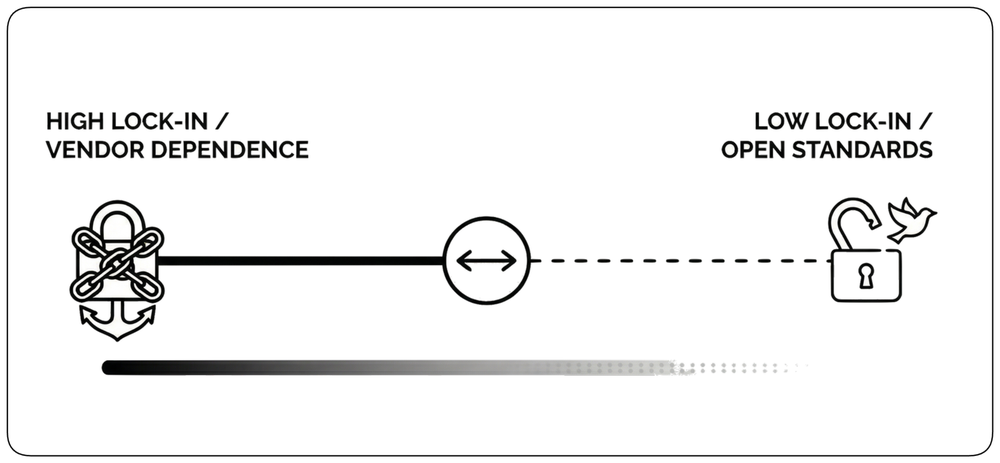
The proprietary trap takes concrete form in vendor lock-in: the degree to which your system depends on a single provider's ecosystem. Understanding this spectrum is essential for evolvability.
The Lock-In Spectrum [Vendor Lock-In]
Lock-in exists on a spectrum from total dependency to full portability. At one end, the entire system is built on proprietary services that exist nowhere else—migration means rewriting everything. At the other, every component uses open standards and can run anywhere—often at the cost of features and velocity.
The goal is not zero lock-in but conscious lock-in: understanding tradeoffs and choosing deliberately where to accept vendor dependency. Lock-in becomes a problem when switching cost exceeds the value the vendor provides.
The Trap of Managed Services [Managed Services Trap]
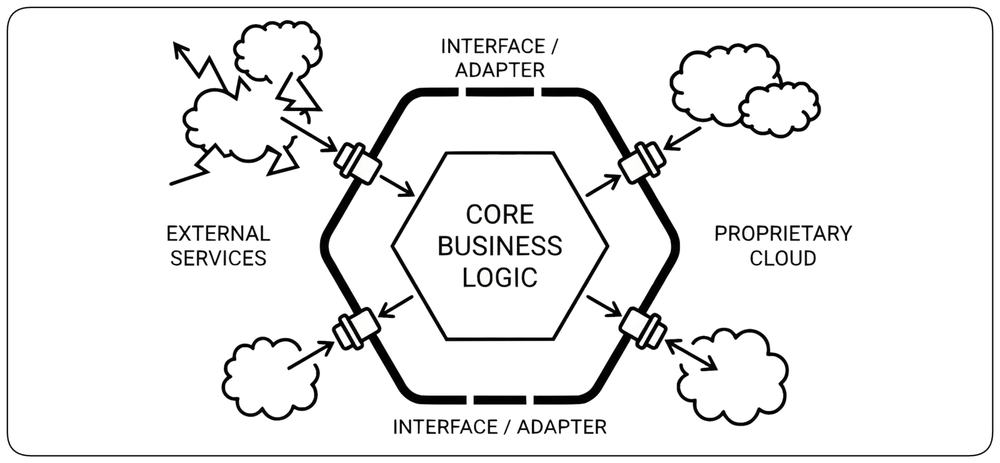
Cloud managed services—proprietary queues, bespoke databases, vendor-specific compute—promise instant capability but embed someone else's expiration date into your core. Every direct call from business logic to a cloud SDK hardcodes a dependency you cannot control. If the provider deprecates or changes the service, your software breaks. The survival strategy is not to avoid these services but to contain them strictly: define your own interfaces, push cloud dependencies to the edges with adapters, and keep core logic oblivious to the infrastructure outside. When a vendor retires a service, only a disposable adapter is affected.
Strategic Integration and Migration [Strategic Decoupling]
Isolating external services behind well-defined interfaces is not paranoia about unlikely scenarios or a mandate to be cloud-agnostic—it is a fundamental engineering principle. Integrate the provider's capability; decouple it from your domain. Minimize migration cost by designing for portability where risk is high: use abstraction layers, prefer managed services built on open foundations (e.g., PostgreSQL, Kafka), and isolate proprietary pieces behind interfaces that could be reimplemented elsewhere.
Multi-cloud is pursued for capability, regulation, or strategy (e.g., avoiding a competitor's cloud). It adds complexity but reduces single-vendor risk. Be intentional: choose multi-cloud where it delivers value, not by default; the overhead of abstracting everything often exceeds the benefit for organizations that will never actually migrate.
Evolutionary Architecture [Evolutionary Architecture]
Classical architecture assumed that most important design decisions could be made up front. For software to last decades, it must be designed to absorb uncertainty. Evolutionary architecture, as defined by Neal Ford, Rebecca Parsons, and Pat Kua, treats guided, incremental change as a fundamental principle across technical and business dimensions.
The Illusion of Predictive Architecture [Predictive Architecture]
Big Design Up Front fails over the long term because requirements, technology, and context change. Evolutionary architecture does not try to predict the future; it creates systems that can be modified incrementally as understanding grows. This relies on mature agile engineering: continuous delivery, automated deployment pipelines, and rigorous testing—but automation alone does not preserve structural integrity.
Architectural Fitness Functions [Fitness Functions]
Borrowed from evolutionary biology, an architectural fitness function is an objective mechanism (metrics or automated tests) that measures how well a given design satisfies its architectural goals. Just as Test-Driven Development (TDD) writes tests before code to ensure functional requirements are met, Fitness Function–Driven Development (FFDD) ensures non-functional requirements—the "-ilities" such as scalability, reliability, observability, and evolvability—are continuously enforced. For example, a fitness function can require that new code introduce structured logging, preventing observability from degrading over time.
Fitness functions can be categorized by how and when they run:
| Type | Execution | Typical use |
|---|---|---|
| Atomic | Isolated; checks a single component or module. | Cyclomatic complexity, coding conventions. |
| Holistic | Shared context; evaluates interaction of many components. | Cross-service resilience, distributed data consistency. |
| Continuous | Real time while the system runs in production. | Latency monitoring, chaos engineering, alerting. |
| Batch | Asynchronous at build time or in overnight jobs. | Deep static security analysis, cyclic dependency checks (e.g., JDepend). |
Controlling architectural coupling is another key concern. The architecture must continually assess how interdependent its components, modules, or abstractions are. Inappropriate coupling turns a clean design into a "Big Ball of Mud." Organizations like Netflix use holistic and continuous fitness functions to validate service topology automatically: tests ensure each microservice keeps a bounded set of dependencies, owns its data store, and respects consumer-driven API contracts. By making these checks strict gates in the continuous integration pipeline, teams prevent silent regression and block destructive shortcuts.
Strategic Architectural Models [Strategic Models]
If fitness functions act as the system's immune system, its "genetic code" must be organized by resilient strategic models. As Ralph Johnson emphasized, architecture is the shared understanding expert developers have of the system design—the important decisions you want to get right early. For code to survive decades, it must reflect the business core and stay isolated from volatile implementation details.
Domain-Driven Design: Strategic Vision [DDD Strategic]
Domain-Driven Design (DDD) grounds evolvability in the business. Unlike purely technical architectures that age when frameworks go out of style, DDD keeps business logic at the center. Many legacy systems fail not because of old technology but because domain logic was poorly modeled and tangled with data access until it became unreadable. DDD prevents this by making the code meaningfully aligned with the domain.
At the strategic level, DDD maps the business domain and defines strict boundaries: Bounded Contexts. A Bounded Context states that a given model or term is valid only inside a specific boundary—often aligned with organizational culture, departments, or application boundaries. To keep concepts aligned across contexts, DDD uses a Ubiquitous Language: a shared glossary that removes ambiguity between non-technical domain experts and developers. At the tactical level, DDD implements the model with entities, value objects, and aggregates within each Bounded Context.
The Symbiosis: DDD and Clean Architecture [DDD and Clean]
DDD provides semantic structure; it is reinforced by structural patterns such as Clean Architecture. DDD and Clean Architecture are orthogonal but complementary. Clean Architecture uses dependency inversion (from SOLID) to physically isolate the business core from databases and user interfaces. That separation allows replacing a database or UI without touching a single line of business rules—a direct enabler of evolvability.
The Microservices Hangover [Microservices Hangover]
The physical deployment of these bounded contexts raises a major debate for evolvability: monoliths vs. microservices. Netflix's move to the public cloud made it a pioneer of microservices; the industry followed by fragmenting applications into small, independently deployable services. That fragmentation has also become a major source of environmental architectural debt. Operating dozens of microservices demands heavy platform engineering, complex network latency management, and handling of distributed failure cascades. Turning a poorly designed monolith into microservices often produces a distributed monolith—the worst of both worlds.
The Modular Monolith [Modular Monolith]
For most organizations aiming at evolvability without the platform-engineering budgets of large tech companies, the modular monolith has emerged as a resilient post-microservices default. A modular monolith is a single application in one repository, built and deployed as one unit (one build, one deployment), but strictly divided into internal modules that respect DDD Bounded Contexts. DDD does not force microservices; it forces modular thinking. Identifying vertical fracture points and isolating data access per context lets the monolith evolve logically while retaining physical cohesion and operational stability.
Write Less Code [Minimalism]
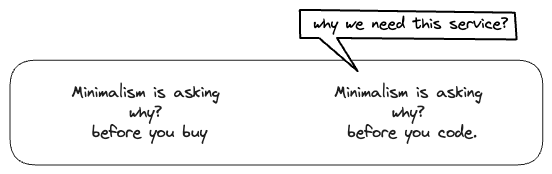
To reduce the impact of software decay, write less code. Every line is a liability: it must be understood, maintained, tested, secured, and eventually replaced. Minimizing code does not mean reducing functionality; it means achieving it in the most economical way—questioning whether custom code is needed when a service exists, choosing libraries that fully solve the problem, and accepting that code you do not write has zero bugs.
Embrace the As-a-Service Paradigm [Service Adoption]
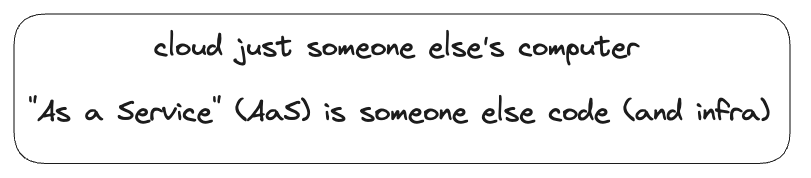
Use services provided by others—the same kind of managed offerings that, when proprietary, we said to contain behind your own interfaces. Requirements are often flexible, and the benefits frequently outweigh the cost of adapting to provider constraints. Updates and vulnerabilities become the provider's concern; scaling is handled by specialists; your team focuses on what differentiates your product. The tradeoff is dependency on the provider—often preferable to dependency on your own capacity to maintain the code.
Alternatives to Writing Code [Code Alternatives]
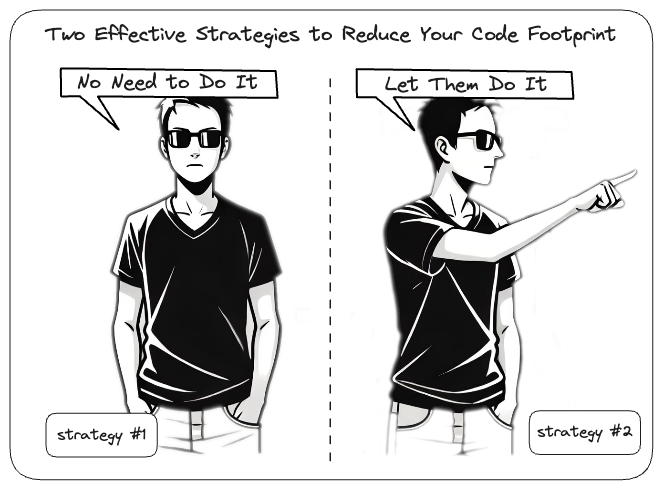
Before writing code, ask: is there another way? Buildpacks can replace hand-crafted Dockerfiles. Configuration can replace custom logic. Declarative specifications can replace imperative implementations. Each alternative is code you do not have to write, test, or maintain.
The Codeless Movement [Codeless]
Beyond writing less code, how you express intent affects evolvability. Declarative and platform-managed approaches often outlast hand-written implementation.
Declarative Advantage [Declarative Approach]
Declarative approaches specify what should exist rather than how to create it. Infrastructure as Code declares desired state; SQL declares desired data operations; CSS declares desired styling. The system determines how to achieve the outcome. Declarative specifications outlive imperative implementations: when you declare that a load balancer should exist with certain properties, the platform can implement that declaration differently as technology evolves. Declare intent; let platforms handle mechanism.
Managed Services and Runtime Composition [Managed Infrastructure]
The choice between managed services and self-managed infrastructure is where to invest your team's expertise. Managed services provide capability without operation; self-managed infrastructure (e.g., via Kubernetes operators) gives control at the cost of operational investment. Both reduce custom code: managed services replace code with configuration; operators replace code with declarations. Modern orchestration also enables runtime behavior through metadata—pod annotations for sidecars, service mesh, authentication, policies—without changing application code. Each capability moved to the platform is code removed from the application.
Institutional Memory [Institutional Memory]
One of the most underestimated drivers of software erosion is institutional amnesia. When the people who designed a system leave, they take the tacit context of architectural choices with them. Code that is poorly documented becomes "legacy" not because it stops working but because the current team no longer understands why it was structured that way—making any change dangerous and expensive.
Architecture Decision Records [ADR Practice]
Traditional documentation—specifications, wikis, manuals—inevitably drifts from the code. Architecture Decision Records (ADRs) address this by capturing significant architectural decisions in a formal, immutable form. An ADR records a single important design decision: what was decided, and why, in response to a significant requirement. The set of ADRs forms the project's architectural decision log (ADL). ADRs prevent future engineers from unnecessarily revisiting settled choices or repeating past mistakes. For example, a strict ADR practice at Shopify stopped a new team from adopting an inappropriate database technology by surfacing an earlier evaluation and rejection for reasons that were still valid.
A minimal ADR anatomy:
- Identification of the need — The specific business or technical problem requiring a long-term, high-impact decision.
- Context — Constraints (environmental, technological, or temporal) surrounding the problem.
- Decision — A clear, factual statement of the chosen solution and how it addresses the context.
- Consequences — Honest assessment of immediate benefits and of tradeoffs, drawbacks, and accepted long-term debt.
ADRs should be concise, stored in a single place accessible to all teams, and treated as part of process—e.g., short readout meetings so everyone digests new decisions. When a decision is superseded, the old ADR is not deleted but marked as superseded with a link to the new one, preserving the genealogy of technical thought.
Living Documentation [Embedded Documentation]
Living documentation is generated automatically, validated continuously, and evolves in lockstep with the code. Organizations like Uber and Spotify use metadata to generate service maps, API contracts, and routing dependencies dynamically. At the specification level, Behavior-Driven Development (BDD) implements living documentation: scenarios in a language like Gherkin ("Given / When / Then") are executable tests. If behavior changes without updating the specification, the test fails and deployment can be blocked. This "red/green" validated documentation keeps a shared domain language and certifies critical behavior while onboarding new developers faster.
Beyond ADRs and BDD, systems can document themselves through types, validation rules, tests, and configuration schemas. Self-documenting systems age better because their documentation cannot drift from reality.
Standing the Test of Time: Case Studies [Case Studies]
The principles above find concrete expression in systems that operate under extreme constraints. Examining them reveals how procedural rigor and intentional design defy technological entropy.
The Horizon Conflict: Software vs. Physical Infrastructure [Horizon Conflict]
Physical infrastructure—power grids, railways—is often built for sixty years or more. Software and operating systems, in contrast, are typically replaced or heavily upgraded every few years. This mismatch forces operators to run long-lived hardware with stacks that were not designed for such horizons, creating lasting compatibility and security challenges.
SQLite and the 2050 Commitment [SQLite]
SQLite is among the best examples of design for longevity. As a serverless, in-process, cross-platform library, it has become the most widely deployed database engine—in every smartphone, major browsers, and countless embedded devices. Its file format is independent of hardware architecture (32/64-bit, endianness) and is recommended by the Library of Congress for long-term storage. The SQLite team has committed publicly to backward compatibility and continued support until 2050. They avoid programming fads and aim for "timeless" C that can be understood and maintained by future generations. The real longevity insurance is their testing regime: the core library is relatively small, but the majority of effort goes into verification. Multiple test harnesses (TCL tests, the C-based TH3, SQL Logic Test for cross-database validation, fuzzing) provide exceptional coverage—including 100% branch and MC/DC (Modified Condition/Decision Coverage) for the main library. A "veryquick" subset of over 132,000 scenarios runs in minutes before each check-in to catch regressions. Exhaustive tests simulate OS crashes to ensure the rollback journal guarantees atomicity and durability in all circumstances. This discipline allows SQLite to improve performance and features over decades without compromising reliability.
The Linux Kernel: Super-Linear Growth and Governance [Linux]
The Linux kernel shows that a very large system can keep evolving when supported by open governance. Classical software evolution theory suggested that growth would slow under the weight of interdependence. Linux, with tens of millions of lines of code, has continued to grow in a super-linear fashion. The Linux Foundation's transparency, provenance tracking, security audits, and modular discipline have allowed the ecosystem to keep expanding. At the same time, Linux highlights the tension between software and hardware lifecycles: LTS branches offer a few years of stability, while some operators need hardware that lasts decades, creating ongoing compatibility challenges.
NASA's Aerospace Legacy [NASA]
NASA exemplifies longevity under harsh conditions. From the Apollo Guidance Computer onward, the agency institutionalized fault-tolerant system engineering. Today, organizations like the Jet Propulsion Laboratory maintain highly critical flight software (FSW) that must be reconfigured or patched from Earth as hardware degrades over decades in space. NASA combines tiered maintenance (classifying components by mission-criticality) with capacitive rather than purely reactive strategies: centers of excellence with expert teams whose job is to prevent defects through constant testing and refactoring. Live traceability of requirements ensures that changes to individual components are understood in terms of system-wide impact, reducing the risk and cost of failures in flight.