Design for the Cloud: Modern Infrastructure [Cloud Infrastructure]
Chapter Info
Calculating... Writing Progress: 80%
!!Cloud computing has transformed how we build, deploy, and operate infrastructure. What once required months of planning, capital investment, and physical hardware procurement now happens in minutes through APIs and automation.!! This shift from physical servers to virtual, software-defined infrastructure has reshaped not just the technology itself, but how organizations approach scalability, reliability, and innovation. !!This chapter explores the principles of modern cloud infrastructure—from service models and cloud-native patterns to Infrastructure as Code as the foundation of it all.!!
The Cloud (R)evolution [Cloud Revolution] {1}
What is Cloud Computing [What is Cloud] {1}
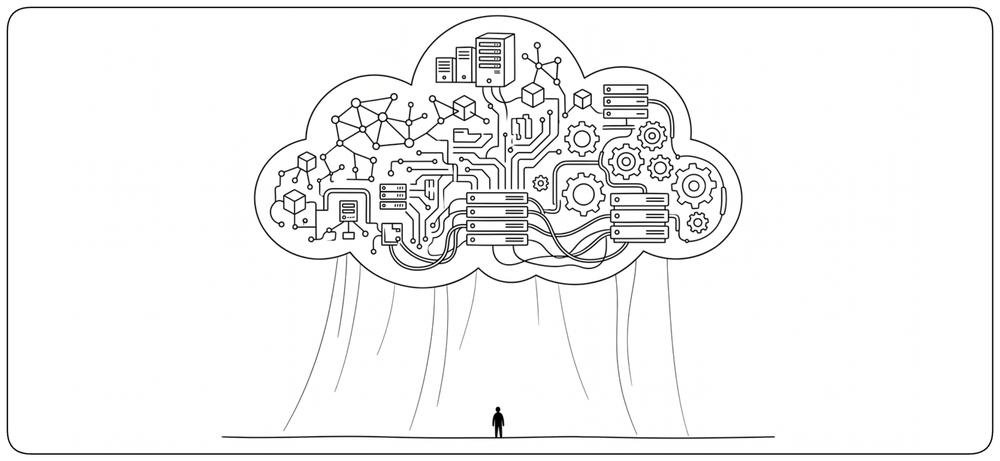
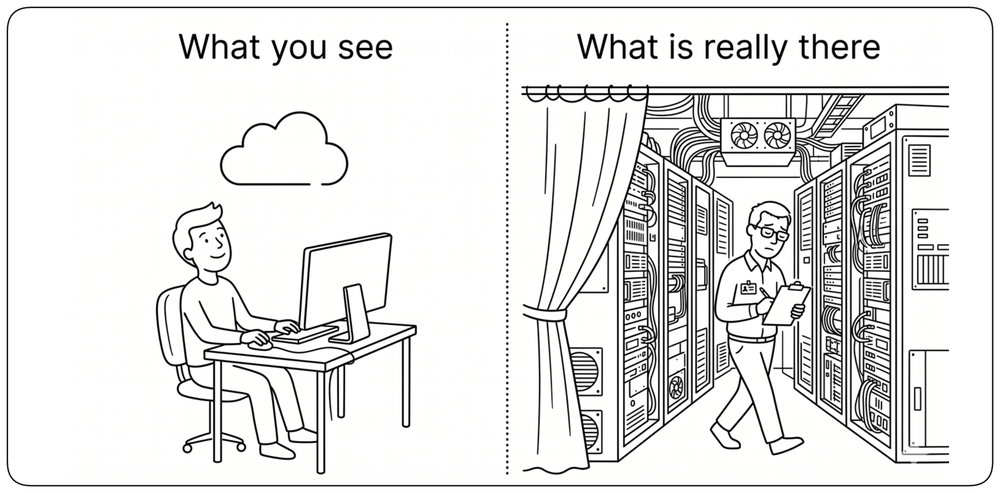
!!The cloud is, in the end, surprisingly simple: it is someone else's data center, exposed through an API.!! On-demand servers, storage, databases, and networking delivered over the internet, operated by third-party providers running facilities at planetary scale. Rather than owning hardware, organizations rent these resources on a pay-per-use basis, accessing them through APIs, web consoles, or command-line interfaces. The magic is not in the cloud itself—it is in the illusion that there is no data center at all.
From Internal Necessity to Business Opportunity [Pre-Cloud Era] {1}
Until the mid-2000s, infrastructure was a necessity, not a product. Organizations ran their own physical servers in on-premises data centers—costly, rigid, slow to scale—and no one imagined it could be sold to anyone else. !!The turning point came when Amazon noticed that the same infrastructure built for its own operations could become a business: by renting out its excess capacity, it turned a cost center into a profit engine.!! That single decision quietly reshaped how technology would be built, delivered, and imagined for the next two decades.
Cloud vs On-Premise: A Mindset Shift [Mindset Shift] {1}
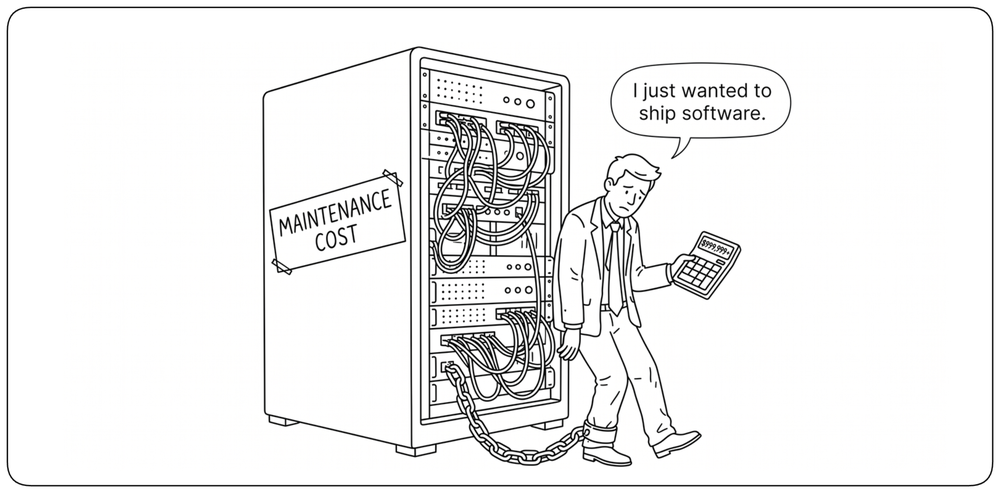
!!The deepest change brought by the cloud is not technical—it's a mindset shift: from owning and nursing servers to treating infrastructure as ephemeral, disposable resources.!! Cloud thinking favors elasticity over worst-case capacity planning, automation over manual work, and Infrastructure as Code over click-ops. Culturally, it means embracing experimentation and prioritizing speed—so we don't just re-implement on-prem patterns in the cloud.
Cloud Economics Through Scale and Multi-Tenancy [Cloud Economics] {1}
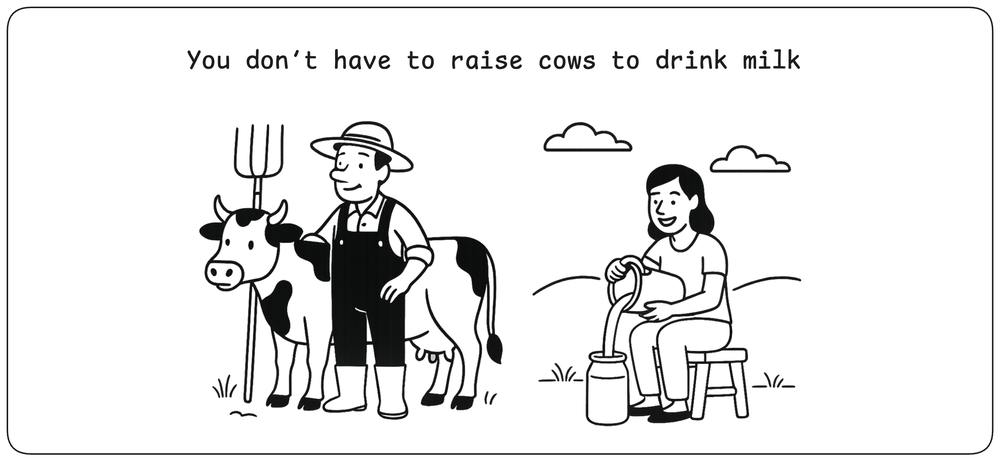
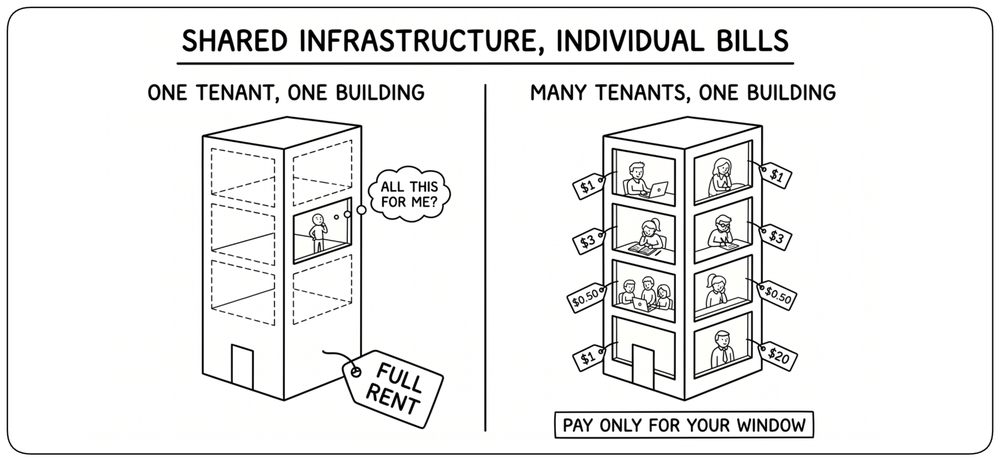
!!Providers operate at industrial scale, achieving economics no single organization could match—much of it coming from multi-tenancy, where physical infrastructure is shared across many customers to pool resources, maximize utilization, and amortize fixed costs.!! The result is instant provisioning, true elasticity that follows demand, and democratization: a startup can access the same infrastructure that powers Netflix, paying only for what it uses.
Freeing Creativity from Physical Limits [Freeing Creativity] {1}
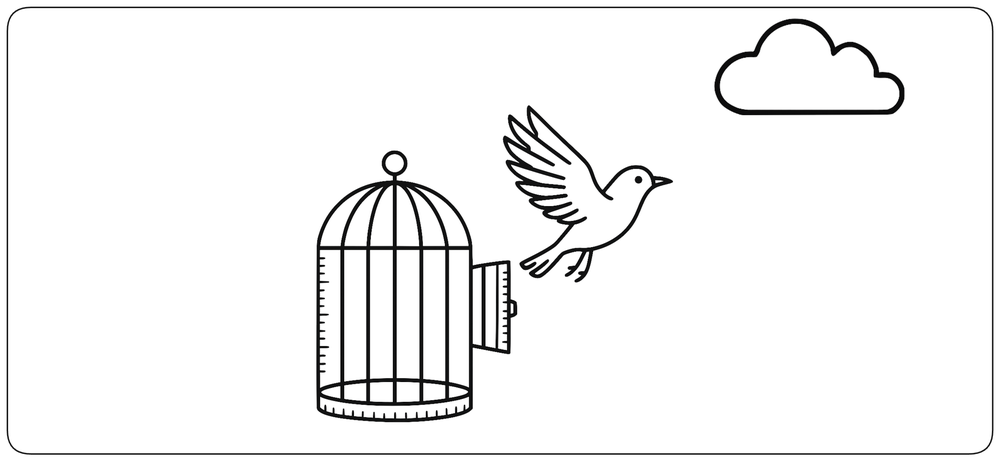
The cloud was not just a technological evolution; it was a cultural turning point. Infrastructure stopped being a constraint and became an enabler. !!Instead of waiting weeks for a server, developers could spin one up in seconds.!! What once required physical presence and manual configuration became programmable and elastic. The revolution was not about virtualization—it was about freeing creativity from physical limits.
Democratization of Software Development [Cloud Evolution] {1}
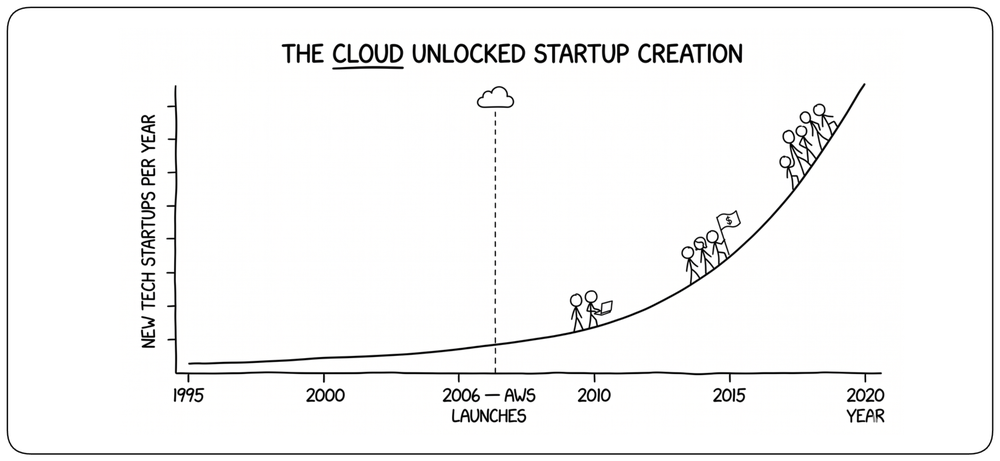
Once infrastructure was freed from physical limits, it was also freed from gatekeepers. !!The same shift that unlocked creativity dissolved the traditional barriers to innovation: enterprise-grade infrastructure became accessible to anyone with a credit card.!! Three developers can now launch a product that serves a thousand paying customers from day one—on the same infrastructure that powers global giants. Organizations compete on ideas and execution, not on capital and hardware procurement—and teams can finally focus on business value rather than infrastructure.
The Startup Era: Small Outruns Big [Startup Era] {1}
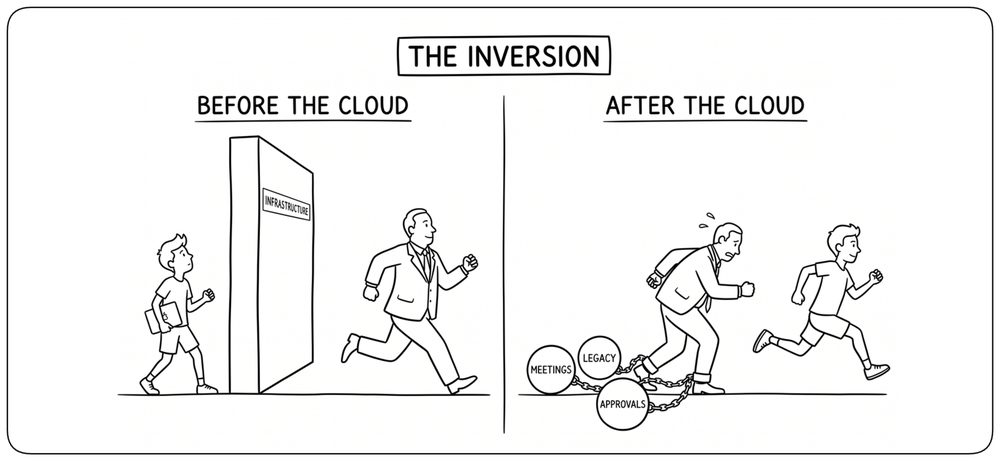
The startup explosion that followed was not just a matter of access — it was powered by a structural and operational advantage the small now held over the big. Once the infrastructure barrier dropped, what remained was what each side carried into the race: the incumbent carried legacy systems, committee approvals, and sunk hardware to protect; the startup carried none of it. !!When a new idea appears, the startup ships it on Monday while the incumbent is still scheduling the meeting to discuss it.!! Agility, once a consolation prize for being small, became the decisive advantage of the new era.
Cloud-Native Mindset [Cloud-Native Mindset] {1}
Cloud-native is less a stack than a set of reversed defaults. Each principle below flips a posture that used to be unquestioned in the pre-cloud era — patching becomes replacing, individual servers become herds, manual operations become forbidden, the pipeline becomes production. !!The cloud rewards systems built on inversions; it punishes systems that brought the old habits along.!! What follows are nine of those inversions — design, build, run, survive.
Everything as Code [Everything as Code] {1}
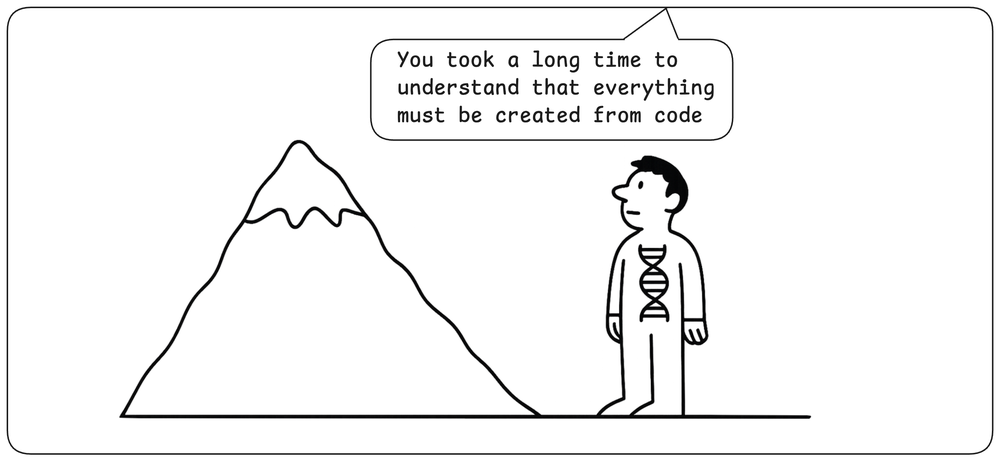
Anything not expressed in code drifts: configurations diverge across environments, knowledge stays trapped in individual heads, changes leave no audit trail. Cloud-native treats every artefact — infrastructure, configuration, policy, documentation — as source code, versioned in Git, reviewed in pull requests, deployed by pipelines. !!If it isn't in code, it doesn't exist.!! Application teams understood this decades ago for product code; the same rigor now applies to everything that makes the product run.
Design Service-Centric Infrastructure [Service-Centric] {1}
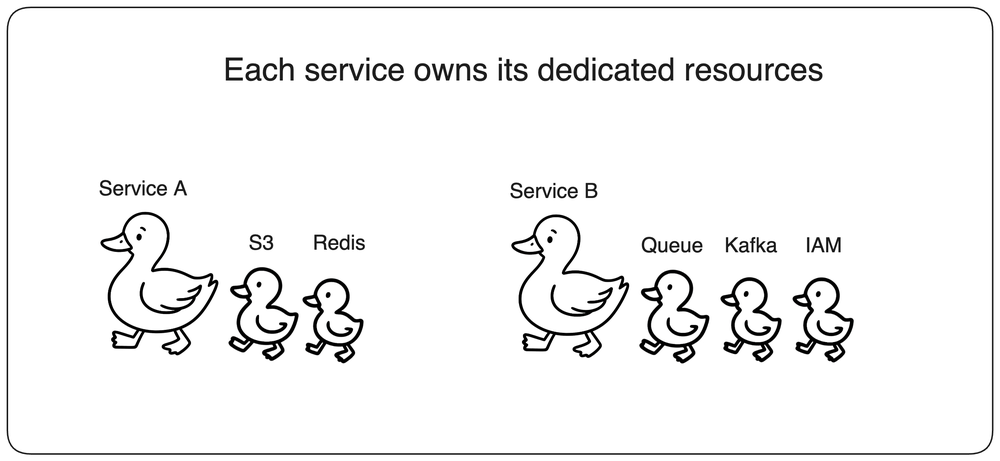
Pre-cloud infrastructure was horizontal: a database team owned all the databases, a network team owned all the networks, a storage team owned all the storage. Cloud-native flips this to vertical: each service owns its own stack end-to-end — its database, its queues, its storage, its IAM policies, its monitoring. !!Each service owns its infrastructure; nothing is shared, nothing is requested from another team.!! This ownership model is the foundation that makes Cattle Not Pets, automation, and clear accountability possible — without it, every other cloud-native principle stalls on coordination.
Immutable Infrastructure [Immutable Infra] {1}
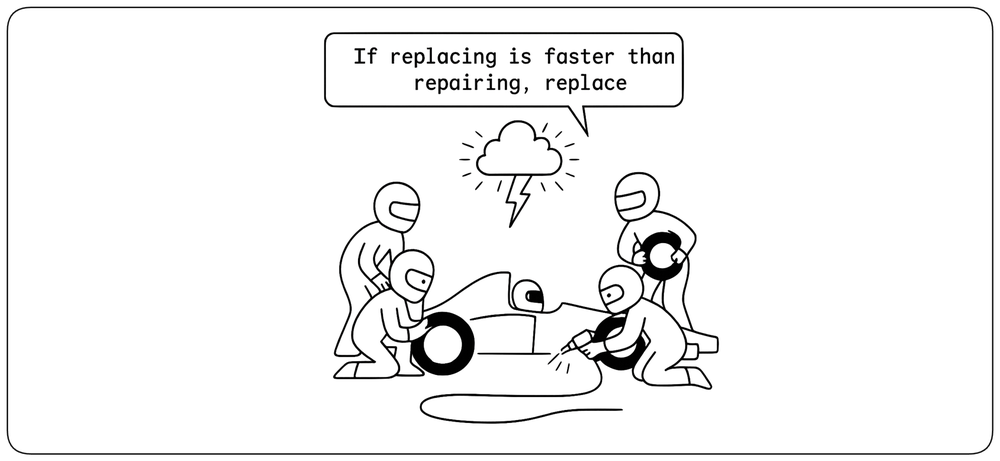
Mutable infrastructure means patching servers in place — applying updates, tweaking configurations, fixing drift. Each patch is a small risk; over time, no two servers are quite the same. Immutable infrastructure replaces this with a simple rule: !!if replacing is faster than repairing, replace.!! Every change rebuilds from a versioned image, validated end-to-end, and swaps the old instance out completely. Drift disappears because nothing is ever modified after deployment. Rollback is trivial — redeploy the previous version. True immutability is mostly achievable at the application layer; persistent resources like databases must still be repaired, which is why idempotence matters too.
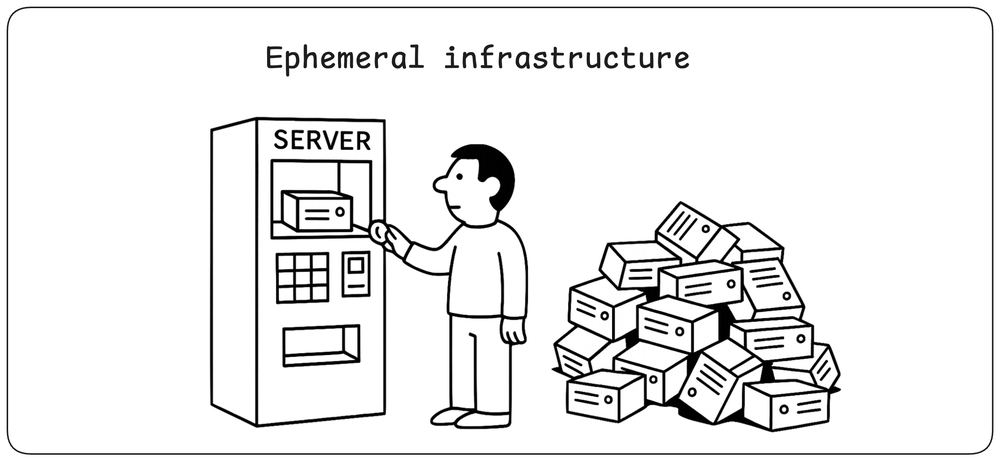
Ephemeral by Design [Ephemeral Infra] {1}
If infrastructure is never modified but replaced wholesale, individual instances become short-lived by definition — created on demand, destroyed when no longer needed. Long-running servers accumulate drift, leaked memory, and silent vulnerabilities; ephemeral ones never get the chance. !!Treat every instance as disposable, every environment as temporary.!! Kubernetes containers spin up and down by the second; CI pipelines provision fresh test environments for every pull request and tear them down on merge. Ephemerality is the operational consequence of taking immutability seriously.
Cattle Not Pets [Cattle not Pets] {1}
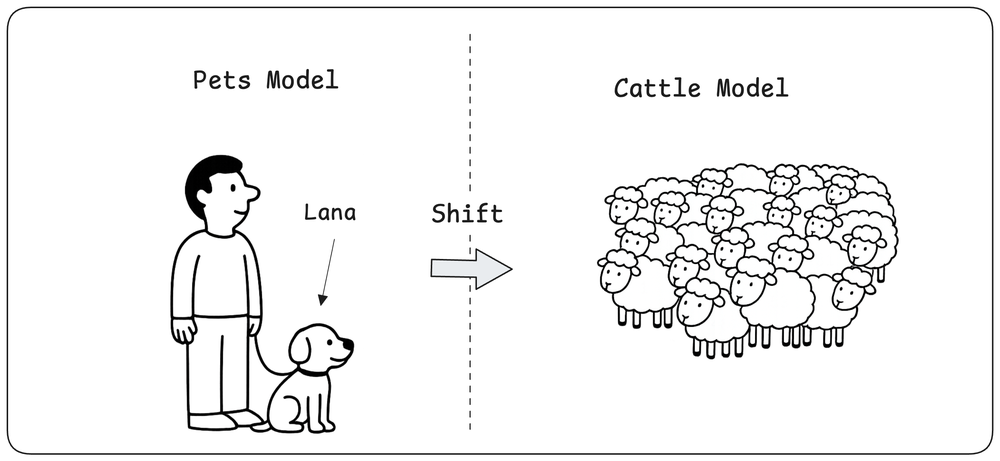
Pre-cloud, every server had a name, a personality, and someone who cared about it — when it got sick, you nursed it back to health. Cloud-native treats servers as cattle: numbered, interchangeable, replaced without ceremony when they fail. !!Servers should die without anyone noticing.!! This isn't cruelty toward machines; it's the only model that scales. A pet server is a single point of failure with a story. A cattle server is one of many, automatically replaced by another identical one when it goes.
Automate Everything [Automate Everything] {1}
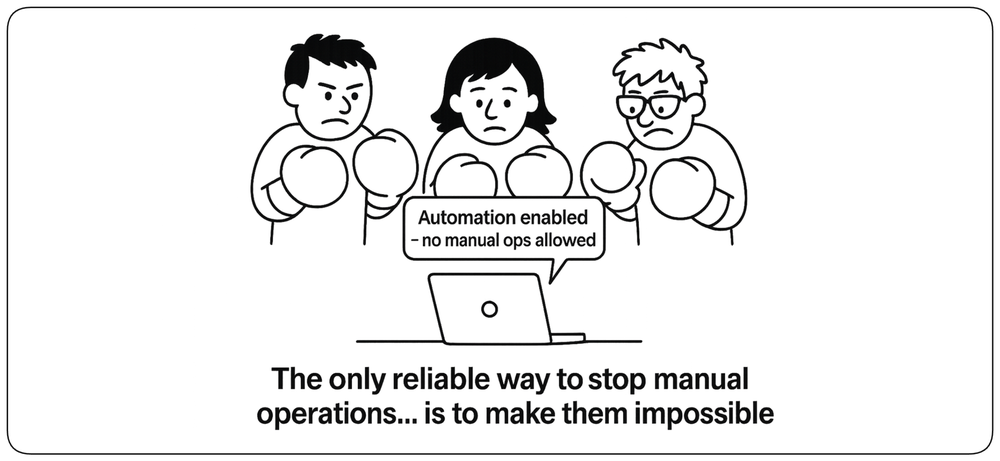
A manual operation is a future incident. It will be performed differently the second time, forgotten the third time, and executed at 3am by the wrong person on the fourth. Cloud-native makes manual operations not just discouraged but impossible: no SSH access to production, no console buttons that bypass the pipeline, no scripts run from a laptop. !!The only reliable way to stop manual operations is to make them impossible.!! Every change — provisioning, key rotation, certificate renewal, deployment, rollback — flows through versioned automation.
Observability Over Monitoring [Observability]
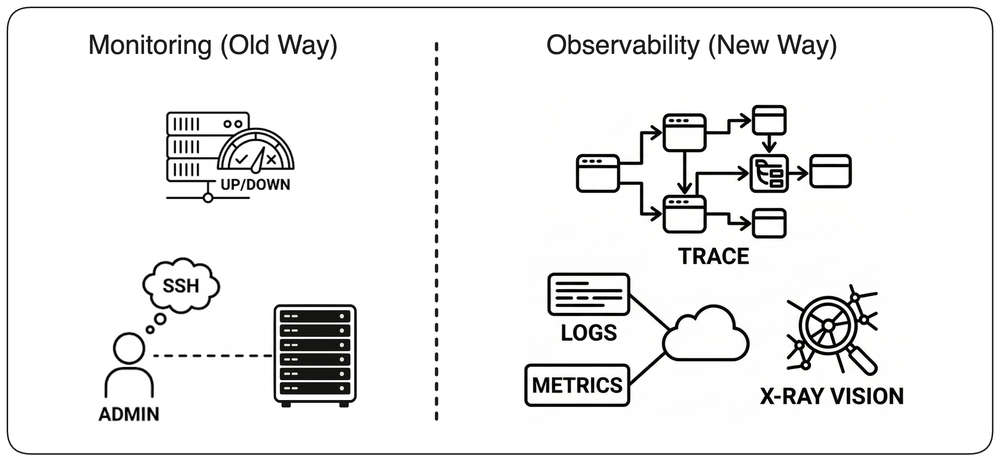
When infrastructure is ephemeral, the server you wanted to SSH into has already been replaced. The old debugging model — log into the box, tail the file, restart the daemon — is gone. Monitoring asks "is it UP or DOWN?"; observability asks "why is it behaving this way?" !!In ephemeral systems, you cannot debug what no longer exists — only what was instrumented before it disappeared.!! Structured logs, distributed traces, and metrics that survive beyond individual instances become the only way to understand a system whose components are in constant flux.
Deep Dive: Observability Principles
For comprehensive coverage of observability concepts, distributed tracing, logging patterns, alerting strategies, and incident response—see the Design for Visibility chapter.
Service Models & Abstraction Levels [Service Models] {1}
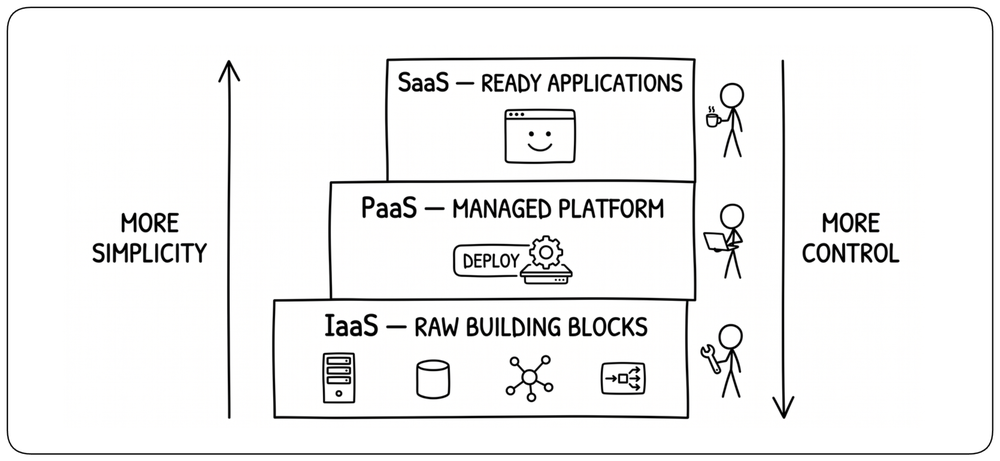
!!Cloud services are organized into layers of abstraction that determine what is provided, how much control you retain, and what operational responsibilities you assume.!! We climb the stack bottom-up: IaaS supplies raw infrastructure building blocks, PaaS offers a managed application platform, and SaaS delivers complete applications ready to use. !!Each layer trades control for simplicity—the higher you go, the more the provider operates, and the less you build from scratch.!!
Each layer also serves a different audience: IaaS is designed for platform engineers, ops, and DevOps teams who architect the underlying infrastructure; PaaS serves developers and application teams who focus on code rather than servers; SaaS targets end users who consume ready-made applications with no operational responsibility at all.
Infrastructure as a Service (IaaS) [IaaS] {1}
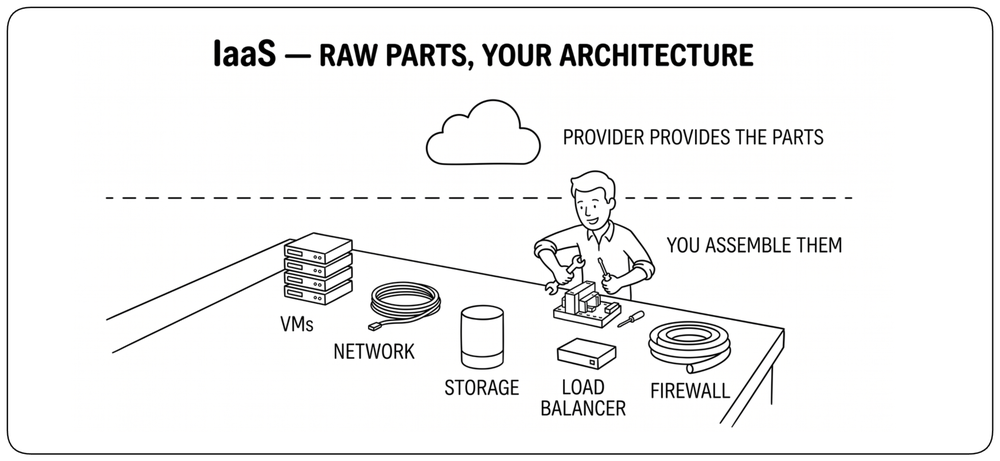
At the bottom of the stack, Infrastructure as a Service (IaaS) provides the fundamental building blocks of cloud computing: virtual machines, storage, networking, load balancers, and other low-level resources. !!These components replace physical hardware and let platform engineers create infrastructure programmatically through APIs.!! The cloud provider runs the physical data centers, servers, and networking hardware, while the customer controls the operating systems, configurations, deployments, and runtime. IaaS offers flexibility and full control, making it the foundation of most modern cloud architectures.
Platform as a Service (PaaS) [PaaS] {1}
One step up the abstraction ladder, Platform as a Service (PaaS) provides a fully managed application platform where developers deploy code without managing the underlying infrastructure. !!The provider handles servers, operating systems, patches, scaling, networking, and runtime environments—developers focus solely on application logic.!! PaaS eliminates operational overhead with built-in deployment pipelines, autoscaling, logging, monitoring, and security hardening by default. This abstraction accelerates delivery while enforcing consistency across environments.
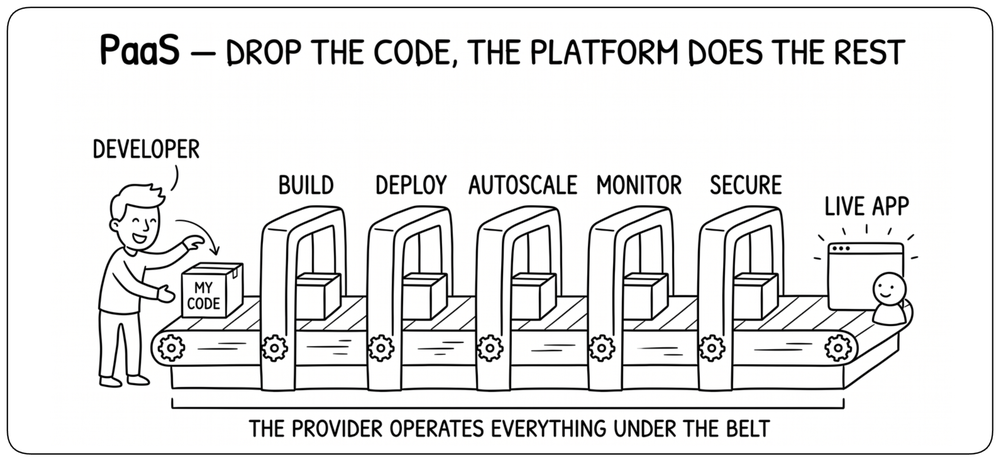
!!PaaS is ideal when teams value speed, standardization, and reduced operational complexity.!! It shifts responsibility away from infrastructure management and toward delivering business value.
Limitations of Platform as a Service (PaaS) [PaaS Limits] {1}
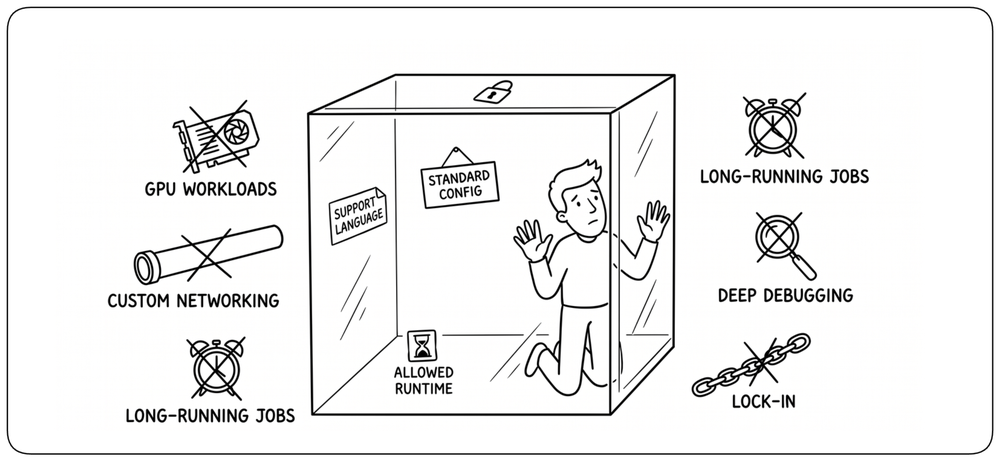
!!While PaaS accelerates development and removes operational burden, it introduces several important trade-offs.!! Customization is restricted—the provider controls the runtime, deployment model, and networking configuration, which may not fit specialized workloads. Platform lock-in is significant: applications coupled to the platform's build system or service integrations are harder to migrate later. Debugging and deep performance tuning are limited because teams cannot access the underlying infrastructure. PaaS also imposes constraints on background processing, long-running tasks, and custom networking. Finally, cost can scale poorly for high-volume workloads compared to IaaS or container-based approaches.
When PaaS Doesn't Fit: Building Your Own Internal Platform [Custom Platform] {1}
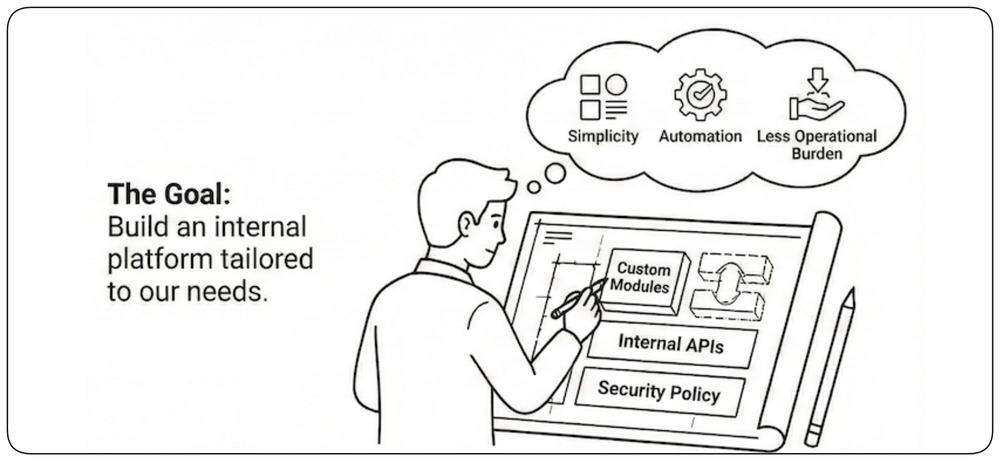
Off-the-shelf PaaS often falls short for teams needing deeper customization, tighter integration, or stricter security. !!To keep the benefits of PaaS—simplicity, automation, less operational burden—many companies build an internal platform: a custom PaaS tailored to their needs.!! The goal is to give developers an easy, consistent way to deploy and operate services, automating provisioning and security, without recreating a public PaaS. This idea is covered further in the chapter Design for Developer.
Software as a Service (SaaS) [SaaS] {1}
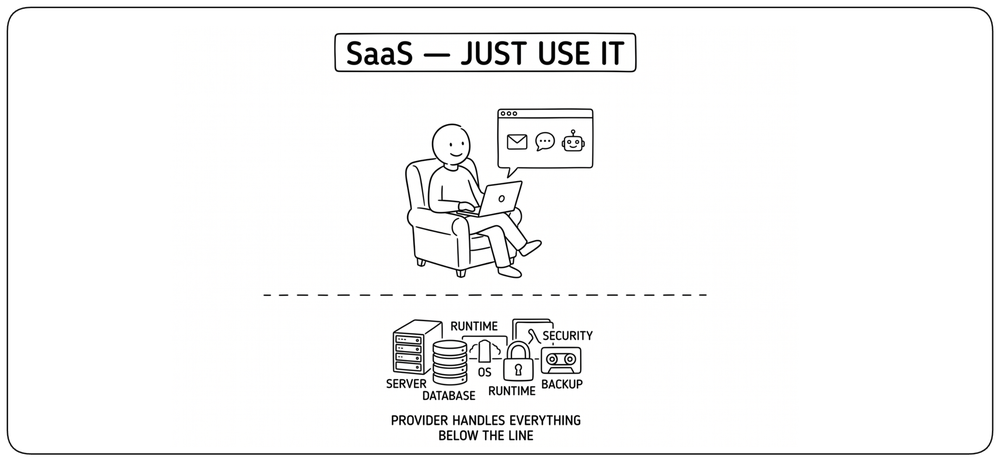
At the top of the stack, Software as a Service (SaaS) delivers complete applications directly to end users without any infrastructure or platform management. !!The provider operates everything—the application, runtime, data storage, scaling, updates, and security—and customers consume the service through an API or web interface with no operational responsibilities.!! Common examples include Gmail, ChatGPT, and Salesforce: services fully consumed without managing any underlying infrastructure.
Managed vs. Unmanaged Services [Managed vs Unmanaged] {1}
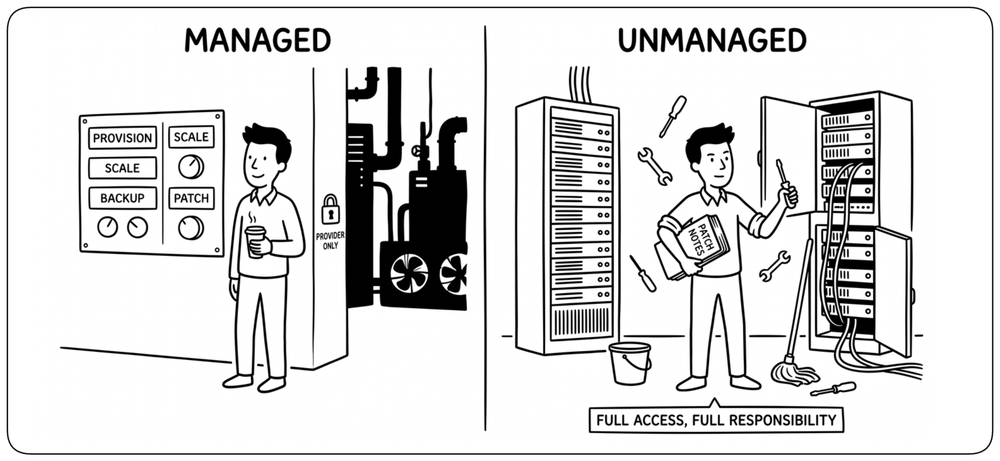
Beyond the IaaS/PaaS/SaaS layering, cloud services also differ by operational model: managed versus unmanaged. !!Managed services handle all operations—provisioning, patching, scaling, monitoring, backups—while you configure them through APIs without touching the underlying systems (RDS, Cloud SQL, managed Kubernetes).!! Unmanaged services give full control but require you to operate everything yourself—VMs, software installation, patches, scaling, troubleshooting. This distinction is orthogonal to service models: most architectures blend both—managed where operational complexity doesn't add value, unmanaged where control matters.
Compute Models: How Your Code Runs [Compute Models] {1}
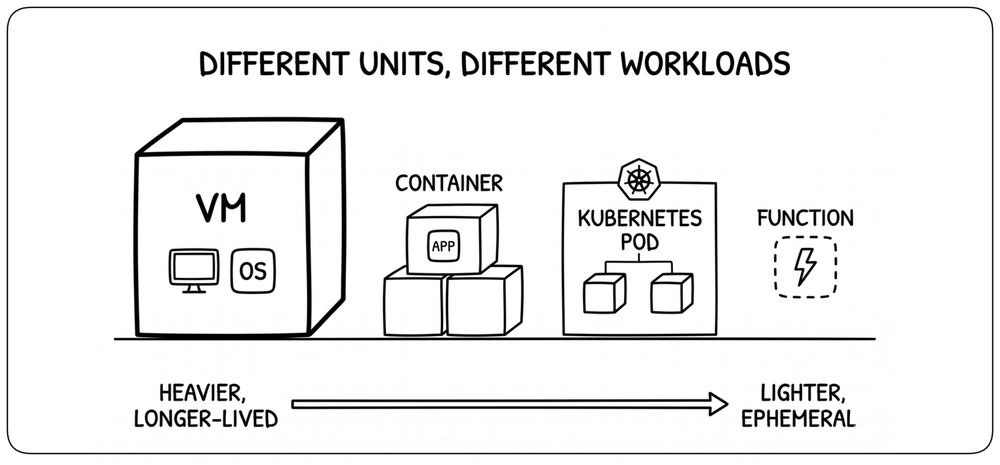
Service models decide who operates what; compute models decide what actually runs your code. The same application can run on a virtual machine, inside a container, orchestrated by Kubernetes, or as a stateless function — and each unit comes with its own trade-offs in startup time, density, isolation, and operational cost. !!Choosing a compute model is not a religion — it is matching the shape of the workload to the shape of the runtime.!!
Virtual Machines: The Default Unit [Virtual Machines] {1}
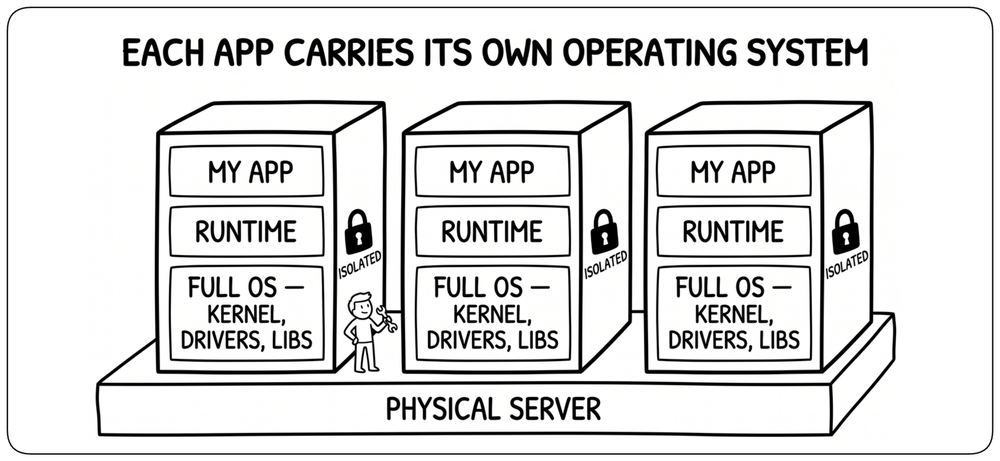
The virtual machine is the original cloud compute model: a full operating system running on shared hardware, isolated from its neighbors. !!VMs offer maximum compatibility — anything that runs on a physical server runs on a VM — and full control over the OS, kernel, drivers, and runtime.!! The trade-off is weight: each VM carries its own operating system, takes minutes to boot, and consumes resources whether it is doing work or not. VMs fit workloads that need OS-level control, legacy applications, specialized drivers, or sustained long-running compute.
Containers: Lighter, Denser, Faster [Containers] {1}
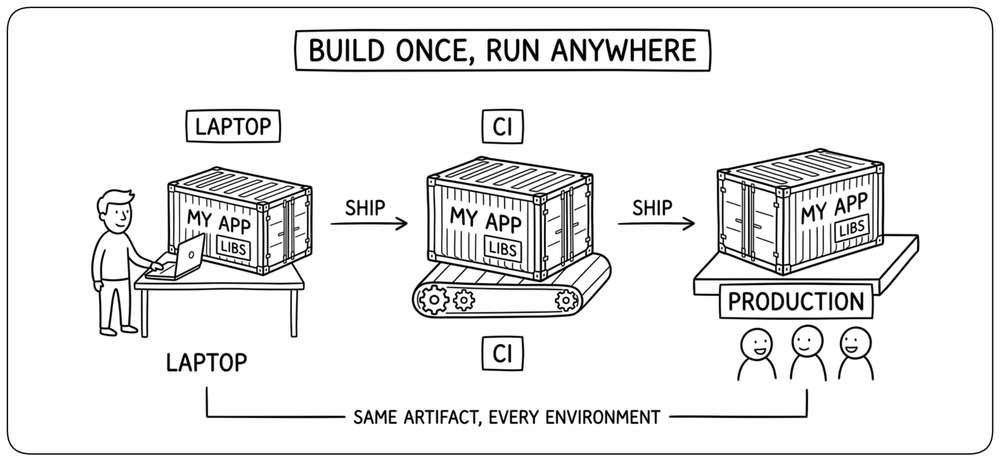
Containers package an application with only the libraries it needs — not a full operating system — and share the host kernel. The result is dramatic: containers start in seconds instead of minutes, pack tens onto a machine that fit only a handful of VMs, and produce identical artifacts that run the same on a laptop, in CI, and in production. !!Containers turned deployment into a build artifact instead of an environment to configure.!! They have become the default unit of compute for new applications — small enough to scale per request, portable enough to move between any host or cloud.
Kubernetes: Orchestrating Containers at Scale [Kubernetes] {1}
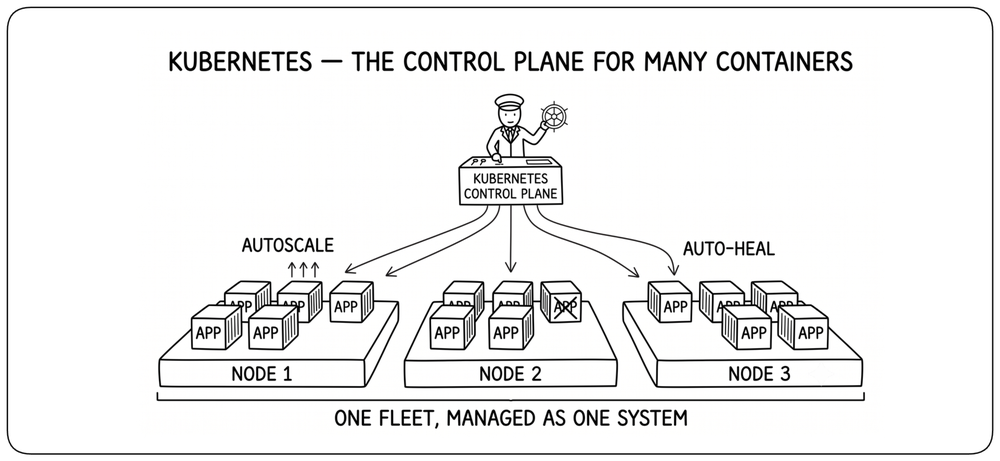
A single container is easy; a thousand containers across dozens of machines is a different problem. Kubernetes is the standard answer: a control plane that decides where each container runs, restarts it when it dies, scales it up under load, balances traffic across replicas, and rolls out new versions without downtime. It has emerged as the de facto standard for cloud-native deployment — portable across every major cloud, and extensible enough to manage almost any platform component through the same declarative patterns. The cost is real: Kubernetes is famously complex, with its own concepts (pods, services, ingresses) and operational burden. !!Kubernetes does not replace containers; it makes a fleet of them behave like one system.!!
Functions: No Server, Just Code [Functions] {1}
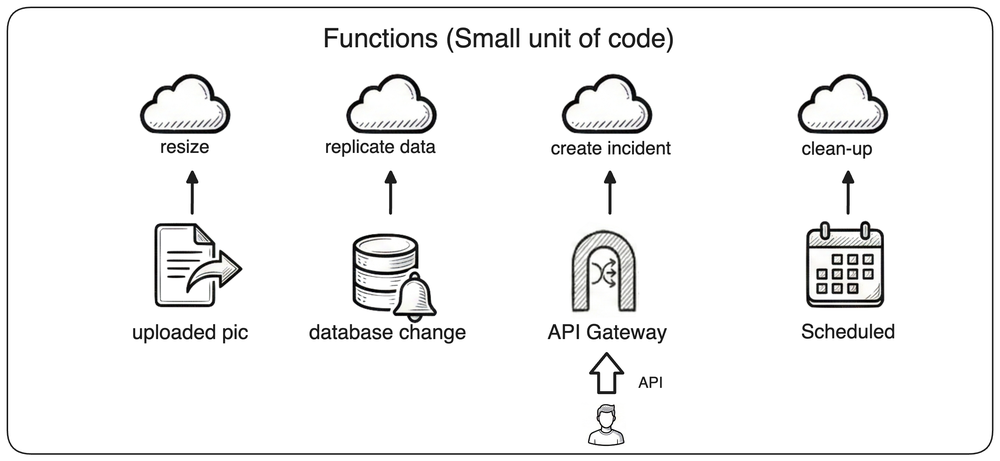
At the lightest end of the spectrum, functions remove the server itself from view. Instead of deploying an application, the developer uploads a single piece of code triggered by an event: an HTTP call, a file upload, a scheduled cron, a database change. The provider runs the function only when needed, scales it from zero to thousands of concurrent invocations instantly, and bills only for the milliseconds of execution. !!Functions are the purest expression of pay-per-use: no servers to provision, no idle capacity to pay for, no runtime to keep alive.!! They fit perfectly for event-driven jobs — image resizing, webhooks, scheduled tasks — but are poorly suited to long-running or stateful workloads.
Database Models: What the Cloud Changed [Database Models] {1}
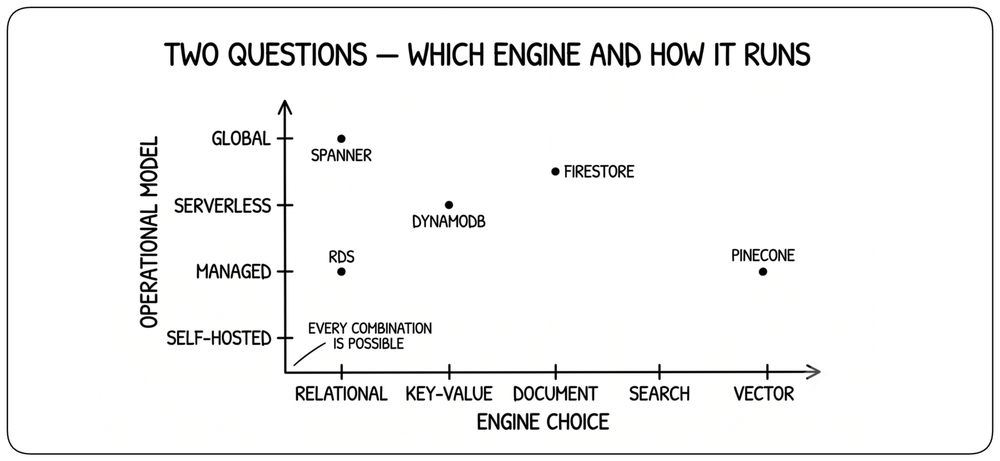
!!The cloud did not invent databases — it inverted how they are chosen and operated.!! Before, the question was mainly which engine fits the data; now it is also which operational model fits the workload. The same data can live on a self-operated Postgres VM, a managed RDS instance, a serverless table that scales to zero between requests, or a globally replicated store spanning continents. !!The interesting choice today is not just the engine — it is how the database scales, costs, and survives.!!
The Engine Zoo: One Shape per Data Pattern [Engine Zoo] {1}
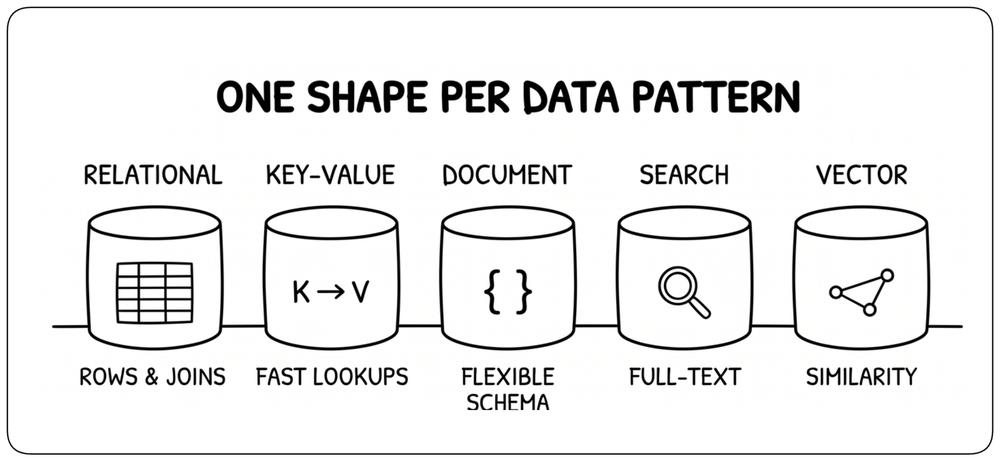
The cloud did not pick a winner — it made every database shape easily available. Relational engines (Postgres, MySQL) still anchor transactional data with schemas and joins. Key-value stores (DynamoDB, Redis) deliver single-digit-millisecond lookups at any scale. Document databases (MongoDB, Firestore) fit semi-structured payloads where the schema evolves with the product. Search engines (Elasticsearch, OpenSearch) handle full-text and ranked queries. Vector databases (Pinecone, pgvector, Weaviate) emerged with LLMs to store embeddings and run similarity search. !!The job is no longer to force every data pattern into one engine — it is to pick the right shape for each piece of data.!!
Serverless Databases: Scale-to-Zero, Pay-per-Request [Serverless Databases] {1}
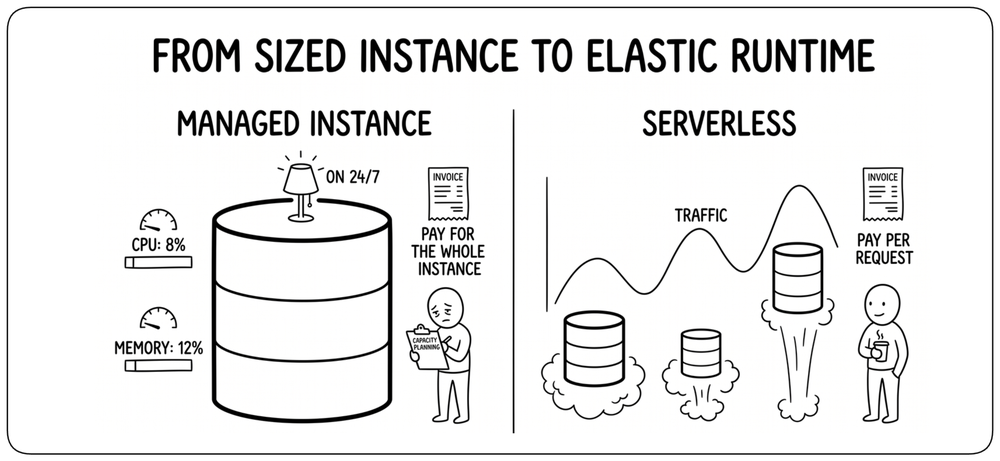
Managed databases removed the burden of patching and backups but kept one assumption from the on-prem world: a database is an instance, sized in advance, paid for whether it is used or not. Serverless databases broke that assumption. Aurora Serverless, DynamoDB on-demand, Firestore, Neon, PlanetScale and others scale capacity up and down automatically, often down to zero between requests, and bill per actual operation. There is no instance to size, no idle capacity to pay for, no capacity planning meeting. !!A serverless database is to a managed database what a function is to a VM — the runtime appears only when there is work to do.!! The trade-off is cold-start latency and per-request pricing that can hurt at very high sustained load.
Decoupling Storage from Compute [Storage/Compute Split] {1}
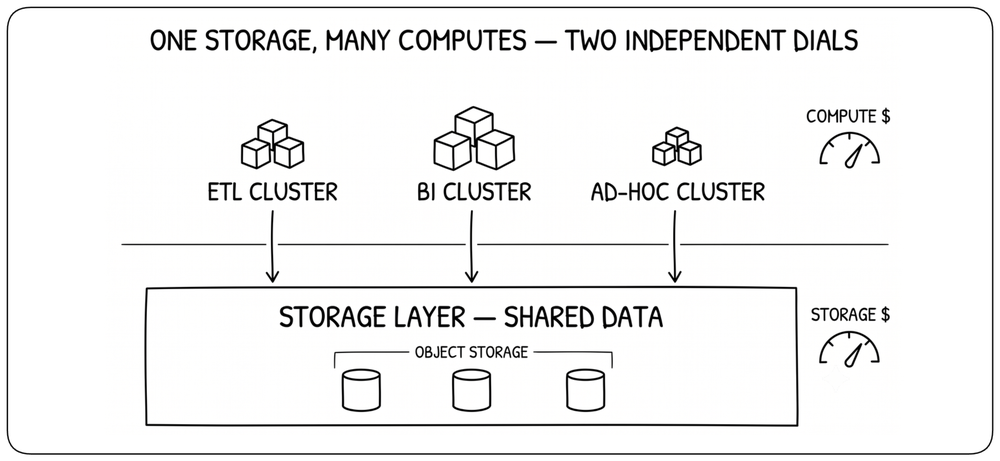
Traditional databases tied storage and compute to the same machine — the disk and the CPU lived and died together. Cloud-native engines like Snowflake, BigQuery, Aurora, Redshift and Neon broke that bond: data sits in a distributed storage layer, often built on object storage, while compute is an elastic cluster that can grow, shrink, or disappear without touching the data. The same storage can be queried by several independent compute clusters at once — one for ETL, one for BI, one for ad-hoc analysis — each sized for its workload. !!Storage and compute became two independent dials, billed separately, scaled separately, operated separately.!! Cloning a multi-terabyte database becomes instantaneous, because only the storage pointers are copied, not the data.
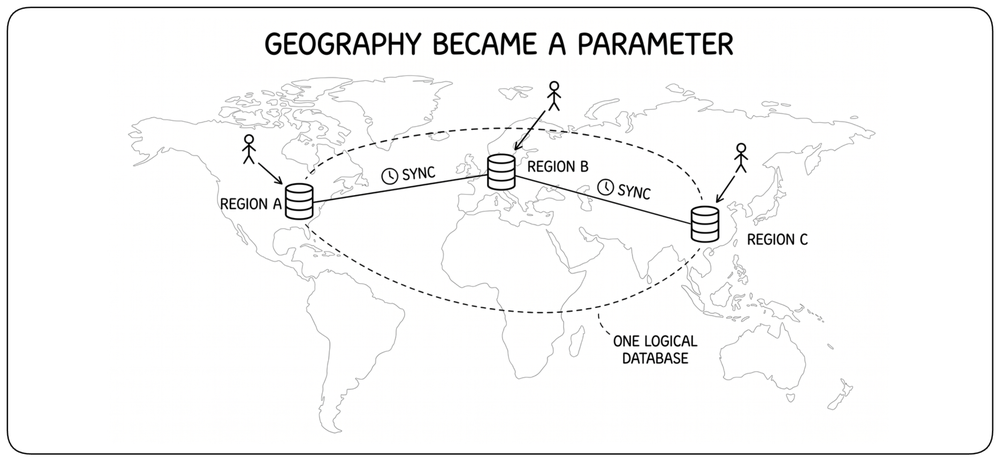
Global Databases: One Logical Store, Many Regions [Global Databases] {1}
Replicating a database across continents used to be a project measured in quarters. !!Google Spanner, DynamoDB Global Tables, Cosmos DB and CockroachDB turned it into a configuration: a single logical database physically replicated across regions, with consistency levels (strong, bounded, eventual) chosen per workload.!! Reads happen near the user, writes converge globally, and regional failover happens without code changes — making global databases the foundation of modern disaster recovery, explored in the Resiliency chapter. !!Geography became a parameter, not an architecture.!! The trade-off is real — cross-region writes cost latency, and strong global consistency is the most expensive guarantee a database can offer.
Multitenancy Models [Tenancy Models] {1}
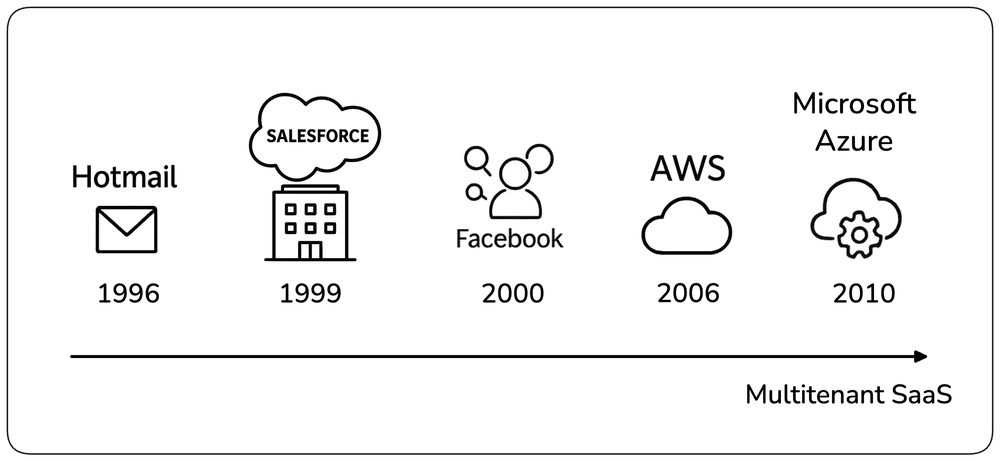
!!Multitenancy is the mindset shift that made the cloud revolution possible.!! At its core, it's simple: a single instance of software or infrastructure serves multiple customers (tenants), each with their own isolated data and configurations. But this simple concept transformed everything. Without multitenancy, cloud providers would need dedicated infrastructure for each customer—making cloud computing just expensive hosting. With multitenancy, AWS serves millions of customers on the same data centers, achieving impossible economies of scale. !!Your startup's application runs alongside Netflix's infrastructure, both sharing the same underlying resources while maintaining security boundaries.!! This massive resource sharing drives costs down by orders of magnitude. The cloud's pay-per-use economics, its accessibility to any organization, its efficient resource utilization—all stem from multitenancy. It's the economic engine that powers modern cloud computing.
Understanding Tenant Isolation Models [Isolation Models] {1}
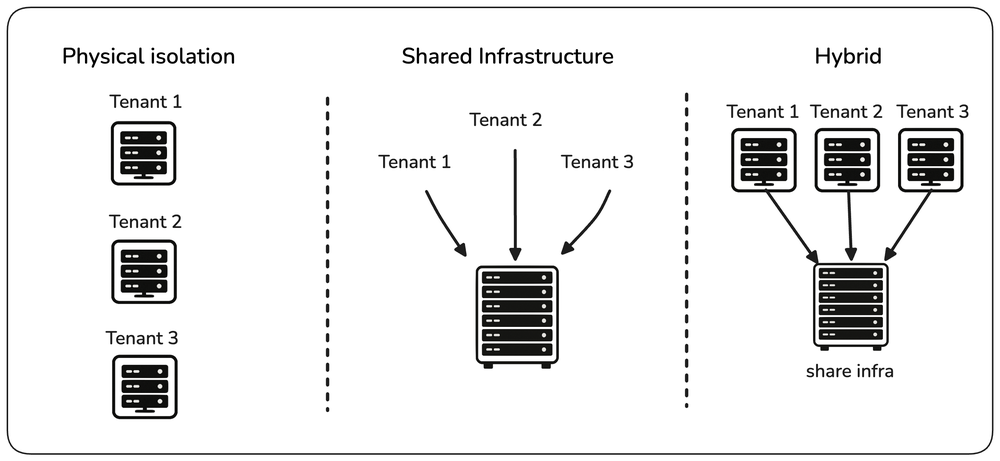
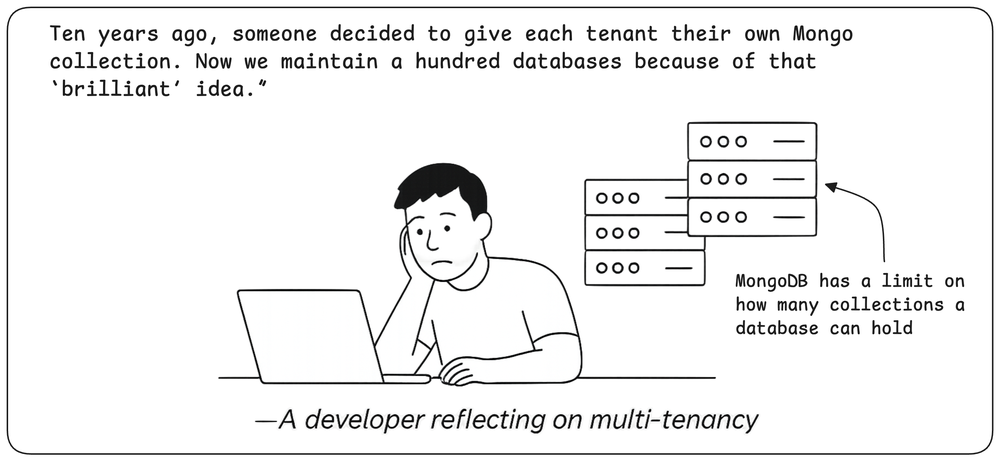
!!Three fundamental strategies exist for isolating tenants in multi-tenant systems.!! Physical isolation provides each tenant dedicated infrastructure—highest security and compliance but maximum cost and operational complexity. Shared infrastructure serves all tenants from common resources with logical separation—maximum efficiency and lowest cost but requires careful isolation design. Hybrid combines both approaches—shared infrastructure for standard tenants, dedicated resources for enterprise customers with specific requirements. The choice depends on security needs, compliance mandates, cost constraints, and operational capacity.
Database Multi-Tenancy Strategies [DB Multi-Tenancy] {1}
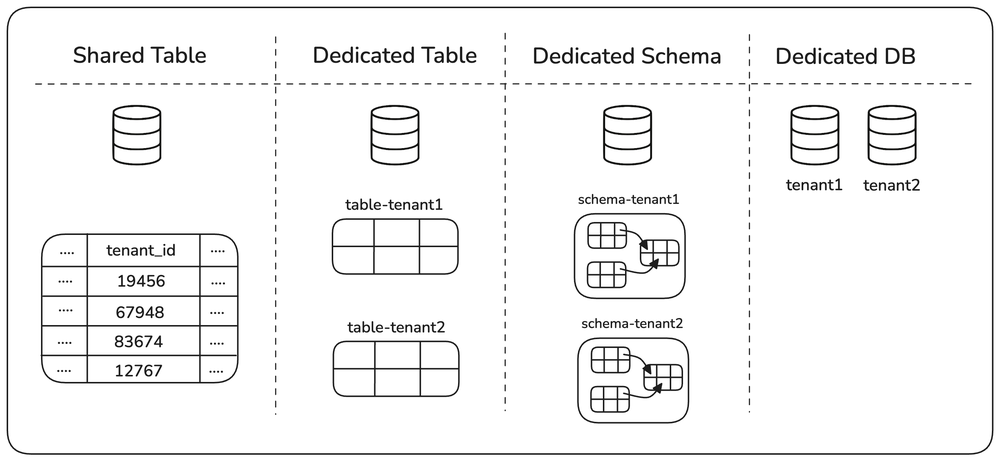
Database architecture plays a critical role in multi-tenant systems. !!The shared database with shared schema approach stores all tenant data in the same tables, using a tenant_id column for isolation - this maximizes density but requires careful query design to prevent data leakage.!! The shared database with separate schemas provides each tenant their own schema within a shared database instance, offering better isolation while maintaining operational simplicity. The dedicated database per tenant approach provides the strongest isolation and easiest data management but increases infrastructure complexity and costs.
Logical Isolation by Default, Physical on Demand [Default Strategy] {1}
!!In most cases, pooled multi-tenancy with logical isolation provides the best balance—minimizing operational overhead, maximizing resource utilization, and offering flexibility for growth.!! This makes a pragmatic starting point. If you've embraced Infrastructure as Code and automated deployments, then full physical isolation becomes technically feasible. With these foundations, spinning up a completely dedicated environment for a customer is no longer a months-long project—it's an automated deployment.
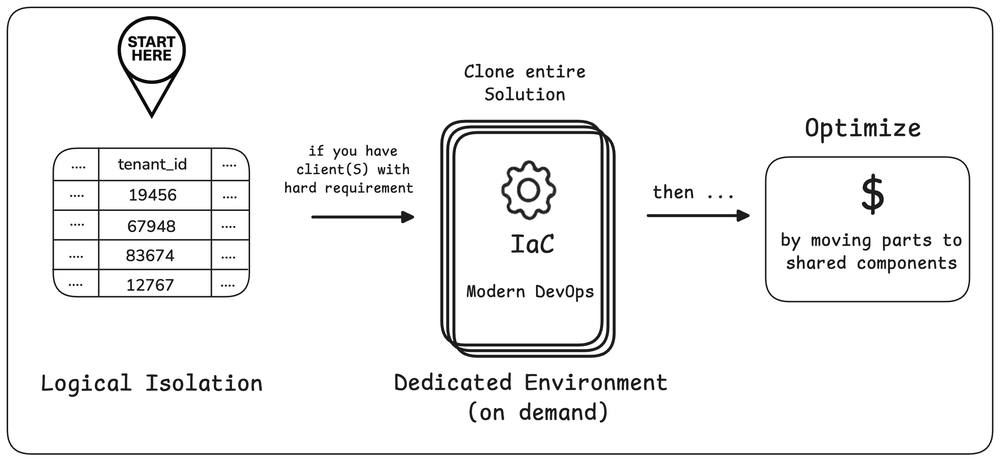
!!Architect your systems to support both strategies from day one.!! As you scale, you can optimize further—perhaps sharing certain infrastructure components like logging systems or notification services across otherwise isolated environments.
Tenant Identification and Context [Tenant Context] {1}
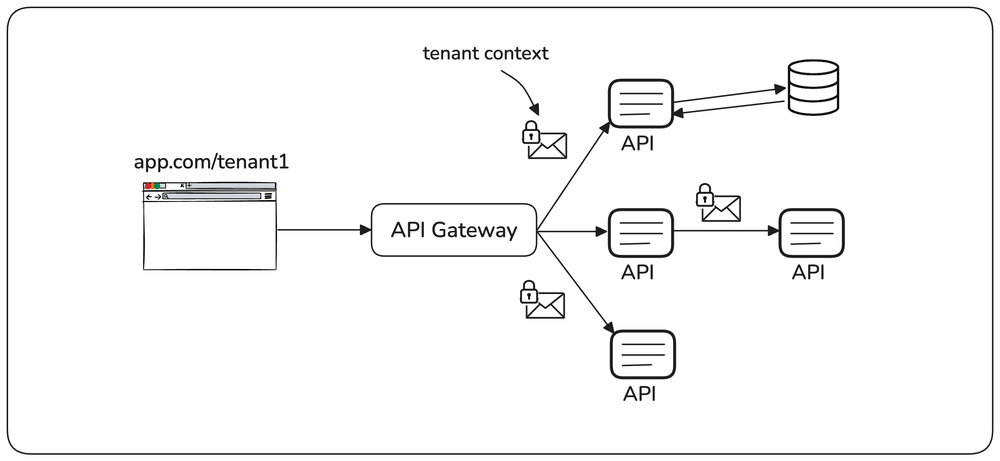
Properly identifying and maintaining tenant context throughout the application stack is essential for multi-tenant security. !!Tenant identification typically occurs at the API gateway or application entry point using methods like subdomain routing (tenant1.app.com), path-based routing (/tenant1/api), or authentication tokens containing tenant information.!! Once identified, the tenant context must be propagated through all layers - from the API to services, databases, and background jobs. This context should be immutable and validated at each boundary to prevent tenant impersonation attacks. Modern frameworks often provide middleware or context propagation mechanisms to ensure tenant information flows seamlessly through the application stack.
Resource Limits and Fair Usage [Resource Limits] {1}
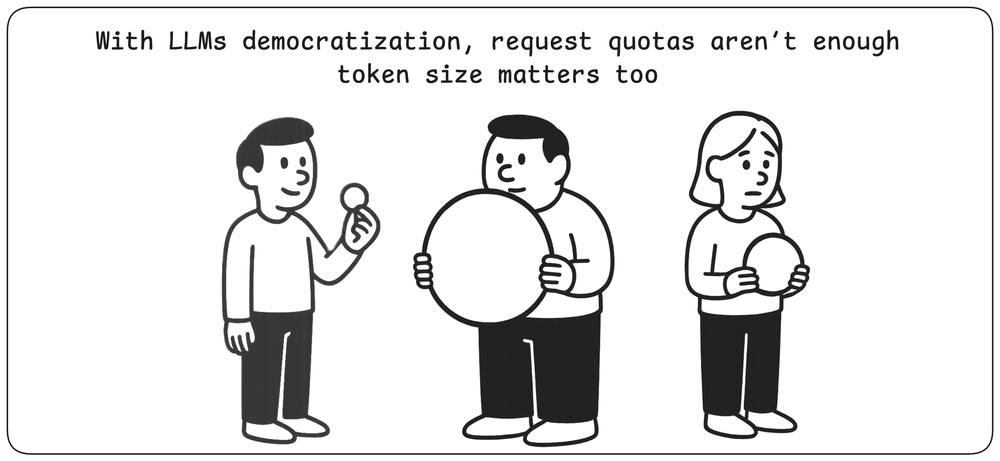
In multi-tenant environments, preventing resource monopolization by any single tenant is critical for maintaining service quality. !!Implement tenant-specific quotas for API calls, storage, compute resources, and concurrent operations.!! Rate limiting should operate at the tenant level, ensuring that one tenant's excessive usage doesn't impact others. Resource scheduling and queuing systems should incorporate tenant fairness algorithms to prevent starvation. Monitoring resource consumption per tenant enables proactive capacity planning and helps identify tenants requiring migration to dedicated infrastructure. These controls ensure that the multi-tenant model remains sustainable while providing consistent performance across all tenants.
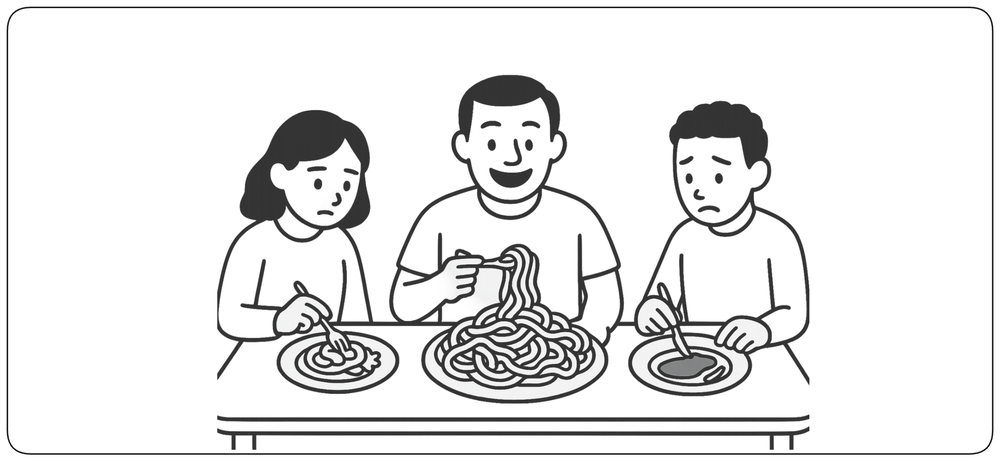
!!Traditional request quotas are no longer sufficient; modern fair usage must account for token volume and context size to reflect the true computational cost of LLM operations.!!
Multi-Tenant Security Considerations [Multi-Tenant Security] {1}
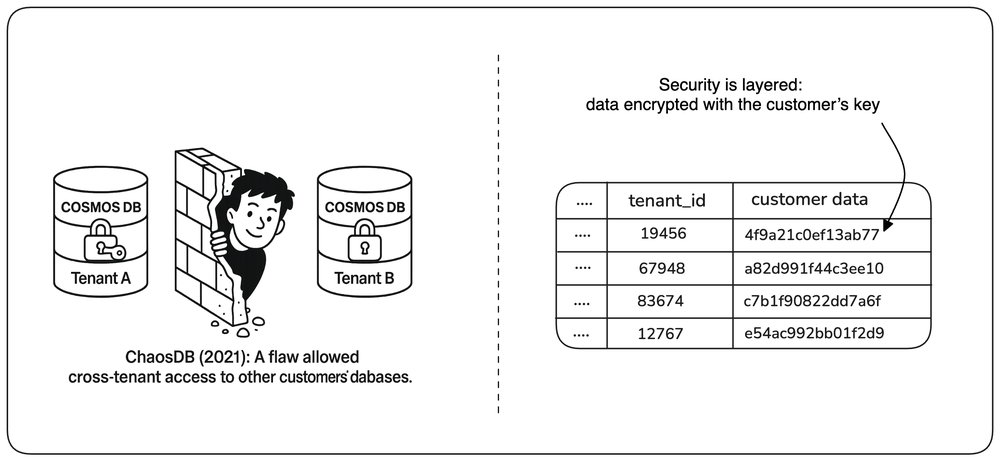
Security in multi-tenant systems requires multiple layers of protection to prevent tenants from accessing each other's data. !!Every request and database query must verify tenant identity, filtering data by tenant ID to ensure users only see their own information.!! Implement row-level security policies as a database-level safety net—even if application code fails, the database prevents cross-tenant access. Use separate encryption keys per tenant for sensitive data, ensuring that bypassing database isolation still cannot decrypt another tenant's information. Log all operations with tenant context to detect suspicious cross-tenant access attempts. Regularly test tenant isolation through penetration testing that specifically attempts tenant impersonation and data access. For enterprise customers requiring enhanced controls, provide tenant-specific security policies beyond standard protections.
Scaling Multi-Tenant Architectures [Multi-Tenant Scaling] {1}
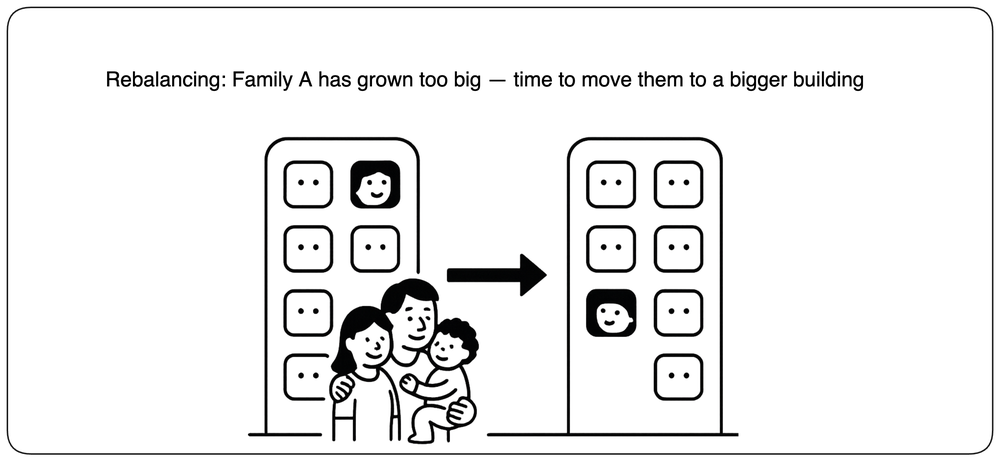
Scaling multi-tenant systems is challenging because tenant growth is unpredictable. !!A tenant that starts small may suddenly become large, creating an uneven distribution where a few heavy tenants overload a specific production environment.!! Since initial placement cannot reliably be based on predictions, platforms must plan for ongoing redistribution: moving tenants, sharding differently, or rebalancing clusters to avoid hotspots. As the system grows, adding new environments and continuously smoothing out tenant placement keeps workloads evenly distributed and ensures the platform remains stable and responsive.
Deployment Models [Deployment Models] {1}
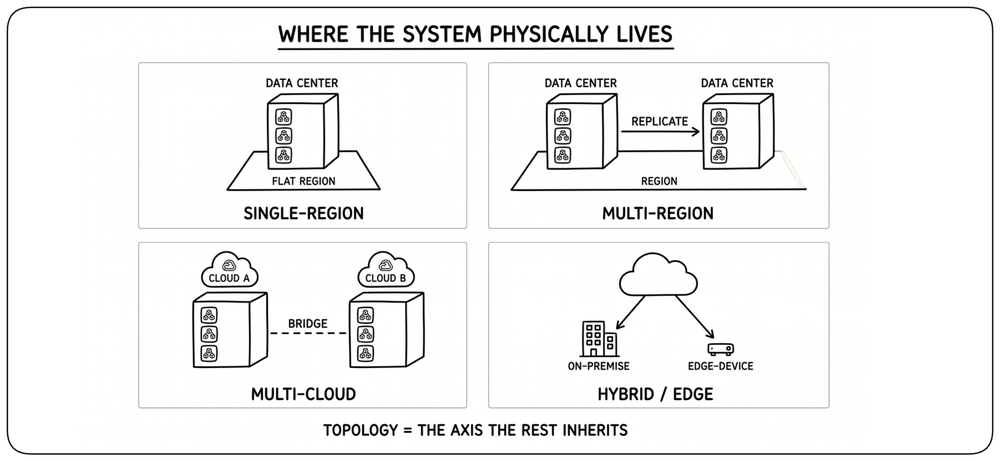
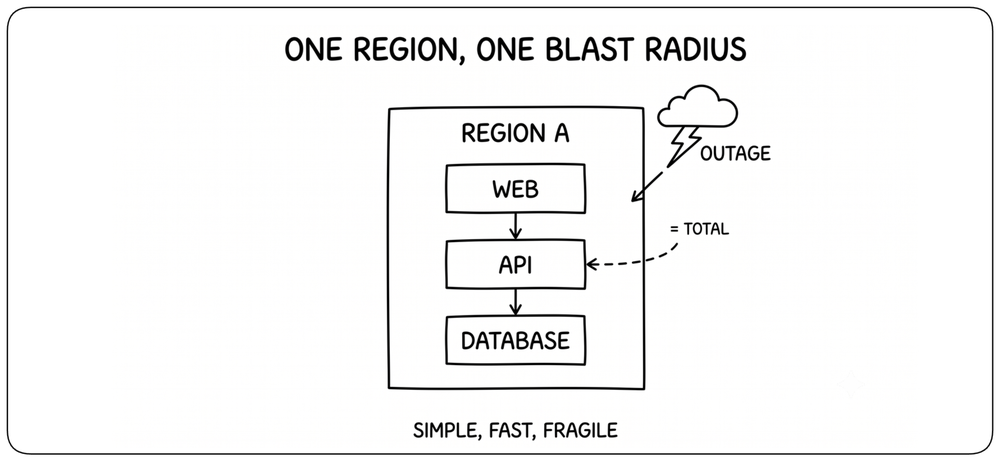
Service, compute, database, and tenancy decisions still leave one question open: where the system physically runs. Deployment topology is the axis that picks how many regions, clouds, or sites the system spans — and how they fail over to each other. A single-region deployment is simple and fast but binds availability to one place. Multi-region buys disaster recovery at the cost of cross-region replication. Multi-cloud and hybrid push optionality further, with more operational debt. !!Topology is a choice the rest of the architecture inherits.!! Picking it late is expensive — it shapes data placement, latency budgets, and identity boundaries.
Single-Region: Default for Simplicity [Single-Region] {1}
Most systems should start in a single region. One region keeps latency low, replication trivial, and operations boring — the simplest topology that ships. The cost is concentration: every service and dependency lives in the same blast radius, so a regional outage stops the whole system at once. For internal tools, early-stage products, and anything where a few hours of downtime is acceptable, this is the right default. !!One region is fast, cheap, and fragile — choose it on purpose, not by accident.!! Promote to multi-region only when an SLO, a customer contract, or a regulator demands it.
Multi-Region: Geographic Resilience [Multi-Region] {1}
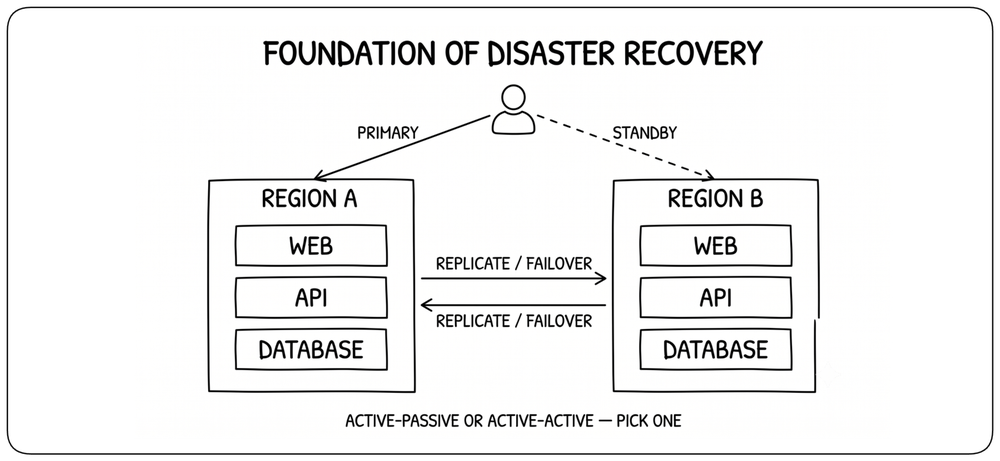
Multi-region deployment is the foundation of cloud disaster recovery, explored in depth in the Resiliency chapter. Two flavors dominate: active-passive (one region serves traffic, another waits warm) trades cost for simplicity; active-active (all regions serve traffic at once) maximizes availability and capacity but forces decisions about data consistency, conflict resolution, and global routing. Global databases, anycast load balancers, and replicated state stores are what make either flavor possible. !!Multi-region is not a feature — it is an architecture.!! It touches every layer above it: identity, observability, deploy pipelines, and the data model itself.
Multi-Cloud: Optionality at a Cost [Multi-Cloud] {1}
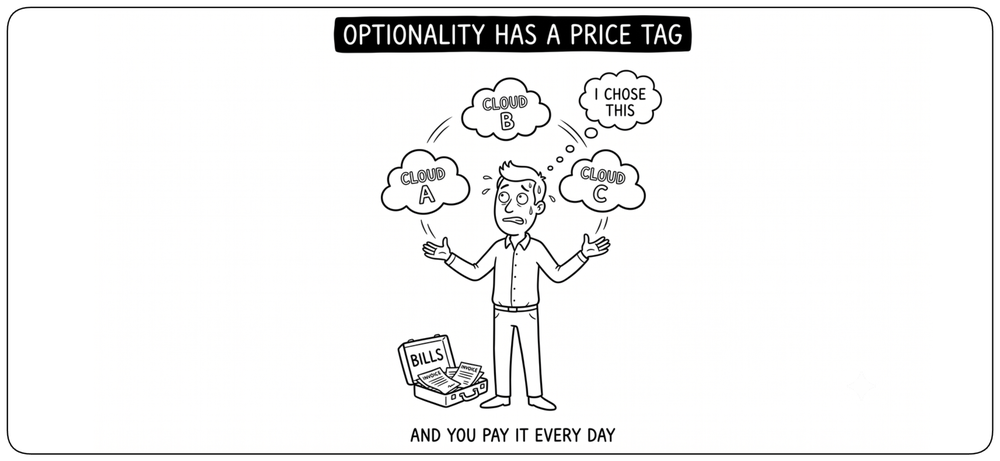
Running across multiple cloud providers sounds like a hedge against lock-in or a regulatory requirement, but in practice it is the most expensive topology to operate. !!Each provider has its own identity model, networking, observability, and managed services — and any abstraction that hides those differences also hides the features that made the cloud worth using in the first place.!! !!Multi-cloud is a real cost paid every day for an optionality you may never exercise.!! Adopt it when compliance, sovereign-cloud rules, or a single critical capability force you — not as insurance against a future you cannot price.
Hybrid & Edge: Compute Where It's Needed [Hybrid Edge] {1}
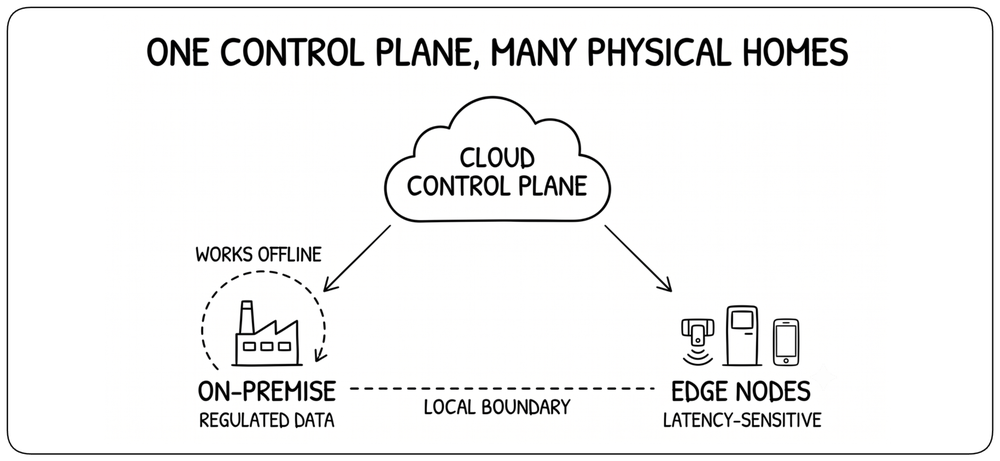
Some workloads cannot live entirely in a central region. Regulated data must stay on-premise, factory floors need millisecond latency, retail stores must keep running when the link to the cloud drops. !!Hybrid topologies extend the cloud control plane down into private data centers; edge topologies push compute even further, into the user's network or device.!! Both shift the design question from "which region" to "which boundary" — what runs locally, what synchronizes, what tolerates being offline. !!Edge is the cloud meeting physics.!! Latency, sovereignty, and intermittent connectivity stop being abstractions and become daily constraints.
Model Selection [Model Selection] {1}
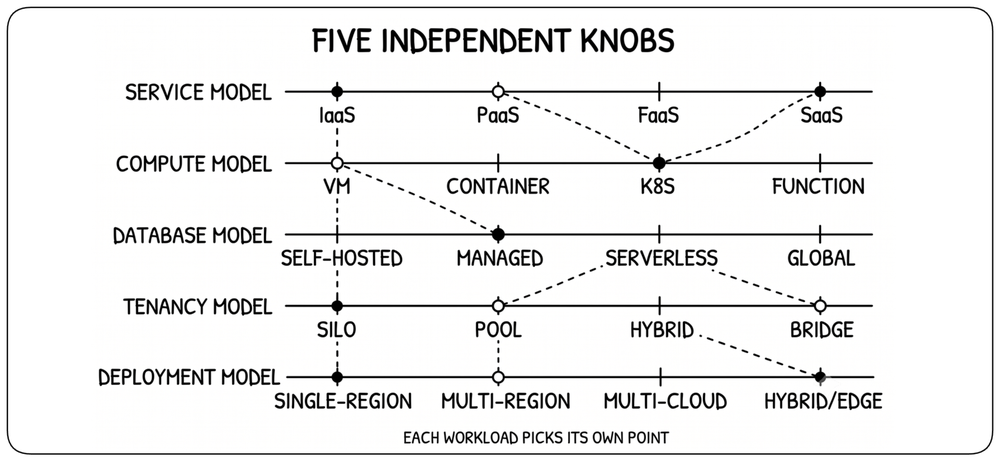
Service models, compute models, database models, multitenancy models, and deployment models are five independent axes — and a real system makes a different choice along each one for each piece of itself. The art is not picking one model and forcing the rest of the system into it; it is knowing which knobs to turn, when, and why. !!A good cloud architecture is not a single answer — it is a set of consistent trade-offs made on purpose.!! What follows are five principles that hold across all five axes.
Right Tool for Each Part of the System [Right Tool] {1}
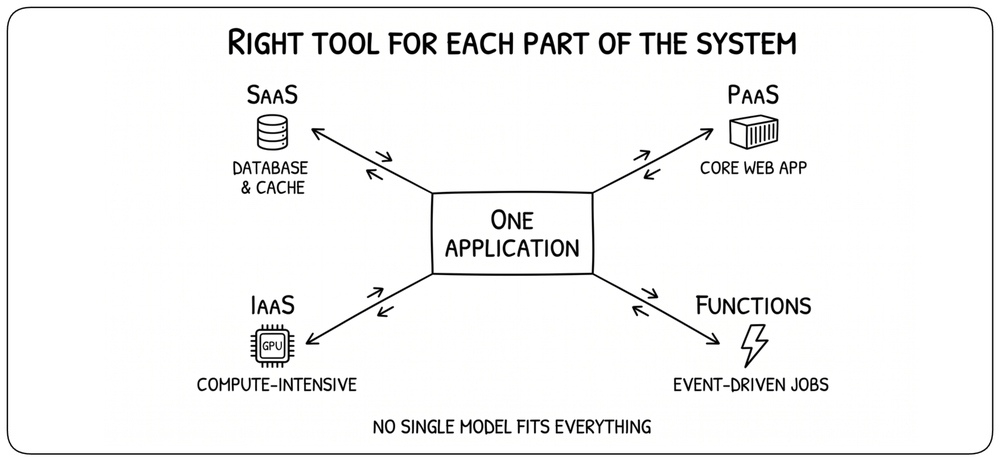
Successful cloud architectures don't standardize on a single model — they match each piece of the system to the most appropriate service, compute unit, data engine, tenant isolation strategy, and deployment footprint. A typical application uses a managed relational database for transactions, a key-value store for cache, containers on Kubernetes for the core web app, IaaS for specialized GPU workloads, functions for event-driven glue, pooled tenancy for standard customers with silo isolation for regulated ones, and a single region for most services with multi-region only for the data plane that can't go down. !!Standardization is comfort; specialization is performance.!! The goal is not to pick one model and force everything into it, but to thoughtfully select the right shape for each specific job — and to draw clear boundaries between them.
Managed by Default, Drop Down Only for a Reason [Managed by Default] {1}
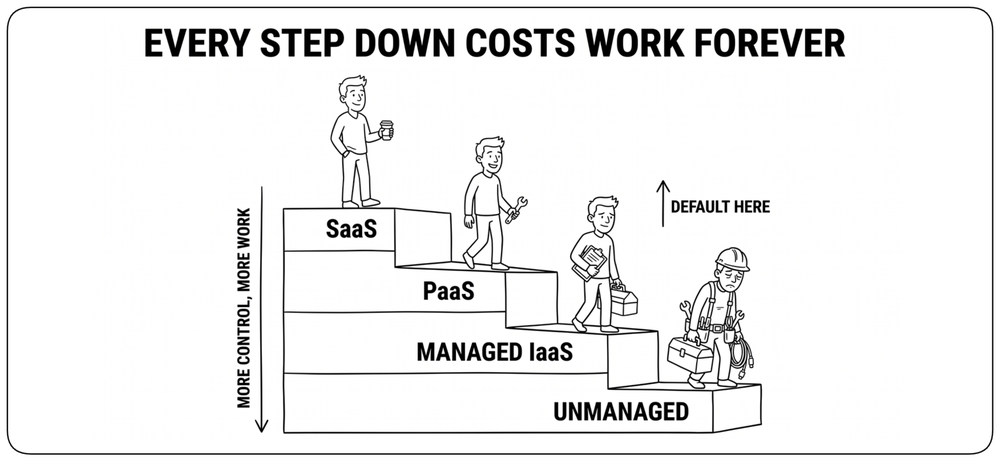
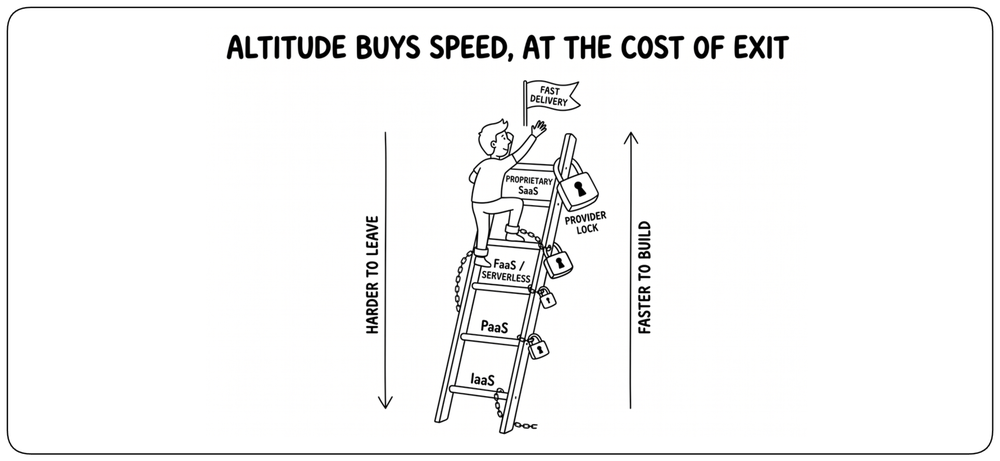
Every step down the abstraction ladder — from SaaS to PaaS, PaaS to IaaS, managed to unmanaged — costs operational work that someone on your team will carry forever. The right default is the highest level that fits: let the provider operate everything they can, and only drop down when a real constraint demands it (compliance, custom kernel, sustained cost at scale, specialized hardware). !!Every operational responsibility you take on is a feature you didn't ship.!! Lower-level control is sometimes essential — but it is never free, and the cost compounds over the lifetime of the system.
Know What You Sign Up to Operate [Shared Responsibility] {1}
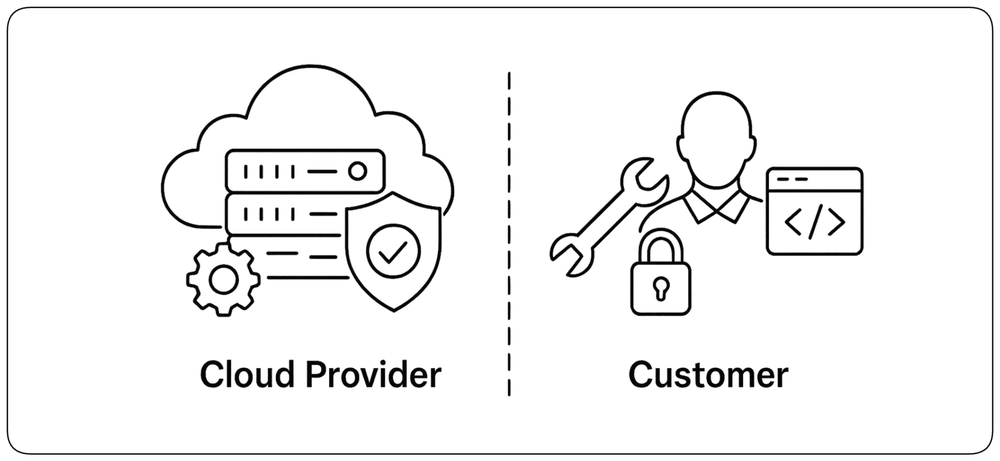
Every model on the abstraction ladder comes with a different invoice of operational work. The Shared Responsibility Model makes that invoice explicit: the provider runs the layers below the line, you run the layers above — and the line moves with each service model. With IaaS, you own the OS, patches, scaling, backups, and most of the security posture. With PaaS, the provider takes the runtime and the platform; you keep the code, the data, and the configuration. With SaaS, almost everything sits on the provider's side except identity, access control, and the data you put in. !!Choosing a service model is not just choosing a level of abstraction — it is choosing which problems you agree to own forever.!! Read the line before you sign, or you will discover it during an incident.
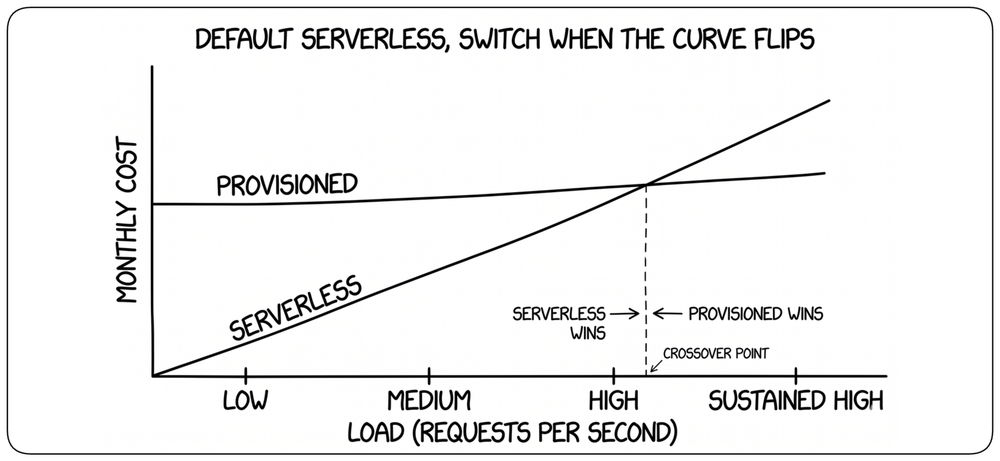
Serverless First, Provisioned When Sustained [Serverless First] {1}
Pay-per-request beats provisioned capacity until the workload becomes predictable and constant. For unknown demand, spiky traffic, and early-stage services, serverless wins on every dimension: no capacity planning, no idle cost, no minimum footprint. But the math flips when load becomes sustained — at high steady-state throughput, per-request pricing crosses over and provisioned instances become cheaper. !!Start serverless; switch to provisioned only when the curve makes it cheaper, not because it feels more "real".!! The same logic applies to compute (functions → containers → VMs) and data (DynamoDB on-demand → provisioned → reserved).
Lock-In Is the Price of Altitude [Lock-In]
The higher you go on the abstraction ladder, the more you trade portability for productivity. SaaS components, proprietary serverless runtimes, and provider-specific databases ship faster and cost less to operate — but they also embed assumptions that don't travel to another cloud. !!Every cloud-native feature you adopt is a small commitment you sign with that provider.!! That is sometimes a fine trade — speed today is worth a lot — but it has to be a conscious choice, not a default. Keep core business logic portable, push provider-specific code to thin adapter layers, and know which doors you are closing as you climb.
Infrastructure as Code [Infrastructure as Code] {1}
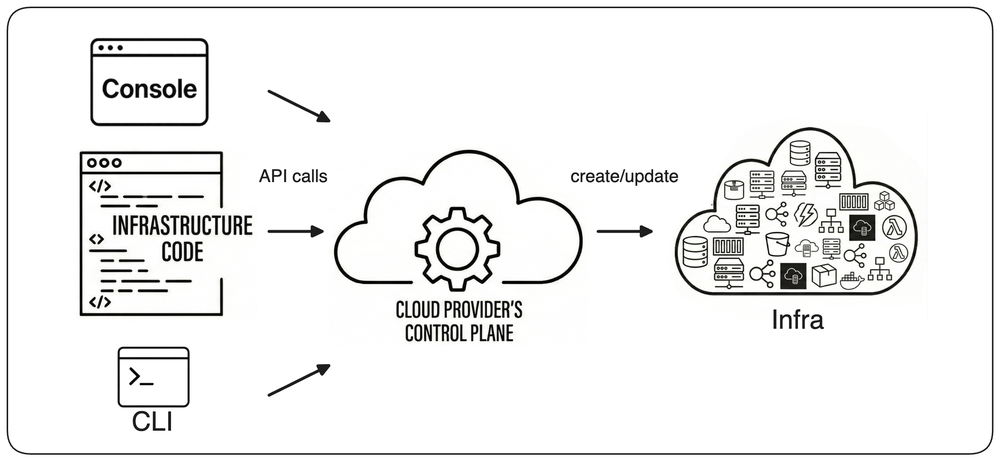
Every operation in the cloud — whether typed in a console or driven by Terraform — ultimately becomes an API call. !!The data center became an API, and infrastructure became something you describe in code rather than something you wire up by hand.!! What follows is the arc that took us there: from manual consoles to imperative scripts, then to declarative IaC and the system-smart capabilities — composability, dependency graphs, reconciliation, idempotence — that make modern infrastructure possible.
The Limits of Manual Console Provisioning [Manual Challenges] {1}
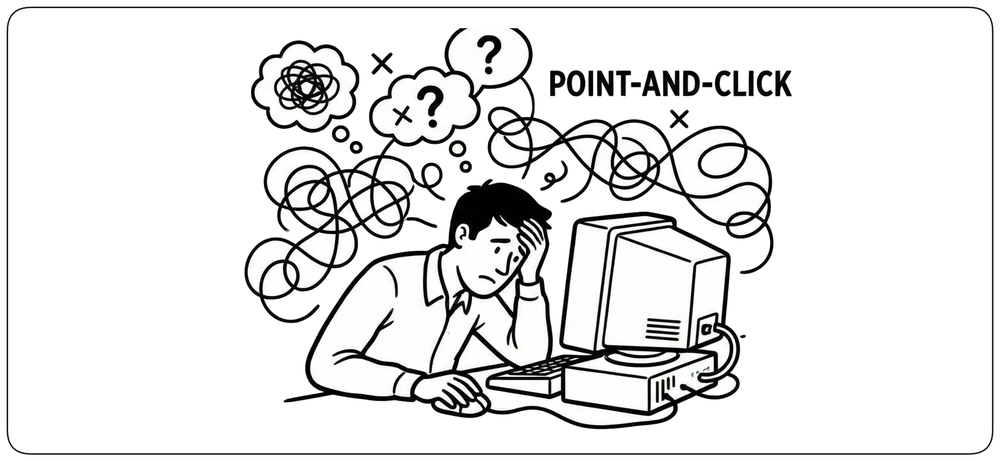
Infrastructure provisioning was long dominated by point-and-click in web consoles. !!Each resource had to be created by hand, one screen at a time — configurations diverged across environments, changes left no audit trail, and provisioning depended on whoever happened to remember the right sequence.!! !!Manual console work doesn't scale, doesn't reproduce, and doesn't survive turnover.!! As systems grew, the console became the bottleneck that no organization could afford.
Script-Based Infrastructure Automation [Imperative Scripts] {1}
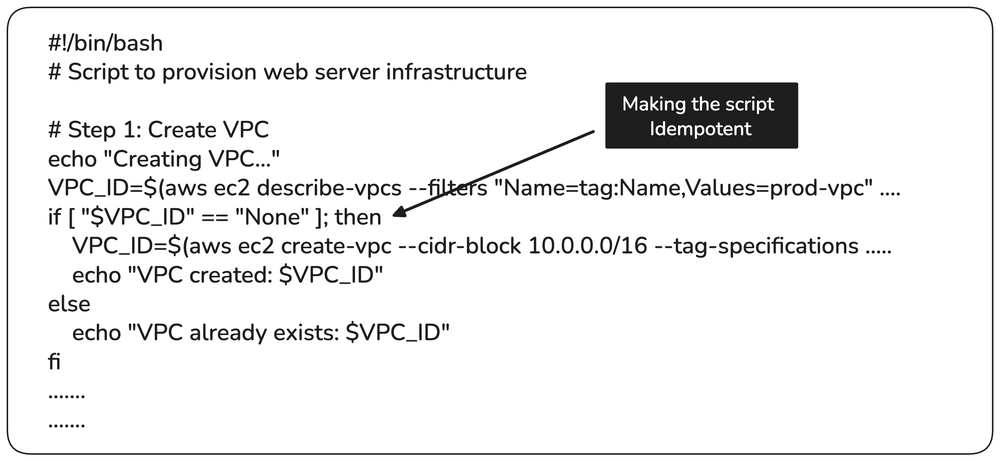
The natural next step was to wrap those manual operations in scripts — bash, Python, AWS CLI calls chained together. !!Imperative automation replaced the mouse with code: faster, more repeatable, and at least theoretically reviewable.!! For the first time, infrastructure could be deployed twice the same way. This was real progress over the console, but it brought new problems of its own.
Scripts: Automation Without Reusability [No Reusability] {1}
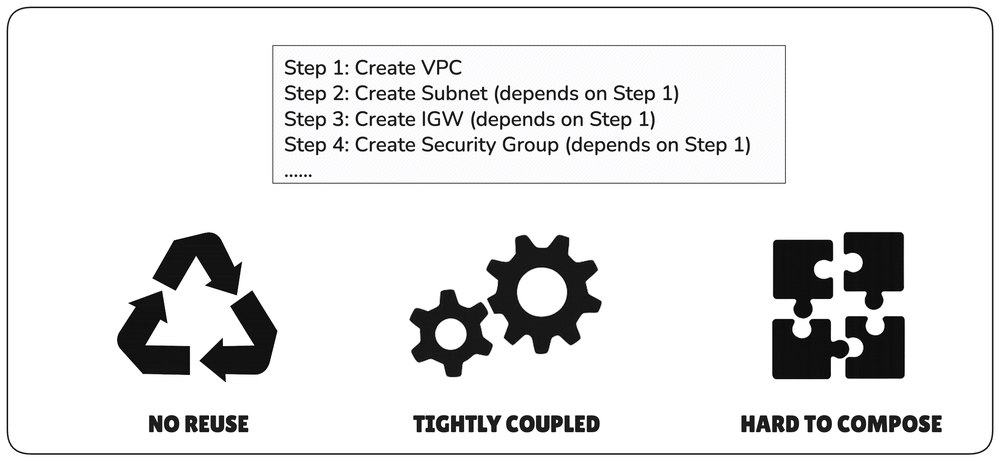
Scripts behave like procedural recipes — step 1 create the VPC, step 2 create the subnet, step 3 attach the gateway — effective for one path, fragile outside it. !!Each script encodes a specific sequence tightly bound to its scenario; parameterizing it for another environment usually means rewriting it.!! !!Imperative scripts automate work, but they don't compose.!! Teams that went down this path accumulated near-duplicate scripts with no shared abstraction, trading the console bottleneck for a maintenance one.
The Declarative Shift: What, Not How [Declarative Shift] {1}
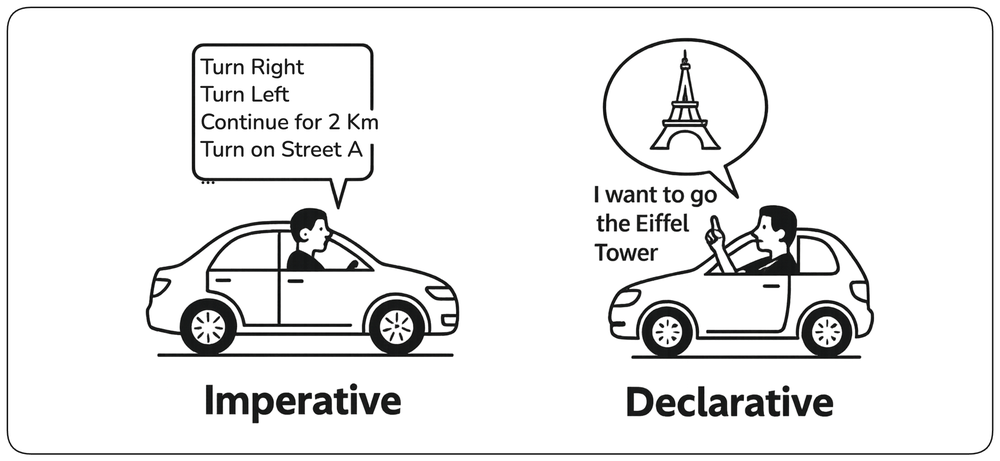
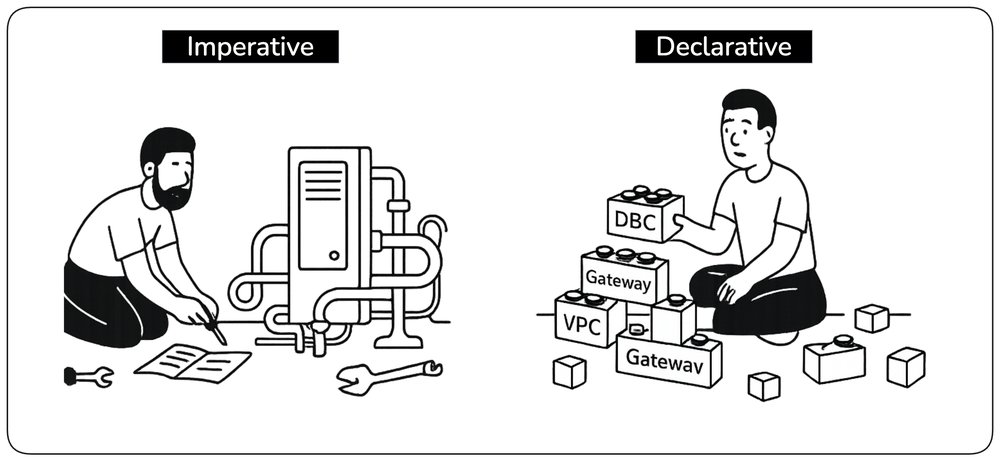
The breakthrough was a change in what gets written. Instead of describing the steps (how to build infrastructure), engineers describe the desired end state (what infrastructure should exist) and let the system figure out the steps. The role itself shifts: engineers stop being operators executing sequences and become designers of intent — they state "three pods running, this service reachable, this policy applied," and the platform handles the rest. !!Stop describing the steps; describe the destination.!! The same trip, two languages — one for the driver, one for the passenger.
Making the Client Dumb and the System Smart [Dumb vs Smart] {1}
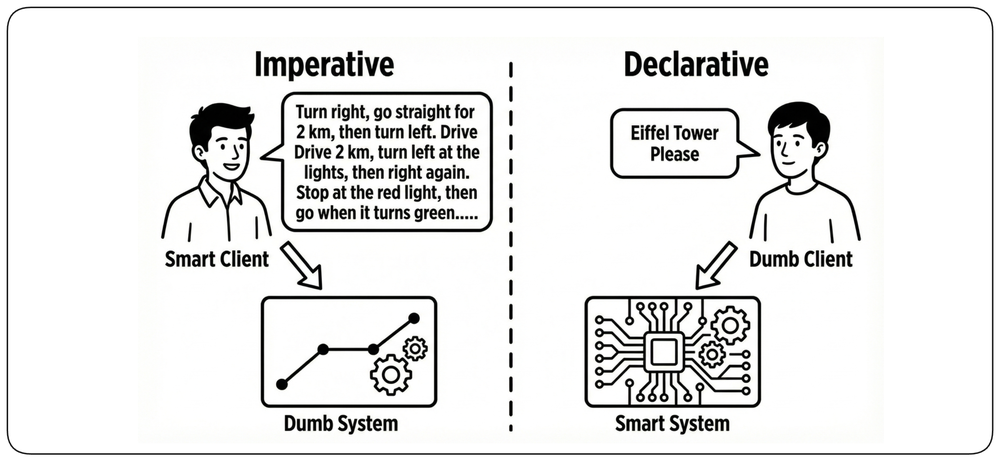
Both imperative and declarative require knowing how to reach the goal — the question is who holds that knowledge. !!Imperative pushes it onto the client: the user must understand every step and instruct the system precisely.!! Declarative shifts it downward: the system itself knows the path, the user only has to express intent. !!Make the client as simple as possible, the system as smart as necessary.!! Everything that follows — composability, dependency graphs, reconciliation — flows from this single inversion.
Composability [Composability] {1}
Because declarative resources are abstractions, they compose like LEGO blocks: state what each piece does, declare how they connect, ignore the internals. A VPC, a subnet, a security group, a database — each is a self-contained module that can be parameterized, nested, and reused across contexts without anyone touching its implementation. !!Build once, compose everywhere.!! This is why declarative infrastructure is inherently more reusable than imperative scripts: it was designed from the ground up to be assembled rather than constructed.
Loose Coupling Through Discovery [Loose Coupling] {1}
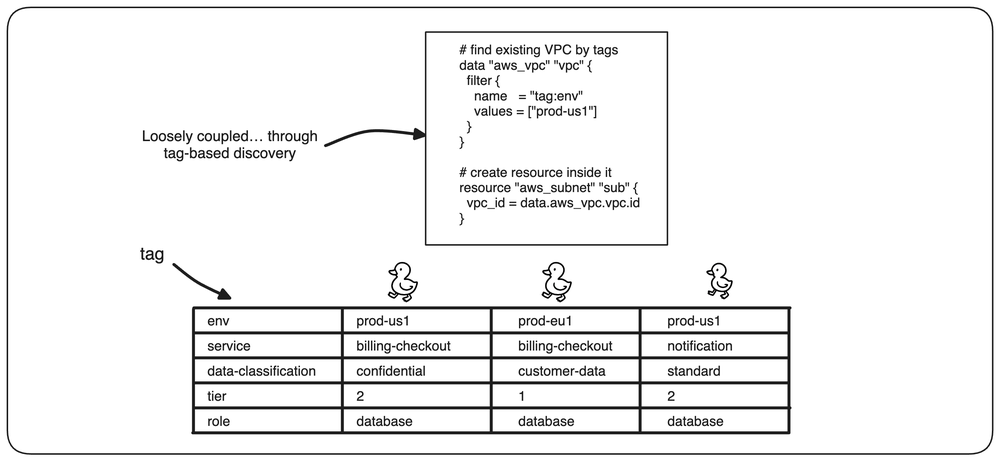
Composing modules only works if they don't hardcode each other. !!An application module that needs a VPC shouldn't bake in vpc-0abc123 — that breaks portability the moment you move to a new environment.!! !!Modules must discover, not hardcode, the resources they depend on.!! Two mechanisms make this possible: tag matching, where a module locates its VPC by searching for env=prod, purpose=apps; and output state, where each module publishes its IDs and endpoints to a shared state others can query. Combined with remote state storage, this is what lets teams compose infrastructure from independent modules without coordinating their identifiers.
Dependency Management [Dependency] {1}
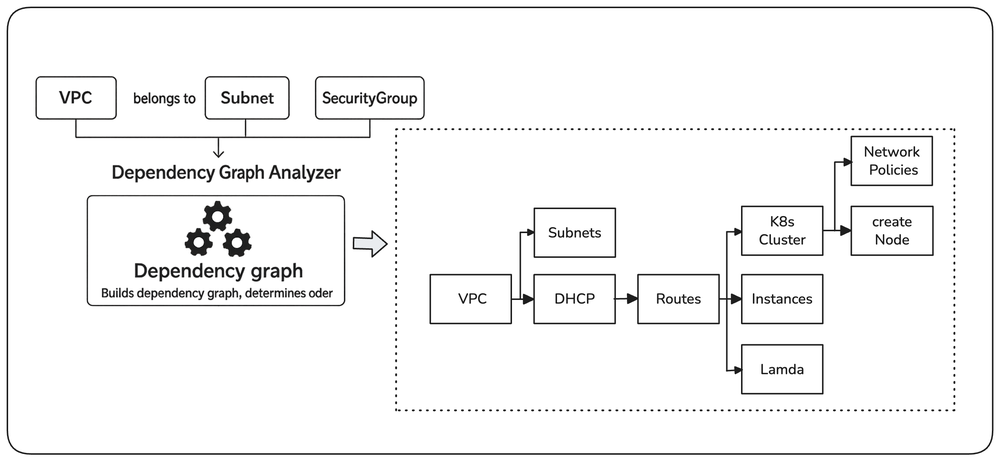
In imperative scripts, ordering is the developer's burden — get the sequence wrong and the deployment fails halfway through. !!Declarative systems eliminate this by treating relationships as data: when you say "this subnet belongs to this VPC," you're not writing a step, you're stating a fact.!! !!Declare relationships, not sequences — let the system compute the order.!! The engine builds a dependency graph, determines the correct order automatically, parallelizes independent operations, and detects cycles before execution. The developer focuses on the what; the choreography is the system's problem.
Consistency through Reconciliation [Consistency] {1}
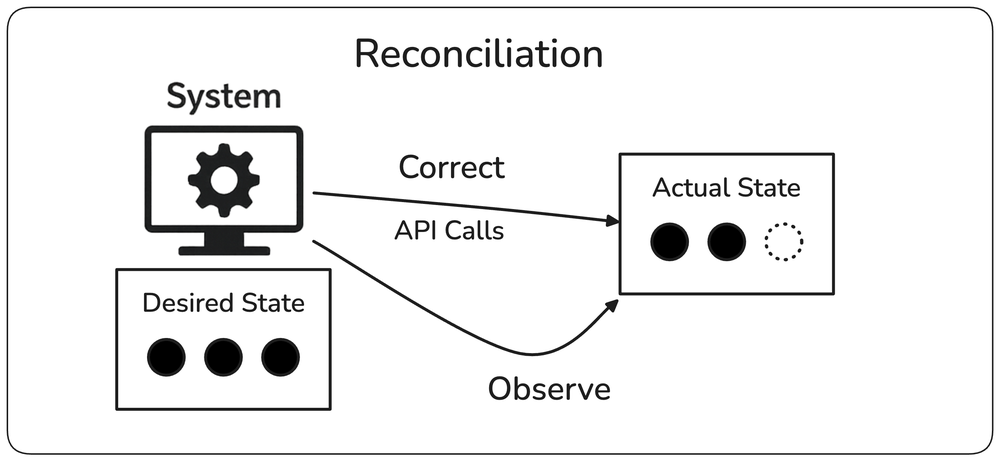
Reconciliation is the beating heart of declarative systems. The engine continuously observes the actual state of the world, compares it to the desired one, and corrects the gap through API calls — recreating what's missing, adjusting what's wrong, removing what doesn't belong. !!Intelligence comes not from executing instructions, but from ensuring reality stays aligned with intent.!! Static configuration becomes self-correcting behavior; drift becomes something the system fixes rather than something the operator notices.
Continuous vs. On-Demand Reconciliation [Reconciliation Patterns] {1}
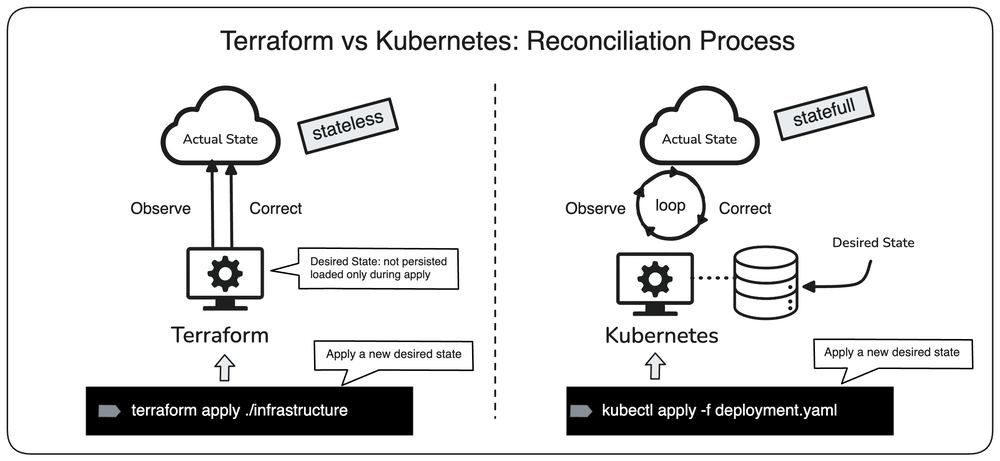
Kubernetes and Terraform both reconcile, but they do it on different schedules. !!Kubernetes runs a continuous loop — it remembers the desired state, watches the actual state, and corrects drift in real time without anyone triggering it.!! Terraform reconciles on demand: it loads the desired state, compares once, applies the diff, then stops until you run terraform apply again. !!Same principle, two timings — continuous self-healing vs. checkpointed convergence.!! Both keep reality aligned with intent; they just disagree on whether alignment is a state or an event.
GitOps: Reconciliation Driven by Git [GitOps] {1}
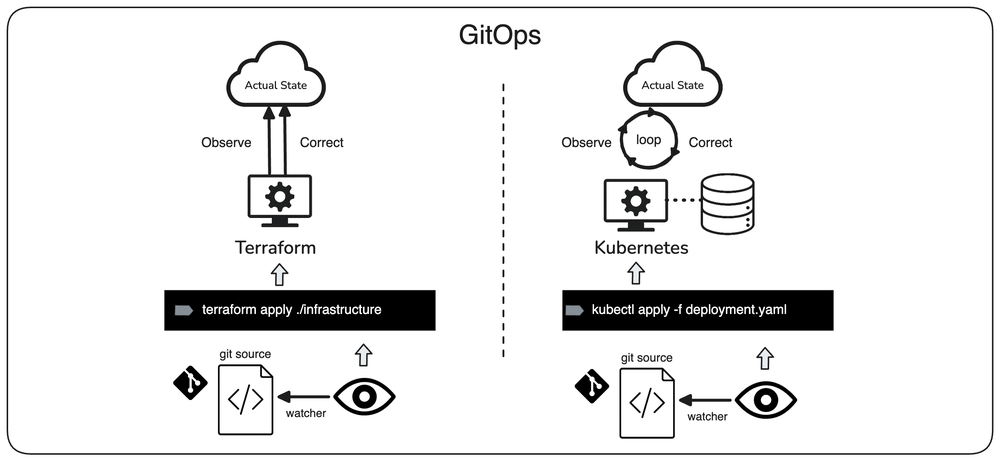
GitOps takes the desired-state idea one step further: Git becomes the single source of truth, and reconciliation triggers automatically on every commit. A watcher monitors the repo, detects merged changes, and reconciles infrastructure or applications without anyone running apply by hand. Every change is a commit (full auditability), every rollback is git revert, every deploy passes through pull-request review and CI policy checks. !!Git becomes the only authorized control plane — if it's not in the repo, it doesn't exist.!! The tradeoff is real: requiring PRs introduces human friction that pure end-to-end automation would avoid.
Idempotence [Idempotence] {1}
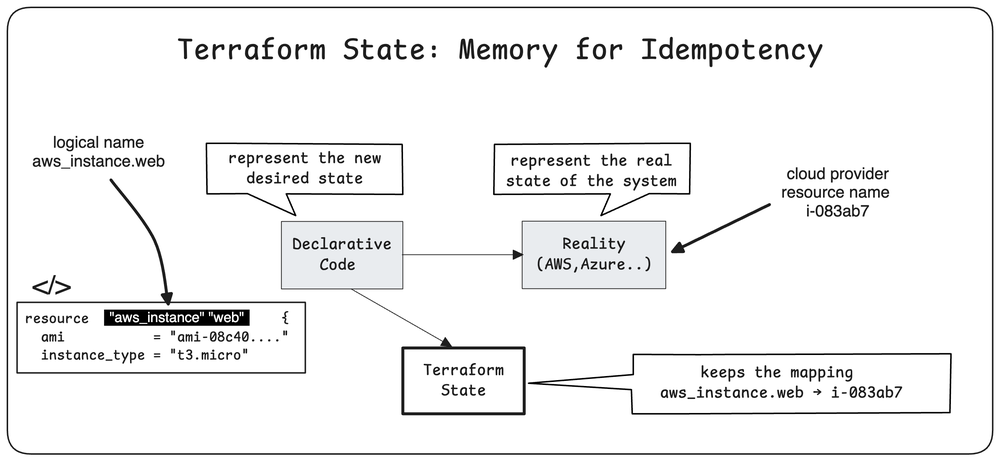
Idempotence means running the same operation many times produces the same result as running it once — no duplicate resources, no cumulative side effects, no surprise on the second apply. !!You can run it again, and again, and again — nothing breaks.!! Modern declarative tools achieve this by mapping each logical name in the configuration (aws_instance.web) to the actual provider resource ID (i-083ab7); on each run, the engine checks whether the resource already exists and matches the spec, then creates, updates, or does nothing — deterministically. !!Without idempotence, every retry is a gamble; with it, automation becomes safe.!!
Operating Cloud Infrastructure [Operating] {1}
!!Mindset sets the posture, IaC gives you the language — what's left is the day-to-day discipline of running cloud infrastructure: when to automate, where to draw ownership lines, how to organize change, and which guardrails keep teams from stepping on each other or on production.!! These practices are the operating manual once the principles are in place.
Automate Provisioning and Deprovisioning [Automate Provisioning] {1}
Automating creation is the obvious half; automating destruction is the half teams forget. !!Uncontrolled deletion leaves orphaned volumes, dangling DNS, and surprise bills that show up two months later — and manual teardown in a hurry is how production gets clipped by mistake.!! !!Deprovisioning matters as much as provisioning — measure maturity by how safely you can take things down, not just how fast you can stand them up.!! Treat both with the same rigor: automated, auditable, dependency-aware, and protected by safeguards against accidental destruction.
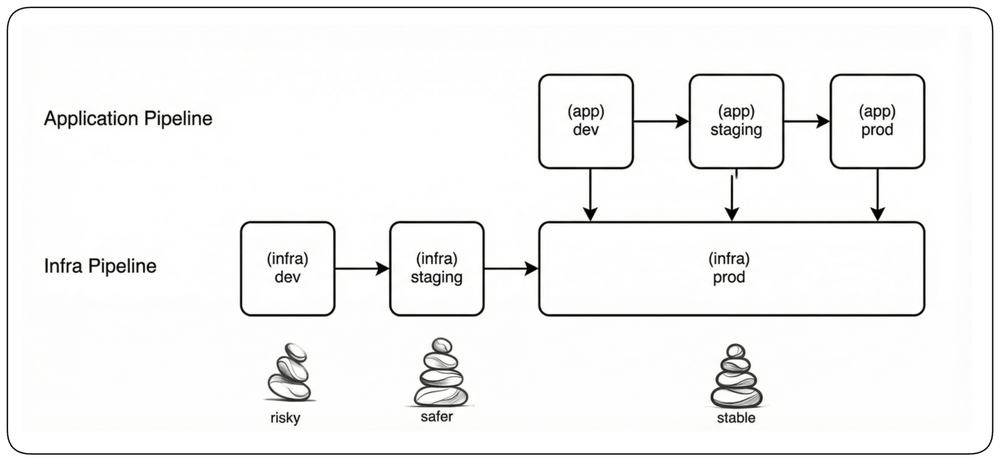
Offset Infrastructure Maturity Ahead of Applications [Offset Maturity] {1}
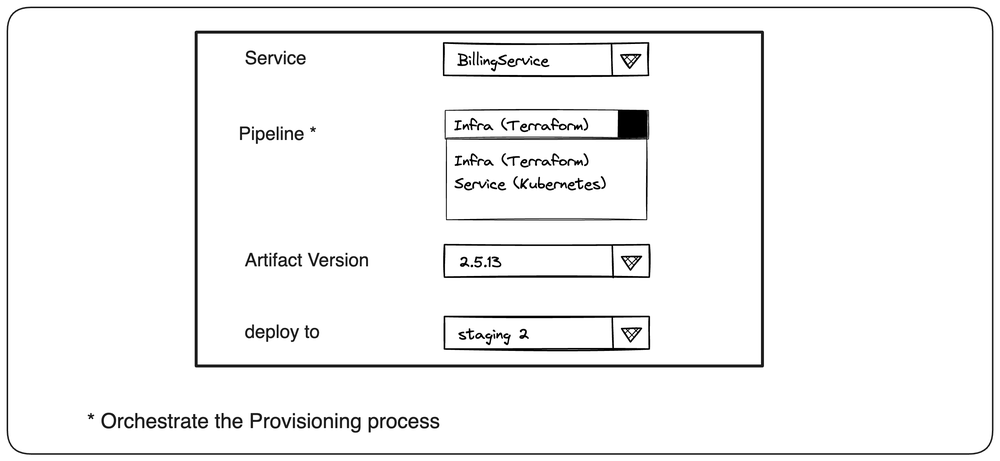
When teams build foundational infrastructure in-house — internal platforms, custom service meshes, ML serving — application teams can't safely consume the infra team's dev or staging environments. !!Breaking changes happen there by design, and apps need stability to develop against.!! !!Applications consume only infrastructure production — never infrastructure dev or staging.!! The pipeline must offset: infra changes are developed, stabilized, and promoted to infra-prod before any application depends on them.
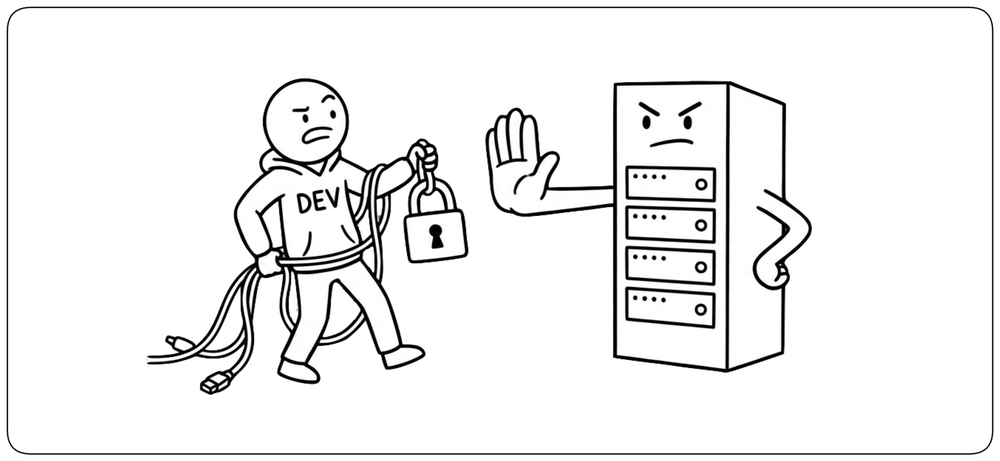
Keep Developers Away from Production Infrastructure [Isolate Devs from Prod] {1}
Direct developer access to production infrastructure is how outages happen — an accidental terminate, a security group widened "just for debugging," a config edit that never made it back to the repo. !!The fix is not to keep developers ignorant of infrastructure; it's to make their only path through code, review, and pipelines.!! !!Developers describe infrastructure in code; pipelines change it in production.!! Platform teams can layer self-service on top, but the substrate is the same: no human hands on prod resources.
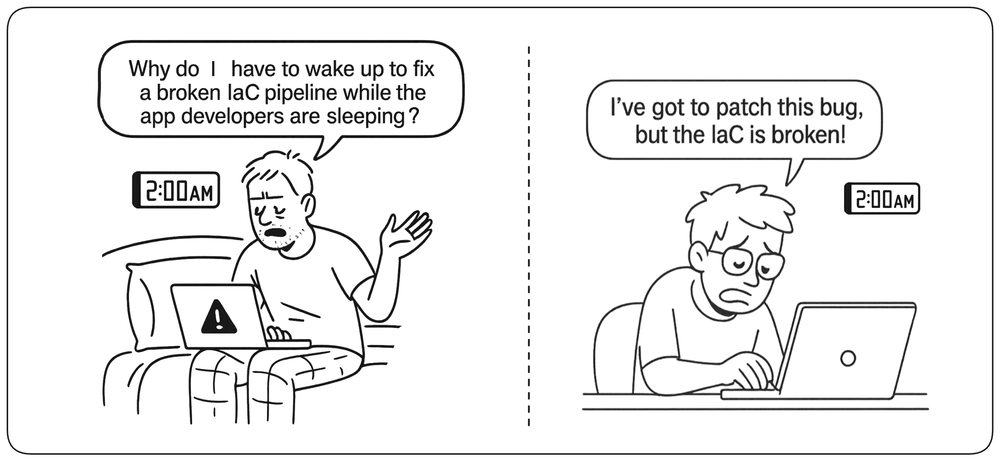
Treat Pipelines as Production [Pipeline = Prod] {1}
If your IaC pipeline is down, you cannot deploy, you cannot patch, you cannot recover. !!If your state file is corrupted, you may have lost the truth about every environment you run.!! !!The pipeline is production — the system that runs production is itself production.!! Cloud-native gives the deploy plane the same treatment as the data plane: encrypted state, locked backends, audit logs, least-privilege credentials, monitoring, on-call. The temptation to treat CI/CD as "internal tooling" disappears the first time a corrupted state cascades into every environment at once.
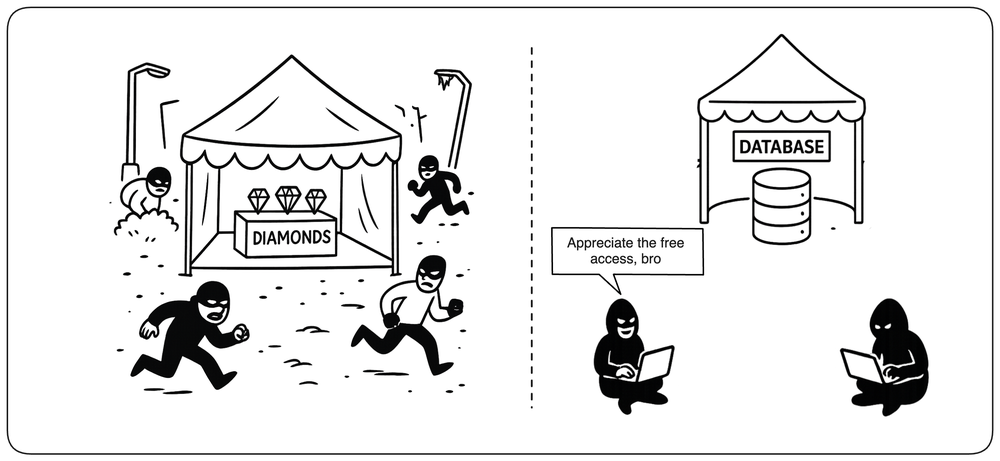
Make Resources Private by Default [Private by Default] {1}
Cloud resources should be unreachable from the public internet unless there's an explicit business reason — a web frontend, a public API. !!Databases, internal services, message queues, object stores: all private.!! !!If a resource doesn't need to be public, it isn't — no exceptions, no "temporarily open."!! Use private subnets, restricted security groups, VPC endpoints, strict bucket policies, and IAM roles in place of long-lived keys. Defense in depth assumes every layer will eventually fail; closing the network layer first is the cheapest insurance you can buy.
Establish Clear Ownership Boundaries [Clear Ownership] {1}
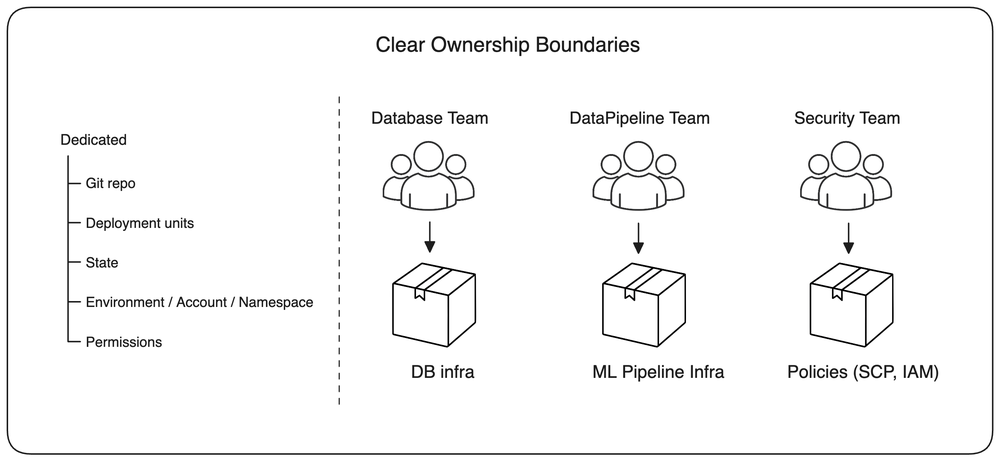
Every infrastructure resource has exactly one owning team — its own repo, its own state file, its own account or namespace, its own IAM. !!Shared state across teams is shared blast radius.!! The Database team owns DB infra, the Data Pipeline team owns its ML pipelines, the Security team owns SCPs and IAM — no one reaches across, no one edits another team's state. !!This is what lets infrastructure scale across an org without every change becoming a cross-team coordination meeting.!!
Group Infrastructure by Change Patterns [Group by Change] {1}
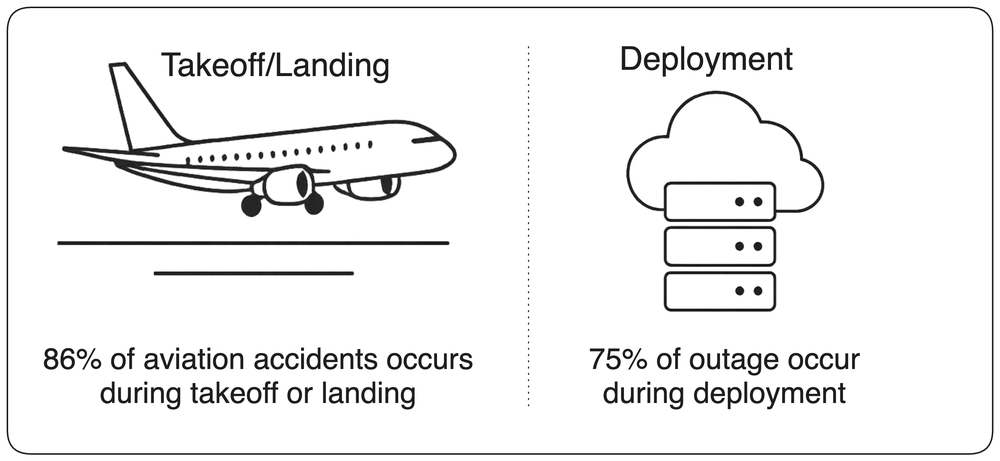
Organize infrastructure code by how often pieces change together, not by what they conceptually are. !!Core networking that changes once a quarter shouldn't share a deployment unit with application security groups that change weekly — a small app change shouldn't risk the VPC.!! !!Group what changes together, separate what doesn't.!! This isn't tidiness; it's blast-radius management. Bounding what each deploy can touch is what makes infrastructure evolution safe at scale.
Restart Systems Regularly [Restart Regularly] {1}
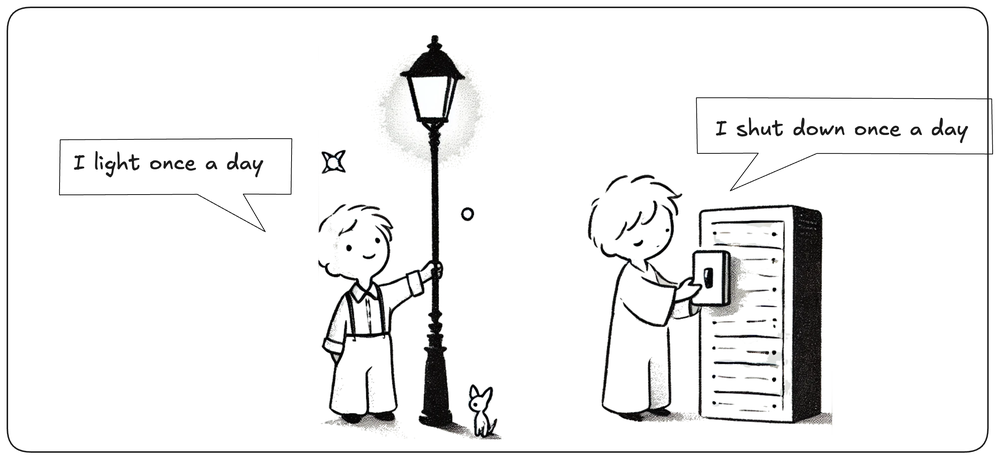
Long-running systems accumulate hidden state — memory leaks, stale caches, processes that forgot why they were started, configuration drift that nobody noticed. !!Restarting on a schedule — daily, weekly — clears all of it and forces the system to prove it can come back.!! !!If your system can't survive a planned restart, it won't survive an unplanned one.!! Scheduled shutdowns are a controlled rehearsal for the failures that will eventually happen anyway, and they catch the brittle spots while you're watching.
Test Backup and Recovery Regularly [Test Backups] {1}
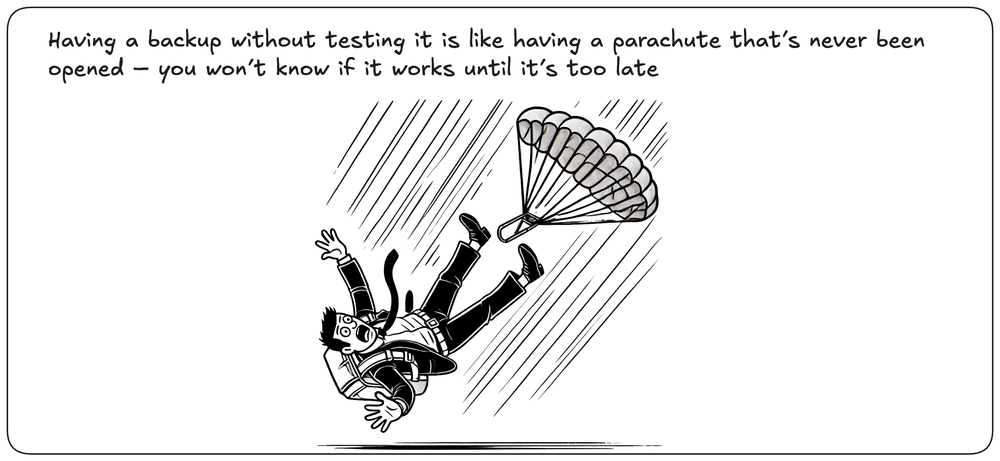
Backups discovered to be broken during an actual disaster are not backups — they're hope. !!Organizations routinely find that their snapshot scripts have been silently failing for months, that the restore path was never wired up, or that recovery time is 10× what the RTO promised.!! !!Untested backups are hope; tested backups are insurance.!! Run real recovery drills in isolated environments, verify integrity, measure actual restore time against the SLO, and rotate the team running the drill — the goal is that the next disaster is boring, not surprising.