About This Book
Book Info
Author: E. Cohen
Last Modified: July 2026
Contact: form
Disclaimer: The views expressed here are mine alone.
About Me [About Me] {1}
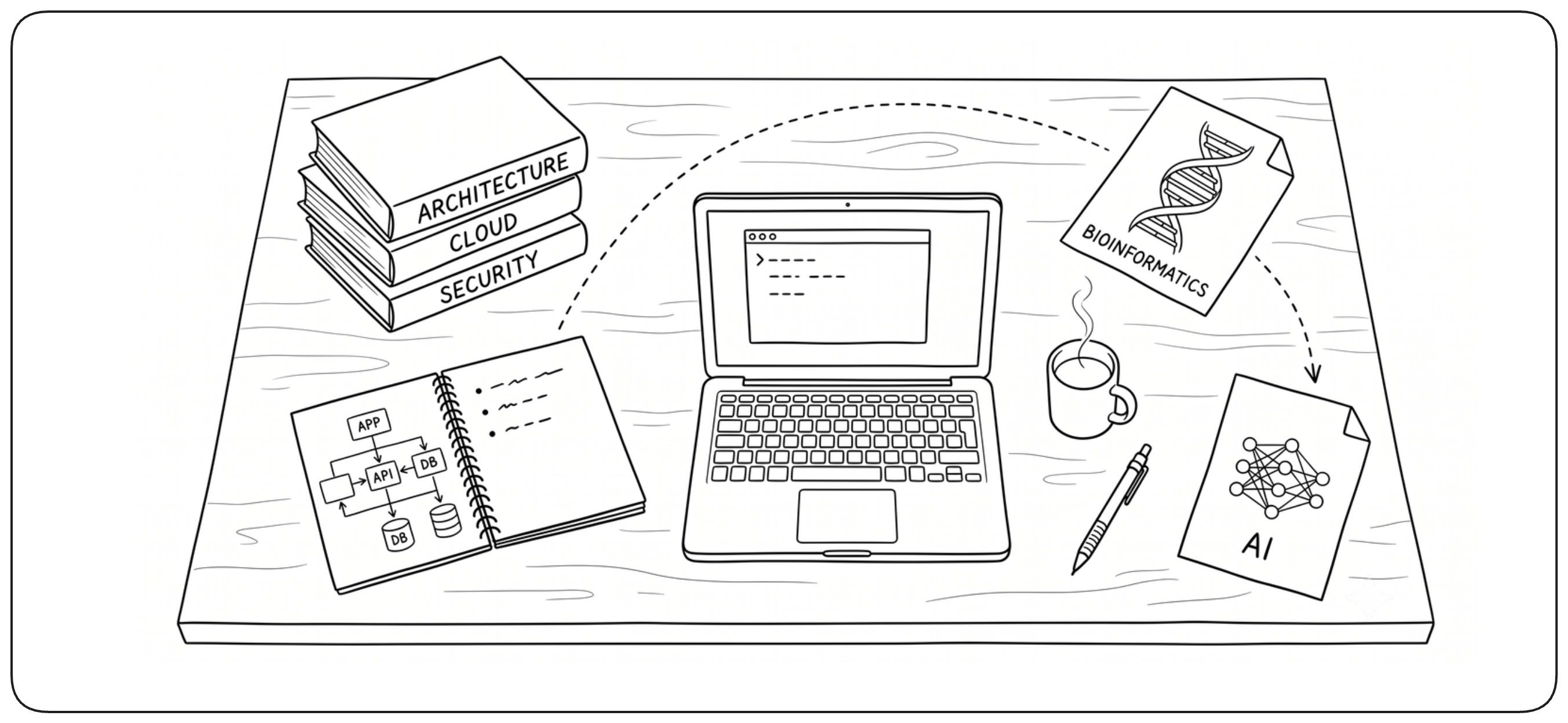
I'm a software engineer with 35 years of experience across a wide range of domains: from low-level systems programming and scientific computing in the 1990s to distributed architectures, cloud, DevOps, security, and — more recently — the infrastructure behind AI systems.
For the last 15 years, I've focused on the intersection of software architecture, cloud platforms, and production engineering.
Over those years, I've had the chance to work inside a very large engineering organization — the kind of place where nothing happens by accident, where scale forces every decision to be intentional, and where strategy, vision, and standards shape how thousands of engineers build software together. That environment has been a constant education in what it takes to run software at real scale.
What shaped my approach the most was the decade I spent in bioinformatics, working on drug discovery. Modeling biological systems — where nothing is exact, everything interacts, and the best you can do is find the abstractions that hold — taught me to look for the small number of principles that explain a large number of situations, rather than accumulating techniques and recipes. Over the years, this has become a conviction: the principles that guide good software decisions are, in the end, based on simple, common-sense foundations. This book is my attempt to lay them out.
What Makes This Book Different [The Digest] {1}
This book does not pretend to explore every subject in the greatest possible depth. For almost every chapter, there are specialized books that go further, explain the topic with more precision, and cover it with greater authority.
What makes this book different is its spirit of synthesis. It tries to take concepts that are often spread across many books, projects, discussions, and years of engineering experience, and make them easier to see together. The goal is not to replace depth, but to offer a digest: a simplified map of the ideas, trade-offs, and principles that keep reappearing across software development.
Who This Book Is For [Who For] {1}
Honestly, I don't fully know — and that's part of why reader feedback would mean a lot to me. If you take the time to read a few chapters, tell me what you got out of them and who you think this book is really speaking to. That would help shape what comes next, and I'd genuinely be glad to hear it.
My best guess is that this book speaks to engineers already in the industry — people with enough experience to recognize the situations described, and enough scars to feel the weight of the trade-offs. Most of what's in here is not new. It's things you probably already know. That is precisely the point. The principles that matter most are the ones we stop seeing — buried under the noise of the latest framework, the current trend, the newest platform. Putting them back in front of your eyes, in one place, is what this book is trying to do.
Why Now? [Why Now] {1}
I had always wanted to write a book. Over the years, I started several times: drafting outlines, sketching structures, trying to give shape to the ideas I had accumulated. But I never felt I had the literary instinct, or the talent for language, to turn those ideas into something readable. What used to feel out of reach became possible with the recent revolution in Large Language Models. That shift is what finally made this book happen: an attempt to lay down the foundations of software development in a form that others can actually pick up.
How to Read This Book [How to Read] {1}
The book is built as a sequence of short slides — each one carrying a single idea, an illustration, and a message tight enough to hold in mind. Chapters stand on their own, so you can start with whichever principle matters most to you and follow your own path through the book.
Two reading modes are available. Essential shows only the core slides for a quick pass through a chapter, giving you the shape of the argument in a few minutes. Complete reveals every slide, with the full nuance and the supporting details. A toggle in the sidebar switches between them, so you can pick the depth that matches the time you have.
From Author to Producer [Author to Producer]
When I started this project, I only intended to use AI as a writing aid. But as the work advanced, my personal touch steadily faded. At first, ChatGPT simply rephrased my sentences for clarity. Gradually, I began providing just a vague concept, and the LLM would generate a complete paragraph. This transition was both mind-blowing and deeply frustrating.
More than once, I wondered if the project was still worth pursuing since my role felt more like a producer than an author. Unwilling to abandon thousands of hours of work, I kept going. I eventually realized my true contribution wasn't just the wording, but the direction, structure, flow of ideas, and ultimate editorial judgment.